
Quartz vs Mechanical Chronograph vs Automatic: Choosing the Movement for Your Custom Wristwatch
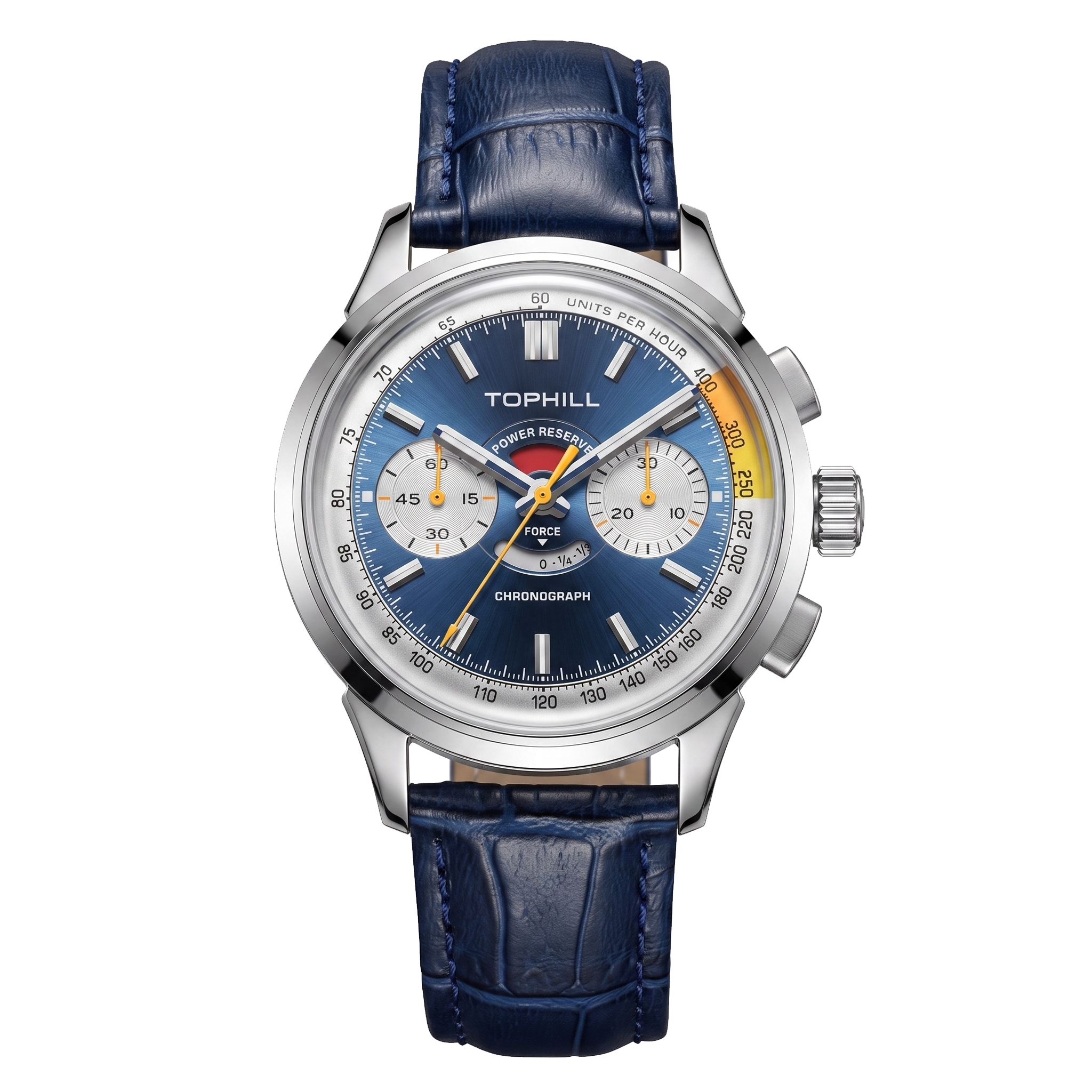
The short answer: In a custom wristwatch program, the movement is selected from the end user's wearing habit, not from the dial artwork. Quartz movements are driven by button batteries and suit high-volume everyday, gifting and ladies' programs where low maintenance matters. Automatic movements store energy in a mainspring wound by wrist movement, and they form the basis of TOPHILL's 200-metre diving platforms. A mechanical chronograph is hand-wound, adds a stopwatch function and a power-reserve indicator, and suits enthusiast and premium sports programs where ownership experience matters more than thinness and simpler servicing.
This guide compares those three movement families as they actually exist in a private label catalogue: what powers them, what maintenance they create for the brand's end customer, how they behave in water-resistance builds, and which buyer scenario each one fits. The reference models are the quartz platforms TR001, TAM002 and TAM001, the automatic platforms TD015G, TD017G and KIM002, and the mechanical platforms KIM003 and KIM001 from DONGGUAN SUPERTIME CO., LTD., a watch manufacturer established in 2022 that operates its proprietary brand TOPHILL.
Problem Definition: Why the Movement Decision Is Made First and Revisited Last
Custom wristwatch projects rarely fail on aesthetics. They fail later, when a retailer has to explain battery replacement to a customer who expected a self-winding watch, when a water-resistance claim is challenged because the wording used is not permitted by the applicable standard, or when a chronograph is ordered into a price band that the movement architecture cannot support. The movement is the part of the watch the end user experiences every day, and it is the part that generates after-sales traffic.
Four buyer questions decide the movement, and they should be answered before case, dial or strap tooling is committed:
- Wearing scenario. Everyday office wear, corporate gifting, or a real diving sports context?
- Maintenance expectation. Is the end user willing to accept periodic battery replacement, or does the product need a movement that runs from wrist movement with no battery?
- Accuracy and testing requirement. Which accuracy verification and which water-resistance level must the finished watch pass before shipment?
- Market access. Which compliance framework applies to the movement type being imported and sold?
Answering these four questions first prevents most of the rework that makes a custom program expensive: re-tooling a case for a thicker movement, re-testing water resistance after a movement change, or re-printing packaging that describes the power source incorrectly.
Industry Background: What the Market Says About Quartz and Mechanical Demand
Movement selection is also a positioning decision. In 2024 industry research published by Industry Research, quartz movements were reported to hold about 75% of global shipment volume, while mechanical watches were reported to contribute over 68% of total market value despite lower unit volume. A separate 2025 dataset from Dataintelo put the global watch movement market at USD 18.4 billion, with automatic movements holding a 38.2% share. Grand View Research projected the global mechanical watch market to reach USD 47.5 billion by 2025.
Read together, those figures describe a market where quartz carries volume and mechanical carries value. The practical implication for a private label brand is straightforward: quartz is normally the engine of an entry-to-mid programme, while automatic and mechanical chronograph models carry the premium tier and most of the mechanical storytelling. That does not make one family better than another; it means the movement must be matched to the tier and the end user the brand is actually selling to.
A second background factor is compliance. Water-resistant watches are governed by ISO 22810:2010, and the term "waterproof" is not permitted under that standard. RoHS Directive 2011/65/EU is mandatory for electronic watches, which includes quartz models, in the EU market. Any movement decision therefore carries a market-access consequence, not only a mechanical one.
The Three Movement Families, Defined
Quartz movement: battery-driven timekeeping
A quartz watch is driven by a button battery. In a custom programme, this is the family with the lowest user-maintenance load: there is no winding habit to teach and no mainspring to service, and the movement is generally thinner, which allows slimmer cases for ladies' and dress models. TOPHILL quartz platforms include models specified with a Japan quartz movement, a Ronda quartz movement, and a Miyota quartz movement.
Automatic movement: self-winding from wrist movement
Mechanical watches run on energy stored in a mainspring. In an automatic winding watch, a rotor winds that mainspring from the natural motion of the wrist, so the watch carries a mechanical story with no battery and no daily winding ritual. TOPHILL's automatic platforms use Japanese Miyota calibres, including the Miyota Automatic 8215 in the diving models and the Miyota 9039 in an ultra-thin elegant model.
Mechanical chronograph: hand-wound movement with a stopwatch function
A mechanical chronograph adds stopwatch timing to a mechanical movement and is wound by hand. The practical difference for the end user is interaction: the user winds the watch, uses the chronograph pushers, and in some designs reads a power-reserve indicator that shows how much running time remains. TOPHILL's chronograph platform, the KIM003, uses a Seagull ST1905 chronograph movement with a power-reserve indicator.
Solar-powered construction is a fourth production mode in TOPHILL's operation, in which visible light is converted into stored electrical energy for timekeeping. For brands evaluating a quartz-like maintenance profile with a solar energy story, it is worth discussing as a separate configuration rather than as a variant of a standard battery quartz model.
Detailed Solution: How TOPHILL Builds Each Movement Family
Quartz custom wristwatch platforms: TR001, TAM002 and TAM001
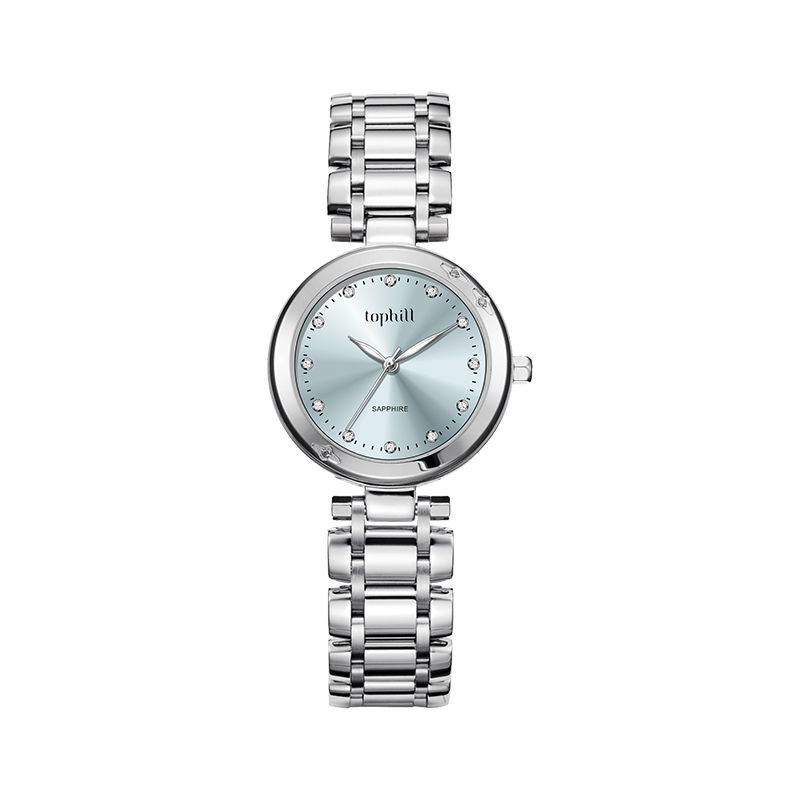
The quartz side of the catalogue is built around 316L stainless steel cases with set zircon stones, snap or screw construction depending on the model, flat sapphire crystal, and 3 ATM water resistance:
- TR001 — a quartz, lady watch and battery watch category model with a 316L stainless steel case with zircon stones and a snap caseback, flat sapphire crystal, glossy dial with printing markers, and a Japan quartz movement. It can be configured with a 316L stainless steel bracelet with butterfly buckle or a genuine leather strap with pin buckle.
- TAM002 — a customized quartz watch classified as an elegant and lady watch, made of 316L stainless steel and brass, with a flat sapphire crystal, a sunburst dial with applied indexes and zircon stones, a 316L stainless steel solid bracelet with butterfly buckle, and a Ronda quartz movement.
- TAM001 — a lady elegant quartz wristwatch in the quartz, lady and elegant watch categories, with a 316L stainless steel case with set zircon stones, a flat sapphire crystal, a sunburst dial with applied index, a 316L stainless steel bracelet with jewellery buckle or a genuine leather strap option, and a Miyota quartz movement.
All three are positioned for fashion accessories, jewellery and ornaments, premium gifts, corporate promotional gifts and retail consumer goods — the scenarios where a slim profile, a low maintenance load and a gifting-friendly price architecture matter most.
Automatic custom wristwatch platforms: TD015G, TD017G and KIM002
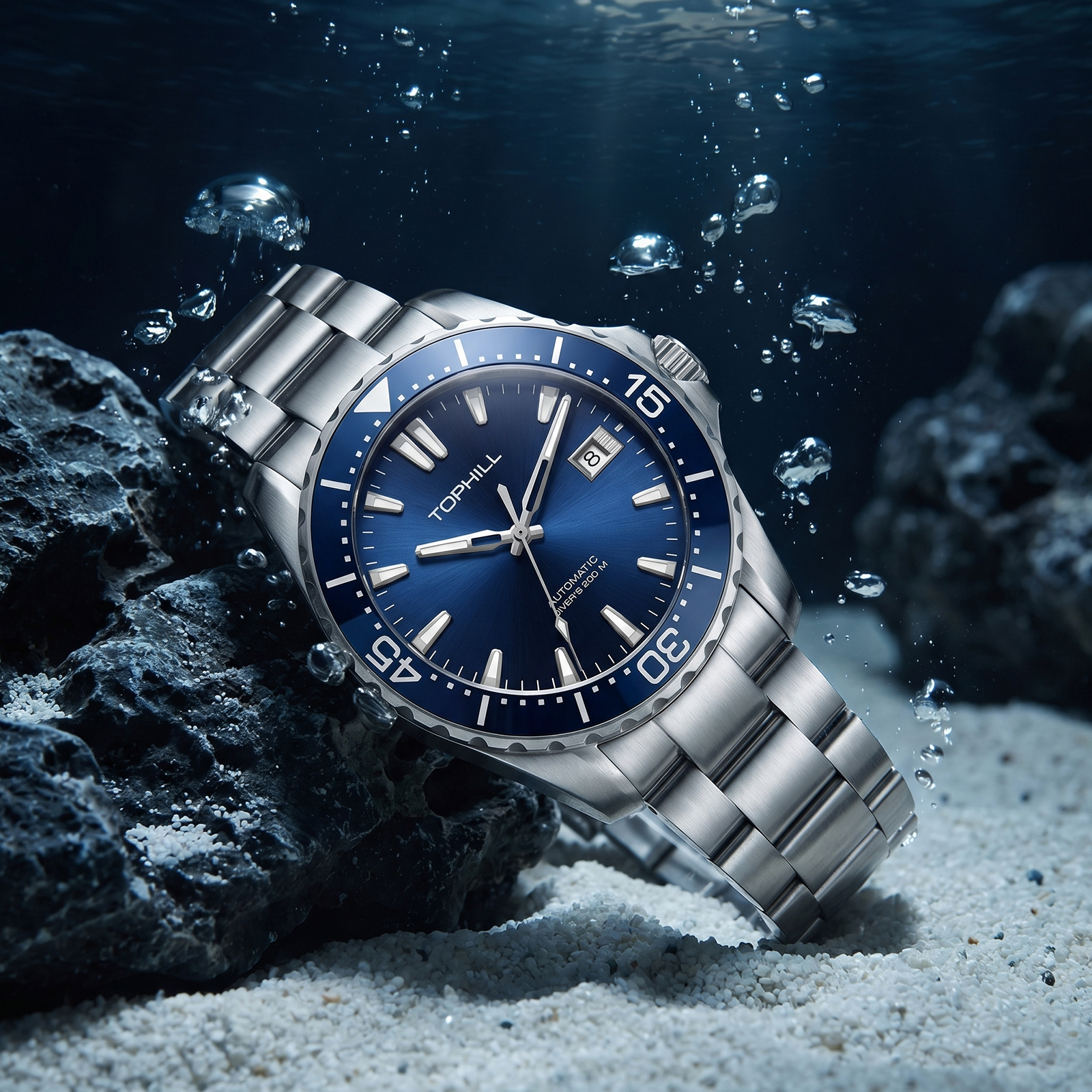
The automatic family is where the mechanical story and the highest water-resistance ratings meet:
- TD015G — the stainless steel 200 metres diving watch, classified as a diving watch, automatic winding watch and men's watch. It uses a 316L stainless steel case with a rotating bezel and a ceramic bezel insert with BGW9 luminous, flat sapphire crystal, a sunburst dial with applied index with BGW9 luminous, a 316L solid bracelet with solid extension buckle, a see-through solid caseback, and a Japan Miyota Automatic 8215 movement.
- TD017G — an automatic diving and luminous watch with a 316L stainless steel case and rotating bezel, ceramic bezel insert with luminous, 10 ATM water resistance, boxed crystal, embossed dial with applied index, luminous hands, a 316L stainless steel solid bracelet with solid turtle buckle, a see-through solid caseback, and a Miyota Automatic 8215 movement.
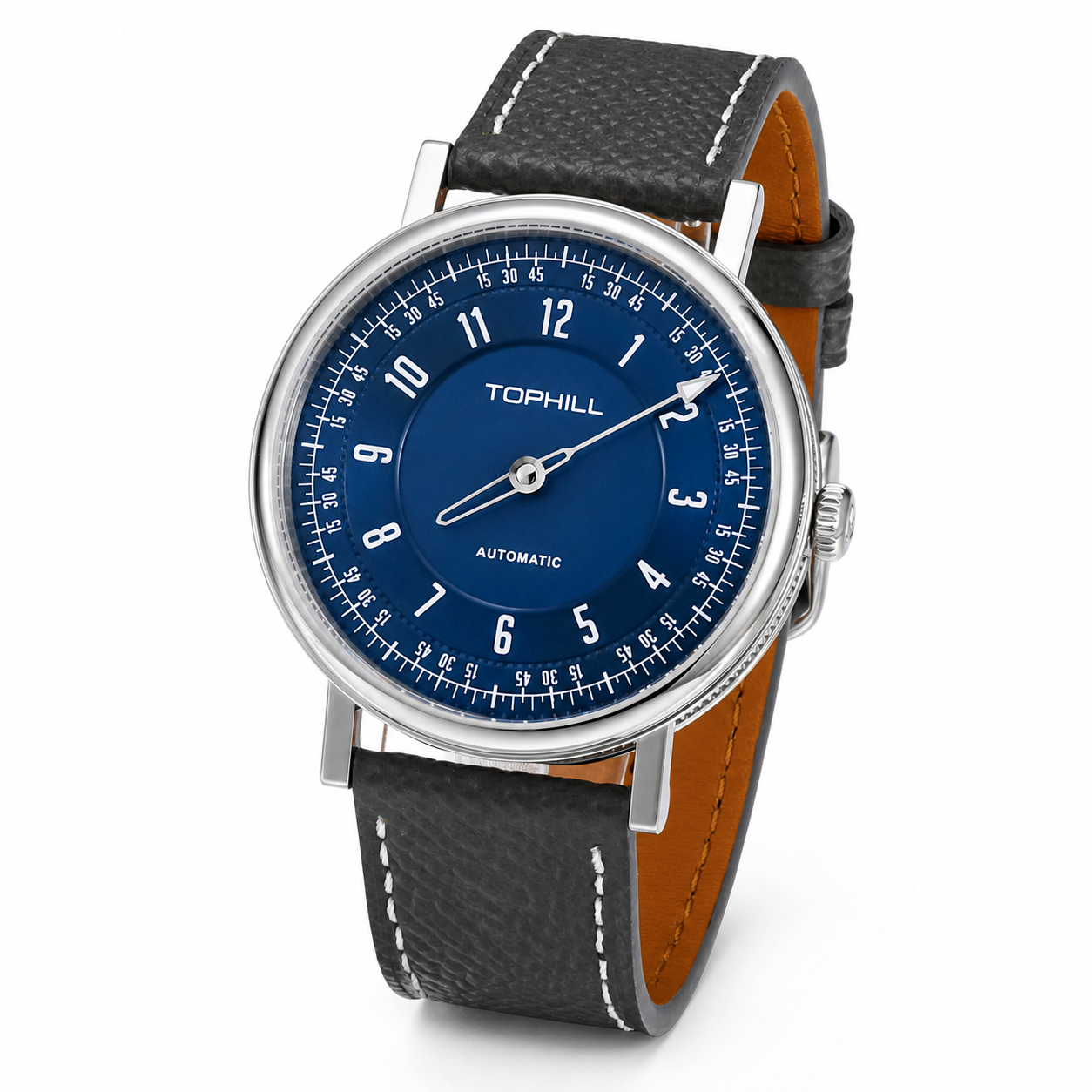
- KIM002 — an automatic winding, customized and elegant wristwatch with a 316L stainless steel case and bezel, 5 ATM water resistance, flat sapphire crystal, an embossed two-layer dial with printing markers, hollow luminous hands, and a Miyota 9039 ultra-thin mechanical movement on a genuine leather strap with quick release spring bar and pin buckle.
Mechanical chronograph and ultra-slim mechanical platforms: KIM003 and KIM001
The chronograph platform is the most interactive product in the range. The KIM003 is a manual winding chronograph and customized wristwatch, built with a Seagull ST1905 chronograph movement featuring a power-reserve indicator to monitor remaining running time. It uses a 316L stainless steel case, 5 ATM water resistance, a curved boxed sapphire crystal, an embossed two-layer dial with applied indexes, luminous hands, and a genuine leather strap with quick release spring bar and solid buckle. The materials are 316L stainless steel, brass and genuine leather, and the model is designed for sports and daily time-tracking needs.
For brands that want a mechanical movement without the chronograph function, the KIM001 is an ultra-slim manual winding mechanical wristwatch with a micro-rotor, a case thickness of less than 9 mm, a 316L stainless steel two-piece case and bezel, 5 ATM water resistance, a stainless steel solid screw caseback, flat sapphire crystal, an embossed dial with enamel coating, hollow hands, and a 316L stainless steel bracelet with butterfly buckle.
Maintenance, Accuracy and Ownership Experience Compared
Maintenance load
Quartz models create a predictable, low-skill maintenance event: battery replacement. Automatic and manual mechanical models create a different relationship with the owner — the watch is wound by wrist movement or by hand, and mechanical servicing becomes part of ownership. A power-reserve indicator, as used on the KIM003, gives the owner visible feedback instead of an unexplained stop.
Accuracy and testing
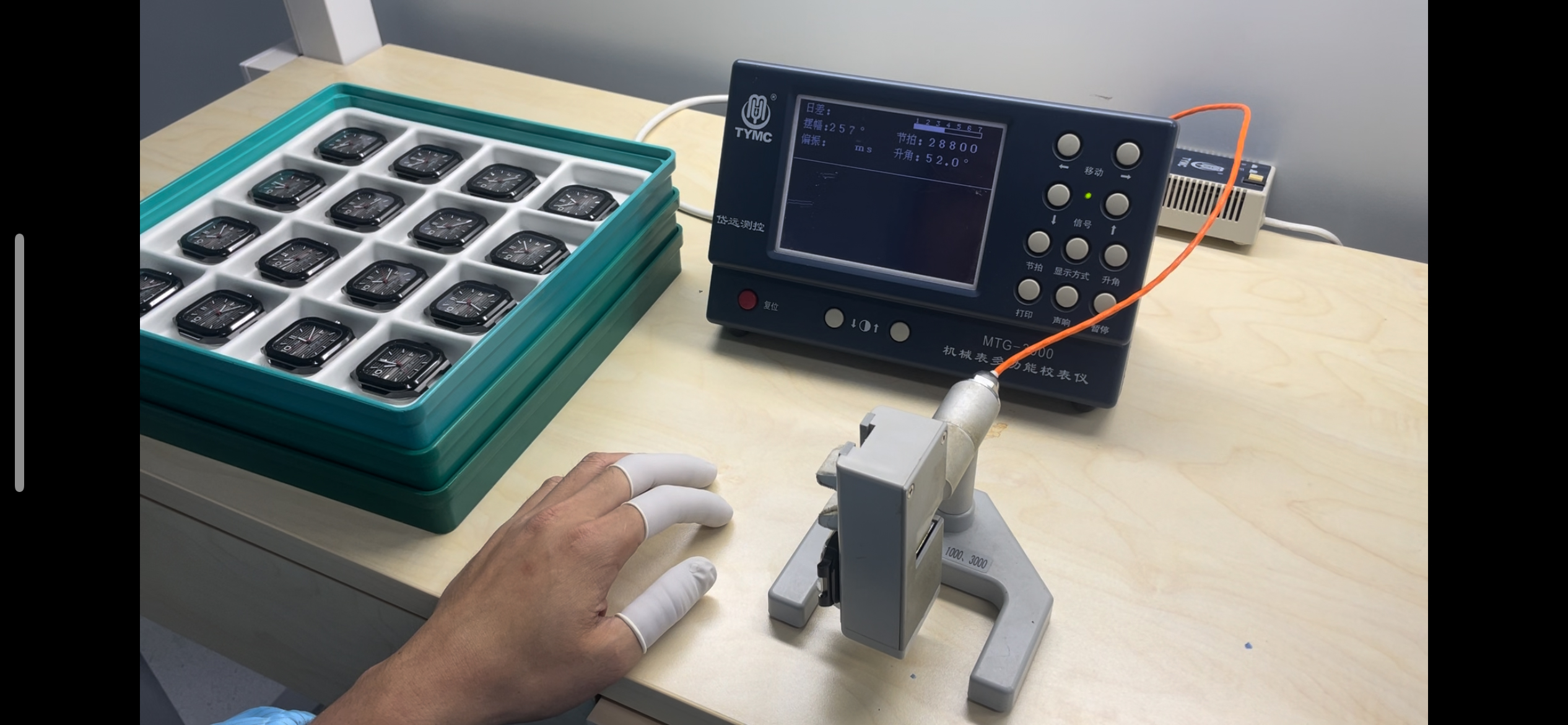
Movement accuracy is verified in-house. TOPHILL's testing equipment includes a water resistant testing machine, a movement stem cutting machine, an automatic movement accuracy testing machine, a strap tension-torsion testing machine, a dial index inspection machine and a dropping test machine. Waterproof watches are supported from 5 to 50 ATM, and every waterproof watch goes through a 100% water pressure test before shipment rather than random sampling. Special requirements such as CE EMC, specified waterproof performance and specified movement accuracy requirements can be built into the project specification.
User experience and the water-resistance interaction
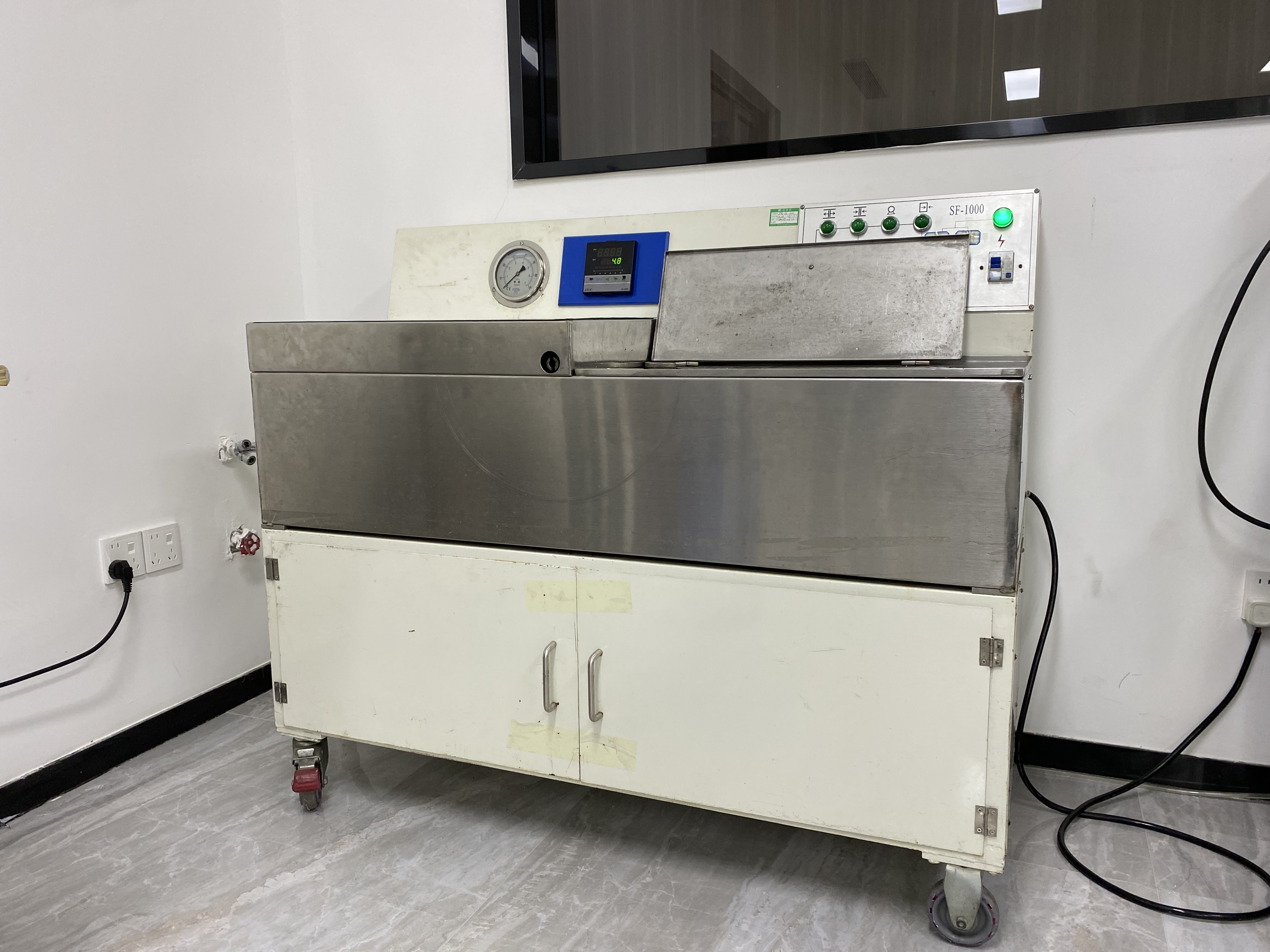
Water resistance is a sealing function of the case, caseback, crystal, crown and pushers, not of the movement itself. The ATM mark on a caseback is a static laboratory pressure value, where 1 ATM corresponds to 10 metres of static water depth; it is not the same as a usable diving depth. As a practical rule, 3–5 ATM suits daily wear and hand-washing, 10–20 ATM suits swimming and surface snorkelling, and 20 ATM and above aligns with diver-watch expectations under ISO 6425. Water resistance is also not permanent: sealing gaskets age with wear and chemical contact, and hot-water or sauna exposure deforms rubber gaskets. This caveat should be transferred to the end user in the brand's own product copy, whichever movement family is chosen.
Step-by-Step Breakdown: Choosing a Movement for a Private Label Programme
- Define the end-user scenario. Write down the single dominant use case: office and gifting wear, water sports, diving, or enthusiast collecting. A programme that tries to serve all four usually ends up over-specified for its volume tier.
- Select the movement family. Quartz for volume, low maintenance and slim ladies' or gifting models; automatic for a battery-free mechanical story with a broad water-resistance range; mechanical chronograph for premium sports and enthusiast positioning.
- Pick the calibre platform. For example, a Japan quartz movement, Ronda quartz movement or Miyota quartz movement on the quartz side; Miyota Automatic 8215 for diving builds and Miyota 9039 for ultra-thin dress builds on the automatic side; a Seagull ST1905 chronograph for the manual chronograph tier.
- Match case, crystal and water resistance. Confirm the target ATM, then check that the case construction supports it — screw-down structures, ceramic bezel inserts, sapphire crystal type and gasket specification all change with the rating.
- Confirm compliance and market access. Verify RoHS applicability for quartz and electronic models, ISO 22810 wording rules for water-resistant claims, and ISO 6425 requirements if the model is marketed as a diver's watch.
- Validate with a prototype or trial run. Concept interpretation, prototype development and structural optimisation are part of the manufacturing workflow, supported by a dedicated CNC prototyping workshop. Small-batch trial custom runs start at 500 pieces, which allows a brand to test retail response before committing to volume.
- Lock the QC plan before mass production. Define movement accuracy testing, 100% water pressure testing, dial index inspection and drop testing per model, so that the finished watch matches the specification the brand has published to its own customers.
Use Cases: Matching Movement to Brand Scenario
Diving sports custom wristwatches
For diving and water-sports positioning, the automatic family is the natural fit. The TD015G is specified as a 200-metre diving watch with a Miyota Automatic 8215 movement, ceramic bezel insert and BGW9 luminous on the bezel, dial indexes and hands for readability in low light. The TD017G covers 10 ATM with the same Miyota Automatic 8215 platform for swimming and surface snorkelling programmes.
Business men custom wristwatches
For a business or dress position, the decision is usually between a thin quartz model and a thin automatic. KIM002 offers an automatic mechanical story with a Miyota 9039 ultra-thin movement, a leather strap and a conservative two-layer dial. A quartz alternative keeps the case slim and the maintenance load low for corporate or volume sales channels.
Luxury women custom wristwatches and gifting programmes
Ladies' and gifting models favour quartz. TR001, TAM002 and TAM001 are all 316L stainless steel cases set with zircon stones, with sapphire crystal and 3 ATM water resistance, offered with steel bracelets, jewellery buckles or genuine leather straps. The quartz architecture keeps the profile slim and the ownership requirement limited to battery service, which suits premium gift, corporate promotional gift and retail consumer goods scenarios.
Enthusiast chronograph programmes
For a brand building a collector-facing chronograph, the KIM003 combines a Seagull ST1905 chronograph movement with a power-reserve indicator, a boxed sapphire crystal, a two-layer embossed dial and a leather strap with quick release spring bar. The interaction — winding, using the chronograph, watching the power reserve — is the product value here, and it justifies a different price tier from a quartz model with comparable case materials.
Comparison Table: Quartz vs Automatic vs Mechanical Chronograph
| Comparison point | Quartz | Automatic | Mechanical chronograph |
|---|---|---|---|
| Power source | Button battery | Mainspring wound by wrist movement via rotor | Mainspring wound by hand |
| Representative TOPHILL models | TR001 (Japan quartz movement), TAM002 (Ronda quartz movement), TAM001 (Miyota quartz movement) | TD015G (Miyota Automatic 8215), TD017G (Miyota Automatic 8215), KIM002 (Miyota 9039) | KIM003 (Seagull ST1905 with power-reserve indicator) |
| Water resistance in the range | 3 ATM on the quartz lady and gifting models | 5 ATM, 10 ATM and 200 metres depending on model | 5 ATM |
| Crystal and case | 316L stainless steel case with set zircon stones, flat sapphire crystal | 316L stainless steel case, flat sapphire or boxed crystal, ceramic bezel insert on diving models | 316L stainless steel case, curved boxed sapphire crystal |
| Ownership experience | Wear and forget; battery service | Mechanical feel with no battery and no daily winding | Manual winding, stopwatch function, power-reserve feedback |
| Typical buyer scenario | Everyday wear, gifting, ladies' fashion, promotional programmes | Business wear and diving sports programmes | Enthusiast and premium sports programmes |
| Maintenance note | Battery replacement; gaskets still age over time | Mechanical servicing expected; accuracy verified by testing equipment | Mechanical servicing and winding discipline; driven by hand |
Note: the KIM001 platform sits outside the chronograph row as an ultra-slim manual winding mechanical watch with a micro-rotor, a case thickness of less than 9 mm and 5 ATM water resistance, for brands that want a mechanical movement in a thin dress case.
Compliance and Market-Access Checks for Movement-Based Programmes
Compliance follows the movement type, so it should be resolved at the same time as the calibre choice rather than at the shipping stage:
- ISO 22810:2010 governs water-resistant watches, and the term "waterproof" is prohibited under this standard. Product copy should use water-resistance ratings and ATM values instead.
- ISO 6425 applies to diver's watches. A model marketed as a diver's watch should be built and tested against that standard, not only against a general water-resistance rating.
- RoHS Directive 2011/65/EU is mandatory for electronic watches, including quartz and smart models, in the EU market.
- CE EMC and specified waterproof or accuracy requirements can be written into the project specification as additional product requirements.
DONGGUAN SUPERTIME CO., LTD. is certified to ISO 9001 for quality management and ISO 14001 for environmental management, and states that its finished products fully meet EU RoHS compliance standards for overseas market access. Export business accounts for 80% of sales, with the EU and the United States as the main markets — which is why the compliance layer is treated as part of the project specification rather than an afterthought.
FAQ: Movement Choice in Custom Wristwatch Manufacturing
1. What compliance rules apply to quartz and mechanical movements in custom wristwatches sold in the EU?
Quartz and other electronic watches fall under RoHS Directive 2011/65/EU, which is mandatory for the EU market. Water-resistance claims are governed by ISO 22810:2010, under which the term "waterproof" is prohibited, and ISO 6425 applies where a model is marketed as a diver's watch. DONGGUAN SUPERTIME CO., LTD. is certified to ISO 9001 and ISO 14001 and states that its finished products fully meet EU RoHS compliance standards.
2. Can one custom wristwatch manufacturer supply quartz, automatic and mechanical chronograph movements?
Yes. TOPHILL's platform range covers all three families: quartz models with a Japan quartz movement, a Ronda quartz movement or a Miyota quartz movement; automatic models with the Miyota Automatic 8215 in the TD015G and TD017G diving watches and the Miyota 9039 in the KIM002 elegant model; and the manual winding KIM003 mechanical chronograph using a Seagull ST1905 movement with a power-reserve indicator. Main product lines include customized watches, quartz watches, automatic watches and chronograph watches.
3. Why do quartz and mechanical custom wristwatches sit in different price tiers?
The difference follows movement architecture and market positioning rather than any single component. Quartz movements were reported to hold about 75% of global shipment volume in 2024, while mechanical watches were reported to contribute over 68% of total market value despite lower unit volume, and the global watch movement market was valued at USD 18.4 billion in 2025 with automatic movements holding a 38.2% share. Within a project, cost also moves with case material, water-resistance rating, crystal type and the testing plan attached to each model.
4. How can a brand validate a movement choice before committing to mass production?
Validation is normally done through prototype development and structural optimisation, followed by a small-batch trial custom run, which can start at 500 pieces, before volume production. The workflow is supported by a CNC prototyping workshop and a QC environment that includes an automatic movement accuracy testing machine, a water resistant testing machine, a dial index inspection machine and a dropping test machine, so movement accuracy, water resistance and assembly quality can be verified on the actual build rather than on a specification sheet.
5. What determines the lead time of a custom wristwatch programme?
Lead time is driven by the calibre chosen, the case and bezel tooling required, the water-resistance target and the testing plan. DOGGUAN SUPERTIME runs an annual production capacity of 400,000 units and has manufactured more than 20 million finished watches to date, with order capacity from small-batch trial runs of 500 pieces up to batches of over 500,000 units. Two-to-five-day movement sourcing and 100% water pressure testing are scheduled into the plan per model. To discuss a specific timeline and a sample or quotation for your movement programme, contact the team by email at vivianli@supertime.hk or by WhatsApp and telephone at +86 137 6014 8724.
Conclusion: Deciding Between Quartz, Automatic and Mechanical Chronograph
The movement decision resolves cleanly once the end user is defined. Quartz is the volume engine for everyday wear, gifting and ladies' programmes, with a slim case profile and a maintenance routine limited to battery service. Automatic is the battery-free mechanical option, and in TOPHILL's range it also carries the highest water resistance, from the 200-metre TD015G and the 10 ATM TD017G to the ultra-thin KIM002 dress model. The mechanical chronograph is the interaction-led product: hand winding, stopwatch timing and a power-reserve indicator on the Seagull ST1905-based KIM003.
What the three families have in common is the requirement to match movement, build and testing: 316L stainless steel cases, sapphire crystal, sealing structures appropriate to the ATM target, and unit-by-unit water pressure testing for waterproof models. Deciding the movement first keeps case tooling, compliance wording and QC planning aligned with the tier the brand actually intends to sell.
Next step: sample, quotation or catalogue
If you are deciding between quartz, automatic and mechanical chronograph movements for a private label programme, the fastest route is a sample build in your target scenario. Send the intended wearing use case, target water resistance and quantity range to vivianli@supertime.hk or WhatsApp and telephone +86 137 6014 8724. The full product and capability profile is available in the downloadable company brochure, and the brand portfolio can be reviewed at TOPHILL. DONGGUAN SUPERTIME CO., LTD., 102, Building 6, 1 Jingdong Road, Fenggang Town, Dongguan City, Guangdong Province.