
Aftermarket Car Radio Supplier Evaluation: A Scorecard for Capability and Delivery Assurance

A supplier evaluation scorecard turns an aftermarket car radio sourcing decision into a scored, evidence-based process. It scores six blocks — product and technical consistency (20 points), certification and compliance documentation (20), manufacturing and quality evidence (15), delivery and commercial terms (20), warranty and after-sales execution (15), and technical communication (10) — and awards business only where every block is supported by a document that can be matched against a physical sample.
This how-to guide is written for buyers entering the research stage of an aftermarket car radio program: distributors building a range, installers standardising a car radio replacement offer, fleet operators retrofitting vehicles, and brand owners preparing an OEM/ODM brief. It explains which documents to request, what each score means, and how the same scorecard carries capability verification through to delivery assurance.
The Problem: Every Supplier Looks Capable Until the Documents Arrive
Aftermarket car radio sourcing rarely fails at the negotiation table. It fails three to six months later, when a container arrives with units whose operating system, memory configuration or accessory content does not match the quotation, or when a certification described as a product approval turns out to be a company-level quality certificate.
Suppliers in this category compete on catalogue breadth. One catalogue may list universal double din car radios, vehicle-specific large-screen units, single din car radios, add-on CarPlay boxes, motorcycle navigation units and dash cameras. Breadth is genuinely useful for a distributor, but breadth is also where evaluation breaks down: the more SKUs a supplier lists, the higher the chance that specifications are copied between listings, that one model appears with two different chipset or memory values, and that a cheap car radio listing is described with the same words as the flagship screen car radio.
Five failure modes account for most of the loss:
- Specification drift. The operating system, CPU, RAM/ROM, screen size or connectivity of a SKU is stated differently on the website, in the quotation and on the product label.
- Certification conflation. E-mark, CE, FCC, RoHS and ISO 9001 are presented as one interchangeable list, so the buyer cannot tell which approval covers the model being purchased.
- Delivery assumptions. Lead time is derived from an annual capacity figure instead of a confirmed production slot for the actual order.
- Accessory gaps. The car radio wiring harness, CAN bus adapter, mounting frame and installation cable appear as extras after the unit price is agreed.
- Warranty without process. A one-year term is printed on the invoice, but there is no DOA window, no RMA route and no spare-part ratio behind it.
Each failure mode is testable before the order is placed. That is the purpose of the scorecard: it converts every risk into a document request with a fixed score, so that the difference between two suppliers is a number you can defend internally rather than an impression of the sales conversation.
Industry Background: A Wider SKU Range Makes Evaluation Harder
Two structural facts shape supplier screening in 2026. First, the category is large enough that supply is fragmented: Mordor Intelligence reports the global car audio market at USD 12.24 billion in 2025, covering speakers, amplifiers and head units. Second, the form factor most aftermarket buyers source dominates revenue — Grand View Research places the Double DIN segment at 44% of car stereo market revenue in 2025.
Trade classification matters as well. Radio-broadcast receivers combined with sound recording or reproducing apparatus are commonly classified under HS 8527.21, which is the reference point buyers and freight forwarders use when checking import documentation for aftermarket head units.
Technology has moved in a direction that makes verification harder rather than easier. Wireless CarPlay and Android Auto have become baseline claims on nearly every listing. Screen sizes now extend from 5-inch motorcycle panels to 16.8-inch vehicle-specific displays. Operating systems split between Android platforms running octa-core processors and Linux platforms chosen for stability and fast start-up. Ruggedised two-wheel navigation units are specified with IP67 protection. A supplier covering several of these categories is not automatically capable — but a supplier covering them with consistent, model-level documentation is far easier to qualify, and that difference is exactly what a scorecard measures.
The Six-Block Supplier Evaluation Scorecard
Each block below is scored criterion by criterion on a three-point scale: 0 when the supplier offers a claim only, 1 when a document is supplied but is incomplete or inconsistent, and 2 when a document is supplied and can be verified against a sample or a third-party record. Weighted scores are added to a total out of 100.
| Block | Weight | What it verifies | Document to request |
|---|---|---|---|
| Product breadth and technical consistency | 20 | Whether each SKU has a stable, complete specification | Model-level datasheet with OS, CPU, RAM/ROM, display, connectivity and operating temperature |
| Certification and compliance documentation | 20 | Whether approvals apply to the exact models being bought | Certificate copies with number, scope and validity; test reports; declarations |
| Manufacturing and quality evidence | 15 | Whether production and routine testing exist as described | Process photographs per stage; routine test list; factory certificate scope |
| Delivery and commercial terms | 20 | Whether time, quantity and box content are committed in writing | Lead time per SKU, production slot confirmation, MOQ, packaging, Incoterms, accessory list |
| Warranty and after-sales execution | 15 | Whether the warranty can actually be operated | Warranty terms, DOA window, RMA turnaround, spare-part ratio, firmware update route |
| Technical communication | 10 | Whether engineering questions receive documented answers | Sample test report, English documentation, named technical contact |
Block 1 — Product Breadth and Technical Consistency (20 points)
The first block answers one narrow question: can the supplier describe the same product the same way twice? Shenzhen Top Navi Electronic Tech Co., Limited — the manufacturer behind the brand TOPNAVI, founded in 2014 in Shenzhen, China — provides a workable reference set because its range spans four different product logics, and each logic uses different specification fields.
- Universal Android multimedia. The TS105 is a 9-inch universal car multimedia player with an IPS capacitive touch screen at 1024×600, Android 14 on a UIS7865 octa-core CPU, built-in wireless CarPlay and Android Auto, and connectivity through USB, built-in WiFi, Bluetooth and a 3G/4G SIM card. It is dashboard-mounted with universal fitment and carries E-mark, CE and FCC certification.
- Vehicle-specific large screen. The TN-3036 is a 16.8-inch car multimedia player with an IPS touch screen at 2560×1440, Android 13 on an 8-core CPU, 4GB RAM and 64GB ROM, wireless and wired CarPlay and Android Auto, 4×50W audio output, 2DIN universal installation and an operating temperature range of -30°C to 75°C.
- Add-on connectivity. The TN-AI47 is a CarPlay box running Android 11.0 on a quad-core CPU with 2GB RAM and 16GB ROM, wireless CarPlay and wireless Android Auto, HDMI video output, a DC 5V 2A supply and a working temperature range of -10°C to 60°C.
- Two-wheel platform. The TN-M9 is a 5-inch motorcycle navigation unit at 854×480 running Linux on a V853 ARM Cortex-A7 1.0GHz CPU with IP67 protection; the TN-M11 is a 6.25-inch IPS unit at 1560×720 with V853 or V533 CPU options, IP67 protection and a 12V–30V power supply.
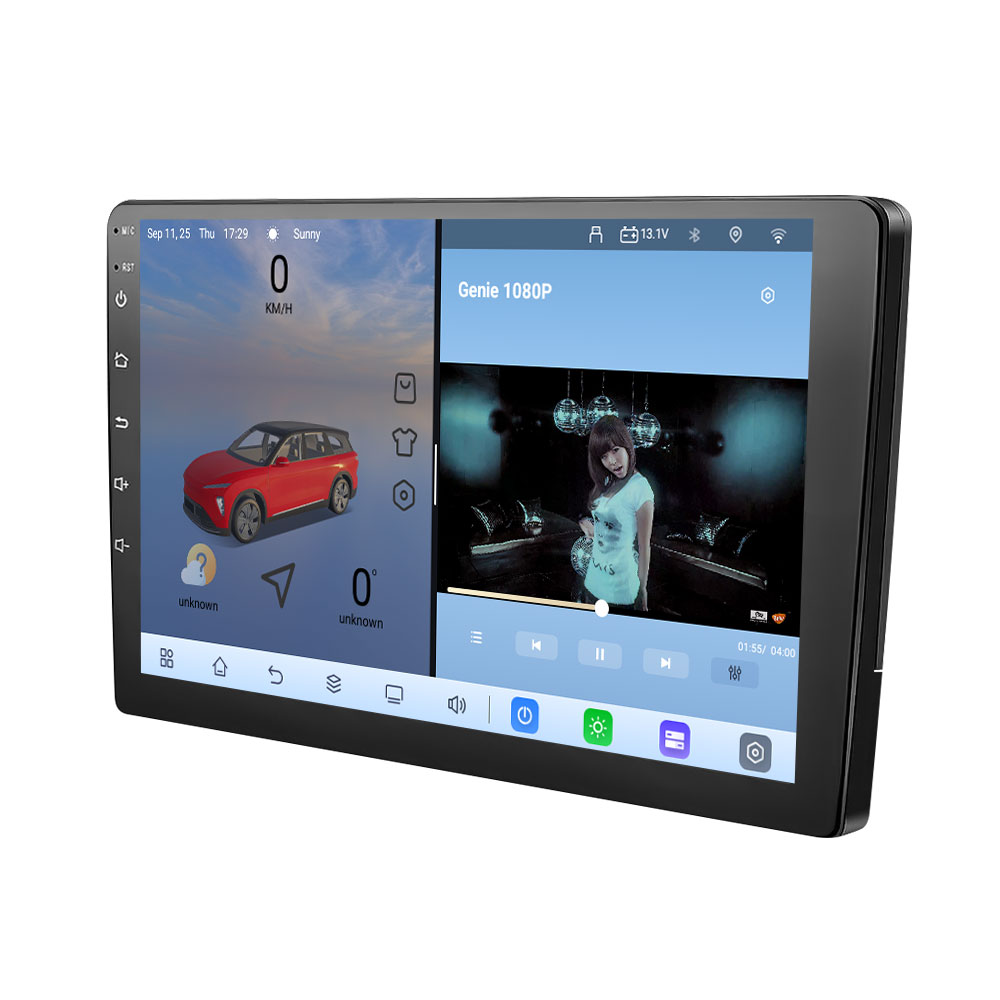
Score this block by checking, for every SKU you intend to buy, whether the operating system version, CPU model, memory, display size and resolution, connectivity, operating temperature and installation method appear in the same form on the datasheet, in the quotation and on the sample label. Language that shifts between documents is the earliest indicator that other, harder-to-check specifications may also be approximate — and it is the reason a cheap car radio listing should be read against a model-level specification, not against a headline feature list.
Block 2 — Certification and Compliance Documentation (20 points)
The second block carries most of the sourcing risk, because the vocabulary is shared across very different documents. E-mark, CE, FCC and RoHS are product-level approvals or declarations for defined model configurations. ISO 9001 is a factory quality-management certificate. They are not interchangeable, and one does not imply another.
In the TOPNAVI range, the TS105 carries E-mark, CE and FCC; the TN-3036 carries CE and FCC; the TN-AI47 carries CE, FCC and RoHS. The company states that its factory holds ISO 9001 certification. Those four lines are exactly what a compliance matrix should record — per model, per approval — rather than a single undifferentiated certification list on a homepage.
Score the block by requesting, for each model: the certificate or declaration number, the issuing body, the model list covered by the scope, and the validity date. Then confirm that the model you are buying appears inside that scope. For units with wireless connectivity, ask for the test report that supports the electromagnetic compatibility and radio requirements of your destination market, and check that the report names the standard applied.
Block 3 — Manufacturing and Quality Evidence (15 points)
Capability claims become useful only when they attach to a process stage. TOPNAVI reports a 20,000 m² manufacturing facility, a workforce of 100+ employees, an annual output of 360,000 units, a 50-engineer R&D team and clients in 70+ countries. These figures are company-reported; their value in the scorecard is that they can be cross-checked against production evidence.

Ask for photographs tied to identified stages — SMT, reflow and wave soldering, temperature chamber testing, drop testing and signal-shielding room testing — plus the routine test list applied to every unit before packing, not only during type testing. A supplier that cannot name the test or locate the stage in a photograph is asking to be taken on trust, and trust is the item the scorecard exists to replace.
Block 4 — Delivery and Commercial Terms (20 points)
Delivery assurance is the block buyers most often score on a feeling. Score it on written items instead: lead time per SKU rather than per factory, the confirmed production slot, minimum order quantity per model, packaging specification, Incoterms, inspection date, and the complete accessory list that ships in the box.
An annual capacity figure such as 360,000 units establishes operating scale; it does not reserve a week of that capacity for your purchase order. Request the commitment in dated form: order date, material lead time, production window, inspection date and ship date, per SKU.
Accessory content belongs in this block because it is where post-award cost appears. A quotation that includes a car radio wiring harness, CAN bus adapter, mounting frame, reverse camera input cable and installation instructions is not comparable with a unit-only price. TOPNAVI's TN-X23, for example, ships with an installation cable and retail box as package content — the kind of line item that must be listed rather than assumed. For universal double din car radio programs, request the harness drawing and connector list per vehicle family; for single din car radio applications, confirm the mounting cage and trim specification.
Block 5 — Warranty and After-Sales Execution (15 points)
A one-year warranty is close to standard in this category, and several TOPNAVI models specify exactly that term, including the TS105, TN-M9, TN-UK1105 and TN-X23. The score should not depend on the number of months but on whether the term can be executed.
Ask how DOA is defined and within what window it applies, whether the customer returns the unit or receives a credit, what RMA turnaround is committed, what spare-part ratio accompanies each shipment, and how firmware is updated after delivery — the TN-AI47, for instance, supports OTA update. Ask as well how long repair support continues for a model that leaves the catalogue. A warranty that cannot be operated is a discount the buyer never received.
Block 6 — Technical Communication (10 points)
Score how engineering questions are answered during the evaluation, because that is the same channel you will depend on after shipment. Useful criteria: a named technical contact, documentation in English, a sample test report, answers that reference a document or a measurement rather than an adjective, and consistency across two separate rounds of questioning.
General enquiries for TOPNAVI run through sales@topnaviauto.com and +86 150-7094-1278. The scorecard question is not whether a contact exists — most suppliers publish one — but whether the technical answer arrives with a specification attached.
Step-by-Step: Running the Scorecard Through One Sourcing Round
Step 1 — Define the purchase profile before the RFQ
Fix the form factor (single din, double din or vehicle-specific), the screen size band, the required operating system, the connectivity set, the fitment strategy and the target market. A profile written before contact prevents a supplier from steering the enquiry toward whatever is in stock, and it makes the quotation comparable line by line.
Step 2 — Build the documentation request list
Convert the six blocks into one request: model datasheet, certificate copies with scope, process and routine-test evidence, lead time and MOQ per SKU, accessory list, warranty mechanism and sample terms. Sending it in a single document reveals how much of the answer set already exists and how much has to be produced for you.
Step 3 — Score capability without samples
Score blocks 1 to 3 from the documents alone. At this point the comparison is between paperwork quality: whether the specification fields are complete, whether approvals name the model, and whether production evidence identifies a stage. Suppliers that score below half on these blocks rarely recover in later stages.
Step 4 — Verify with a physical sample
Test on the target vehicle where possible: dashboard fitment, cold start and application launch, wireless CarPlay and wireless Android Auto pairing, display readability, audio output against the stated rating, reverse camera input, steering wheel control mapping, and behaviour against the stated temperature range. For two-wheel units such as the TN-M9 and TN-M11, verify the IP67 sealing and the handlebar mounting. Record the serial number and firmware version of the sample and compare them with the datasheet.
Step 5 — Negotiate delivery and warranty in writing
Score blocks 4 and 5 only after the supplier has put lead time, production slot, accessory content, inspection arrangement, warranty mechanism and RMA route into the quotation or the order confirmation. Verbal assurances belong nowhere in a weighted score.
Step 6 — Award, then re-score quarterly
Keep the completed scorecard with dated documents attached. Re-score the supplier each quarter against the same criteria. A score that holds across two quarters is stronger evidence of delivery assurance than any single audit, because it shows the specification, the paperwork and the shipments stayed aligned.
Where the Scorecard Changes the Outcome
A distributor building a double din range
Breadth matters here, but only breadth with a consistent specification logic. A range running from a 9-inch TS105 universal unit to a 16.8-inch TN-3036 vehicle-specific unit should be documented with the same fields at every price step. The scorecard exposes the step where the documentation thins out, which is usually the lower price band where cheap car radio listings compete.
An installer network replacing factory radios
Fitment and accessory completeness outweigh chipset arguments. A wiring harness drawing, CAN bus adapter availability and steering wheel control support decide whether the installation takes one hour or three. For vehicles already carrying OEM wired CarPlay, the TN-AI47 CarPlay box extends the existing screen rather than replacing the head unit, which changes both the labour estimate and the warranty exposure.

A fleet retrofit programme
Fleet buyers weight durability and service process above audio features. Temperature range, routine test evidence, spare-part ratio and RMA turnaround become the deciding lines. Units specified for wide operating ranges — the TN-3036 at -30°C to 75°C, for example — reduce seasonal failure risk, but only if the routine test list supports the claim.
A brand owner preparing an OEM/ODM brief
Here capability means iteration speed and documentation discipline: a 50-engineer R&D team, an annual output figure that can support a launch volume, and a sample process that returns measured results rather than opinions. The scorecard supplies the shared language for the first three meetings.
A two-wheel accessory line
Motorcycle navigation is a different qualification problem. IP67 protection, a 12V–30V supply range and handlebar mounting define the product, and the TN-M9 and TN-M11 both sit in that specification envelope. Buyers adding this category should score it separately from car radio programs rather than averaging the two.

Scorecard-Relevant Specification Comparison: Five TOPNAVI Models
The table below shows how the documentation should look for a mixed range. It uses model-level parameters only; certification entries should still be confirmed against certificate scope before award.
| Model | Category | OS / CPU | Display | Connectivity | Certification | Mounting / notes |
|---|---|---|---|---|---|---|
| TS105 | Universal car multimedia player | Android 14; UIS7865 octa-core | 9-inch IPS, 1024×600 | USB, built-in WiFi, Bluetooth, 3G/4G SIM; built-in wireless CarPlay and Android Auto | E-mark, CE, FCC | Dashboard mount, universal fitment; 1-year warranty |
| TN-3036 | 16.8-inch car multimedia player | Android 13; 8-core; 4GB RAM + 64GB ROM | 16.8-inch IPS, 2560×1440 | Wireless and wired CarPlay and Android Auto; Bluetooth 5.0; FM/AM RDS; 4×50W audio output | CE, FCC | 2DIN universal; -30°C to 75°C; DC 12V |
| TN-AI47 | CarPlay box | Android 11.0; quad-core; 2GB RAM + 16GB ROM | No screen; 1920×1080 output to car screen | Wireless CarPlay, wireless Android Auto, WiFi, Bluetooth 5.0, HDMI | CE, FCC, RoHS | DC 5V 2A; -10°C to 60°C; OTA update |
| TN-M9 | Motorcycle navigation | Linux; V853 ARM Cortex-A7 1.0GHz | 5-inch, 854×480 | Wireless CarPlay and Android Auto; USB, built-in WiFi, Bluetooth | Not stated in the available model parameters | Dashboard mount on motorcycle; IP67; 1-year warranty |
| TN-M11 | Motorcycle navigation | Linux; V853 or V533 | 6.25-inch IPS, 1560×720 | CarPlay, Android Auto, wireless mirror link, GPS tracking, DVR, TPMS; dual Bluetooth 4.2/5.0; WiFi; FM | Not stated in the available model parameters | Handlebar mount; IP67; 12V–30V; -10°C to +60°C |
Frequently Asked Questions
Which certifications should I verify before importing an aftermarket car radio?
Verify product-level approval for the exact model, not for the company. In this category the common set is E-mark for automotive applications, CE for the EU, FCC for the United States and RoHS for restricted substances. TOPNAVI documents approvals at model level: the TS105 carries E-mark, CE and FCC; the TN-3036 carries CE and FCC; the TN-AI47 carries CE, FCC and RoHS. Request the certificate or declaration number, the issuing body, the model list inside the scope and the validity date, then confirm the wireless functions are covered by a test report for your destination market. A factory quality certificate such as ISO 9001 does not substitute for a product approval.
How do I check whether a supplier's car radio range is technically consistent?
Compare the same fields for every SKU in scope: operating system version, CPU model, RAM and ROM, screen size and resolution, connectivity, operating temperature and installation method. A consistent range states those fields in the same form on the datasheet, in the quotation and on the sample label. Reference points from the TOPNAVI range: TS105 — Android 14, UIS7865 octa-core, 9-inch IPS at 1024×600, built-in wireless CarPlay and Android Auto; TN-3036 — Android 13, 8-core, 4GB+64GB, 16.8-inch IPS at 2560×1440, -30°C to 75°C; TN-AI47 — Android 11.0, quad-core, 2GB+16GB, HDMI output; TN-M9 and TN-M11 — Linux on V853 or V853/V533 CPUs with IP67 protection. If a supplier cannot repeat the values identically, treat the unspecified fields as unknown rather than assumed.
How should budget be compared across car radio suppliers?
Compare landed cost per installed unit, not unit price. Four items usually explain the gap: certification coverage for the models you actually buy, accessory content in the box — car radio wiring harness, CAN bus adapter, mounting frame, installation cable and packaging — the warranty term and its execution mechanism, and the shipping configuration. A low unit price with a unit-only box tends to become the more expensive quotation once accessories and replacements are added. Keep every quotation in one currency and one Incoterm so the comparison survives an internal review.
What should a sample evaluation of an aftermarket car radio include?
Test on the target vehicle where possible: dashboard fitment, cold start and application launch, wireless CarPlay and wireless Android Auto pairing, display readability, audio output against the stated rating (4×50W on the TN-3036), reverse camera input, steering wheel control mapping, and behaviour against the stated temperature range. For two-wheel units such as the TN-M9 and TN-M11, verify IP67 sealing and the handlebar mount. Record the serial number and firmware version of the sample and compare them with the datasheet before the sample is accepted as representative.
What delivery commitments should be written into the order?
Write lead time per SKU, the confirmed production slot, MOQ per model, packaging specification, Incoterms, inspection date and the complete accessory list. An annual capacity figure — TOPNAVI reports 360,000 units per year — indicates operating scale, not your allocation; the commitment must name your order and its dates. Add the warranty mechanism: DOA window, RMA turnaround, spare-part ratio and firmware update route. Buyers who want to run this scorecard against the range can request a current quotation and sample terms from TOPNAVI at sales@topnaviauto.com or +86 150-7094-1278.
Run the scorecard against a live quotation
Request the model datasheets, certification scope and sample terms for the TOPNAVI aftermarket car radio range, then score the response against the six blocks above.
Email: sales@topnaviauto.com | Tel / WhatsApp: +86 150-7094-1278 | Website: www.topnavi.com.cn
Product catalogue: download the TOPNAVI brochure (PDF)

Conclusion: Score Capability, Then Hold the Score Through Delivery
An aftermarket car radio supplier should be judged on evidence that survives the order. Product breadth and technical consistency tell you whether the catalogue can be trusted; certification scope tells you whether the model can enter your market; manufacturing and routine-test evidence tells you whether the units will repeat; delivery and warranty terms tell you whether the promise converts into shipments and replacements.
The scorecard does not remove judgement from sourcing, but it makes judgement comparable. Score the six blocks, keep the dated documents with the score, verify the highest-weighted claims with a physical sample, and re-score the supplier each quarter. Buyers who do this consistently stop arguing about adjectives and start closing corrective actions — which is the practical definition of delivery assurance in this category.
Have Questions or Need More Details?
Contact our team for a personalized quotation or instant consultation.
Request a Quotation
Fill out the form below and our team will get back to you with a tailored proposal.
WhatsApp Direct Chat
Prefer to chat in real-time? Message us on WhatsApp for instant assistance & quick answers.
- Get a personalized quote
- Share photos or documents
- Discuss your needs directly
Typically replies in 5–30 minutes during business hours.