China Die Spring Manufacturer: TOPWAY SPRINGS Deep Analysis
China Die Spring Manufacturer: TOPWAY SPRINGS Deep Analysis
Dalian TopWay Precise Mould & Die Co., Ltd., which trades as TOPWAY SPRINGS, is a China-based die spring manufacturer founded in 2012 that builds rectangular wire compression springs to ISO 10243, JIS B5012, and American Standard (Inch series) specifications. The company operates a 16,500 m² production site in the Economic and Technological Development Zone of Dalian, Liaoning, China, reports an annual output of 3,600,000 pieces, and exports to the EU and USA — markets that together account for 50% of its sales.
This analysis is written for die spring buyers at the awareness and research stage: engineers, tooling managers, importers, and distributors who are still identifying which manufacturers are worth shortlisting. It covers company structure, standard product families, manufacturing and quality systems, application coverage, and the specific points a buyer should verify before issuing a purchase order. Where a statement is a company-declared capability rather than an independently verifiable fact, it is identified as such.

Why Buyers Searching for "China Die Spring Manufacturers" Struggle to Compare
The discovery stage of die spring sourcing is harder than it looks. A press tool cannot be taken out of production while a buyer experiments, and a spring that is dimensionally close but load-incorrect will either fail early or damage guide components. Yet most supplier listings in this category use the same vocabulary — high quality, OEM available, fast delivery — without stating the three facts that actually decide whether a purchase is safe: the governing standard, the production identity of the supplier, and the repeatability of the part.
A practical screening framework therefore reduces to three questions:
- Standard identity. Which system does the spring conform to — ISO 10243, JIS B5012, or an American inch series — and is conformance dimensional, load-deflection, or both? This determines whether the spring is a true drop-in replacement or a modification project.
- Production identity. Does the supplier own coiling, tempering, end-face grinding, and load-testing equipment, or does it resell parts made elsewhere? A direct manufacturer can usually demonstrate process control and material traceability that a trading intermediary cannot.
- Continuity identity. Can the supplier repeat the identical part next quarter, and how quickly can it ship a replacement when a spring fails mid-production run?
TOPWAY SPRINGS is useful to examine against this framework because its published product data is specific: named model series, defined load classes with color coding, stated dimension ranges, a declared material grade, and stated dispatch times. The remainder of this article tests those points against the company's own published information and against public industry data.
Industry Background: A Growing Market With Fragmented Standards
Demand for die springs is driven by press tooling activity rather than by spring consumption as an end in itself. Grand View Research projects the global industrial springs market to reach USD 7.1 billion by 2033 in its report “Industrial springs Market Size And Share Report, 2025-2033”, with Asia Pacific holding a 33.4% revenue share in 2024. On the demand side, Market Research Future valued the global automotive stamping market at USD 87.98 billion in 2024 — a figure that matters here because automotive stamping dies are one of the largest single applications for rectangular-section compression springs.
Market size figures vary considerably between research houses depending on what is counted. Grand View Research estimates industrial springs at USD 4.9 billion in 2024, while Fortune Business Insights reports a broader spring market of USD 13.92 billion for 2026; the gap reflects whether automotive suspension springs and other non-precision categories are included. For a die spring buyer, the more consequential fragmentation is technical, not financial.
Two standards govern most rectangular-section die springs in global tooling:
- ISO 10243:2019 standardizes color-coding and dimensions for rectangular-section compression springs used in press tools, and its dimensional logic is built around housing and rod diameters.
- JIS B5012 specifies allowable tolerances of the inner and outer diameters of springs, and its load-class color conventions differ from the ISO system.
The two systems are not interchangeable at the color level. The same color can indicate a different load class depending on which system the tool was designed to, which is a documented source of selection error in global tooling programmes. That single detail explains why a buyer researching Chinese die spring manufacturers should ask for the standard number first and the price second.
Company Overview: Dalian TopWay Precise Mould & Die Co., Ltd.
Dalian TopWay Precise Mould & Die Co., Ltd. is a professional precise mould and die parts manufacturer operating two specialized business units: a Spring Division and a Mould Parts Division. The Spring Division concentrates on the R&D, engineering, and precision manufacturing of high-performance industrial springs, and the company describes its offering as a one-stop solution integrating sales, technical consultation, custom design, manufacturing, and global export support.
| Company fact | Detail |
|---|---|
| Legal entity | Dalian TopWay Precise Mould & Die Co., Ltd. (brand: TOPWAY SPRINGS) |
| Founded | 2012 |
| Business units | Spring Division and Mould Parts Division |
| Facility size | 16,500 m² |
| Employees | 58 |
| Annual output | 3,600,000 pieces |
| R&D team | 5 engineers |
| Main products | Die springs (rectangular wire compression springs) |
| Export ratio | 50% of sales |
| Main markets | EU and USA |
| Standards supported | ISO 10243, JIS B5012, American Standard (Inch series) |
| Location | NO.49-1, Gushan Street, Economic and Technological Development Zone, Dalian 116610, Liaoning, China |
The company states that it introduced advanced production technologies, automated coiling and grinding equipment, and strict quality control systems from Europe, Japan, and the United States, and it positions itself as a certified OEM manufacturing partner for leading international mold component brands. Its official site is available at www.onetopway.com.
Core Products and Solutions
TOPWAY SPRINGS builds three standard die spring families plus fully custom units. All three families share the same base material — 55CrSi (Chrome Silicon) oil-tempered spring alloy steel — and the same finish approach: a color-coded powder coating, with closed-and-ground or closed-un-ground end types and right or left coiling direction available across the range.
ISO 10243 Standard Springs
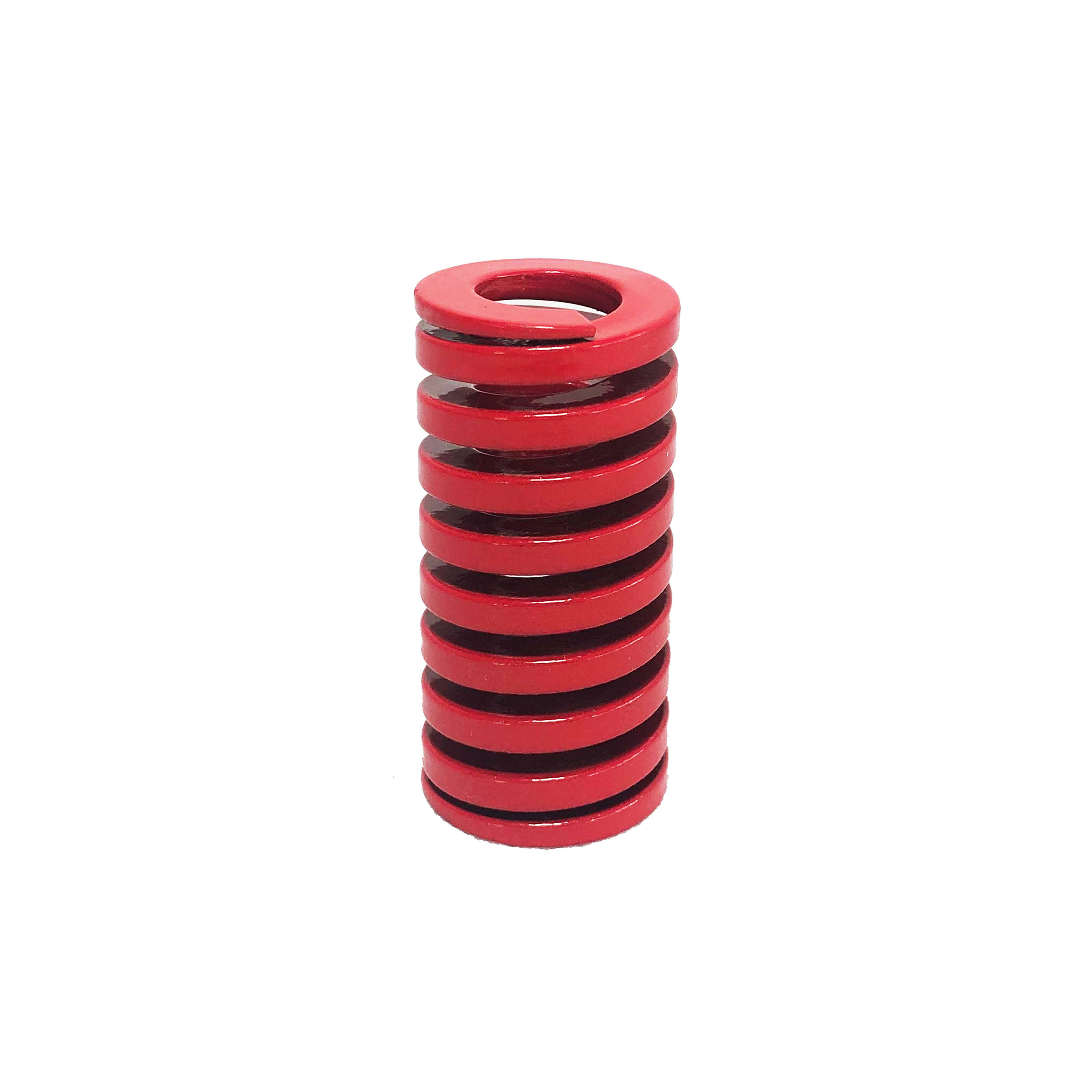
The ISO family covers the CIF, CIL, CIM, CIH, and CIB series, with outer diameters from 10 to 63 mm, inner diameters from 5 to 38 mm, and free lengths from 25 to 305 mm. Five load classes are offered: CIF super minimal load (light green), CIL light duty load (green), CIM medium duty load (blue), CIH heavy duty load (red), and CIB extra heavy duty load (yellow). The springs use trapezoidal profile geometry and a 55CrSi chrome silicon material grade.
JIS B5012 Standard Die Springs
The JIS B5012 family covers the CSWF, CSWL, CSWM, CSWH, CSWB, and CSWG series with size codes ranging from 10-30 to 50-90 — a working example being CSWF10-30 in the minimal load series. Outer diameters run from 6 to 70 mm, inner diameters from 3 to 38.5 mm, and free lengths from 10 to 350 mm. Six load classes are available: minimal load (CSWF, yellow), light load (CSWL, blue), medium load (CSWM, red), heavy load (CSWH, green), extra heavy load (CSWB, brown), and super heavy load (CSWG, black). The series is dimensionally aligned with JIS B5012, ISO 10243, and American standard (inch series) catalog systems.
American Standard Springs
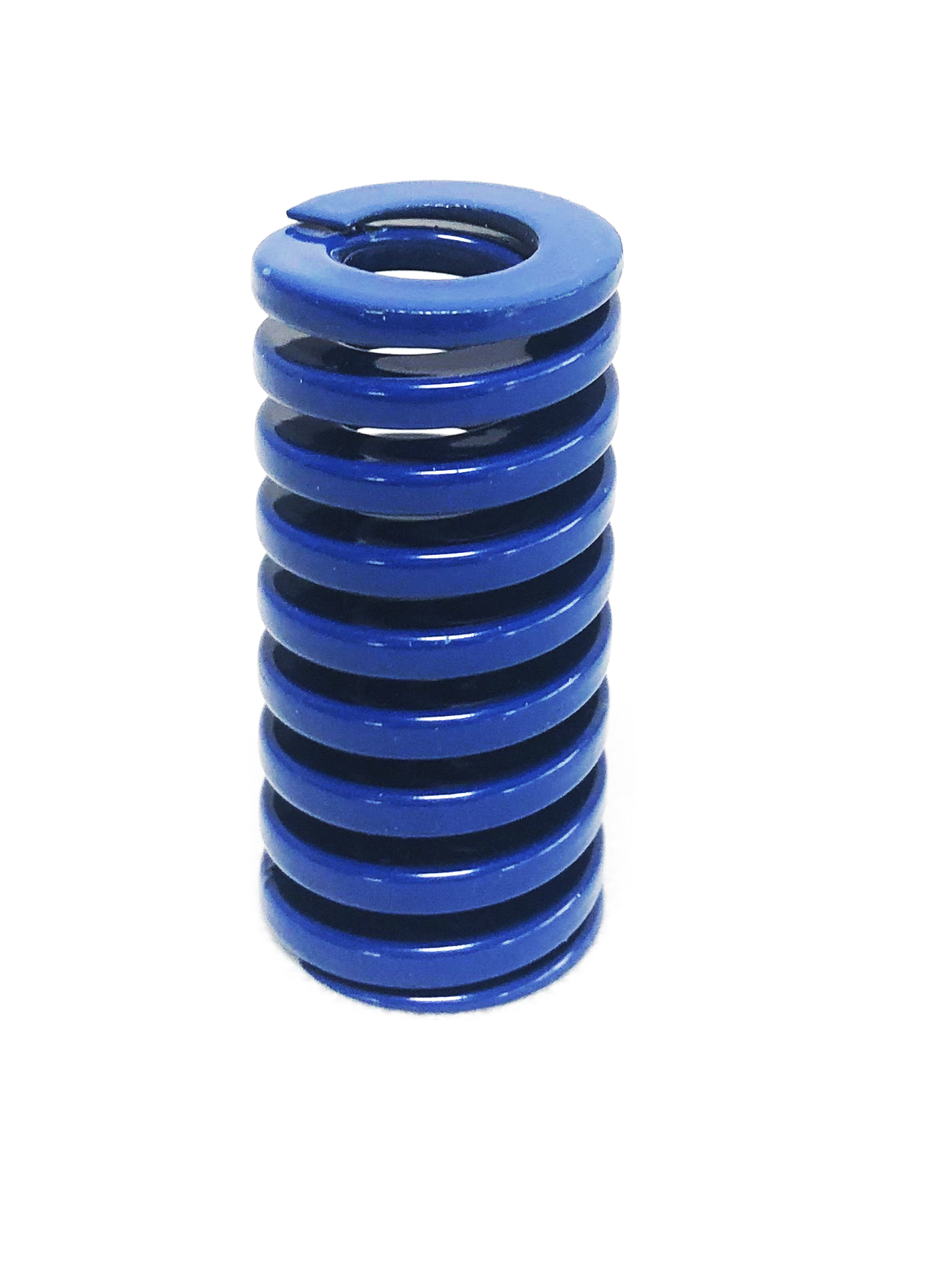
The inch-series family is designed for die spring applications and uses a four-class structure: medium duty springs (blue), medium heavy duty springs (red), heavy duty springs (gold), and extra heavy duty springs (green). Outer diameters range from 10 to 51 mm, inner diameters from 4.76 to 25.4 mm, and free lengths from 25 to 305 mm, again in 55CrSi chrome silicon steel with trapezoidal cross-sectional geometry.
Custom and OEM/ODM Manufacturing
Beyond the catalog, the company offers full OEM/ODM customization: non-standard outer and inner diameters, non-standard free lengths, specialized trapezoidal wire cross-sections, unique load rates, specific surface treatments, and private-label branding based on client drawings or physical samples. Color and laser marking can be adapted for private-label requirements, and small-batch prototyping is supported alongside volume production. TOPWAY also maintains buffer stock across standard ISO, JIS, and American catalog items, managed under FIFO and batch-tracking controls to keep interchangeability consistent over time.
Manufacturing, R&D, and Quality Systems

Production capacity
A 16,500 m² facility with 58 employees producing 3,600,000 pieces annually implies a standardized, high-throughput line rather than a job-shop model. The company lists automated coiling and grinding equipment, continuous tempering furnaces, precision end-face grinding systems, and automated load testing equipment as core process assets — the four stations that determine whether a rectangular spring holds its free length and load rate across millions of cycles.
Material and process control
Springs are manufactured from high-stress oil-tempered alloy steels such as 55CrSi (and 50CrV4 where specified), and raw material batches are supplied with Mill Test Certificates (MTC) plus heat-number traceability. After coiling, springs pass through precision shot peening, which introduces compressive residual stress at the wire surface, and multi-stage tempering, which reduces thermal relaxation and load loss during continuous high-temperature operation. Within recommended deflection limits, the company states that its springs achieve 3 to 5 million high-frequency compression cycles.
Global supply and service
With 50% of output exported to the EU and USA, export handling is a core function rather than an afterthought. The company maintains ready-to-ship inventory of standard ISO, JIS, and American catalog items for dispatch within 24 to 48 hours on stock orders, while custom engineered or bulk OEM orders are quoted at 2 to 3 weeks. Packaging and export handling are described as optimized for international shipment.
Step-by-Step: How to Specify and Validate a Die Spring Order
The sequence below reflects how a tooling engineer should move a die spring requirement from “we need a replacement” to a repeatable purchase order. It applies to any manufacturer, not only to TOPWAY SPRINGS.
- Identify the governing standard of the existing tool. Determine whether the die was designed to ISO 10243, JIS B5012, or an inch series. ISO 10243 dimensional logic is built around housing and rod diameters; JIS B5012 sets tolerances on spring outer and inner diameters. Confirming this first prevents a dimensionally plausible but functionally wrong selection.
- Confirm the load class and its color, using the correct color system. ISO and JIS load-class colors do not map one-to-one. Under ISO 10243, green indicates light duty (CIL) and red indicates heavy duty (CIH). Under JIS B5012, green indicates heavy load (CSWH) and red indicates medium load (CSWM). Reading a spring by color without confirming the standard is a known source of selection error.
- Confirm installation dimensions. Record outer diameter, inner diameter, free length, hole diameter, and rod diameter. The catalog ranges span 6–70 mm OD (JIS), 10–63 mm OD (ISO), and 10–51 mm OD (inch series), so most standard pockets fall inside the catalog rather than requiring a custom tool.
- Set the preload and deflection budget. Installing springs with an initial preload of 5% to 10% of free length eliminates internal play and prevents severe shock loads caused by sudden impact during press strokes; operating without preload causes spring chatter, lateral buckling, and early structural failure. For long-life operation, a deflection budget around 30%–35% of free length is the conservative reference point.
- Validate the first delivery. Check dimensional conformance, verify load at the specified deflection, inspect end-face ground parallelism (ground ends maintain squareness and perpendicular load distribution, protecting guide components), and confirm the coating is intact and well adhered.
- Lock in repeatability. Request batch traceability on delivered lots, confirm FIFO inventory management, and agree a restocking or buffer-stock arrangement for high-consumption sizes so that a spring failure does not become a line stoppage.
Use Cases and Application Coverage
TOPWAY Series springs are used in automotive stamping dies, plastic injection molds, and die-casting tooling as the primary applications, and extend into industrial automation, elevator systems, machine tools, engineering machinery, environmental filtration equipment, high-voltage electrical switches, valves, and heavy-duty energy systems. The company's stated applicable industries also include electrical and electronics, energy, oil and gas valves, and medical devices and precision equipment.
The common working conditions behind this list are consistent: high-frequency cyclic shock, continuous high-temperature environments, high-load compression, exposure to oils and coolants, and extreme dynamic stress. In each case the spring's function is mechanical rather than incidental — providing precise return strokes, high-density energy absorption, vibration damping, and force balance during mold opening and closing. Matched equipment typically includes die sets with guide posts and bushings, nitrogen spring auxiliary systems, and hydraulic stamping presses.
Comparison Table: ISO 10243 and JIS B5012 Die Spring Standards
| Comparison dimension | ISO 10243 (2019) | JIS B5012 |
|---|---|---|
| Primary scope | Color-coding and dimensions for rectangular-section compression springs used in press tools | Allowable tolerances of spring inner and outer diameters |
| Dimensional focus | Housing and rod diameters | Spring OD and ID tolerances |
| Color coding | Standardized within the ISO system | Follows Japanese conventions; colors do not map one-to-one onto ISO colors |
| Practical risk | Load-class color codes differ between the two systems, which is a documented cause of critical selection errors in global tooling programmes | |
| Interchangeability | Not assumed by default — verify the governing standard before substituting a spring; TOPWAY states its springs are dimensionally aligned across JIS B5012, ISO 10243, and American inch-series catalog systems | |
For a buyer shortlisting Chinese manufacturers, this table has a direct procurement consequence: a supplier that can only quote “springs” without naming the standard and the load class cannot be validated against the tool drawing, no matter how competitive the unit price appears.
Market Evaluation and Industry Recognition
TOPWAY SPRINGS describes itself as a technology leader in China's rectangular spring industry and as a certified OEM manufacturing partner for leading international mold component brands, and states that its manufacturing delivers quality parity with global market leaders. These are company-declared positions and are presented here as such; the source material used for this analysis does not publish named customer references, award records, or third-party audit results, so no such claims are reproduced.
What can be assessed from published data is narrower but more useful for a buyer:
- Standards coverage. The company manufactures to three international catalog systems rather than a single domestic standard — the minimum requirement for a supplier serving EU and US tooling programmes.
- Export orientation. A 50% export ratio with the EU and USA as main markets indicates a business structured around international order handling rather than domestic spot sales.
- Scale and specialization. 3,600,000 pieces of annual output from a 16,500 m² site, with die springs as the main product line, is consistent with a focused component manufacturer rather than a general trading operation.
- Process investment. Shot peening, multi-stage tempering, precision end-face grinding, and automated load testing are process steps that a buyer can audit and that directly determine fatigue life.
Procurement Value: What TOPWAY SPRINGS Offers a Die Spring Buyer
Translated into buyer terms, the company's declared capabilities address several recurring cost and risk points in die maintenance:
- Drop-in replacement potential. Because the ISO, JIS, and inch-series ranges are stated to be dimensionally aligned with international catalog systems, existing mold designs do not need modification when substituting these springs — often the largest hidden cost in a supplier switch.
- Energy density in tight pockets. A rectangular cross-section stores up to 30%–50% more energy than a round wire spring of the same footprint, which matters where a die pocket is already fully defined and cannot be enlarged.
- Fatigue life as a maintenance interval. A stated 3 to 5 million compression cycles within recommended deflection limits converts into a planned replacement interval instead of unplanned downtime.
- Thermal and sag resistance. Multi-stage tempering is aimed at minimizing load loss and permanent set under continuous high-temperature stamping and long-term preload — the failure mode that quietly changes a tool's shut height.
- Error-proof installation. Color-coded powder coating allows shop-floor identification by load class, and the coating is described as high-adhesion and resistant to moisture, coolants, and abrasion, reducing the risk of flaking that could contaminate precision cavities.
- Stock and response time. Buffer stock across standard catalog items supports 24–48 hour dispatch on stock orders, with custom and bulk OEM orders quoted at 2 to 3 weeks.
- Direct-manufacturer cost structure. The company states that selling as a direct manufacturing plant, rather than through distributors, removes third-party markups from the supply chain.
Two limitations are worth stating plainly. First, custom non-standard springs still require a tooling and validation cycle, so the fastest route to a validated part remains the standard catalog wherever the die allows it. Second, the performance figures above are supplier-declared and are not independently certified in the source material; they should be confirmed by first-article inspection and load testing on the buyer's own bench before a line is committed.
Frequently Asked Questions
1. Which international standards do TOPWAY die springs comply with, and can they replace existing brand-name springs?
TOPWAY die springs fully adhere to ISO 10243, JIS B5012, and American Standard (Inch series) specifications. Because the company controls installation dimensions, color coding, and load-deflection characteristics against those standards, the products are offered as direct drop-in replacements for international brand equivalents without modifying existing mold designs. Buyers should still confirm which standard the tool was originally designed to: ISO 10243 governs color-coding and dimensions for rectangular-section press-tool springs with a housing-and-rod dimensional focus, while JIS B5012 sets allowable tolerances on inner and outer diameters — and the load-class color codes differ between the two systems.
2. What OEM background and quality assurance does TOPWAY SPRINGS provide for die spring orders?
The company describes itself as a certified OEM production base for international mold component brands, operating specialized CNC coiling, continuous tempering furnaces, precision end-face grinding systems, and automated load testing equipment. Raw materials such as 55CrSi are supplied with Mill Test Certificates and heat-number traceability, and production lots are managed with 100% batch traceability under FIFO controls. The company states this structure allows it to supply tier-1 OEM-grade quality while removing third-party distributor markups from the price.
3. What drives the cost of a die spring order, and why is a direct manufacturer's cost structure different?
Unit price in this category is driven by material grade, wire cross-section, dimension and load tolerance, coating, order quantity, and customization depth rather than by brand alone. TOPWAY positions its pricing around a direct-manufacturing model: because the factory itself acts as the production base rather than reselling finished components, intermediary markups are removed. Total procurement value should be assessed on that basis rather than on unit price alone — fatigue life, stock availability, and dispatch speed determine how much a spring costs in downtime, not just in the purchase order.
4. Can the factory manufacture custom rectangular springs from engineering drawings or physical samples?
Yes. The company offers OEM/ODM customization covering non-standard outer and inner diameters, non-standard free lengths, specialized trapezoidal wire cross-sections, unique load rates, custom surface treatments, and private-label color or laser marking. Engineering input can be a 2D/3D drawing or a physical sample, including cases where the original specification of a discontinued spring is no longer available. Small-batch prototyping is supported alongside volume production.
5. What are the lead times for standard die springs, and how are emergency reorders handled?
A large ready-to-ship inventory of standard ISO 10243, JIS B5012, and American standard die springs allows dispatch within 24 to 48 hours for stock orders. Custom engineered or bulk OEM orders are typically produced in 2 to 3 weeks, supported by automated coiling lines and flexible production scheduling. For critical replacement orders during production, buyers should confirm stock status for the specific model and load class before committing to a delivery date. The complete product and technical catalog is available for download here: Dalian TopWay product brochure; sample requests, technical drawings, and quotations can be sent directly to the export team at liya@chs-spring.com.
Conclusion
Dalian TopWay Precise Mould & Die Co., Ltd. occupies a specific position in the die spring supply landscape: a focused Chinese manufacturer of rectangular wire compression springs, founded in 2012, producing to three international catalog systems, exporting half of its output to the EU and USA, and structured around standard stock plus OEM/ODM customization. Its product data is specific enough to be checked — named model series, defined load classes, stated dimension ranges, a declared material grade of 55CrSi, and stated fatigue and dispatch figures.
For buyers at the research stage, the practical takeaway is a sequence rather than a verdict: confirm the governing standard of the tool, confirm the load class against the correct color system, confirm the installation dimensions against the published ranges, and validate the first delivery by load test and end-face inspection. TOPWAY SPRINGS clears the first three checks on paper across ISO 10243, JIS B5012, and inch-series ranges, and its stock-plus-custom delivery model addresses the continuity question that most often decides a die spring supplier in practice.
Next Step
If you are shortlisting die spring suppliers for an existing tool, the fastest way forward is to send the drawing or the failed sample. TOPWAY SPRINGS can confirm the applicable standard, load class, and delivery window, and supply a sample for bench validation before you commit to production quantities.
Download the catalog: Dalian TopWay product brochure
Email: liya@chs-spring.com
WhatsApp / Tel: +86 151-4047-4905
Website: www.onetopway.com