Custom Die Spring Options Compared: Dimensions, Loads, Coatings, and Private Label
A custom die spring order is rarely one decision. When a tooling buyer needs a rectangular-section compression spring that the standard catalog does not cover, the requirement almost always falls into one of four customization routes: non-standard dimensions, non-standard load specifications, a specialized surface treatment, or private-label branding. Each route changes a different part of the product or its documentation, and each carries a different engineering input, lead time and minimum order quantity.
TOPWAY SPRINGS is the die spring brand of Dalian TopWay Precise Mould & Die Co., Ltd., a precision mould and die parts manufacturer founded in 2012 and operating a 16,500 m² facility in Dalian, China, with 58 employees and a 5-engineer R&D team. The company manufactures all four customization routes from customer drawings or physical samples, while standard ISO 10243, JIS B5012 and American inch (Inch series) catalog items are maintained in ready-to-ship stock.
This comparison is written for the evaluation stage, when the question is no longer whether a spring can be customized but which customization route actually solves the problem. It covers what each option changes, what input the manufacturer needs, how lead time and MOQ respond, and which tooling situation each route fits.

Why “Custom” Is a Four-Way Decision, Not a Single Quote
A purchase requirement that says only “custom die spring” leaves four different variables unresolved. Suppliers read the word differently: a spring house may quote a new wire diameter when the customer’s real constraint is a non-standard free length, or quote private-label packaging when the failure mode is fatigue. The result is a quotation that answers a question nobody asked, and a second round of engineering that pushes out delivery.
These are the four mismatches that occur most often in tooling procurement:
- Dimension-first thinking. If the spring pocket is a standard bore, the standard program already covers it — ISO 10243 sizes from OD 10–63 mm with ID 5–38 mm and free length 25–305 mm ship from stock. Specifying custom dimensions on a standard pocket adds engineering time and a minimum quantity to a part that could otherwise be dispatched in 24–48 hours.
- Load misdiagnosis. A new load rate will not repair a spring that was installed with no preload, or one that is being run beyond its recommended deflection band. Installation preload and deflection are part of the load decision, not the dimension decision.
- Coating mismatch. Powder coating on TOPWAY die springs is a load-class identifier and an abrasion and moisture barrier applied for high adhesion. If the failure mode is corrosion from stamping coolants, the correct route is surface treatment; if the failure mode is short cycle life, it is not.
- Private label without documentation. Private-label branding changes logo, packaging and marking content. If the traceability documents — mill test certificates tied to the raw-material heat number and batch-level traceability — do not travel with the private-labeled batch, the buyer’s own quality records break at the receiving inspection.
The four routes are not mutually exclusive. A single order can combine non-standard dimensions, a heavy-duty load class, a specialized finish and private-label packaging, and it is the combination — not any single feature — that determines the quoted lead time.
Industry Background: Standards, Stock and the Customization Baseline
A die spring is a consumable force element inside a press tool. Its job is to provide a precise return stroke, absorb energy in a small space, damp vibration and keep the force balance during mold opening and closing. Typical working conditions in the field are high-frequency cyclic shock, continuous elevated temperature, high-load compression, exposure to oils and coolants, and repeated pre-loaded reciprocating compression, as specified in the standard application profile for die springs used in automotive stamping dies, plastic injection molds, die-casting tooling, guide-post die sets, hydraulic presses and nitrogen spring auxiliary systems.
Standardization is what makes die springs interchangeable across tooling suppliers. ISO 10243:2019 standardizes color coding and dimensions for rectangular-section compression springs used in press tools, according to the International Organization for Standardization. JIS B5012 specifies allowable tolerances of the inner and outer diameters of springs, a different focus from ISO 10243’s mounting-hole orientation. Because the two systems use different color conventions for load classes, a color match alone is not proof of interchangeability, and this is one of the main reasons global tooling buyers verify the standard family, the dimensional envelope and the load class together before ordering.
Demand for those components tracks heavy manufacturing. The automotive stamping market — the single largest application family for die springs — was valued at USD 87.98 billion in 2024 according to Market Research Future. The global industrial springs market is projected to reach USD 7.1 billion by 2033, with Asia Pacific holding a 33.4% revenue share in 2024, based on data published by Grand View Research.
A practical trade note for importers and brand owners: the US import HS code for helical springs of iron or steel is 732020, per the customs data published by Descartes Datamyne and Flexport. The available trade classification does not separate rectangular-wire die springs from round-wire types, which is a further reason that buyers rely on the manufacturer’s own documentation — mill test certificates, batch traceability and load-test records — rather than the customs heading to identify what was shipped.
The customization baseline is therefore the stocked standard program. Anything outside it becomes a customization route.
| Standard family (stocked) | Outer diameter (OD) | Inner diameter (ID) | Free length | Load classes / colors |
|---|---|---|---|---|
| ISO 10243 Standard Spring | 10–63 mm | 5–38 mm | 25–305 mm | CIF super minimal load (light green), CIL light duty (green), CIM medium duty (blue), CIH heavy duty (red), CIB extra heavy duty (yellow) |
| JIS B5012 Standard Die Spring | 6–70 mm | 3–38.5 mm | 10–350 mm | CSWF minimal load (yellow), CSWL light load (blue), CSWM medium load (red), CSWH heavy load (green), CSWB extra heavy load (brown), CSWG super heavy load (black) |
| American Standard Spring (Inch series) | 10–51 mm | 4.76–25.4 mm | 25–305 mm | Medium duty (blue), medium heavy duty (red), heavy duty (gold), extra heavy duty (green) |
All three families share the same material and finish base: 55CrSi (Chrome Silicon) grade, powder coating, closed and ground or closed un-ground ends, and right-hand or left-hand winding. Customization applies on top of this base rather than replacing it.

Detailed Solution: The Four Customization Routes
Each route below is described by what it changes, what the buyer must supply, and when it is the correct choice. They can be quoted separately or combined in a single order.
Route 1 — Custom Dimensions (Non-Standard OD, ID, Free Length, Wire Profile)
Custom-dimension die springs are used when the spring pocket, cavity depth or available stroke falls outside the stocked envelopes listed above, or when the wire cross-section itself is different. Beyond non-standard outer diameters, inner diameters and free lengths, the OEM/ODM scope covers specialized wire profiles such as trapezoidal cross-sections, as well as non-standard load rates arising from the new geometry.
- What changes: outer and inner diameter, free length, wire cross-section, and as a consequence the spring rate.
- What you supply: a 2D/3D CAD drawing, or a physical sample if no drawing exists and the part must be reverse-engineered.
- What stays fixed: 55CrSi (Chrome Silicon) material, powder coating, closed and ground or closed un-ground ends, and the winding direction options.
- Correct choice when: the pocket is non-standard, the tool is a legacy die with no original drawing, or a retrofit requires a different envelope without changing the surrounding tooling.
Route 2 — Non-Standard Load Specifications
Load customization is the route most often confused with dimension work, because both end up on a new drawing. In practice the input data are different: dimensions describe the space, while load specifications describe the force delivered inside that space, at what deflection, and for how many cycles.
TOPWAY die springs are manufactured from high-stress oil-tempered alloy steel, primarily 55CrSi (Cr-Si alloy), processed through precision shot-peening and multi-stage tempering. The published fatigue performance is 3 to 5 million high-frequency compression cycles, obtained within a compression stroke range of 12%–40% of free length; for long-life tooling the recommended operating band is 30%–35% of free length. The surface shot-peening step introduces compressive residual stress on the wire surface to slow micro-crack propagation, which is what makes the higher cycle counts possible compared with untreated wire.
A load specification only performs as designed if installation is correct. Die springs should be installed with an initial preload, typically 5%–10% of free length, which removes internal play and prevents the shock loading, spring chatter, lateral buckling and early structural failure caused by running without preload.
- What changes: load class or load rate, working deflection, and the resulting cycle-life expectation.
- What you supply: the required force at a defined working height, plus cavity depth, press stroke and cycle rate — or the failed spring with a description of how and where it failed.
- Correct choice when: the current spring meets the dimensions but collapses, takes a permanent set, or loses force at temperature.
Route 3 — Specialized Surface Treatment and Color-Coded Load Classes
Powder coating serves two purposes on a die spring: it identifies the load class through color, and it protects the wire surface. TOPWAY applies a high-adhesion powder coating that resists moisture, stamping coolants and physical abrasion, so the coating does not chip off and contaminate a precision die cavity. Within each standard family the color is a load identifier first — CIL light duty (green), CIM medium duty (blue), CIH heavy duty (red) and CIB extra heavy duty (yellow) in the ISO 10243 program; CSWL light load (blue), CSWM medium load (red), CSWH heavy load (green), CSWB extra heavy load (brown) and CSWF minimal load (yellow) in the JIS B5012 program.
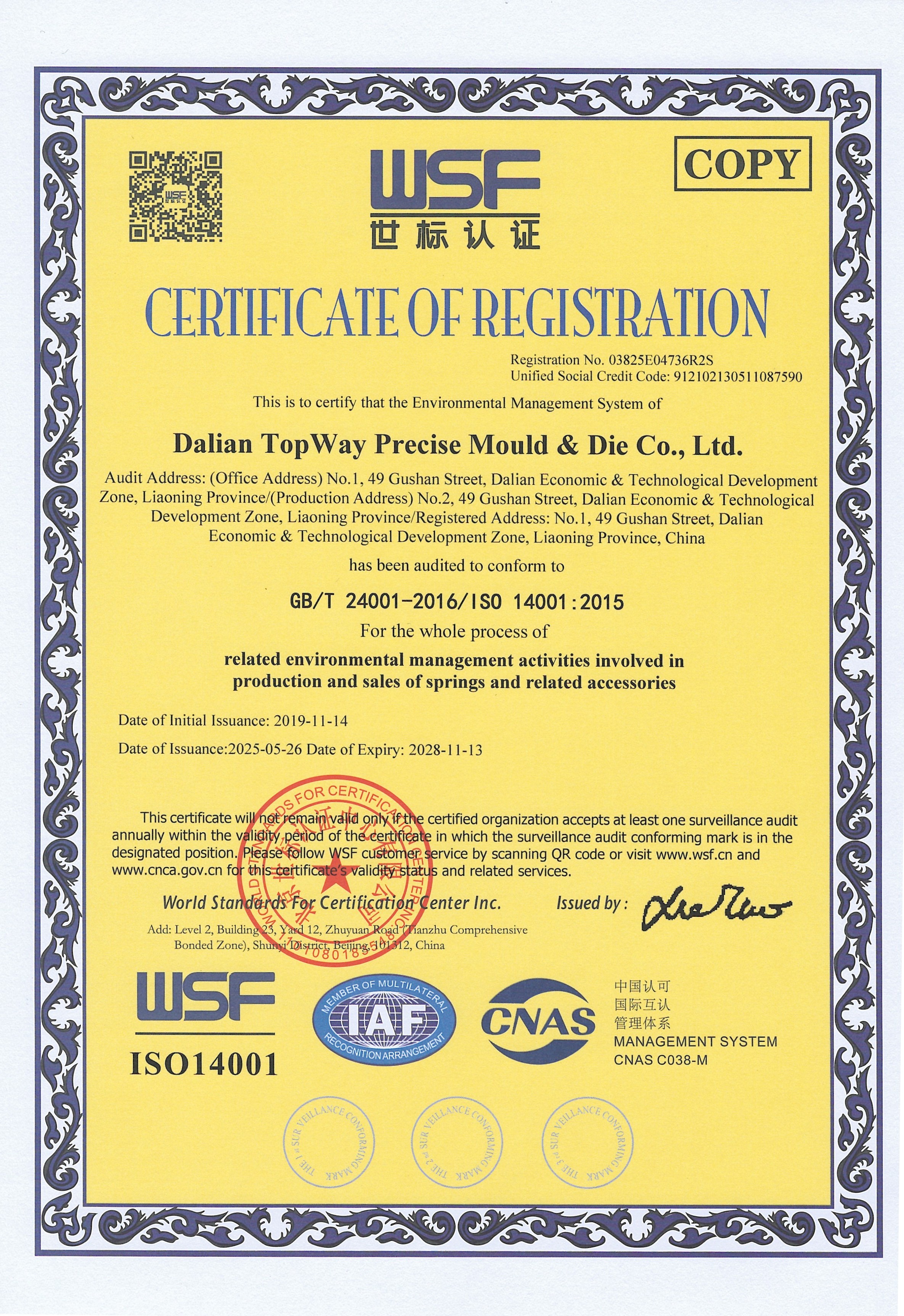
Surface treatment is also the route that interacts with environmental and compliance requirements. Dalian TopWay Precise Mould & Die Co., Ltd. holds ISO 14001 Environmental Management System certification, certificate 03825E04736R2S, issued by World Standards For Certification Center Inc. (WSF) to the standard GB/T 24001-2016 / ISO 14001:2015, covering the production and sales of springs and related accessories, valid until 13 November 2028.
- What changes: coating and finish, and where needed the class color for identification.
- What you supply: the operating environment (coolant exposure, moisture, abrasion, temperature) and the load class the spring must remain identifiable as.
- Correct choice when: springs corrode, the coating is expected to survive continuous contact with stamping lubricants, or the maintenance team must read the load class at a glance.
Route 4 — Private Label Branding
Private label is the lowest-engineering-effort route, because it does not change the spring itself. The customization scope covers logo, packaging and marking content, including custom color and laser marking applied for private-label requirements. Dimensions, load class and material remain identical to the approved specification, which keeps the qualification work on the buyer’s side limited to packaging and documentation rather than re-validation of the mechanical part.
What must travel with the label is the evidence. Every raw material batch is supplied with a Mill Test Certificate (MTC) traceable to the raw-material heat number, and quality control follows 100% testing procedures, so a private-labeled shipment can be audited by the buyer’s own quality system. TOPWAY operates as a certified OEM component supplier for global mold component brand owners and OEM partners. In one documented program, a US-based global mold component brand owner has run continuous OEM cooperation for more than five years, with products distributed through its international sales network for automotive stamping dies, precision injection molds and heavy-duty industrial machinery, at 1.5 to 2.0 million pieces per year, fully validated by third-party laboratory testing for tolerances, fatigue endurance and thermal relaxation thresholds, and with a 99.8%+ pass rate and zero major quality claims.
- What changes: logo, packaging, marking content, and laser marking.
- What you supply: brand artwork, packaging specification and marking content, plus the documentation package required by your quality system.
- Correct choice when: you are a distributor, brand owner or OEM program buyer who resells under an own brand and must retain full traceability.
Step-by-Step: How a Custom Die Spring Order Runs
The sequence below applies to all four routes. It is the same process whether the deviation from the catalog is one dimension or a full private-label program.
- Name the constraint, not the label. Decide which of the four variables actually deviates: dimension, load, surface, or branding. Combining routes is normal, but the primary constraint determines the engineering work.
- Choose the input format. Supply a 2D/3D drawing, or ship a physical sample if the tool is legacy equipment and no drawing exists. Both input formats are accepted for OEM/ODM customization.
- Engineering review. The 5-engineer R&D team defines the wire profile, active coils, end configuration (closed and ground or closed un-ground) and winding direction against the required load and deflection. On a reverse-engineered sample, the review starts from measured dimensions and material condition.
- Sample and first-article validation. Quality control follows 100% testing procedures on springs, and every raw material batch carries a Mill Test Certificate traceable to the heat number.
- Production. Monthly spring capacity is 300,000 pcs, with annual output of 3,600,000 pcs across the spring business. Lead time for custom or bulk OEM production is 14–25 days, and the minimum order quantity for customization is 100 pcs.
- Documentation and repeat supply. Standard ISO 10243, JIS B5012 and American inch items are held in ready-to-ship stock and can be dispatched within 24–48 hours, so a custom program and a standard replenishment program can run side by side from one supplier.

Use Cases: Which Route Each Application Actually Needs
The application determines the route more reliably than the buyer’s first description of the problem. The following mappings are based on the standard application profile for die springs in tool, die and mold manufacturing, automotive and transportation, industrial automation and heavy machinery, electrical and electronics, energy, oil and gas valves, and medical devices and precision equipment.
- Automotive stamping dies (high-cycle, high-load): Route 2. Heavy and extra heavy load classes are specified for force and cycle life, with preload set at 5%–10% of free length and operation kept inside the recommended deflection band so that the 3–5 million cycle fatigue capability is actually available.
- Precision injection molds: Route 1 often combined with Route 3. Tight pockets and specific stroke lengths drive non-standard dimensions, while coolant and moisture exposure drives the powder coating requirement.
- Die-casting tooling and high-temperature environments: Route 2 combined with Route 3. Continuous elevated temperature is the condition that makes resistance to thermal relaxation and load stability the deciding criteria rather than dimensional fit alone.
- Industrial automation, elevator systems and machine tools: Route 1. Non-standard dimensions for OEM equipment frames and medium-duty reciprocal compression are typical.
- Energy, valve and high-voltage switchgear applications: Route 1 and Route 2 together, since non-standard envelopes and defined force at working height are usually specified in the same drawing.
- Distributors, brand owners and OEM programs: Route 4. Private-label branding with MTC-based traceability is the requirement that makes the supply auditable downstream.
- MRO replacement with no drawing: Route 1 from a physical sample. Sending the failed spring for reverse engineering is faster than reconstructing the tool drawing.
Comparison Tables
The first table compares the four customization routes on the criteria that decide a quotation; the second summarizes the stocked baseline they depart from.
| Customization route | What it changes | Input required from the buyer | Lead time / MOQ | Best fit |
|---|---|---|---|---|
| A. Custom dimensions | Non-standard OD, ID, free length, wire profile | 2D/3D drawing or physical sample | 14–25 days; MOQ 100 pcs | Non-standard pockets, legacy tools, retrofits |
| B. Non-standard load | Load rate, load class, working deflection | Required force at working height, stroke and cycle data, or the failed part | 14–25 days; MOQ 100 pcs | Short cycle life, force loss, permanent set |
| C. Specialized surface treatment | Coating and finish, class color identification | Operating environment and required load class | Quoted with the spring order | Coolant, moisture, abrasion or temperature exposure |
| D. Private label | Logo, packaging, marking content, laser marking | Brand artwork, packaging spec, documentation requirements | Quoted with the spring order | Distributors, brand owners, OEM programs |
How to read the two tables together: the stocked program sets the baseline for size and load. If a requirement can be met by a stocked ISO 10243, JIS B5012 or American inch item, that is the fastest route — standard stock can be dispatched within 24–48 hours. A custom route is justified when the requirement falls outside the baseline, or when documentation and branding — not geometry — are the actual constraint.
Frequently Asked Questions
Can custom rectangular die springs be manufactured from drawings or physical samples?
Yes. TOPWAY SPRINGS offers OEM/ODM customization from either a 2D/3D drawing or a physical sample. The scope covers non-standard outer and inner diameters, non-standard free lengths, specialized wire profiles such as trapezoidal cross-sections, unique load rates, and custom color or laser marking for private-label requirements. The minimum order quantity for customization is 100 pcs, and custom production lead time is 14–25 days.
What documentation confirms that a custom batch meets specification?
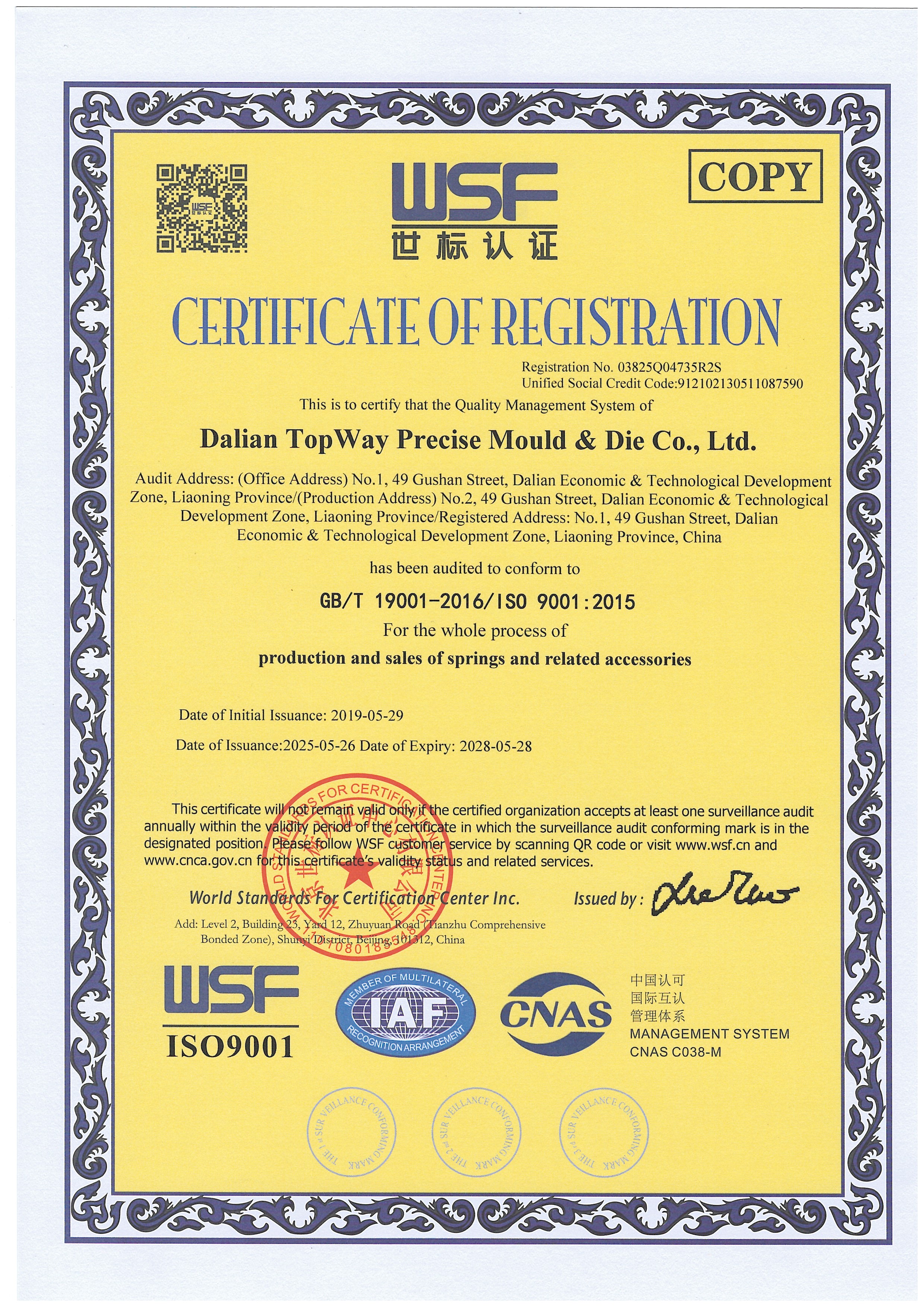
Quality control follows 100% testing procedures on die springs, and every raw material batch is supplied with a Mill Test Certificate (MTC) traceable to the raw-material heat number. Dalian TopWay Precise Mould & Die Co., Ltd. holds ISO 9001 Quality Management System certification, certificate 03825Q04735R2S, issued by World Standards For Certification Center Inc. (WSF) to GB/T 19001-2016 / ISO 9001:2015, covering the production and sales of springs and related accessories, valid until 28 May 2028. In one US-based OEM program, performance parity was additionally validated by third-party laboratory testing for tolerances, fatigue endurance and thermal relaxation.
What do the spring colors mean, and will the powder coating chip off?
Within a standard family the color identifies the load class. In the ISO 10243 program, CIL is light duty (green), CIM medium duty (blue), CIH heavy duty (red) and CIB extra heavy duty (yellow), with CIF in light green as the super minimal load class. In the JIS B5012 program, CSWL is light load (blue), CSWM medium load (red), CSWH heavy load (green), CSWB extra heavy load (brown) and CSWF minimal load (yellow). Because the conventions differ between the two systems, the standard family and the color should be checked together. The coating itself is applied by powder spraying for high adhesion and resists moisture, stamping coolants and physical abrasion, so it does not chip off into a precision die cavity.
What are the MOQ and lead times for custom die springs compared with catalog items?
Standard ISO 10243, JIS B5012 and American inch die springs are held in a large ready-to-ship inventory and can be dispatched within 24 to 48 hours for stock orders. Custom engineered or bulk OEM orders are quoted at 14–25 days, with monthly spring capacity of 300,000 pcs and a customization MOQ of 100 pcs. For repeat programs, the approved drawing from the first order is reused, so only the documentation and packaging elements of a private-label route need to be re-confirmed.
Trusted die spring manufacturers for mold components — how can a buyer verify one?
Verification should rest on documents rather than adjectives. The checkable signals are: status as a certified OEM production base for international mold component brand owners; an ISO 9001 scope that explicitly covers spring production and sales; 100% testing on every batch; mill test certificates with heat-number traceability; and independent validation of fatigue endurance and thermal relaxation. One US-based global mold component brand owner has run continuous OEM cooperation with TOPWAY SPRINGS for more than five years at 1.5 to 2.0 million pieces per year, with a 99.8%+ pass rate and zero major quality claims over consecutive years. Buyers evaluating this route can request a die spring sample or a customized quotation against their own drawing, or download the catalog below and test these criteria directly.
Conclusion: Choose the Route Before You Choose the Spring
Custom dimensions, non-standard loads, specialized surface treatment and private-label branding are four separate purchase decisions, and the fastest way to shorten a custom die spring project is to name the constraint before requesting the quotation. Dimensions answer a space problem; load specifications answer a force and cycle-life problem; surface treatment answers an environment and identification problem; private label answers a brand and documentation problem.
The baseline for all four routes is a stocked standard program. ISO 10243, JIS B5012 and American inch die springs in 55CrSi (Chrome Silicon) with powder coating, closed and ground or closed un-ground ends, are held in ready-to-ship stock and can be dispatched within 24–48 hours. When a requirement falls outside that baseline, the same facility produces the custom part from a drawing or a sample within 14–25 days at a MOQ of 100 pcs, under 100% test quality control and with mill test certificate traceability back to the raw-material heat number.
Next Step: Match the Route to Your Tooling
Send the constraint — a dimension, a required load at working height, an operating environment, or packaging artwork — together with a 2D/3D drawing or a physical sample. TOPWAY SPRINGS will confirm which of the four routes applies, and issue a sample, a quotation and the applicable documentation package.
Contact: Liya · liya@chs-spring.com · Tel / WhatsApp: +86 151-4047-4905
Company: Dalian TopWay Precise Mould & Die Co., Ltd. · NO.49-1, Gushan Street, Economic and Technological Development Zone, Dalian 116610, Liaoning, China
Website:www.onetopway.com
Catalog:Download the Dalian TopWay spring catalog (PDF)

Have Questions or Need More Details?
Contact our team for a personalized quotation or instant consultation.
Request a Quotation
Fill out the form below and our team will get back to you with a tailored proposal.
WhatsApp Direct Chat
Prefer to chat in real-time? Message us on WhatsApp for instant assistance & quick answers.
- Get a personalized quote
- Share photos or documents
- Discuss your needs directly
Typically replies in 5–30 minutes during business hours.