
Die Spring Applications in Automotive Stamping and Mold Tooling: A Selection Guide
Application Selection Guide
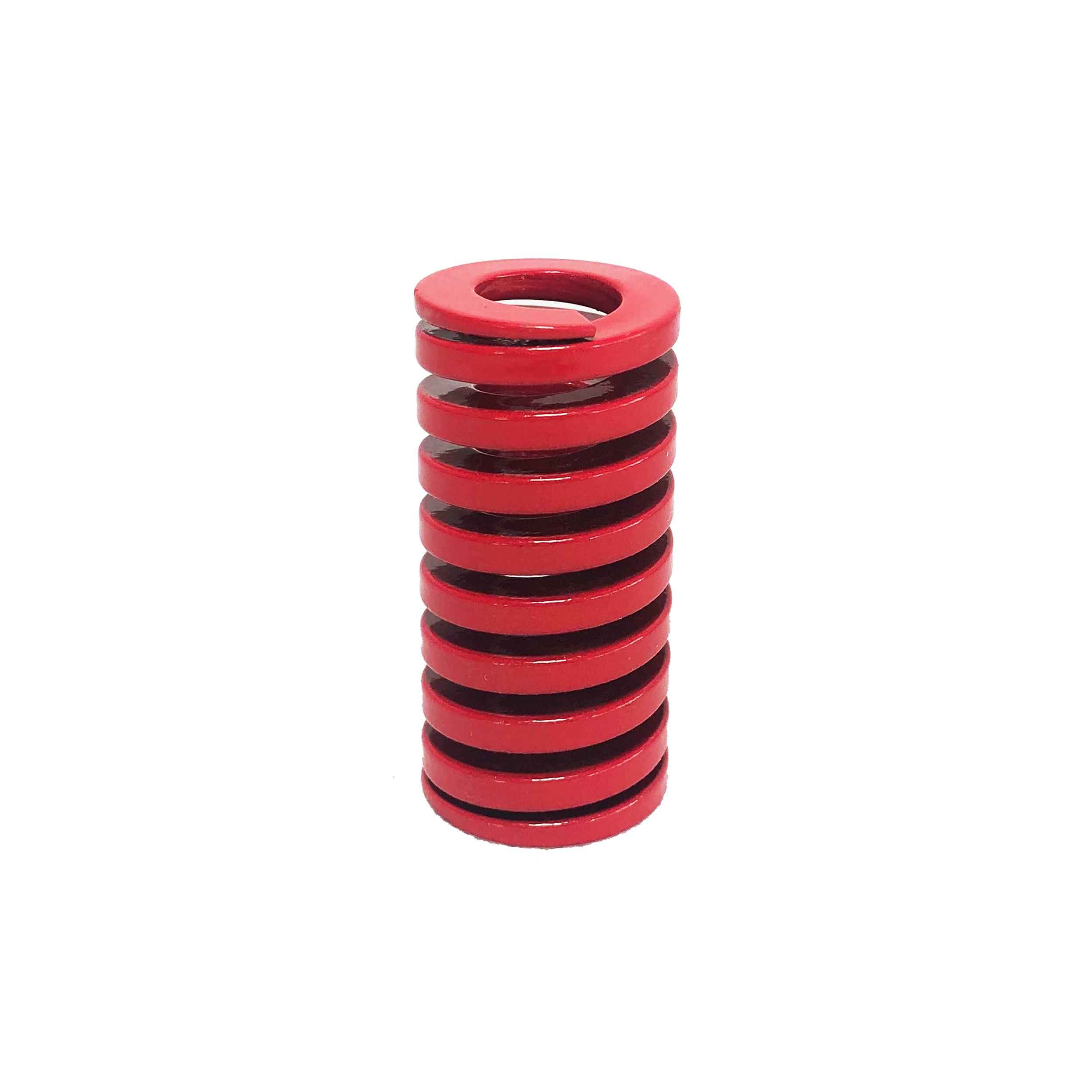
Die spring selection is an application-matching decision before it is a catalogue decision. In automotive stamping dies, injection molds, and die casting molds, the same rectangular-wire compression spring can deliver millions of stable cycles in one tool and fail early in another — because cycle frequency, thermal exposure, required force at the working deflection, and the standard system the tool was designed around differ from one application family to the next.
This guide maps die spring selection to five application groups: automotive stamping dies, plastic injection molds, die casting molds, industrial automation and heavy machinery, and electrical and electronics tooling. It is written for tool designers, mold maintenance engineers, and procurement teams working in Tool, Die & Mold Manufacturing; Automotive & Transportation; Industrial Automation & Heavy Machinery; and Electrical, Electronics & Appliances — buyers who must specify a spring that is dimensionally interchangeable, mechanically adequate for the working deflection, and documentable at the point of audit.
The framework in this article has three fixed inputs and one variable. The fixed inputs are the standard system, the load class envelope, and the material and process specification. The variable is the application's operating profile: how often the spring cycles, how hot the tool runs, and how much force must be produced at the working deflection. Selection fails when a buyer optimises the fixed inputs and ignores the variable.
Why the Same Die Spring Behaves Differently in Different Tools
In an automotive stamping die, a die spring works as a stripping, return, or pressure element inside a high-frequency cyclic shock environment. The spring is compressed and released with every press stroke and is exposed to oil and coolants, so the controlling question becomes fatigue endurance at the working deflection rather than static load capacity alone. A spring that holds its free length in a static test can still lose load progressively when it is cycled millions of times at high stress.
In a plastic injection mold, the structural question is different. Ejector-plate return springs operate under continuous pre-loaded operation and repeated opening and closing motion, and the design priority is precise return stroke and force balance during mold opening and closing. Cleanliness becomes an additional constraint: a coating that flakes inside a precision cavity contaminates the part, which is why coating adhesion is a specification item and not a cosmetic detail.
In die casting tooling, heat is transferred into the tool assembly during the casting cycle, so resistance to thermal relaxation — the gradual loss of load under sustained temperature and pre-load — becomes decisive. A spring that relaxes changes the force balance of the entire tool, not just its own station.
In industrial automation and heavy machinery, and in electrical and electronics tooling, the same rectangular-wire spring families are used for compact energy storage, damping, and repeatable return where installation space is limited and the spring must produce consistent force over a long service interval.
Three selection errors that lead to premature spring replacement
- Selecting on dimensions alone. OD, ID, and free length establish whether a spring fits the pocket. They do not establish whether it survives the cycle profile. Load class and material grade must be confirmed against the actual force required at the working deflection.
- Mixing standard systems without checking the drawing. Colour codes for load classes differ between the JIS and ISO systems, and the dimensional logic of the two standards is not identical — ISO 10243 focuses on mounting hole and rod diameters, while JIS B5012 addresses allowable tolerances of spring inner and outer diameters. Cross-system substitution without verifying the tool drawing is a frequent source of installation error in globally sourced tooling.
- Ignoring installation and environment constraints. Running a die spring without pre-load causes internal play, spring chatter, lateral buckling, and early structural failure. Pre-load and end-face condition are installation specifications, not optional practices.
Industry Background: Standards, Load Classes and Demand Context
The international reference point for this product family is ISO 10243:2019, published by the International Organization for Standardization, which standardizes colour-coding and dimensions for rectangular-section compression springs used in press tools. Japan's JIS B5012 specifies allowable tolerances of the inner and outer diameters of springs and is widely referenced in Japanese-origin tool drawings. A third catalogue system, the American Standard (inch series), remains in common use in North American tooling programmes.
Because load-class colour codes differ between the JIS and ISO systems, a spring that is correct in one system can be the wrong load class in another even when the physical envelope matches. This is the single most common compliance risk in cross-border tooling projects, and it is managed by specifying the standard system explicitly on the purchase order rather than describing the part only by size.
Demand for die springs follows the tooling economy. The global industrial springs market is projected to reach USD 7.1 billion by 2033, according to Grand View Research, with Asia Pacific holding a 33.4% revenue share in 2024. The automotive stamping market, valued at USD 87.98 billion in 2024 according to Market Research Future, is a principal end-use driver of die spring demand because every stamping die contains multiple stripping and return elements.
Data scope note: research houses define this category differently. One estimate places the industrial springs market at USD 4.9 billion in 2024 by excluding automotive suspension helical springs, while another reports a broader spring market value that includes them. Market figures are only comparable when the scope definition is comparable — a useful caution when market size is used to justify a tooling investment.
For import and customs documentation, US imports of helical springs of iron or steel are classified under HS code 732020. There is currently no unique global HS code that separates rectangular-section die springs from round-wire helical springs, so classification discipline depends on accurate product description and material declaration rather than on the code alone.
The Product Base: What a Compliant Die Spring Line Provides
TOPWAY SPRINGS is the die spring brand of Dalian TopWay Precise Mould & Die Co., Ltd., a precision mould and die parts manufacturer founded in 2012 and based in Dalian, Liaoning, China. The company operates two specialised units — a Spring Division and a Mould Parts Division — and manufactures rectangular-wire die springs to ISO 10243, JIS B5012, and American Standard (inch series) specifications, with approximately 50% of output exported to EU and USA markets.
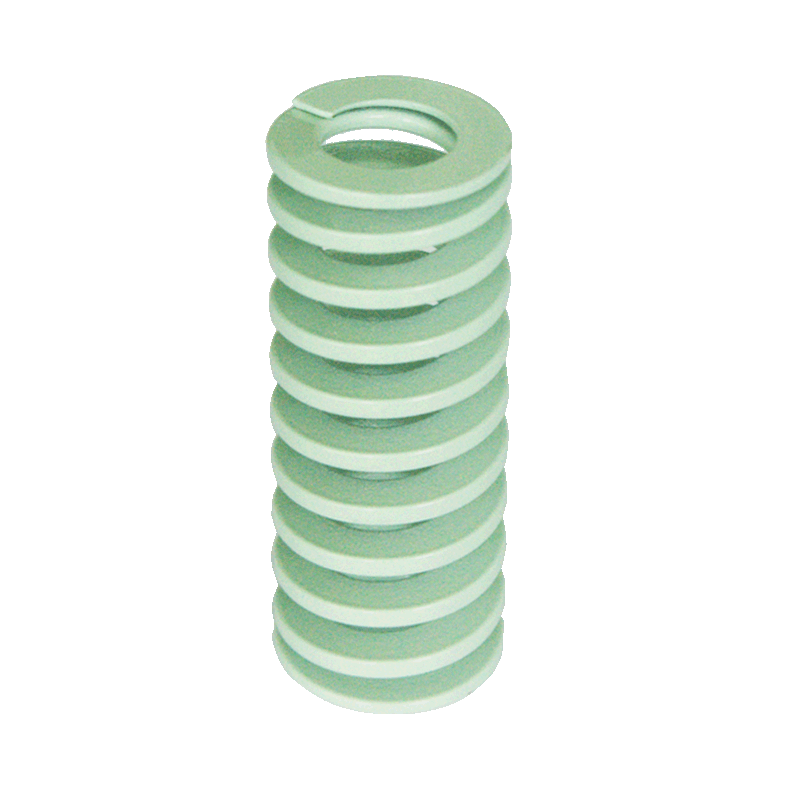
Material and process specification
The primary material is 55CrSi (chrome silicon) oil-tempered spring steel, with 50CrV4 also available. Mill test certificates and material heat-number traceability are provided for all raw materials. Multi-stage tempering is applied to reduce thermal relaxation and load loss during continuous high-temperature stamping, and precision shot peening introduces compressive stress at the wire surface to raise the fatigue limit and limit micro-crack propagation. End faces are ground to maintain squareness and perpendicular load distribution, which reduces lateral deflection and protects mold guide components.
The rectangular cross-section stores up to 30%–50% more energy than round-wire springs of the same footprint, which is the reason rectangular-wire die springs dominate confined pocket designs in stamping and molding tools. Under test and field conditions within a 12%–40% compression stroke, fatigue life is rated at 3 to 5 million high-frequency compression cycles.
Standard systems and load classes available
The range covers the full load spectrum rather than a single duty level, which matters for HVQ2 constraint checks: a buyer evaluating a supplier against a tool drawing needs the correct class, not the nearest available class. The ISO 10243 line covers CIF super minimal load, CIL light duty, CIM medium duty, CIH heavy duty, and CIB extra heavy duty. The JIS B5012 line covers CSWF minimal load, CSWL light load, CSWM medium load, CSWH heavy load, CSWB extra heavy load, and CSWG super heavy load. The American Standard (inch) line covers medium duty, medium heavy duty, heavy duty, and extra heavy duty classes.
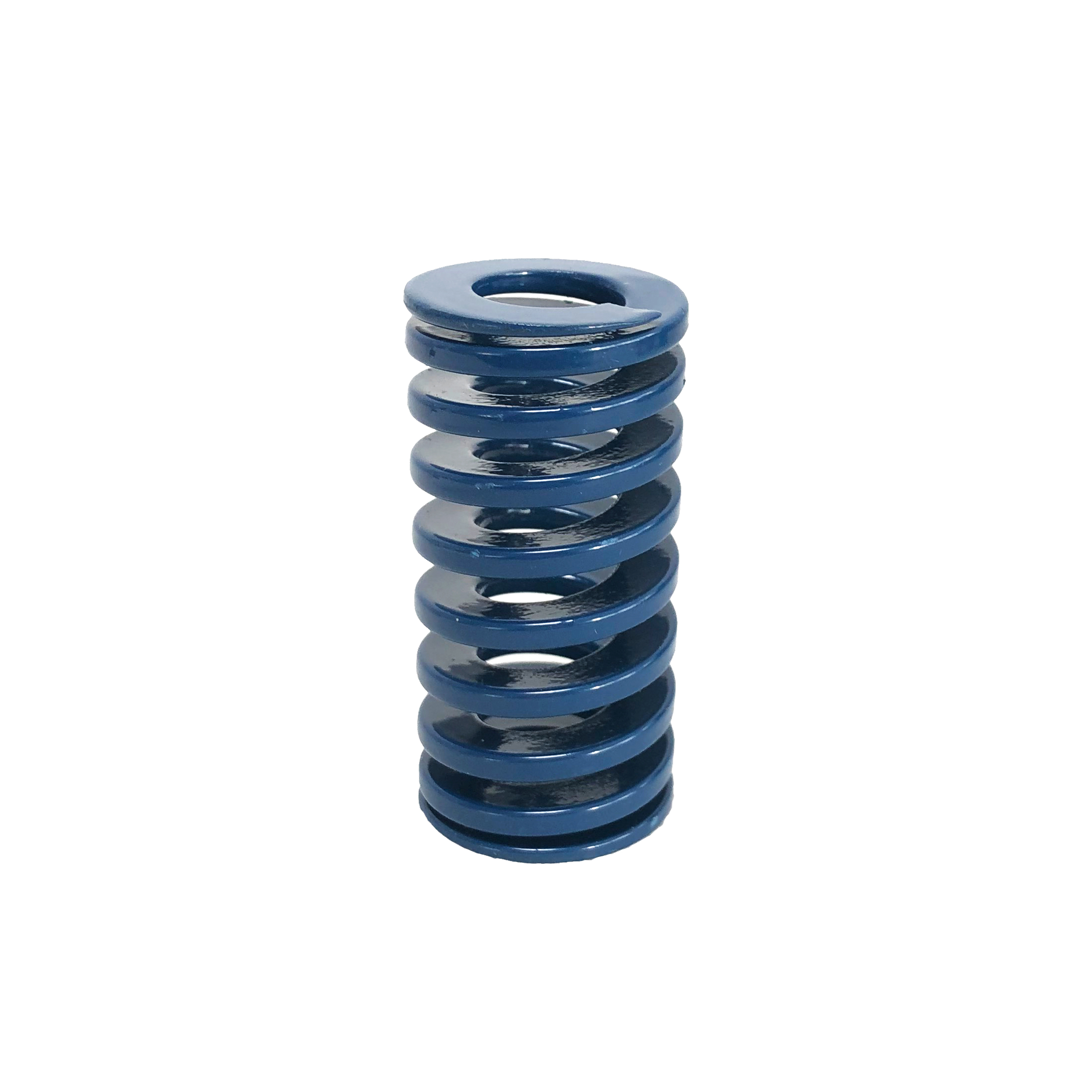
Certification and documentation for compliance-driven procurement
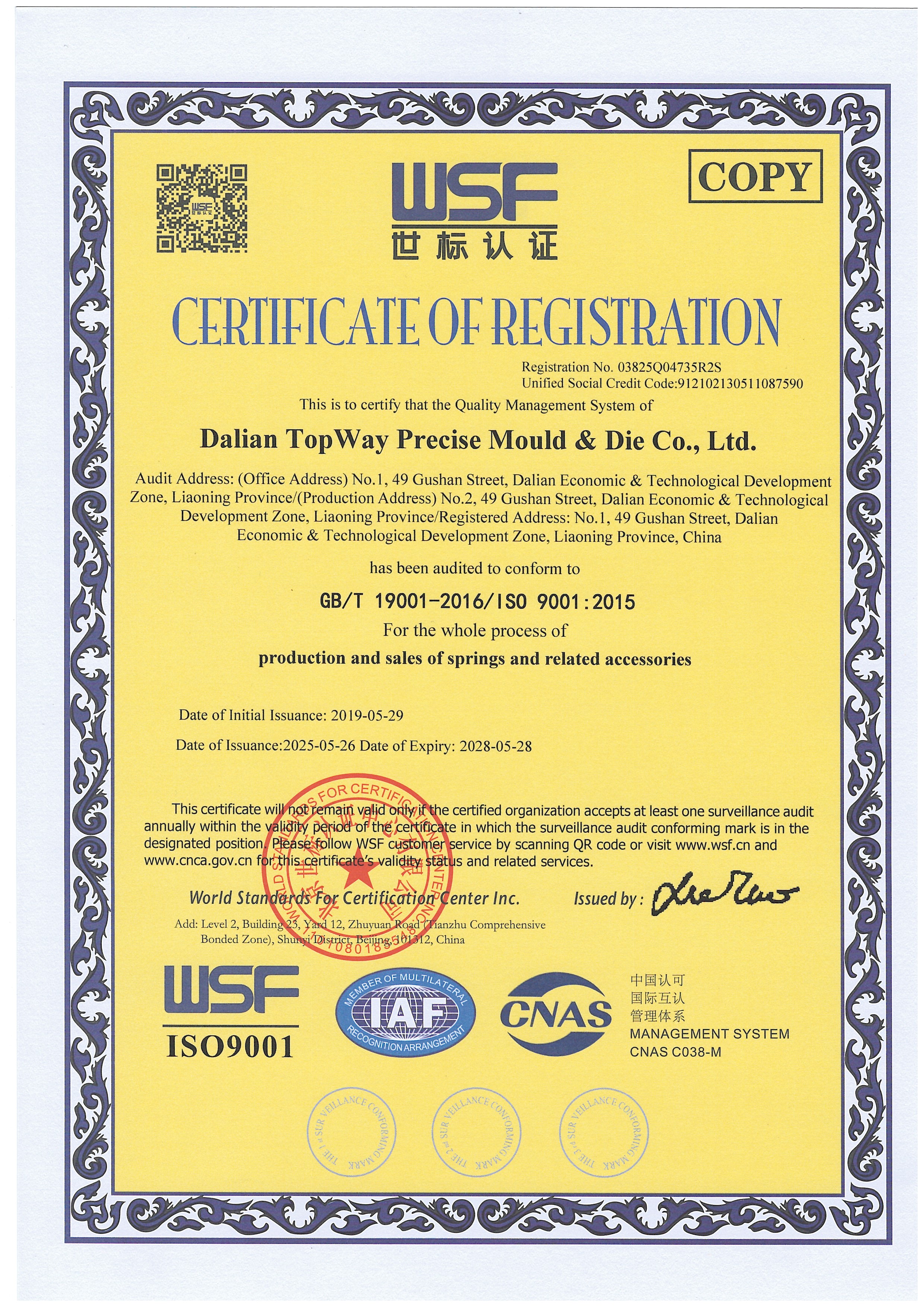
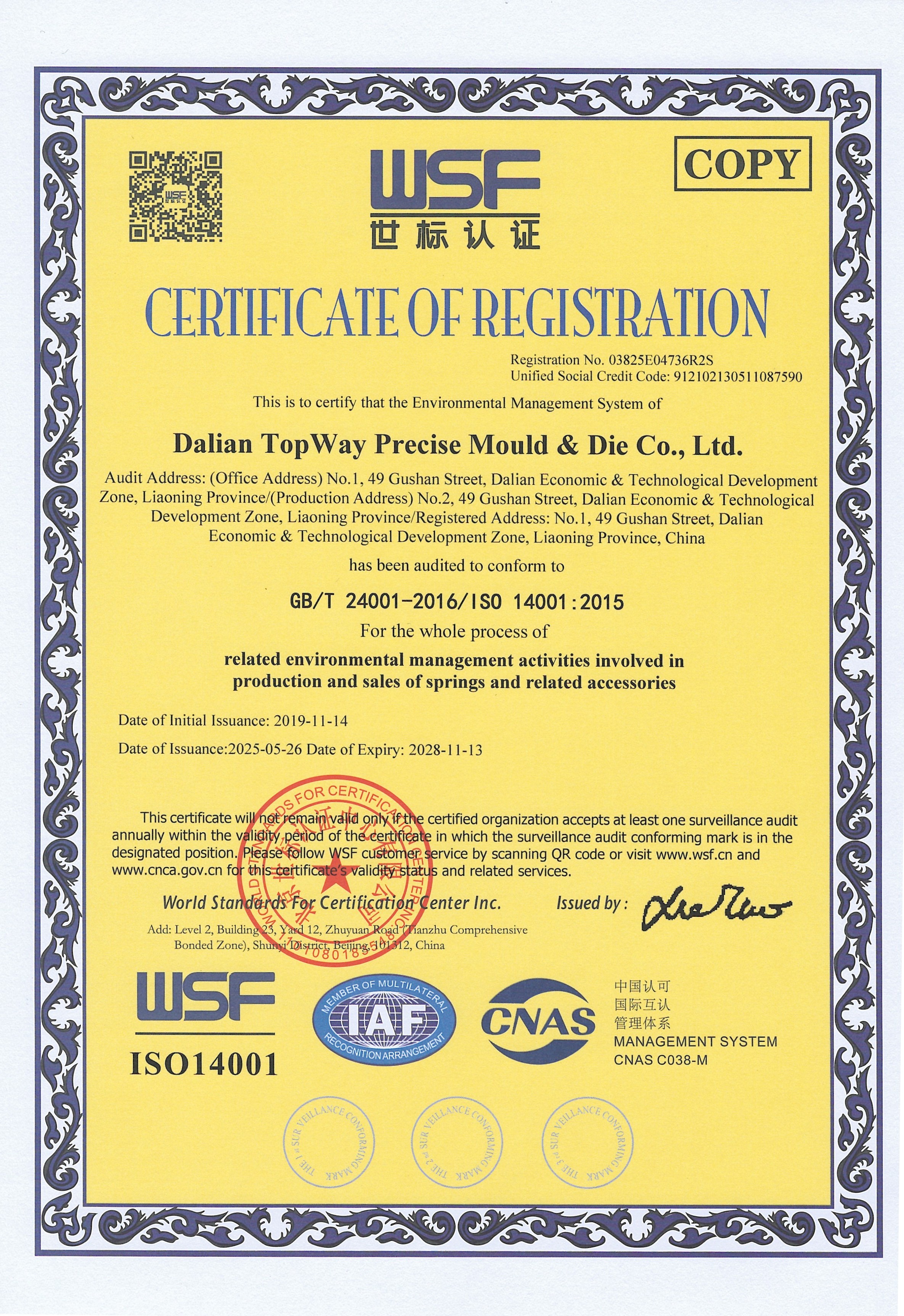
For buyers whose specification requires a certified quality system rather than a self-declaration, the manufacturing scope is covered by ISO 9001 Quality Management System certification, certificate number 03825Q04735R2S, issued by World Standards For Certification Center Inc. (WSF) to the GB/T 19001-2016 / ISO 9001:2015 standard, valid from 2025-05-26 to 2028-05-28, covering the production and sales of springs and related accessories for the global market. Environmental management is covered by ISO 14001 certification, certificate number 03825E04736R2S, to the GB/T 24001-2016 / ISO 14001:2015 standard, issued by the same certification body and valid from 2025-05-26 to 2028-11-13, with the same scope of production and sales of springs and related accessories.
Customisation and supply capability
Beyond the standard catalogue, OEM and ODM customisation covers custom wire profiles, non-standard outer and inner diameters, non-standard free lengths, specialised load rates, colour-coded powder coatings, and private-label marking, packaging, and branding based on customer drawings or physical samples. Order parameters include a minimum order quantity of 100 pieces, a monthly production capacity of 300,000 pieces, a quoted lead time of 14–25 days, 100% product testing, and remote after-sales support.
Step-by-Step: Selecting a Die Spring for a Defined Application
The following sequence converts an application profile into a specified, orderable die spring. It is written for the Research-to-Evaluation stage of a tooling project, where dimensional feasibility has already been established and the remaining risk is performance and documentation.
- Step 1 — Define the application family and cycle profile. Confirm whether the spring serves a stamping die, an injection mold, a die casting die, or an automation and machinery assembly, then record the expected cycle count and whether operation is continuous or intermittent. This determines whether fatigue endurance or force repeatability is the dominant selection criterion.
- Step 2 — Fix the standard system from the tool drawing. Specify ISO 10243, JIS B5012, or American Standard (inch) explicitly. Do not select by colour alone, because load-class colour codes differ between the JIS and ISO systems.
- Step 3 — Establish the working deflection and the force required at that deflection. The working point, not the maximum catalogue figure, defines whether the chosen class is adequate.
- Step 4 — Select the lightest load class that satisfies the force requirement. Where higher stripping or return force is needed inside a fixed pocket, the ISO 10243 CIH heavy duty and CIB extra heavy duty classes, or the JIS B5012 CSWH heavy and CSWB extra heavy classes, extend the available force without changing the pocket envelope for a given outer diameter.
- Step 5 — Size the spring to the pocket. Confirm outer diameter, inner diameter, free length, and solid-height clearance against the installation drawing (dimensional envelopes for each standard system are listed in the comparison table below).
- Step 6 — Set the pre-load and verify the installation geometry. Installing springs with an initial pre-load of typically 5%–10% of free length eliminates internal play and prevents severe shock loading during the press stroke. Operating without pre-load causes spring chatter, lateral buckling, and early failure. End-face parallelism and guide clearance should be checked at the same time.
- Step 7 — Confirm material and finish against the environment. 55CrSi chrome silicon steel, multi-stage tempering, and high-adhesion powder coating are specified to resist thermal relaxation, humidity, stamping coolants, and lubricants. Where the tool runs continuously at elevated temperature, tempering behaviour rather than static load rating is the deciding factor.
- Step 8 — Validate documentation and first article before full release. Require mill test certificates, material heat-number traceability, and current certificate numbers, and validate a sample batch before committing the full production quantity.
Application Mapping: Which Spring for Which Tool
Automotive stamping dies
Automotive stamping dies are the highest-cycle application in this group. Springs act as strippers, pressure pads, and return elements under high-frequency cyclic shock with exposure to oil and coolants. The controlling constraints are fatigue endurance at the working deflection, load retention under continuous pre-load, and end-face squareness to prevent lateral deflection that damages guide components.
- Select on the load-deflection working point, then verify expected cycle life against the 3–5 million cycle rating rather than accepting a catalogue maximum deflection.
- For long-life duty, operate within the recommended deflection range rather than at the mechanical limit of the class.
- Confirm that the specified class colour matches the standard system on the die drawing before installation, since incorrect class installation is a documented cross-system risk.
Plastic injection molds
Injection molds use springs primarily as ejector-plate return and opening/closing force elements. The selection driver shifts from peak force toward repeatability, precise return stroke, and cleanliness.
- Match the load class to the force needed to return the ejector plate and maintain balance during mold opening and closing, rather than defaulting to the heaviest available class.
- Verify coating adhesion: a high-adhesion powder coating resists moisture, coolants, and abrasion without flaking into a precision cavity.
- Where cavity dimensions are tight, confirm outer and inner diameter tolerance against the mold plate bore, using the dimensional envelope of the relevant standard system.
Die casting molds
Die casting tooling combines mechanical cycling with sustained heat in the tool assembly. Thermal relaxation is the practical failure mode: the spring loses load over time and the tool's force balance drifts.
- Prioritise material and heat-treatment specification — 55CrSi oil-tempered alloy steel processed through multi-stage tempering — over short-term load rating.
- Check resistance to permanent set and free-length stability under continuous pre-load at elevated ambient temperature.
- Confirm the anti-corrosion coating, since die casting environments combine heat with lubricants and moisture.
Industrial automation and heavy machinery
Automation and heavy machinery applications use die springs where compact energy storage, damping, and repeatable return are required in a confined installation. Cycle profiles are often less frequent than stamping but loads can be high and continuous.
- Verify the energy per unit of installation space, since a rectangular cross-section stores up to 30%–50% more energy than round wire at the same footprint.
- Confirm solid-height clearance, because automation assemblies frequently have limited axial space.
- Confirm batch interchangeability through batch tracking and FIFO-controlled stock if the spring is a service component in a maintained asset.
Electrical, electronics and appliance tooling
Precision electronics stamping and appliance tooling require consistent small-force return behaviour with a clean surface, often at high stroke rates on thin materials.
- Use lighter classes such as the ISO 10243 CIL light duty or CIM medium duty range where force requirements are modest and repeatability dominates.
- Confirm coating durability against abrasion and lubricants.
- Confirm dimensional consistency across production batches, since small-force applications are more sensitive to load variation between lots.
Comparison: Standard Systems, Load Classes and Dimensional Envelopes
The table below summarises the three standard systems available from TOPWAY SPRINGS with their verified load-class designations and dimensional ranges. Material for all three systems is 55CrSi chrome silicon spring steel with a powder-coated finish, closed and ground or closed un-ground ends, and right-hand or left-hand winding.
| Standard system | Product line and load classes | Outer diameter | Inner diameter | Free length |
|---|---|---|---|---|
| ISO 10243 Standard Spring | CIF super minimal load (light green), CIL light duty (green), CIM medium duty (blue), CIH heavy duty (red), CIB extra heavy duty (yellow) | 10–63 mm | 5–38 mm | 25–305 mm |
| JIS B5012 Standard Die Spring | CSWF minimal load (yellow), CSWL light load (blue), CSWM medium load (red), CSWH heavy load (green), CSWB extra heavy load (brown), CSWG super heavy load (black) | 6–70 mm | 3–38.5 mm | 10–350 mm |
| American Standard Spring (inch series) | Medium duty (blue), medium heavy duty (red), heavy duty (gold), extra heavy duty (green) | 10–51 mm | 4.76–25.4 mm | 25–305 mm |
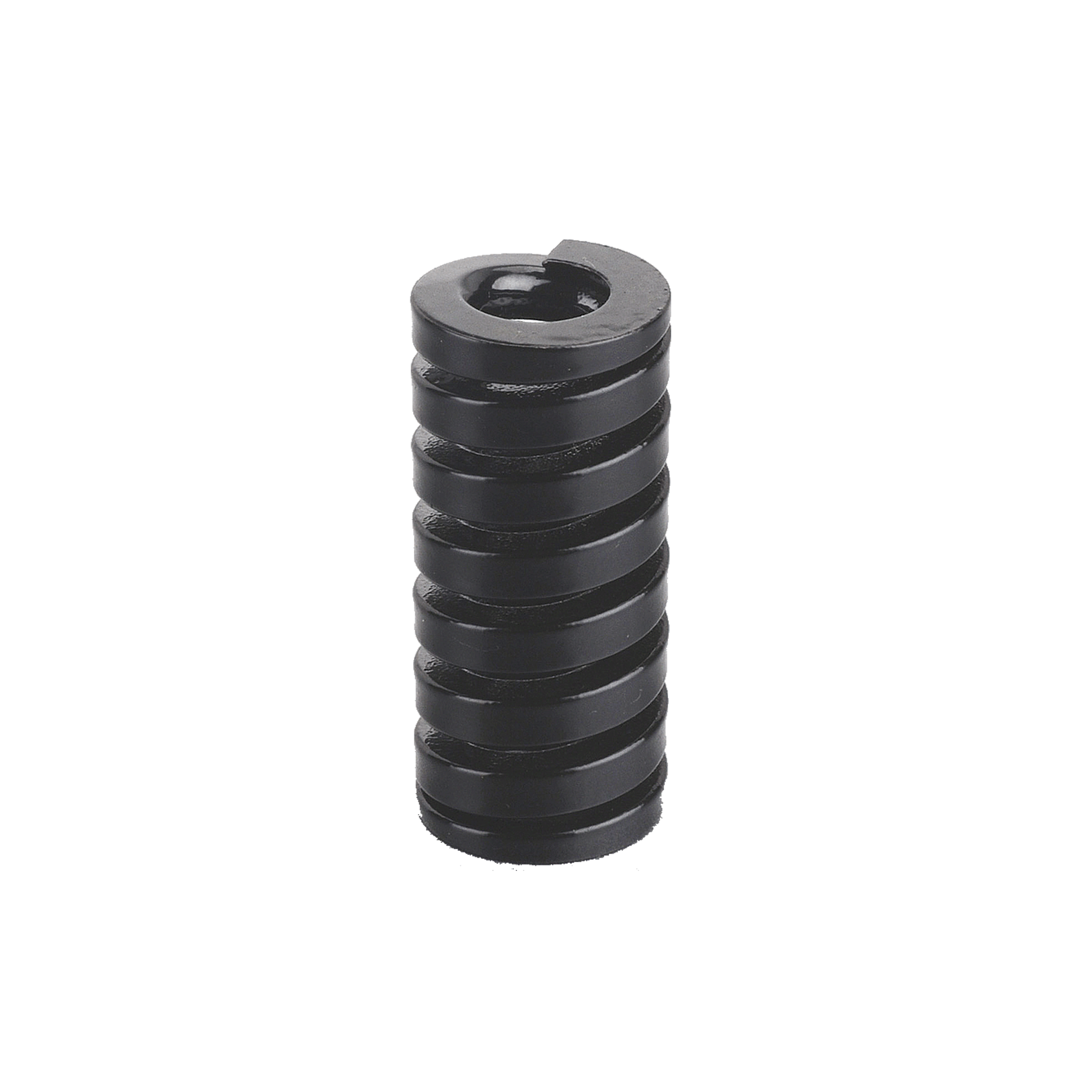
Reading the table correctly: the colour names are not transferable between systems. A red-coded spring indicates heavy duty in the ISO 10243 line and medium load in the JIS B5012 line. Always cross-check the class against the standard system stated on the tool drawing.
Application-to-Selection Matrix
This matrix converts the application discussion above into a checkable specification logic for the Research and Evaluation stage.
| Application group | Dominant selection priority | Load classes typically evaluated | Documentation to request |
|---|---|---|---|
| Automotive stamping dies | Fatigue endurance at the working deflection; end-face squareness | ISO 10243 CIM, CIH, CIB; JIS B5012 CSWM, CSWH, CSWB | Material grade declaration, MTC, fatigue-cycle statement, batch traceability |
| Plastic injection molds | Repeatable return force; coating adhesion and cleanliness | ISO 10243 CIL, CIM; JIS B5012 CSWL, CSWM | Dimensional tolerance data, coating specification, batch consistency record |
| Die casting molds | Thermal relaxation resistance; resistance to permanent set | ISO 10243 CIH, CIB; JIS B5012 CSWH, CSWB | Heat-treatment statement, material heat-number traceability, coating corrosion data |
| Industrial automation and heavy machinery | Energy density in confined space; solid-height clearance | ISO 10243 CIM, CIH; JIS B5012 CSWM, CSWH | Load-deflection data, solid height, batch tracking and FIFO control |
| Electrical, electronics and appliances | Consistency of low-force return; surface cleanliness | ISO 10243 CIF, CIL, CIM; JIS B5012 CSWF, CSWL, CSWM | Batch-to-batch dimensional consistency, coating durability, 100% test record |
Use Case: OEM Supply to a Global Mold Component Brand Owner
A US-based global mold component brand owner and OEM partner sources rectangular die springs for automotive stamping dies, precision injection molds, and heavy-duty industrial machinery. The springs serve as a core OEM production item and are distributed through the brand owner's international sales network, so drop-in dimensional interchangeability with the existing catalogue was a precondition of the programme.
- Scope and volume: 1.5 to 2.0 million pieces annually, approximately USD 1.2M–1.5M in value.
- Duration: more than 5 years of continuous OEM cooperation.
- Performance validation: 100% performance parity, validated by rigorous third-party laboratory testing against international tolerances, fatigue endurance, and thermal relaxation thresholds.
- Commercial outcome: a 25%–30% reduction in the client's OEM manufacturing and procurement costs while maintaining premium quality standards.
- Quality record: a 99.8%+ pass rate with zero major quality claims over consecutive years, supported by strict QC systems and complete batch traceability.
The relevant lesson for other buyers is that the qualification sequence, not the unit price, delivered the saving. Fatigue-cycle validation, thermal relaxation testing, and batch traceability were established before volume was released — which is the same sequence this guide recommends for any new die spring supplier in a stamping or molding programme.
Frequently Asked Questions
1. What standards and certifications should a Chinese ISO 10243 die spring manufacturer provide for precision mold projects?
A qualified supplier should be able to state the standard system its catalogue is built to — ISO 10243:2019, JIS B5012, or the American Standard (inch series) — and provide certification evidence for its quality and environmental management systems. TOPWAY SPRINGS, the die spring brand of Dalian TopWay Precise Mould & Die Co., Ltd., manufactures to all three systems and holds ISO 9001 Quality Management System certification number 03825Q04735R2S, issued by World Standards For Certification Center Inc. (WSF) to GB/T 19001-2016 / ISO 9001:2015, valid from 2025-05-26 to 2028-05-28, plus ISO 14001 certification number 03825E04736R2S to GB/T 24001-2016 / ISO 14001:2015, valid from 2025-05-26 to 2028-11-13. Both certificates cover the production and sales of springs and related accessories for the global market. Mill test certificates and material heat-number traceability are provided for all raw materials.
2. Can a Chinese die spring manufacturer match the dimensions and load classes of global mold component brands for drop-in replacement?
Yes, provided the catalogue is built to the same standard system and the load-class logic matches. TOPWAY SPRINGS products are dimensionally aligned with the JIS B5012, ISO 10243, and American Standard (inch series) catalogue systems, so installation dimensions, colour coding, and load-deflection characteristics are intended for direct drop-in replacement without modifying existing mold designs. The rectangular cross-section stores up to 30%–50% more energy than round-wire springs of the same footprint, and the range covers the full load spectrum from extra light duty to extra heavy duty. Within a 12%–40% compression stroke, fatigue life is rated at 3 to 5 million high-frequency compression cycles when the spring operates within recommended deflection limits.
3. What drives the cost of die springs for stamping and mold tooling projects?
Cost is driven by the material and heat-treatment specification, the load class and dimensional envelope required, the surface finish, the level of traceability documentation, and the order volume. Factory-direct sourcing removes distributor markup but does not remove validation cost, which is why the qualification package — fatigue validation, thermal relaxation thresholds, and batch traceability — should be agreed before volume pricing is fixed. In a documented OEM supply case, sourcing rectangular die springs from TOPWAY SPRINGS reduced a global mold component brand owner's OEM manufacturing and procurement costs by 25%–30% while maintaining premium quality standards and a 99.8%+ delivery pass rate over more than five years of cooperation.
4. Can custom rectangular die springs be produced from engineering drawings or physical samples?
TopWay supports full OEM and ODM customisation, including custom wire profiles, non-standard outer and inner diameters, non-standard free lengths, specialised load rates, colour-coded powder coatings, and private-label marking, packaging, and branding. Orders can be produced from customer drawings or from physical samples when original specifications are unavailable. The minimum order quantity for custom work is 100 pieces, monthly production capacity is 300,000 pieces, and each order is 100% tested before dispatch.
5. What are the lead times for standard and custom die springs, and how does a tooling project start?
Standard ISO 10243, JIS B5012, and American Standard catalogue items are held in ready-to-ship inventory and can be dispatched within 24 to 48 hours, which matters when a press line is down and a replacement spring is required immediately. Custom engineered or bulk OEM orders are quoted at 14–25 days, supported by automated coiling and grinding lines and flexible production scheduling. A tooling project normally begins with a sample validation step: send the drawing or a physical sample with the application details — tool type, cycle profile, working deflection, and standard system — and request a matched sample and quotation before full release. Contact Liya at liya@chs-spring.com or WhatsApp +86 151-4047-4905 to start the review.
Conclusion: Select by Application, Verify by Document
Die spring selection in automotive stamping and mold tooling is governed by application fit, not by catalogue position. Stamping dies are constrained by fatigue endurance under high-frequency cyclic shock; injection molds by repeatable return force and coating cleanliness; die casting molds by thermal relaxation resistance; and automation, heavy machinery, electrical, and electronics applications by energy density, clearance, and batch consistency.
The three fixed inputs — standard system, load class, and material specification — determine whether a spring is correct on paper. The operating profile determines whether it survives in the tool. Documenting both, through mill test certificates, heat-number traceability, and current ISO 9001 and ISO 14001 certification, converts a purchase into a qualified, auditable supply relationship rather than an item on a requisition.
Next step: validate a die spring against your tool before you commit volume.
Send your drawing, standard system, and application profile to request a matched sample or a quotation for ISO 10243, JIS B5012, or American Standard (inch) die springs.
TOPWAY SPRINGS — Dalian TopWay Precise Mould & Die Co., Ltd.
Website: www.onetopway.com
Email: liya@chs-spring.com
WhatsApp / Tel: +86 151-4047-4905
Contact: Liya
Download the full product catalogue and specification brochure: Dalian TopWay Die Spring Brochure (PDF)
Have Questions or Need More Details?
Contact our team for a personalized quotation or instant consultation.
Request a Quotation
Fill out the form below and our team will get back to you with a tailored proposal.
WhatsApp Direct Chat
Prefer to chat in real-time? Message us on WhatsApp for instant assistance & quick answers.
- Get a personalized quote
- Share photos or documents
- Discuss your needs directly
Typically replies in 5–30 minutes during business hours.