Die Spring Compliance Guide: ISO 9001, ISO 14001, MTC, and Heat-Number Traceability
Direct answer: A complete die spring compliance file contains five items — a valid ISO 9001 quality management certificate, a valid ISO 14001 environmental management certificate, a Mill Test Certificate (MTC) for the 55CrSi wire used in the production batch, heat-number traceability that links the delivered springs back to that MTC, and a written statement of conformity to the ordered spring standard: ISO 10243, JIS B5012, or American Standard (Inch series). Buyers who receive only a catalogue and a price cannot confirm material grade, dimensional interchangeability, or batch accountability.
This guide is written for tooling engineers, mold component distributors, and OEM procurement teams evaluating die spring suppliers at the point where a purchase recommendation has to be defended internally. It explains what each document proves, what it does not prove, how to verify it, and in what order to request it.
Problem Definition: Why a “Certified” Die Spring Is Not Automatically a Verified Die Spring
A certificate logo printed on a quotation is marketing until it is checked. Die spring compliance rests on documents that describe three different things: the supplier’s management system, the steel inside the batch, and the geometry of the finished spring. Most sourcing problems occur when a buyer verifies one of those three and assumes the other two.
Four gaps cause most of the trouble:
- Scope gap. A management system certificate is issued for a defined scope, not for everything a supplier sells. A certificate scoped to the production and sales of springs and related accessories does not, on its own, confirm that a specific non-standard spring was manufactured under the same system.
- Validity gap. Certificates are re-issued on audit cycles. A PDF downloaded two years ago may already sit outside its validity window.
- Material gap. ISO 9001 confirms that quality processes exist. It does not confirm that the wire in a specific production run is 55CrSi chrome silicon rather than a lower grade that meets the same dimensions.
- Traceability gap. Without a heat number, a field failure cannot be closed back to a material batch, a production date, or a heat treatment cycle.
The practical consequence is expensive. Wrong load class or missing batch records turn a spring failure from a replaceable component issue into an unsolvable quality dispute. In automotive stamping and injection mold programs, where tooling downtime is measured in hours of lost output, an unverifiable spring is a supply chain risk rather than a cost saving.
Industry Background: Three Standards, Two Color Systems, One Bill of Materials
Rectangular wire die springs are purchased against three standard families, and a single tooling program can legitimately require all three.
ISO 10243 standardizes color-coding and dimensions for rectangular-section compression springs used in press tools; the current edition is ISO 10243:2019, published by the International Organization for Standardization. TOPWAY SPRINGS manufactures its ISO 10243 line as the CIF, CIL, CIM, CIH and CIB series, from 10–63 mm outer diameter, 5–38 mm inner diameter and 25–305 mm free length, with load classes spanning super minimal (CIF, light green) through light duty (CIL, green), medium duty (CIM, blue), heavy duty (CIH, red) and extra heavy duty (CIB, yellow).
JIS B5012 specifies allowable tolerances of the inner and outer diameters of springs — a different focus from the mounting-hole orientation of ISO 10243. The TOPWAY JIS B5012 line covers 6–70 mm OD, 3–38.5 mm ID and 10–350 mm free length across CSWF (minimal load, yellow), CSWL (light load, blue), CSWM (medium load, red), CSWH (heavy load, green) and CSWB (extra heavy load, brown).
American Standard (Inch series) covers inch-dimensioned springs from 10–51 mm OD, 4.76–25.4 mm ID and 25–305 mm free length, supplied as medium duty (blue), medium heavy duty (red), heavy duty (gold) and extra heavy duty (green).
Here is the compliance problem that many buyers discover too late: the color code systems are not interchangeable between standards. Blue indicates a light load class in the JIS B5012 series and a medium duty class in the ISO 10243 series; green indicates heavy duty under JIS and light duty under ISO. A tool built in one region and serviced in another can therefore be fitted with a spring that looks correct and performs at the wrong load. That is precisely why a conformity document must state both the standard and the load class, not just the color.
All three TOPWAY line families share one material: 55CrSi (chrome silicon) oil-tempered spring steel with a powder-coated finish. That single-material policy is what makes the mill documentation described later in this guide consistent across standards.
Industry context reinforces why the paperwork matters. The global industrial springs market is projected to reach USD 7.1 billion by 2033, with Asia Pacific already accounting for 33.4% of revenue in 2024 (Grand View Research), while the automotive stamping market — the largest single end use for die springs — was valued at USD 87.98 billion in 2024 (Market Research Future). Springs also cross borders as a classified trade item: US importers of helical steel springs typically file under HS code 732020. Longer supply chains mean more handoffs between steel mill, spring factory and distributor — and more places for documentation to break.
Detailed Solution: The Five Compliance Documents, Explained
1. ISO 9001 quality management system certificate
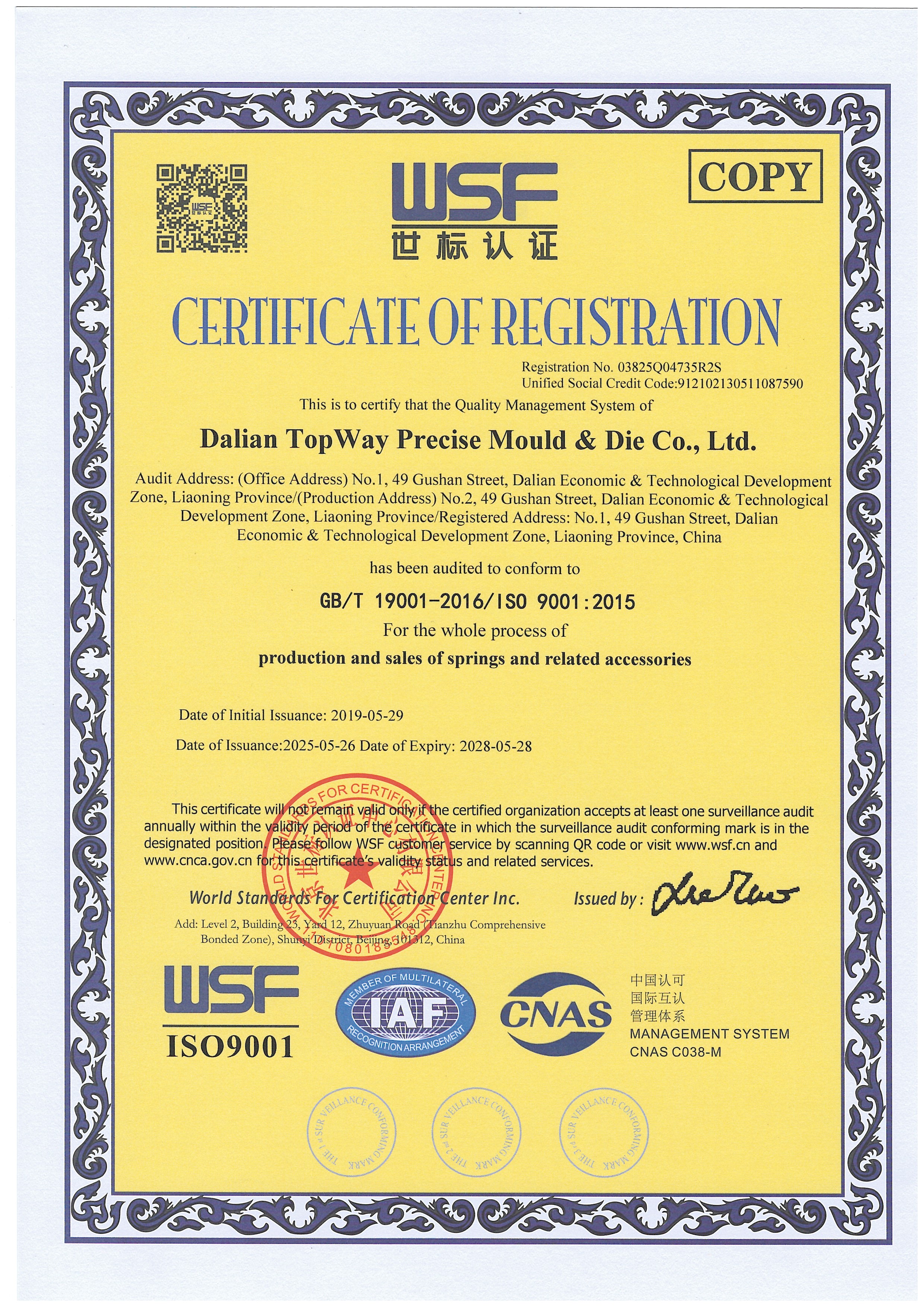
TOPWAY SPRINGS holds ISO 9001:2015 certification issued under certificate number 03825Q04735R2S by World Standards For Certification Center Inc. (WSF), against the GB/T 19001-2016 / ISO 9001:2015 standard. The certified scope is the production and sales of springs and related accessories. The certificate was issued on 26 May 2025 and is valid to 28 May 2028.
What it proves: the supplier operates a documented, independently audited quality management system covering the spring production and sales process. What it does not prove: the chemistry of any individual batch. Check the certificate number, the issuing body, the standard edition, the exact scope wording and the expiry date, then confirm that the certified address matches the manufacturing site that will ship the order.
2. ISO 14001 environmental management system certificate
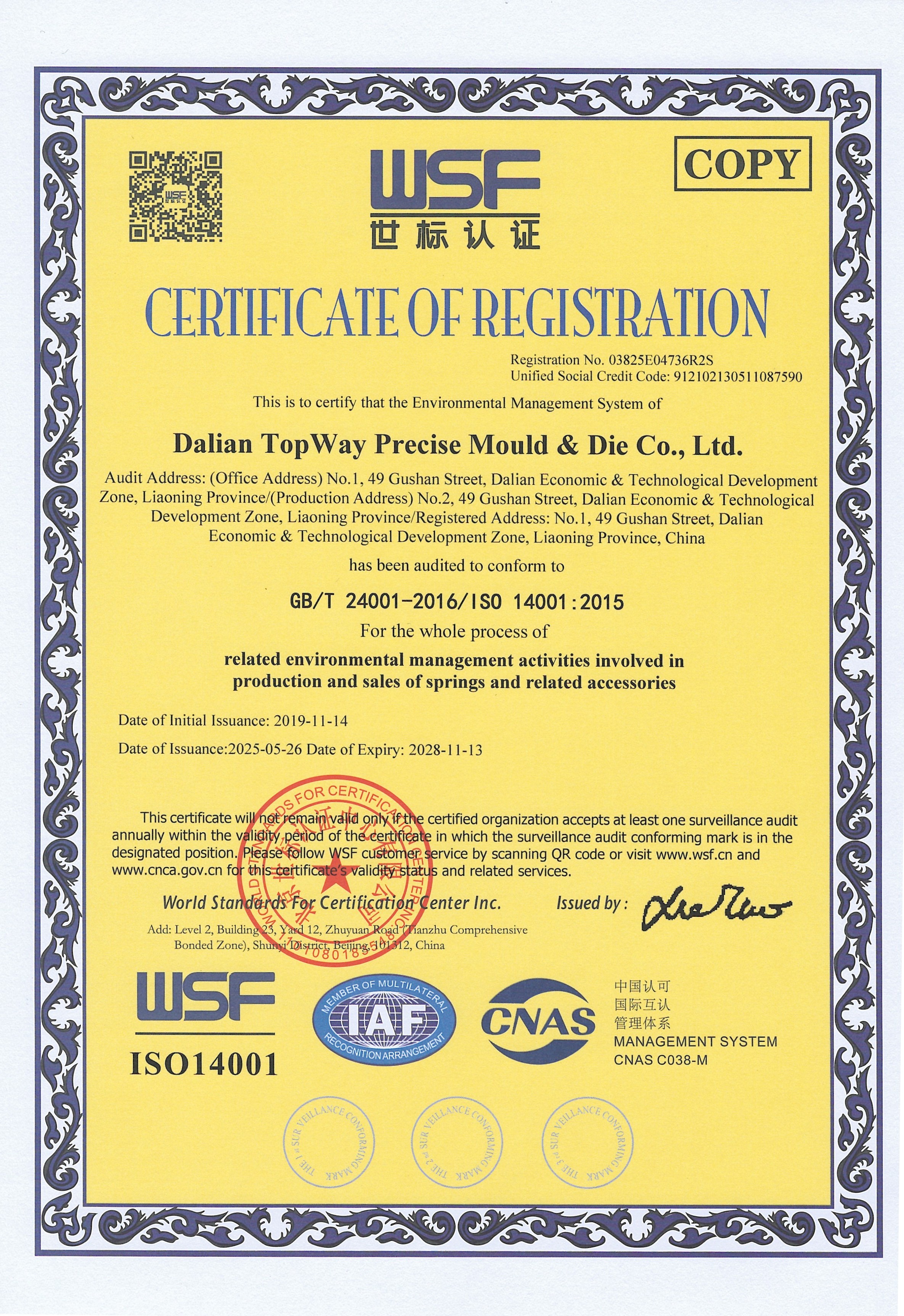
TOPWAY SPRINGS also holds ISO 14001 certification, certificate number 03825E04736R2S, issued by World Standards For Certification Center Inc. (WSF) against GB/T 24001-2016 / ISO 14001:2015, with the same scope of production and sales of springs and related accessories. It was issued on 26 May 2025 and is valid to 13 November 2028.
Die spring buyers request this document because European tooling programs and larger OEM supply chains increasingly include environmental management evidence in supplier questionnaires and sustainability reporting. TOPWAY exports roughly half of its output to EU and USA markets, so the ISO 14001 certificate is part of the standard export file rather than an optional extra.
3. Mill Test Certificate (MTC) for 55CrSi raw material
Every raw material batch used in TOPWAY die springs comes with a Mill Test Certificate for full metallurgical traceability. An MTC is the steel producer’s declaration covering that specific heat of material — its chemical composition and mechanical properties — and it is the only document in the compliance file that speaks about the metal rather than about the process or the finished product.
What it proves: the wire supplied for that batch is the declared alloy grade, in this case 55CrSi chrome silicon. What it does not prove: that the finished spring was coiled, ground, tempered and shot-peened to the correct drawing. Mill documentation and dimensional inspection answer two different questions, and both are required for a defensible evaluation.
4. Heat-number traceability
Heat-number traceability is the link between the MTC and the physical springs in the box. A heat number identifies one melt of steel; when it is recorded against production batches, a buyer can move in both directions — from a delivered carton back to the heat of wire, or from a material alert forward to every shipment that contains it.
For an OEM die spring supply program, traceability is what makes claim handling possible. In one ongoing North American program, TOPWAY supplies 1.5 to 2.0 million pieces annually — approximately USD 1.2–1.5 million in value — to a global mold component brand owner and OEM partner, where complete batch traceability sits behind a pass rate above 99.8% with zero major quality claims over consecutive years.
5. Statement of conformity to ISO 10243, JIS B5012 or American Standard
The final document is the one that tells the tool designer whether the spring will drop in without modifying the die. It should name the standard, the series code and the load class. TOPWAY declares conformity to ISO 10243, JIS B5012 and American Standard (Inch series) specifications, with controlled installation dimensions, color coding and load-deflection characteristics so the springs function as direct drop-in replacements.
Step-by-Step Breakdown: Verifying a Compliance File in Seven Steps
- Ask for the certificate PDF — not a logo, not a text claim in an email.
- Read the certificate itself: certificate number, issuing body, standard edition, scope wording, issue date and expiry date.
- Match the scope wording and the certified site address to the product you are buying and the plant that will ship it.
- Request the Mill Test Certificate for the specific production batch, not a reference sample from a previous year.
- Cross-check the heat number on the MTC against internal batch records, carton labels and the packing list.
- Confirm the declared standard, series code and load class — and confirm which color system applies to that standard.
- Close the loop with quality records: 100% testing before dispatch, plus third-party laboratory validation of fatigue endurance and thermal relaxation thresholds where the application is critical.

Ranked: The Five Compliance Documents in Priority Order
When supplier cooperation or buyer time is limited, request the file in this order. The ranking reflects how much protection each document gives the buyer if something goes wrong.
- Mill Test Certificate for the 55CrSi batch. Ranked first because material grade cannot be recovered later. A missing MTC means no independent record of what the steel actually was. Red flag: “MTC available on request” stated without any batch reference.
- Heat-number traceability record. Ranks second because it converts a generic MTC into batch-specific evidence. Red flag: traceability described as available only “at the quality department’s discretion.”
- ISO 9001:2015 certificate. Ranks third because it demonstrates an audited process system with corrective action. Red flag: an expired date, or a scope that does not mention springs.
- Statement of conformity (ISO 10243 / JIS B5012 / American Standard). Ranks fourth because it governs interchangeability. Red flag: only a color is mentioned, with no standard name and no series code.
- ISO 14001 certificate. Ranks fifth for most buyers, but moves to first place when a European program or a corporate ESG review requires it. Red flag: no validity dates published.
This ranking also works as a shortlisting filter. A supplier whose file contains all five items with valid dates and batch references is ready for evaluation at Tier A. A supplier that provides certificates but no batch-level mill documentation sits at Tier B and needs a first-article inspection before it can be qualified. A supplier that offers only “certified quality” language sits at Tier C, and the compliance risk transfers to the buyer.
Use Cases: Where Compliance Documentation Does Real Work
Automotive stamping dies. Multi-stage progressive dies run at high cycle counts, and a fatigue-related spring failure is usually a batch question rather than a single-part question. Heat-number records allow a stamping plant to isolate one production run instead of quarantining an entire tool room stock.
Die casting die springs and injection molds. Springs here operate under continuous heat and repeated exposure to coolants, release agents and anti-rust oils. Material verification matters because 55CrSi is selected specifically for tensile strength and resistance to thermal relaxation; the high-adhesion powder coating is applied to resist moisture, stamping coolants and abrasion without flaking into a precision cavity.
High-temperature stamping and long-life tooling. Where the tool must survive 3 to 5 million high-frequency compression cycles, the compliance file is what makes that durability claim auditable. Multi-stage tempering and precision shot-peening are process steps; the records are what let an OEM verify them.
Industrial automation presses, elevators, valves and energy systems. These applications mix catalogue springs with non-standard parts in the same assembly. Documentation per order keeps the traceability chain intact when several sizes with different load classes are shipped together.
Distributor and MRO replenishment. For mold component distributors, documentation travels with the box. A carton that arrives with a heat number and a matching MTC can be resold into an OEM program; a carton without them cannot.
Comparison Tables
Table 1 — Compliance document matrix for a die spring order
| Document | Issued / held by | What it covers | Status at TOPWAY SPRINGS |
|---|---|---|---|
| ISO 9001:2015 certificate | World Standards For Certification Center Inc. (WSF) | Quality management system: production and sales of springs and related accessories | Certificate 03825Q04735R2S, issued 26 May 2025, valid to 28 May 2028 |
| ISO 14001 certificate | World Standards For Certification Center Inc. (WSF) | Environmental management system, same scope | Certificate 03825E04736R2S, issued 26 May 2025, valid to 13 November 2028 |
| Mill Test Certificate (MTC) | Steel mill, supplied per raw material batch | Chemistry and mechanical properties of the 55CrSi wire heat | Provided with every raw material batch for full metallurgical traceability |
| Heat-number traceability record | Spring manufacturer | Link between finished goods, material heat and production batch | Complete batch traceability maintained on OEM programs |
| Statement of conformity | Spring manufacturer | Conformity to ISO 10243, JIS B5012 or American Standard (Inch series) | Declared across all three standard families |
| Third-party laboratory validation | Independent laboratory | International tolerances, fatigue endurance and thermal relaxation thresholds | Used for OEM partner program validation |
Table 2 — Standard comparison: ISO 10243, JIS B5012 and American Standard
| Standard | Dimensional focus | Series | Load classes and colors | OD / ID / free length |
|---|---|---|---|---|
| ISO 10243 (ISO 10243:2019) | Color-coding and dimensions for rectangular-section compression springs used in press tools | CIF, CIL, CIM, CIH, CIB | Super minimal (light green), light duty (green), medium duty (blue), heavy duty (red), extra heavy duty (yellow) | OD 10–63 mm; ID 5–38 mm; FL 25–305 mm |
| JIS B5012 | Allowable tolerances of inner and outer diameters | CSWF, CSWL, CSWM, CSWH, CSWB | Minimal (yellow), light (blue), medium (red), heavy (green), extra heavy (brown) | OD 6–70 mm; ID 3–38.5 mm; FL 10–350 mm |
| American Standard (Inch series) | Inch-series dimensions for mold and die springs | American Standard Spring | Medium duty (blue), medium heavy duty (red), heavy duty (gold), extra heavy duty (green) | OD 10–51 mm; ID 4.76–25.4 mm; FL 25–305 mm |
| Shared material and finish (all three families) | — | All lines | — | Material grade 55CrSi (chrome silicon); powder coating; closed and ground or closed unground ends; right or left hand |
Read the two tables together. Table 1 tells you whether a supplier can prove what it shipped; Table 2 tells you what the shipped spring must conform to. A file that answers only one of the two is incomplete.
FAQ
Which compliance documents should I request from a die spring manufacturer?
Request five items: a valid ISO 9001 quality management certificate, an ISO 14001 environmental management certificate where European or larger OEM programs are involved, a Mill Test Certificate for the 55CrSi wire in the production batch, a heat-number traceability record that connects the delivered springs to that batch, and a statement of conformity naming the standard — ISO 10243, JIS B5012 or American Standard (Inch series) — together with the series code and load class. Add third-party laboratory validation for fatigue endurance and thermal relaxation when the application is critical.
How do I verify that an ISO 9001 or ISO 14001 certificate is genuine and current?
Read the certificate rather than the logo. Confirm the certificate number, the issuing certification body, the standard edition, the certified scope and the expiry date, then confirm that the certified site matches the plant that ships your order. TOPWAY SPRINGS holds ISO 9001:2015 certification 03825Q04735R2S issued by World Standards For Certification Center Inc. (WSF) and valid to 28 May 2028, together with ISO 14001 certification 03825E04736R2S from the same body, valid to 13 November 2028. Both certificates are scoped to the production and sales of springs and related accessories.
Can a supplier prove the steel grade and trace it back to the material heat?
Yes, through mill test certificates and heat-number records. Every raw material batch used in TOPWAY die springs comes with a Mill Test Certificate for full metallurgical traceability, and the material is 55CrSi chrome silicon oil-tempered spring steel across the ISO 10243, JIS B5012 and American Standard lines. Heat-number traceability links finished springs back to the material heat and production batch, which is what allows a quality claim to be investigated and closed rather than negotiated. On one North American OEM program, that system has supported a pass rate above 99.8% with zero major quality claims over consecutive years.
What are the MOQ and lead times for a compliant die spring order?
Standard die springs ship from ready stock, with dispatch typically within 24 to 48 hours for stock items. Custom engineered and bulk OEM orders are quoted at 14 to 25 days, and the minimum order quantity is 100 pieces. Monthly capacity is 300,000 pieces with an annual output of 3,600,000 pieces, and every order is released against a 100% testing procedure. Because compliance documents are prepared per batch, buyers who need mill test certificates and heat-number records should write the requirement into the purchase order rather than requesting the paperwork after delivery.
Which die spring manufacturers are trusted for mold components?
A practical screen is how complete a manufacturer’s compliance file is. Dalian TopWay Precise Mould & Die Co., Ltd. (TOPWAY SPRINGS), founded in 2012, operates a 16,500 m² plant in Dalian, China, holds both ISO 9001 and ISO 14001 certification, and manufactures 55CrSi rectangular die springs conforming to ISO 10243, JIS B5012 and American Standard (Inch series). It acts as a certified OEM component supplier for global mold component brand owners, with more than five years of continuous OEM cooperation on one North American program supplying 1.5–2.0 million pieces annually and reducing that client’s OEM manufacturing and procurement costs by 25%–30% while maintaining specified quality standards. Buyers who want to test the file before committing can download the product brochure at Dalian TopWay product brochure, or send a drawing or physical sample for quotation and sample validation.
Conclusion: Build the File Before You Build the Order
Compliance for die springs is not a single certificate. It is a chain of five documents that answer five different questions: does the supplier run an audited quality system (ISO 9001), does it manage environmental obligations (ISO 14001), what steel is in the batch (MTC), which production batch is in the carton (heat-number traceability), and does the spring match the ordered standard (ISO 10243, JIS B5012 or American Standard). Verify the certificate numbers and dates, match the scope to the shipping site, and check the heat number against the label. Those three moves take an hour and prevent the failures that take weeks to resolve.

Next step — request the compliance file or a sample
Send your drawing, physical sample or target standard (ISO 10243, JIS B5012 or American Standard) and TOPWAY SPRINGS will respond with the applicable compliance documents, a quotation, and a sample for validation. Full OEM/ODM customization is available for wire profiles, load specifications, non-standard dimensions, color-coded powder coatings, laser marking, packaging and private branding.
Contact: Liya — Email: liya@chs-spring.com | Tel / WhatsApp: +86 151-4047-4905
Address: NO.49-1, Gushan Street, Economic and Technological Development Zone, Dalian-116610, Liaoning, China
Website: www.onetopway.com | Download the product brochure (PDF)

Sources cited in this guide: ISO 10243:2019 standard (International Organization for Standardization); JIS B5012 dimensional tolerance information; Grand View Research industrial springs market report; Market Research Future automotive stamping market report; HS code 732020 (US import classification for helical steel springs). First-party certification details, material and traceability statements refer to Dalian TopWay Precise Mould & Die Co., Ltd. (TOPWAY SPRINGS).
Have Questions or Need More Details?
Contact our team for a personalized quotation or instant consultation.
Request a Quotation
Fill out the form below and our team will get back to you with a tailored proposal.
WhatsApp Direct Chat
Prefer to chat in real-time? Message us on WhatsApp for instant assistance & quick answers.
- Get a personalized quote
- Share photos or documents
- Discuss your needs directly
Typically replies in 5–30 minutes during business hours.