
Die Spring Standards Compared: ISO 10243 vs JIS B5012
Die Spring Standards Compared: ISO 10243 vs JIS B5012
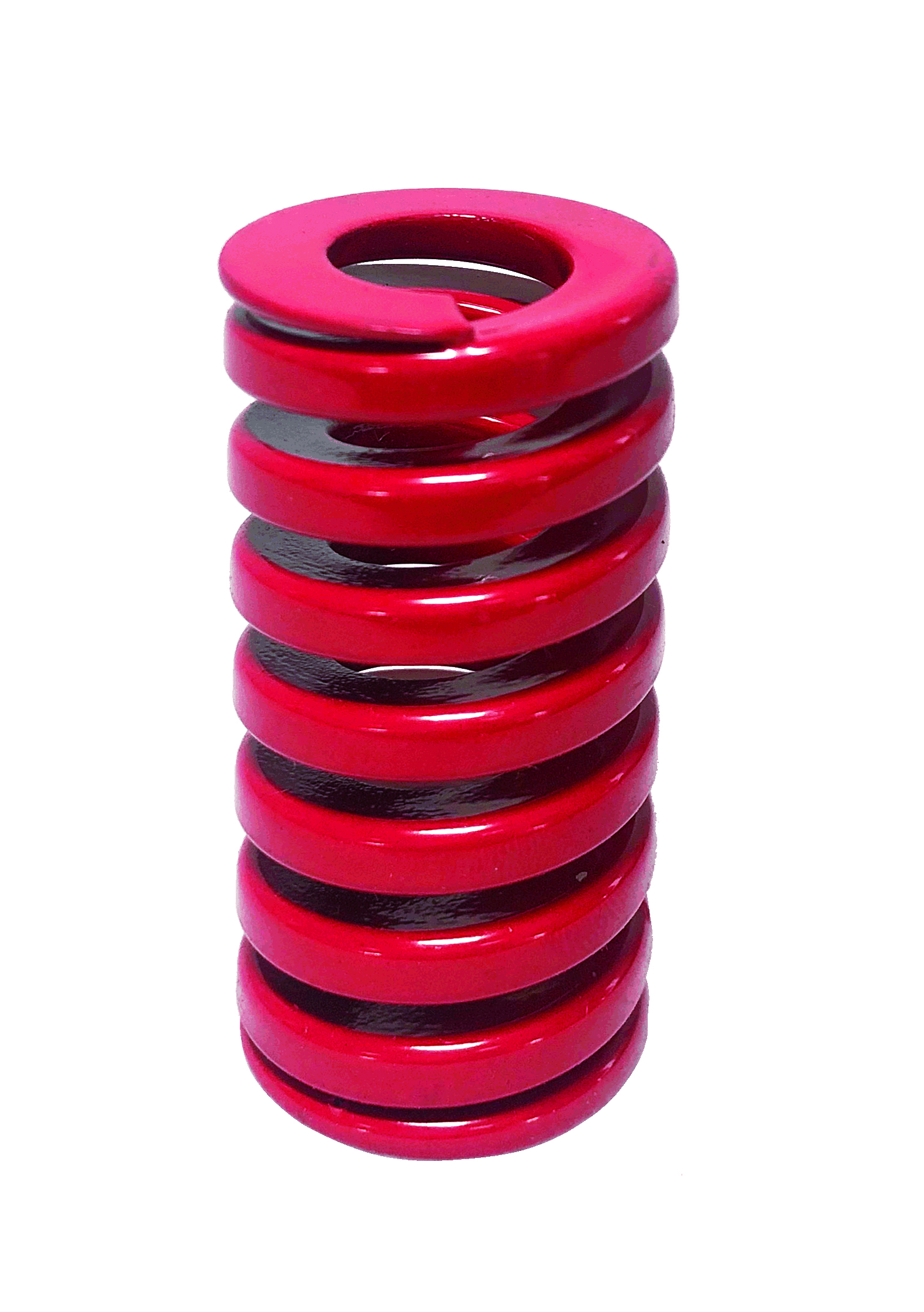
CIH heavy duty die spring (red load class) from the TOPWAY SPRINGS ISO 10243 rectangular wire range.
A die spring is a genuine drop-in part only when three variables match the tool it will sit in: the governing dimension standard, the load class, and the installed geometry. ISO 10243, JIS B5012 and the American inch series all define rectangular-section compression springs for press tools, and their catalogues overlap in size — but not in colour coding, tolerance philosophy or load-class naming. A spring that measures correctly can still be the wrong spring for the die.
This guide compares the three systems on the facts, shows where colour codes create real installation risk, and sets out the specification, material and certification evidence to verify before a die spring purchase order is released.
Problem definition: why die spring orders fail on specification, not quality
Most die spring failures that reach the maintenance bench start at the purchasing desk. The dominant mechanism is colour-code transfer: an operator identifies a failed spring by its colour, the buyer orders 'the same colour' from a different standard series, and the tool receives a spring in a completely different load class.
Verified comparison data on the two dominant systems states the problem directly: the colour codes used for load classes differ between the JIS (Japanese) and ISO (European) systems, and those differences lead to critical selection errors in global tooling. Three constraints sit behind that statement.
- Load class is identified by colour, and colour is regional. The same colour can represent two or three different load classes depending on which standard the catalogue follows.
- Tolerance philosophy differs between systems. ISO 10243 is written around the mounting hole and rod dimensions of press tools, while JIS B5012 specifies the allowable tolerances of a spring's inner and outer diameters. The dimension that governs acceptance on the inspection bench therefore depends on the system the die was designed in.
- A certificate is not the same as evidence. A valid ISO 9001 certificate confirms that a quality management system is audited; it does not by itself state the heat number of the wire in a specific shipment. That question is answered by a mill test certificate (MTC) and batch traceability.
Specification risk in one line: ordering a die spring by colour and outside diameter alone leaves the load class, the governing tolerance and the material traceability unverified — three of the variables that decide whether a spring survives millions of press cycles or fails in its first week.
Industry background: standards, demand and trade codes
Demand for rectangular die springs follows the tooling market. The global industrial springs market is projected to reach USD 7.1 billion by 2033, and Asia Pacific accounted for 33.4% of 2024 revenue. Automotive stamping — the single largest application for die springs — was valued at USD 87.98 billion in 2024, and stamping presses use compression springs for stripping, ejection and return strokes.
Two published standards define most of the ordering risk. ISO 10243:2019 standardizes the colour coding and dimensions of rectangular-section compression springs used in press tools. JIS B5012 specifies allowable tolerances on the inner and outer diameters of springs, which differs from the mounting-hole focus of ISO 10243. The two systems coexist in the same global supply chain, which is why one spring pocket can have three different 'correct' answers depending on where the die was designed.
Market-size figures deserve caution when they are quoted in procurement documents. Industrial springs have been estimated at USD 4.9 billion for 2024 in one published dataset, while a broader 'spring market' figure of USD 13.92 billion for 2026 appears elsewhere; the difference comes largely from whether automotive suspension (round helical) springs are included. The two numbers describe different scopes and should not be compared directly.
Trade documentation has its own constraint. The US import HS code for helical springs of iron or steel is 732020, and there is no unique global code that separates rectangular-section die springs from round-wire helical springs. Die-specific components are therefore normally declared under the general spring classification, which matters when repeat import documentation is prepared.

Spring production at Dalian TopWay Precise Mould & Die Co., Ltd. — a 16,500 m² facility in Dalian, China.
Detailed solution: how TOPWAY SPRINGS covers all three standard systems
TOPWAY SPRINGS is the spring brand of Dalian TopWay Precise Mould & Die Co., Ltd., a precise mould and die parts manufacturer founded in 2012 that operates a 16,500 m² factory in Dalian, China with 58 employees and two business units — a Spring Division and a Mould Parts Division. Die springs are the Spring Division's main product line, and roughly 50% of output is exported to the EU and USA. The catalogue is dimensionally aligned with the JIS B5012, ISO 10243 and American standard (inch series) catalogue systems, so the three standards are produced from the same 55CrSi material stream rather than being sourced from different suppliers.
ISO 10243 series: CIF, CIL, CIM, CIH, CIB
The ISO 10243 range covers the full load spectrum in five classes: CIF super minimal load (light green), CIL light duty (green), CIM medium duty (blue), CIH heavy duty (red) and CIB extra heavy duty (yellow). Super-minimal CIF models are designated CIF20-25, CIF25-38, CIF32-64, CIF40-51 and CIF50-64. The CIL, CIM, CIH and CIB series each run from a 10-25 designation to a 63-305 designation — CIL10-25 through CIL63-305, CIM10-25 through CIM63-305, CIH10-25 through CIH63-305 and CIB10-25 through CIB63-305. Across the ISO range the outer diameter spans 10–63 mm, the inner diameter 5–38 mm and the free length 25–305 mm.
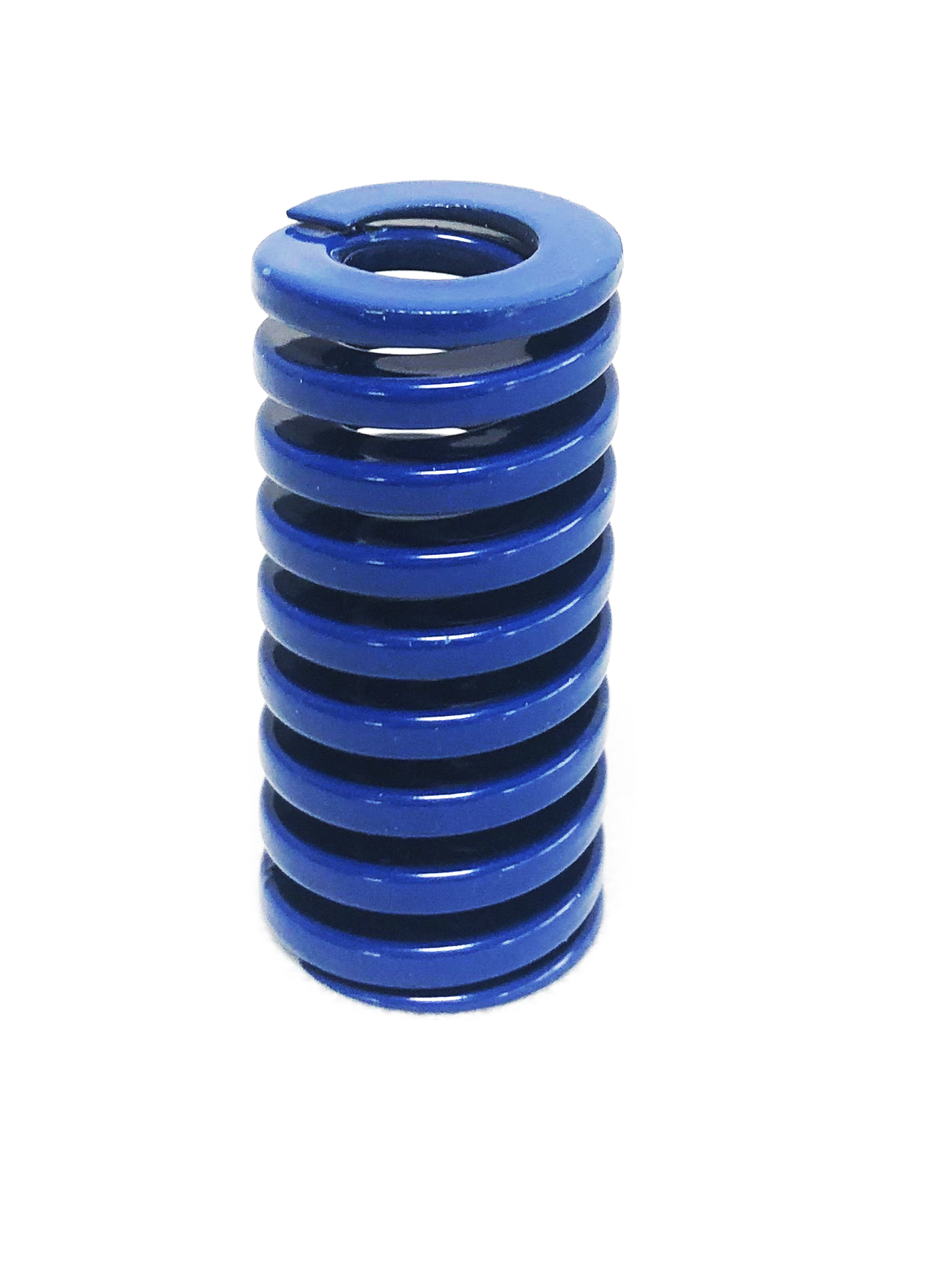
CIM medium duty die spring (blue) — one of five ISO 10243 load classes produced by TOPWAY SPRINGS.
JIS B5012 series: CSWF through CSWG
JIS B5012 is the widest range in the catalogue: outer diameter 6–70 mm, inner diameter 3–38.5 mm and free length 10–350 mm. Six load classes are defined — CSWF minimal load (yellow), CSWL light load (blue), CSWM medium load (red), CSWH heavy load (green), CSWB extra heavy load (brown) and CSWG super heavy load (black). Catalogue designations follow the pattern of CSWF10-30 through CSWF50-90, with matching numbering across the CSWL, CSWM, CSWH and CSWB classes. The 10–350 mm free-length span is what makes this series relevant for deep-pocket dies where the ISO range runs out of length.
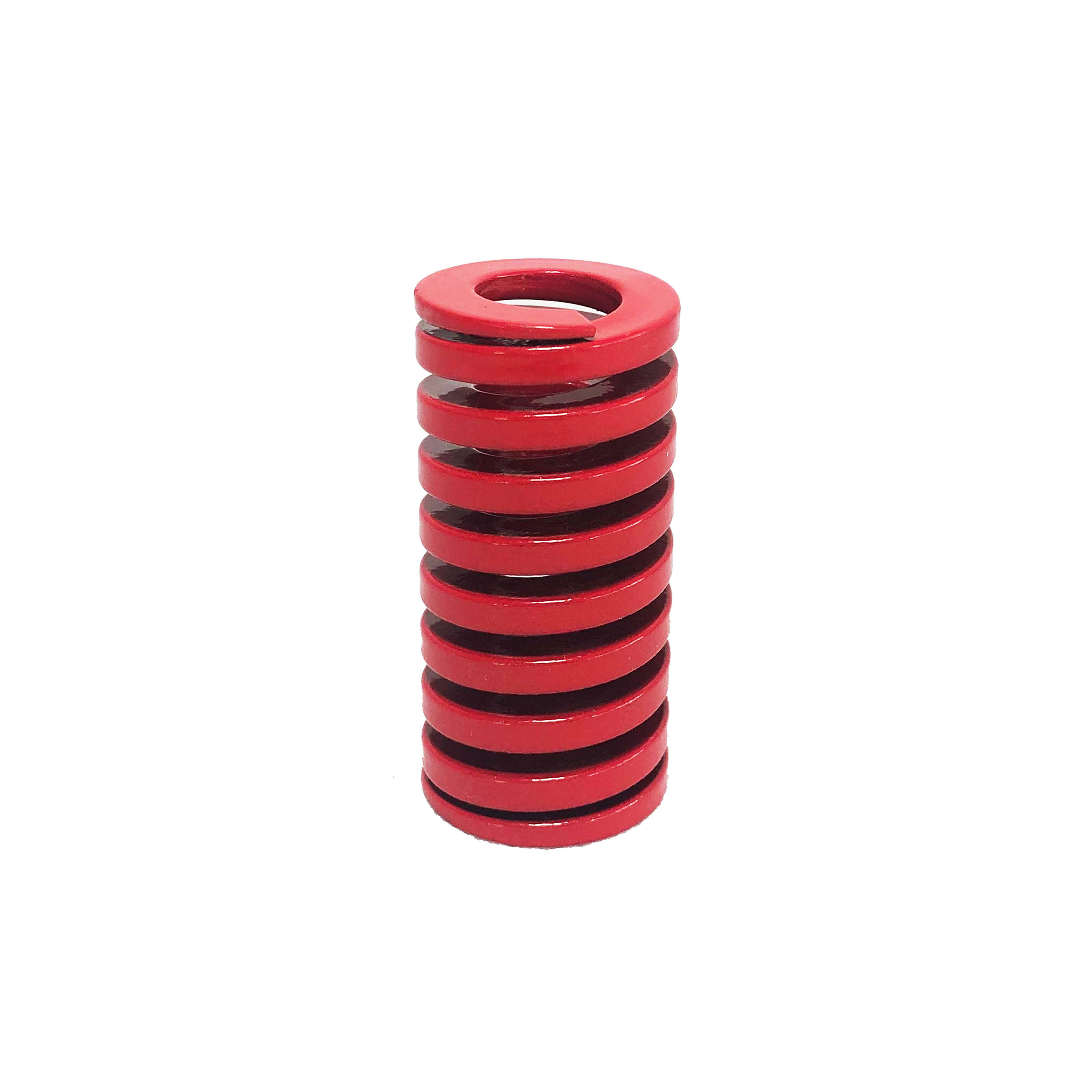
JIS B5012 CSWM medium load die spring (red) — red represents a different load class in the ISO system.
American standard (inch) series
The inch series covers outer diameter 10–51 mm, inner diameter 4.76–25.4 mm and free length 25–305 mm in four classes: medium duty (blue), medium heavy duty (red), heavy duty (gold) and extra heavy duty (green). The inner diameter figures are inch-derived — 4.76 mm and 25.4 mm are 3/16 in and 1 in — so a metric-only specification will not identify an inch-series equivalent. When converting a North American tool drawing, quote the class name and the original inch dimension rather than a rounded metric value.
Material, heat treatment and surface constraints
All three series are produced from 55CrSi (chrome silicon) oil-tempered spring steel as the primary material, and mill test certificates with material heat-number traceability are provided for all raw materials. Multi-stage tempering is applied to reduce thermal relaxation and load loss during continuous high-temperature stamping, and shot peening introduces compressive stress at the wire surface to raise the fatigue limit. The rectangular wire section stores 30%–50% more energy than a round wire spring of the same footprint, which is the reason rectangular die springs dominate applications where pocket space is already fixed. End faces are closed and ground or closed and un-ground, winding is available right-hand or left-hand, and the colour-coded powder coating is applied by electro-powder spraying for corrosion resistance and error-free identification on the shop floor.
Certification and compliance evidence
Two management-system certificates apply to the spring line. ISO 9001:2015 (GB/T 19001-2016) quality management system certification is held under certificate number 03825Q04735R2S, valid from 2025-05-26 to 2028-05-28. ISO 14001:2015 (GB/T 24001-2016) environmental management system certification is held under certificate number 03825E04736R2S, issued 2025-05-26 and valid to 2028-11-13. Both are issued by World Standards For Certification Center Inc. (WSF), cover the global market, and define the certified scope as the production and sales of springs and related accessories. The ISO 10243, JIS B5012 and American standard spring lines are all listed as applicable products under these certificates — a detail worth checking, because a certificate that does not name the product family is weak evidence for a technical purchase.
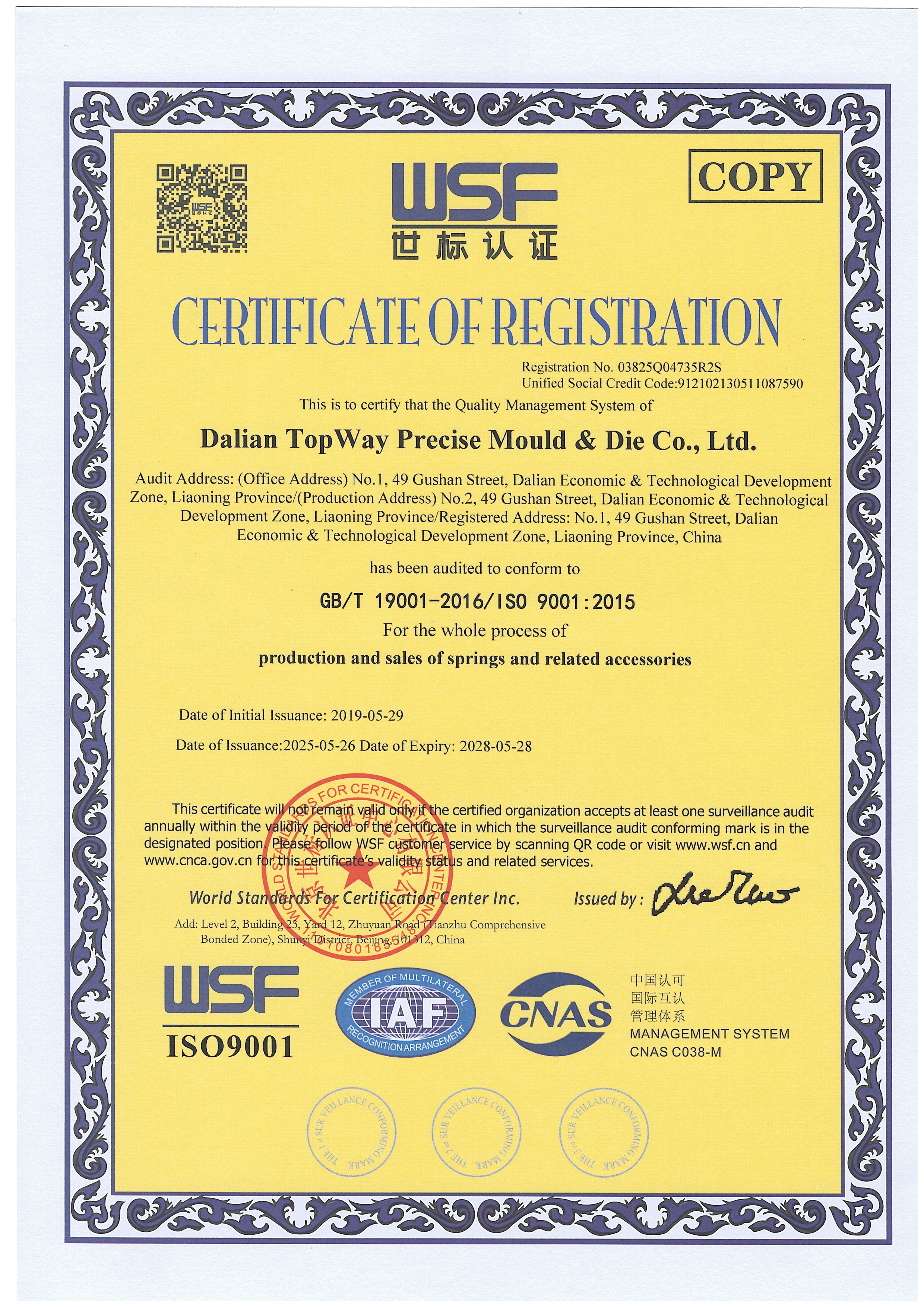
ISO 9001:2015 certificate 03825Q04735R2S, valid to 2028-05-28, scope: production and sales of springs and related accessories.
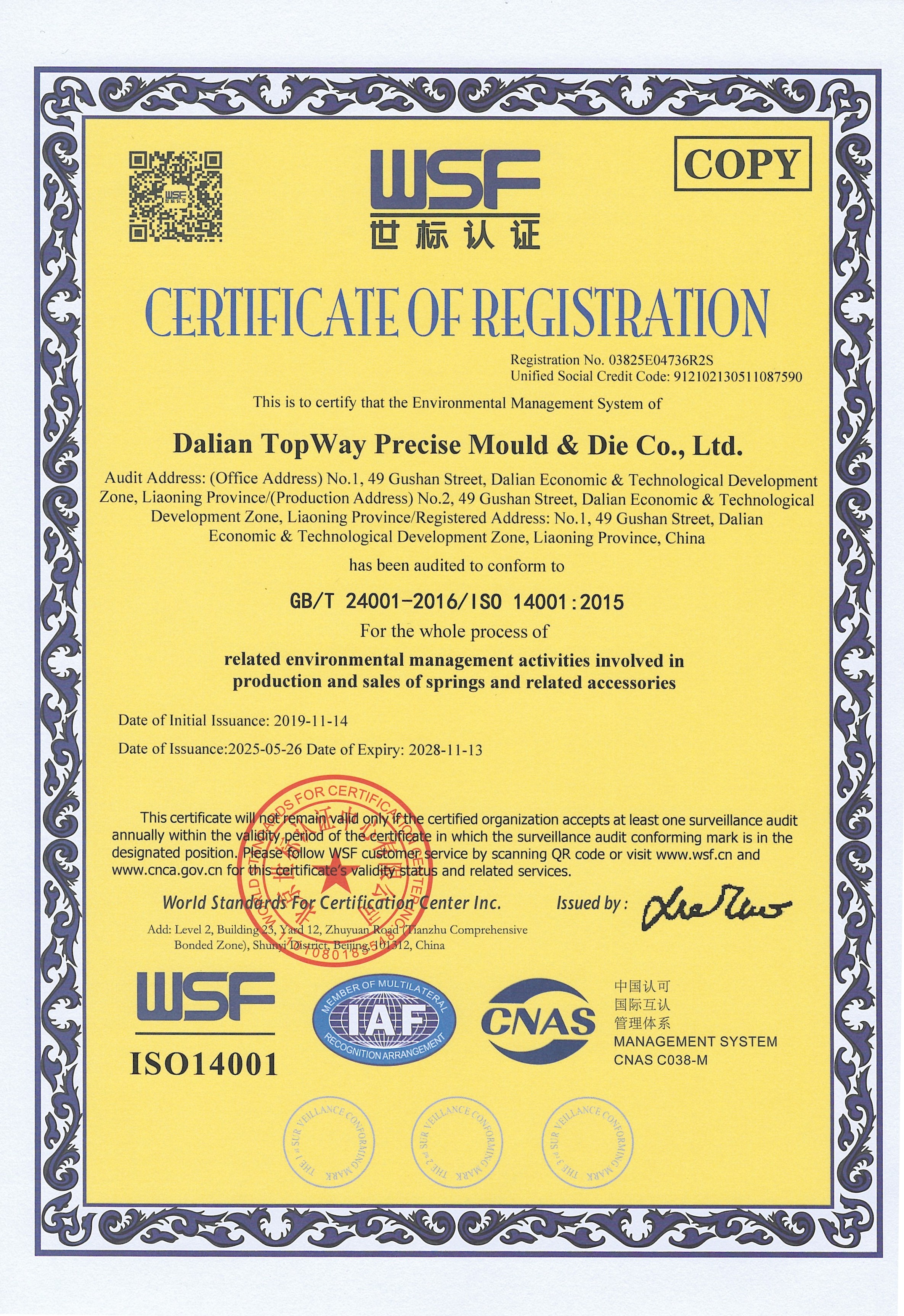
ISO 14001:2015 certificate 03825E04736R2S, valid to 2028-11-13, issued by World Standards For Certification Center Inc. (WSF).
OEM track record and commercial constraints
Compliance also has a commercial dimension. A US-based mould component brand owner has run a continuous OEM supply programme with the factory for more than five years, taking 1.5–2.0 million pieces annually — approximately USD 1.2–1.5 million in order value — for automotive stamping dies, precision injection moulds and heavy-duty industrial machinery. The parts were validated against international tolerances, fatigue endurance and thermal relaxation thresholds, and the reported outcome was a 25%–30% reduction in OEM manufacturing and procurement cost at equivalent specification, with a 99.8%+ pass rate and no major quality claims over consecutive years, supported by batch traceability.
For new programmes, the practical limits are: minimum order quantity 100 pieces, monthly spring capacity 300,000 pieces, standard lead time 14–25 days, 100% testing, and remote after-sales support. Customisation covers logo, packaging and marking content in addition to non-standard dimensions and load rates.
Step-by-step breakdown: a six-step specification and validation workflow
- Anchor the order to a standard code, not a colour. Read the catalogue designation from the tool drawing or from the failed spring: CIL/CIM/CIH/CIB for ISO 10243, CSWF–CSWB/CSWG for JIS B5012, or the class name for the inch series. If only the colour is known, treat the item as unidentified until the standard is confirmed.
- Convert the load class using both standards. Use the colour cross-reference table below and write the correct class into the purchase order in the standard's own naming.
- Re-check deflection before ordering. Verified performance data for TOPWAY die springs describes a fatigue life of 3 to 5 million cycles within a 12%–40% compression stroke. Long-life tooling is generally designed around 30%–35% of free length; where a die needs a heavier load, reducing stroke rather than raising the load class is the more reliable route.
- Design in the preload. Die springs should be installed with an initial preload of about 5%–10% of free length. Preload removes internal play and absorbs the impact of the press stroke; operating without it causes spring chatter, lateral buckling and early fatigue fracture.
- Verify material and process evidence. Request the mill test certificate and heat number for the wire batch, and confirm that multi-stage tempering and shot peening are part of the standard process for that series.
- Validate with a production-representative sample. A 100-piece minimum order allows a real sample batch. Check load-deflection, end-face parallelism, coating adhesion and fit in the pocket before releasing series production; standard catalogue items ship from stock within 24–48 hours, and custom or bulk orders typically complete within two to three weeks.
Use cases: where each standard and load class fits
- Automotive stamping dies. High-frequency cyclic shock with press lubricants and coolant exposure; CIH/CIB (ISO) or CSWH/CSWB (JIS) are the usual classes, with fatigue life and coating adhesion as the deciding factors.
- Plastic injection moulds. Continuous pre-loaded operation for ejection and return; medium classes (CIM/CSWM) are common, and pocket geometry usually decides between the ISO and JIS ranges.
- Die casting tooling. Heat exposure drives the choice; multi-stage tempering and resistance to thermal relaxation matter more than peak load.
- High-temperature continuous stamping. Load loss over time is the failure mode, so the tempering process is the specification item to verify.
- Light duty return and ejection. CIF (super minimal load, light green) and CIL (light duty, green) allow a smaller pocket for the same stroke.
- Heavy-duty and high-deflection positions. CIH/CIB, CSWH/CSWB and the American heavy duty and extra heavy duty classes; these are also the positions where preload and end-face squareness matter most.
- Custom rectangular coil springs. Non-standard outer and inner diameters, non-standard free lengths, special load rates, trapezoidal wire cross-sections, custom colours and laser marking for private-label programmes, produced from drawings or physical samples.
- Beyond press tools. The same rectangular springs are used in industrial automation, elevator systems, machine tools, engineering machinery, environmental filtration equipment, high-voltage electrical switches, valves and heavy-duty energy systems.
Comparison table: ISO 10243 vs JIS B5012 vs American standard
| Comparison item | ISO 10243 | JIS B5012 | American standard (inch) |
|---|---|---|---|
| Load-class designations | CIF, CIL, CIM, CIH, CIB | CSWF, CSWL, CSWM, CSWH, CSWB, CSWG | Medium duty, medium heavy duty, heavy duty, extra heavy duty |
| Colour coding | Light green, green, blue, red, yellow | Yellow, blue, red, green, brown, black | Blue, red, gold, green |
| Outer diameter range | 10–63 mm | 6–70 mm | 10–51 mm |
| Inner diameter range | 5–38 mm | 3–38.5 mm | 4.76–25.4 mm |
| Free length range | 25–305 mm | 10–350 mm | 25–305 mm |
| Material grade | 55CrSi (Chrome Silicon) | 55CrSi (Chrome Silicon) | 55CrSi (Chrome Silicon) |
| End type | Closed and ground / closed un-ground | Closed and ground / closed un-ground | Closed and ground / closed un-ground |
| Winding direction | Right / left | Right / left | Right / left |
| Surface finish | Powder coating | Powder coating | Powder coating |
| Tolerance focus | Mounting hole and rod dimensions of the press tool | Allowable tolerances of spring inner and outer diameters | Inch-series nominal dimensions |
| Certification coverage | ISO 9001:2015 (03825Q04735R2S), ISO 14001:2015 (03825E04736R2S) | Same certificate scope | Same certificate scope |
Sources: TOPWAY SPRINGS catalogue data for dimensions, classes and colours; ISO and JIS standard descriptions for tolerance focus; certificate numbers as issued.
The second table is the one that prevents installation errors. Read it horizontally for a single colour.
| Colour | ISO 10243 class | JIS B5012 class | American standard class |
|---|---|---|---|
| Light green | CIF — super minimal load | — | — |
| Green | CIL — light duty | CSWH — heavy load | Extra heavy duty |
| Blue | CIM — medium duty | CSWL — light load | Medium duty |
| Red | CIH — heavy duty | CSWM — medium load | Medium heavy duty |
| Yellow | CIB — extra heavy duty | CSWF — minimal load | — |
| Brown | — | CSWB — extra heavy load | — |
| Black | — | CSWG — super heavy load | — |
| Gold | — | — | Heavy duty |
Reading the table: a green spring is ISO light duty, JIS heavy load and American extra heavy duty. A yellow spring is ISO extra heavy duty but JIS minimal load. Order by class code, and use colour only as a final visual check inside the die.
FAQ
Which international standards and certifications should a Chinese ISO 10243 die spring manufacturer provide for precision moulds?
A compliant supplier should be able to state which standard its catalogue follows and provide certificates with numbers, scope and validity dates. For ISO 10243 rectangular die springs, the governing product standard is ISO 10243:2019, which standardizes colour coding and dimensions for rectangular-section compression springs used in press tools, alongside JIS B5012 for the Japanese series and the American inch series. TOPWAY SPRINGS holds ISO 9001:2015 quality management system certification (certificate 03825Q04735R2S, valid 2025-05-26 to 2028-05-28) and ISO 14001:2015 environmental management system certification (certificate 03825E04736R2S, valid to 2028-11-13), both issued by World Standards For Certification Center Inc. (WSF) with the scope 'production and sales of springs and related accessories' and the ISO, JIS and American spring lines listed as applicable products.
What do the colours on a die spring mean, and can the coating chip off inside a mould?
Colour identifies the load class, and the meaning is standard-dependent. In the ISO 10243 range, CIF is light green (super minimal load), CIL green (light duty), CIM blue (medium duty), CIH red (heavy duty) and CIB yellow (extra heavy duty). In the JIS B5012 range, CSWF yellow is minimal load, CSWL blue light load, CSWM red medium load, CSWH green heavy load, CSWB brown extra heavy load and CSWG black super heavy load. Because the same colour maps to different classes across systems, the class code should always be quoted alongside the colour. The colour is applied as a high-adhesion electro-powder coating that resists moisture, stamping coolants and abrasion, and is designed not to flake into a precision die cavity.
What steel is used in rectangular die springs, and how long do they last?
TOPWAY die springs are manufactured from 55CrSi (chrome silicon) oil-tempered spring steel as the primary material, with mill test certificates and material heat-number traceability provided for all raw materials. Multi-stage tempering reduces thermal relaxation and load loss during continuous high-temperature stamping, and shot peening introduces compressive stress at the surface to increase the fatigue limit. Within a 12%–40% compression stroke, the springs are rated for a fatigue life of 3 to 5 million high-frequency compression cycles; long-life tooling is normally designed around 30%–35% of free length deflection, with an installation preload of 5%–10% of free length.
Can custom rectangular coil springs be produced from drawings or physical samples, and what is the minimum order?
Yes. Full OEM/ODM customisation is available for non-standard outer and inner diameters, non-standard free lengths, specialised trapezoidal wire cross-sections, unique load rates, custom colours and laser marking, plus logo, packaging and marking content for private-label programmes. Orders can be produced from customer drawings or from physical samples when original specifications are unavailable. The minimum order quantity is 100 pieces, which is small enough to run a production-representative sample batch for load-deflection, squareness and coating checks before series release.
What are the typical lead times for standard die springs and for custom OEM orders?
Standard ISO 10243, JIS B5012 and American standard catalogue items are held in ready-to-ship inventory and are dispatched within 24–48 hours, which is the relevant figure for emergency reorders that would otherwise stop a press. Custom engineered and bulk OEM orders typically complete within 14–25 days (two to three weeks) because automated coiling and grinding lines can be rescheduled for both large runs and small custom batches; monthly capacity is 300,000 pieces and every part is tested. To start a validation order, send the drawing or the physical sample, the standard and class code, and the installed deflection — a sample and quotation request can be raised directly with the factory through www.onetopway.com or by email to liya@chs-spring.com.
Conclusion
Die spring procurement is a constraint problem before it is a price problem. The standard decides which dimensions are toleranced, the class code decides the load, the material and heat treatment decide fatigue life, and the certificate and mill test certificate decide whether any of it can be verified after delivery. Colour is the least reliable identifier in that chain, because green means light duty under ISO 10243, heavy load under JIS B5012 and extra heavy duty in the American inch series.
TOPWAY SPRINGS covers all three systems from a single 55CrSi production stream: ISO 10243 classes CIF to CIB (10–63 mm OD, 25–305 mm free length), JIS B5012 classes CSWF to CSWG (6–70 mm OD, 10–350 mm free length) and the American inch series (10–51 mm OD), with ISO 9001:2015 and ISO 14001:2015 certification, mill test certificates and heat-number traceability, a 100-piece minimum order, and 14–25 day custom lead times supported by ready-to-ship stock for standard items.
Next step
Download the full TOPWAY SPRINGS product and capability catalogue for complete model lists, load tables and certification details: TOPWAY SPRINGS catalogue (PDF).
For sample validation, quotation or an OEM programme review, contact the factory directly: Dalian TopWay Precise Mould & Die Co., Ltd., No.49-1, Gushan Street, Economic and Technological Development Zone, Dalian-116610, Liaoning, China. Email liya@chs-spring.com · Tel / WhatsApp +86 151-4047-4905 · www.onetopway.com
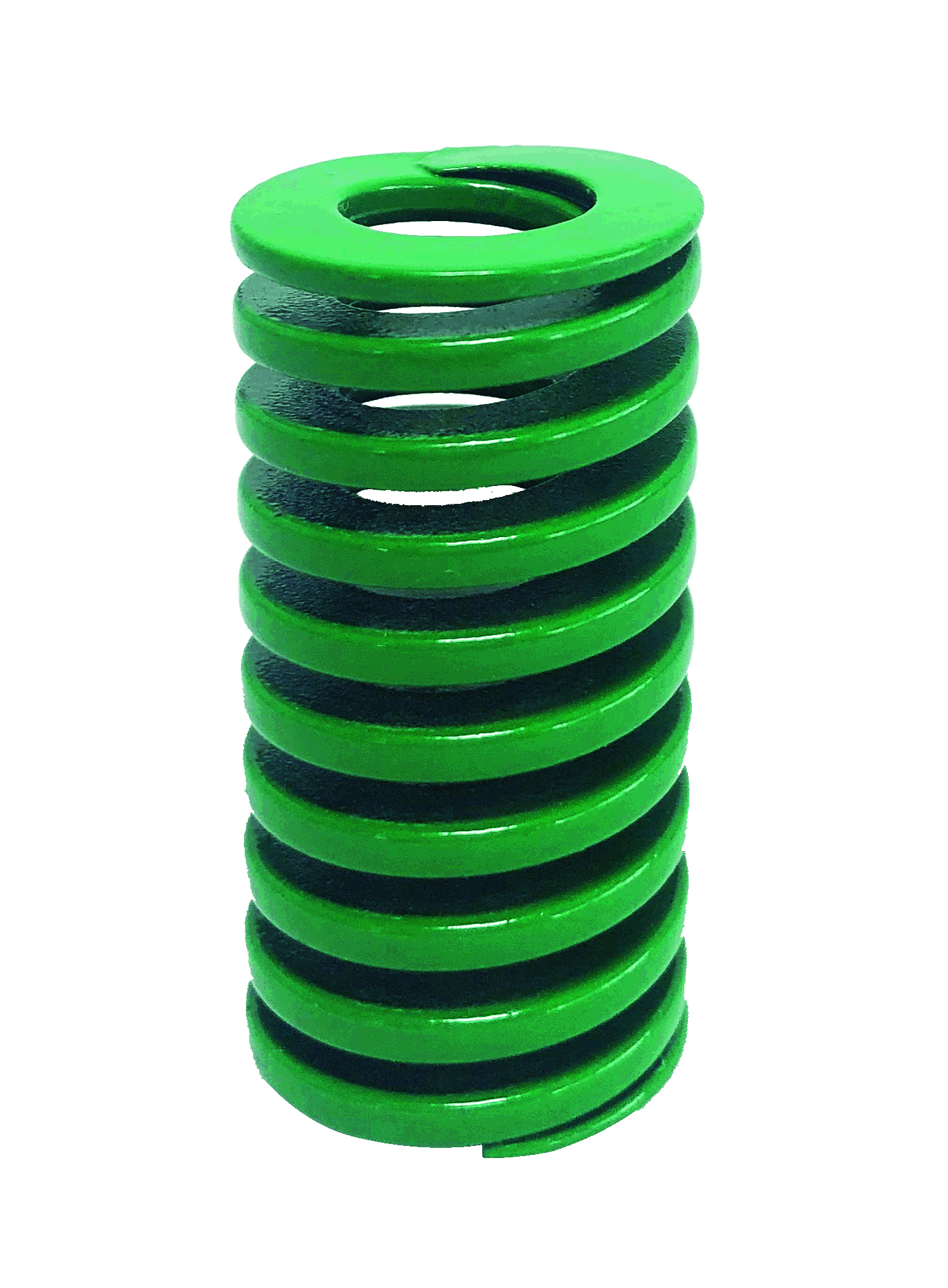
CIL light duty die spring (green) — request a sample to validate load class, dimensions and coating before series release.