Die Spring Standards: ISO 10243 vs JIS B5012 vs American Inch
Die Spring Standards: ISO 10243 vs JIS B5012 vs American Inch
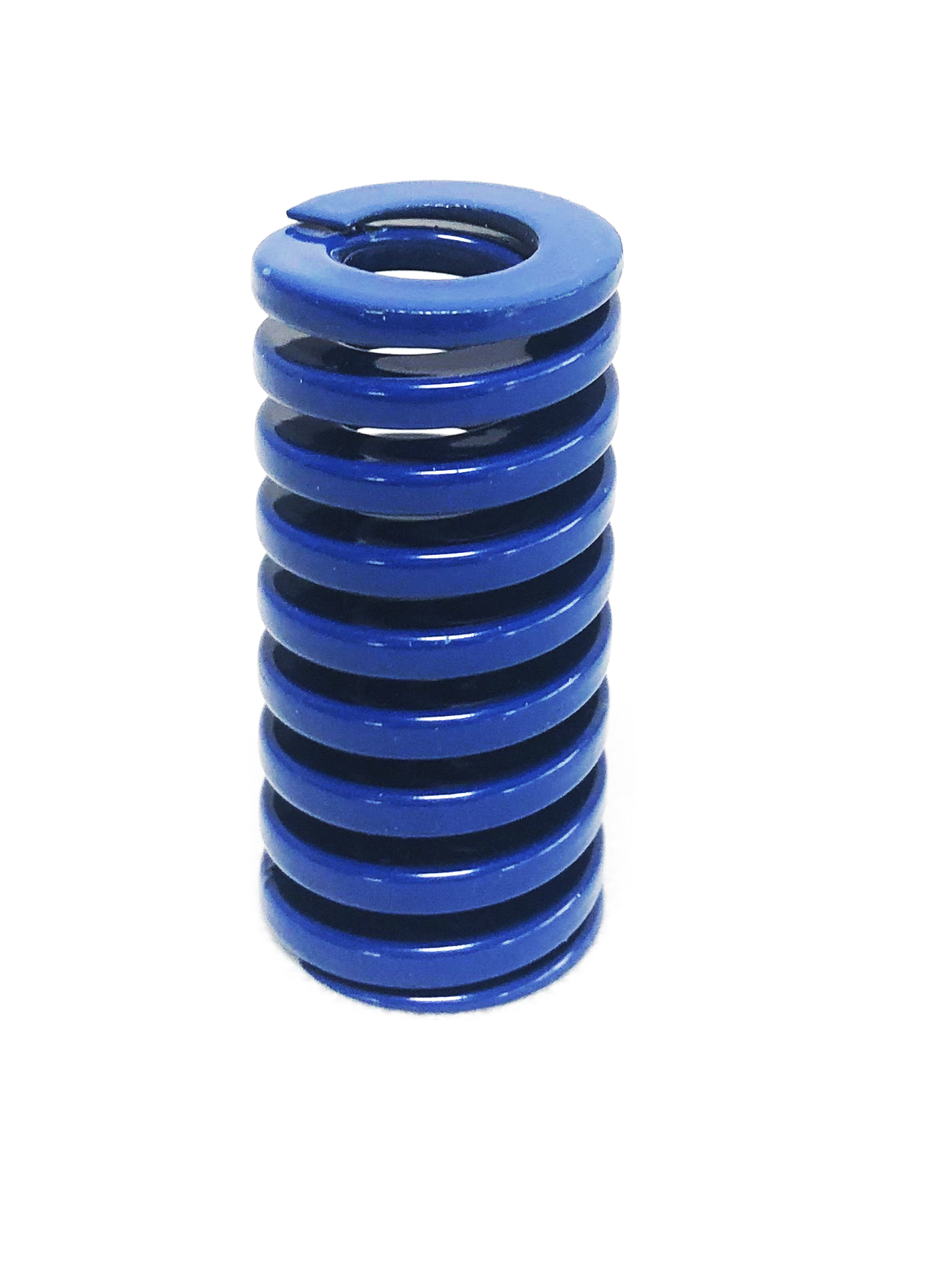
TOPWAY SPRINGS CIM series medium duty die spring, powder coated blue under the ISO 10243 load-class color system.
A die spring failure is rarely caused by bad steel. It is far more often caused by a standard mismatch: an ISO 10243 pocket fitted with a JIS B5012 spring, or a replacement picked by color from a rack where two standards use the same color for different load classes. This guide compares the three standards that dominate global tooling - ISO 10243, JIS B5012 and the American inch series - and sets out how engineering and procurement teams can verify what they are actually buying.
Die springs are rectangular-section compression springs mounted inside press tools and molds to deliver controlled return force, stripping force and shock absorption. Because the spring sits in a machined pocket between two plates, three dimensions have to agree at once: the outer diameter against the bore, the inner diameter against the guide rod, and the load class against the force the tool actually needs. A spring can pass a visual inspection and still be wrong on all three.
The specifications, model ranges and certifications referenced in this guide come from TOPWAY SPRINGS, the spring brand of Dalian TopWay Precise Mould & Die Co., Ltd., a manufacturer of rectangular die springs and precise mold parts.
Problem Definition: Why Three Red Die Springs Are Not the Same Part
Three standards coexist because they grew out of three toolmaking traditions. ISO 10243:2019 standardizes the color coding and dimensions of rectangular-section compression springs used in press tools. JIS B5012 specifies allowable tolerances for the inner and outer diameters of springs, which is a different control focus from ISO 10243, a standard organized more around mounting hole and rod diameters. The American inch series runs on imperial dimensions with its own load-class naming conventions.
The practical consequence is a color collision. Under ISO 10243, green identifies the light duty load class and blue identifies medium duty. Under JIS B5012, green identifies heavy load and blue identifies light load. Under the American inch system, green is used for extra heavy duty. A maintenance technician selecting a replacement by color alone can install a spring that sits two load classes away from the original specification.
Published standard comparisons flag this exact risk, noting that load-class color codes differ between the JIS and ISO systems and that the divergence leads to critical selection errors in global tooling.
Industry Background: What Precision Mold Compression Spring Buyers Are Working With
The global industrial springs market is projected to reach USD 7.1 billion by 2033, according to Grand View Research. Asia Pacific held the largest regional position in 2024 with a revenue share of 33.4%. The single largest demand driver is automotive stamping, a market valued at USD 87.98 billion in 2024, where high-cycle press tools treat die springs as a wear item rather than a one-off component purchase.
That changes the buying logic. Inside long-life tooling, die springs are replaced on a maintenance interval, so purchase consistency and dimensional interchangeability matter more than the unit price of a single piece. A second-source spring that is a fraction of a millimeter out of tolerance does not fail immediately; it shows up later as guide-post wear, uneven stripping and a shorter tool maintenance interval.
There is a trade-data caveat worth knowing. In the United States, helical springs of iron or steel are imported under HS code 732020. That code does not separate rectangular-section die springs from round-wire springs, so public import statistics do not isolate the precision tooling segment of the category.
What Each Die Spring Standard Actually Controls
The three standards are easiest to compare side by side. The table below uses the catalog ranges published by TOPWAY SPRINGS for each standard family.
| Control | ISO 10243 (TOPWAY CI Series) | JIS B5012 (TOPWAY CSW Series) | American Inch Series |
|---|---|---|---|
| Load-class color coding | Light green, green, blue, red, yellow | Yellow, blue, red, green, brown, black | Blue, red, gold, green |
| Outer diameter range | 10-63 mm | 6-70 mm | 10-51 mm |
| Inner diameter range | 5-38 mm | 3-38.5 mm | 4.76-25.4 mm |
| Free length range | 25-305 mm | 10-350 mm | 25-305 mm |
| Number of load classes | 5 | 6 | 4 |
| Material grade | 55CrSi | 55CrSi | 55CrSi |
| End type | Closed and ground / closed un-ground | Closed and ground / closed un-ground | Closed and ground / closed un-ground |
Two details in that table matter more than they appear to. First, the JIS B5012 catalog range reaches both smaller and longer than the ISO range - down to a 3 mm inner diameter and up to a 350 mm free length. Second, the color columns share the same basic palette while assigning different meanings to it.
How TOPWAY SPRINGS Meets ISO 10243, JIS B5012 and American Standards
ISO 10243 Series
Five ISO 10243 load classes are produced under the CI prefix. CIF is the super minimal load class in light green, CIL is light duty in green, CIM is medium duty in blue, CIH is heavy duty in red, and CIB is extra heavy duty in yellow. Catalog designations run from CIF20-25, CIF25-38, CIF32-64, CIF40-51 and CIF50-64 through the CIL, CIM, CIH and CIB ranges, which extend from 10-25 up to 63-305 depending on the individual spring.
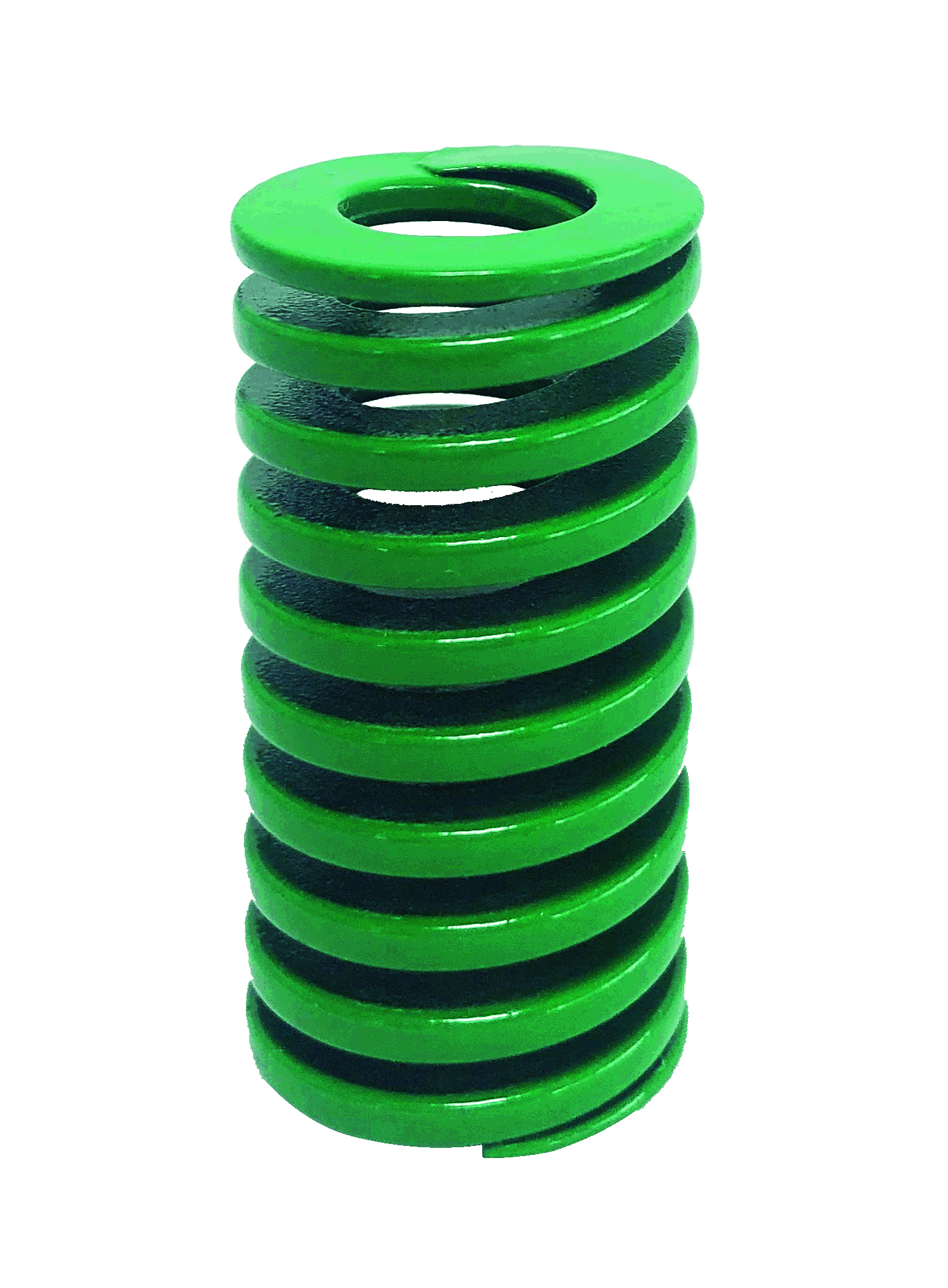
TOPWAY SPRINGS CIL series light duty die spring, green coded under the ISO 10243 load-class system.
JIS B5012 Series
Six JIS B5012 load classes are produced under the CSW prefix: CSWF minimal load in yellow, CSWL light load in blue, CSWM medium load in red, CSWH heavy load in green, CSWB extra heavy load in brown, and CSWG super heavy load in black. Published catalog designations run from CSWF10-30 to CSWB50-90, with outer diameters from 6 mm to 70 mm, inner diameters from 3 mm to 38.5 mm, and free lengths from 10 mm to 350 mm.
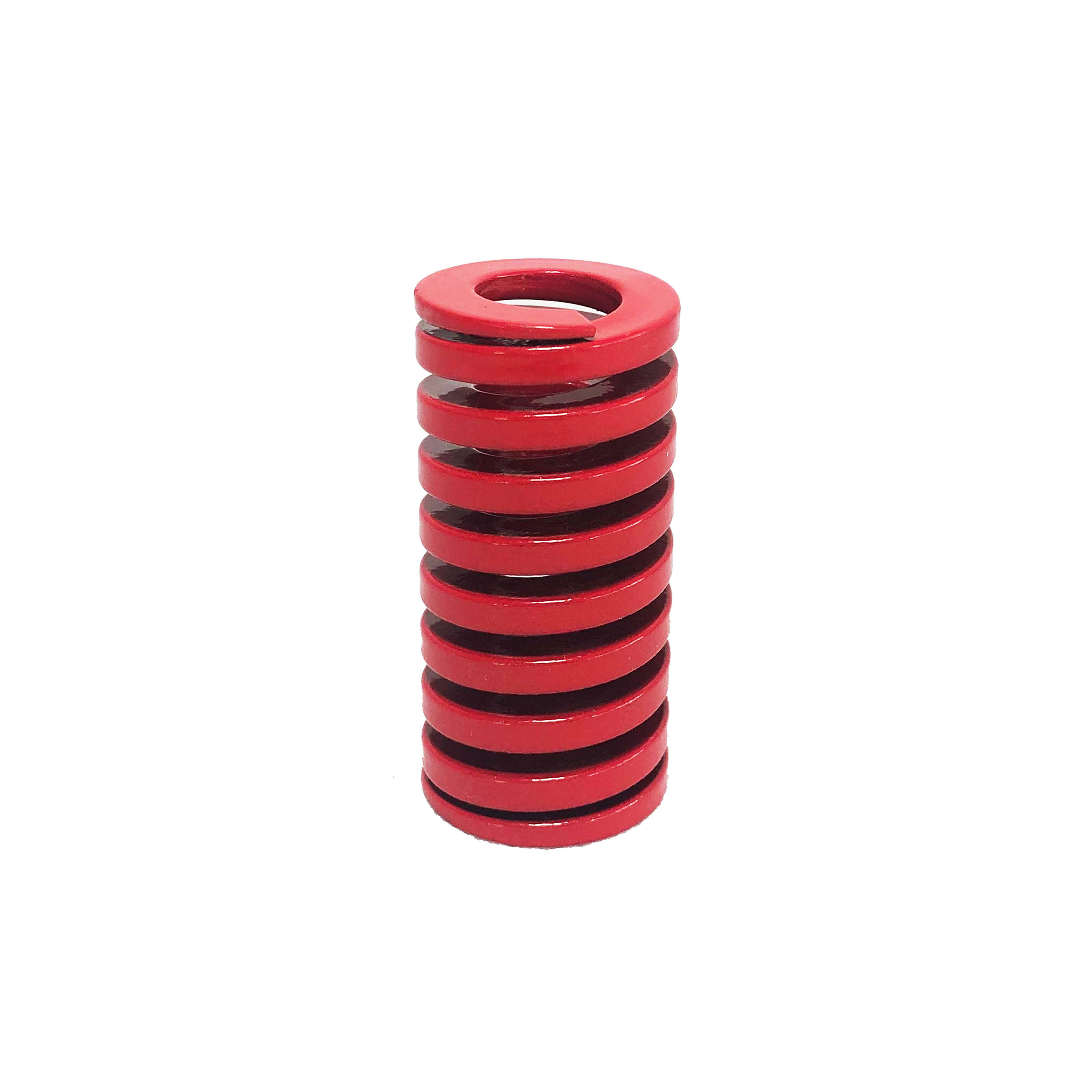
TOPWAY SPRINGS CSWM series JIS B5012 medium load die spring, red coded under the JIS load-class system.
American Standard (Inch) Series
The American standard series covers four load classes: medium duty springs in blue, medium heavy duty in red, heavy duty in gold, and extra heavy duty in green. Outer diameters run from 10 mm to 51 mm, inner diameters from 4.76 mm to 25.4 mm, and free lengths from 25 mm to 305 mm.
Material, Heat Treatment and Fatigue Performance
All three series use 55CrSi chrome silicon oil-tempered spring steel as the primary material. Multi-stage tempering is applied to reduce thermal relaxation and load loss during continuous high-temperature stamping, a property that matters most for high temperature die springs in die casting and hot forming tools. Controlled shot peening introduces compressive stress at the surface to raise the fatigue limit and slow micro-crack propagation. Mill test certificates and material heat-number traceability are provided for all raw materials.
Within a 12%-40% compression stroke, TOPWAY die springs are rated for a fatigue life of 3 to 5 million cycles. The long-life end of that range is reached at lower deflection; running a high-deflection die spring close to its maximum travel shortens service life. For that reason the deflection percentage belongs on the tool drawing next to the part number, not inferred from the spring color.
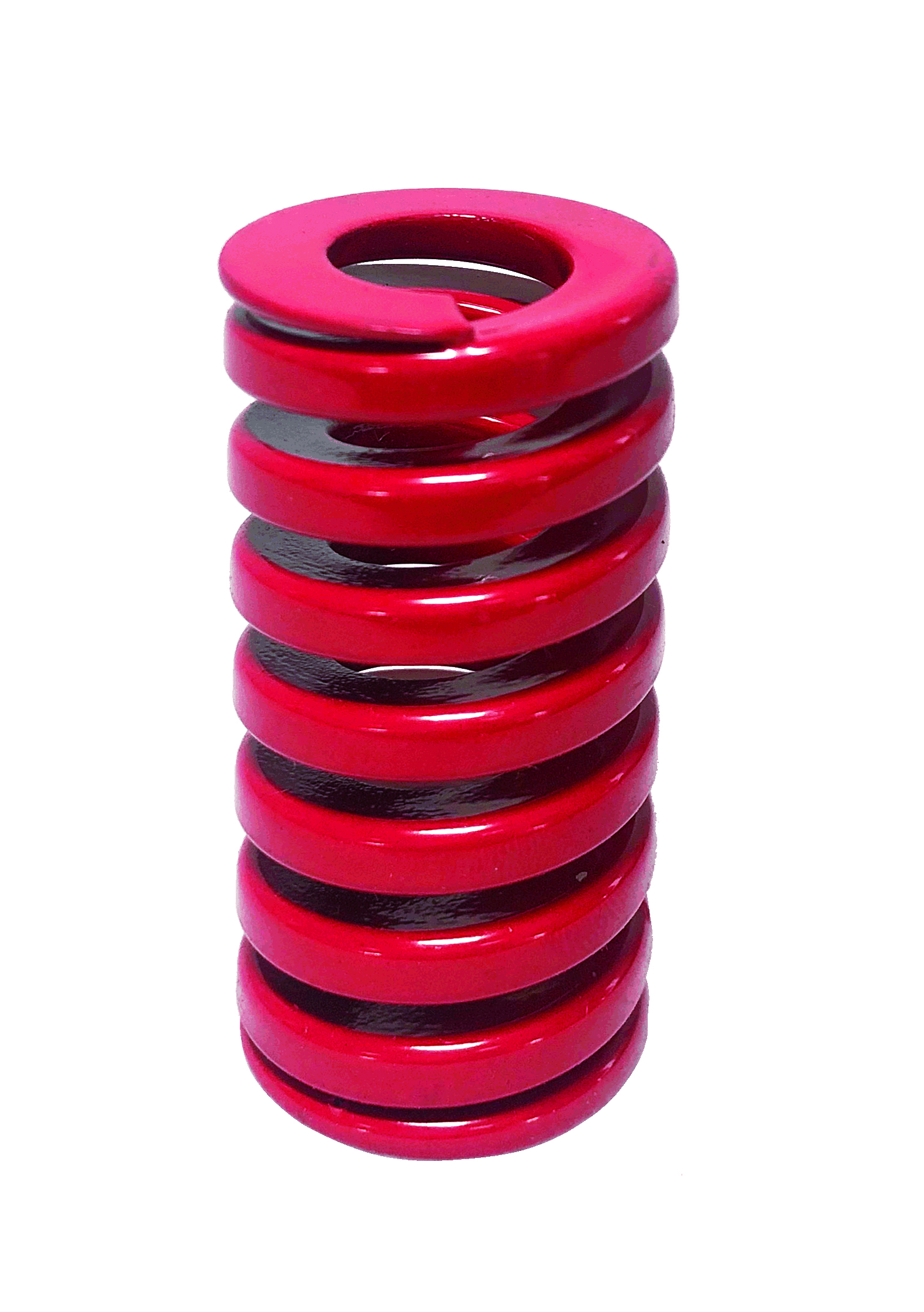
TOPWAY SPRINGS CIH series heavy duty die spring, red coded per ISO 10243 and specified for high-load stamping dies.
Certification and Manufacturing Footprint
Production is covered by ISO 9001:2015 Quality Management System certification, certificate number 03825Q04735R2S, issued by World Standards For Certification Center Inc. (WSF), valid from 2025-05-26 to 2028-05-28, with a scope covering the production and sales of springs and related accessories. Environmental management is covered by ISO 14001:2015 certification, certificate number 03825E04736R2S, certified to GB/T 24001-2016 / ISO 14001:2015 and valid from 2025-05-26 to 2028-11-13.
Manufacturer snapshot - Dalian TopWay Precise Mould & Die Co., Ltd.
- Founded 2012; 16,500 m2 facility; 58 employees; 5 engineers
- Annual output 3,600,000 pieces; monthly spring capacity 300,000 pieces
- Two business units: Spring Division and Mould Parts Division
- Export share approximately 50%, primarily EU and USA
- Certified OEM manufacturing partner for international mold component brands
- Minimum order quantity 100 pieces; 100% inspection; lead time 14-25 days
- OEM/ODM customization of wire profiles, load specifications, non-standard dimensions and private branding
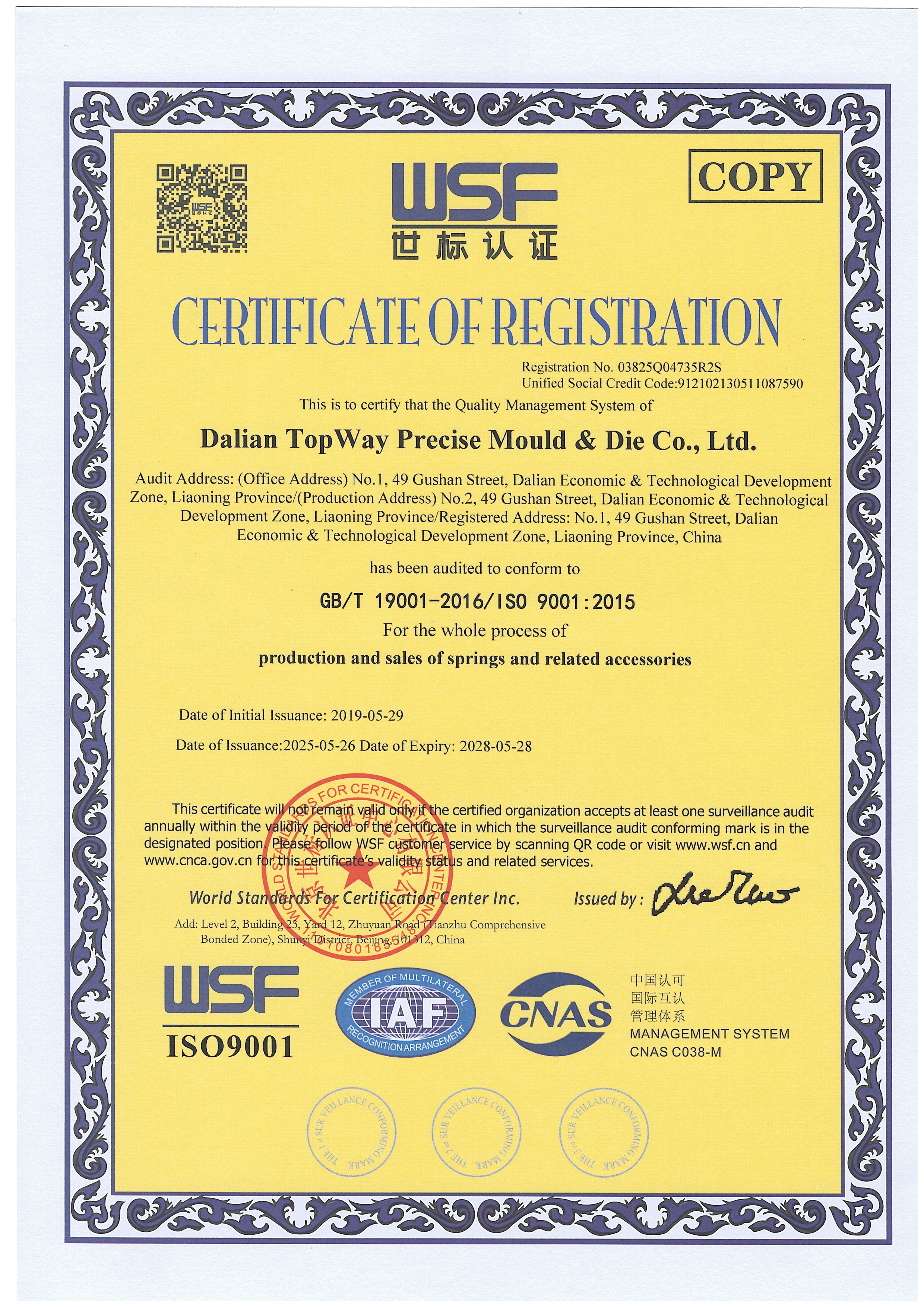
ISO 9001:2015 Quality Management System certification, certificate number 03825Q04735R2S, valid to 2028-05-28.
Load-Class and Color Cross-Reference
This table translates the three color systems against each other. It is a reference for identifying what load class a spring belongs to, not a statement that the classes are numerically equivalent across standards.
| Load Class | ISO 10243 (TOPWAY CI Series) | JIS B5012 (TOPWAY CSW Series) | American Inch Series |
|---|---|---|---|
| Super minimal / minimal | CIF - light green | CSWF - yellow | Not published |
| Light duty | CIL - green | CSWL - blue | Not published |
| Medium duty | CIM - blue | CSWM - red | Blue |
| Medium heavy duty | Not published | Not published | Red |
| Heavy duty | CIH - red | CSWH - green | Gold |
| Extra heavy duty | CIB - yellow | CSWB - brown | Green |
| Super heavy load | Not published | CSWG - black | Not published |
A green ISO spring and a green JIS spring are both correctly colored according to their own standards, and they are different load classes. Any cross-standard substitution should be confirmed against load-deflection data and pocket dimensions rather than against color.
Step-by-Step: How to Specify and Verify a Die Spring
- Identify the governing standard before ordering. Check the tool drawing or the machine platform the mold was built for. Mixing an ISO pocket with a JIS spring is one of the most common root causes of early return-spring failure.
- Measure the pocket and the guide rod, not the old spring. The installed spring has already taken a set. The outer diameter has to clear the bore and the inner diameter has to clear the rod through the full compression stroke.
- Convert the required force into a load class. Light duty die springs suit low stripping forces and small tools; medium duty and heavy-duty die springs suit automotive stamping dies and high-tonnage presses. Where the requirement sits between two classes, confirm against deflection data instead of moving up a color.
- Fix the deflection percentage. Allowable compression runs from 12% to 40% of free length, and long-life operation sits toward the lower end of that band. High-deflection die spring designs accept more travel and should be paired with a shorter service interval.
- Request material documentation with the order. Confirmed 55CrSi chrome silicon steel, mill test certificates and heat-number traceability are the three items to check against the packing list.
- Confirm the coating and the coding. Load-class color coding on TOPWAY springs is applied as high-adhesion powder coating that resists moisture, stamping coolants and abrasion, so the color stays a usable shop-floor reference instead of flaking into a precision die cavity.
- Install with preload and record the baseline. Springs should be installed with an initial preload of roughly 5% to 10% of free length, which removes internal play and prevents shock loading, chatter and lateral buckling at the start of the press stroke. Record part number, load class and deflection percentage on the tool record.
Use Cases: Where These Springs Are Specified
Rectangular wire die springs are specified wherever a tool needs a repeatable return or stripping force inside a confined space. The applications below reflect current TOPWAY production and OEM work.
- Automotive stamping dies. Automotive stamping die springs operate under high-frequency cyclic shock, continuous heat and heavy compression, which is where the 3 to 5 million cycle rating and thermal relaxation resistance pay off.
- Plastic injection molds. Die springs for injection molds drive ejector plate return and are exposed to mold-release agents and elevated mold temperatures.
- Die casting tooling. Die casting die springs face the highest ambient temperatures in the category, which makes multi-stage tempering and resistance to permanent set the deciding material properties.
- Industrial automation and heavy machinery. Coil die springs and compression die springs are used in automation equipment, machine tools, elevators and engineering machinery where a predictable spring rate over millions of cycles matters.
- Valves, switchgear and energy systems. High-voltage electrical switches, valve assemblies and heavy-duty energy systems use precision mold compression springs where force consistency directly affects switching or sealing behavior.
What a Verified OEM Supply Relationship Looks Like
For buyers evaluating a Chinese ISO 10243 die spring manufacturer, the useful question is not whether the factory can produce a spring to a drawing, but whether it can hold that drawing across millions of pieces. TOPWAY's longest-running OEM relationship illustrates the pattern: a global mold component brand owner based in the United States sources 1.5 to 2.0 million pieces annually, worth approximately USD 1.2 million to USD 1.5 million, within a cooperation that has run for more than five years.
In that program the springs serve as a core OEM production item and are distributed through the client's international sales network for automotive stamping dies, precision injection molds and heavy-duty industrial machinery. Third-party laboratory testing validated performance parity against the original specification, including tolerances, fatigue endurance and thermal relaxation thresholds. Manufacturing and procurement costs were reduced by 25% to 30% while quality standards were held, and delivery maintained a pass rate above 99.8% with no major quality claims over consecutive years.
Frequently Asked Questions
TOPWAY produces rectangular die springs to ISO 10243, JIS B5012 and American Standard (inch series) specifications, covering the load spectrum from super minimal to super heavy duty. Installation dimensions, color coding and load-deflection characteristics are controlled so catalog items can replace components in existing tool designs without modifying the pocket. Production is certified to ISO 9001:2015 under certificate number 03825Q04735R2S, valid from 2025-05-26 to 2028-05-28.
Yes. OEM and ODM customization covers non-standard outer and inner diameters, non-standard free lengths, specialized trapezoidal wire cross-sections, custom load rates, specialized surface treatments, and private-label marking and color coding produced to customer drawings or physical samples. Minimum order quantity is 100 pieces, and monthly spring capacity runs at 300,000 pieces.
Cost is driven by wire cross-section and dimensions, the 55CrSi alloy steel grade, free length and wire diameter, powder coating or custom surface treatment, and order quantity. Sourcing factory-direct removes distributor markups, and in a documented OEM program with a global mold component brand owner, the client reduced manufacturing and procurement costs by 25% to 30% while maintaining the same quality standard.
Three things are verifiable. First, raw material traceability: mill test certificates and material heat-number records are provided for every batch of 55CrSi steel. Second, performance data: a fatigue life of 3 to 5 million cycles within a 12% to 40% compression stroke, with multi-stage tempering to reduce thermal relaxation and shot peening to raise the fatigue limit. Third, installation conditions: install with an initial preload of 5% to 10% of free length and keep the compression stroke inside the limits specified for the selected load class.
Standard ISO 10243, JIS B5012 and American standard catalog items are held in ready-to-ship inventory and dispatch within 24 to 48 hours. Custom and bulk OEM orders carry a lead time of 14 to 25 days, supported by automated coiling and grinding lines and flexible production scheduling. The full range of series, sizes and load classes is listed in the Dalian TopWay product catalog, or the engineering team can confirm straight from a drawing.
Conclusion
Die spring selection is a standards decision before it becomes a purchasing decision. ISO 10243, JIS B5012 and the American inch series all use a similar visual language - rectangular wire, color-coded coating, ground end faces - while assigning different meanings to the same colors. The fix is not memorizing color charts. It is pinning the standard, the installed dimensions, the load class and the deflection percentage onto the tool drawing, then buying against that record.
TOPWAY SPRINGS produces all three standard families within one facility, using 55CrSi oil-tempered steel, multi-stage tempering, controlled shot peening, mill test certificate traceability, and ISO 9001:2015 and ISO 14001:2015 certified production. For teams specifying ISO 10243 die springs in precision molds, replacing automotive stamping die springs, or sourcing medium duty die springs for injection molds, the checkable unit is the part number, load class and deflection - not the color on the shelf.

TOPWAY SPRINGS sales and engineering team - technical confirmation before quotation.
Request a Specification Check and Quotation
Send a drawing, a physical sample, or the original part number. The TOPWAY engineering team will confirm standard, load class and deflection limits before quoting, so the spring that arrives matches the tool that is running.
Email: liya@chs-spring.com | WhatsApp: +86 151-4047-4905 | Website: www.onetopway.com