Die Spring Standards: ISO 10243 vs JIS B5012 vs Inch Series
Die Spring Standards: ISO 10243 vs JIS B5012 vs Inch Series
A rectangular die spring is a constrained part. ISO 10243, JIS B5012, and the American (inch series) systems all describe the same family of heavy-duty compression springs used as return elements in stamping dies, injection molds, and die casting tooling — but each one standardizes dimensions, load classes, and color coding differently. Mixing them up is not a catalog error. It is a procurement error that shows up later as uneven spring pockets, lateral buckling, or premature fatigue failure inside a running press.
At the center of this standard landscape sits TOPWAY SPRINGS (Dalian TopWay Precise Mould & Die Co., Ltd.), a precision mould and die parts manufacturer based in Dalian, China. The company runs two specialized business units — a Spring Division and a Mould Parts Division — and its spring lines cover ISO 10243, JIS B5012, and American Standard catalogs in 55CrSi chrome silicon steel, backed by ISO 9001 and ISO 14001 management system certifications.
This article breaks down what each standard actually constrains, what certification really covers, and how buyers can use both to specify and verify die springs without carrying rework risk into production.
Why Die Spring Standards Are a Constraint, Not a Formality
Die springs absorb impact on every press stroke. In production tooling, a single spring can pass through millions of compression cycles. When its free length, outer diameter, or load curve falls outside the tolerance of the pocket it sits in, the failure mode is mechanical rather than cosmetic: uneven load distribution across the spring seat, lateral deflection against the guide pin, over-stressing of adjacent mold components, or fracture inside a live production run.
Most procurement failures trace back to three constraint gaps:
- Diameter tolerance gap. ISO 10243 and JIS B5012 define the same spring differently. ISO 10243 focuses on the housing and rod diameters — the pocket the spring drops into. JIS B5012 specifies allowable tolerances on the spring’s own inner and outer diameters. Both can be true at once, yet a spring that fits one definition may not fit the other.
- Color coding reversal gap. Load class is indicated by color in all three systems, but the same color means different things across them. A green spring under ISO 10243 is a light-duty die spring. A green spring under JIS B5012 is a heavy-duty die spring. Selecting by color memory instead of by standard is a real failure path.
- Certification scope gap. A supplier may hold a valid ISO 9001 certificate whose scope does not actually cover the specific spring type being ordered. Reading the scope line is part of the job, not an afterthought.
None of these gaps are exotic. They close quickly once the standard is treated as a purchasing specification rather than a category label.
The Standards Landscape Behind Global Die Spring Supply
Industrial compression springs are a large, steadily expanding component category. Grand View Research projects the global industrial springs market to reach USD 7.1 billion by 2033. In 2024, Asia Pacific already accounted for 33.4% of that revenue, making the region the largest single manufacturing base for precision springs.
Downstream demand is anchored in tooling and stamping activity. The automotive stamping market — one of the largest end-use segments for die springs — was valued at USD 87.98 billion in 2024 according to Market Research Future. That figure reflects continuous high-volume press cycles, which is precisely the operating environment that heavy-duty and long-life die springs are engineered for.
At the trade documentation level, helical springs of iron or steel imported into the United States fall under HS code 732020. There is no unique global HS code that separates rectangular wire die springs from round-wire helical springs, so customs paperwork typically groups them together. That is where trade classification stops and technical specification has to take over.
What Each Die Spring Standard Actually Constrains
ISO 10243:2019
ISO 10243:2019 standardizes color-coding and dimensions for rectangular-section compression springs used in press tools. Its defining characteristic is emphasis on mounting hole and rod diameters, which is why it is the dominant reference in European tool design.
Within TOPWAY SPRINGS’ ISO 10243 line, the catalog covers five load series:
- CIF — super minimal load (light green)
- CIL — light duty load (green)
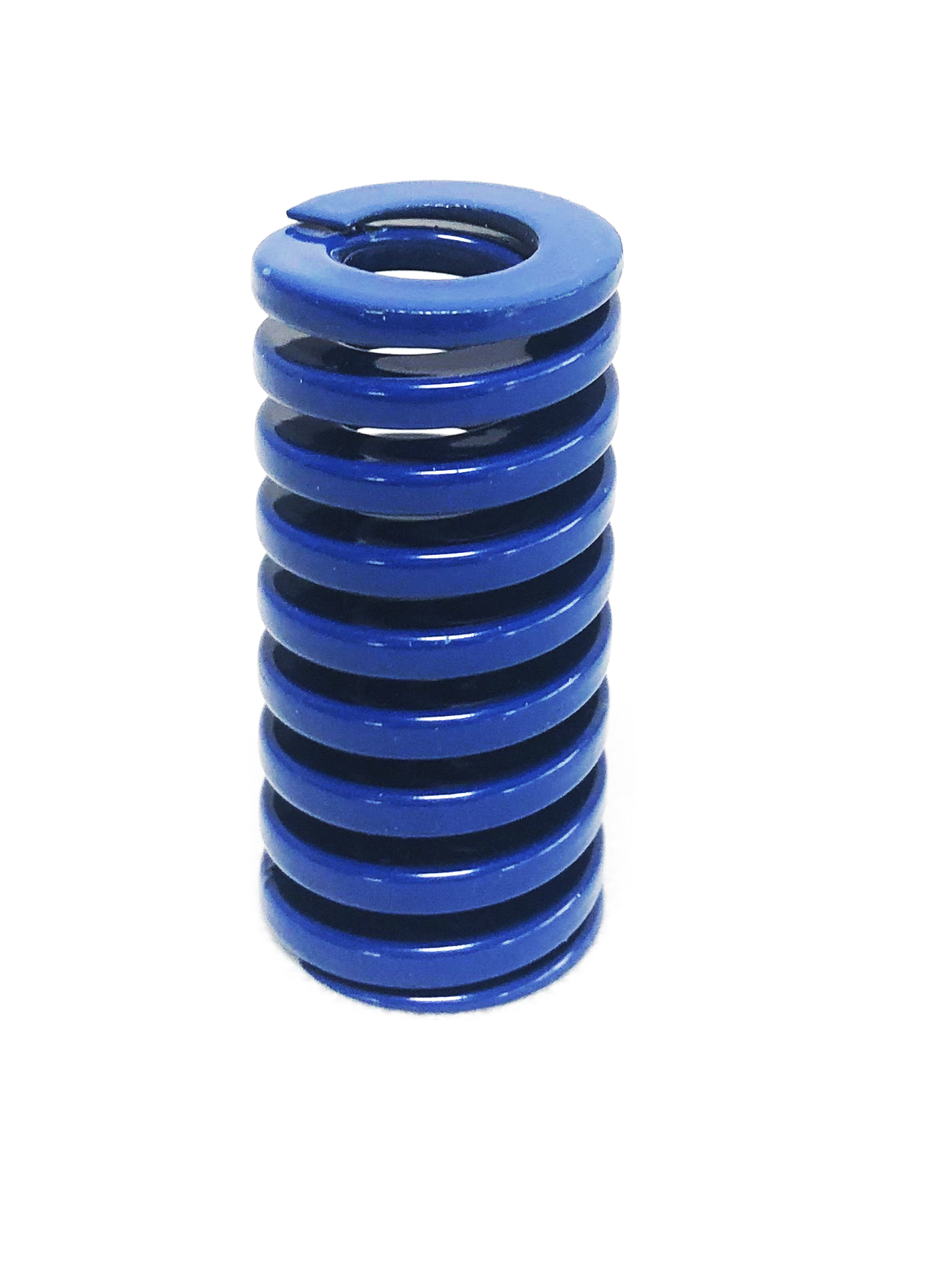
- CIM — medium duty load (blue)
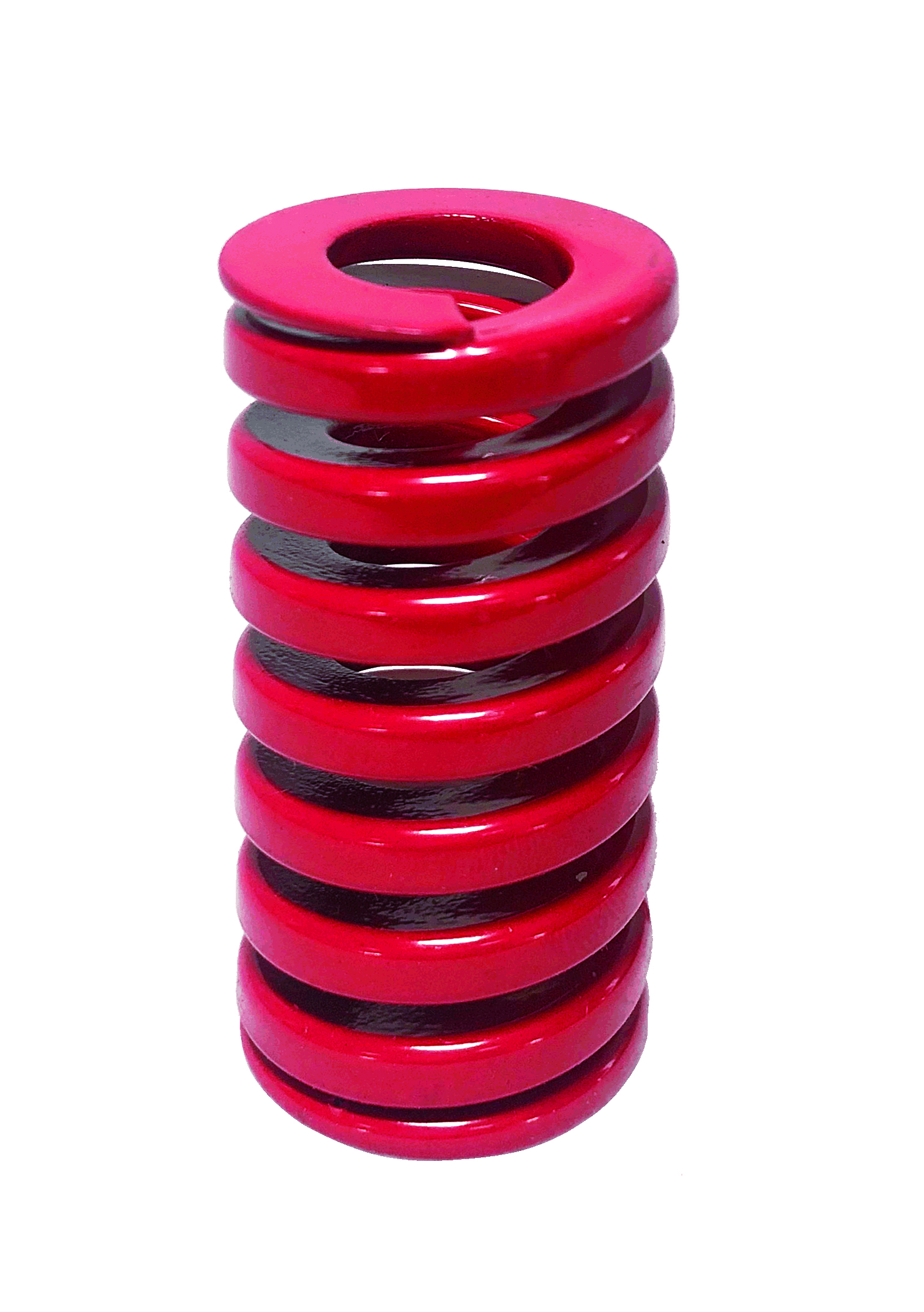
- CIH — heavy duty load (red)
- CIB — extra heavy duty load (yellow)
The dimensional envelope runs from 10–63 mm outer diameter, 5–38 mm inner diameter, and 25–305 mm free length. Model numbering encodes the data: a CIM25-89 is a medium-load, 25 mm OD spring with 89 mm free length; a CIH40-152 is a heavy-load, 40 mm OD spring at 152 mm free length.
JIS B5012
Where ISO 10243 pins the housing dimensions, JIS B5012 specifies allowable tolerances of the inner and outer diameters of the spring itself. That distinction matters in Asian tool manufacturing, where designers verify the spring rather than the bore it sits in.
JIS B5012 defines six load classes — one more than ISO:
- CSWF — minimal load (yellow)
- CSWL — light load (blue)
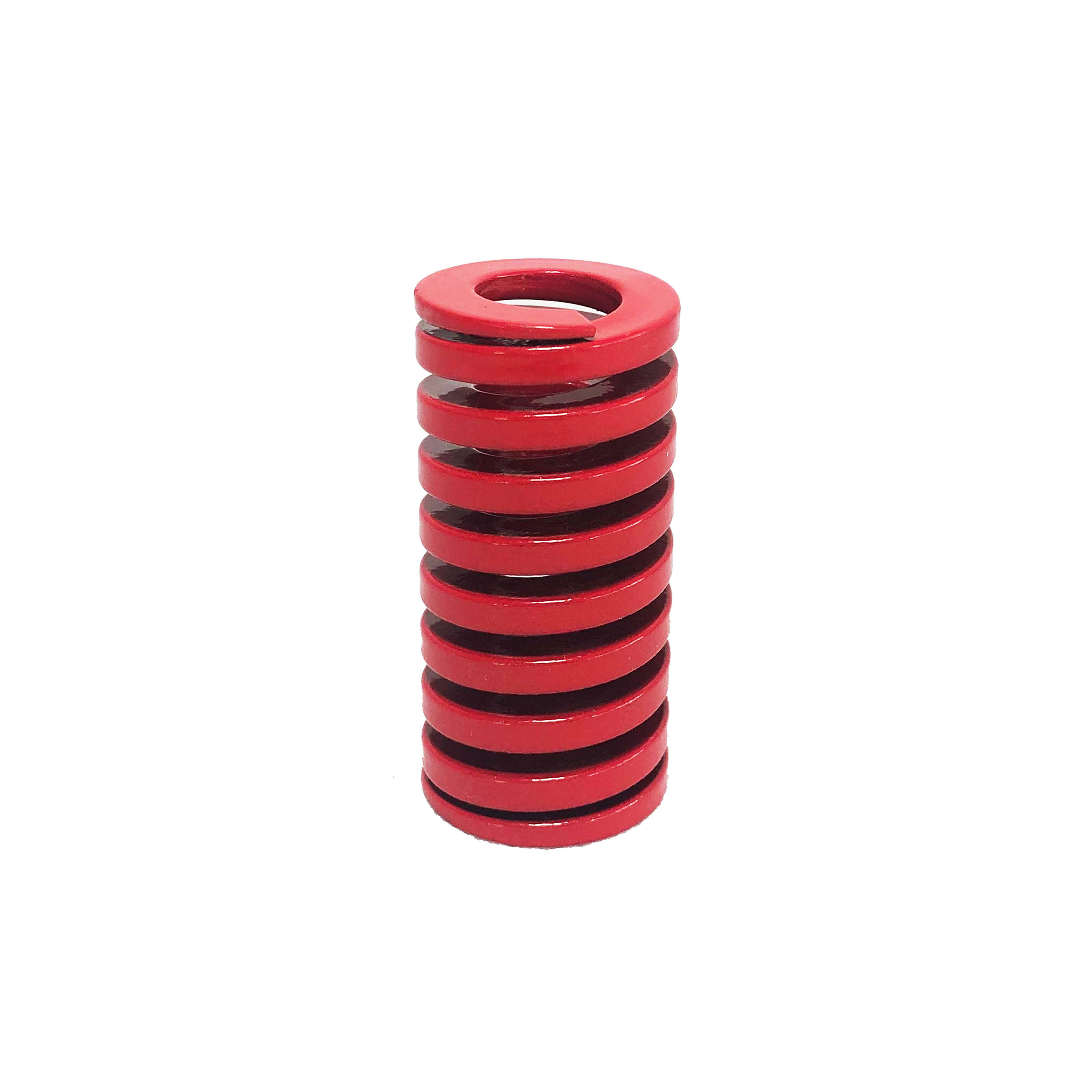
- CSWM — medium load (red)
- CSWH — heavy load (green)
- CSWB — extra heavy load (brown)
- CSWG — super heavy load (black)
The JIS B5012 catalog reaches smaller outer diameters (from 6 mm) and longer free lengths (up to 350 mm) than the ISO line, with an inner diameter range of 3–38.5 mm. That wider envelope gives tool designers additional room when a deep pocket needs a longer return spring than the ISO series offers.
American Standard (Inch Series)
The American Standard serves North American tool shops that still work in inch dimensions. It uses a narrower load class structure — medium duty springs (blue), medium heavy duty springs (red), heavy duty springs (gold), and extra heavy duty springs (green) — with an outer diameter range of 10–51 mm, inner diameter of 4.76–25.4 mm, and free length of 25–305 mm.
Because the inch series colors do not map cleanly onto either ISO or JIS, a buyer sourcing across regions has to specify by standard name, load class, and dimensions together — never by color alone.
Material and Process Constraints Common to All Three Standards
Regardless of which standard governs the geometry, the material and processing chain converges on the same requirements:
- Material. 55CrSi (chrome silicon) oil-tempered spring steel is the primary material. Mill test certificates and material heat-number traceability are provided for all raw materials.
- Heat treatment. Multi-stage tempering is applied to reduce thermal relaxation and load loss during continuous high-temperature stamping, which is what makes high temperature die spring performance possible.
- Surface treatment. Shot peening introduces compressive stress at the wire surface and raises the fatigue limit.
- End type. Closed and ground, or closed and un-ground. For molds that depend on perpendicular load transfer, closed and ground is the default.
- Winding direction. Right-hand or left-hand, selected according to the mold design.
- Coil counts. Total coils and active coils are defined according to each individual spring.
Why the same color means different loads: ISO 10243 codes green as light duty and yellow as extra heavy duty. JIS B5012 codes green as heavy load and yellow as minimal load. American Standard codes green as extra heavy duty. Any cross-standard sourcing exercise that treats color as a universal load indicator will produce mismatched die springs.
What Certification Actually Covers
Certification is the most frequently misread part of the constraint set, because a certificate covers a defined scope rather than a product category.
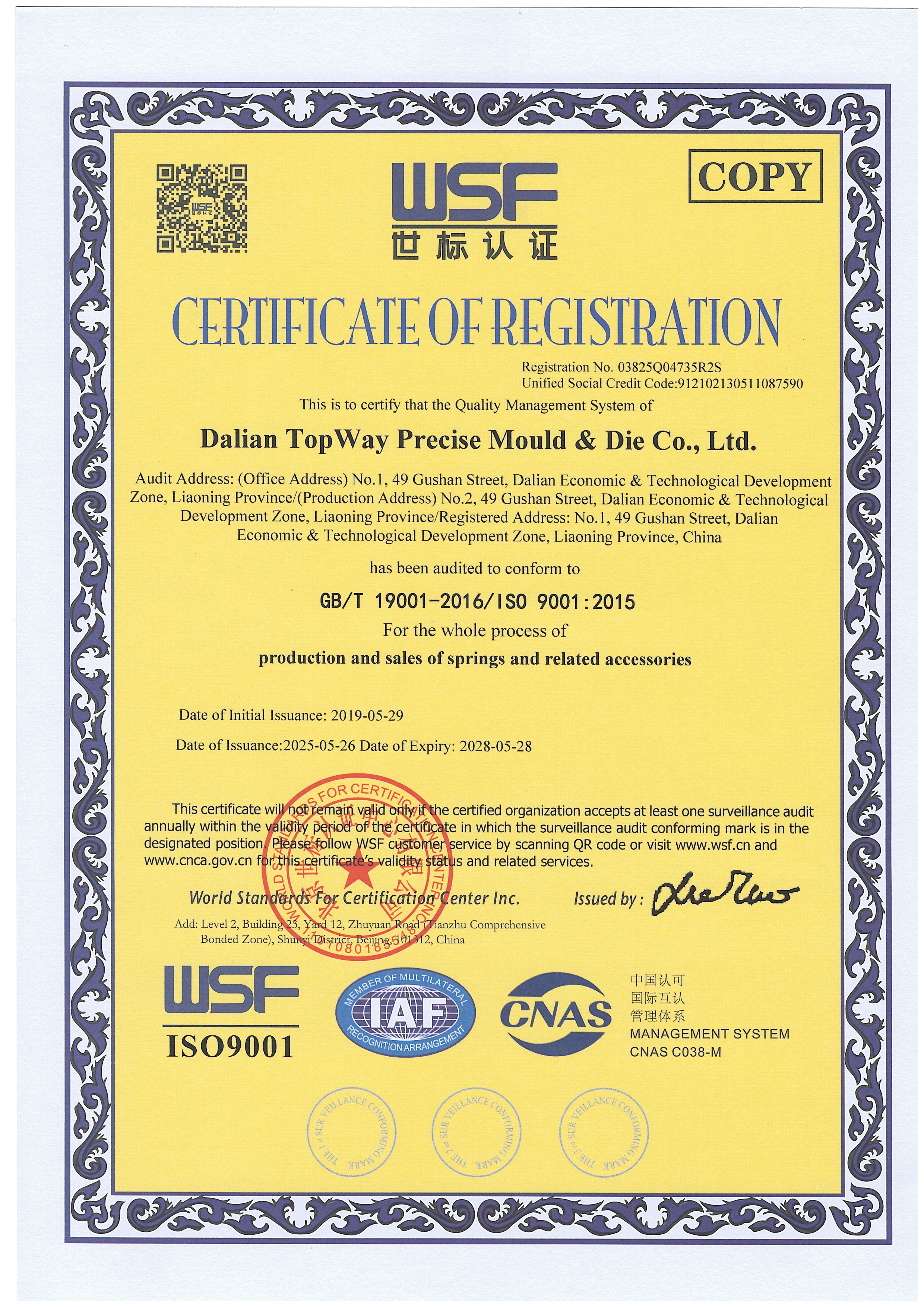
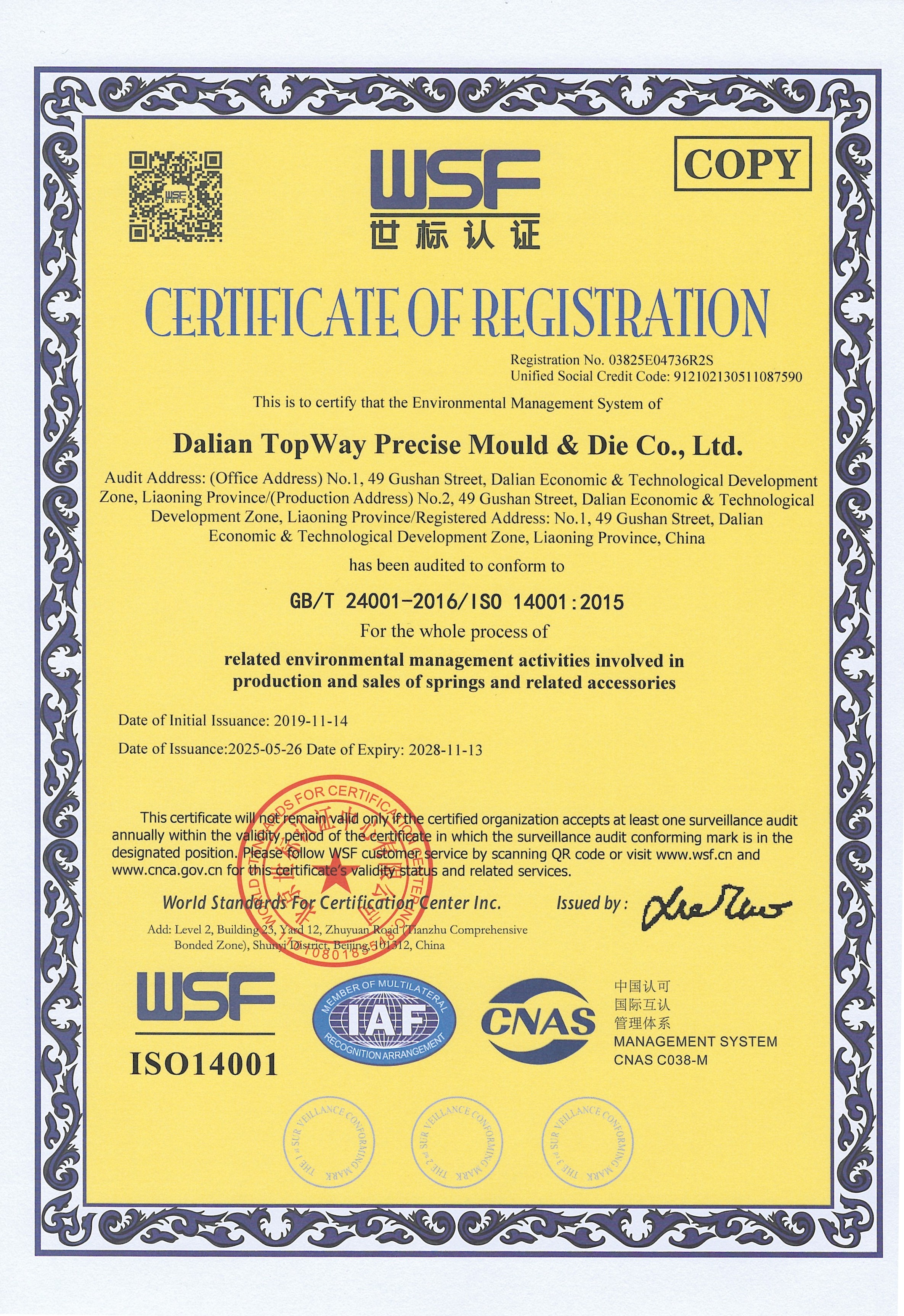
TOPWAY SPRINGS holds two management system certifications, both issued for the production and sales of springs and related accessories:
- ISO 9001:2015 Quality Management System — certificate number 03825Q04735R2S, issued by World Standards For Certification Center Inc. (WSF), standard GB/T 19001-2016 / ISO 9001:2015, valid from 2025-05-26 to 2028-05-28.
- ISO 14001:2015 Environmental Management System — certificate number 03825E04736R2S, issued by World Standards For Certification Center Inc. (WSF), standard GB/T 24001-2016 / ISO 14001:2015, valid from 2025-05-26 to 2028-11-13.
The ISO 9001 certification applies to both the JIS B5012 standard die spring product and the ISO 10243 standard spring product, for the global market. The ISO 14001 certification likewise covers the JIS B5012 standard die spring. Buyers evaluating mold component springs should always confirm that the scope line on the certificate matches the product family they are ordering.
A Step-by-Step Die Spring Specification Workflow
Specifying a compliant die spring is a repeatable sequence, not a single catalog lookup. The following workflow applies equally to ISO, JIS, and inch-series projects.
- Identify the standard the tool was designed against. Check the original drawings. Most European tooling follows ISO 10243; Japanese and many Asian tool drawings follow JIS B5012; legacy North American dies follow the inch series.
- Match load class to the correct color table. Use the color chart belonging to that specific standard. Long-life die springs are normally operated within a conservative compression stroke to preserve fatigue endurance.
- Verify OD, ID, and free length against the catalog envelope. Confirm the required spring sits inside the published range. The ISO 10243 line spans 10–63 mm OD, while JIS B5012 spans 6–70 mm OD. A dimension that exists in one catalog may not exist in another.
- Confirm material and traceability. Require mill test certificates and heat-number traceability for the raw-material batch. This is the verification step that distinguishes 55CrSi chrome silicon die springs from generic carbon steel.
- Plan for preload at installation. Installing with an initial preload — typically 5% to 10% of free length — eliminates internal play and prevents severe shock loading caused by sudden impact during press strokes. Springs run without preload are prone to chatter, lateral buckling, and early structural failure.
- Confirm certification scope covers the product. A valid ISO 9001 certificate is only meaningful for procurement if the scope line names spring production and sales.
- Validate with a sample before full production. For non-standard dimensions, specialized load rates, or private-label work, order physical samples and confirm load curve and color coding before committing a full run.
- Plan replenishment and lead time. For standard catalog items, verify stock depth and dispatch speed. For custom or bulk orders, confirm lead time and minimum order quantity up front.
Where Standard-Compliant Die Springs Are Used
Rectangular wire die springs appear well beyond general stamping. The operating conditions vary enough that the underlying constraint set — compression stroke, cycle frequency, and working temperature — is what actually drives selection.
- Automotive stamping dies. High-frequency cyclic shock, exposure to stamping lubricants, and continuous high-load compression. This is the environment where long-life die springs with 3 to 5 million cycle fatigue endurance matter most.
- Plastic injection molds. Springs operate across repeated thermal cycles and must deliver a stable return stroke between the cavity and the ejector plate.
- Die casting tooling. Die casting die springs face elevated ambient temperature and continuous preloaded operation, which places high temperature die spring behavior under direct scrutiny.
- Precision electronics stamping. Tight end-face parallelism is essential to avoid lateral force transfer into the guide pins.
- Industrial automation and heavy machinery. Coil die springs serve as return and buffer elements in fixtures, indexing mechanisms, and machine tooling.
- Energy, valve, and electrical switchgear. Compression die springs provide vibration damping and force balance in high-voltage switches, industrial valves, and heavy-duty energy systems.
Across all of these, the working conditions share a common profile: high-frequency cyclic shock, elevated temperature, high-load compression, and exposure to oil or coolant. Standard compliance ensures the spring physically fits; material grade and heat treatment determine whether it survives in service.
ISO 10243 vs JIS B5012 vs American Standard: Side-by-Side Comparison
| Parameter | ISO 10243 | JIS B5012 | American Standard (Inch) |
|---|---|---|---|
| Standardization focus | Mounting hole and rod diameter | Spring ID / OD tolerances | Inch-series mold components |
| Outer diameter range | 10–63 mm | 6–70 mm | 10–51 mm |
| Inner diameter range | 5–38 mm | 3–38.5 mm | 4.76–25.4 mm |
| Free length range | 25–305 mm | 10–350 mm | 25–305 mm |
| Number of load classes | 5 | 6 | 4 |
| Load class series | CIF, CIL, CIM, CIH, CIB | CSWF, CSWL, CSWM, CSWH, CSWB, CSWG | Medium, medium heavy, heavy, extra heavy |
| Material | 55CrSi (Chrome Silicon) | 55CrSi (Chrome Silicon) | 55CrSi (Chrome Silicon) |
| End type options | Closed and ground / closed un-ground | Closed and ground / closed un-ground | Closed and ground / closed un-ground |
| Surface finish | Powder coating (color-coded) | Powder coating (color-coded) | Powder coating (color-coded) |
| Winding direction | Right / left | Right / left | Right / left |
| Certification coverage at TOPWAY SPRINGS | ISO 9001:2015 (03825Q04735R2S) | ISO 9001:2015 (03825Q04735R2S); ISO 14001:2015 (03825E04736R2S) | Catalog series |
Note on color coding: the color-to-load mapping is not shared across the three systems. Green die springs represent light duty under ISO 10243, heavy load under JIS B5012, and extra heavy duty under the American Standard. Cross-standard sourcing must always be verified against the target standard’s chart, not against visual memory.
On dimensional interchangeability: because load-deflection characteristics, installation dimensions, and color coding are controlled to standard tolerances, catalog die springs produced to these three systems function as direct drop-in replacements for international mold component brands without requiring modification to existing mold designs.
Frequently Asked Questions
Which international standards do TOPWAY SPRINGS rectangular die springs comply with, and can they replace global brands directly?
TOPWAY SPRINGS rectangular die springs comply with ISO 10243, JIS B5012, and American Standard (inch series) specifications. Because installation dimensions, color coding, and load-deflection characteristics are tightly controlled, they serve as direct drop-in replacements for international brand springs without modifying existing mold designs.
What certifications does TOPWAY SPRINGS hold for its die spring products?
The company holds ISO 9001:2015 Quality Management System certification, certificate number 03825Q04735R2S, issued by World Standards For Certification Center Inc. (WSF) and valid from 2025-05-26 to 2028-05-28. It also holds ISO 14001:2015 Environmental Management System certification, certificate number 03825E04736R2S, valid from 2025-05-26 to 2028-11-13. Both certifications apply to the production and sales of springs and related accessories in the global market.
What steel is used in TOPWAY SPRINGS rectangular die springs, and how long do they last under continuous stamping?
The springs are manufactured from 55CrSi chrome silicon oil-tempered spring steel, with mill test certificates and material heat-number traceability provided for all raw materials. When operated within the recommended compression stroke, they achieve a fatigue life of 3 to 5 million high-frequency compression cycles. This is supported by multi-stage tempering, which reduces thermal relaxation and load loss, and by controlled shot peening, which introduces compressive surface stress to limit micro-crack propagation.
Can TOPWAY SPRINGS manufacture custom rectangular coil springs from drawings or physical samples?
Yes. The company supports full OEM/ODM customization, including non-standard outer and inner diameters, specialized free lengths, custom wire profiles, non-standard load specifications, color-coded powder coatings, and private-label branding — all based on client drawings or physical samples. Custom and bulk OEM orders carry a minimum order quantity of 100 pcs.
What are the lead times and MOQ for TOPWAY SPRINGS die springs?
Standard catalog die springs are held in ready-to-ship inventory and can be dispatched quickly to support urgent replenishment. Custom and bulk OEM orders carry a standard production lead time of 14–25 days with a minimum order quantity of 100 pcs. For specific project timelines, buyers can send their specification directly to the factory for a confirmed schedule. Samples and current catalogs are available on request.
Final Thoughts: Turning Standard Compliance into a Purchasing Decision
Treating die spring standards as one interchangeable category is one of the most avoidable causes of mold component failure. ISO 10243, JIS B5012, and the American inch series each draw clear boundaries, and crossing those boundaries cannot be compensated for later by better material or tighter machining.
The working constraint list is short: identify the standard the tool was designed against, read the color table belonging to that standard, confirm the dimensions fall inside the relevant catalog envelope, verify material traceability and certificate scope, and validate with a sample before committing to volume. Each step is straightforward. What makes it difficult is that each standard defines the same handful of parameters differently.
TOPWAY SPRINGS manufactures rectangular wire die springs in Dalian, China across all three standard systems, in 55CrSi chrome silicon steel, under ISO 9001 and ISO 14001 certification. The Spring Division operates as a certified OEM manufacturing partner for international mold component brands, with a monthly capacity of 300,000 pcs, 14–25 day lead times on custom orders, and a 100 pcs minimum order quantity. The product range covers light-duty die springs through heavy-duty and extra heavy duty classes, for automotive stamping dies, injection molds, die casting tooling, and general industrial equipment.
For buyers currently comparing standard-compliant die spring suppliers, the practical next step is a sample validation run against your own tooling.
Request a Die Spring Sample or Quotation
Send your specification, drawing, or physical sample requirement directly to the TOPWAY SPRINGS team. Standard ISO 10243, JIS B5012, and American Standard items are available from stock; custom rectangular coil springs are quoted against drawings and samples.
Email: liya@chs-spring.com | Tel / WhatsApp: +86 151-4047-4905 | Website: www.onetopway.com