
Die Springs Losing Load in High-Heat Stamping: A Problem-Solution Walkthrough
A die spring that loses load in a high-heat stamping die has usually not failed visibly. Its force at working height has fallen below the design value because the wire relaxed under sustained heat, sustained stress and cyclic compression. The reliable correction is a specification decision rather than a maintenance habit: rectangular-wire die springs made from oil-tempered 55CrSi, tempered in multiple stages to resist thermal relaxation, shot peened to place the wire surface under compression, and closed and ground so the load transfers squarely into the pocket.
This walkthrough is written for tool designers, die maintenance engineers and procurement teams who are evaluating replacements for springs that have gone soft in hot stamping, warm forming, die-casting tooling or other elevated-temperature press applications. It defines what load loss is, explains why heat accelerates it, shows which manufacturing processes counter it, and sets out how to specify a rectangular wire die spring under ISO 10243, JIS B5012 or the American Standard (inch series) so the replacement holds its rated force across the intended service interval.

What Load Loss Actually Means in a Hot Stamping Die
Load loss is a change in force at a defined height, not a change in appearance. A spring can look intact, keep its colour code, and still deliver noticeably less force at the installed height than it did when the tool was built. In practice, engineers detect it through behaviour rather than through inspection: the stripper plate stops returning fully, the pad pressure becomes uneven across the tool, parts start to stick or mark, and someone adds a shim to compensate. By the time a shim appears, the spring has usually been out of specification for several production runs.
Four distinct mechanisms produce that result, and they are frequently confused with one another:
- Thermal relaxation. Under sustained elevated temperature and sustained compressive stress, the steel gradually loses part of its ability to resist the applied load. Force at working height drops while free length changes only slightly. This is the dominant mechanism in high-heat stamping.
- Permanent set from over-deflection. Running a spring beyond its rated travel pushes the material past its elastic range, and the spring comes back taller and softer. This is a specification error, not a material defect.
- Fatigue-driven stiffness change. Surface micro-cracks initiate and propagate under cyclic compression, progressively reducing the effective section carrying load. Failures of this type often begin at the wire surface and at the end coils.
- Installation geometry losses. Un-ground ends, a missing preload, or excessive guide clearance allow the spring to sit or deflect unevenly, so the nominal load is never fully delivered to the pad even when the spring itself is healthy.
Only the first mechanism is genuinely a heat problem. The other three are design and installation problems that heat makes worse. A replacement spring that fixes the material and the heat treatment but keeps un-ground ends and zero preload will still lose performance, which is why the solution set in this article covers process, geometry and installation together.
Why High-Heat Stamping Punishes Die Springs
Stamping tools generate heat continuously, and the springs inside them sit in that heat under constant preload. High-speed progressive dies add friction-driven temperature rise to the tool stack. Hot forming, warm forming and die-casting operations introduce heat from the workpiece side. Where a die spring is mounted close to a heated block or a casting shot, it experiences a combination that is far more demanding than ambient-temperature stamping: elevated temperature, sustained static stress from preload, and repeated dynamic stress from every press stroke.
The commercial context explains why this matters to so many tool rooms. The automotive stamping market was valued at USD 87.98 billion in 2024, and it is a key driver for die spring demand, according to Market Research Future. Every one of those tools carries return, stripper and pressure springs that are wear parts. When those parts relax early, the cost does not appear as a spring purchase — it appears as scrap, rework, unplanned press stops and premature die maintenance.
Standardization sets the baseline, not the ceiling
Rectangular-section die springs are a standardized commodity, which is helpful for interchangeability and unhelpful for differentiation. ISO 10243:2019 standardizes the colour-coding and dimensions for rectangular-section compression springs used in press tools. JIS B5012 specifies allowable tolerances for the inner and outer diameters of springs, which differs from the mounting-hole focus of ISO 10243. The American Standard (inch series) governs the inch-based sizing used across North American tooling.
Because the three systems describe different things — colours and dimensions in one case, diameter tolerances in another, inch sizing in a third — a spring that is dimensionally interchangeable is not automatically equivalent in metallurgy or heat treatment. Load-class colour conventions are also not identical between the ISO and JIS systems, so a colour match between two catalogues is not a specification match. Tool rooms that source across regions and rely on colour alone are exposed to exactly this kind of selection error.
The practical rule: treat the standard as the dimensional envelope and the contract documents, not as evidence of fatigue life or thermal stability. Two springs can both sit inside ISO 10243 and behave very differently after a month in a hot die.
The Solution Set: 55CrSi Rectangular Wire, Multi-Stage Tempering, Controlled Shot Peening, Ground Ends
The countermeasure to load loss is a combination of four process decisions applied to the same part. Dalian TopWay Precise Mould & Die Co., Ltd., which manufactures under the TOPWAY SPRINGS brand, builds rectangular wire die springs to ISO 10243, JIS B5012 and American Standard (inch series) specifications using exactly this combination. The company operates a dedicated Spring Division focused on rectangular spring engineering and a separate Mould Parts Division, and it functions as a certified OEM manufacturing partner for international mold component brands.
1. Material grade: oil-tempered 55CrSi alloy steel
TOPWAY springs are made from high-stress oil-tempered alloy steels such as 55CrSi. Compared with standard carbon spring steels, this Cr-Si alloy offers higher tensile strength, a higher fatigue limit, and better resistance to permanent set and thermal relaxation under cyclic heavy loading. Each raw material batch is supplied with a Mill Test Certificate (MTC) so the metallurgy can be traced to the heat number. Material grade is the foundation of heat resistance: no downstream process can recover stability that the base steel does not have.
2. Cross-section geometry: rectangular wire inside a standard envelope
Die springs in press tools use a rectangular wire cross-section rather than a round one, and the standardized OD, ID and free length in ISO 10243, JIS B5012 and the inch series exist precisely to make that section fit a defined pocket and rod. Rectangular wire is also the basis for TOPWAY's custom work: the Spring Division can tailor wire profiles, load specifications and non-standard dimensions to a drawing or a physical sample when a standard catalogue item does not fit the available space.
3. Multi-stage tempering: the direct answer to thermal relaxation
Multi-stage tempering is the process step that most directly addresses the problem in this article. After coiling and hardening, the spring is tempered in controlled stages rather than in a single pass. The result, as specified by TOPWAY, is a spring with superior tensile strength, exceptional resistance to thermal relaxation, and an extended fatigue life capable of withstanding 3 to 5 million high-frequency compression cycles under demanding working conditions. Thermal relaxation is a microstructure-driven process; staged tempering is how that microstructure is stabilized before the spring ever enters a hot die.
4. Controlled shot peening: compressive stress at the wire surface
Precision shot peening introduces compressive residual stress on the wire surface, which suppresses the initiation and propagation of micro-cracks that would otherwise reduce the load-carrying section over time. Fatigue in a compression spring almost always starts at the surface, so surface condition is not cosmetic. Shot peening and multi-stage tempering work as a pair: tempering stabilizes the bulk material, peening protects the surface where fatigue damage begins.
5. Ground end faces: square load distribution
Closed and ground ends matter more in a hot die than many buyers expect. A ground end face produces the perpendicularity needed for the spring to sit square in the pocket, so the load is distributed evenly around the circumference instead of concentrating on one side. TOPWAY specifies tight end-face perpendicularity (ground parallelism) as a standard requirement, using precision end-face grinding systems in production. An un-ground end, by contrast, introduces lateral loading and buckling tendency that accelerates both wear and apparent load loss.
6. Verification: 100% test and batch traceability
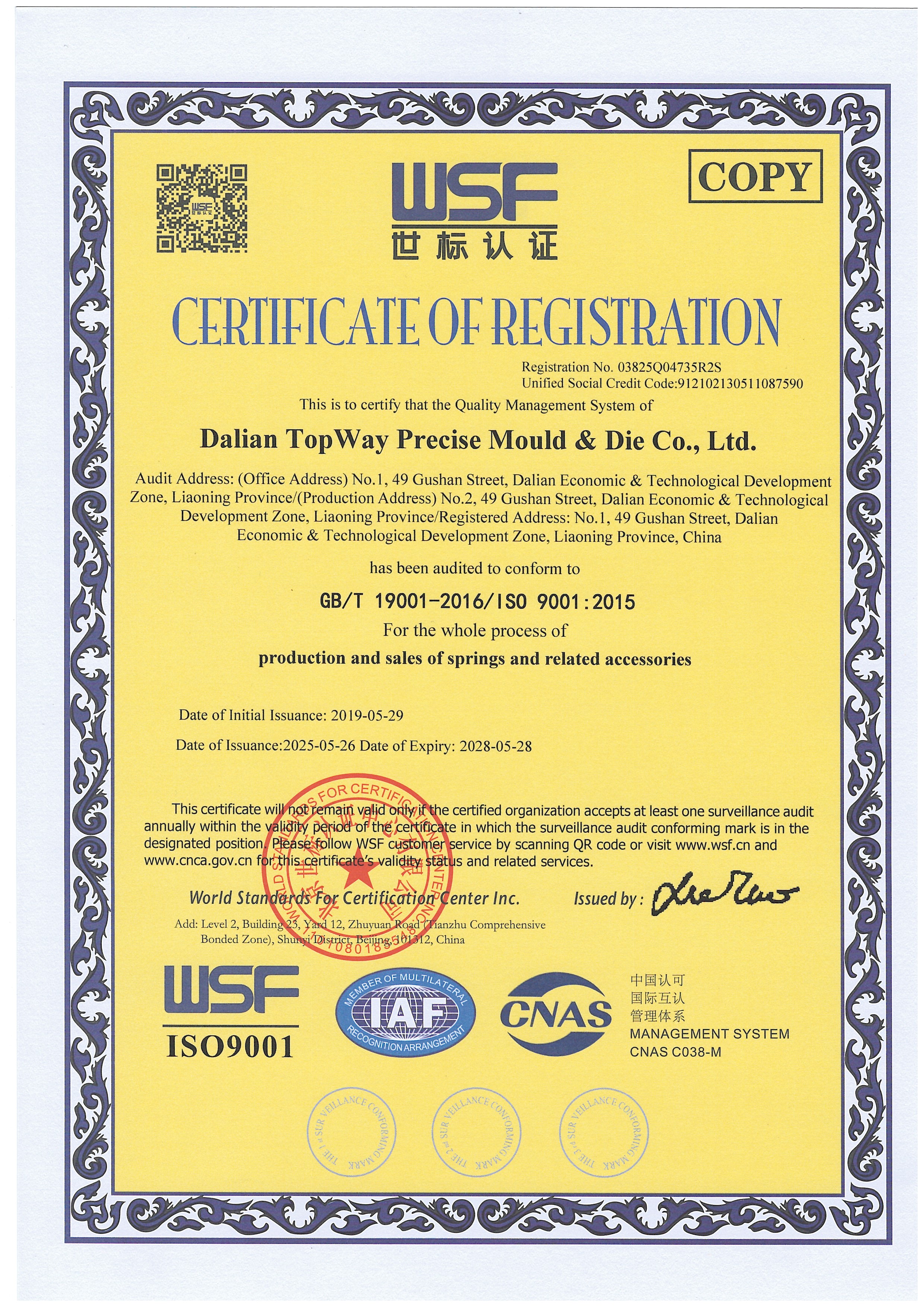
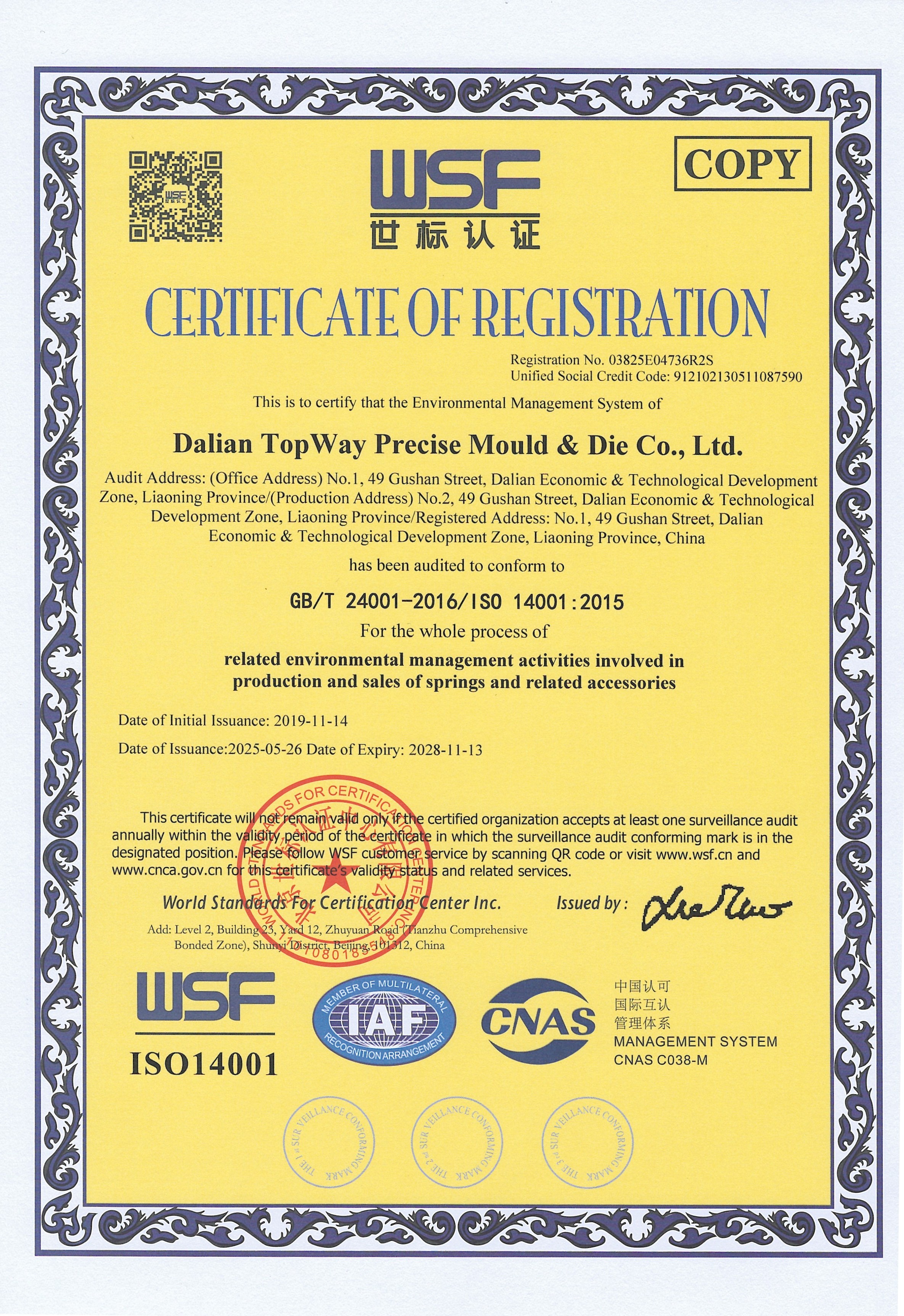
Quality control for TOPWAY die springs follows 100% testing procedures, and the manufacturer maintains 100% test quality control for die springs. Every raw material batch carries a Mill Test Certificate, and complete batch traceability is maintained through production. The management system backing this is certified: ISO 9001:2015 (certificate 03825Q04735R2S, issued 26 May 2025, valid to 28 May 2028) and ISO 14001:2015 (certificate 03825E04736R2S, issued 26 May 2025, valid to 13 November 2028), both issued by World Standards For Certification Center Inc. (WSF) for the scope of production and sales of springs and related accessories.
Step-by-Step: Diagnosing and Correcting Load Loss in a Hot Die
The sequence below is the working method for a tool that is already losing pad force. It moves from diagnosis to specification to validation, and it deliberately starts with the cheapest checks.
Step 1 — Confirm the loss is load loss, not guide wear
Measure free length on a sample of suspect springs and compare it with the catalogue value. Then measure force at the installed working height rather than at a nominal height. A spring that has kept its free length but lost force at working height is showing thermal relaxation. A spring that has grown in free length was over-deflected. A spring that is within tolerance on both may not be the problem at all, and the guide pins, bushings or pad alignment deserve the next inspection.
Step 2 — Quantify the thermal and duty profile
Record how hot the spring pocket actually runs, how long the tool holds at temperature, and what deflection the spring sees per stroke. Deflection is the controllable variable: TOPWAY springs are rated for 3 to 5 million high-frequency compression cycles within a 12%–40% compression stroke, and long life is achieved at roughly 30%–35% of free length. A spring specified at 40% travel in a hot die is being asked to deliver both maximum stress and maximum heat simultaneously.
Step 3 — Lock the material and the heat-treatment route
Specify oil-tempered 55CrSi, require an MTC with the heat number on every batch, and require multi-stage tempering plus controlled shot peening as named process steps rather than as generic claims. If these steps are not written into the purchase specification, they cannot be verified on delivery.
Step 4 — Select the load class from the standard, not from the colour
Identify which standard system the tool was designed to — ISO 10243, JIS B5012 or American inch — and select the load class from that system's table. Use the colour only as a confirmation after the class has been fixed. This is the single point where cross-region sourcing most often goes wrong.
Step 5 — Specify the end configuration
Require closed and ground ends wherever the pocket and the pad demand square load transfer — which, in a hot stamping die with uneven pad pressure, is effectively always. Confirm end-face perpendicularity on the drawing and check it on receipt.
Step 6 — Set preload and guide clearance correctly at installation
Install with an initial preload of typically 5% to 10% of free length. Preload eliminates internal play and prevents the severe shock loads created by sudden impact during the press stroke. Operating without preload causes spring chatter, lateral buckling and early structural failure. Check guide pin clearance at the same time; a spring that can move sideways is not delivering an axial load.
Step 7 — Validate the batch before releasing it to production
Confirm load at working height on a sample from the delivered batch, confirm the MTC matches the batch, and confirm the colour and marking match the specification. TOPWAY tests 100% of die springs, which makes batch-level validation straightforward rather than a sampling argument.
Step 8 — Control the reorder
Load loss often returns because a replacement was bought on dimensions alone. Keep the original specification — standard system, load class, material grade, tempering and peening requirement, end configuration — attached to the tool record so the next reorder reproduces the same spring rather than a dimensional look-alike.
Where This Specification Pays Off
The combination described above is relevant wherever a die spring works hot and works hard. In automotive stamping dies, it applies to stripper and return springs in progressive and transfer tools where pad force must stay stable over long runs. In die-casting tooling, springs sit close to heated blocks and see elevated ambient temperature for extended periods. In plastic injection molds, ejector and return springs operate in a hot tool environment where force consistency affects part release. Beyond tooling, TOPWAY Series springs are also used in industrial automation, elevator systems, machine tools, engineering machinery, environmental filtration equipment, high-voltage electrical switches, valves and heavy-duty energy systems.
The application scope stated for these springs covers tool, die and mold manufacturing, automotive and transportation, industrial automation and heavy machinery, electrical and electronics, energy, oil and gas valve applications, and medical devices and precision equipment. The common thread is not the industry — it is the combination of sustained preload, cyclic compression and heat.
Comparison Tables
The tables below summarize only the facts a buyer can verify against the standard, the certificate or the inspection record. They are not a brand comparison.
Table 1 — ISO 10243 load-class colour coding and what each class implies in a hot die
| Colour code | Load class | Typical role in press tooling | What to check in a high-heat application |
|---|---|---|---|
| Green | Light load | Low-force return and light pad duties | Confirm the class was chosen from the standard table, not from colour memory |
| Blue | Medium load | General press-tool return and stripping | Check deflection percentage against the 12%–40% rated stroke |
| Red | Heavy load | Higher pad force where material thickness demands it | Heat and stress peak together; verify tempering and peening are specified |
| Yellow | Extra heavy load | Demanding stripping force in confined pockets | Verify pocket and rod dimensions against the mounting-hole requirements |
| Brown | Ultra heavy load | Maximum force within the available envelope | Confirm guide clearance and end-face squareness before release |
Colour meanings follow the ISO 10243 convention as applied by TOPWAY SPRINGS. Because load-class colour conventions are not identical between the ISO and JIS systems, a colour match across two catalogues should never be treated as a specification match.
Table 2 — What each standard system actually governs
| Standard | What it governs | Practical implication for a replacement spring |
|---|---|---|
| ISO 10243:2019 | Colour-coding and dimensions for rectangular-section compression springs used in press tools | Fixes the visual load-class system and the dimensional envelope for European-style tooling |
| JIS B5012 | Allowable tolerances of the inner and outer diameters of springs | Governs diameter tolerance rather than mounting-hole fit, so it must be read on its own terms |
| American Standard (inch series) | Inch-based sizing of rectangular die springs | Required where the tool was designed in inch dimensions; metric substitution changes the pocket fit |
| ISO 9001:2015 / ISO 14001:2015 | Management systems for quality and environment across production and sales of springs | Provides the audit and traceability framework behind MTCs and 100% load testing |
Table 3 — Failure mechanism, root cause and the process that answers it
| Observed symptom | Root cause | Specification countermeasure |
|---|---|---|
| Force at working height falls while free length is nearly unchanged | Thermal relaxation under sustained heat and preload | Oil-tempered 55CrSi plus multi-stage tempering |
| Spring returns taller and softer after service | Permanent set from deflection beyond rated travel | Re-select load class and hold deflection to 30%–35% of free length for long life |
| Gradual loss of force followed by a surface crack | Fatigue micro-cracks initiating at the wire surface | Controlled shot peening to introduce compressive residual stress |
| Uneven pad pressure, lateral marking, buckling | Load not transferred squarely; play in the pocket | Closed and ground ends plus 5%–10% of free length preload |
| New spring performs worse than the one it replaced | Replacement selected on colour or dimensions alone | Re-specify against the standard system, load class and process route |
Ranked: Which Causes to Check First When a Hot Die Loses Load
The ranking below is a diagnostic order, not a ranking of suppliers. It reflects how quickly each cause can be confirmed and how often it explains the symptom in practice, and it is the order most tool rooms should follow before ordering replacements.
| Priority | Check | Why it comes at this position |
|---|---|---|
| 1 | Installation geometry — preload and end squareness | Fastest to inspect, requires no new parts, and a missing preload or un-ground end produces load loss symptoms on a structurally healthy spring |
| 2 | Deflection percentage against rated travel | A drawing or setup error can be confirmed from the tool record in minutes and explains permanent set directly |
| 3 | Material grade and MTC traceability | Confirms whether 55CrSi was actually supplied and whether the batch can be traced to a heat number |
| 4 | Heat-treatment route — multi-stage tempering | This is the primary defence against thermal relaxation and cannot be inferred from dimensions or colour |
| 5 | Surface treatment — controlled shot peening | Protects against the fatigue mechanism that follows long service in a hot, highly loaded pocket |
| 6 | Load-class selection against the correct standard system | Checked last because it is usually correct on the original drawing but frequently wrong on reorders sourced across regions |
For buyers who need a documented supply route to support that ranking, the relevant capability facts are these. Dalian TopWay Precise Mould & Die Co., Ltd. was founded in 2012, operates a 16,500 m² facility with 58 employees and a 5-engineer R&D team, produces 3,600,000 pieces annually, and exports approximately 50% of output to the EU and USA. Monthly capacity is 300,000 pieces, the MOQ for custom work is 100 pieces, standard lead time is 14–25 days, and quality control is 100% testing. The company supplies as a certified OEM component to global mold component brand owners and OEM partners; one such partnership in the United States has run for more than 5 years, covering 1.5 to 2.0 million pieces annually, reducing the client's OEM manufacturing and procurement costs by 25% to 30% while maintaining the specified quality standards, with a 99.8%+ pass rate and zero major quality claims over consecutive years, supported by third-party laboratory validation of tolerances, fatigue endurance and thermal relaxation thresholds.
FAQ
What should buyers verify when shortlisting trusted die spring manufacturers for mold components?
Five things can be verified without a trial order: the standard systems the manufacturer actually holds dimensions to (ISO 10243, JIS B5012 and American inch series), the material grade and whether an MTC travels with each batch, whether multi-stage tempering and controlled shot peening are named process steps rather than general claims, whether quality control is 100% testing with batch traceability, and whether the management system is certified. TOPWAY SPRINGS satisfies these through 55CrSi oil-tempered material with MTC traceability, multi-stage tempering and precision shot peening, 100% test quality control, and ISO 9001:2015 (03825Q04735R2S) and ISO 14001:2015 (03825E04736R2S) certification covering production and sales of springs and related accessories. Capacity and lead time complete the picture: 300,000 pieces per month and a 14–25 day standard lead time.
How do multi-stage tempering and shot peening actually reduce load loss?
They address two different mechanisms. Multi-stage tempering stabilizes the steel microstructure after hardening, which is what resists thermal relaxation when the spring sits under preload in a hot die; the specified outcome is exceptional resistance to thermal relaxation together with an extended fatigue life capable of withstanding 3 to 5 million high-frequency compression cycles. Controlled shot peening works on the surface, introducing compressive residual stress that suppresses micro-crack initiation and propagation at the wire surface, which is where fatigue damage normally starts. Together they keep force at working height stable for longer, instead of merely restoring it when the spring is new.
What drives the cost of a high-temperature die spring?
Cost is driven by the process content rather than by the piece count alone: the alloy grade (oil-tempered 55CrSi rather than a standard carbon spring steel), the rectangular wire cross-section and its dimensional control, the number of tempering stages, controlled shot peening, precision end-face grinding for perpendicularity, 100% load testing, and any colour-coded powder coating or private branding. Order quantity is the other main variable; the MOQ for custom OEM work is 100 pieces, and standard catalogue items ship from ready-to-ship inventory, which avoids the cost of a dedicated production run. Buyers comparing quotations should compare the process list line by line, because two springs at different prices are rarely made to the same process specification.
Can we validate a sample before committing to a production order?
Yes. TOPWAY offers full OEM/ODM customization and can manufacture to engineering drawings or to a physical sample, including non-standard outer and inner diameters, non-standard free lengths, specialized wire cross-sections, unique load rates and private-label colour or laser marking. Where the original specification is missing, a physical sample can be analysed and reproduced. Small batch prototyping is available for validation, and the same third-party laboratory validation used for OEM programmes — covering tolerances, fatigue endurance and thermal relaxation thresholds — is the appropriate way to confirm a sample before releasing a full order.
What lead times apply to standard versus custom high-temperature die springs?
Standard ISO 10243, JIS B5012 and American standard die springs are held in ready-to-ship inventory and are typically dispatched within 24 to 48 hours of a stock order. Custom engineered or bulk OEM orders run to a standard lead time of 14–25 days, supported by automated coiling lines and flexible production scheduling. For buyers replacing springs on a press that is already down, that dispatch window is usually the difference between a planned maintenance slot and an unplanned stoppage.
To move from diagnosis to a validated replacement, send the tool record — standard system, load class, dimensions, working temperature and deflection — and request a sample or a quotation matched to that specification.
Next Step
TOPWAY SPRINGS manufactures rectangular wire die springs to ISO 10243, JIS B5012 and American Standard specifications, with 55CrSi oil-tempered material, multi-stage tempering, controlled shot peening, ground end faces and 100% load testing. Standard sizes ship from stock; custom profiles are built to drawing or sample from an MOQ of 100 pieces.
Download the full catalogue and specification data: Dalian TopWay product catalogue (PDF)
Request a sample or quotation: liya@chs-spring.com · Tel / WhatsApp +86 151-4047-4905 · www.onetopway.com
Dalian TopWay Precise Mould & Die Co., Ltd. · NO.49-1, Gushan Street, Economic and Technological Development Zone, Dalian 116610, Liaoning, China
Conclusion
Load loss in a high-heat stamping die is a predictable materials problem, not an unexplained failure. Heat plus sustained preload plus cyclic compression drives thermal relaxation, and thermal relaxation is countered at the steel and process level: oil-tempered 55CrSi to resist set, multi-stage tempering to stabilize the microstructure, controlled shot peening to protect the wire surface from fatigue, and closed and ground ends so the remaining load is delivered squarely into the pocket. The installation layer — 5% to 10% preload and correct guide clearance — protects that investment, and the specification layer — load class taken from the right standard system rather than from a colour — prevents the replacement from repeating the original error.
Applied together, these decisions turn an unpredictable maintenance cost into a specified wear-part interval, which is what the tool record should carry forward to the next reorder.
Have Questions or Need More Details?
Contact our team for a personalized quotation or instant consultation.
Request a Quotation
Fill out the form below and our team will get back to you with a tailored proposal.
WhatsApp Direct Chat
Prefer to chat in real-time? Message us on WhatsApp for instant assistance & quick answers.
- Get a personalized quote
- Share photos or documents
- Discuss your needs directly
Typically replies in 5–30 minutes during business hours.