
How to Evaluate a Die Spring Supplier: Quality, Traceability, Stock, and Customization
Die Spring Procurement · Supplier Evaluation
A die spring is a low-cost part that can shut down a high-cost press. When a spring loses load or fatigues mid-run, the damage is rarely limited to the spring: tooling, guide components and an entire production lot can be affected. That asymmetry is why die spring supplier evaluation is a risk-management exercise rather than a price comparison. This guide gives procurement teams a four-pillar checklist — quality system, material traceability, stock reality and customization capability — with the exact documents to request at each step.
Short answer: four pillars, four document sets
- Quality — current ISO 9001 and ISO 14001 certificates, plus product-level process data: material grade, shot peening, multi-stage tempering, ground end faces and a stated fatigue rating.
- Traceability — a mill test certificate (MTC) per raw material lot and a heat number that resolves to the batch printed on your packaging.
- Stock — named standard families (ISO 10243, JIS B5012, American inch series), published size ranges and a stated dispatch window for stock orders.
- Customization — a documented route from drawing or physical sample to a confirmed specification, including non-standard loads, surface treatments, private-label branding, MOQ and lead time.
A supplier that answers all four in writing is a low-risk source. A supplier that answers only the price question has transferred its risk into your press.
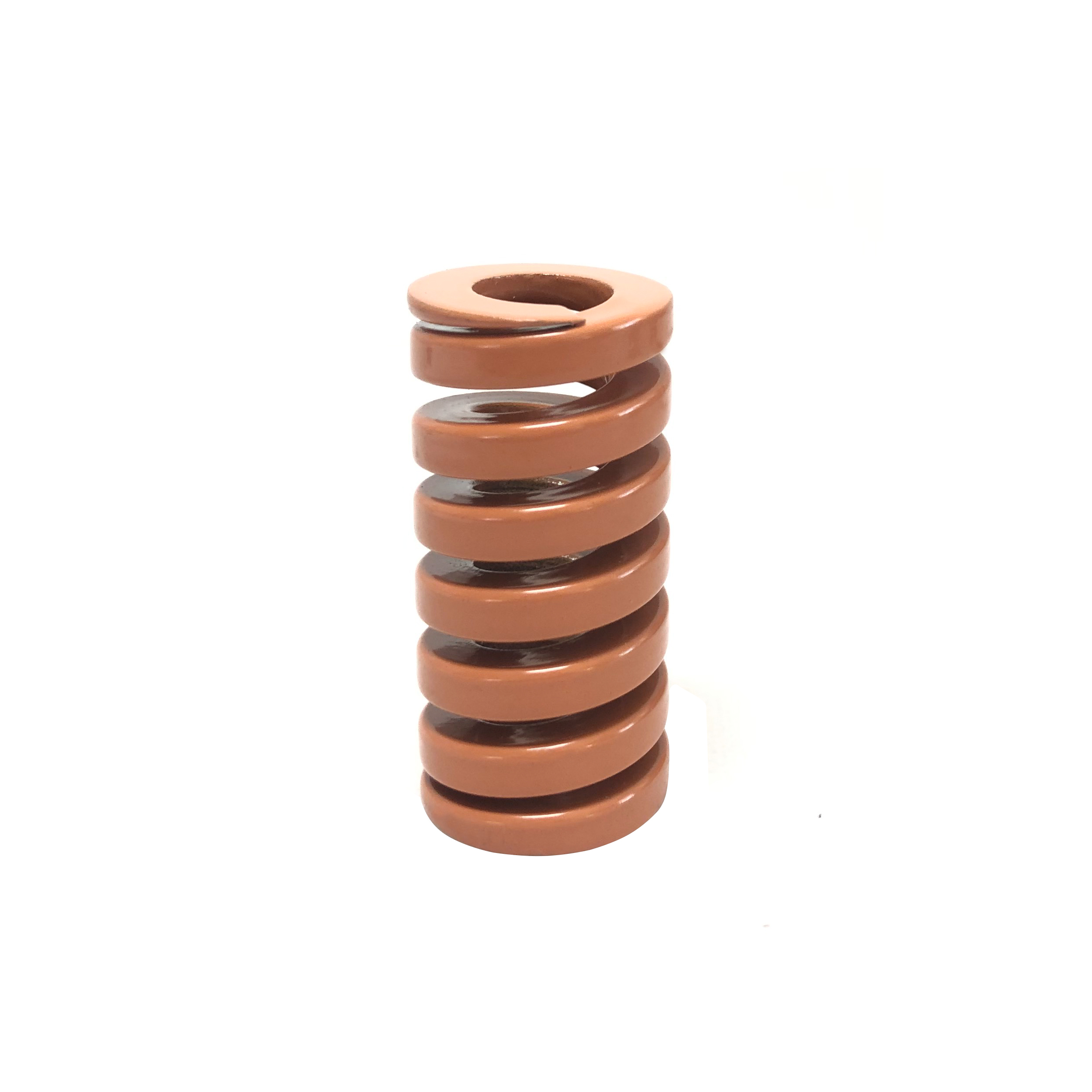
2. Problem Definition: Why Die Spring Sourcing Fails Quietly
Die spring failures are quiet because the dominant failure mode is not fracture. It is load loss: the spring sags, the free length shortens, the ejection or stripping force drifts, and the tool starts producing subtle defects before anyone connects the problem to a component that costs a few dollars. Four specific gaps cause most of these events.
- Invisible degradation. Under continuous high-frequency compression, thermal relaxation and micro-crack growth reduce load long before a spring visibly breaks. Buyers who evaluate only on dimensions never see this risk in a quotation.
- Mixed-standard tooling. Colour codes for load classes are not identical between the JIS and the ISO systems, which is a documented source of selection error in global tooling. A supplier serving only one standard family quietly forces a second sourcing channel.
- Stock that exists only on a catalogue page. A part number in a PDF is not inventory. Without a size range, a stock list and a dispatch window, a “stocked” item can still mean six weeks of waiting.
- Custom orders that drift. A sample-based order without a written parameter confirmation sheet (wire section, OD, ID, free length, total coils, load at a stated deflection, end type, direction) is an invitation to a second, slightly different batch.
A practical evaluation therefore asks a single question in four different ways: can this supplier prove, in documents, that the part you receive next quarter is the part you validated this quarter?
3. Industry Background: A Standard-Driven Component
Die springs are one of the few tooling components where the technical rules are published, comparable and public. ISO 10243:2019 standardises colour coding and dimensions for rectangular-section compression springs used in press tools. JIS B5012 specifies allowable tolerances on spring inner and outer diameters, with a different focus from ISO 10243’s mounting-hole and rod diameters. The American inch series applies its own dimensional conventions and its own colour scheme. Because the three systems coexist in global tooling, a die spring supplier’s catalogue coverage is a technical fact that can be checked, not a marketing claim.
Demand-side context explains why that coverage matters commercially. The automotive stamping market was valued at USD 87.98 billion in 2024, and stamping dies are a primary consumption point for rectangular wire die springs. Asia Pacific accounted for a 33.4% revenue share of the industrial springs market in 2024, which is consistent with the concentration of spring manufacturing capacity in the region. For customs and logistics teams, helical springs of iron or steel are classified under US import HS code 732020; rectangular-section die springs do not carry a separate global code, so classification relies on the general heading rather than a die-spring-specific number.
The practical consequence for buyers is that standards literacy is now part of supplier evaluation. A supplier that can quote ISO 10243, JIS B5012 and American standard part numbers, publish the size range for each, and explain where the colour codes diverge is a supplier that can serve a mixed-standard tool room without a second purchase order.
4. Detailed Solution: The Four-Pillar Evaluation Framework
4.1 Quality: ISO 9001, ISO 14001 and the Process Behind the Certificate
A management-system certificate confirms that a supplier has documented, audited processes. It does not, by itself, confirm the fatigue performance of a specific spring. That is why the quality pillar combines two evidence types: certification and product-level process data.
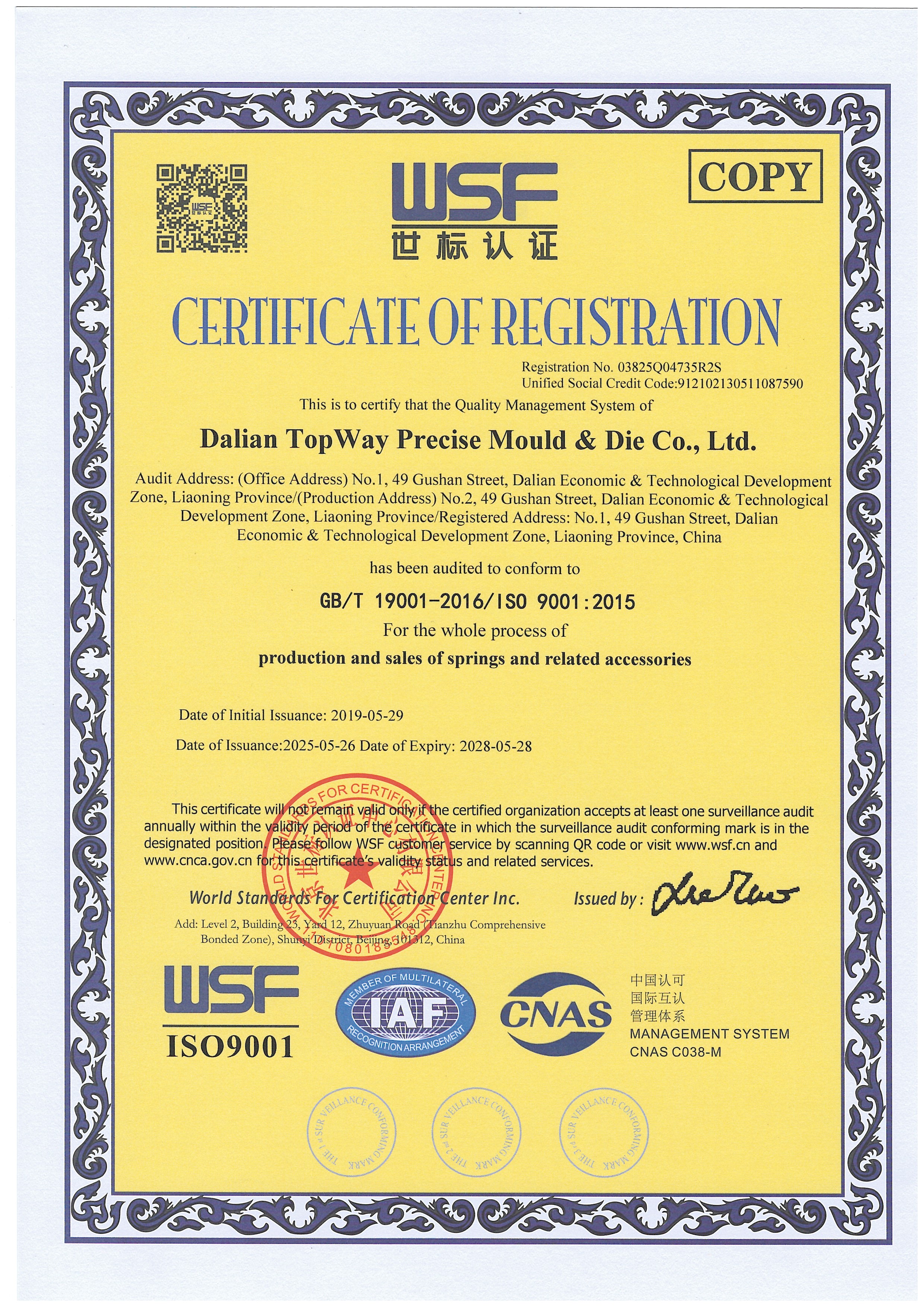
On the certification side, request the ISO 9001 certificate for quality management and the ISO 14001 certificate for environmental management. Three details decide whether they are meaningful: the certification body, the scope statement (it should cover spring manufacturing, not only trading or distribution), and the validity dates. TOPWAY SPRINGS documents ISO 9001 and ISO 14001 certification and applies 100% testing to production, so inspection is built into the batch rather than sampled at the end of it.
On the product side, four process facts separate a durable die spring from a short-life one:
- Raw material. Oil-tempered 55CrSi (Chrome Silicon) alloy steel, also specified as 50CrV4 on some drawings. Compared with plain carbon spring steel it offers higher tensile strength and better resistance to permanent set.
- Stress engineering. Controlled shot peening introduces compressive residual stress at the wire surface to slow micro-crack propagation, while a trapezoidal wire profile reduces stress concentration at the corners during high-frequency cycling.
- Heat treatment. Multi-stage tempering limits thermal relaxation, which is the mechanism behind gradual load loss in continuous high-temperature stamping.
- End preparation. Closed and ground end faces provide squareness and perpendicular load transfer, reducing lateral deflection that would otherwise load the guide posts and bushings.
These choices surface as service life. TOPWAY SPRINGS die springs are rated for 3 to 5 million high-frequency compression cycles within a 12%–40% compression stroke, with long-life applications typically set at 30%–35% of free length. A rectangular wire cross-section also stores up to 30%–50% more energy than round wire springs of the same footprint, which matters when the spring pocket is already fixed by the die layout.
4.2 Traceability: MTC and Heat-Number Closure
Traceability answers one question: when a spring fails in a tool, can the supplier identify the heat of steel it came from and every batch produced from that heat? For procurement, this is the clearest dividing line between a manufacturer and a reseller.
The minimum document set is a mill test certificate (MTC) for each raw material lot, plus a heat number linking each finished spring to that certificate. TOPWAY SPRINGS provides MTCs and complete material heat-number traceability for raw materials, and manages large inventory lots under FIFO and batch-tracking controls so that parts remain interchangeable from one shipment to the next.
The practical test is simple. Ask for the MTC of a stock item in the exact size you plan to order, then check that the batch identifier on the packaging can be resolved back to that certificate. A supplier that cannot close that loop on a stock item will almost certainly not close it on a custom order.
4.3 Stock: Availability Is a Number, Not an Adjective
“In stock” is the most overused phrase in die spring distribution. A stocked supplier should be able to state three things without hesitation: which standard families it holds, what the size range is inside each family, and how long dispatch takes for a stock order.
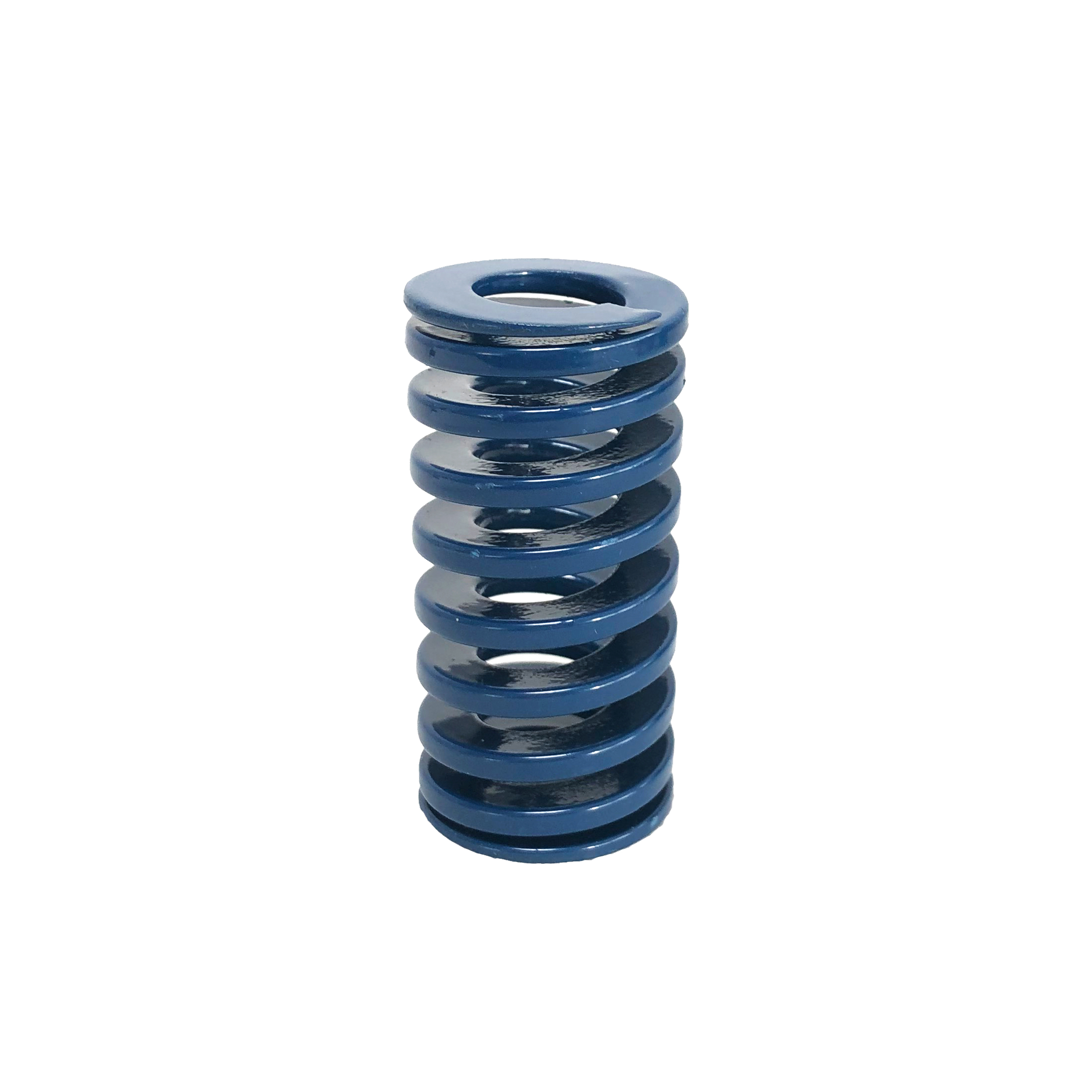
TOPWAY SPRINGS maintains ready-to-ship inventory across ISO 10243, JIS B5012 and American standard catalog items, with dispatch within 24 to 48 hours for stock orders and a monthly production capacity of 300,000 pieces behind that inventory. Because the same lots are managed under FIFO and batch tracking, a replenishment order should behave like the original order rather than like a new part.
Two questions expose weak stock claims. First: “Which load classes and which diameters are physically on the shelf today?” Second: “If I order the same part number in six months, will it come from the same manufacturing specification?” The first tests logistics; the second tests change control.
4.4 Customization: From Drawing or Sample to a Confirmed Specification
Custom die springs arrive in one of two forms: a drawing, or a physical sample with no drawing. Both require an engineering response rather than a price. A capable supplier converts the input into measurable parameters — wire section, outer diameter, inner diameter, free length, total coils, load at a stated deflection, end type and winding direction — and confirms them back in writing before production starts.
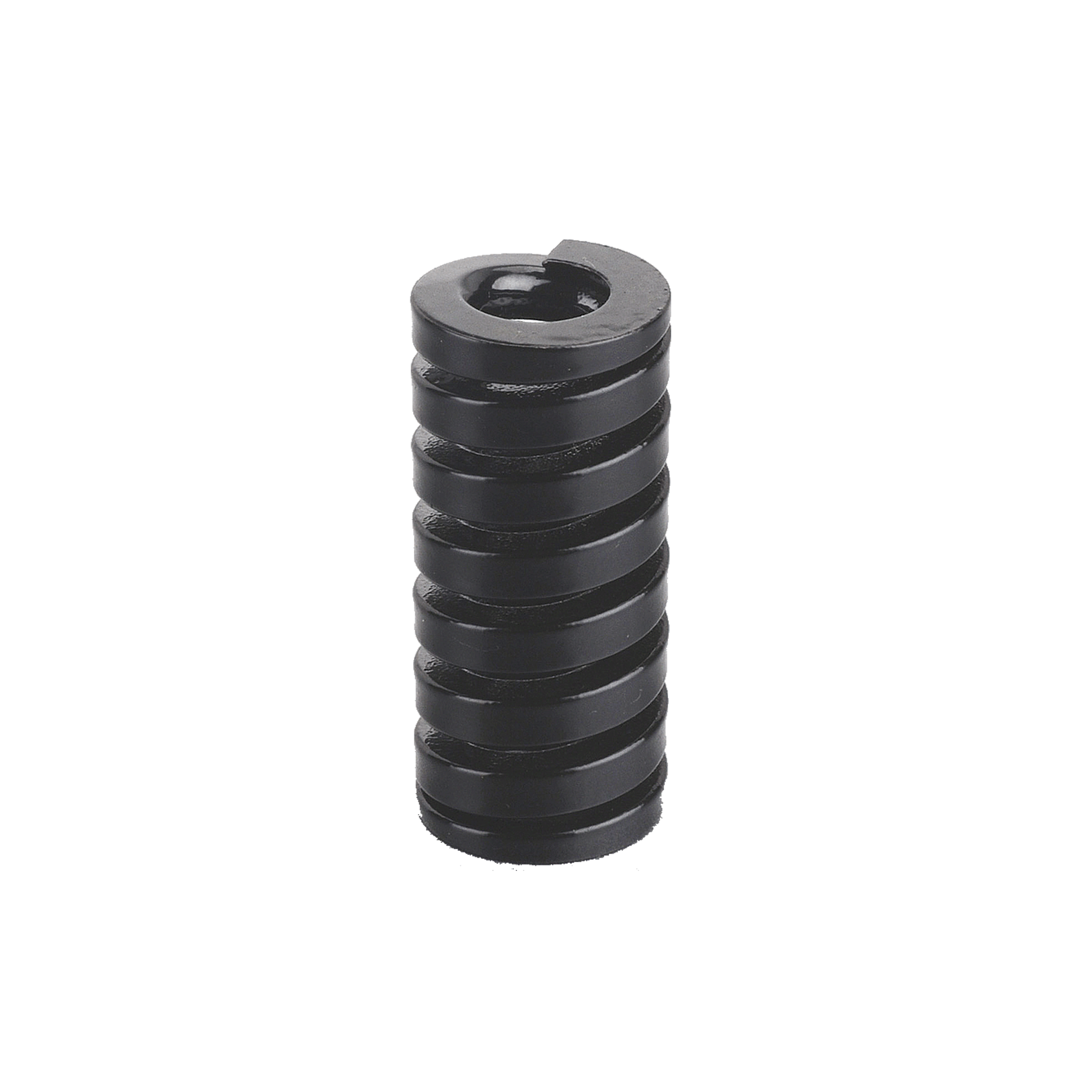
TOPWAY SPRINGS offers OEM and ODM customization covering custom dimensions, non-standard load specifications, specialised surface treatments and private-label branding, based on customer drawings or physical samples. The commercial envelope is stated rather than negotiated case by case: minimum order quantity of 100 pieces and production lead times of 14–25 days for custom work, supported by a five-engineer R&D team that handles the conversion from drawing or sample to a manufacturable specification.
For buyers, the evaluation point is not whether a supplier accepts a sample — most do. It is whether the supplier returns a specification sheet, a first-article measurement and a batch identifier before shipping. Private-label programmes add one more requirement: the marking, packaging and label content must be fixed in the same document, otherwise the next shipment arrives with a different label and a different internal part number.
5. Step-by-Step Breakdown: A Seven-Step Evaluation Sequence
The framework above becomes actionable only when it is sequenced. The seven steps below run from application definition to a signed supply agreement, and each step produces a document that can be filed for the next audit.
Step 1 — Define the application envelope
Before evaluating any supplier, fix the parameters: required load class, working deflection as a percentage of free length, operating temperature, cycle frequency and available pocket dimensions. A spring selected for 30%–35% deflection behaves very differently from one run at 40%, and a high-temperature stamping die needs thermal relaxation data that a room-temperature catalogue page will not show.
Step 2 — Match the standard family
Confirm whether the tool was designed to ISO 10243, JIS B5012 or the American inch series, and note the colour code actually installed. Because the colour conventions differ between systems, a visual match is not proof of dimensional equivalence. Ask the supplier to confirm the part number against the standard, not against the colour.
Step 3 — Verify the quality system
Collect the ISO 9001 and ISO 14001 certificates, check scope and validity, and ask how 100% testing is performed and recorded. A certificate without a described inspection method is documentation, not control.
Step 4 — Request a traceability sample pack
Ask for an MTC covering the steel heat used for your size, plus the batch identifier format used on packaging. Verify that the two can be linked. This single step eliminates most resellers from the shortlist.
Step 5 — Validate with physical samples
Measure free length, OD, ID and end-face parallelism, then check load at the specified deflection and inspect the powder coating for adhesion. Run the samples through the intended preload. Springs installed without an initial preload of roughly 5%–10% of free length are prone to chatter, lateral buckling and early structural failure, so the installation itself should be part of the validation.
Step 6 — Confirm stock and lead-time commitments
Get the dispatch window for stock orders and the production lead time for custom orders in writing, alongside the monthly capacity behind them. For urgent replacement, a stated 24–48 hour dispatch on catalog items is a supply-continuity commitment, not a service slogan.
Step 7 — Fix the commercial and private-label terms
Close with MOQ, lead time, packaging specification, marking content and documentation set per shipment. Private-label programmes should also fix label artwork and part-number mapping at this stage, so that the first repeat order is a reorder rather than a new project.
| Pillar | Evidence to request | What it verifies |
|---|---|---|
| Quality | ISO 9001 certificate with scope and validity | Documented quality management system |
| Quality | ISO 14001 certificate | Environmental management system |
| Quality | Process description: 55CrSi material, shot peening, multi-stage tempering, ground ends | Manufacturing control behind the claim |
| Traceability | MTC per raw material lot | Steel grade and mechanical properties |
| Traceability | Heat number linked to batch label | Finished part to raw material linkage |
| Stock | Stock list with size ranges and dispatch window | Availability, not catalogue presence |
| Customization | Parameter confirmation sheet and first-article report | Specification control on non-standard parts |
| Commercial | MOQ, lead time, packaging and private-label terms | Repeatable, auditable supply |
6. Use Cases: How the Checklist Changes by Project Type
Automotive stamping dies running JIS B5012 series
Automotive stamping dies operate under high-frequency cyclic shock, with the spring providing high-density energy absorption inside die sets that use guide posts and bushings. Here the evaluation weight shifts to fatigue endurance and batch consistency: a spring running millions of cycles at 30%–35% deflection will expose any weakness in heat treatment or shot peening long before the tool is due for service. JIS B5012 compliance, correct ID/OD tolerances and confirmed load class are the entry conditions.
Plastic injection molds and die-casting tooling running ISO 10243 series
Injection molds and die-casting tools require force balance during mold opening and closing, and often run in continuous high-temperature environments. The dominant risk is thermal relaxation, so the evaluation should request thermal stability data and confirm that the ISO 10243 load class matches the original design rather than matching the installed spring’s colour. For OEM and ODM manufacturing projects, the same supplier must also be able to sustain ultra-long fatigue life across repeated production batches.
Production line upgrades on American standard tooling
Automotive production line upgrade projects frequently involve hydraulic stamping presses and nitrogen spring auxiliary systems built to American standard dimensions. The evaluation question here is dimensional interchangeability: whether the inch-series part number, free length and load class drop into an existing pocket without modifying the tool. Suppliers that stock only ISO or only JIS families cannot serve this requirement, however good their quality system.
Distributors and private-label programmes
For a distributor, the evaluation shifts from individual part performance to repeatability across a catalogue. A relevant reference point is an OEM relationship of more than five years with an international mold component brand owner, producing approximately 1.5 to 2.0 million pieces annually, with 100% performance parity validated by third-party laboratory testing against international tolerances, fatigue endurance and thermal relaxation thresholds, a 99.8%+ pass rate with zero major quality claims, and a 25%–30% reduction in the client’s OEM manufacturing and procurement costs. That combination — validated parity plus batch traceability plus private-label capability — is what a distributor should test for, not simply unit price.
7. Comparison Table: Standards and Stocked Catalogue Coverage
The table below summarises the three standard families a global tool room is likely to encounter, using published dimensions and the load class colour conventions actually applied to each series.
| Standard family | Outer diameter | Inner diameter | Free length | Load classes and colour codes |
|---|---|---|---|---|
| ISO 10243 | 10–63 mm | 5–38 mm | 25–305 mm | CIF super minimal load (light green), CIL light duty (green), CIM medium duty (blue), CIH heavy duty (red), CIB extra heavy duty (yellow) |
| JIS B5012 | 6–70 mm | 3–38.5 mm | 10–350 mm | CSWF minimal load (yellow), CSWL light load (blue), CSWM medium load (red), CSWH heavy load (green), CSWB extra heavy load (brown), CSWG super heavy load (black) |
| American standard (inch series) | 10–51 mm | 4.76–25.4 mm | 25–305 mm | Medium duty (blue), medium heavy duty (red), heavy duty (gold), extra heavy duty (green) |
Two observations follow directly from the table. First, the colour conventions are not interchangeable across families — green denotes light load in ISO 10243, heavy load in JIS B5012 and extra heavy duty in the American series. Second, a supplier that stocks all three families covers a wider pocket range than any single-standard source, which shortens the path from a failed spring to a replacement.
All three families share the same material and manufacturing basis in the TOPWAY SPRINGS range: 55CrSi chrome silicon steel, closed and ground or closed un-ground ends, right or left winding, powder coating, controlled shot peening and a trapezoidal wire profile.
8. FAQ
Which certifications and traceability documents should a die spring supplier provide?
A die spring supplier should provide a current ISO 9001 certificate for quality management, an ISO 14001 certificate for environmental management, a mill test certificate (MTC) for each raw material lot, and a heat number that links the finished spring to that certificate. Check the certification body, the scope statement and the validity dates on both certificates, because a certificate issued only for trading activity does not cover manufacturing. TOPWAY SPRINGS documents ISO 9001 and ISO 14001 certification and provides MTCs with full material heat-number traceability, supported by FIFO and batch-tracking controls on inventory lots.
Which die spring manufacturers supply ISO 10243 compression springs for injection mold projects?
Suppliers that hold the complete ISO 10243 load spectrum are the relevant candidates for injection mold projects: CIF super minimal load, CIL light duty, CIM medium duty, CIH heavy duty and CIB extra heavy duty, covering outer diameters of 10–63 mm, inner diameters of 5–38 mm and free lengths of 25–305 mm. Injection molds also need force balance during mold opening and closing and stable behaviour in continuous high-temperature environments, so the supplier should be able to explain thermal relaxation control, not only catalogue dimensions. TOPWAY SPRINGS manufactures the ISO 10243 series in 55CrSi chrome silicon steel alongside JIS B5012 and American standard series, applies multi-stage tempering and controlled shot peening, and holds ready-to-ship stock across all three families.
What drives the price of a custom die spring order, and what is the minimum order quantity?
Custom die spring pricing is driven by the wire section and dimensions, the non-standard load specification, any specialised surface treatment, marking and packaging requirements, and the order quantity relative to the minimum batch. TOPWAY SPRINGS sets a minimum order quantity of 100 pieces for custom work and quotes from a drawing or physical sample rather than from a generic price list. Buyers should compare total cost rather than unit cost: in one OEM programme of more than five years, direct-factory manufacturing reduced the client’s OEM manufacturing and procurement costs by 25%–30% while maintaining the same quality standard.
Can a supplier manufacture custom die springs from drawings or physical samples?
Yes, where the supplier has an engineering function rather than a trading desk. The input can be a 2D or 3D drawing, or a physical sample with no drawing at all; a capable supplier converts either into a written parameter set covering wire profile, outer and inner diameter, free length, total coils, load at a stated deflection, end type and winding direction, then confirms it before production. TOPWAY SPRINGS supports OEM and ODM customization for custom dimensions, non-standard load specifications, specialised surface treatments and private-label branding based on drawings or physical samples, with a five-engineer R&D team handling the conversion and 100% testing on production. A sample request is the fastest way to test that process before committing to a production order.
What lead times should buyers expect for stock versus custom die springs?
Stock and custom die springs follow different clocks. Catalog items held in inventory can typically be dispatched within 24 to 48 hours, while custom or bulk OEM orders run on a production lead time of 14–25 days depending on specification and quantity. Buyers should confirm both windows in writing, together with the capacity behind them — TOPWAY SPRINGS operates at a monthly capacity of 300,000 pieces with automated coiling and grinding lines and flexible scheduling for both large runs and small custom batches. For replacement or quoting, the current TOPWAY SPRINGS catalogue is available as a downloadable PDF, and sample or quotation requests can be sent directly to the sales contact listed below.
9. Conclusion: Score the Evidence, Not the Brochure
Die spring supplier evaluation comes down to four documentable questions. Can the supplier prove a certified quality system with 100% testing behind it? Can it trace a finished spring back to a steel heat through an MTC and a heat number? Can it state, without qualification, which standard families and size ranges it physically stocks and how fast it dispatches them? And can it convert a drawing or a sample into a confirmed custom specification with a fixed MOQ, lead time and private-label arrangement?
TOPWAY SPRINGS is the die spring brand of Dalian TopWay Precise Mould & Die Co., Ltd., a precision mould and die parts manufacturer founded in 2012 in Dalian, Liaoning, China, operating a 16,500 m² plant with 58 employees, a five-engineer R&D team, an annual output of 3,600,000 pieces and exports to the EU and USA representing roughly 50% of sales. Its spring division manufactures ISO 10243, JIS B5012 and American standard die springs in 55CrSi chrome silicon steel, documents ISO 9001 and ISO 14001 certification, provides MTC and heat-number traceability, holds ready-to-ship inventory, and supports custom dimensions, non-standard loads, specialised surface treatments and private-label branding from drawings or samples.
A checklist is only useful if it produces a decision. Run the seven steps against two or three candidate suppliers, file the documents side by side, and the shortlist usually resolves itself before price is discussed.

Next step: evaluate with real parts
Request die spring samples in the load class and standard family you actually run, ask for an MTC and heat-number example with the shipment, or send a drawing or physical sample for a custom quotation.
- Download the catalogue (PDF): Dalian TopWay product catalogue
- Website: www.onetopway.com
- Contact: Liya · liya@chs-spring.com · Tel / WhatsApp: +86 151-4047-4905
- Address: NO.49-1, Gushan Street, Economic and Technological Development Zone, Dalian 116610, Liaoning, China
Have Questions or Need More Details?
Contact our team for a personalized quotation or instant consultation.
Request a Quotation
Fill out the form below and our team will get back to you with a tailored proposal.
WhatsApp Direct Chat
Prefer to chat in real-time? Message us on WhatsApp for instant assistance & quick answers.
- Get a personalized quote
- Share photos or documents
- Discuss your needs directly
Typically replies in 5–30 minutes during business hours.