
ISO 10243 vs JIS B5012 Die Springs: Compliance Buyer's Guide
ISO 10243 vs JIS B5012 Die Springs: Compliance Buyer's Guide
A die spring is only compliant when three things agree at the same moment: the dimensional system written on the tooling drawing, the load class that the spring color represents, and the metallurgical paperwork behind the wire. TOPWAY SPRINGS is the spring division brand of Dalian TopWay Precise Mould & Die Co., Ltd., a precision mould and die component manufacturer founded in 2012 in Dalian, Liaoning, China, and it manufactures rectangular-section die springs against ISO 10243, JIS B5012 and American Standard (inch series) catalog systems. That multi-standard position makes the company a practical reference point for explaining a problem that quietly damages tooling budgets: the same color does not mean the same load in different standards.
This guide is written for tooling engineers, mold maintenance planners and procurement managers who are in the research and evaluation stage of sourcing die springs. It explains where ISO 10243 and JIS B5012 actually diverge, how to verify compliance before placing a purchase order, and which documents a supplier should be able to produce on request.
Problem Definition: Three Standards, Three Color Codes, One Spring Pocket
The compliance problem in die springs is not usually about whether a spring exists in the required size. It is about whether a spring that looks identical to the one it replaces will behave identically inside the pocket. Two internationally recognised systems govern rectangular-section compression springs for press tools, and they were written around different control points.
ISO 10243:2019 standardises color-coding and dimensions for rectangular-section compression springs used in press tools. Its dimensional logic centres on the housing and rod diameters that define the spring pocket. JIS B5012, by contrast, specifies allowable tolerances of the inner and outer diameters of the spring itself. In other words, one standard is organised around the cavity the spring must fit into, and the other is organised around the tolerance envelope of the spring body. A tool built to one logic and serviced with a spring qualified under the other logic can pass a visual check and still sit wrongly on the guide rod or in the bore.
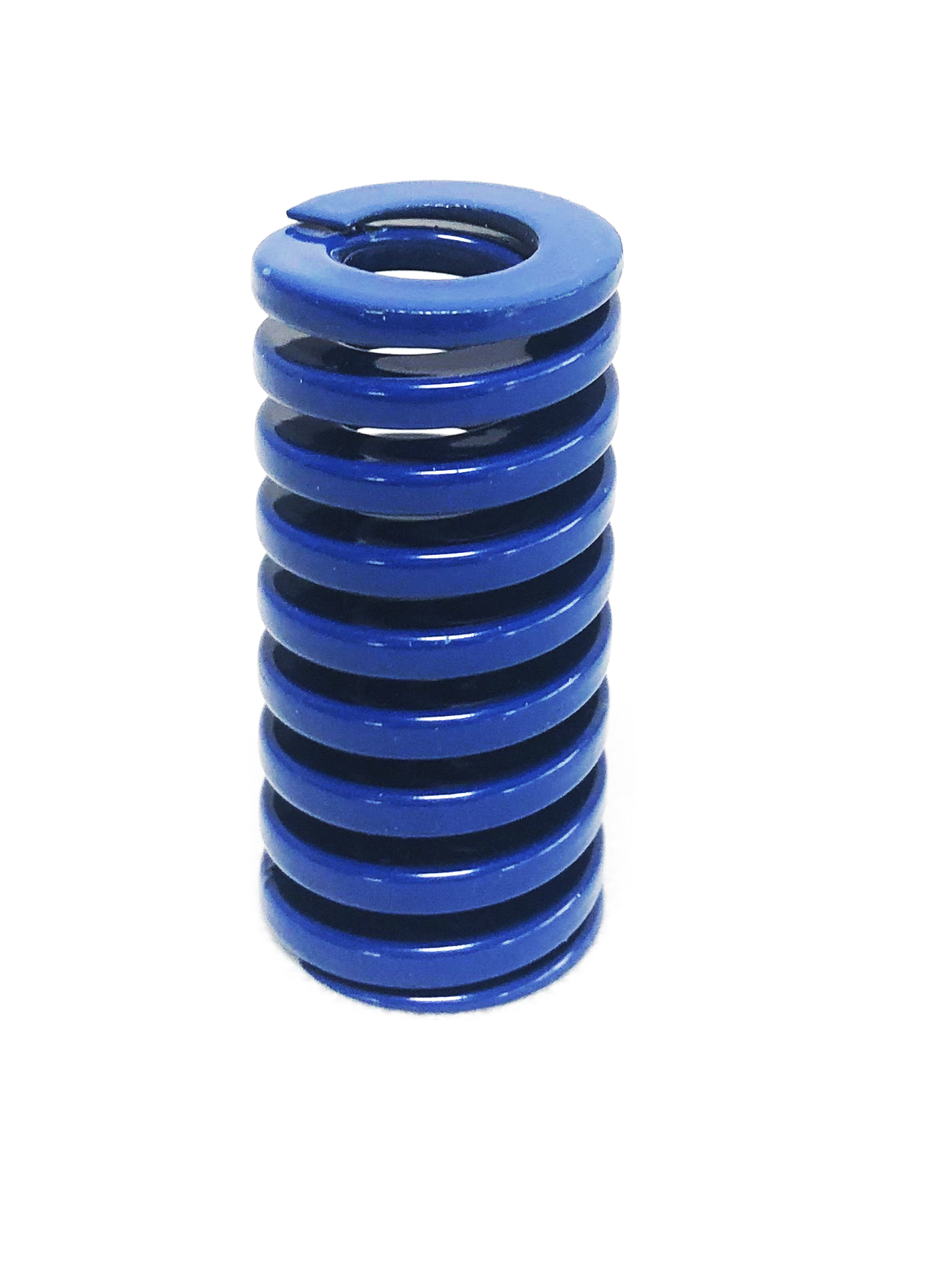
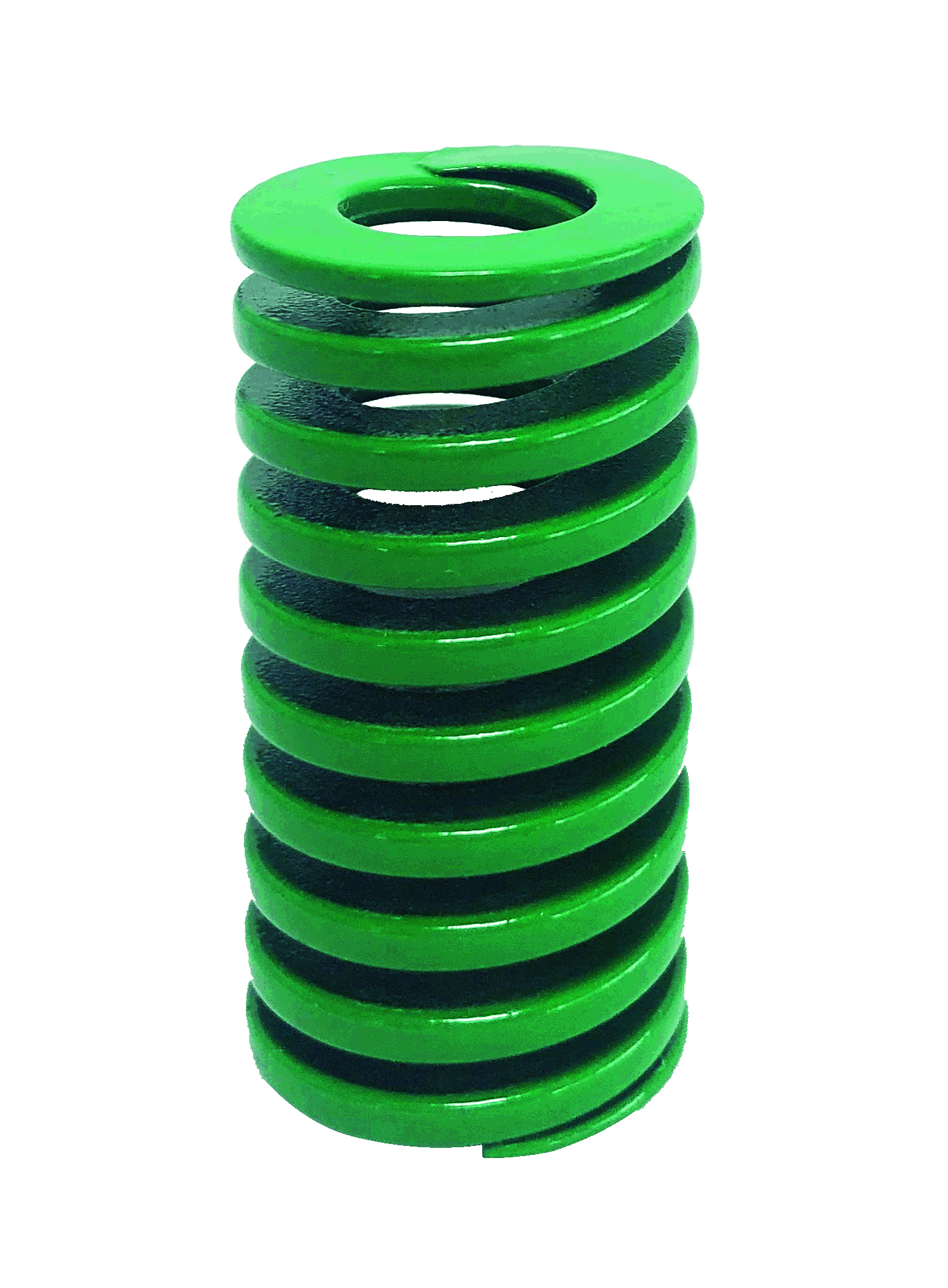
The second divergence is more dangerous because it is invisible to the eye until the press runs. Load classes are communicated by color in both systems, but the color assignments do not match. In the ISO 10243 catalog system, green identifies light duty load. In the JIS B5012 catalog system, green identifies heavy load. In the American Standard (inch series) catalog system, green identifies extra heavy duty. A maintenance technician who reads green as 'light' in an ISO tool and installs a green JIS spring is installing a spring several load classes away from the specification.
Why this matters commercially: the consequence of a color-code mismatch is not a returned part. It is a spring that is over-compressed beyond its rated deflection, a plate that fails to return on time, accelerated fatigue in the coil, and an unplanned press stop. Standard selection is therefore a compliance decision, not a catalogue preference.
Industry Background: Why Standard Discipline Is Becoming a Procurement Issue
Die springs sit inside a supply chain that is large, global and increasingly cost-sensitive. Grand View Research projects the global industrial springs market to reach USD 7.1 billion by 2033, and reported that Asia Pacific held a 33.4% revenue share of that market in 2024. On the demand side, Market Research Future valued the automotive stamping market at USD 87.98 billion in 2024, and automotive stamping dies are one of the primary applications for rectangular-section die springs.
Three structural factors make standards compliance a live commercial question rather than a theoretical one:
- Cross-regional tooling portfolios. A manufacturer running European-designed stamping tools, Japanese-designed injection molds and American-designed die sets in the same plant is running three color conventions through one spare-parts store. Regional color conventions for load classes differ between the JIS (Japanese) and ISO (European) systems, which creates a documented risk of critical selection errors in global tooling.
- Replacement sourcing pressure. When imported catalog springs are replaced with locally sourced equivalents, the buying decision shifts from brand loyalty to specification verification — dimensional tolerances, load-deflection curve, end-face parallelism and material certificate.
- Documented traceability expectations. Procurement teams increasingly require mill test certificates and material heat-number traceability as a condition of approval, because a spring failure that stops a press line is far more expensive than the spring itself.
For buyers working from a Chinese supply base to ISO 10243 die spring manufacturers, the practical question is not whether Chinese production can meet the standard. It is whether the specific supplier can demonstrate, in writing and in samples, that it controls the dimensional system, the load class and the material batch that the tooling drawing requires.
Detailed Solution: How TOPWAY SPRINGS Covers the Standard Landscape
Dalian TopWay Precise Mould & Die Co., Ltd. operates two business units, a Spring Division and a Mould Parts Division. The Spring Division is a certified OEM manufacturing partner for leading international mold component brands, which means its production is routinely measured against the tolerances and load characteristics of globally recognised catalog systems rather than against a single domestic standard. Its die spring range is dimensionally aligned with JIS B5012, ISO 10243 and the American Standard (inch series) catalog systems, so a buyer can specify by standard, size and load class instead of by brand part number alone.
ISO 10243 Standard Springs (CIF / CIL / CIM / CIH / CIB)
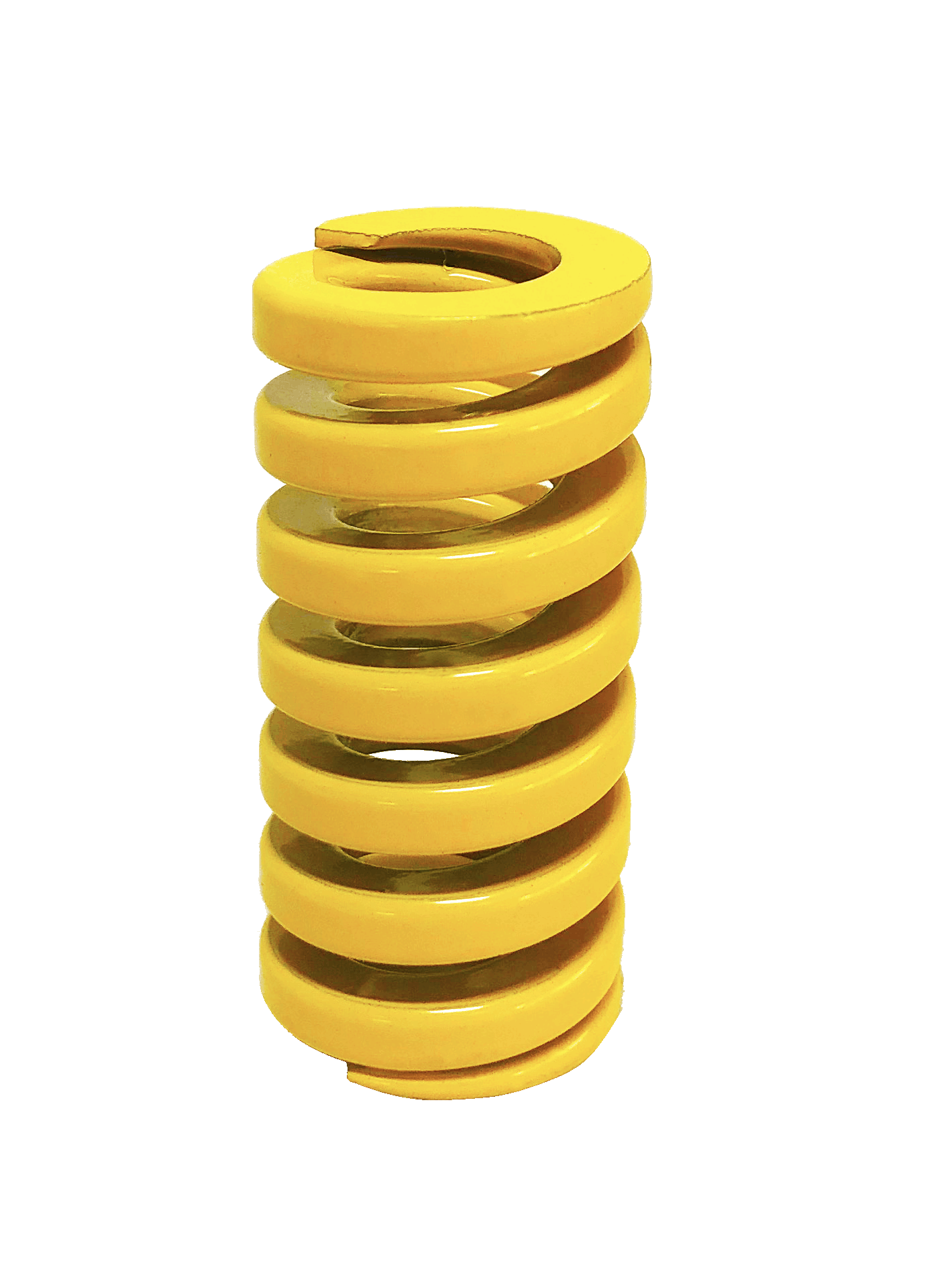
The ISO 10243 range is organised into five load classes, each identified by a standardized color: CIF super minimal load (light green), CIL light duty load (green), CIM medium duty load (blue), CIH heavy duty load (red), and CIB extra heavy duty load (yellow). Catalog model designations cover the CIF series starting at CIF20-25, CIF25-38, CIF32-64, CIF40-51 and CIF50-64, plus full CIL, CIM, CIH and CIB series that extend from 10-25 through 63-305 designations.
Dimensional coverage for the ISO 10243 range is 10–63 mm outer diameter, 5–38 mm inner diameter, and 25–305 mm free length. End types are closed and ground or closed un-ground, and winding direction is available in right-hand or left-hand configurations. Total coil count and active coil count are defined according to each individual spring rather than fixed across the range.
JIS B5012 Standard Die Springs (CSWF / CSWL / CSWM / CSWH / CSWB / CSWG)
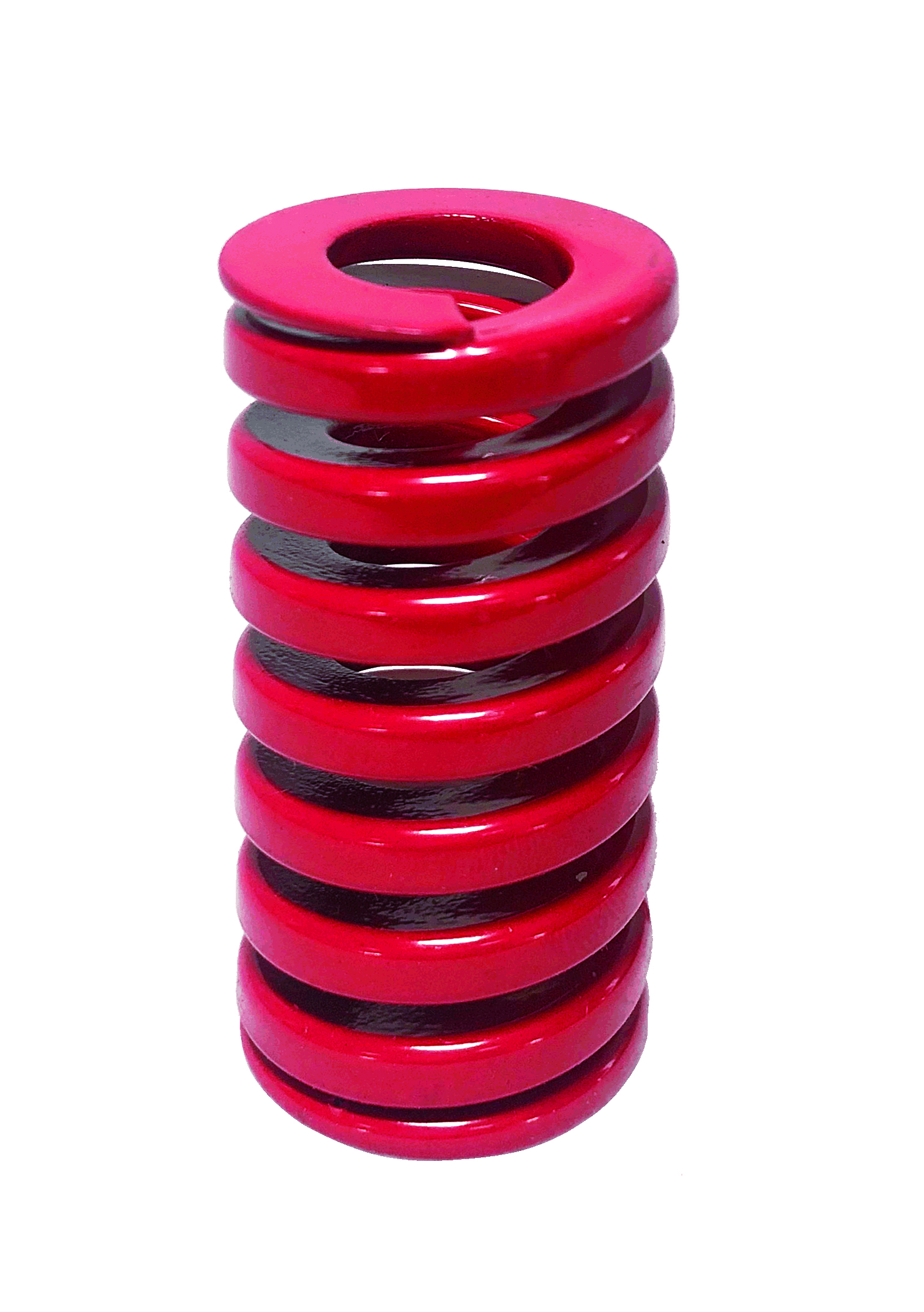
The JIS B5012 range adds a sixth load class and uses a different color set: CSWF minimal load (yellow), CSWL light load (blue), CSWM medium load (red), CSWH heavy load (green), CSWB extra heavy load (brown), and CSWG super heavy load (black). Model designations run from CSWF10-30 through CSWB50-90, covering five catalogued series in the current range.
JIS B5012 dimensional coverage is broader on the small end: 6–70 mm outer diameter, 3–38.5 mm inner diameter, and 10–350 mm free length. As with the ISO range, end type, winding direction and coil configuration are specified per spring.
American Standard (Inch Series) Springs
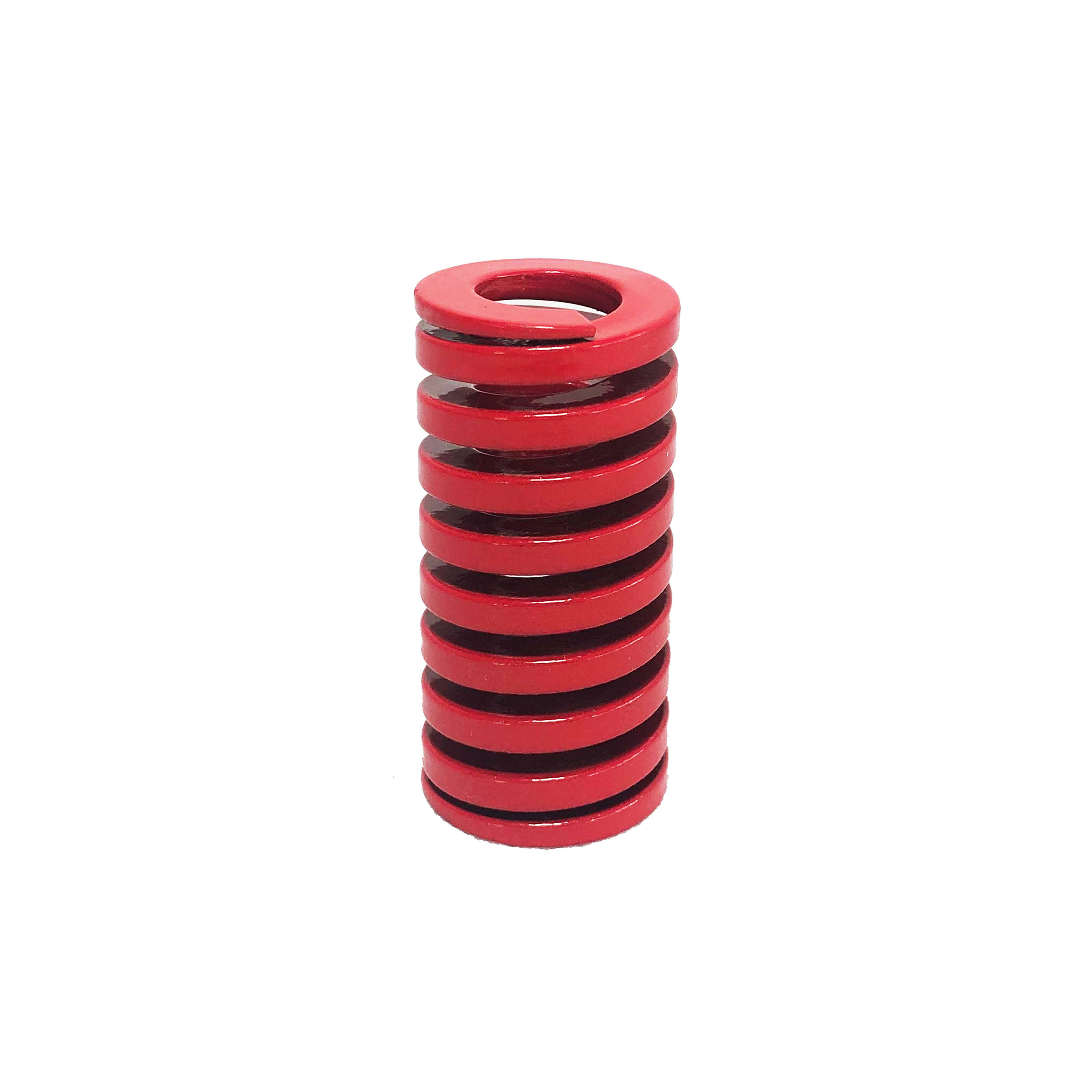
The American Standard range is catalogued in four load classes — medium duty springs (blue), medium heavy duty springs (red), heavy duty springs (gold) and extra heavy duty springs (green) — with an outer diameter range of 10–51 mm, inner diameter range of 4.76–25.4 mm, and free length range of 25–305 mm. The inch-based inner and outer diameter values are the practical reason this range exists: an American-designed die pocket does not map cleanly onto a metric catalog without dimensional conversion risk.
Material, Heat Treatment and Traceability Controls
All three standard families share the same material and process foundation. The primary material is 55CrSi chrome silicon spring steel. Mill test certificates and material heat-number traceability are provided for all raw materials used. Multi-stage tempering is applied to reduce thermal relaxation and load loss during continuous high-temperature stamping, and shot peening is applied to the surface to introduce compressive stress and raise the fatigue limit.
Two mechanical details deserve attention from an engineering standpoint. First, the rectangular wire cross-section stores more energy in a given footprint than round wire, which is why the design is used where pocket space is fixed. Second, ground end faces provide the squareness and perpendicular load distribution that keep the spring from deflecting laterally and loading the guide components unevenly. Powder coating is applied as a durable, color-coded finish so that load class can be identified at the point of installation without opening a catalog.
Durability reference point: TOPWAY SPRINGS die springs are specified for a fatigue life of 3 to 5 million cycles when operated within a 12%–40% compression stroke. Cycle life depends on the actual deflection percentage used in the tool, which is why the compression stroke must be confirmed before a load class is locked in.
Certification Coverage Relevant to Die Spring Orders
Two management system certifications cover spring production and are directly relevant to supplier approval files:
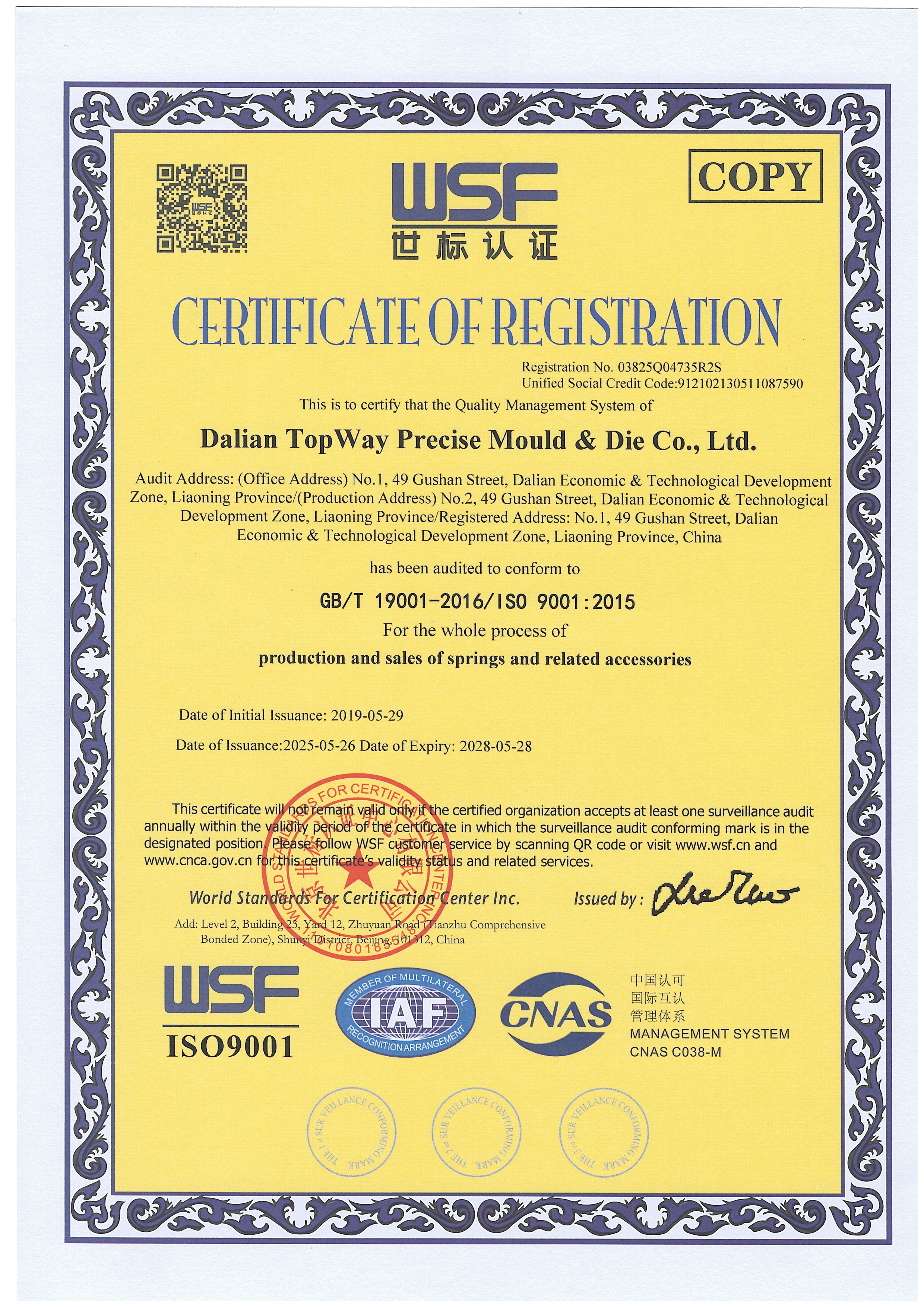
- ISO 9001 Quality Management System Certification, certificate number 03825Q04735R2S, issued by World Standards For Certification Center Inc. (WSF), valid from 2025-05-26 to 2028-05-28. The scope covers production and sales of springs and related accessories, and the certificate applies to the JIS B5012 Standard Die Spring and the ISO 10243 Standard Spring product lines in the Global market.
- ISO 14001 Environmental Management System Certification, certificate number 03825E04736R2S, issued by World Standards For Certification Center Inc. (WSF), valid from 2025-05-26 to 2028-11-13, against the GB/T 24001-2016 / ISO 14001:2015 standard, with the same production and sales scope.
For buyers who need to file supplier evidence, those certificate numbers and validity windows can be recorded directly against the die spring line rather than against a general company profile.
Step-by-Step Breakdown: Verifying Die Spring Compliance Before You Order
The following sequence is built for the evaluation stage, where a shortlist of suppliers is being reduced to an approved source. Each step produces a document or measurement that can be filed with the tooling record.
- Identify the governing standard of the tool, not the supplier. Confirm whether the die was designed around ISO 10243, JIS B5012 or an inch-series American catalog. The standard determines the dimensional control logic — housing and rod diameters versus spring OD and ID tolerances — and therefore determines which datasheet values must be verified.
- Fix the load class before discussing color. Determine the required load class from the tooling design, then translate that class into the color code of the governing standard. Do not choose by the color of the spring currently in the pocket, because the pocket may already contain a cross-standard substitution.
- Check the compression stroke against the rated range. Confirm that the working deflection sits inside the acceptable range for the selected load class. A 3 to 5 million cycle fatigue life is a within-deflection figure, not an unconditional one.
- Verify installation dimensions in millimetres or inches as drawn. For ISO 10243 the working envelope is 10–63 mm OD, 5–38 mm ID and 25–305 mm free length; for JIS B5012 it is 6–70 mm OD, 3–38.5 mm ID and 10–350 mm free length; for the inch series it is 10–51 mm OD, 4.76–25.4 mm ID and 25–305 mm free length. Cross-check the bore and guide rod clearance at the same time.
- Confirm end type and winding direction. Closed and ground versus closed un-ground, and right-hand versus left-hand winding, are separate line items. Both must match the pocket and the assembly method.
- Request material documentation, not a material statement. Ask for the mill test certificate and the heat-number traceability record covering the actual production batch of 55CrSi wire used. This is the difference between a claim and a record.
- Request the certification set against the specific product line. ISO 9001 certificate 03825Q04735R2S and ISO 14001 certificate 03825E04736R2S, with their validity windows, should be issued in a form that can be filed against the purchase order.
- Validate with a sample before committing to volume. Order a small batch, install it in the actual tool, and confirm return force, seating on the guide rod, end-face contact and color identification on the shop floor. Sample validation is the only step that tests the supplier's dimensional control and the tool's geometry together.
- Lock the commercial terms and the replenishment path. Confirm minimum order quantity, production lead time, stock availability for standard catalog items, and the batch-consistency arrangement that keeps replacement parts interchangeable over the life of the tool.
Steps 1 through 3 are engineering decisions. Steps 4 through 9 are procurement and quality decisions. Suppliers that can support all nine steps with documents rather than assurances are the ones that reduce total tooling risk, not just unit price.
Use Cases: Where Die Spring Standard Selection Changes the Outcome
Die springs from this range are used across tool, die and mold manufacturing, automotive and transportation, industrial automation and heavy machinery, electrical and electronics production, energy and oil and gas valve applications, and medical device and precision equipment manufacturing. In practice, the standard question appears in a few recurring scenarios.
Automotive Stamping Dies
Automotive stamping is a high-cycle, high-shock environment. Springs here must deliver a precise return stroke, absorb energy in a compact pocket, damp vibration and maintain force balance across the die as it opens and closes. The working conditions combine high-frequency cyclic shock, continuous elevated temperature, high-load compression and exposure to stamping lubricants. In this setting, ISO 10243 and JIS B5012 tools frequently coexist in the same plant, which is exactly where color-code discipline prevents a wrong-class installation.
Plastic Injection Molds
Injection molds create a different profile: sustained pre-load, elevated mold temperatures, and a requirement that the spring hold its nominal free length and load accuracy over long production runs. Resistance to permanent set and thermal relaxation matters more here than peak impact absorption, which is why multi-stage tempering and traceable 55CrSi material are relevant to the specification rather than to marketing.
Die Casting Tooling
Die casting adds heat and contamination to the load case. Springs are specified with attention to coating adhesion and corrosion resistance so that the powder coating survives contact with lubricants and does not flake into a precision cavity. The coating is also the load-class identifier on the shop floor.
MRO Replacement and Line Upgrades
A large share of die spring demand is maintenance-driven rather than new-build. Mold standard component replacement, automotive production line upgrades and urgent replenishment all require that the replacement part match the original specification — dimensional, load class and material — without re-engineering the pocket.
Custom R&D and OEM Programs
Where no catalog item fits, custom rectangular coil springs are engineered from drawings or physical samples, including non-standard outer and inner diameters, non-standard free lengths, alternative wire profiles, adjusted load rates and private-label marking. The relevant capability data for planning such a program is a 300,000 piece monthly capacity, a minimum order quantity of 100 pieces, 100% testing, and a production lead time of 14–25 days.
Comparison Table: Standard Systems and Load Class Colors
The two tables below are the practical core of this guide. Table 1 compares the three standard systems on the dimensions a buyer must verify. Table 2 cross-references the color codes, which is where cross-standard errors originate.
Table 1 — ISO 10243 vs JIS B5012 vs American Standard (Inch Series)
| Comparison dimension | ISO 10243 | JIS B5012 | American Standard (inch) |
|---|---|---|---|
| Standard control focus | Rectangular-section compression springs for press tools; dimensions and color-coding by load class (ISO 10243:2019) | Allowable tolerances of spring inner and outer diameters | Inch-series press tool springs catalogued by load class |
| Load classes offered by TOPWAY SPRINGS | CIF super minimal (light green), CIL light duty (green), CIM medium duty (blue), CIH heavy duty (red), CIB extra heavy duty (yellow) | CSWF minimal (yellow), CSWL light (blue), CSWM medium (red), CSWH heavy (green), CSWB extra heavy (brown), CSWG super heavy (black) | Medium duty (blue), medium heavy duty (red), heavy duty (gold), extra heavy duty (green) |
| Outer diameter range | 10–63 mm | 6–70 mm | 10–51 mm |
| Inner diameter range | 5–38 mm | 3–38.5 mm | 4.76–25.4 mm |
| Free length range | 25–305 mm | 10–350 mm | 25–305 mm |
| Material | 55CrSi (Chrome Silicon) | 55CrSi (Chrome Silicon) | 55CrSi (Chrome Silicon) |
| End type | Closed and ground / closed un-ground | Closed and ground / closed un-ground | Closed and ground / closed un-ground |
| Surface finish | Powder coating | Powder coating | Powder coating |
| Color cross-check risk | Green = light duty | Green = heavy load | Green = extra heavy duty |
Table 2 — Color Code Reference Matrix by Standard
| Color | ISO 10243 meaning | JIS B5012 meaning | American Standard meaning |
|---|---|---|---|
| Light green | CIF super minimal load | Not catalogued in this range | Not catalogued in this range |
| Green | CIL light duty load | CSWH heavy load | Extra heavy duty |
| Blue | CIM medium duty load | CSWL light load | Medium duty |
| Red | CIH heavy duty load | CSWM medium load | Medium heavy duty |
| Yellow | CIB extra heavy duty load | CSWF minimal load | Not catalogued in this range |
| Brown | Not catalogued in this range | CSWB extra heavy load | Not catalogued in this range |
| Black | Not catalogued in this range | CSWG super heavy load | Not catalogued in this range |
| Gold | Not catalogued in this range | Not catalogued in this range | Heavy duty |
Read Table 2 as a warning, not as a catalogue. Three colors — green, blue and yellow — carry meaning in all three systems, and only blue is close in intent across the board. Any plant that stores springs from more than one standard system in the same bin should label by standard name as well as by color.
Frequently Asked Questions
Q1. Which international standards do these die springs comply with, and can they replace brand-name catalog springs?
Dimensional compliance covers ISO 10243, JIS B5012 and the American Standard (inch series) catalog systems. Because installation dimensions, color coding and load-deflection characteristics are controlled against those systems, the products are built to serve as direct drop-in replacements for international mold component catalogs without modifying the existing mold design. For a precision mold project, the practical verification is to compare the required standard, load class, outer diameter, inner diameter and free length against the datasheet before release — the color printed on the coil is an installation aid, not the compliance evidence.
Q2. Which quality and environmental certifications cover the die spring production lines?
Spring production and sales are covered by ISO 9001 Quality Management System Certification, certificate number 03825Q04735R2S, issued by World Standards For Certification Center Inc. (WSF), valid from 2025-05-26 to 2028-05-28. Environmental management is covered by ISO 14001 certification, certificate number 03825E04736R2S, issued by the same body, valid from 2025-05-26 to 2028-11-13, against GB/T 24001-2016 / ISO 14001:2015. Both certificates apply across the Global market and cover the production and sales of springs and related accessories. In addition, mill test certificates and material heat-number traceability are provided for all raw materials, which links each production batch back to its 55CrSi wire source.
Q3. What drives the cost of a die spring order, and how should budget be assessed?
Cost is driven by material grade, dimensional control requirements, load class, surface finish, order quantity and whether the item is a standard catalog size or a custom design. The commercially significant variable is the supply route: a direct manufacturing plant removes distributor markups, which is why factory-direct sourcing from a certified OEM production base can materially change the landed cost while keeping tier-1 equivalent quality. As a documented reference point, one global mold component brand owner operating a five-year-plus OEM cooperation program in the United States reduced its OEM manufacturing and procurement costs by 25%–30% while maintaining its premium quality standards, with a pass rate of 99.8% or above and zero major quality claims over consecutive years. Budget should therefore be assessed on total cost of tooling risk — spring price plus downtime exposure plus replacement frequency — rather than on unit price alone.
Q4. Can custom rectangular springs be manufactured from drawings or from a physical sample?
Yes. Full OEM/ODM customization is available, including non-standard outer and inner diameters, non-standard free lengths, specialized trapezoidal wire cross-sections, adjusted load rates, specialized surface treatments and private-label marking based on customer drawings or physical samples. Where original specifications are missing, a physical sample can be analysed and reverse-engineered into a production specification. The standard commercial parameters for a custom program are a minimum order quantity of 100 pieces, 300,000 pieces monthly capacity and 100% testing on production. Logo, packaging and marking content can also be customized for private-brand programs.
Q5. What are the typical lead times, and how are urgent replacement orders handled?
Standard catalog sizes are held in ready-to-ship inventory across the ISO 10243, JIS B5012 and American Standard ranges, which allows dispatch within 24 to 48 hours for stock orders. Custom engineered or bulk OEM orders are produced within 14–25 days depending on quantity and specification, supported by automated coiling and grinding lines and flexible production scheduling. For maintenance teams facing unplanned press downtime, the fastest route is to identify the governing standard and load class first, then confirm whether the size is a stock item — a standard-size spring that ships immediately is usually worth more than a marginally cheaper custom item that arrives in three weeks.
Conclusion: Compliance Is a Document Trail, Not a Color
Choosing a die spring for a precision mold or a stamping die comes down to four verifiable facts: the governing standard of the tool, the load class required by the design, the dimensional envelope available in the pocket, and the material batch behind the wire. ISO 10243 and JIS B5012 organise those facts differently, and their color codes actively conflict on green, blue and yellow. Suppliers that can produce standard-aligned dimensional data, certificate numbers with valid dates, mill test certificates with heat-number traceability and installable samples are the ones that remove selection risk from the maintenance store.
TOPWAY SPRINGS, operated by Dalian TopWay Precise Mould & Die Co., Ltd., covers ISO 10243, JIS B5012 and American Standard (inch series) die springs from a 16,500 m² facility in Dalian, China, with two specialized business units, five R&D engineers and an annual output of 3,600,000 pieces, serving customers in the EU and USA alongside a 50% export ratio. The fastest way to close a standards question is to test the answer in the tool.
Next Step
If you are specifying for a precision mold, a stamping die or a die casting tool, send the governing standard, load class and installation dimensions — or a physical sample — and request a matching sample set for validation before committing to production volume. Full product, standard and capability details are in the catalogue.
Download the catalogue: Dalian TopWay Product Catalogue (PDF)
Contact: Liya · Email liya@chs-spring.com · Tel / WhatsApp +86 151-4047-4905 · Website www.onetopway.com