What Is a Rectangular Wire Die Spring? A Basic Explainer for Tool and Die Buyers
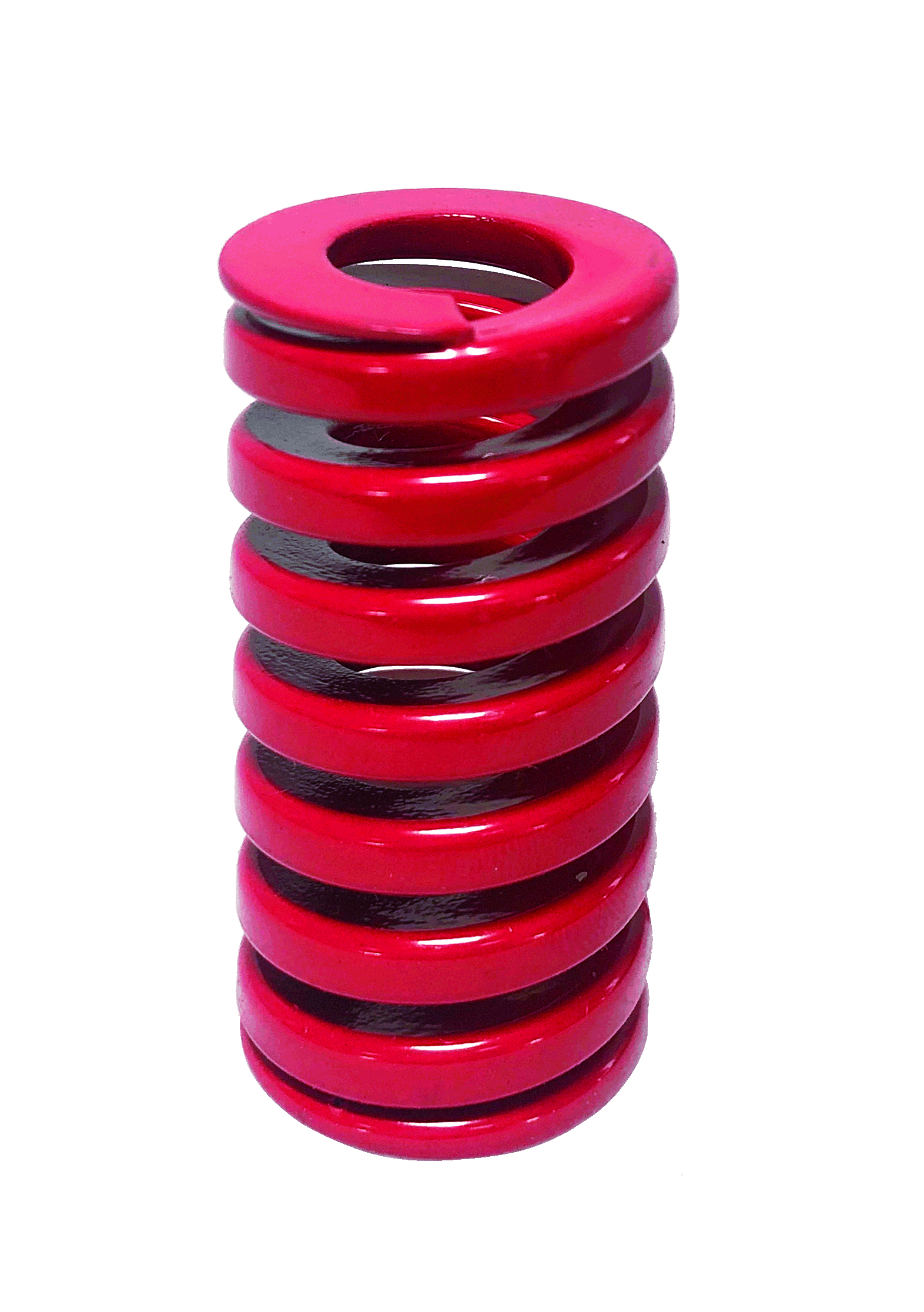
Answer first: A rectangular wire die spring is a helical compression spring made from rectangular-section wire, usually with closed and ground ends, designed to fit a standardized spring pocket in press tools, dies, and molds. It stores energy in axial compression and returns the tooling component after the press stroke. The rectangular wire section is chosen because it can use the available annular space more efficiently than round wire, which is why buyers often see higher energy storage in the same footprint.
For a tool and die buyer, the practical question is not only what a die spring is. The harder question is how to specify one that fits the pocket, carries the right load, survives the required cycle life, and matches the standard used by the tooling drawing. This explainer covers the basic categories, the role of 55CrSi chrome silicon steel, the difference between ISO 10243, JIS B5012, and American Standard inch-series springs, and the color-coded load classes that buyers see in catalogs.
The Buyer Problem: A Die Spring Is Easy to Name and Harder to Specify
Die springs look simple in a catalog. They are listed by outside diameter, inside diameter, free length, load class, and color. In practice, those few fields hide several decisions. A spring that fits the hole may not fit the rod. A spring with the right color may not deliver the required load at the working deflection. A spring that works in a low-cycle mold may fail early in a high-frequency stamping die.
The problem becomes larger when a buyer is replacing an imported spring or sourcing a custom rectangular coil spring for a new tool. ISO 10243, JIS B5012, and American Standard inch-series springs are not always labeled the same way. Color codes can differ between standards, and a color that means heavy load in one catalog may not mean the same in another. That is why experienced tooling buyers treat color as a starting point, not a specification.
The core decision is to match six things together: installation envelope, standard system, load class, working deflection, end type, and fatigue life target. When those six items are aligned, a rectangular wire die spring becomes a predictable component. When they are not, the result can be buckling, loss of preload, spring breakage, or unplanned press downtime.
Where Rectangular Wire Die Springs Fit in Tooling
Rectangular wire die springs are used where a tool needs a compact, repeatable return force. Common applications include automotive stamping dies, plastic injection molds, die-casting tooling, industrial automation presses, machine tools, elevator systems, and heavy-duty energy equipment. In a stamping die, the spring may provide stripper pressure, lift, or cushioning. In an injection mold, it may support ejection or core movement. In die-casting tooling, the spring must tolerate heat, lubricants, and high cyclic load.
The category is large enough to support specialized supply. Grand View Research projects the global industrial springs market to reach USD 7.1 billion by 2033, and the same source reports that Asia Pacific held a 33.4% revenue share in 2024. Automotive stamping, a major end-use driver, was valued at USD 87.98 billion in 2024 by Market Research Future. These figures explain why die spring buyers increasingly compare suppliers across regions, not only within local distribution.
Trade classification is another practical detail. The US import HS code for helical springs of iron or steel is 732020. That code covers helical springs generally; it does not create a unique code for rectangular wire die springs. Buyers should therefore confirm product description, dimensions, and standard compliance in the commercial documents rather than relying on the HS code alone.
TOPWAY SPRINGS is the spring brand of Dalian TopWay Precise Mould & Die Co., Ltd., a Chinese manufacturer founded in 2012 in Dalian, Liaoning. The company produces die springs and mould parts, operates a 16,500 m² factory with 58 employees, and reports annual output of 3,600,000 pieces, a five-engineer R&D team, and exports of about 50% to the EU and USA. Its spring range covers ISO 10243, JIS B5012, and American Standard inch-series specifications.
What a Rectangular Wire Die Spring Is and How It Works
A rectangular wire die spring is a coiled compression spring. The wire itself has a rectangular cross-section rather than a round one. The spring is compressed along its axis, stores energy, and pushes back when the load is released. In tooling, that return force can strip a part, lift a plate, cushion a shock, or keep a mold component in position.
Rectangular wire versus round wire
The reason rectangular wire is used is space efficiency. A rectangular section can fill more of the available annular space between the rod and the hole than a round wire of similar envelope. In the same footprint, category comparisons often cite a 30% to 50% energy storage advantage for rectangular wire over round wire. That figure is a useful starting point, not a guarantee. The actual gain depends on wire section, active coils, free length, load class, and working deflection. Buyers should confirm the result on the supplier's load-deflection curve rather than selecting by wire shape alone.
This is also why rectangular wire die springs are common in heavy-duty die springs, high-deflection die springs, and long-life die springs where the pocket size is fixed but the tool needs more force or more travel. The design trade-off is that rectangular wire springs are less forgiving of misalignment and poor end-face parallelism. Correct pocket guidance and preload matter.
Material and heat treatment: why 55CrSi matters
Most high-stress rectangular die springs are made from oil-tempered alloy steel. TOPWAY uses 55CrSi chrome silicon steel, a Cr-Si alloy grade selected for tensile strength, fatigue resistance, and resistance to permanent set and thermal relaxation under cyclic heavy loading. Compared with standard carbon spring steel, 55CrSi is intended for higher stress and better stability in demanding tooling.
Material grade alone is not enough. Manufacturing affects life. TOPWAY describes a process that includes precision coiling, multi-stage tempering, shot peening, end-face grinding, and powder coating. Shot peening introduces compressive residual stress on the wire surface to help resist micro-crack propagation. Multi-stage tempering supports dimensional stability. Every raw material batch is supported by a Mill Test Certificate for metallurgical traceability.
For buyers, the material claim should be checked against documents. Ask for the steel grade, heat number, MTC, and load test record. A chrome silicon die spring is only as good as its traceability and heat treatment control.
Standards and color-coded load classes
Three standard systems appear most often in tooling drawings. ISO 10243:2019 standardizes color-coding and dimensions for rectangular-section compression springs used in press tools. JIS B5012 is the Japanese standard and is described as specifying allowable tolerances of the inner and outer diameters of springs, while ISO 10243 focuses more on mounting hole dimensions. American Standard inch-series springs are the third classification used in North American and global tooling projects.
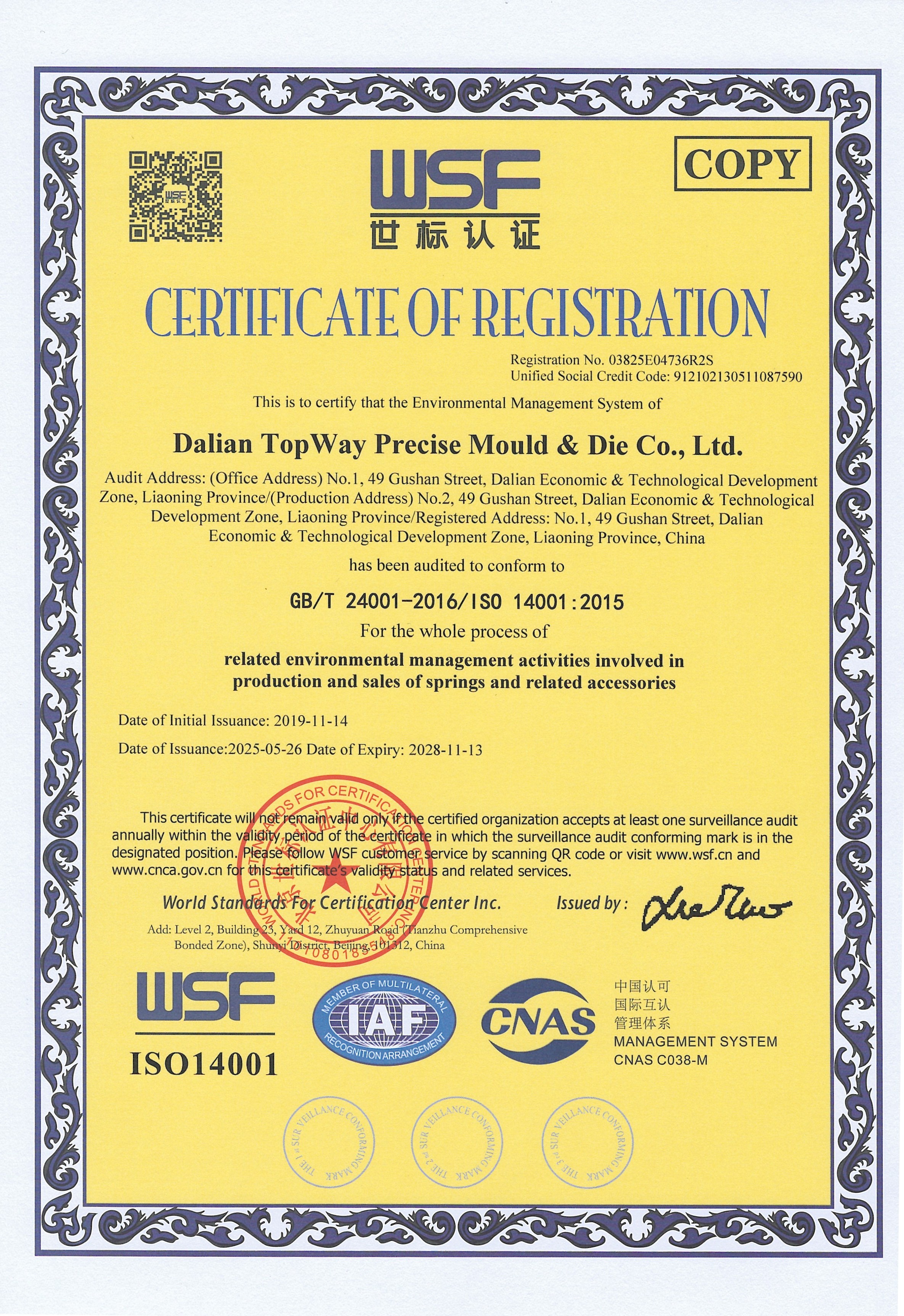
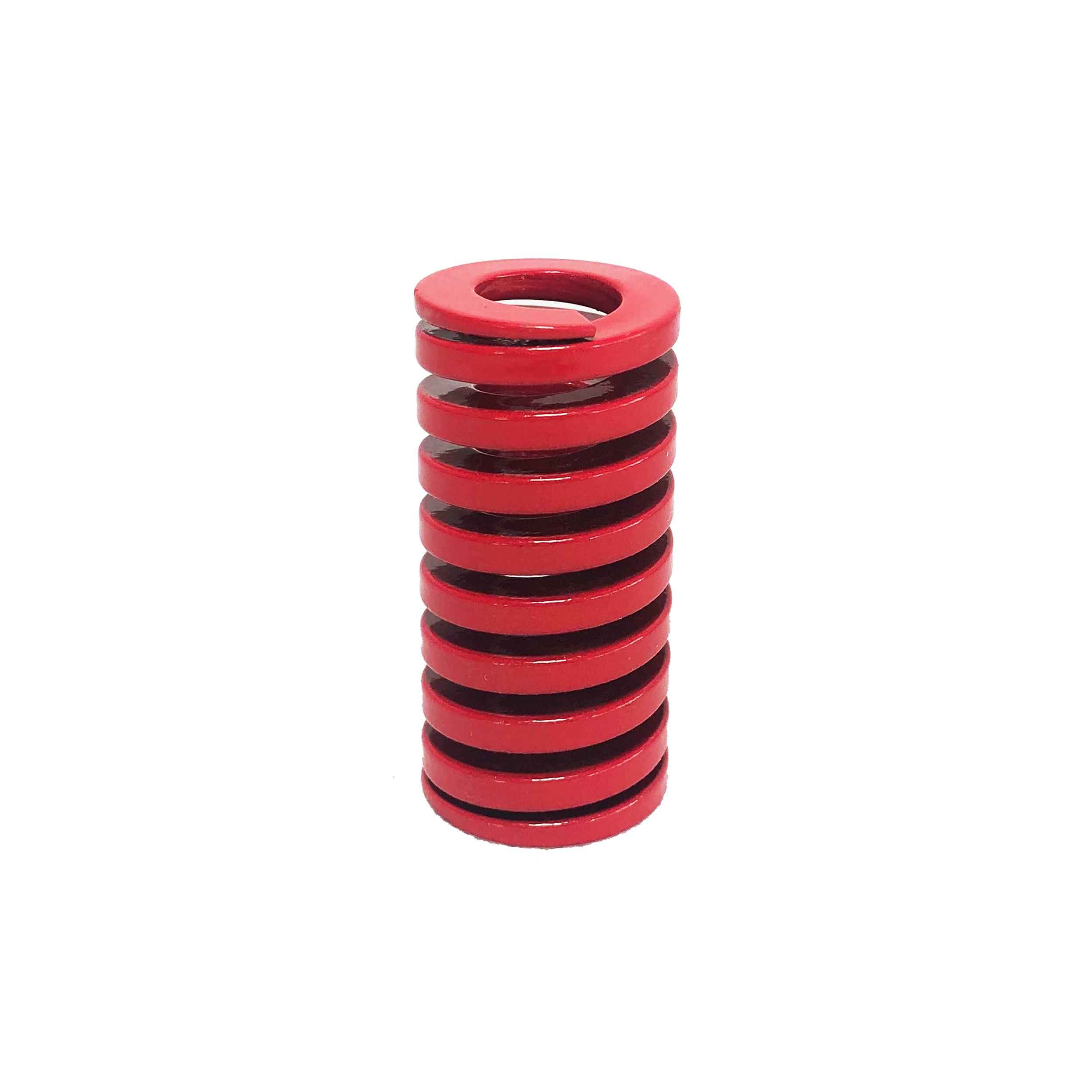
Color is a load-class label. It is not a performance guarantee. In common ISO-style catalogs, green is often light load, blue medium load, red heavy load, yellow extra heavy load, and brown ultra heavy load. However, JIS and ISO color conventions can differ, and not every supplier uses the same sequence. The safe buyer practice is to match the supplier's color chart to the required load class and then verify the load at the working deflection.
TOPWAY's ISO 10243 series lists CIF super minimal load in light green, CIL light duty load in green, CIM medium duty load in blue, CIH heavy duty load in red, and CIB extra heavy duty load in yellow. Its JIS B5012 range includes the CSWF, CSWL, CSWM, CSWH, and CSWB model families. Buyers should not assume that a red spring from one standard is a direct substitute for a red spring from another without checking dimensions and load data.
Manufacturing and quality controls
Rectangular wire die springs are not only catalog items. They are manufactured components with measurable process controls. TOPWAY operates automated coiling and grinding equipment and reports a monthly capacity of 300,000 pieces. The company provides OEM and ODM production for die springs, including custom wire profiles, non-standard dimensions, special load rates, color-coded powder coatings, marking content, and private branding.
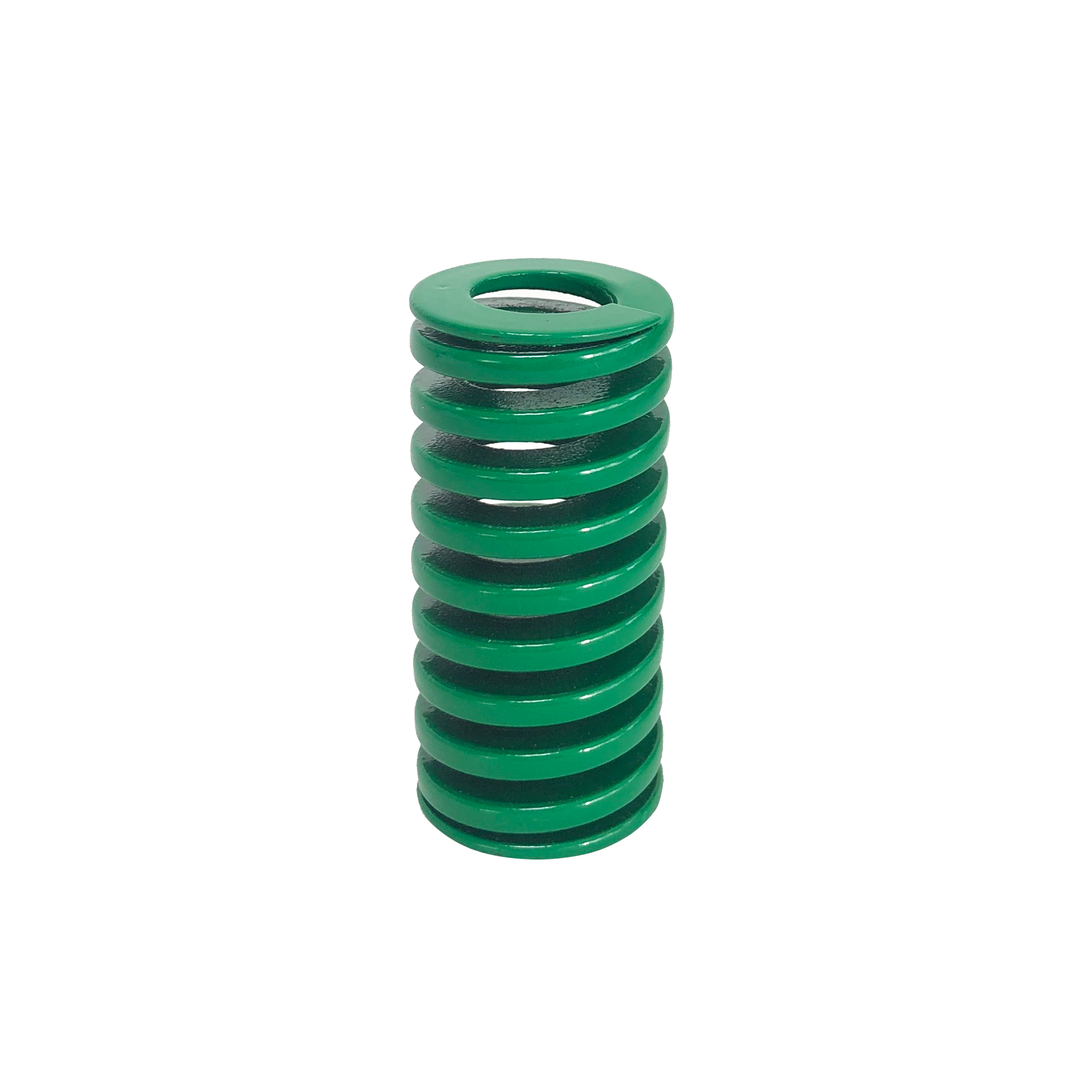
Quality control includes 100% testing and batch traceability. TOPWAY holds ISO 9001:2015 certification number 03825Q04735R2S, valid to 2028-05-28, and ISO 14001:2015 certification number 03825E04736R2S, valid to 2028-11-13. The certification scope covers production and sales of springs and related accessories.
Fatigue life is a key selection metric. TOPWAY states that its die springs offer 3 to 5 million cycles within a 12% to 40% compression stroke. For long-life targets, a working deflection of about 30% to 35% of free length is often used. These are application-dependent figures. The buyer should confirm the expected stroke, cycle count, and allowable stress for the specific tool.
A Buyer's Step-by-Step Specification Path
The following sequence keeps a die spring project from becoming a trial-and-error exercise. It applies to standard catalog springs and to custom rectangular coil springs.
- Define the pocket envelope. Record the hole diameter, rod diameter, free length available, maximum travel, and any space restriction. These dimensions determine whether an ISO 10243, JIS B5012, or American Standard spring can fit without modification.
- Choose the standard system before choosing the color. Match the drawing or existing tooling to one standard. Do not mix ISO, JIS, and inch-series dimensions in the same pocket. If the tool is a drop-in replacement project, confirm that the supplier's dimensions match the original brand.
- Match the load class to the working deflection. Use the supplier's load-deflection curve, not the color alone. A heavy-duty die spring may be wrong if the pocket cannot support the resulting stress. A light-duty spring may be wrong if the tool needs more return force.
- Set the deflection and life target. Confirm the compression stroke as a percentage of free length. For long-life applications, stay within the supplier's recommended range and check the expected cycles. A 3 to 5 million cycle target is realistic only when the spring is operated within its design envelope.
- Specify the end type and preload. Closed and ground ends improve squareness and load transfer. Closed un-ground ends may be acceptable in less demanding pockets. Install with a preload of about 5% to 10% of free length to remove play and reduce shock loading. Without preload, the spring can chatter, buckle, or fail early.
- Validate a sample or prototype. Check free length, outside diameter, inside diameter, end squareness, load at specified deflection, coating condition, and fit in the pocket. For custom work, send a drawing or physical sample so the supplier can confirm wire profile, load rate, and marking.
- Confirm production terms and traceability. For TOPWAY, the MOQ is 100 units per order, standard lead time is 14 to 25 days, and stock items can be dispatched within 24 to 48 hours. Commercial terms include EXW-Factory, 30% T/T in advance and 70% T/T before shipment, with third-party inspection such as SGS available. Ask for the MTC and batch records before releasing volume production.
Where Buyers Specify Rectangular Wire Die Springs
Automotive stamping dies
Automotive stamping dies are a high-cycle environment with shock, vibration, and lubricant exposure. Buyers often specify heavy-duty die springs or extra heavy-duty die springs for stripper pressure and cushioning. The spring must maintain load over millions of strokes and resist fatigue. In these projects, the load-deflection curve and heat treatment record matter as much as the catalog color.
Injection molds and precision mold components
In injection molds, mold component springs and precision mold compression springs support ejection, core movement, and return functions. Medium-duty and heavy-duty rectangular wire springs are common where space is tight. The buyer should confirm that the powder coating is compatible with the mold environment and that the spring does not shed coating into a precision cavity.
Die-casting tooling
Die casting die springs face heat, high load, and cyclic shock. Material stability and resistance to thermal relaxation are important. A 55CrSi oil-tempered spring with proper tempering and shot peening is designed for this type of duty, but the buyer should still verify the working temperature and deflection against the supplier's recommendation.
Industrial automation and heavy equipment
Rectangular wire die springs also appear in industrial automation presses, machine tools, elevator systems, environmental filtration equipment, high-voltage switches, valves, and heavy-duty energy systems. In these applications, the spring may be a custom rectangular coil spring rather than a catalog item. OEM and ODM support becomes important when the pocket, load, and marking are project-specific.
TOPWAY's OEM case record includes more than five years of continuous cooperation with a global mold component brand owner, supplying about 1.5 to 2.0 million pieces annually. The reported results include a 99.8%+ pass rate with zero major quality claims and a 25% to 30% reduction in the client's OEM manufacturing and procurement costs. These are supplier-reported case facts; buyers should validate them through samples, audits, and inspection records.
ISO 10243 vs JIS B5012 vs American Standard: What Buyers Need to Compare
The table below summarizes the main comparison points that affect a die spring purchase. It is a buyer checklist, not a claim that one standard is universally better than another.
| Standard / classification | Typical scope | What it controls or describes | Buyer check before ordering |
|---|---|---|---|
| ISO 10243:2019 | International standard for rectangular-section compression springs used in press tools | Standardizes color-coding and dimensions for rectangular-section die springs; mounting hole focus | Confirm hole diameter, rod diameter, free length, load class, and color chart from the supplier |
| JIS B5012 | Japanese standard for die springs | Specifies allowable tolerances of inner and outer diameters; color conventions can differ from ISO | Verify OD and ID tolerances, load class, and interchangeability with the original Japanese tooling |
| American Standard inch series | Inch-series die spring classification used in North American and global tooling projects | Inch-based dimensions and load classes referenced by suppliers such as TOPWAY | Check inch dimensions, load rating, end type, and whether the pocket is designed for inch or metric springs |
FAQ for Tool and Die Buyers
What standards should a rectangular wire die spring meet, and are ISO 10243, JIS B5012, and American Standard springs interchangeable?
Die springs are commonly specified to ISO 10243, JIS B5012, or American Standard inch series. Interchangeability depends on matching installation dimensions, load class, and end type. TOPWAY states that its springs adhere to ISO 10243, JIS B5012, and American Standard specifications and are intended for direct replacement where dimensions and load ratings match. Color codes can differ between standards, so buyers should verify the supplier chart rather than rely on color alone.
How do I evaluate Chinese die spring manufacturers with ISO 10243 production capability?
Check the manufacturer's stated standard coverage, quality system, and production evidence. TOPWAY manufactures to ISO 10243, JIS B5012, and American Standard specifications, holds ISO 9001 and ISO 14001 certification, and reports a monthly capacity of 300,000 pieces. It provides OEM and ODM production, 100% testing, batch traceability, and MTC documentation. A factory audit, sample validation, and third-party inspection can confirm these claims for a specific order.
What is the MOQ and typical commercial terms for a die spring order?
TOPWAY's MOQ is 100 units per order. Delivery terms are EXW-Factory. Payment terms are 30% T/T in advance and 70% T/T before shipment. Third-party inspection, such as SGS, is available as an acceptance option. Buyers should confirm the final terms in the quotation or purchase order because they can vary by product, quantity, and destination.
Can a factory make custom rectangular springs from drawings or physical samples?
Yes. TOPWAY provides OEM and ODM production for die springs. Custom work can include non-standard outside and inside diameters, non-standard free lengths, specialized wire cross-sections, unique load rates, custom color or laser marking, and private branding. Buyers can supply 2D or 3D drawings or a physical sample for engineering review. A prototype or first-article sample should be approved before volume production.
What are the lead times for standard and custom die spring orders?
TOPWAY maintains ready-to-ship stock for standard ISO, JIS, and American standard die springs, with dispatch typically within 24 to 48 hours for stock orders. Custom engineered or bulk OEM orders are quoted at 14 to 25 days, depending on quantity and specification. For urgent replacement orders, buyers should confirm stock availability and expedited dispatch before placing the order. To start a sample or quote request, contact Liya at liya@chs-spring.com or +86 151-4047-4905.
Conclusion: Specify the Spring, Not Just the Color
Rectangular wire die springs are compact energy-storage components used in stamping dies, injection molds, die-casting tooling, and industrial equipment. The rectangular wire section offers space-efficient energy storage, while 55CrSi chrome silicon steel and controlled heat treatment support fatigue life and load stability. The ISO 10243, JIS B5012, and American Standard systems provide the dimensional and load-class framework, but the buyer still has to match the pocket, load, deflection, end type, and life target.
For a new tool or a replacement project, the reliable approach is to start with the installation envelope, select the standard, verify the load-deflection curve, set the preload, and validate a sample. Color is a label, not the specification. A supplier that can provide load data, material traceability, consistent coating, and responsive customization support is more useful than a catalog that only shows a color chart.
Need a rectangular wire die spring for a stamping die, injection mold, or die-casting tool?
TOPWAY SPRINGS supplies ISO 10243, JIS B5012, and American Standard die springs, with OEM and ODM customization, MOQ from 100 units, and standard lead times of 14 to 25 days. Share your drawing, sample, or pocket dimensions for a technical review and quotation.
Email: liya@chs-spring.com | Tel / WhatsApp: +86 151-4047-4905 | Website: www.onetopway.com
Download the company brochure: Dalian TopWay product brochure
Address: NO.49-1, Gushan Street, Economic and Technological Development Zone, Dalian 116610, Liaoning, China.

Have Questions or Need More Details?
Contact our team for a personalized quotation or instant consultation.
Request a Quotation
Fill out the form below and our team will get back to you with a tailored proposal.
WhatsApp Direct Chat
Prefer to chat in real-time? Message us on WhatsApp for instant assistance & quick answers.
- Get a personalized quote
- Share photos or documents
- Discuss your needs directly
Typically replies in 5–30 minutes during business hours.