Die-Cast vs. Standard Plastic Pallet Boxes for Automotive Engines: A Comparison Guide
The choice between a die-cast pallet box and a standard storage pallet box for automotive engines usually comes down to part geometry, not price. When the load is an engine block, a cylinder head or a transmission housing that has to sit in a shaped cradle and stay clear of impact, the die-cast pallet box at 1230×830×1000 mm is the closer fit. When the load is a mixed stream of smaller car parts handled in high volume, the standard boxes at 1200×800×1000 mm and 1000×800×800 mm give a more compact and more standardized footprint. This guide compares the three configurations on dimensions, HDPE versus HDPE/PP construction, the published 100–200 L capacity band, enclosed nestable design, applications and the supply terms an automotive buyer needs to check before committing.

Die-cast pallet box in open status: enclosed body, nestable design, and an open face that allows an inner lining to be fitted for engine and transmission parts.
Why Engine Handling Is a Harder Packaging Problem Than General Cargo
An automotive engine is a concentrated, machined, oil-bearing load. That combination creates four separate failure modes inside a warehouse or a truck:
- Point loading. A block or housing transfers its weight through a small contact area, so the container base has to spread that load rather than deform under it.
- Impact between parts. Machined surfaces and housings are damaged by contact with each other, which is why a Mexican automobile manufacturer standardizing on 1000 pieces of storage capacity for car transmission gearboxes recorded the avoidance of collision damage as the core project result.
- Fluid residue. Oil, coolant and cleaning fluids migrate to the base of the container, so the box has to be enclosed rather than open-slat.
- Round-the-clock handling. Engine and gearbox stores typically run 24/7 with forklift and racking movement, where stability under repeated handling matters more than one-off strength.
In logistics warehousing and packaging projects, the working condition is often described as high humidity, dust and a wide temperature range, with waterproof and anti-static requirements sitting alongside stacking and storage duty. The special requirements that repeat in these projects are moisture-proofing, shock resistance and stable load bearing. A pallet box that fails any one of those four points shows up later as scrap, rework or a line stoppage, not as a container problem.
Industry Background: Why Enclosed Plastic Boxes Dominate Engine Logistics
The global pallet box market was valued at USD 2.19 billion in 2024, based on industry market research covering material segmentation across plastic and wood. On the supply side, China remains the dominant exporter of plastic crates and boxes under HS 392310, with an export value of USD 2.33 billion in 2022. The three models discussed in this guide are themselves classified under HS code 3923100000, which is the code buyers should expect to see on shipping and customs documentation.
Two design conventions explain why enclosed plastic boxes have become the default for engine and car-part handling. First, the closed body separates the part from dust, humidity and cross-contamination in shared warehouses. Second, nestable geometry means empty containers collapse into each other rather than occupying full erected volume; in the wider folding pallet box category, published fold ratios reach 5:1, meaning five folded boxes occupy the space of one erected box. Where antistatic performance is required, as it is in some automotive electronics and precision-part areas, compliance is measured against ANSI/ESD S541-2019, the standard governing packaging used to store, transport and protect ESD-susceptible items, with conductive polymer blends typically specified in the 10⁴–10¹⁰ Ω surface resistance range.
Detailed Solution: The Three Configurations
1. Die-cast pallet box — 1230×830×1000 mm
This is the configuration built around engine duty. Its full product designation is a storage box in the plastic pallet box family, using die-cast honeycomb board construction. Published parameters list HDPE/PP material, a 100–200 L capacity band, enclosed type, nestable and recyclable features, custom size, custom colour, free logo printing, and applications covering oil, industrial alcohol, alkali, acid, industrial wastewater, water and car parts. Origin is Suzhou, China, with production capacity stated at 30,000 sets per year.
The 1230×830 mm footprint is the practical differentiator. It is 30 mm wider and 30 mm deeper than the 1200×800 mm module used by the standard boxes, so a fleet that mixes both sizes cannot assume identical rack openings, truck deck plans or stacking patterns. Buyers standardizing across a plant should confirm the footprint decision before ordering, because the extra margin exists to accommodate a larger part envelope and a fitted cradle, not to match the standard module.
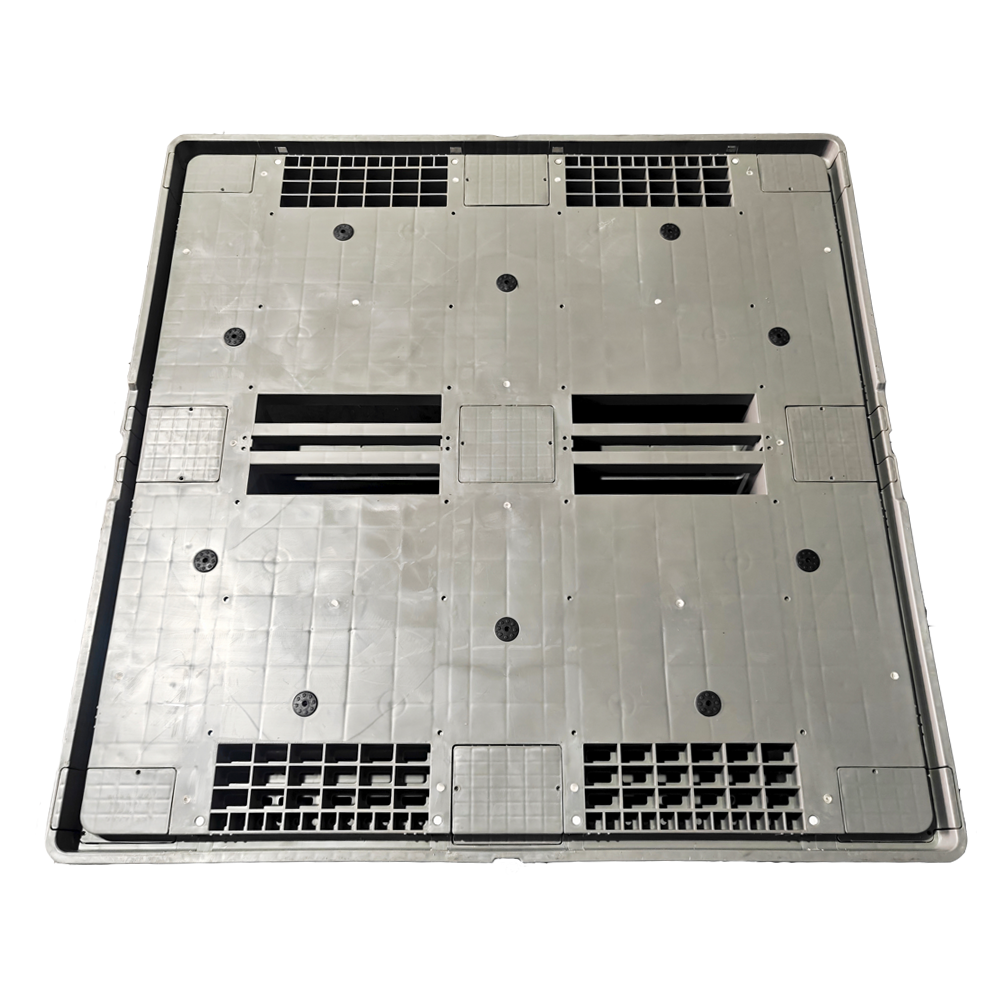
Anti-slip base design: relevant when engine-loaded boxes are stacked or moved repeatedly in a 24/7 store.
2. Standard storage pallet box — 1200×800×1000 mm
The 1200×800×1000 mm box is the general-purpose workhorse of the range, built on the standard 1200×800 mm pallet module. It is listed with HDPE/PP material, a 100–200 L capacity band, enclosed type, nestable and recyclable features, the same custom size, colour and free logo printing options, and the same application list of oil, industrial alcohol, alkali, acid, industrial wastewater, water and car parts. Its full-height 1000 mm body suits parts that need vertical clearance, including gearbox and transmission assemblies stored upright with a fitted tray.
3. Standard storage pallet box — 1000×800×800 mm
The 1000×800×800 mm box is the compact option, and it appears in the range both as a storage pallet box and as a plastic honeycomb panel box produced by the blow-molding route. Its published parameters follow the same pattern: HDPE/PP material, 100–200 L capacity band, enclosed type, nestable, recyclable, custom size and colour, free logo printing, the same application list, and Suzhou, China as origin. The smaller 800 mm height reduces the vertical envelope, which matters where engine sub-components rather than complete engines are stored and where stacking height is limited by racking.
Note on capacity: all three models are published with the same 100–200 L capacity band. On paper, therefore, capacity does not separate them. The differences that actually drive the decision are footprint (1230×830 versus 1200×800 versus 1000×800), height (1000 mm versus 800 mm), construction type (die-cast honeycomb board versus honeycomb panel) and the inner lining that can be fitted to hold a specific engine or transmission part.
4. Shared design and supply terms across all three models
All three sit in the same engineered family, so several attributes are common rather than differentiating:
- Enclosed, nestable, recyclable construction in HDPE or HDPE/PP, with the die-cast model listed as HDPE and the standard models listed as HDPE/PP.
- Customization in dimension, logo, colour and material, under an OEM/ODM production mode.
- MOQ of 1 unit, which allows a single box to be ordered for trial fit before a fleet order.
- Lead time of 7–15 days, against a monthly capacity of 3,000 pieces.
- Quality control stated at 50% test, and a 5-year after-sales guarantee that excludes damage caused by human error or by excessive storage weight.
- Custom inner linings, including vacuum-formed tray options, which is where most engine-specific engineering actually happens.
These terms come from Zhangjiagang Fenghui Logistics Equipment Co., Ltd., the manufacturer behind the TOYOE brand — a Suzhou, Jiangsu-based producer founded in 2010, operating a 4,000 m² factory with 34 employees, an annual output of 30,000 units, 2 R&D engineers, and exports representing 40% of output, primarily to Mexico and the USA. The company's main products are plastic pallet boxes, storage boxes, plastic crates and honeycomb panel boxes, published at toyoebox.com.
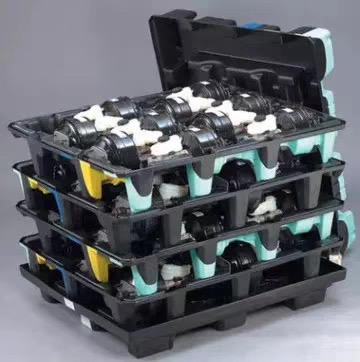
Heavy-duty vacuum-formed inner lining tray: the component that converts a standard enclosed box into an engine-specific container.
Step-by-Step: Selecting a Pallet Box for an Engine Application
- Define the part envelope, not just the part weight. Measure the engine block, cylinder head or housing including any protruding studs or shafts. Compare that envelope against 1230×830×1000, 1200×800×1000 and 1000×800×800, and check whether the part must sit upright or on its side.
- Confirm the footprint against your existing module. If your racking, truck deck and stacking plan are built on the 1200×800 mm module, the 1000×800×800 and 1200×800×1000 boxes drop in directly. A 1230×830 mm die-cast box requires a deliberate decision because it does not share that module.
- Choose the material against the fluid environment. The die-cast model is listed as HDPE; the standard models as HDPE/PP. Where the load carries oil, industrial alcohol, alkali, acid, industrial wastewater or water, confirm the material selection with the supplier rather than assuming a single resin suits every chemical.
- Specify the inner lining. A bare enclosed box protects the outer surfaces of a part; a vacuum-formed tray protects the machined faces and stops lateral movement. This is the step where the die-cast box earns its place for complete engines and where the standard boxes work best for gearboxes and sub-assemblies.
- Run a sample fit. With an MOQ of 1 unit and samples accepted, a single box plus lining can be tested on a real engine before a fleet order is raised. Check forklift entry, stacking stability under load, and whether the lining interferes with loading.
- Align delivery and service terms to the project plan. A 7–15 day lead time against a monthly capacity of 3,000 pieces sets the rhythm for a phased rollout, while the 5-year after-sales guarantee, excluding human-error damage and excessive storage weight, defines the long-term support boundary.
Use Cases: Where Each Configuration Earns Its Place
Engine and transmission housings that need a cradle
The clearest reference case is an automobile manufacturer in Mexico that deployed 1,000 pieces to store car transmission gearboxes. The project ran for three years and delivered standardized storage of auto parts, avoidance of collision damage to gearboxes, and improved warehouse management efficiency. The recorded highlight was high load-bearing capacity, shock resistance and a stable structure that fits the size of an automotive transmission gearbox precisely. That combination — load bearing, shock resistance and a part-specific fit — is exactly what the die-cast 1230×830×1000 configuration and its lining options are intended to deliver.
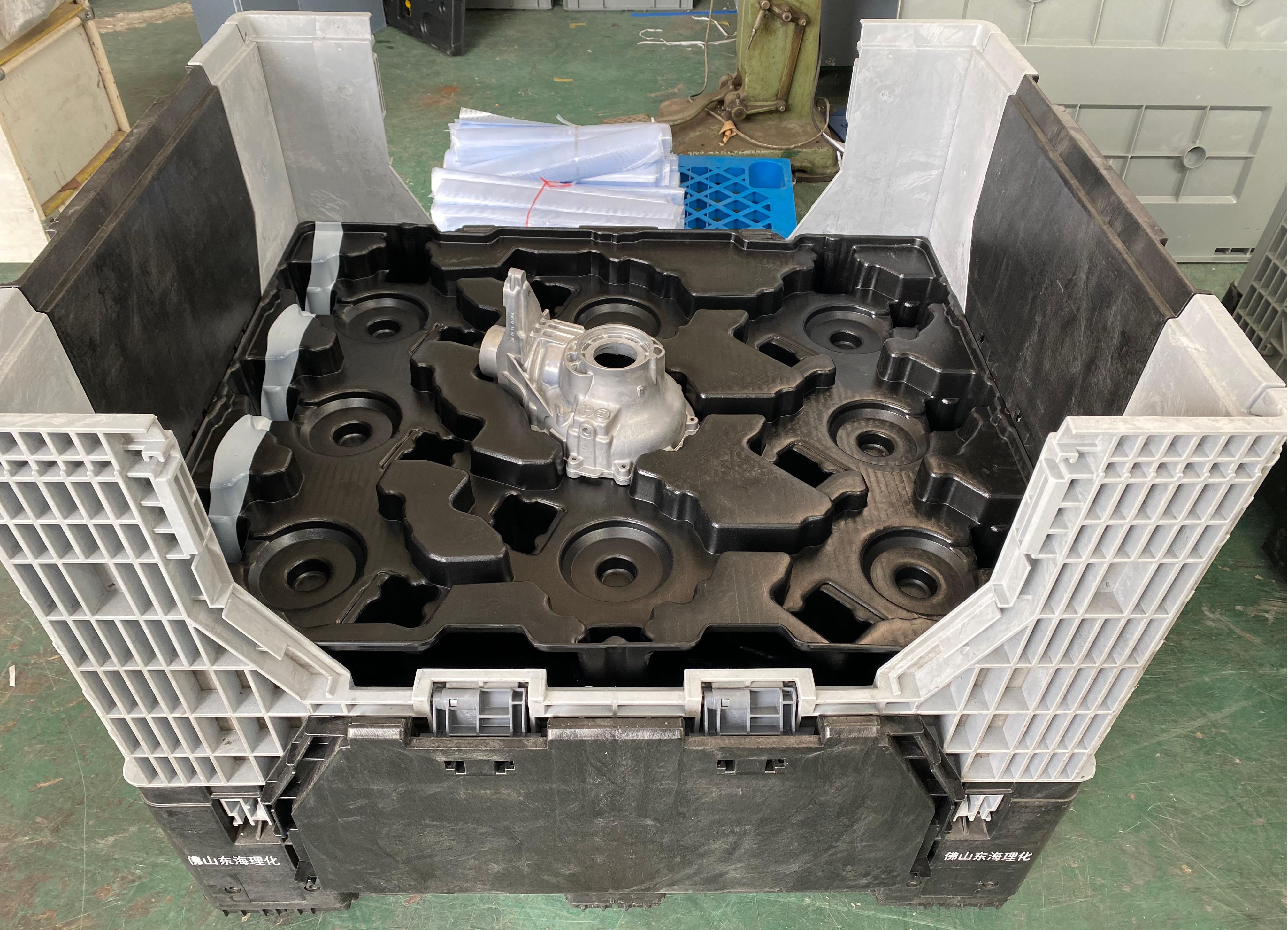
Transmission blister inner lining tray: part-specific cavity geometry that prevents movement inside the box.
Fluid-bearing and chemical-adjacent environments
Engine stores are rarely dry. The published application list for all three models covers oil, industrial alcohol, alkali, acid, industrial wastewater and water, alongside car parts. That matters where drained blocks, coolant residue or washing stations sit near the storage area. A waterproof and anti-static environment is a recurring requirement in logistics warehousing and packaging projects, and in Mexico in particular this scenario appears frequently in project specifications.
High-humidity, dusty, wide-temperature warehouses
Where the store runs continuously across a wide temperature range with dust present, the enclosed body shields the part, while the special requirements recorded for these projects — moisture-proofing, shock resistance and stable load bearing — map directly onto the box specification. Stacking stability under 24/7 forklift and racking movement is the operating condition to test at sample stage.
Mixed car-part streams in high volume
For brackets, housings, covers and other car parts moving in volume rather than as single large assemblies, the 1000×800×800 standard box reduces the vertical envelope and allows denser stacking, while the 1200×800×1000 version covers taller parts on the same 1200×800 mm module. Both keep the range inside the same enclosed, nestable, recyclable design language as the die-cast box.
Comparison Table
| Attribute | Die-cast pallet box | Standard storage pallet box | Standard storage pallet box |
|---|---|---|---|
| Model | 1230*830*1000 Pallet Box | 1200*800*1000 Plastic Pallet Box | 1000*800*800 Pallet Box |
| Type | Storage Box – Plastic Pallet Box – Die-cast Honeycomb Board Box | Storage Box – Plastic Pallet Box – Plastic Honeycomb Panel Box | Storage Box – Plastic Pallet Box (also produced as a blow-molded honeycomb panel box) |
| Material | HDPE (listed as HDPE/PP in the specification block) | PP / HDPE | HDPE / PP |
| Capacity | 100–200 L | 100–200 L | 100–200 L |
| Features | Recyclable, Durable, Nestable | Recyclable, Durable, Nestable | Recyclable, Durable, Nestable |
| Box type | Enclosed | Enclosed | Enclosed |
| Size | Customized | Customized | Customized |
| Colour / logo | Customized colour, free logo printing | Customized colour, free logo printing | Customized colour, free logo printing |
| Applications | Oil, industrial alcohol, alkali, acid, industrial wastewater, water, car parts | Oil, industrial alcohol, alkali, acid, industrial wastewater, water, car parts | Oil, industrial alcohol, alkali, acid, industrial wastewater, water, car parts |
| Origin | Suzhou, China | Suzhou, China | Suzhou, China |
| HS code | 3923100000 | 3923100000 | 3923100000 |
| MOQ | 1 unit | 1 unit | 1 unit |
| Lead time | 7–15 days | 7–15 days | 7–15 days |
| Quality control / after-sales | 50% test; 5-year guarantee (excluding human-error damage or excessive storage weight) | 50% test; 5-year guarantee (excluding human-error damage or excessive storage weight) | 50% test; 5-year guarantee (excluding human-error damage or excessive storage weight) |
Decision rule: choose the die-cast 1230×830×1000 when a complete engine, cylinder head or transmission housing must sit in a shaped cradle inside an oversized envelope. Choose the 1200×800×1000 when the part is tall but the site already runs a 1200×800 mm module. Choose the 1000×800×800 when the load is a sub-component and stacking density matters more than internal height.
Frequently Asked Questions
What HS code applies to these plastic pallet boxes, and what does a buyer need on the documentation?
All three models — the die-cast 1230×830×1000 box, the 1200×800×1000 standard box and the 1000×800×800 standard box — are classified under HS code 3923100000. Importers should ensure the commercial invoice, packing list and customs declaration use that code consistently. Where antistatic packaging is part of the same shipment, note that ESD packaging is governed by ANSI/ESD S541-2019, so compliance evidence should be requested separately from the pallet box classification.
Can the box be customized for a specific engine or gearbox, and what is the production capability behind it?
Yes. Customization covers dimension, logo, colour and material under an OEM/ODM production mode, and the practical engine-specific work is the inner lining, including vacuum-formed trays and blister trays shaped to the part. Production capacity is stated at 3,000 pieces per month and 30,000 sets per year, from a 4,000 m² factory in Suzhou, China, with 2 in-house R&D engineers supporting customized specifications.
What drives the cost of a die-cast pallet box compared with a standard box?
Because all three models share the same published 100–200 L capacity band, recyclable, durable and nestable features, and the same enclosed type, the cost difference sits in the construction type, the non-standard 1230×830 mm footprint, and any part-specific inner lining added on top. A minimum order quantity of 1 unit allows a single piece to be bought for validation before a volume order, which is the lowest-risk way to establish the real cost of a configuration.
Can I get a sample before committing to a fleet order?
Samples are accepted, and the MOQ is 1 unit, so a single die-cast box or standard box can be delivered for a physical fit test with the actual engine or transmission part. Testing on the real part is the only reliable way to confirm forklift entry, stacking stability and lining clearance before standardizing across a plant.
What is the lead time, and how is quality and after-sales support handled?
Lead time is 7–15 days. Quality control is stated at 50% test, and the product carries a 5-year after-sales guarantee that excludes damage caused by human error or by excessive storage weight. To move from comparison to a concrete proposal, send the part envelope and any lining requirement through the TOYOE contact channels or download the product catalogue (PDF) for the full specification set.
Conclusion
The die-cast pallet box at 1230×830×1000 mm and the standard storage pallet boxes at 1200×800×1000 mm and 1000×800×800 mm are not competing products so much as three positions on the same platform. They share the enclosed, nestable, recyclable design, the 100–200 L published capacity band, the HDPE/PP material family, the oil, industrial alcohol, alkali, acid, industrial wastewater, water and car-parts application list, HS code 3923100000, an MOQ of 1 unit, a 7–15 day lead time, 50% test quality control and a 5-year after-sales guarantee.
What separates them is the physical envelope and the degree of part-specific engineering. Engine and transmission work benefits from the die-cast box plus a shaped lining; a mixed car-part flow benefits from the standard module. The safe sequence is to define the part envelope, confirm the footprint against existing racking, specify the lining, and validate with a single sample before scaling — which is also the sequence in which the reference project in Mexico reached standardized gearbox storage without collision damage.
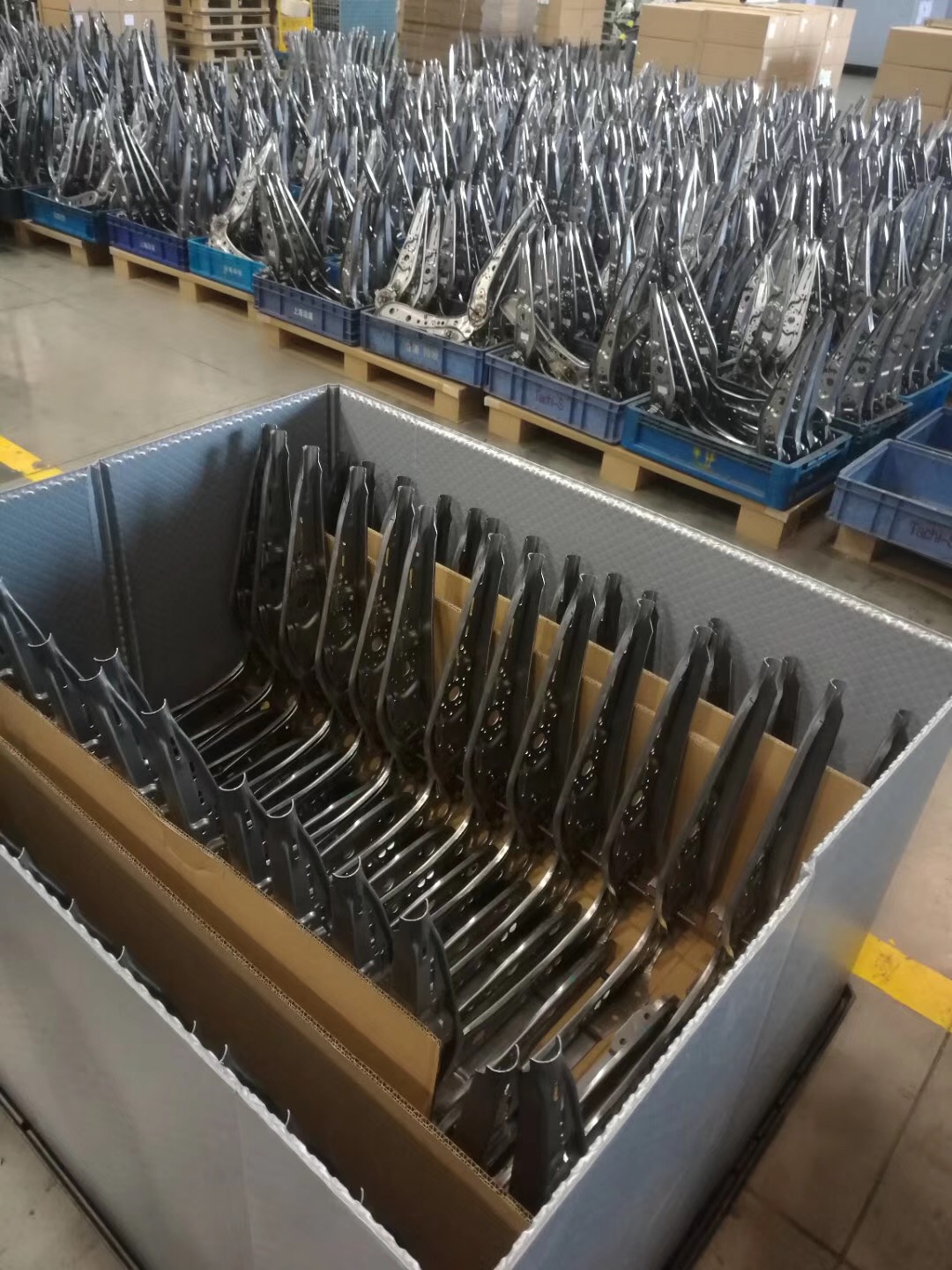
Inner lining design: the specification step that determines whether a pallet box fits an engine part or merely contains it.
Next step: validate the configuration on your own part
Send the engine or transmission envelope, the fluid exposure and the stacking plan, and TOYOE will match it against the die-cast 1230×830×1000 box or the standard 1200×800×1000 and 1000×800×800 boxes, including a proposed inner lining. Samples are accepted with an MOQ of 1 unit and a 7–15 day lead time.
Zhangjiagang Fenghui Logistics Equipment Co., Ltd. (TOYOE) · No. 5 Donghuan Road, Zhaofeng Leyu Town, Zhangjiagang, 215600, Suzhou, Jiangsu, China · Email: zjgfh@zjgfenghui.cn · WhatsApp: +86 199 0149 9028 · toyoebox.com · Download the catalogue
Have Questions or Need More Details?
Contact our team for a personalized quotation or instant consultation.
Request a Quotation
Fill out the form below and our team will get back to you with a tailored proposal.
WhatsApp Direct Chat
Prefer to chat in real-time? Message us on WhatsApp for instant assistance & quick answers.
- Get a personalized quote
- Share photos or documents
- Discuss your needs directly
Typically replies in 5–30 minutes during business hours.