Nestable Plastic Pallet Boxes in Heavy Industry: Fluid and Car Part Storage Guide
Enclosed nestable plastic pallet boxes made from HDPE or PP give a heavy-industry or automotive site one reusable container that holds fluid, protects car parts, stacks on warehouse shelving and moves by forklift. Two footprints cover most projects: the 1200 x 800 x 1000 mm plastic pallet box and the 1000 x 800 x 800 mm storage pallet box, both enclosed and both rated at a 100-200 L capacity. Both are produced under the TOYOE brand by Zhangjiagang Fenghui Logistics Equipment Co., Ltd., based in Zhangjiagang, Suzhou, Jiangsu, China.
This application guide is written for the people who actually make that choice: an importer's procurement team, a plant engineer, a warehouse planner or a distributor specifying packaging for oil, industrial alcohol, alkali, acid, industrial wastewater, water and car parts in the same facility. It covers how the two main footprints differ, how a box is configured for each duty, which supporting equipment the layout requires, and which project terms - MOQ, sample, lead time and after-sales - apply before a trial order is placed.
Problem Definition: Why Fluids and Car Parts Break Ordinary Packaging
Fluid storage and car part storage pull packaging in opposite directions. A container holding oil, industrial alcohol, alkali, acid, industrial wastewater or water has to be fully enclosed, non-absorbent and dimensionally stable when wet. A container holding car parts has to protect geometry and machined surfaces from impact, dust and moisture while still stacking to a repeatable height. Packaging that satisfies only one of those demands fails as soon as both duties share a site.
The failure patterns are predictable:
- Wood absorbs liquid, swells and loses dimensional stability. It cannot be returned to a repeatable clean condition, and splintering creates a surface risk for machined parts.
- Corrugated and fibreboard boxes protect against dust but have no containment capability for liquid, and they lose strength in humidity.
- Open crates and open pallet boxes let fluid escape during handling and let dust settle directly onto machined surfaces.
- Non-nestable containers consume return-transport volume when empty, which inflates the cost of every closed loop.
- Single-use packaging converts a fixed, reusable asset into a repeating purchase and disposal cost.
Heavy-industry working conditions add pressure on top of that. A logistics and packaging project serving automotive parts commonly runs 24/7 under high humidity, dust and a wide temperature range, in areas that also call for waterproof and, in some cases, anti-static protection. The special requirements recorded for these projects are moisture-proof performance, shock resistance and load-bearing stability - three properties that must hold at the same time, not one at a time. Supporting equipment such as forklifts, warehouse shelves and logistics handling equipment sets the physical limits the box has to work inside.
Industry Background: Why Enclosed Plastic Replaced Wood in These Duties
The container shift is measurable. Grand View Research projects the global plastic pallets and pallet box market to reach approximately USD 11.2 billion by 2030, driven by the move from wood to durable plastic solutions in logistics. Straits Research reports that Asia Pacific accounted for the largest revenue share of the plastic pallet market in 2023, at over 32%, with China leading industrial production capacity. Estimates differ by scope - IMARC Group puts a comparable market at USD 10.4 billion by 2034 - so buyers should read the absolute figure as an order of magnitude rather than a precise forecast.
Two sub-categories matter for fluid and car part duty. Global Market Insights projects the plastic honeycomb board packaging market to grow at a CAGR of 5.9% through 2032, largely because of its strength-to-weight ratio in automotive parts transport. Research Nester expects the ESD packaging market, which includes trays and pallet boxes, to reach USD 5.89 billion by 2035, growing at a CAGR of 5.8%. Together they explain why enclosed HDPE and PP boxes with configurable internals have become a default specification rather than a premium option.
TOYOE is the pallet box brand of Zhangjiagang Fenghui Logistics Equipment Co., Ltd., a logistics packaging equipment manufacturer established in 2010 with 14 years of experience in the sector. The company operates a 4,000 m2 manufacturing facility with approximately 34 staff, including a research and development team of 2 engineers, and produces about 30,000 units per year. Its main products are plastic pallet boxes, storage boxes, plastic crates and honeycomb panel boxes. Export business accounts for 40% of total sales, with Mexico and the USA as the main markets.
Detailed Solution: How an Enclosed Nestable Pallet Box Is Configured
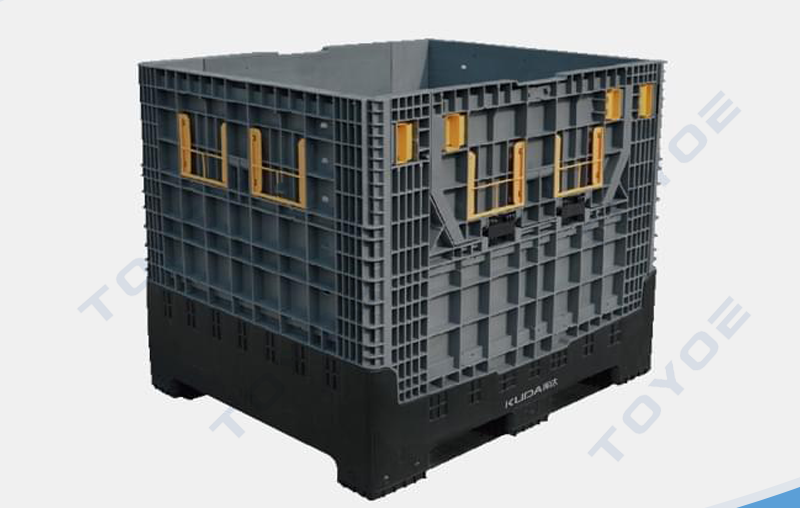
Start with the container type. A pallet box for fluid or protected car parts should be specified as an enclosed type - closed sides that contain liquid and keep dust out - rather than an open variant. In the TOYOE range, enclosed boxes are produced in HDPE, in PP, or in a combination of the two, depending on the model line. All of them share the same base properties: recyclable, durable and nestable.
The three construction routes available are:
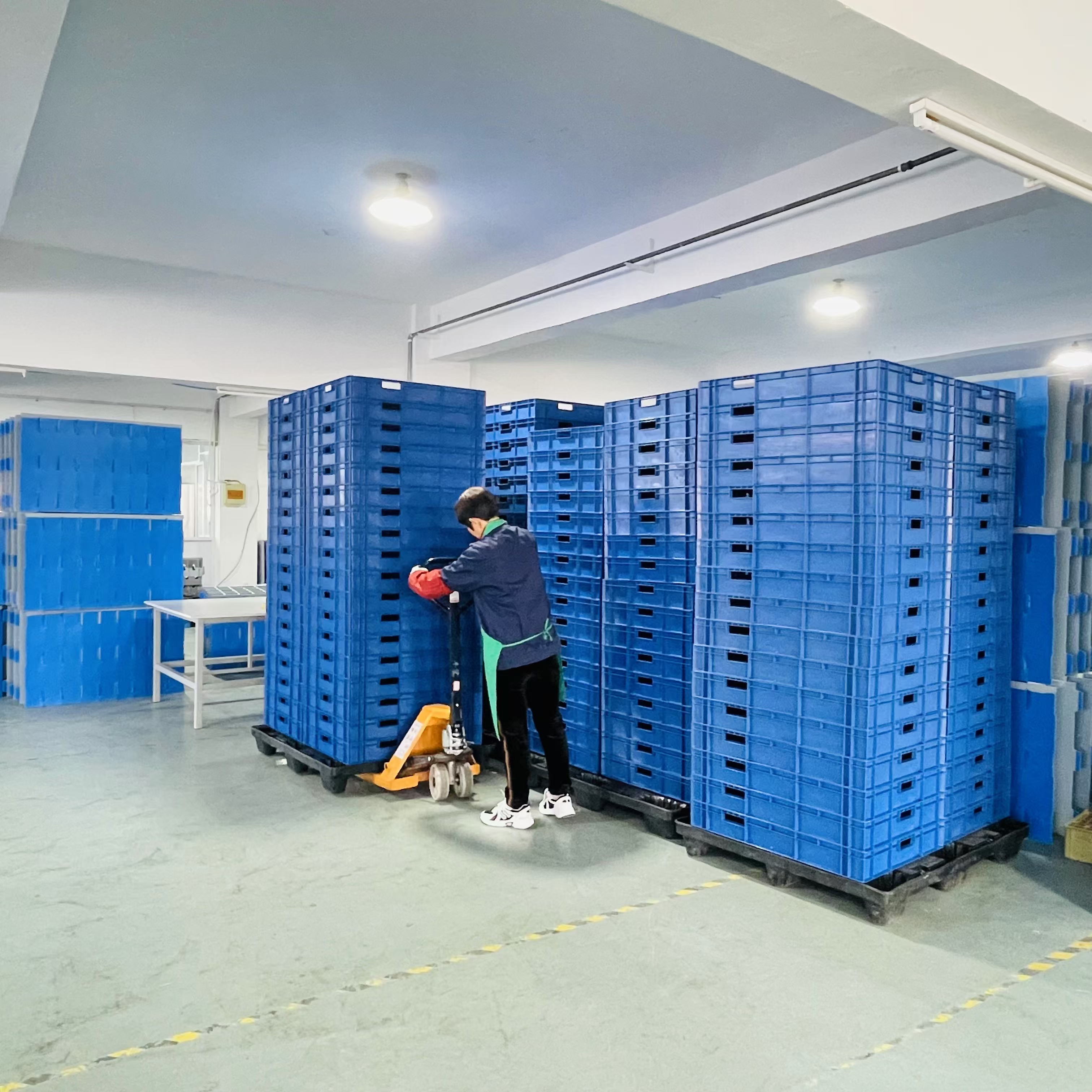
- Injection-moulded HDPE or PP boxes - the standard route for enclosed storage where repeatable dimensions and a cleanable interior matter.
- Blow-moulded honeycomb board boxes - a double-wall construction used where stiffness and strength-to-weight ratio are the priority.
- Die-cast honeycomb board boxes - the route used for the 1230 x 830 x 1000 mm model, applied to automotive engine assemblies and similar heavy, geometry-sensitive parts.
All three routes take the same options on a project order: customised size, customised colour and free logo printing. Boxes ship packed in plastic film. The harmonised customs code for the product family is 3923100000, with Suzhou, China as the origin. Working capacity across the enclosed range is 100-200 L. The stated applications are oil, industrial alcohol, alkali, acid, industrial wastewater, water and car parts, and the intended industry list covers automobile manufacturing, precision electronics, food cold chain, home logistics, medical and health care, and heavy industry.
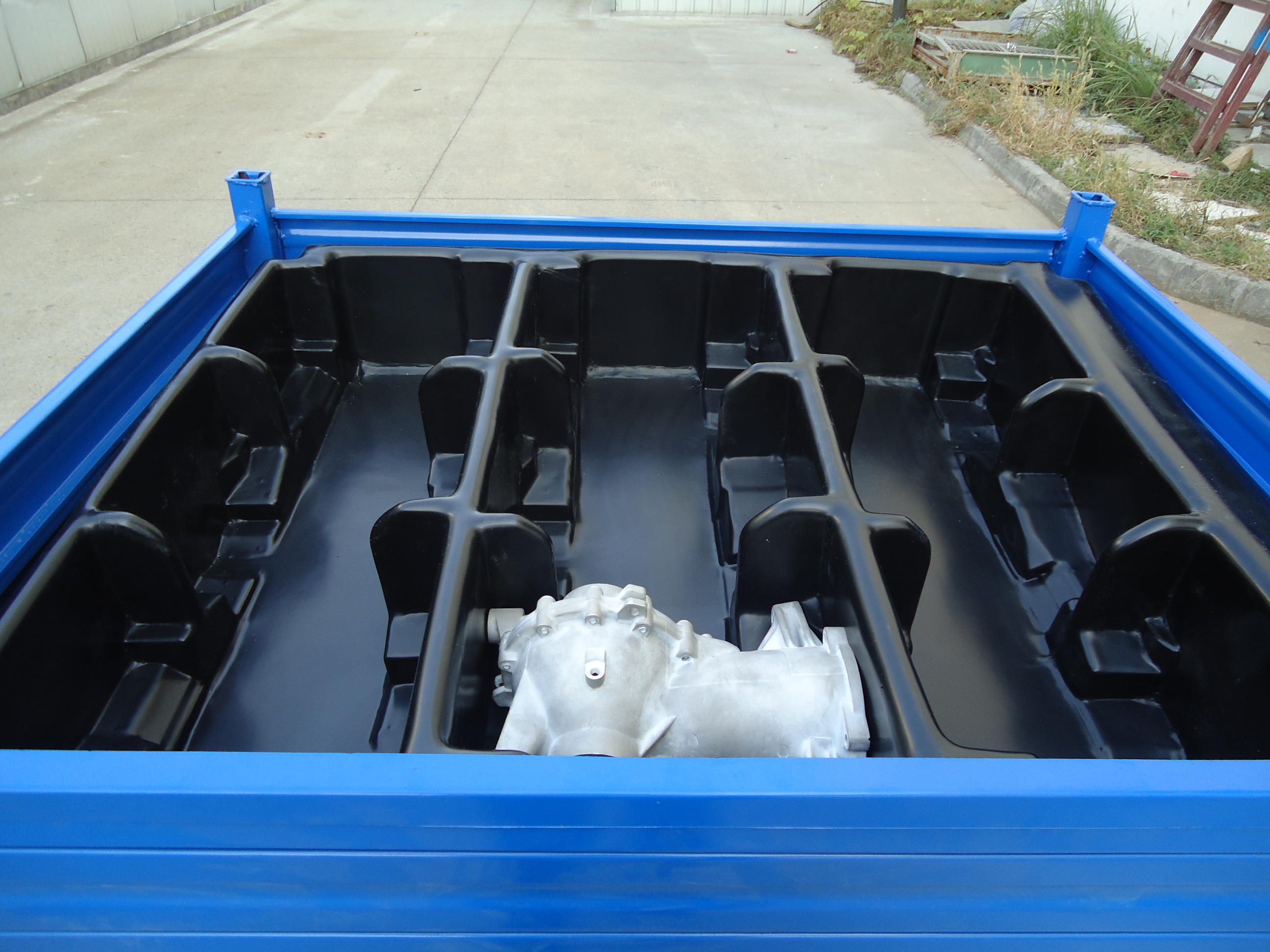
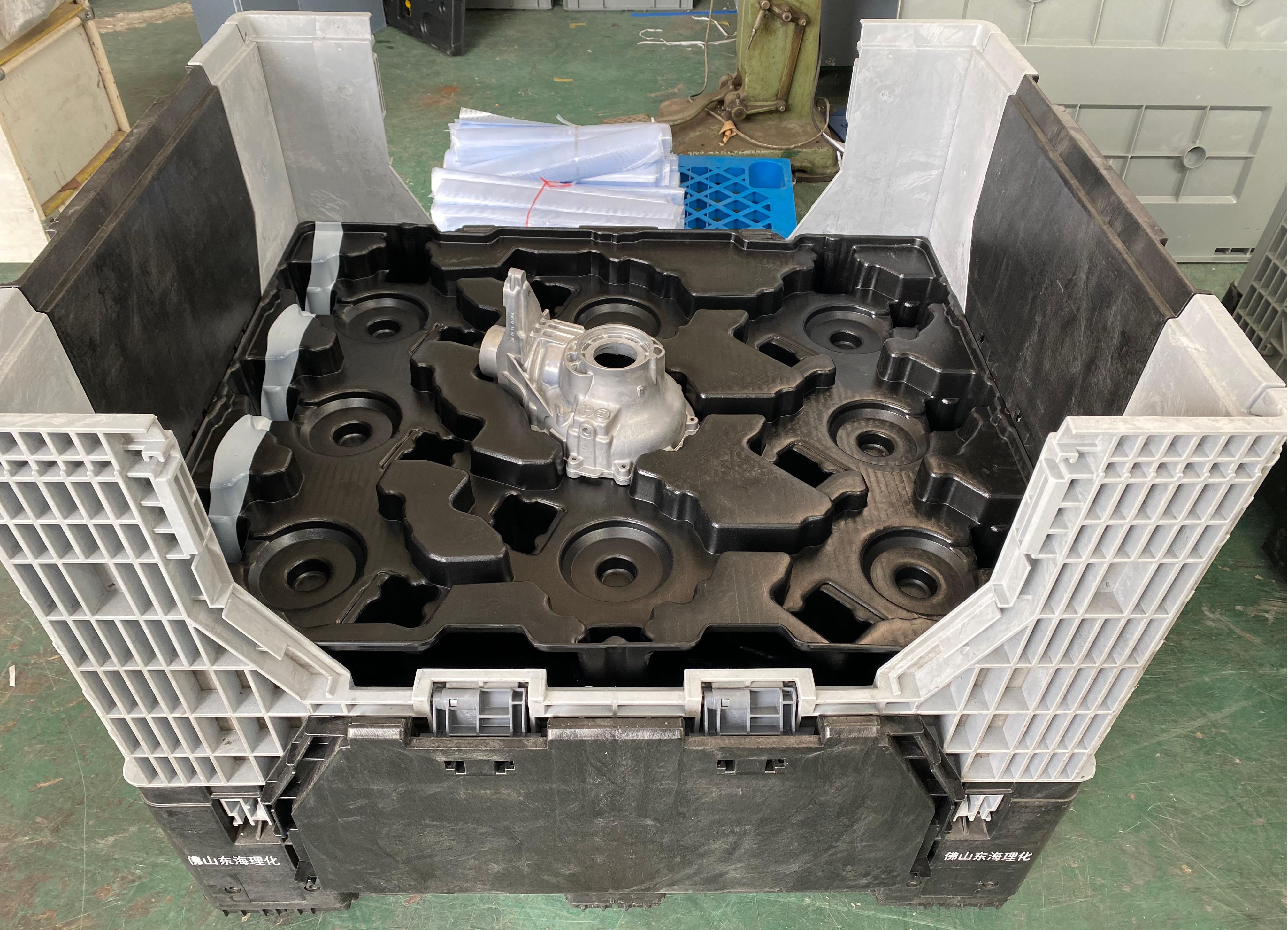
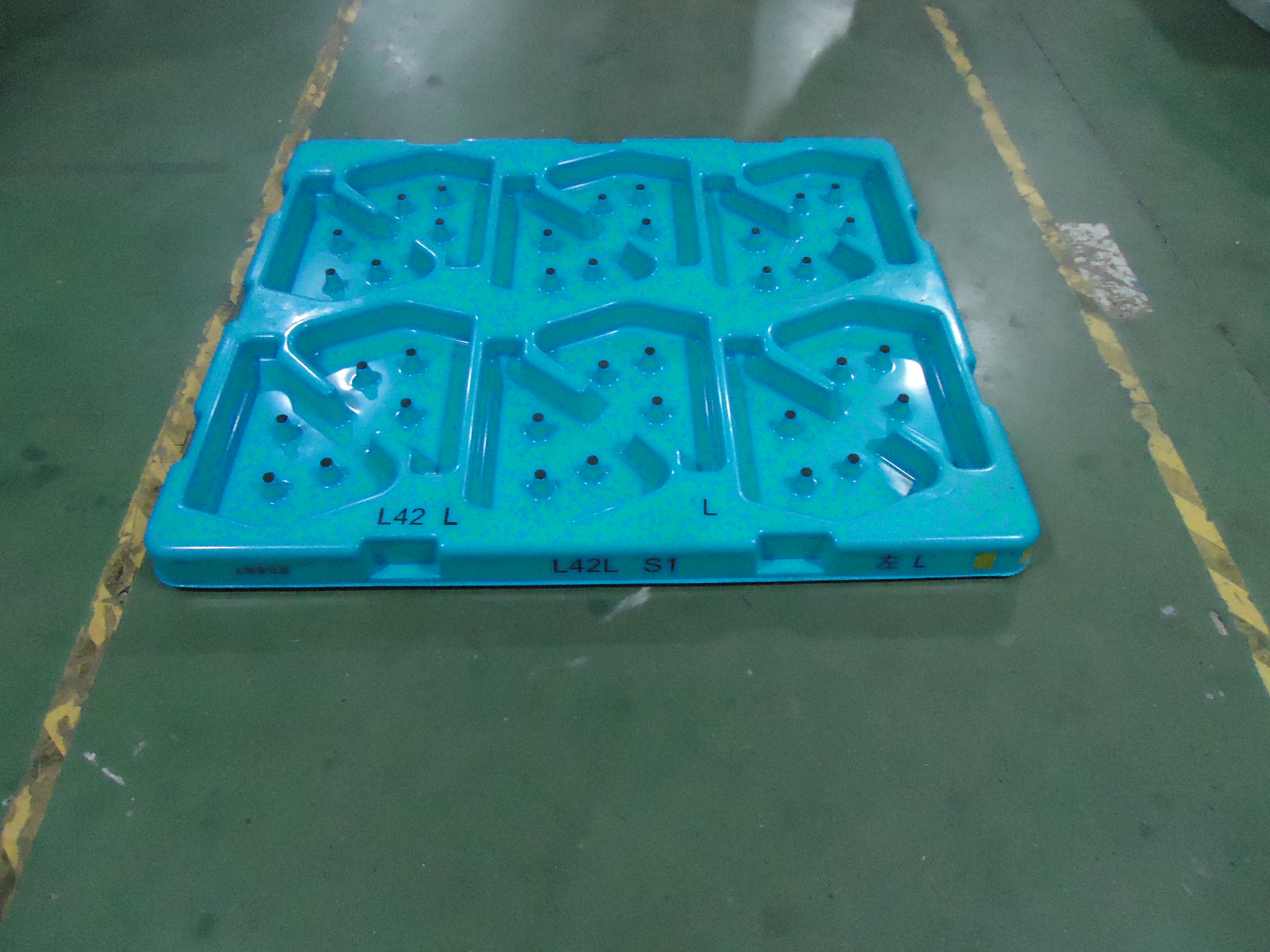
Interior configuration is where fluid duty and parts duty diverge. A bare enclosed box is sufficient for a single liquid, or for loose and robust items. A box carrying machined, coated or fragile parts normally takes an inner lining. Options include a vacuum-formed inner lining tray, a heavy-duty vacuum-formed inner lining tray, a transmission blister inner lining tray and an anti-static blister tray. The lining fixes part position, removes component-to-component contact during transport and - in the anti-static variant - addresses the anti-static requirement recorded for electronics-adjacent automotive work.

Step-by-Step Breakdown: Matching a Box to a Heavy-Industry Project
Step 1 - Define the contents and the worst-case condition
List every medium that will enter the box, not just the primary one. Oil, industrial alcohol, alkali, acid, industrial wastewater and water each behave differently in handling, and a box specified for water may carry something more aggressive next quarter. Record the site condition at the same time: humidity level, dust load, temperature range, whether the area is treated as waterproof or anti-static, and whether the operation runs 24/7.
Step 2 - Choose the footprint
Two sizes carry most of the volume. Use the 1200 x 800 x 1000 mm pallet box when the load is bulky, when the box must match a 1200 x 800 mm footprint across the racking system, or when usable fluid volume per trip is the limiting factor. Use the 1000 x 800 x 800 mm storage pallet box when the priority is a lower stacking height, easier access at the top tier, or a smaller return footprint per unit of parts. Both are enclosed, and both sit inside the same 100-200 L capacity band.
Step 3 - Confirm material and construction
HDPE and PP both appear across the range. Match the construction form to the duty: moulded boxes for general enclosed storage and fluid containment, honeycomb board boxes where stiffness per kilogram matters, and the die-cast honeycomb board box at 1230 x 830 x 1000 mm for heavy, high-value assemblies such as automotive engines.
Step 4 - Configure the interior
Decide between a bare box and a lined box, then choose the lining type. Vacuum-formed trays suit general part separation; heavy-duty vacuum-formed trays suit heavier components; blister trays suit transmission-type geometries; anti-static blister trays suit work where electrostatic discharge protection is required.
Step 5 - Match the box to handling equipment
Confirm the forklift type and fork entry, and check that the loaded box matches the warehouse shelf or racking beam spacing. Standardised stacking is one of the stated functions of these boxes, and it only works if the footprint, the racking and the forklift are agreed before the order is placed.
Step 6 - Validate with a sample, then scale
Samples are accepted, and the minimum order quantity for a trial is 1 unit. Standard lead time is 7-15 days. Production applies a 50% inspection rate on output, and the product carries a 5-year after-sales guarantee. Treat the trial box as a test of the whole loop - filling, forklift movement, stacking, emptying, cleaning and nesting - before converting a project line to the new container.
Use Cases
Heavy-industry fluid handling and storage
Enclosed HDPE or PP pallet boxes are used for oil, industrial alcohol, alkali, acid, industrial wastewater and water. The value in this duty is containment plus reusability: the same box returns to the line empty, nests down to save transport volume, and does not have to be replaced after every wet cycle. A closed body also keeps rainwater and airborne dust out of the contents during outdoor staging.
Automotive parts storage and transportation
For car parts, the box performs storage, standardized stacking and transportation protection at the same time. Gearbox, booster, transmission and engine-type components are handled in the same family of enclosures, with the lining selected per part. The die-cast honeycomb board box at 1230 x 830 x 1000 mm is the variant used for heavier engine assemblies, where load-bearing stability and shock resistance are the deciding requirements.
Mexico logistics and warehousing projects
Automotive parts storage projects in Mexico are a documented application for this product, and they set a demanding brief: high humidity, dust and a wide temperature range, in a facility that also specifies waterproof and anti-static conditions, operating 24/7 with forklifts, warehouse shelves and logistics handling equipment. Moisture-proof performance, shock resistance and load-bearing stability are the three requirements recorded for these projects. A lined enclosed box with an anti-static tray option covers the parts side; an unlined enclosed box covers the fluid side.
Mixed sites: fluid and parts in one racking system
Where both duties share a warehouse, standardising on one footprint family reduces complexity. The 1200 x 800 x 1000 mm box takes bulk fluid and larger parts; the 1000 x 800 x 800 mm box handles smaller, higher-count components at a lower stacking height. Because both are nestable, the empty return load is governed by the largest footprint rather than by a mix of unrelated containers.
Comparison Table: Matching Model, Condition and Configuration
Use the two tables below to shortlist. The specifications are those published for the product family; confirm the final configuration against your own filling, stacking and transport test.
| Model | Overall dimensions | Material | Type | Capacity | Design features | Typical duty |
|---|---|---|---|---|---|---|
| Die-cast pallet box for automotive engines | 1230 x 830 x 1000 mm | HDPE | Enclosed, die-cast honeycomb board box | 100-200 L | Recyclable, durable, nestable | Heavy engine and drivetrain assemblies |
| Pallet box, main enclosed model | 1200 x 800 x 1000 mm | PP and HDPE | Enclosed, honeycomb panel box | 100-200 L | Recyclable, durable, nestable | Bulk fluid and larger car parts, including gearbox and booster storage |
| Storage pallet box | 1000 x 800 x 800 mm | HDPE | Enclosed storage box | 100-200 L | Recyclable, durable, nestable | Higher-count smaller parts at a lower stacking height |
| Plastic honeycomb panel box | 1000 x 800 x 800 mm | HDPE, PP | Enclosed, blow-moulded honeycomb board box | 100-200 L | Recyclable, durable, nestable | Strength-to-weight priority in automotive parts transport |
Shared family specifications: origin Suzhou, China; HS code 3923100000; packing in plastic film; production capacity 30,000 sets per year; custom order accepted for size, colour and logo; free logo printing; sample accepted.
| Site condition | Configuration decision |
|---|---|
| Oil, industrial alcohol, alkali, acid, industrial wastewater, water | Enclosed box, unlined or with a simple vacuum-formed tray, HDPE or PP |
| Machined or fragile car parts | Enclosed box plus vacuum-formed or heavy-duty vacuum-formed inner lining tray |
| Drivetrain and transmission geometries | Enclosed box plus transmission blister inner lining tray |
| Anti-static environment | Enclosed box plus anti-static blister tray |
| Heavy engine assemblies | Die-cast honeycomb board box, 1230 x 830 x 1000 mm |
| High humidity, dust, wide temperature range, 24/7 operation | Enclosed box with moisture-proof, shock-resistant, load-bearing stable performance; forklift and warehouse shelf matching confirmed first |
| Empty return and storage volume | Nestable box to reduce empty transport volume; recyclable at end of life |
Frequently Asked Questions
What should buyers check on compliance when a pallet box will hold acid, alkali or industrial wastewater?
Three items are open to verification. First, container construction: the box must be an enclosed type so contents are contained, and the base material must be HDPE or PP rather than an absorbent material. Second, customs classification: this product family carries HS code 3923100000 and originates from Suzhou, China, which is the code and origin a buyer's customs broker will work with. Third, standards reference: EN 13626:2003, published by CEN, is the primary European standard specifying requirements and test methods for reusable box pallets used for material handling, and it is commonly used as a reference point in EU-facing procurement. Buyers should confirm in writing which standard applies in their own market rather than assuming that a general-purpose box meets it.
Can a pallet box be customised for a specific fluid or a specific car part?
Yes. Custom order is accepted on the enclosed range, covering customised size, customised colour and free logo printing, and the interior can be fitted with a vacuum-formed inner lining tray, a heavy-duty vacuum-formed inner lining tray, a transmission blister inner lining tray or an anti-static blister tray. Working capacity across the range is 100-200 L, and multiple specifications are available with customisation. For a new fluid or a new part geometry, the practical route is to specify the dimensions and the internal support pattern first, then confirm the fit on a physical sample.
What is the minimum order quantity, and what drives the cost?
The minimum order quantity is 1 unit for a trial order, so a single box can be evaluated before a project line is converted. Cost is driven by the model and its dimensions, the material and construction route (moulded HDPE or PP, honeycomb board or die-cast honeycomb board), the type of inner lining, and any custom colour or logo work. Packing is in plastic film. Because configuration rather than volume sets the specification, it is worth fixing the dimensions and the lining before requesting a quotation.
Can a sample be supplied before a full project order?
Samples are accepted on this product family. A sample lets the buyer test filling, forklift handling, stacking height, nesting volume when empty and cleaning before committing to a project quantity. Combined with the 1-unit trial MOQ, this means a heavy-industry or automotive site can validate a container against its real working condition before any volume commitment is made.
What is the lead time, and what after-sales cover applies?
Standard lead time is 7-15 days, and production applies a 50% inspection rate on output. The product carries a 5-year after-sales guarantee. To start, send the intended medium or part, the target dimensions and the handling equipment to the TOYOE team by sales email zjgfh@zjgfenghui.cn, phone 86-15370396661 or WhatsApp +86-19901499028, and request a sample or a quotation for the configuration described in this guide.
Conclusion
For heavy-industry sites that store fluid and car parts, the working answer is an enclosed, nestable plastic pallet box in HDPE or PP, chosen from two principal footprints: 1200 x 800 x 1000 mm where bulk and fluid volume lead, and 1000 x 800 x 800 mm where stacking height and part count lead. Both sit in the 100-200 L capacity band, both are recyclable, durable and nestable, and both take project-specific customisation in size, colour, logo and interior lining.
The decision sequence is short: define the media and the worst-case condition, choose the footprint, match the material and construction route, configure the lining, confirm forklift and racking compatibility, then validate with a sample. TOYOE supports that sequence with sample acceptance, a 1-unit trial MOQ, a 7-15 day lead time, a 50% inspection rate and a 5-year after-sales guarantee, from a Suzhou-based facility producing around 30,000 units per year.
Next step: sample, quotation or catalogue
Send the medium or part, the target dimensions and the handling equipment, and the TOYOE team will confirm the configuration and the lead time.
Email: zjgfh@zjgfenghui.cn | Tel: 86-15370396661 | WhatsApp: +86-19901499028
Website: www.toyoebox.com
Download the full product brochure: TOYOE pallet box brochure (PDF)
Have Questions or Need More Details?
Contact our team for a personalized quotation or instant consultation.
Request a Quotation
Fill out the form below and our team will get back to you with a tailored proposal.
WhatsApp Direct Chat
Prefer to chat in real-time? Message us on WhatsApp for instant assistance & quick answers.
- Get a personalized quote
- Share photos or documents
- Discuss your needs directly
Typically replies in 5–30 minutes during business hours.