Pallet Box 101: Understanding Enclosed, Nestable Plastic Containers for Industrial Use
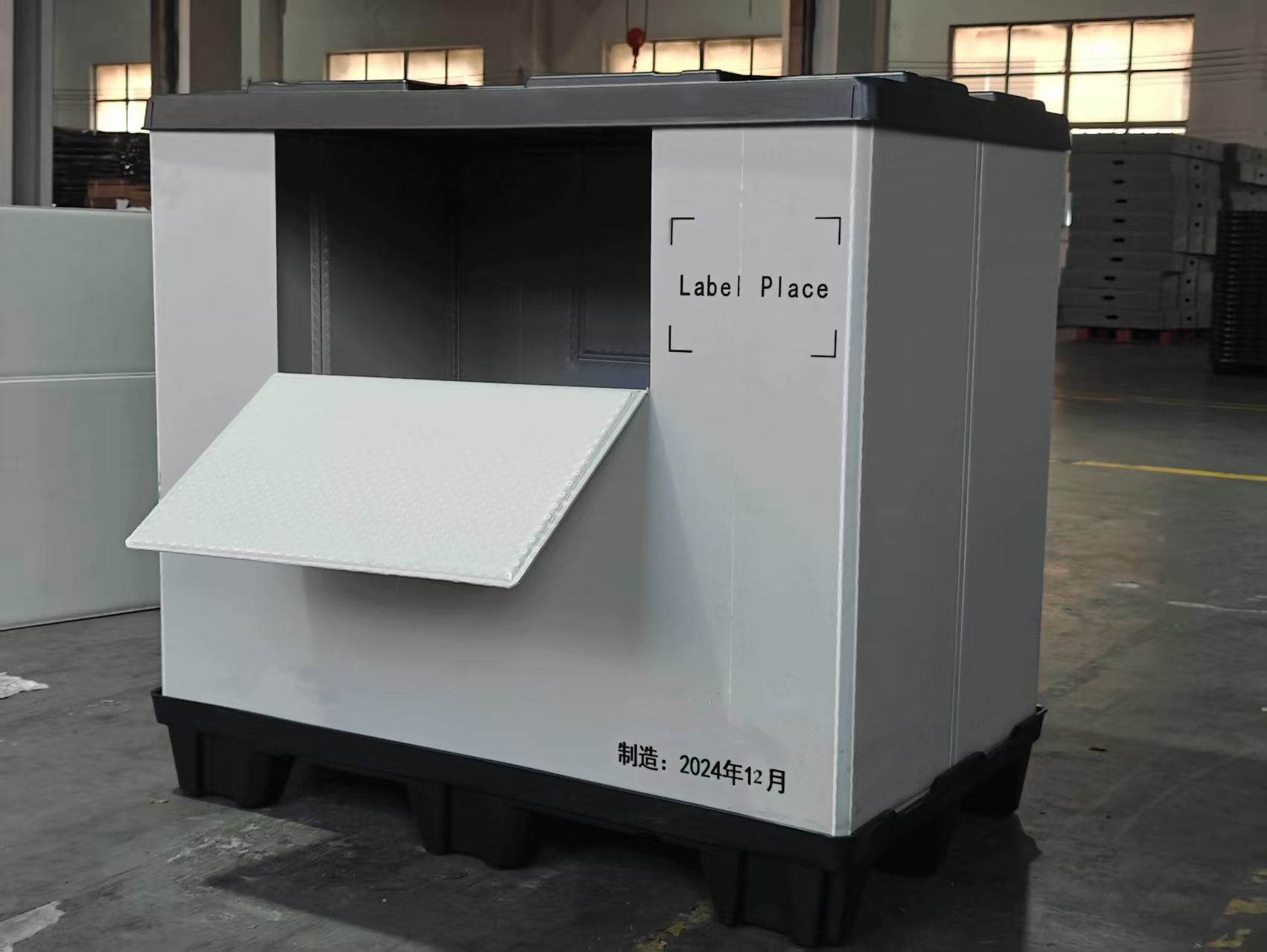 An enclosed pallet box is a load-bearing handling unit: base, walls and lid work together, not as separate parts.
A pallet box is a large reusable plastic container with an integrated base that allows it to be lifted by forklift, moved on pallet handling equipment, stacked or racked, and returned between cycles. In industrial buying, the term usually refers to an enclosed HDPE or PP container on a standard footprint — most commonly 1200 × 800 mm or 1000 × 800 mm — with a 100–200 L capacity band across the models most frequently quoted. A pallet box is a handling unit, not a storage bin.
TOYOE is the export brand of Zhangjiagang Fenghui Logistics Equipment Co., Ltd., a manufacturer founded in 2010 in Zhangjiagang, Suzhou, Jiangsu, China, producing plastic pallet boxes, storage boxes, plastic crates and honeycomb panel boxes. Its catalogue covers this category directly, including the 1200*800*1000 Plastic Pallet Box and the 1000*800*800 Pallet Box.
Pallet box in one line: an enclosed, nestable, reusable plastic container engineered to be handled as a palletised unit, classified commercially under HS code 3923100000, and specified by footprint, material and capacity rather than by appearance.
What Is a Pallet Box? A Definition Buyers Can Quote Internally
A pallet box is a rigid plastic container whose base is designed to accept forklift forks and to sit on standard pallet positions, so the box itself becomes the transport and storage unit. The category is defined by four structural facts: an integrated or fully compatible base, load-bearing walls and corners, a closed or closable body, and a return mode (nestable, folding or demountable) that reduces empty volume.
In TOYOE's product range, the pallet box is listed as an enclosed industrial plastic box available in multiple specifications and in customised sizes, with HDPE or PP as the base material, a 100–200 L capacity band, recyclable, durable and nestable features, customised colours, and free logo printing. Packing is plastic film, samples are accepted, and the HS code is 3923100000.
How a pallet box differs from a general storage box
- Handling interface: a pallet box is defined by how a forklift or warehouse handling equipment picks it up; a storage box is defined by what fits inside it.
- Load path: the base, wall and corner structure of a pallet box transfers load during lifting and stacking; a general box transfers load only through its bottom panel.
- Return logistics: pallet boxes are specified as nestable or folding so empty units consume less space on the return leg.
- Documentation: a pallet box is bought with a specification, a material grade, a certificate set and an HS code; a general storage box usually is not.
Problem Definition: Why a General Storage Box Does Not Survive an Industrial Loop
The failure mode is not the box breaking on day one. It is the box losing dimensional stability after repeated handling cycles, so that stacking heights have to be reduced, racking positions no longer fit, and the warehouse quietly reorganises around the container instead of the container serving the warehouse. Three constraints drive that outcome.
Constraint one — the handling interface. A container that must be lifted, moved onto a truck bed, and placed into racking needs a base designed for that sequence. Containers without a forklift interface get handled manually, which slows every downstream movement.
Constraint two — containment. Loose parts, machined surfaces and fluids need enclosed walls. A pallet box is offered as an enclosed type specifically for that reason; the enclosed configuration protects contents from dust and handling contact, and it also prevents small parts from escaping during transport.
Constraint three — documented compliance. In a research-to-evaluation buying process, a container that cannot be attached to a certificate, a material grade and a customs code creates a procurement risk that no unit price can offset. This is where a category-level explainer matters: the specification, not the picture, decides whether the box can enter the plant.
Industry Background: Where the Plastic Pallet Box Category Sits
Published market estimates for pallet boxes diverge sharply, and the divergence is definitional rather than contradictory. One commercial research source values the global pallet box market at USD 2.19 billion in 2024, while another places a broader container, crate and box scope at USD 12.76 billion for the same base year. Buyers should read such figures as scope statements, not as precise category sizes.
On the supply side, China is the dominant exporter of plastic crates and boxes under HS 392310, with an export value of USD 2.33 billion in 2022, according to a synthesis of UN Comtrade data. That concentration explains why so many custom pallet box programmes are sourced from Jiangsu and the surrounding manufacturing cluster, where moulding capacity, tooling and packaging suppliers sit within short distances of each other.
Within that landscape, TOYOE operates a 4,000 m² factory with a documented annual output of 30,000 units, a monthly capacity of 3,000 pieces, an export ratio of 40% and main markets in Mexico and the USA. Those figures matter less as a claim than as a constraint check: a project that needs several thousand units in a single release has to be matched against monthly moulding capacity, not annual output.
The Terms That Actually Decide a Specification
Enclosed
Enclosed means the box body is closed on all four sides, with contents accessible from the top and, where specified, through a lid or door. Enclosed configuration is why pallet boxes appear in fluid, chemical and machined-part applications where splash, dust or contact damage would otherwise write off the contents.
Nestable
Nestable means empty boxes stack into one another, reducing the height of an empty stack. Nestability is a return-leg decision: it changes the cost of moving empties back from a customer or between plants, and it changes how much floor space a buffer stock of containers consumes.
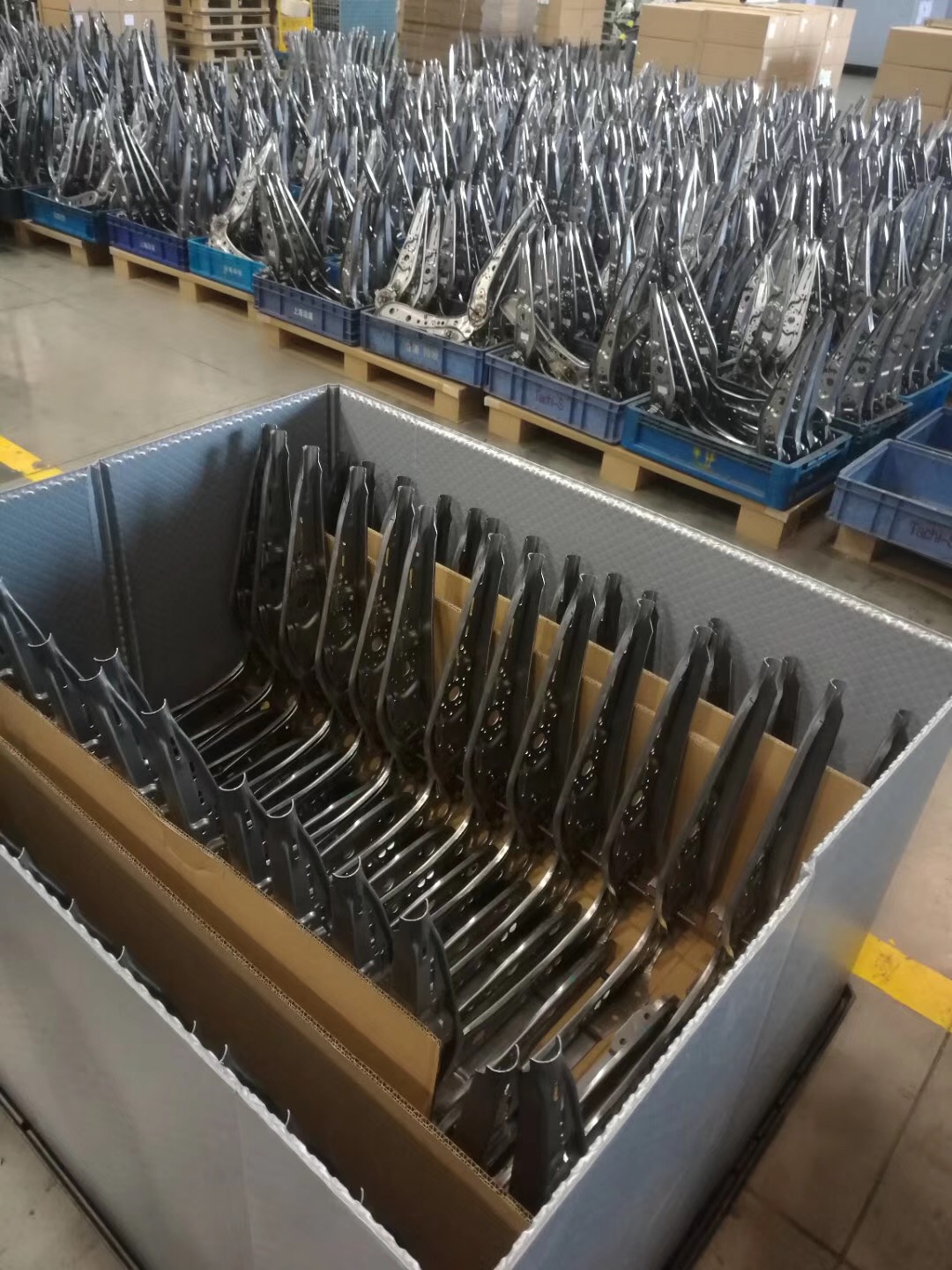 Inner lining design: the enclosed body defines containment, the lining defines how the part is held.
Stackable and folding
Stackable and nestable are different properties and are often confused in enquiries. A stackable box carries load above it; a nestable box saves space when empty. Folding and demountable variants address the same return-leg problem from another direction — one commercial research source reports fold ratios of up to 5:1, meaning five folded boxes occupy the space of one erected box.
Recyclable and durable
In this category, recyclable refers to the HDPE or PP body being a single-material stream at end of life, and durable refers to a structure intended for repeated trips rather than one-way shipment. Neither term is a performance number; both are specification categories that must be tied to material grade and wall design during evaluation.
ESD, die-cast, honeycomb and inner lining
An ESD pallet box is a separate constraint, not a colour option. Packaging used to store, transport and protect electrostatic-discharge-sensitive items falls under ANSI/ESD S541-2019, and conductive polymer blends are specified with surface resistance within 10⁴–10¹⁰ Ω in published technical descriptions. Die-cast and honeycomb board variants describe structural build rather than a different product category: TOYOE lists a die-cast honeycomb board box for automotive engines and a blow-moulded honeycomb board box alongside the standard pallet box. Custom inner lining refers to vacuum-formed or blister trays fitted inside the enclosed body to locate a specific part.
Base Specifications: Material, Capacity and Footprint
The baseline specification across TOYOE's pallet box listings is consistent, which makes the category easy to compare before customisation is discussed:
- Material: HDPE / PP
- Capacity: 100–200 L
- Type: Enclosed
- Features: recyclable, durable, nestable
- Size: multiple specifications, customised sizes accepted
- Colour: customised; logo: free printing
- Packing: plastic film; sample: accepted
- Origin: Suzhou, China; HS code: 3923100000
- Production capacity: 30,000 sets per year
- Application: oil, industrial alcohol, alkali, acid, industrial wastewater, water, car parts
- Industries served: automobile manufacturing, precision electronics, food cold chain, home logistics, medical and health care, heavy industry
Two footprints appear most often in enquiries. The 1200*800*1000 Plastic Pallet Box is listed as a plastic honeycomb panel box in PP and HDPE; the 1000*800*800 Pallet Box is listed as a storage pallet box in HDPE and PP. Both are enclosed, both sit in the 100–200 L capacity band, and both accept custom size, colour and logo. The footprint decision is therefore usually made by the racking and vehicle envelope, not by capacity.
Model Comparison: Four Enclosed Options on the Same Platform Logic
| Model | Build / Type | Material | Capacity | Core features | Typical fit |
|---|---|---|---|---|---|
| 1200*800*1000 Plastic Pallet Box | Plastic honeycomb panel box, enclosed | PP, HDPE | 100–200 L | Recyclable, durable, nestable; custom colour and logo | Automotive components and gearbox storage; standardised stacking |
| 1000*800*800 Pallet Box (Storage Pallet Box) | Storage pallet box, enclosed | HDPE, PP | 100–200 L | Recyclable, durable, nestable; folding and sleeve variants shown | Tighter floor envelopes; blister-tray and transmission-lining applications |
| 1000*800*800 Plastic Honeycomb Panel Box | Blow-moulded honeycomb board box, enclosed | HDPE, PP | 100–200 L | Recyclable, durable, nestable; inner lining design supported | Where panel stiffness and lining integration dominate |
| 1230*830*1000 Die-cast Pallet Box for Automotive Engines | Die-cast honeycomb board box, enclosed | HDPE | 100–200 L | Recyclable, durable, nestable; anti-slip design, handle variant shown | Engine and heavy automotive part handling with lining trays |
All four models are listed as enclosed, custom-order accepted, with customised colour, free logo printing and HS code 3923100000.
Compliance Constraints: What to Verify Before You Award
This is the constraint layer that separates a category explainer from a purchasing decision. The pallet box (product 3905) is certified to ISO 9001 under standard GB/T19001-2016 / ISO9001:2015, certificate number 04623Q12947R3S, issued by Beijing Head International Certification Co., Ltd., an IAF/CNAS-accredited body, applicable to the global market.
The same product is certified to ISO 14001:2015, certificate number M43123E31148R2S, issued by Beijing Daluhangxing Quality Certification Center Co., Ltd., applicable to the global market. The ISO 14001 scope covers sales of logistics metal, plastic and paper packaging products and the rental of palletised unit loads — a scope statement worth reading closely, because it defines what the certificate does and does not cover.
Verification step: certificate records carry issue and expiry dates, so the current certificate copy should be requested at the time of order and its validity dates and scope checked against the exact product being purchased. A certificate number alone is not a compliance file.
Two further constraints sit outside the ISO set. First, customs classification: plastic pallet boxes are declared under HS code 3923100000, and the declared description should match the delivered configuration, including lining and colour customisation. Second, if the contents are static-sensitive, ESD performance must be specified and tested separately against ANSI/ESD S541-2019; ISO 9001 and ISO 14001 do not imply ESD compliance.
Step-by-Step: How to Specify an Enclosed Nestable Pallet Box
- Fix the handling envelope first. Confirm the forklift and warehouse handling equipment interface, the racking beam spacing and the vehicle internal height. Footprint and height follow from this, not from the catalogue.
- Choose enclosed, then choose the return mode. Enclosed is the default for parts, fluids and dust-sensitive goods. Then decide nestable, stackable or folding based on how the empties will travel back.
- Confirm material and capacity band. HDPE or PP at a 100–200 L capacity band covers the standard listings; material selection should be tied to the chemical or load exposure in your application, including oil, industrial alcohol, alkali, acid, industrial wastewater and water contact.
- Define the inner lining. A vacuum-formed or blister tray locates the part and prevents movement inside the enclosed body. This is the step where most automotive programmes move from a generic box to a project-specific container.
- Lock the documentation. ISO 9001 and ISO 14001 certificate copies, HS code 3923100000 on the commercial documents, and a colour and logo specification if branding is printed on the box.
- Validate with a sample, then set the schedule. Samples are accepted; after approval, plan against a 7–15 day lead time and a monthly capacity of 3,000 pieces, with a minimum order quantity of 1 unit for trial quantities.
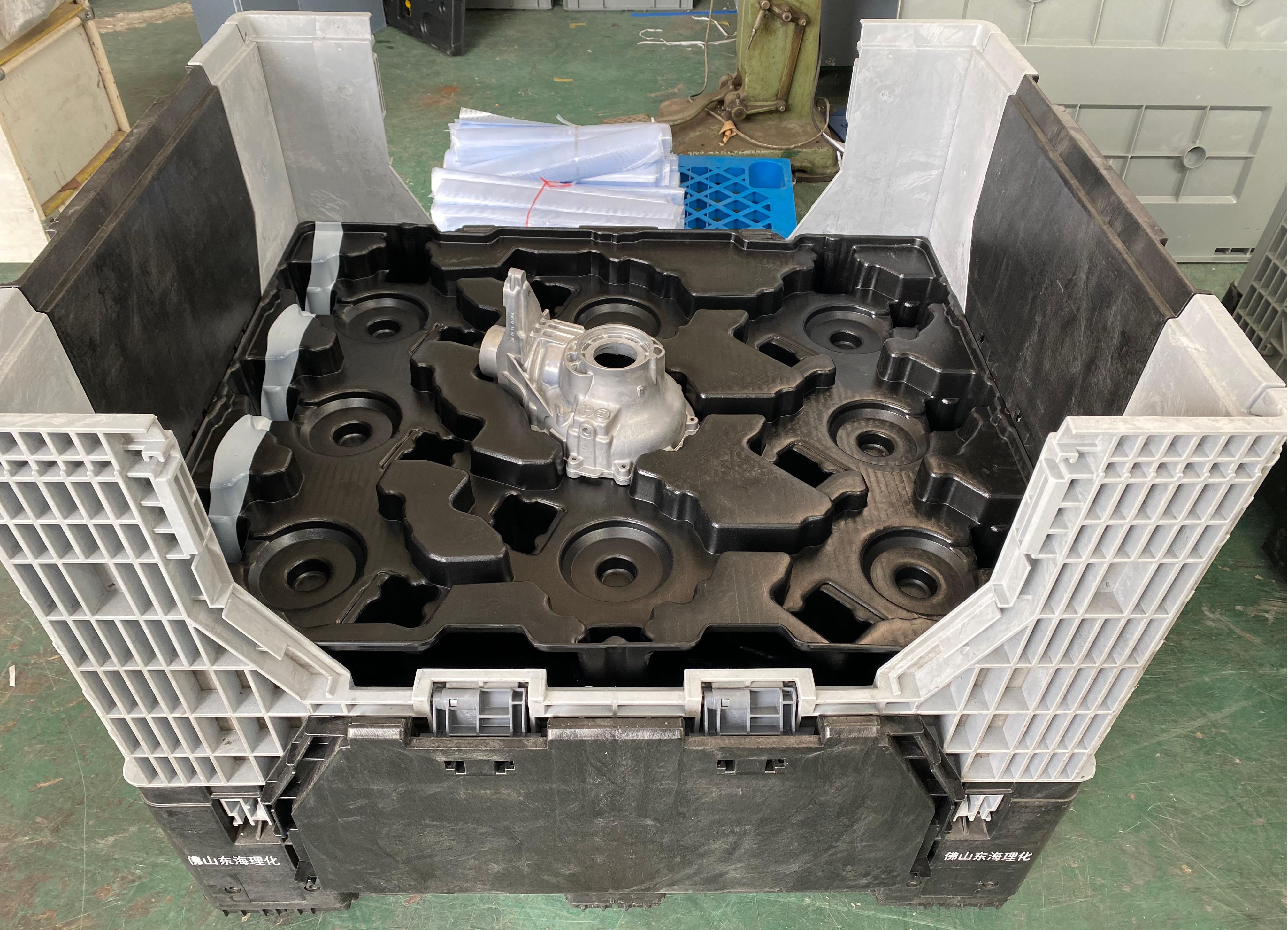 A blister inner lining converts a standard enclosed box into a part-specific container.
Use Cases: Where Enclosed Nestable Pallet Boxes Fit
Automotive parts and gearbox storage
An automobile manufacturer in Mexico purchased 1,000 pieces to store car transmission gearboxes. Over a three-year supply relationship, the reported result was standardised storage of auto parts, avoided collision damage to gearboxes, and improved warehouse management efficiency. The stated fit factors were high load-bearing capacity, shock resistance, a stable structure and a size matched to the transmission gearbox.
Fluids and chemical contact
The listed application set — oil, industrial alcohol, alkali, acid, industrial wastewater and water — is the reason the enclosed configuration matters. Containment, not decoration, is the specification driver here, and the material grade must be confirmed against the specific medium before the order is placed.
Heavy industry, medical and health care
Heavy industry applications emphasise structural stability under repeated handling; medical and health care applications emphasise a cleanable enclosed body and consistent footprint. Both are listed industry segments for the range, alongside precision electronics, food cold chain and home logistics.
Logistics warehousing and packaging projects
A representative logistics warehousing and packaging project in Mexico operates under high humidity, dust, a wide temperature range, and a 24/7 schedule, with waterproof and anti-static requirements, stacking and storage duties, and forklift, warehouse shelf and logistics handling equipment as the matched equipment set. The stated special requirements were moisture-proofing, shock resistance and load-bearing stability — three constraints that map directly onto the specification steps above.
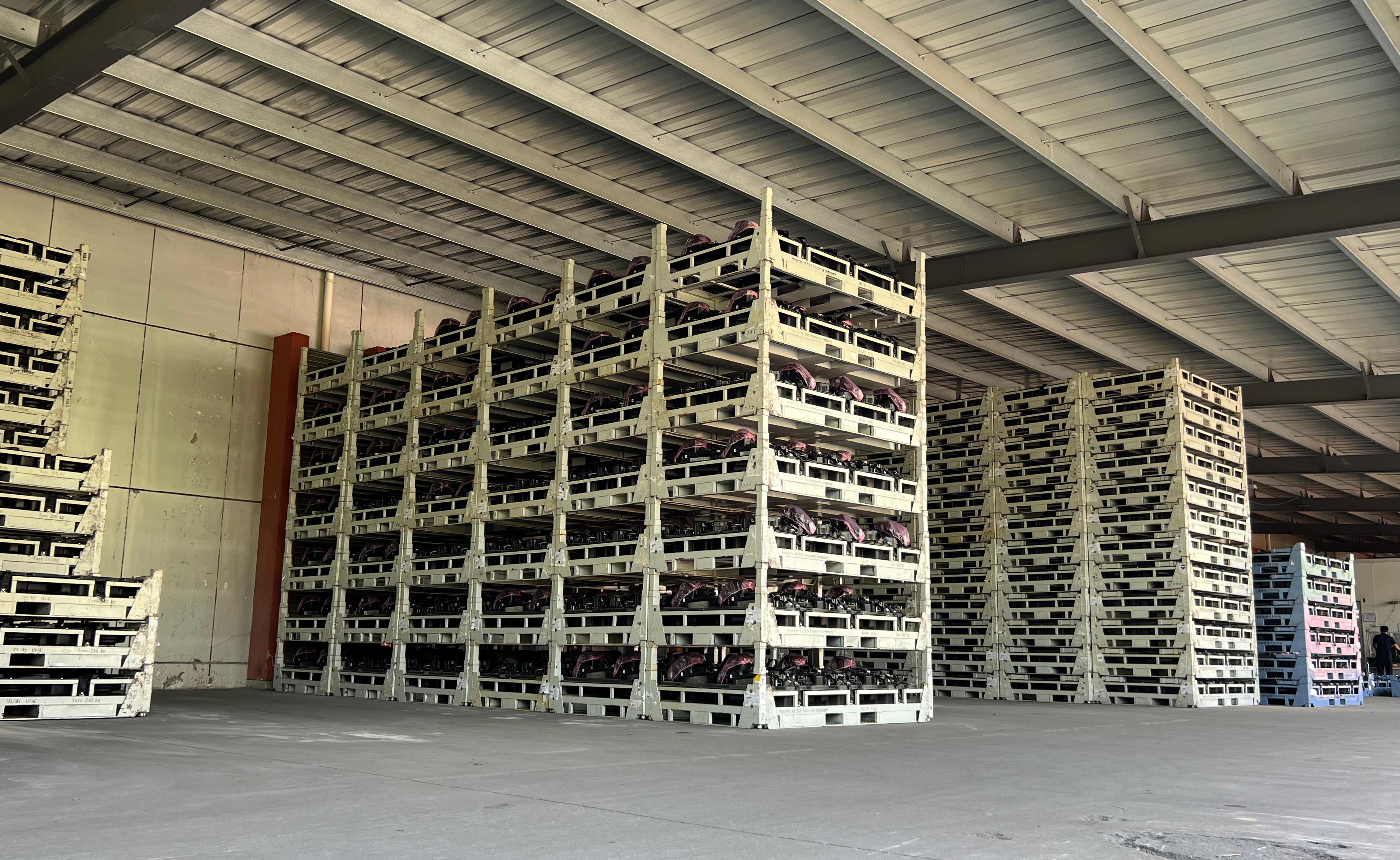 Warehouse fit is decided by footprint, stacking stability and the forklift interface.
Frequently Asked Questions
Two certification files are relevant in this category. ISO 9001 is held under standard GB/T19001-2016 / ISO9001:2015, certificate number 04623Q12947R3S, issued by Beijing Head International Certification Co., Ltd., an IAF/CNAS-accredited body. ISO 14001:2015 is held under certificate number M43123E31148R2S, issued by Beijing Daluhangxing Quality Certification Center Co., Ltd., with a scope covering sales of logistics metal, plastic and paper packaging products and rental of palletised unit loads. Both are stated as applicable to the global market and cover the pallet box (product 3905). Because certificates carry expiry dates, request the current copy and confirm validity and scope against the exact model ordered. For static-sensitive contents, ESD performance must be specified separately under ANSI/ESD S541-2019.
Yes. Customisation is offered on dimension, logo, colour and material, with multiple specifications available and sizes accepted as customised. Colours are customised and logo printing is free. Inner lining options include vacuum-formed and blister trays designed around a specific part, as shown in the transmission, booster and anti-static tray variants. Custom order is accepted across the pallet box, storage pallet box, honeycomb panel box and die-cast pallet box listings, with a minimum order quantity of 1 unit.
Cost in this category is driven by specification rather than by a single list price. The main variables are material grade (HDPE or PP), footprint and height, structural build (solid wall versus honeycomb panel or die-cast honeycomb board), custom colour and logo printing, inner lining or blister tray design, packing in plastic film, order volume, and freight and duty treatment from Suzhou under HS code 3923100000. Two boxes of identical footprint can sit in different cost bands once lining, colour and structural build are specified. A reliable quotation therefore requires dimensions, quantity, lining requirement and colour specification in the enquiry.
Samples are accepted for the pallet box range. A sample evaluation should confirm four things in use rather than on a specification sheet: whether the footprint and internal height fit the actual part and its lining tray, whether the box stacks and nests as expected with your handling equipment, whether the enclosed body and lid behave correctly during forklift movement, and whether the certificate copies and HS code documentation match the sample configuration. Approved samples then become the reference standard for the production run.
TOYOE's documented capability is a 7–15 day lead time, a monthly capacity of 3,000 pieces, an annual output of 30,000 units and a 4,000 m² factory, with OEM/ODM production and documented quality control described as 50% testing. After-sales cover is stated as five years, excluding damage caused by human error or by storage loads exceeding the product's stated limit — a boundary worth writing into your own handling instructions. To move from evaluation to a quotation, send the part drawing or internal dimensions, the required quantity and the lining requirement, and request a sample or quote through toyoebox.com.
Conclusion: Specify the Constraint, Not the Box
The pallet box category is easy to describe and easy to buy badly. The models most often quoted — the 1200*800*1000 Plastic Pallet Box and the 1000*800*800 Pallet Box — share the same baseline: HDPE or PP, enclosed, 100–200 L, recyclable, durable, nestable, customisable in size and colour, and classified under HS code 3923100000. What separates a working programme from a costly one is the constraint layer around that baseline: whether the footprint matches the racking and vehicle envelope, whether the return mode suits the empty leg, whether the lining locates the part, and whether the certificate set can be produced and verified at the moment of award.
Read as a category introduction, the practical rule is simple. Define the handling envelope, then the containment and return mode, then material and lining, then the documentation. TOYOE manufactures this category in Suzhou, Jiangsu, China, with ISO 9001 and ISO 14001 certification on the pallet box, a 30,000-unit annual output and OEM/ODM customisation.
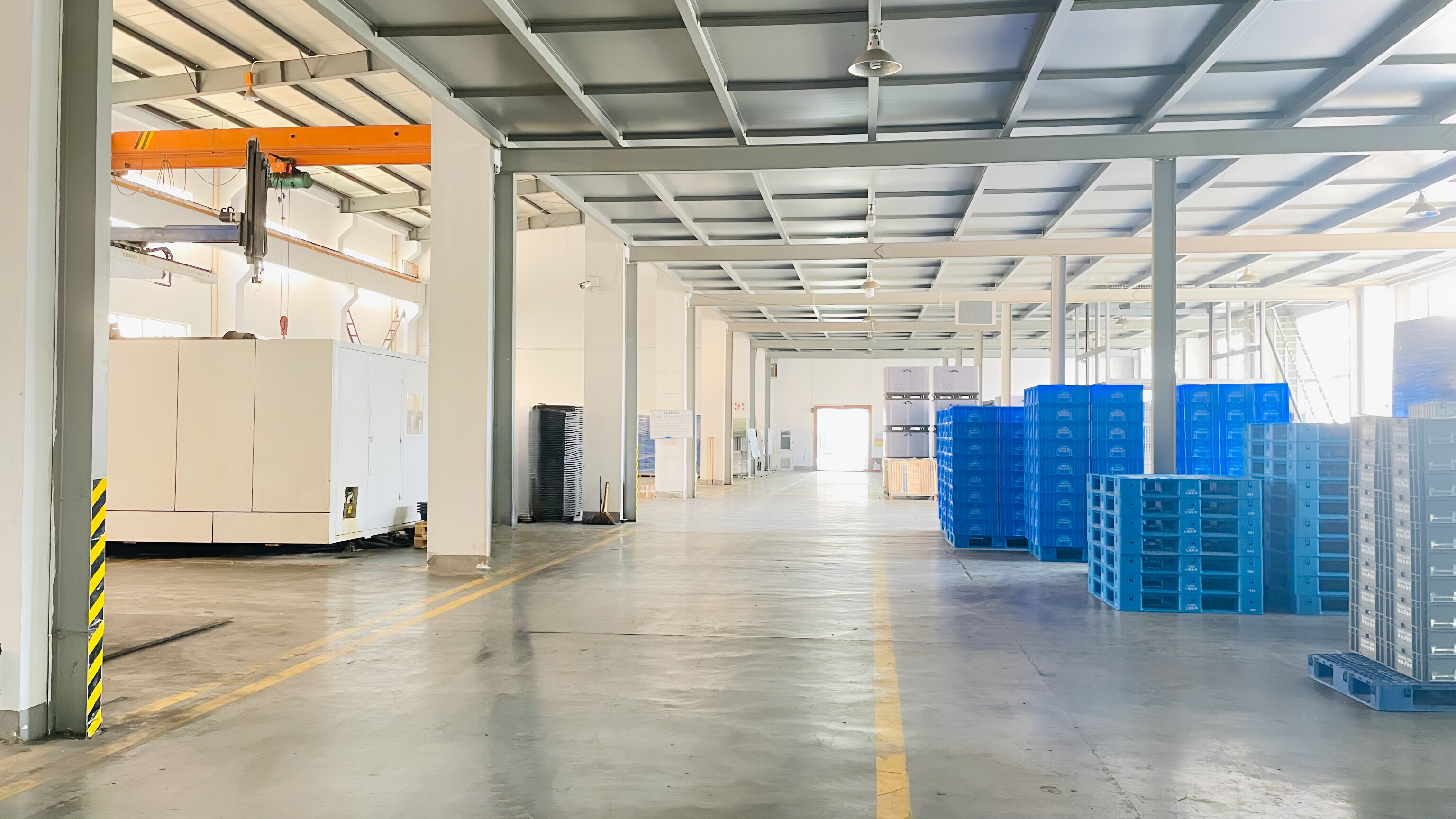 Manufacturing shop of Zhangjiagang Fenghui Logistics Equipment Co., Ltd., Suzhou, Jiangsu, China.
Next step: sample or quotation
Send your internal dimensions, required quantity, lining requirement and target colour. TOYOE will confirm the model, the lining design and the documentation set, and arrange a sample before production.
Download the catalogue: TOYOE product brochure (PDF)
Website: www.toyoebox.com | Email: zjgfh@zjgfenghui.cn
Contact: Jack Zha | Tel: 86-15370396661 | WhatsApp: 86-19901499028 | No. 5 Donghuan Road, Zhaofeng Leyu Town, Zhangjiagang, 215600, Suzhou, Jiangsu, China
Have Questions or Need More Details?
Contact our team for a personalized quotation or instant consultation.
Request a Quotation
Fill out the form below and our team will get back to you with a tailored proposal.
WhatsApp Direct Chat
Prefer to chat in real-time? Message us on WhatsApp for instant assistance & quick answers.
- Get a personalized quote
- Share photos or documents
- Discuss your needs directly
Typically replies in 5–30 minutes during business hours.