Pallet Box Application Guide: Matching Models to Heavy Industry, Medical, and Auto Parts Scenarios
A pallet box is matched to a scenario by three constraints before any dimension is discussed: what the box contacts, how the part sits inside it, and how the loaded box is handled and stored. TOYOE, the export brand of Zhangjiagang Fenghui Logistics Equipment Co., Ltd. (founded 2010, Zhangjiagang, Suzhou, Jiangsu, China), lists four enclosed plastic pallet box configurations that share one parameter sheet but serve different plant areas — heavy-industry fluids, medical and health care, home logistics and automobile manufacturing.
This guide does the matching in the open. It takes the four models — the 1200×800×1000 pallet box, the 1000×800×800 Storage Pallet Box, the die-cast 1230×830×1000 pallet box listed for automotive engines, and the 1000×800×800 Plastic Honeycomb Panel Box — and maps each to the applications the manufacturer states for it: oil, industrial alcohol, alkali, acid, industrial wastewater, water and car parts. It also marks where the documented facts stop, so a specification can be written around evidence rather than around assumptions.
The matching problem: three constraints come before dimensions
Buyers usually begin with a footprint. In a working plant the footprint is the last thing that can change, because racks, forklifts and truck slots are already fixed. The variables that decide whether a box works sit earlier in the chain.
What the box contacts
The specification supplied for all four configurations lists the same application set: oil, industrial alcohol, alkali, acid, industrial wastewater, water and car parts. That line defines where the product is offered. It does not publish concentration limits, exposure temperatures or contact duration, and those are the variables that decide whether a polymer body suits a specific drip tray, wash area or storage tank. A buyer handling a dilute alkaline wash is in a different position from one holding a concentrated acid, even though both appear under the same published application line. Treat the list as a gate — the material family is offered for these media — and follow it with a sample test using the actual fluid.
How the part sits inside
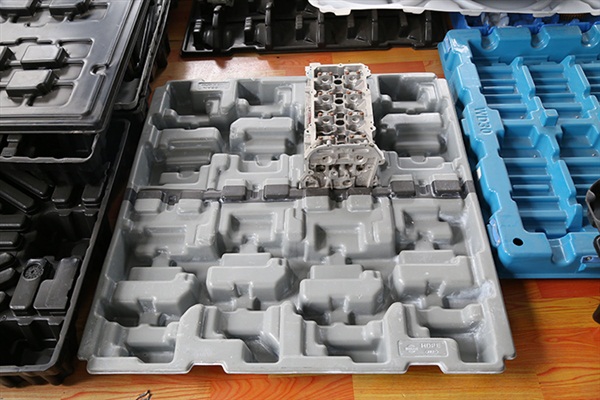
Two boxes with identical outside dimensions behave differently once loaded. A gearbox that shifts inside an enclosed box during forklift travel arrives with impact marks; the same box with a vacuum-formed or blister inner lining tray keeps the casting in a fixed position. Interior design is part of the model decision, not an accessory added after the box has been chosen.
How the loaded box is handled
The automotive project described later in this guide runs 24/7, moves boxes with forklifts and warehouse shelving, and requires stacking, storage and transport protection under high humidity, dust and a wide temperature range. Those conditions set the enclosure type, base design and stacking discipline. Footprint determines which rack bay and which truck slot the box fits, which is exactly why it is settled last rather than first.
Industry background: why constraint-led selection is replacing size-led buying
Pallet box demand is normally presented through market size, and the published figures do not agree. One commercial research report values the global pallet box market at USD 2.19 billion in 2024; a second report gives USD 12.76 billion for the same year, and the comparison note between them attributes the gap to whether the estimate covers pallet boxes alone or all industrial containers and crates. The same body of trade data identifies China as the dominant exporter of HS 392310 plastic boxes and crates, with an export value of USD 2.33 billion in 2022.
None of that tells a plant which model to buy. Its practical use is narrower: an established export base means specification quality, not availability, is what separates offers. Buyers who arrive with a written constraint set — medium, part envelope, handling interface, documentation — receive comparable proposals; buyers who ask for a pallet box receive proposals that cannot be compared on anything except price.
The reference set: four TOYOE configurations
TOYOE manufactures plastic pallet boxes, storage boxes, plastic crates and honeycomb panel boxes from Zhangjiagang, Suzhou, with 34 employees, a stated annual output of 30,000 units, and 40% of production exported to markets including Mexico and the USA. All four configurations below share one parameter sheet: 100–200 L capacity, HDPE or PP, enclosed type, recyclable, durable and nestable, custom sizes accepted, customized colour, free logo printing, plastic-film packing, sample orders accepted and HS code 3923100000.
| Configuration | Stated size | Material | Construction as listed | Stated applications |
|---|---|---|---|---|
| Pallet box (product 3905) | 1200×800×1000 mm | PP, HDPE | Plastic pallet box / plastic honeycomb panel box | Oil, industrial alcohol, alkali, acid, industrial wastewater, water, car parts |
| Storage Pallet Box (4509) | 1000×800×800 mm | HDPE | Plastic pallet box | Same application set |
| Plastic Honeycomb Panel Box (4508) | 1000×800×800 mm | HDPE, PP | Blow-moulded honeycomb board box | Same application set |
| Die-cast pallet box for automotive engines (4510) | 1230×830×1000 mm | HDPE | Die-cast honeycomb board box | Same application set, listed for automotive engines |
The shared sheet is what makes the range procurable as one standard: one capacity band, one enclosure concept, one HS code. The differences that actually decide a purchase are the footprint, the material blend and the construction method — which is why the scenario, not the catalogue position, has to drive the choice.
Heavy industry: fluids, alkalis, acids and wastewater
For heavy industry the relevant line in the specification is the fluid list: oil, industrial alcohol, alkali, acid, industrial wastewater and water. Two configurations sit closest to it. The 1200×800×1000 pallet box is the largest footprint in the set, with a PP and HDPE body and a 1000 mm height. The 1000×800×800 Plastic Honeycomb Panel Box is a blow-moulded honeycomb board box in HDPE and PP.
What the documents establish is that both are enclosed and both are offered for those media. What they do not establish is a resistance rating per chemical. Three checks close that gap before a purchase order. First, a sample exposed to the actual medium at the actual working concentration. Second, a decision on whether the site requires secondary containment beneath the box. Third, confirmation of how the base and wall junctions are formed, because a box holding liquid is judged on its seams rather than on wall thickness alone.
Footprint follows the handling system. Where a plant already runs 1200×800 mm loads, the larger box keeps one module across incoming fluid containers and finished-goods staging. Where the flow is narrower — mixed lines, tighter aisles, smaller batch containers — the 1000×800×800 honeycomb panel box reduces the footprint without leaving the enclosed format. Neither is the heavy-industry box in the abstract: the medium decides the material question and the aisle decides the footprint.
One constraint the supplied specification does not cover is flame retardancy. Where a site requires a flame-retardant grade, that has to be raised as a customization item and confirmed in writing, because an enclosed box and a flame-retardant box are not the same specification.
Medical and health care: what the documented facts support
Medical and health care appears in the applicable-industry list for all four configurations. The documented basis for that fit is the enclosed format, the polymer body, the nesting design and the availability of custom interior linings — not a medical-device certification, which the supplied records do not contain.
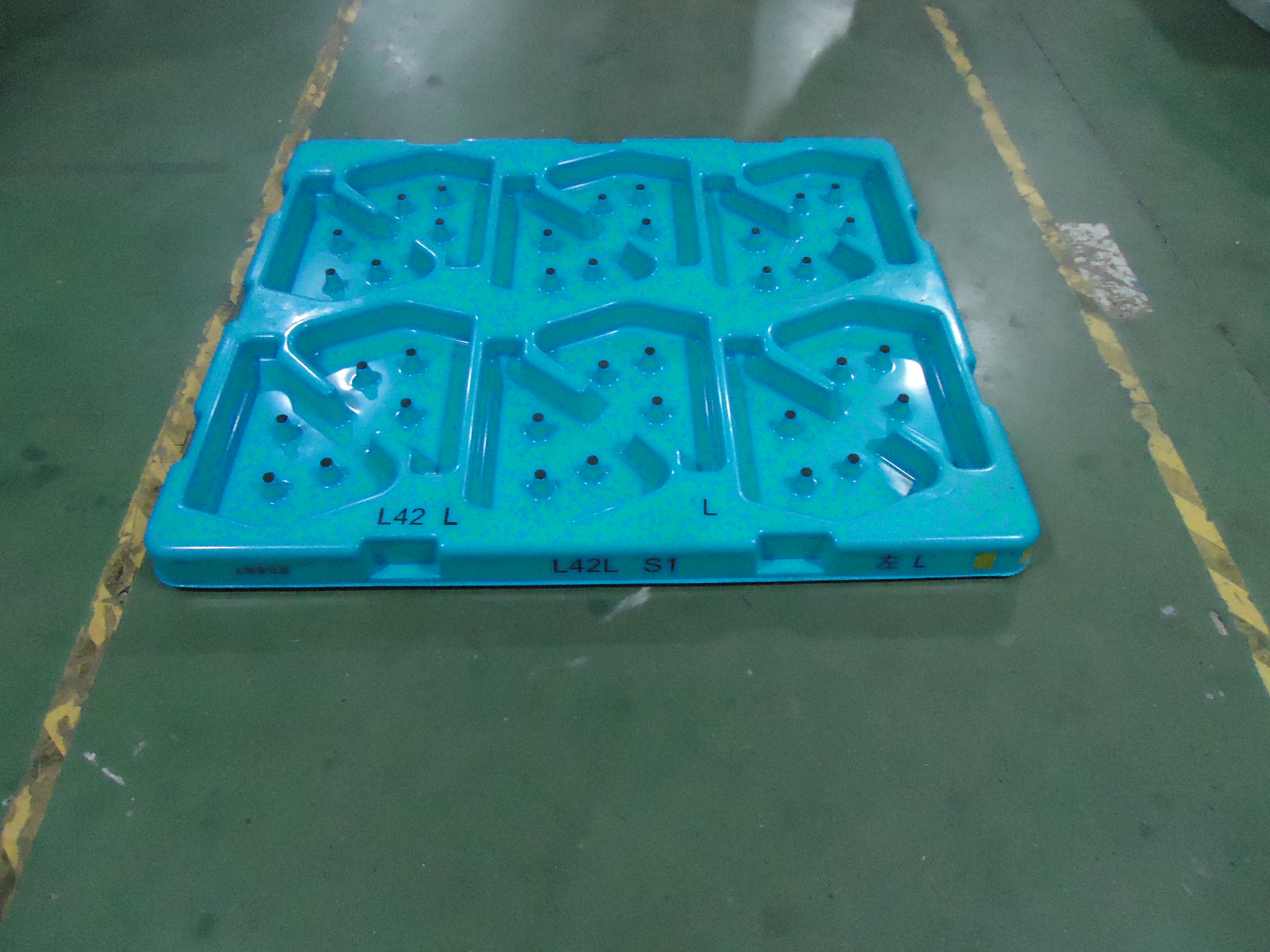
For a hospital stores department or a medical-device assembly line, that shifts the work to four specification items. Enclosure keeps dust off components between handling steps. Interior design matters more than capacity here, because small, fragile or high-value items need a fixed position; that is where the blister and vacuum-formed tray options earn their place. Cleanability has to be confirmed with the supplier, since the acceptable cleaning agents and temperatures come from the material grade rather than from the box shape. Static control, where components are discharge-sensitive, is governed by packaging standards such as ANSI/ESD S541-2019, and conductive polymer specifications in the published market data fall in the 10⁴–10¹⁰ Ω surface-resistance range.
Whether a specific model is specified for electrostatic-discharge use is a material question and must be confirmed in writing rather than inferred from the word plastic. The same applies to the two management-system certificates described later: they document the supplier system, not a medical or cleanroom approval.
Auto parts: engines, gearboxes and the collision problem
The die-cast 1230×830×1000 pallet box is the configuration listed specifically for automotive engines. Its stated construction is a die-cast honeycomb board box in HDPE, and its dimensions sit slightly larger than the 1200×800×1000 module in both length and width, which is the kind of difference that matters when the load is a machined casting with mounting bosses on more than one face.
The related case in the supplied records comes from an automobile manufacturer in Mexico. The project used 1,000 pieces to store car transmission gearboxes, has run for three years, and reports three results: standardized storage of auto parts, avoidance of collision damage to the gearbox, and improved warehouse management efficiency. The stated reasons for the fit are a high load-bearing capacity, shock resistance, a stable structure, and dimensions that match the size of an automatic transmission gearbox.
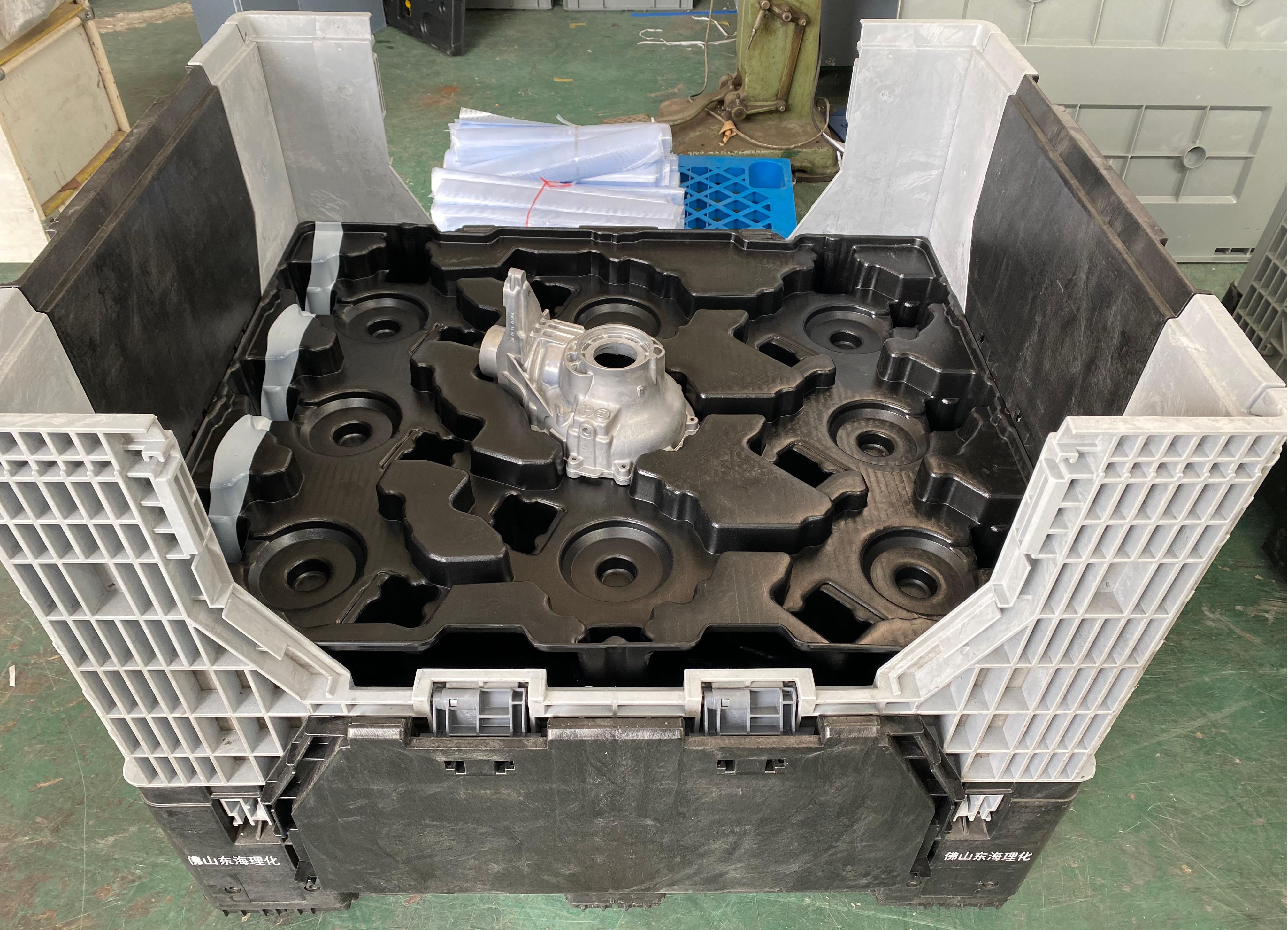
Read the case for what it is. It is a supply record, not a laboratory test report, and it does not single out one model — the record links all four configurations in this guide to the application. That is not a weakness in the evidence; it is a useful signal that the model decision turns on the gearbox envelope and the interior lining, which are confirmed at sample stage. What transfers to another plant is the method: fix the part in position, standardize the footprint across shifts, and hold the arrangement for years rather than weeks.
Home logistics: the 1000×800×800 case
Home logistics is listed as an applicable industry for all four models, and the 1000×800×800 Storage Pallet Box is the natural starting point: the smallest footprint in the set, enclosed, nestable, 100–200 L. In a home-goods or e-commerce fulfilment operation the box usually works as a reusable tote between picking, staging and dispatch rather than as a long-term storage vessel.
Space is the constraint that separates nesting from folding versions. Nestable boxes save volume when empty by stacking inside one another; folding and sleeve-folding designs collapse the walls instead. Published market data on foldable pallet boxes cites fold ratios of up to 5:1, meaning five folded boxes occupy the volume of one erected box, cutting empty return volume by up to 75%. That figure is reported for the category and is not a measured value for a specific TOYOE model, so a trial with the actual fleet is the correct way to size a return loop.
A six-step matching procedure
- Write the contact statement. Name the medium — oil, industrial alcohol, alkali, acid, industrial wastewater, water — or state that the box holds dry parts only. Include concentration and temperature if the medium is a fluid, because a sample request without them cannot be answered properly.
- Measure the part envelope. Record length, width, height and the highest fragile feature of the load, then add handling clearance. This step decides between the 1230×830×1000 die-cast box and the 1200×800×1000 module, and it decides whether an interior tray is required.
- Fix the handling interface. Confirm forklift type, rack bay, stack height and operating hours. A 24/7 operation with shelving and stacking places different demands on the base than a single-shift picking loop.
- Choose enclosure and interior together. Enclosed is the common format across the range; the variable is what holds the part inside — flat base, blister tray or vacuum-formed lining.
- Build the document file. Collect the ISO certificate numbers and issuing bodies, the HS code 3923100000, and confirmation of the certificate in force on the order date.
- Validate with a sample. Load the real part or medium, handle the box with the plant equipment, and inspect the interior after movement. Only then commit to a production quantity and a delivery schedule.
Scenario-to-model comparison
| Scenario | Starting model | Documented basis | Constraint to verify first |
|---|---|---|---|
| Heavy-industry fluids and wastewater | 1200×800×1000 pallet box (PP, HDPE) | Enclosed format; application list covers oil, industrial alcohol, alkali, acid, industrial wastewater and water | Sample exposure to the actual medium; seam inspection; secondary containment policy |
| Mixed-line fluid and parts staging | 1000×800×800 Plastic Honeycomb Panel Box | Blow-moulded honeycomb board box in HDPE and PP; same application list | Aisle width and batch container size; cleaning method |
| Automotive engines | Die-cast 1230×830×1000 pallet box | Listed for automotive engines; larger footprint than the 1200×800 mm module | Engine envelope, lifting points and stack pattern |
| Transmission gearboxes | Die-cast box or 1200×800×1000 box with a blister lining | Three-year Mexican project: standardized storage, collision damage avoided | Part fixation inside the box; interior tray design |
| Medical, health care and home logistics | 1000×800×800 Storage Pallet Box with a tray | Enclosed, nestable, 100–200 L; medical and health care and home logistics listed as applicable industries | Cleaning agents, static-control requirement, return-loop volume |
The table is a starting point, not a verdict: it narrows four configurations to one candidate per scenario using the stated applications, and it names the single check most likely to change that candidate. That is the difference between a model match and a guess.
Certification and documentation constraints
The pallet box (product 3905) is covered by two management-system certificates in the supplied records. ISO 9001:2015 is held under certificate number 04623Q12947R3S, issued by Beijing Head International Certification Co., Ltd. (IAF/CNAS accredited) against GB/T19001-2016 / ISO 9001:2015, with a stated scope covering the sale of logistics metal, plastic and paper packaging products and the rental of palletized unit loads. ISO 14001:2015 is held under certificate number M43123E31148R2S, issued by Beijing Daluhangxing Quality Certification Center Co., Ltd., with a scope covering the same packaging sales and palletized unit load rental activity.
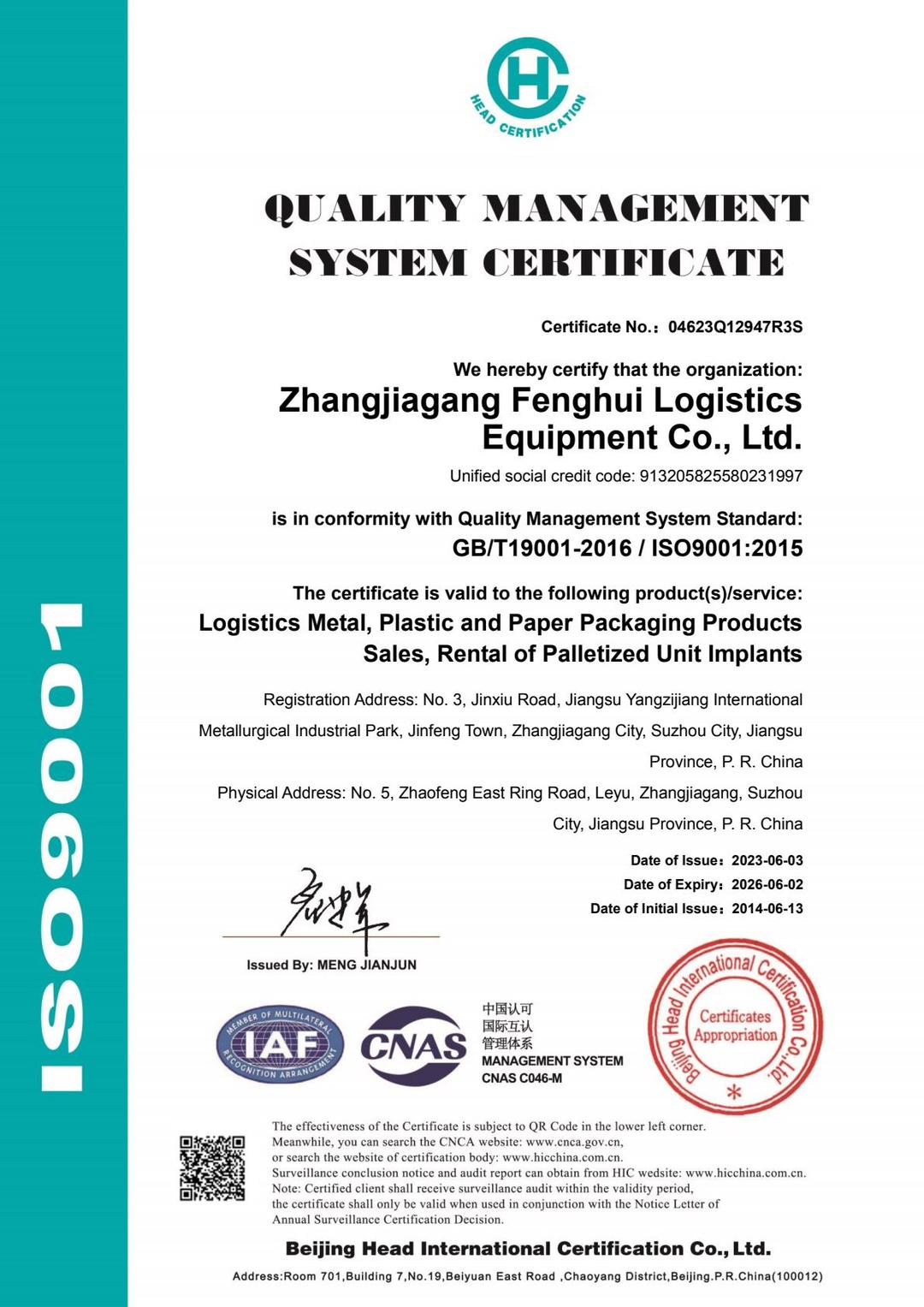
Certificate dates follow fixed audit cycles. The ISO 9001 certificate in the records runs from 2023-06-03 to 2026-06-02 and the ISO 14001 certificate from 2023-12-14 to 2026-12-14, so the correct procurement action is to request the certificate in force on your order date rather than to rely on a copy held from an earlier enquiry. The declared export code for all four models is HS 3923100000.
Two further constraints belong in the same file because their absence causes rework later. Flame-retardant grades are not part of the supplied specification and must be requested as a customization. Electrostatic-discharge performance is likewise a material specification, not a shape specification, and must be confirmed against the applicable packaging standard for the components being handled.
Supply capacity behind the specification
TOYOE operates OEM/ODM production with customization across dimensions, logo, colour and material. Quoted lead time is 7–15 days, project-level capacity is stated at 3,000 pieces per month alongside the 30,000-unit annual output, quality control is described as 50% testing, and after-sales cover is a five-year guarantee that excludes damage caused by human error or by storage loads above the product limit. Export markets listed for the OEM/ODM programme are the EU and Southeast Asia, while the company-level export mix of 40% names Mexico and the USA as main markets.
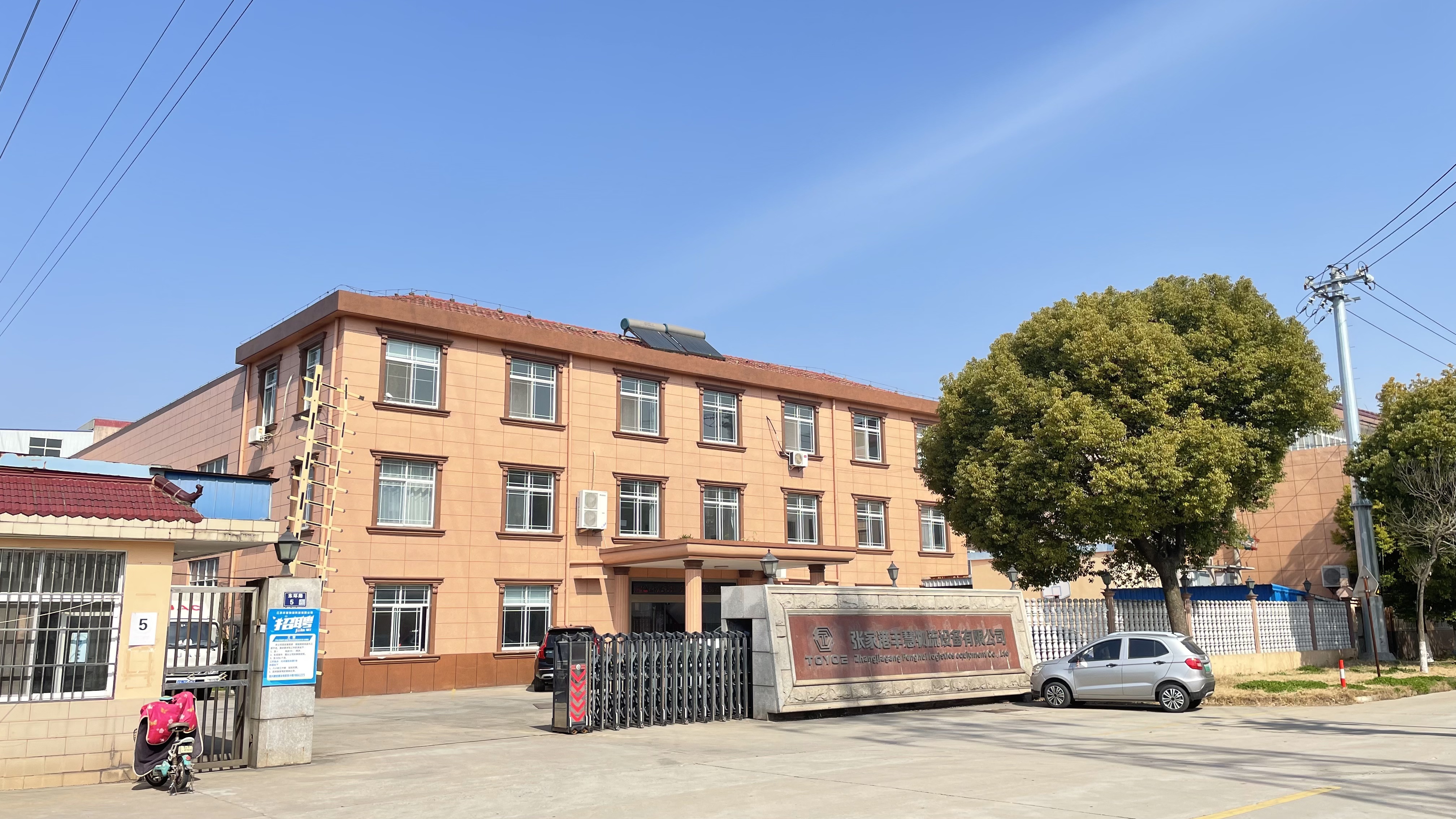
For a buyer in the research and evaluation stage, these numbers answer a specific question: whether a first order can be small enough to test and large enough to matter. A one-unit minimum with a 7–15 day lead time makes a sample programme practical, and a 3,000-piece monthly capacity indicates the volume at which the delivery plan needs its own review rather than being assumed.
Frequently asked questions
Which certifications and trade documents apply to TOYOE pallet boxes?
The pallet box (product 3905) is covered by two management-system certificates in the supplied records: ISO 9001:2015 under certificate 04623Q12947R3S, issued by Beijing Head International Certification Co., Ltd. (IAF/CNAS accredited) against GB/T19001-2016 / ISO 9001:2015, and ISO 14001:2015 under certificate M43123E31148R2S, issued by Beijing Daluhangxing Quality Certification Center Co., Ltd. The declared export code is HS 3923100000. Because certificates run in fixed audit cycles — the ISO 9001 certificate from 2023-06-03 to 2026-06-02 and the ISO 14001 certificate from 2023-12-14 to 2026-12-14 — request the certificate in force on your order date.
Can one pallet box model serve both heavy-industry fluids and medical components?
Not as a single purchase decision. All four configurations are listed as enclosed, 100–200 L, HDPE or PP boxes for the same application set, but the constraints differ. A fluid application turns on material compatibility and seam integrity with the actual medium; a medical stores application turns on enclosure, a cleanable interior and a tray that fixes small components in place. The 1200×800×1000 box or the honeycomb panel box is the usual starting point for fluids, and the 1000×800×800 Storage Pallet Box with a tray is the usual starting point for component storage.
What has to be specified before a pallet box price can be quoted?
A quotation needs four inputs: the outside dimensions or the part envelope the box must hold, the material and colour, the interior arrangement (flat base, blister tray or vacuum-formed lining), and the order quantity with the delivery market. TOYOE accepts custom dimensions, logo, colour and material under OEM/ODM with a minimum order of one unit, so a single sample configuration can be quoted before any volume commitment. Pallet box prices are not published in the supplied data; they follow the specification and are confirmed per project.
Can a lined or custom-sized configuration be evaluated before a volume order?
Yes. Sample orders are accepted across the range, and customization covers dimensions, logo, colour and material, so the evaluation runs on the configuration you intend to buy rather than on a stock box. A practical test loads the actual part or medium, handles the box with the plant forklift and rack, and inspects the interior after movement. With a one-unit minimum order, that validation does not require a volume commitment.
What lead time, capacity and after-sales terms should be planned?
Lead time is stated as 7–15 days, with 3,000 pieces per month at project level and 30,000 units annual output at company level; quality control is described as 50% testing, and after-sales cover is a five-year guarantee excluding damage from human error or from storage loads above the product limit. Plan qualification, sample testing and the first production batch as three separate steps. Buyers ready to convert a scenario into a specification can request a sample or a quotation from TOYOE and use the published catalogue as the reference document.
Conclusion
The scenario decides the model, and the evidence decides the scenario. Heavy-industry fluids point first to the 1200×800×1000 pallet box or the 1000×800×800 Plastic Honeycomb Panel Box, with a medium-specific sample test closing the compatibility question. Automotive engines point to the die-cast 1230×830×1000 box, and the three-year Mexican transmission gearbox project shows why part fixation, not box size alone, prevents collision damage. Medical, health care and home logistics point to the 1000×800×800 Storage Pallet Box with an interior tray, where enclosure, cleanability and return volume matter more than nominal capacity.
Behind all four sits one specification sheet, one export code and a documented supplier system at Zhangjiagang Fenghui Logistics Equipment Co., Ltd., with certificate numbers and dates that can be checked rather than assumed. The next step is narrow: pick the scenario, write the three constraints, and test one sample against them.
Reference documents
Download the TOYOE product catalogue for dimensions, materials and interior options before drafting a specification: TOYOE pallet box catalogue (PDF).
Have Questions or Need More Details?
Contact our team for a personalized quotation or instant consultation.
Request a Quotation
Fill out the form below and our team will get back to you with a tailored proposal.
WhatsApp Direct Chat
Prefer to chat in real-time? Message us on WhatsApp for instant assistance & quick answers.
- Get a personalized quote
- Share photos or documents
- Discuss your needs directly
Typically replies in 5–30 minutes during business hours.