Pallet Box Compliance Guide: Building the File for EU, Southeast Asia, Mexico and U.S. Shipments
A pallet box compliance file is not a certificate. It is a small set of dated documents that lets three different readers — an importer, a customs broker and a receiving quality engineer — reach the same conclusion about one consignment. A certificate can sit inside that file, but it cannot replace it.
TOYOE, the brand of Zhangjiagang Fenghui Logistics Equipment Co., Ltd., publishes material that makes a useful worked example: two model records, one stated HS code (3923100000), an origin of Suzhou, China, a material line of HDPE/PP, two ISO certificate records, and a market profile that lists Mexico and the U.S. as main markets with the EU and Southeast Asia recorded as export markets at a 40% export ratio. All of those are inputs. None of them is, on its own, a compliance answer for your destination.
This guide treats compliance as a documentation exercise. It explains what belongs in the file, how the two model records differ on paper, what the ISO records actually establish, how customization forces part of the file to be rebuilt, and which questions must be answered by your importer rather than assumed from a supplier's brochure.
What a pallet box compliance file is — and what it is not
A usable file answers five questions, and each answer needs its own document with an owner and a review date.
- Identity. What is in the container: model, dimension, material, capacity, colour, logo and packing. Source: specification plus packing list.
- Classification. How it is described to customs: HS code 3923100000 and the national suffix that applies at destination. Source: commercial invoice plus broker confirmation.
- Origin. Where it was made: Suzhou, China. Source: invoice or origin statement.
- System evidence. How the supplier manages quality and environment: ISO 9001 and ISO 14001 records with numbers, scope text and validity dates.
- Product-specific evidence. The test or declaration your end use triggers: a resistance report for ESD parts, a food-contact declaration, a load test, or a destination declaration signed by the importer.
The common failure is a mismatch between item one and items two to five. A file can look complete and still be unusable if the invoice says "plastic box" while the specification says 1230×830×1000. Documentation discipline starts with refusing that mismatch, not with collecting more certificates.
Anchor one: HS code 3923100000 and a Suzhou origin
Both TOYOE model records carry the same classification: 3923100000. Under the Harmonized System, heading 3923 covers plastic articles for the conveyance or packing of goods, and 392310 is the entry for boxes, cases, crates and similar articles. The first six digits are internationally harmonised; the digits after them are set at national tariff-line level. That is why the same box can be declared under different eight- or ten-digit suffixes in different countries, and why the code on a supplier specification is a starting point for your broker rather than a final answer.
The heading carries volume. UN Comtrade data records Chinese exports under HS 392310 at USD 2.33 billion in 2022. A high-volume heading is an argument for precise descriptions, not a reason to assume any particular level of scrutiny.
Origin is the second anchor. The recorded origin for both models is Suzhou, China, and the company address is in Zhangjiagang, Suzhou, Jiangsu. The origin statement in your file should read exactly as it will appear on the invoice, because origin claims, preference questions and marking requirements are checked against that line. Whether a given origin attracts a preferential duty rate is a question for your broker, not a conclusion to draw from a quotation.
It is equally important to see what the code does not do. It does not describe the model, the dimension, the polymer grade or the end use. A customs description built only from 3923100000 is a classification, not a description, and a receiving clerk cannot book goods in against it.
Anchor two: the HDPE/PP material line and the word recyclable
Both model records list the material as HDPE/PP and the feature line as recyclable, durable and nestable. Those are three different kinds of statement, and a compliance file should keep them apart.
- HDPE/PP is a material family, not a grade. Two boxes in the same family can differ in wall thickness, additive package and colour masterbatch. Record which polymer applies to your order.
- Recyclable is a material property, not a route. It does not by itself establish recycled content, a take-back arrangement or a packaging-waste registration. If your destination file needs a recycled-content figure or a scheme number, that is a separate document.
- Durable and nestable are design descriptions. They are not measured values, and no test method is attached to either word in the published record.
Capacity is recorded as a range — 100–200 L for both models — rather than a single figure. Because it is a range, confirm the usable internal volume for your specific part in writing before the packing list is fixed. Dimension and capacity are the two numbers most often copied incorrectly between quotation and invoice, and copying them from one source only, once, removes most of that risk.
The two model records and the dimensions your paperwork must carry
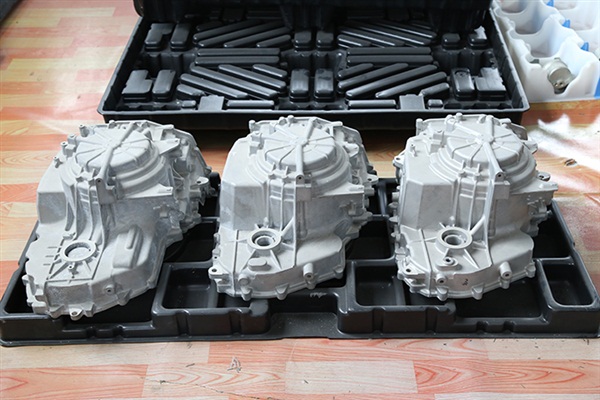
Two model records are published, and they differ on two lines that matter to a file: the dimension code and the construction description.
| Recorded field | Model A | Model B |
|---|---|---|
| Product name | Die-cast pallet boxes for automotive engines | Storage Pallet Box |
| Model / dimensions | 1230×830×1000 mm | 1000×800×800 mm |
| Type line | Storage Box – Plastic Pallet Box – Die-cast Honeycomb Board Box | Storage Box – Plastic Pallet Box (also recorded as Plastic Honeycomb Panel Box) |
| Material / capacity | HDPE/PP; 100–200 L | HDPE/PP; 100–200 L |
| Design / features | Enclosed; recyclable, durable, nestable | Enclosed; recyclable, durable, nestable |
| Customization | Size and colour customized; logo free printing | Size and colour customized; logo free printing |
| Packing / sample | Plastic film; sample accepted | Plastic film; sample accepted |
| Origin / HS code | Suzhou, China / 3923100000 | Suzhou, China / 3923100000 |
Almost everything on the declaration is shared, and that is where mistakes start. A packing list reading "plastic pallet box, 1000×800×800, HDPE/PP, 3923100000" can be matched to a model record and checked on arrival. A packing list reading "plastic pallet box" cannot. Neither a customs officer, an insurance assessor nor a receiving clerk has a way to reconcile it after the container has closed.
Note what the records do not contain: a numeric load rating. The case record for the Mexican automotive project describes high load-bearing capacity and shock resistance qualitatively, and the application record lists load-bearing stability among its operating requirements, but no kilogram figure appears in the published specification. If your file needs a stated load, request it in writing with the test condition attached, and file it next to the specification rather than in a separate email thread.
What the ISO 9001 and ISO 14001 records establish
Two certificate records are published for the pallet box line. Both are management-system certificates.
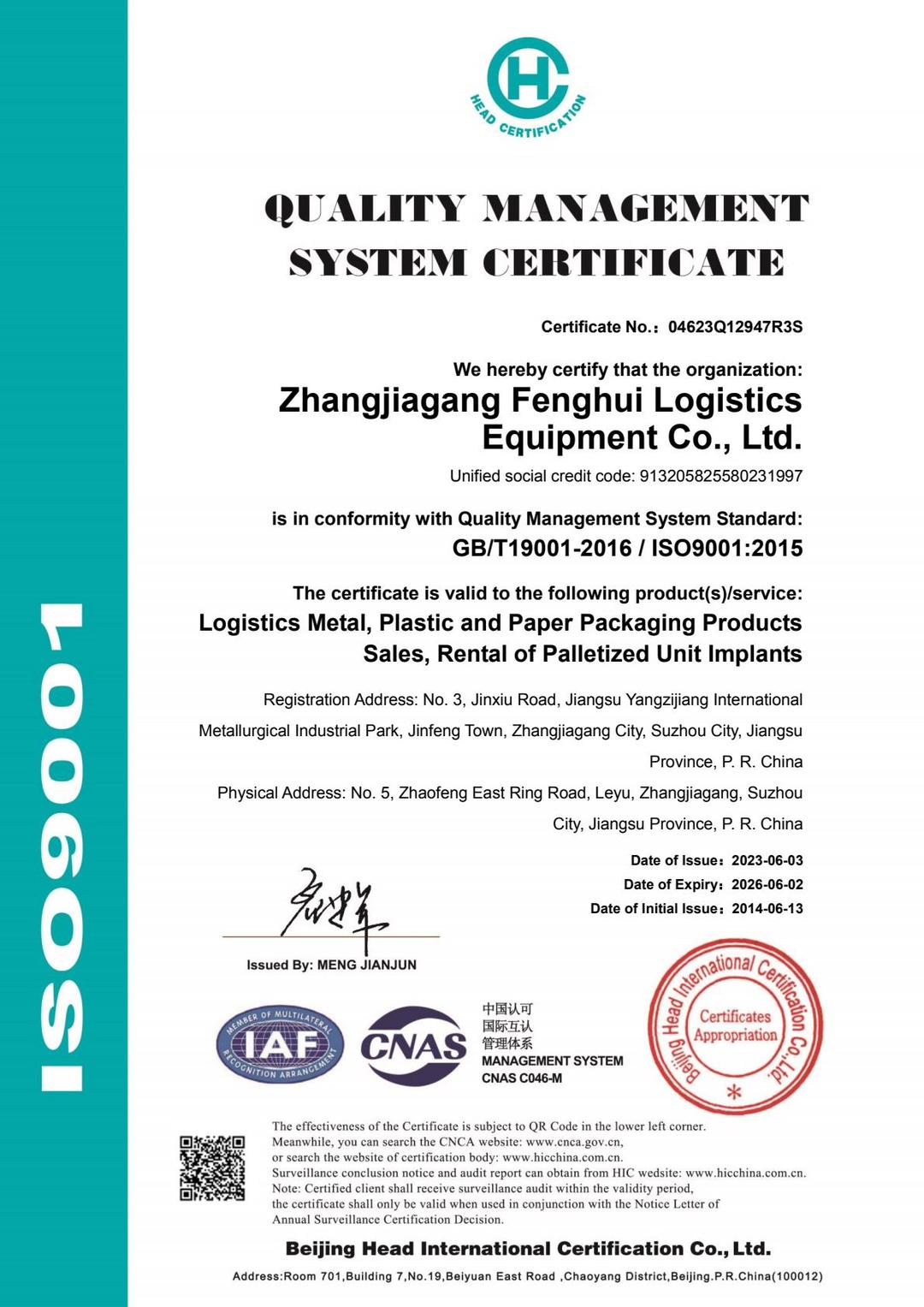
- ISO 9001, certificate number 04623Q12947R3S, issued by Beijing Head International Certification Co., Ltd. (IAF/CNAS accredited) against GB/T19001-2016 / ISO 9001:2015. Recorded issue date 3 June 2023; recorded expiry 2 June 2026. Recorded scope: sales of logistics metal, plastic and paper packaging products; rental of palletized unit loads.
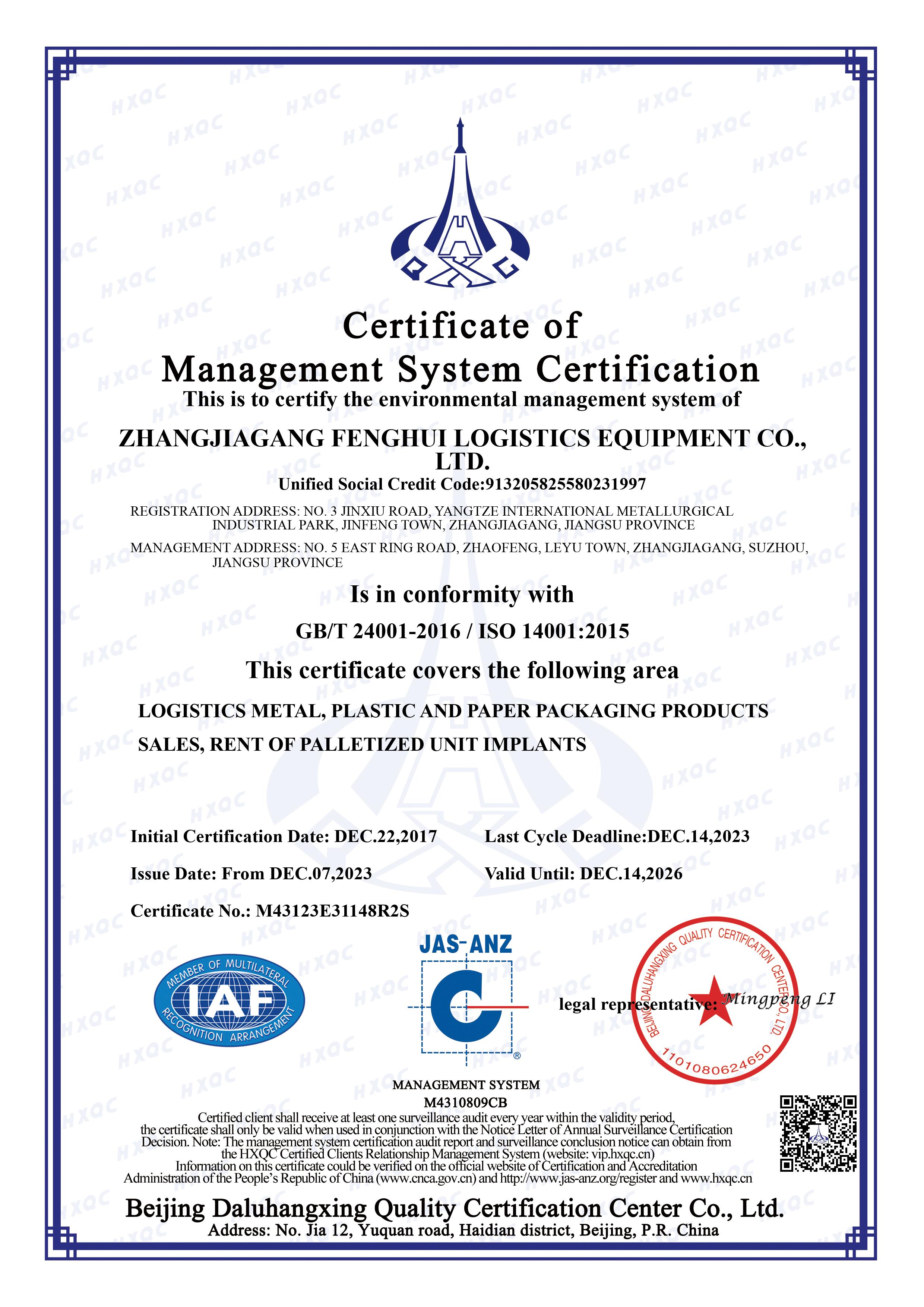
- ISO 14001, certificate number M43123E31148R2S, issued by Beijing Daluhangxing Quality Certification Center Co., Ltd. against ISO 14001:2015. Recorded issue date 14 December 2023; recorded expiry 14 December 2026. Recorded scope: logistics metal, plastic and paper packaging products sales.
Three habits follow from those two documents.
Read the scope before the logo. Both scopes describe sales activity at product-family level. Neither names a dimension, a polymer grade, a load rating, an ESD resistance value or a food-contact approval. A management-system certificate says how a supplier controls its processes; it does not say what a specific box will do in your application.
Read the dates second. As of November 2026, the ISO 9001 record shows an expiry of 2 June 2026 and the ISO 14001 record shows 14 December 2026. A buyer assembling a file now should request the current ISO 9001 certificate and confirm the ISO 14001 renewal position before any shipment that will be received after mid-December 2026. This is not a criticism of the supplier; it is how management-system certificates work. They renew on a cycle, and a PDF saved last year goes out of date quietly.
Do not substitute one document type for another. If your destination or your customer requires a product-level record — a resistance report, a food-contact declaration, a packaging mark, a fire-performance classification — a quality-system certificate cannot fill that place. Substituting one for the other leaves the file short at the moment it is tested.
| Document | What it establishes | What it does not establish |
|---|---|---|
| ISO 9001 certificate | A quality management system certified by an accredited body for the stated scope | Product conformity, load rating, ESD or food-contact approval |
| ISO 14001 certificate | An environmental management system certified for the stated scope | Certified recyclability, recycled content or a take-back scheme |
| Model specification | Declared dimensions, material, capacity, HS code and customization options | Measured performance; no numeric load appears in the record |
| Test report, where requested | A measured result on a named sample and method | Uniform performance of every unit unless sampling is defined |
| Destination declaration | That a named economic operator claims conformity with named rules | Supplier responsibility; confirm who signs yours |
How customization rewrites part of the file
The recorded customization options are dimension, logo, colour and material. Each touches a different line, and none is automatically covered by the base specification.
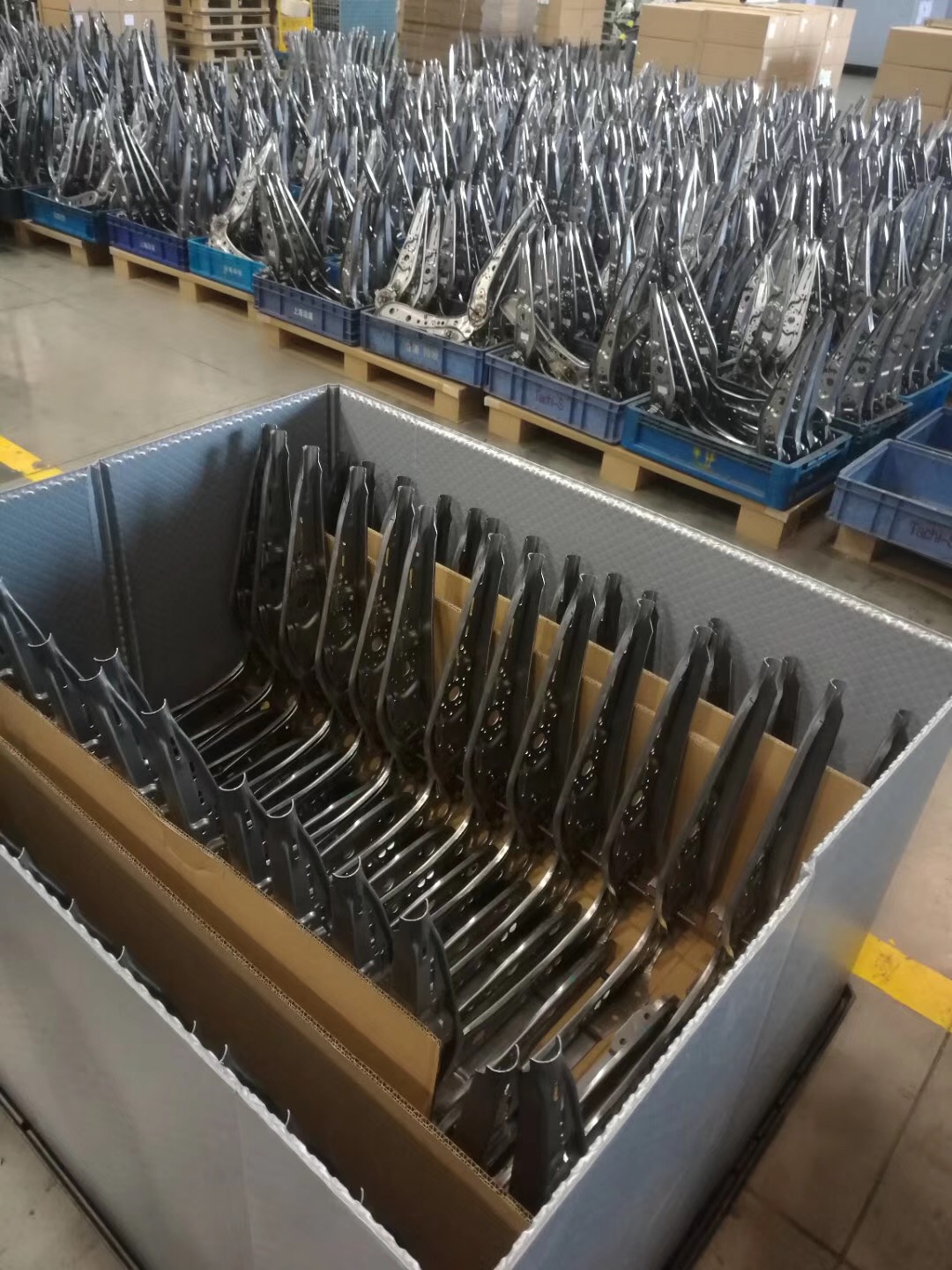
- Dimension. Changes the model reference, the packing-list description, the invoice description and the load plan. If your part fits only at a specific internal dimension, that dimension needs a written tolerance — "customized size" is not a specification.
- Colour. Cosmetic in most files, but colour is also an identification field. If your plant identifies containers by colour, it belongs on the packing list, and a masterbatch change can affect the material declaration.
- Logo. Recorded as free printing. Artwork ownership and authorisation should be settled in writing before production; printing a third party's mark without authorisation creates a documentation problem that has nothing to do with the box.
- Material. HDPE and PP are both recorded. Switching polymer changes the material declaration, may change the recyclability statement your buyer wants, and may change suitability for the contents. Re-verify instead of reusing the previous file.
Two adjacent requests often arrive alongside customization but are not on the recorded option list: an inner lining or dunnage, and ESD performance. Treat both as separate questions. For a lining, ask whether it is quoted as its own line and get its material and dimensions in writing. For ESD, note that neither model record states a surface-resistance value: packaging used to store, transport and protect ESD-susceptible items is addressed by ANSI/ESD S541-2019, and a usable file normally carries a test report for the actual production batch against the applicable method, not a general certificate. One recorded project profile — a Mexican logistics and warehousing application — lists anti-static among its operating conditions alongside high humidity, dust and a wide temperature range. Where a word like anti-static appears in a specification, the supporting document is the resistance report.
Building the file: six steps per consignment
- Freeze the specification. One document, one version, used verbatim on quotation, invoice and packing list: model record, dimension code, material, capacity, colour, logo, packing (plastic film is the recorded packing line) and quantity.
- Confirm classification and origin at destination. Take 3923100000 to your broker and get the national suffix back in writing. Record the origin exactly as Suzhou, China, and hold any origin statement your buyer requests as its own page.
- Collect system evidence with dates. Both ISO copies in force for your shipment window, with scope text and issuing body visible. Set a reminder before each expiry.
- Add the product-specific layer your end use triggers. Only what applies, and only with a method attached. The capability record notes quality control as "50% test"; if your file depends on inspection, ask what is tested, on what sample and at which stage, because a percentage without a method is not evidence.
- Re-run steps one to four for every customization delta. If anything changed after the file was first approved, decide in writing which documents are now invalid rather than assuming they still hold.
- Assign an owner and a review date. Every dated page gets a calendar entry. The ISO 14001 expiry of 14 December 2026 is a concrete reason to start this habit on your current file.
Destination verification: four markets, three parties who hold the answers
The company records Mexico and the U.S. as main markets, the EU and Southeast Asia as export markets, and a 40% export ratio. That mix explains why one box is shipped against four different paperwork expectations — and why this guide will not tell you what each destination requires. Requirements depend on material, end use, packaging status, importer status and shipment date, and they change. What can be standardised is the set of questions your file answers before the booking is made.
| Market | Recorded status | Questions your file should already answer |
|---|---|---|
| EU | Recorded export market | Which product rules apply to your end use, per your importer? Who issues the declaration your buyer wants? Is the box treated as packaging for registration purposes? What format and language must the material statement take? |
| Southeast Asia | Recorded export market | Which national suffix applies to 3923100000 at destination? Does the importer require pre-shipment inspection or registration? What language and units are needed on documents? |
| Mexico | Recorded main market; location of the recorded automotive case | Which national code suffix is confirmed? Does the importer need Spanish-language documents? What does the receiving plant's own specification require on dimensions, stacking and load? Does the recorded anti-static condition apply to your line? |
| United States | Recorded main market | Is the tariff classification confirmed for your configuration? Who is importer of record and signs declarations? Does your buyer's compliance team name an end-use rule? Are dimensions stated in the format the receiving plant reads? |
Three parties can close a file: the importer of record, the customs broker and the receiving plant's quality team. A supplier can provide its own documents; it cannot confirm your destination's rules for your end use, and a well-run supplier will say so instead of implying otherwise.
Three buyer profiles and the file depth each one needs
Automotive parts importer. The recorded case is a Mexican automobile manufacturer that has used 1,000 pallet boxes for car transmission gearbox storage for three years, with recorded results of standardised parts storage, avoided collision damage to gearboxes and improved warehouse management efficiency; the recorded highlights are high load-bearing capacity, shock resistance, a stable structure and a fit to gearbox dimensions. The file needs the dimension and load statement in writing, the receiving plant's specification, the stacking plan, and the 5-year guarantee terms — which exclude damage from human error or excessive storage weight, making the load figure a commercial question as much as a customs one.
Electronics and precision assembly. If parts are ESD-sensitive, the file needs a batch resistance report and a stated method. The application record for the Mexican project also lists dust, high humidity and a wide temperature range, so the operating conditions belong on the same page as the test.
Heavy industry, chemical and wastewater. The recorded application line lists oils, industrial alcohol, alkali, acid, industrial wastewater, water and car parts. That list is a scope indication for the product family, not a chemical-resistance test result. For aggressive contents, request a written suitability statement for the specific substance and keep it with the material declaration.
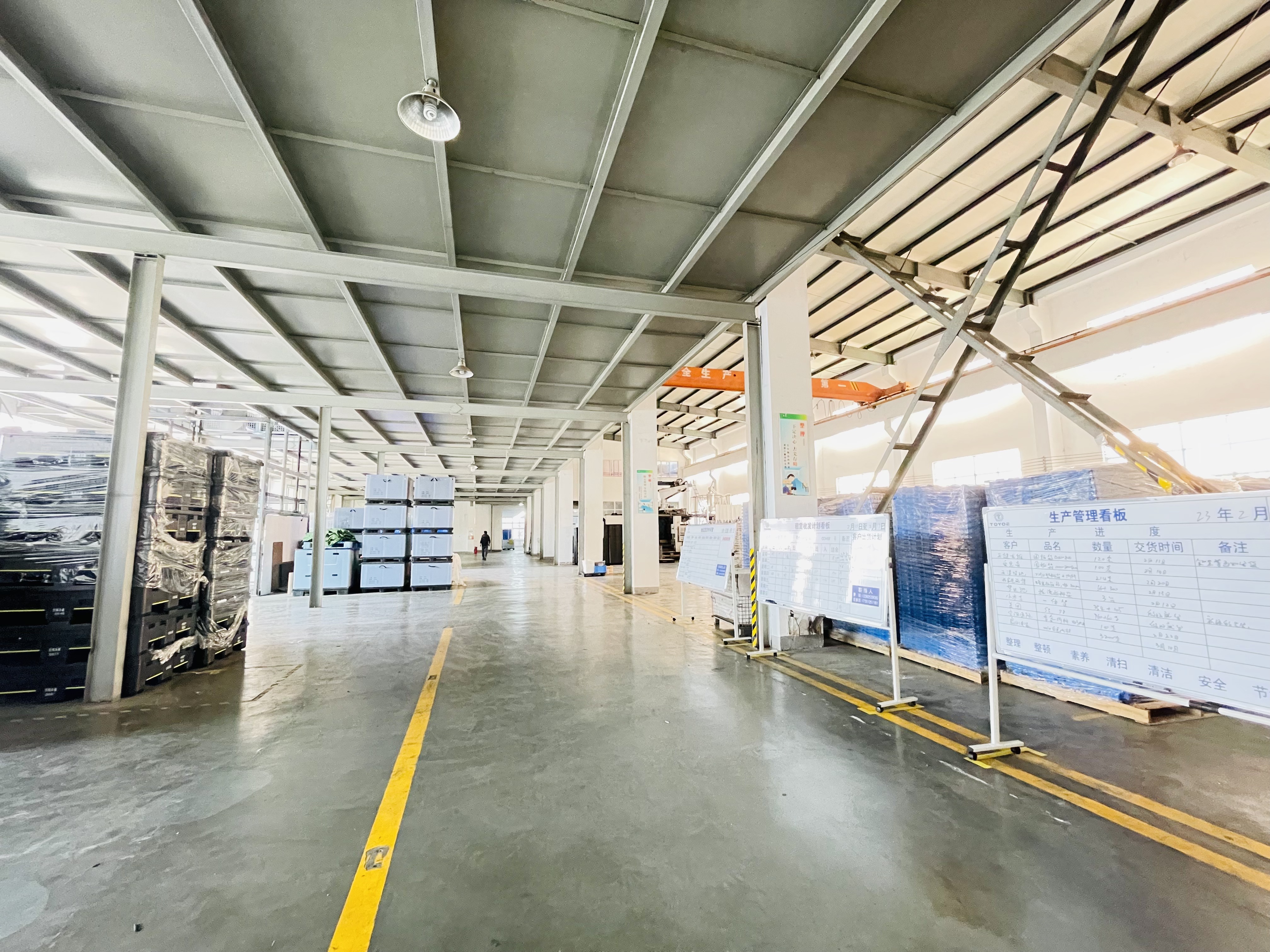
In all three profiles the file is assembled through the same six steps. Only step four changes.
FAQ
Do the ISO 9001 and ISO 14001 certificates make a TOYOE pallet box compliant for EU, Southeast Asian, Mexican or U.S. import?
No. They are management-system certificates for a stated scope and validity window. The ISO 9001 record (04623Q12947R3S) covers sales of logistics metal, plastic and paper packaging products and rental of palletized unit loads, with a recorded expiry of 2 June 2026. The ISO 14001 record (M43123E31148R2S) covers packaging products sales activity, with a recorded expiry of 14 December 2026. Neither names a dimension, a load rating, an ESD value or a destination rule. File them as two documents, request current copies, and confirm destination requirements with your importer.
What has to be added if my parts are ESD-sensitive?
A resistance test report for the batch, against the applicable packaging method — ANSI/ESD S541-2019 addresses packaging used to store, transport and protect ESD-susceptible items — plus the stated method and result. Neither model record lists a surface-resistance value, and a quality-system certificate is not a substitute. If your line lists anti-static as a condition, ask for the report before the order is placed rather than after the container is loaded.
Do custom size, colour, logo and material create a new compliance file?
They create new lines in the same file, and each can invalidate a document. A dimension change alters the model reference and the packing-list description; a material change such as HDPE to PP alters the material declaration and may alter the recyclability statement; colour and logo changes alter identification and artwork authorisation. The recorded customization options are dimension, logo, colour and material, so re-issue the specification and check which of the six file steps the change touches.
What should budget planning assume for a customized order?
The recorded minimum order quantity is 1 unit, and no price list appears in the product documentation, so a quotation has to be built from a written specification: size, colour, logo and material are each quotation variables, and packing is recorded as plastic film. Budget for document work as well as product — certificate copies, broker classification and any test report all take time, and a document gap at destination costs more than a document prepared in advance.
Can I get a sample before committing?
Yes. Sample is recorded as accepted on both model specifications. Define what the sample is meant to prove before it ships: which model and dimension, which polymer, and whether it is production-representative or a demonstration unit. A sample that differs from the ordered configuration cannot support the compliance file, so record the sample's specification next to any test or approval it is used for.
What lead time should the file plan around?
Production lead time is recorded at 7–15 days, with monthly capacity of 3,000 pieces against stated annual output of 30,000 units. Document time runs in parallel rather than inside that window, so request certificate copies, broker classification and any test report at the same time as the quotation. For a starting point, the product brochure can be downloaded from https://cdn.socialarks.com/sbsp/24892/common/2026/0521/6a0e9c4aea871.pdf, and specifications for the two models can be requested alongside a written description of the shipment so that the file and the order are built from one document set.
Conclusion: a file is built, not bought
The documents a supplier publishes — two model records with dimensions, HS code 3923100000, a Suzhou origin, an HDPE/PP material line and two ISO records with scopes and dates — are raw material. What makes them usable is the discipline around them: one frozen specification, a classification confirmed at destination, certificates checked for scope and validity rather than for a logo, product-specific evidence added only where the end use requires it, and a review date on every dated page.
For buyers shipping into the EU, Southeast Asia, Mexico or the U.S., the most useful habit is the simplest one. Before assuming a certificate covers your use case, write down the question that certificate is supposed to answer. If its scope text does not answer that question, you have found the gap early — which is the cheapest moment to find it.
TOYOE is the brand of Zhangjiagang Fenghui Logistics Equipment Co., Ltd., founded in June 2010 and based at No. 5 Donghuan Road, Zhaofeng Leyu Town, Zhangjiagang, 215600, Suzhou, Jiangsu, China. The company supports OEM/ODM orders with customization of dimension, logo, colour and material, accepts samples, and records a 5-year guarantee that excludes damage from human error or excessive storage weight. For a quotation or a document set matched to a specific shipment, contact Jack Zha at zjgfh@zjgfenghui.cn or +86-15370396661.
Download the TOYOE product brochure (PDF)
Have Questions or Need More Details?
Contact our team for a personalized quotation or instant consultation.
Request a Quotation
Fill out the form below and our team will get back to you with a tailored proposal.
WhatsApp Direct Chat
Prefer to chat in real-time? Message us on WhatsApp for instant assistance & quick answers.
- Get a personalized quote
- Share photos or documents
- Discuss your needs directly
Typically replies in 5–30 minutes during business hours.