Pallet Box Export Compliance: HS Code, Material Docs, EU & SEA Checks
Pallet Box Export Compliance: HS Code, Material Docs, EU & SEA Checks
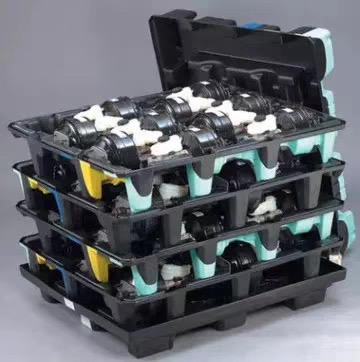 The product at the centre of the file: an enclosed plastic pallet box with a vacuum-formed inner lining tray in automotive component storage.
An export-ready pallet box order is not proven by a code or a certificate on its own. It is proven when four records agree with each other: the customs classification, the material statement, the specification sheet, and the evidence a buyer can audit. In this product category, most documentation problems are mismatches rather than missing documents — a drawing that specifies 1200 x 800 x 1000 mm while the invoice says only pallet box, a resin written as HDPE in the material file and as plastic everywhere else, or a certificate quoted after the date printed on it.
This guide sets out what to align, and in what order, for moulded plastic pallet boxes shipped from China. It covers HS code 3923100000, Suzhou origin, HDPE and PP construction and recyclability wording, the four customization axes of dimension, color, logo and material, the checks that matter for EU and Southeast Asian destinations, and how a 50% product-testing regime fits into a buyer audit. It is written for procurement, quality and logistics teams at the research and evaluation stage. It is a documentation guide, not legal advice: classification, duty treatment and market access are confirmed with your customs broker, your importer of record and the relevant authority.
What export compliance means for a moulded pallet box
For a plastic pallet box, export compliance means the shipped unit, the paperwork describing it and the evidence behind it are the same thing. Three questions settle it:
- Classification: is the article declared under the heading that matches what it actually is, and kept consistent for every shipment of the same part number?
- Material: does the declaration describe the resin, the colorant and any inner lining actually used, rather than a generic word like plastic?
- Evidence: are the test records and management-system certificates current, in scope, and traceable to the batch that ships?
Underneath these sits a division of labour. Exporters usually control classification inputs, origin evidence and production records. Importers of record usually carry the destination-market obligations that attach to the product being placed on that market. Files break when either side assumes the other has already covered a document.
Where pallet box export files break most often
Specification drift. The drawing, the purchase order, the invoice description and the packing list each describe the box slightly differently. A customs query or an audit finding rarely needs a serious error; a color code that appears on the PO but not on the invoice is enough.
Material shorthand. Plastic pallet box is a product name, not a material statement. A declaration that omits the resin, the colorant and the lining material cannot be checked against the drawing, so it cannot be defended in a review.
Certificate overreach. A management-system certificate is quoted as if it certified the product, its dimensions, its load rating or the destination regulation. It certifies none of these things.
Origin inconsistency. Suzhou, Jiangsu and China appear in different fields. Origin wording must be identical across the invoice, packing list and origin document, and must match the address of the manufacturing entity.
HS code 3923100000: what it fixes and what it does not
Plastic pallet boxes sit in Chapter 39 of the Harmonized System. Heading 3923 covers articles of plastics for the conveyance or packing of goods, and subheading 3923.10 covers boxes, cases, crates and similar articles. The ten-digit form 3923100000 is the line used on Chinese export declarations. The European Union Combined Nomenclature carries the equivalent eight-digit line 3923 10 00. National tariff lines and national suffixes differ, so the number on your entry is confirmed by your declarant for your destination rather than copied from a supplier invoice.
Three consequences follow, and they are worth stating plainly.
- Custom sizes stay in the same subheading. Changing dimension, color, logo or inner lining does not move a moulded box out of 3923.10. What changes is the description on the documents, which must then match the new specification.
- The code is neither a duty rate nor a permission. It identifies the goods for tariff and statistical purposes. Duty rates, preferential treatment, import licensing and product rules are separate questions answered by the destination market.
- Declare per line. A shipment containing boxes, lids and vacuum-formed inner trays contains more than one article; folding a tray into the box line makes the file harder to check, not shorter.
Scale context helps explain why documentation practice in this category is mature on the Chinese export side. In a 2026 trade compilation drawing on United Nations Comtrade data, China 2022 exports under HS 392310 were reported at USD 2.33 billion, the largest figure among the top five exporters listed. That is a 2022 observation rather than a current forecast, but the volume behind it means the paperwork is routine and the errors are usually procedural.
Origin matters in two places: the origin statement on invoice and packing list, and the certificate of origin used to claim preferential treatment where an agreement allows it. Preferential duty is not granted on an invoice statement alone; it depends on the applicable rules of origin and a valid origin document. In the case of TOYOE — the brand of Zhangjiagang Fenghui Logistics Equipment Co., Ltd., a manufacturer founded in 2010 and based in Zhangjiagang, Suzhou, Jiangsu, China, producing plastic pallet boxes, storage boxes, plastic crates and honeycomb panel boxes — the origin wording should read consistently as Suzhou, China across the set. Further company detail is available at toyoebox.com.
Building the material file for HDPE and PP boxes
A material file that survives an audit answers four questions: which resin, what else is in it, what happens at end of life, and which components are not the box itself.
- Resin. TOYOE published pallet box parameters state HDPE or PP as the material, an enclosed type and plastic-film packing. Write the resin on the declaration exactly as it appears on the drawing; do not let one document say HDPE and another say plastic.
- Colorant. Color is a customization axis. Where your specification restricts substances, list the colorant as its own line instead of folding it into customized color.
- End of life. The boxes are described as recyclable. Recyclable is a statement about the material suitability for recycling, not a recycled-content figure. If your market or your customer needs recycled-content percentages, request them as a separate declaration and do not infer them from the word recyclable.
- Components that are not the box. Vacuum-formed inner lining trays are separate parts with their own material and fit criteria, and belong on separate lines in the file.
Two specification keywords need their own evidence line rather than a label. Where a drawing calls for an anti-static or ESD pallet box, cite the standard your quality team works to; packaging for ESD-susceptible items is commonly referenced to ANSI/ESD S541-2019, and the matching surface-resistance test record should be requested for the configuration you are buying. Where a drawing calls for a heavy-duty or high-load-bearing box, the supporting document is a load or stacking test record, not the adjective on a datasheet.
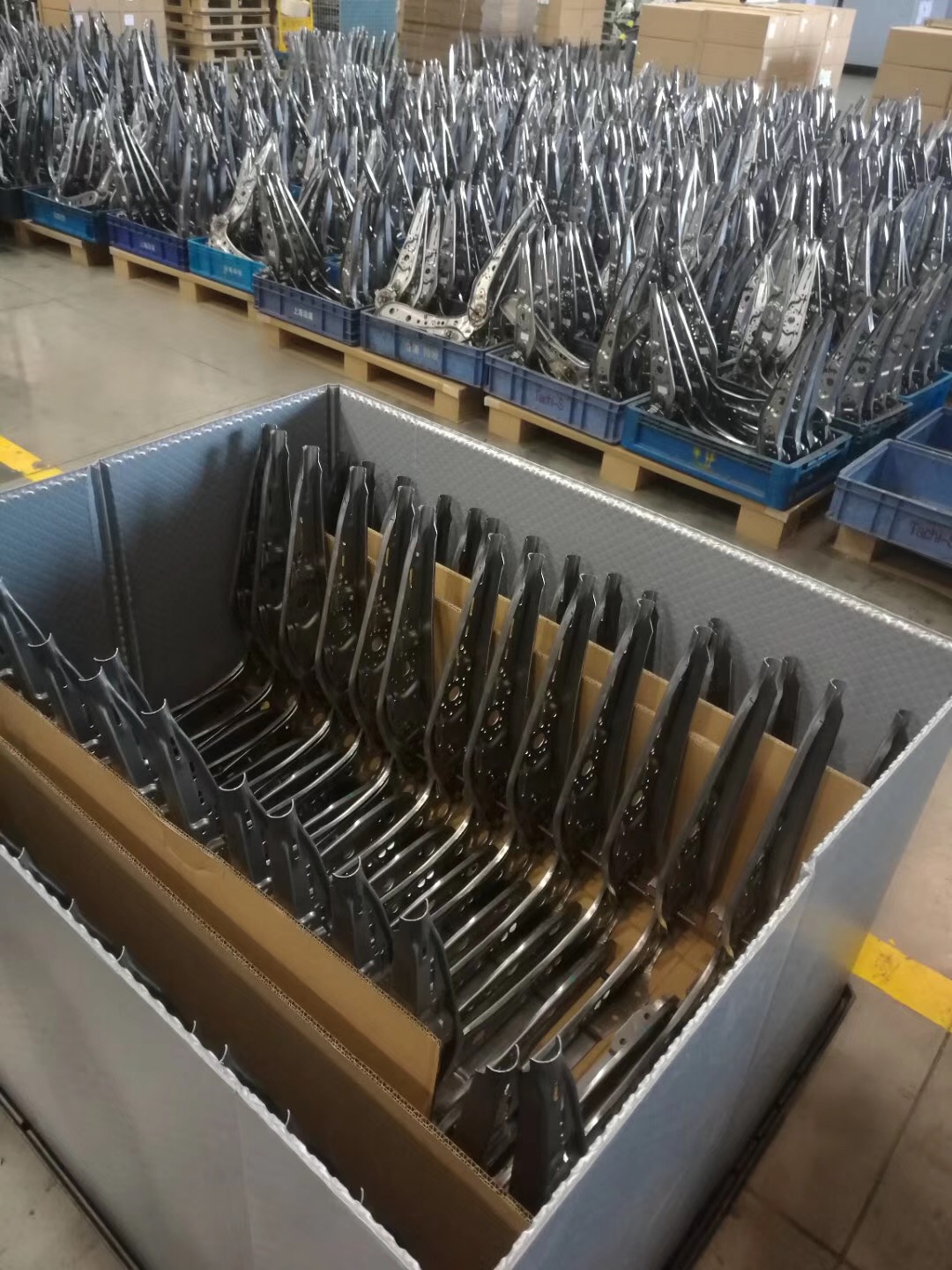 Inner lining design: trays are separate articles with their own material line and fit criteria in the export file.
The document set, mapped to what it actually proves
Most export files in this category contain the same eight documents. What differs is whether each one is written so that someone else can check it.
| Document | What it establishes | Usual source | Frequent gap |
|---|---|---|---|
| Commercial invoice | Commercial description of the goods and price basis | Exporter | Description narrower than the drawing — pallet box instead of resin, size and color |
| Packing list | Quantities, packages, weights, packed dimensions | Exporter | Does not match the invoice line for line |
| Customs declaration | Classification (3923100000) and origin | Exporter and declarant | Code copied, not confirmed for the destination |
| Material declaration | Resin, colorant, recyclability statement, lining material | Manufacturer | Plastic instead of HDPE or PP; recyclable read as recycled content |
| Certificate of origin | Origin for verification or preferential treatment | Issuing authority or chamber | Origin wording differs from the invoice |
| Test or inspection record | Performance of the configuration actually shipped | Manufacturer | Undated, or not tied to a batch |
| Management-system certificates | The management system and the scope it covers | Certification body | Quoted outside validity or beyond its scope |
| Packaging and labelling spec | Marking, label position, printed content | Buyer and supplier agreement | Agreed verbally, never written into the file |
The cheapest fix for all eight is to make one specification sheet the master document. The invoice description, the packing list and the material declaration are then copied from it rather than written independently, which removes the mismatch before it exists.
Seven steps from locked specification to shippable file
- Lock the specification sheet. Dimension with tolerance, color reference, logo artwork and print position, resin, inner lining, packing method. Everything downstream copies from this sheet.
- Confirm classification per part number with your declarant before the first shipment, and record the answer so repeat shipments reuse the same line and the same description.
- Write the material declaration against the sheet: resin, colorant, recyclability statement, lining material.
- Collect origin evidence. Keep the origin wording identical on invoice, packing list and origin document, and consistent with the manufacturer address.
- Verify certificates as documents, not as logos: certificate number, issuing body, standard, issue date, expiry date and the exact scope wording.
- Define the test evidence you will accept: which characteristics, on what sampling basis, in what record format, retained for how long.
- Apply change control. Any change to dimension, color, logo or material re-issues the specification sheet and updates the invoice description before goods move.
European Union checks
Classification and entry. The EU Combined Nomenclature line for boxes, cases and crates of plastics is 3923 10 00. The importer of record files the entry and holds the EORI number; duty and VAT are assessed at that point. The exporter contribution is a description and code the importer can file without rework.
Material information. Under REACH, information duties can apply to articles containing substances of very high concern above 0.1% by weight. The practical response is a written material declaration naming resin, colorant and lining, plus confirmation of obligations with your importer rather than a general claim of EU compliance.
Packaging rules. The EU regulates packaging placed on its market, including recyclability and packaging-waste obligations. Those obligations generally attach to the operator placing the packaging on the market, so confirm with your importer what applies to the box and to the plastic film used for packing.
The wood comparison. Wood packaging entering many markets must meet ISPM 15 treatment and marking. Moulded plastic boxes are outside that wood-packaging regime, which is one reason plastic pallet boxes appear in supply chains that want to avoid wood treatment steps. Destination-specific rules still apply and should be confirmed for the market you ship to.
Southeast Asia checks
Tariff structure. ASEAN members apply the ASEAN Harmonised Tariff Nomenclature at eight digits and add national lines beyond that. A ten-digit Chinese export code will not map directly onto every national import line, so the destination line is confirmed by the importer.
Preferential origin. Under the ASEAN-China FTA, preferential treatment is claimed with a certificate of origin, commonly Form E; RCEP has its own origin documentation and rules. Which route applies depends on the consignment and on the rates in force at the time, so it is a question to settle before the purchase order rather than after the container is booked.
National import requirements. Licensing, registration and national standards vary by member state and by product scope. A single Southeast Asia checklist is not a substitute for per-country confirmation from the importer.
Working conditions and stocking. Humidity, dust and wide temperature ranges change what the specification should say, and the specification is what the material and test records are later checked against. For a distributor restocking, freight volume matters as much as the code: foldable pallet boxes are reported to reach fold ratios of up to 5:1, meaning five folded boxes occupy the space of one erected box — a figure for your own freight calculation, not for the customs description.
Reading certification correctly: ISO 9001 and ISO 14001
Pallet box product 3905 holds two management-system certificates. Both should be read as documents with visible dates and scope, not as marks on a page.
- ISO 9001. Certificate 04623Q12947R3S, to GB/T19001-2016 / ISO9001:2015, issued by Beijing Head International Certification Co., Ltd. (IAF/CNAS accredited), issued 3 June 2023 with a stated validity to 2 June 2026. The scope wording covers sales of logistics metal, plastic and paper packaging products and rental of palletized unit loads.
- ISO 14001. Certificate M43123E31148R2S, to ISO 14001:2015, issued by Beijing Daluhangxing Quality Certification Center Co., Ltd., issued 14 December 2023 with a stated validity to 14 December 2026. The scope wording covers logistics metal, plastic and paper packaging products sales and rental of palletized unit loads.
Two honest points for a buyer evaluating in late 2026. First, dates. As of November 2026, the ISO 14001 certificate is inside its stated validity but expires on 14 December 2026, so ask for the renewal record before that date. The copy of the ISO 9001 certificate in circulation carries a stated validity to 2 June 2026, so ask for the current certificate and its renewal record rather than accepting an older copy in a tender pack. Second, scope. Both certificates describe a scope framed around the sale and rental of logistics packaging products. If your own procedure requires a certificate whose scope names a specific manufacturing activity, ask the supplier to confirm which scope applies and whether your activity is covered.
Neither certificate certifies a dimension, a load rating, a resin grade or compliance with a destination regulation. Those are answered by the specification sheet, the test record and your importer checks. Stating that boundary is not a weakness in the file; it is what makes the rest of the file credible.
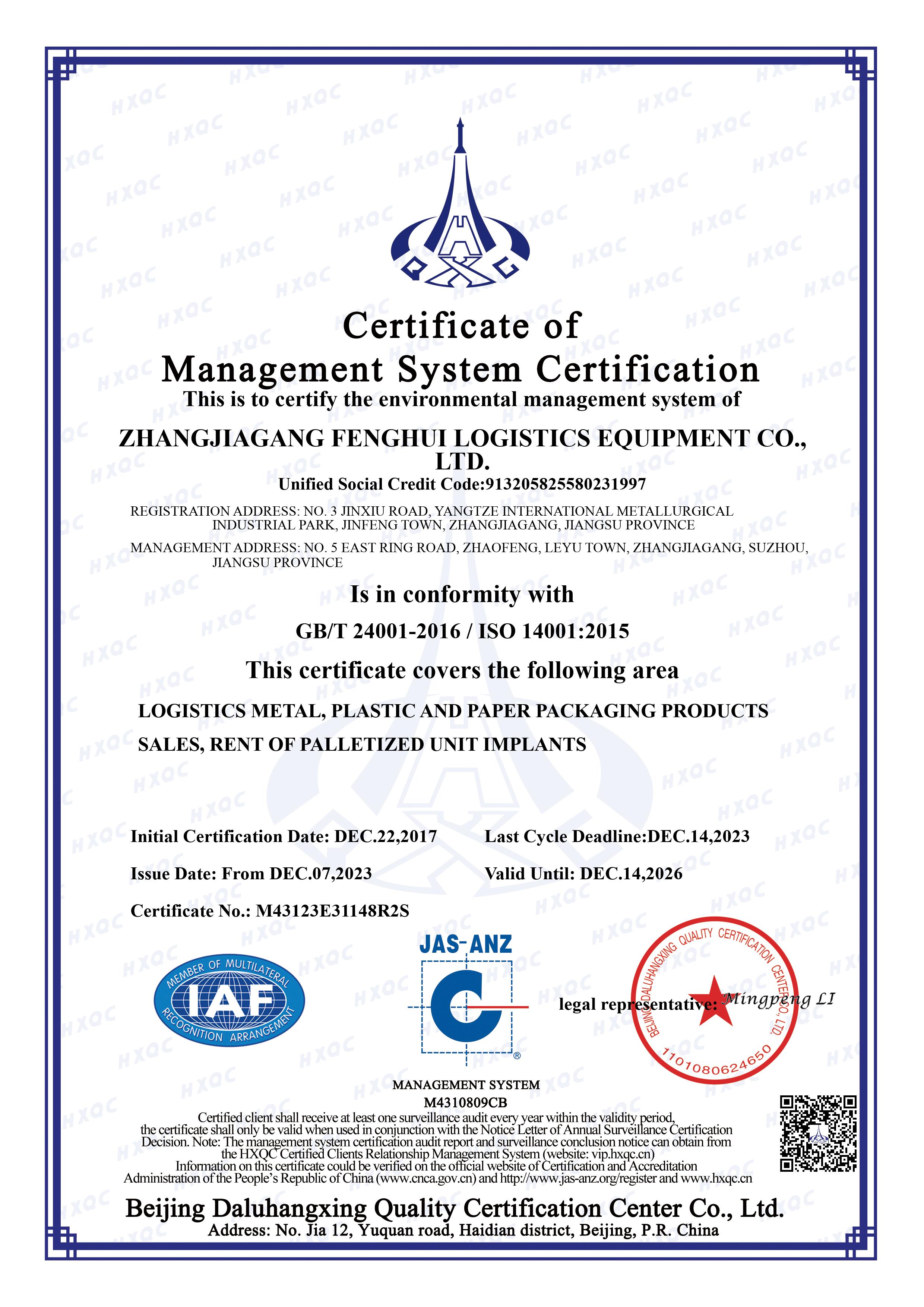 ISO 14001:2015 certificate M43123E31148R2S, issued 14 December 2023 with a stated validity to 14 December 2026.
What 50% product testing gives an auditor, and what it does not
TOYOE stated quality-control position is 50% product testing, alongside OEM/ODM production, monthly capacity of 3,000 pieces, annual output of 30,000 sets, a minimum order of 1 unit and a lead time of 7-15 days. For a buyer building an audit trail, the useful question is not the percentage on its own but what it is applied to.
Four things are worth clarifying when you review the claim:
- Which characteristics are tested — dimensions, stacking load, drop or impact, wall section, color match, lining fit.
- On what basis — every second unit of a run, a sample per batch, or a sample per order.
- Against which criteria — your drawing and tolerances, or an internal standard. Those are two different documents.
- In what record — dated, batch-referenced, and retained long enough to cover your audit cycle.
A testing statement is a production-control fact. It is not third-party certification, and it does not travel to a different configuration. If your order changes resin, wall section or lining, request the record that matches the configuration you will actually receive.
 Production environment behind the record: the batch reference on a test document is only useful if it points back to a run like this one.
Customization and the paperwork it changes
TOYOE customizes dimension, logo, color and material, with OEM/ODM production and free printing for logos. Each axis touches a different document, which is why change control matters more than the customization itself.
| Customization | Document that must change | Why it matters at the border or in an audit |
|---|---|---|
| Dimension | Specification sheet, drawing, invoice description, packing list | Size is checked against the drawing first and is the most common mismatch found |
| Color | Specification sheet with color reference, invoice | A color code on the PO but not on the invoice invites a query |
| Logo | Artwork file, print position on the sheet, labelling spec | Branded packaging can raise labelling questions in some markets |
| Material (HDPE or PP) | Material declaration, test record | The resin is exactly what those two documents are evidence for |
| Inner lining | Separate material line, drawing | A tray is a separate article with its own material and fit criteria |
| Folding or demountable design | Specification sheet, packing list, freight document | Changes packed volume, which changes freight and storage planning |
The rule that keeps all of this aligned is simple: no shipment is released against a specification sheet that has not been re-issued after a change. Written change control costs less than a re-declaration at the destination port.
Two buyer scenarios and one documented project
Consider an EU importer standardizing a custom-sized enclosed pallet box for automotive parts. The file that clears without rework contains a CN line confirmed by the broker, a specification sheet with tolerance and color reference, a material declaration naming HDPE or PP plus the colorant, a separate lining line, a certificate of origin matching the invoice wording, and a batch-referenced dimensional record. That is a conditional example of how the file is assembled, not a description of a specific shipment.
Consider a Southeast Asian distributor restocking folding boxes for a parts warehouse. The additional questions are the national tariff line, whether a Form E or an RCEP origin document applies, and what packed volume does to freight cost. The box itself may be unchanged; the file around it is not.
A documented project shows the shape of a usable record. TOYOE supplied 1,000 pallet boxes to an automobile manufacturer in Mexico for transmission gearbox storage, a project running three years, with a recorded result of standardized parts storage, avoided collision damage to gearboxes and improved warehouse management efficiency, supported by a box sized to the gearbox, high load-bearing capacity and shock resistance. That project is in Mexico rather than the EU or Southeast Asia, and the result is supplier-reported rather than independently tested — but the structure is what to copy: application, quantity, duration, configuration match and stated result.
Frequently asked questions
Which HS code applies to a custom-sized plastic pallet box?
A moulded plastic pallet box falls under HS heading 3923, subheading 3923.10 — boxes, cases, crates and similar articles of plastics. The ten-digit form 3923100000 is the line used on Chinese export declarations, while the EU Combined Nomenclature uses the eight-digit 3923 10 00. A custom dimension, color, logo or inner lining does not move the article out of that subheading; it changes the description that must match the new specification. National tariff suffixes differ by destination, so confirm the exact line with your declarant before the first shipment of a new part number and reuse the same line for repeat shipments.
What material documentation should come with an HDPE or PP pallet box?
At minimum three items: a material declaration naming the resin as it appears on the drawing, a statement of colorant and any inner lining material as separate lines, and a recyclability statement. TOYOE boxes are described as recyclable, which is a statement about the material suitability for recycling rather than a recycled-content figure; request recycled-content percentages separately if your market needs them. Where a specification adds anti-static or ESD performance, treat it as its own requirement with its own test record referenced to the standard your quality team works to, since packaging for ESD-susceptible items is commonly referenced to ANSI/ESD S541-2019.
Can dimension, color, logo and material be customized without disrupting the export file?
Yes. These are the four customization axes TOYOE offers, alongside OEM/ODM production and free logo printing, with a minimum order of 1 unit. The file stays intact as long as each change is pushed through the same documents: specification sheet and drawing, invoice description, packing list, and the material declaration wherever resin or colorant changes. The recurring failure is not customization itself but a change that reaches production without reaching the paperwork, which is why a written rule not to ship against an unrevised specification sheet prevents most of the risk.
What is the minimum order, and what should a first documented order include?
The minimum order is 1 unit, standard lead time is 7-15 days once the specification is locked, monthly capacity is 3,000 pieces and annual output is 30,000 sets. For a first order, ask for the full file rather than the invoice alone: specification sheet with tolerances, material declaration, origin wording, the test record for the configuration ordered, current certificate copies with dates and scope visible, and the packing and labelling specification. Reviewing those six items before the purchase order is far cheaper than resolving a mismatch after the container is booked.
How do we validate a sample, and how long does shipment take?
Samples are accepted, and the purpose of the sample is to fix the specification. Validate it against the same drawing and tolerances that will govern production — dimension, color reference, logo position, resin, lining fit — and ask for the test record that corresponds to that configuration rather than to a catalogue model. Once the specification is locked, standard lead time is 7-15 days. A 5-year guarantee applies, excluding damage caused by human error or by storage weight beyond the stated limit. If you want the document set checked against your own import requirements before ordering, you can request a sample and specification review, or download the TOYOE product brochure for the full parameter set.
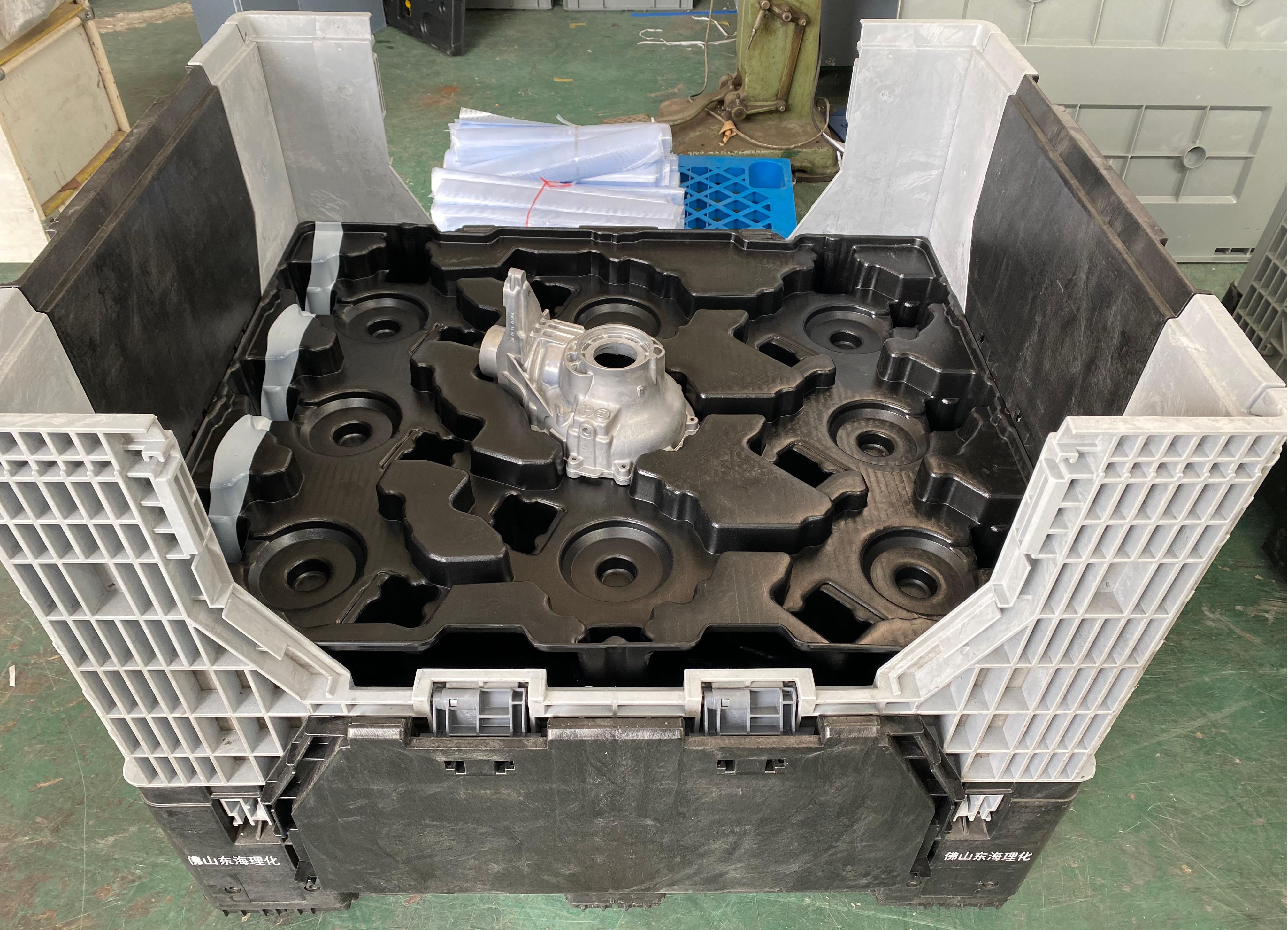 A configuration that can be sampled and quoted against a drawing, with its own material and fit line in the export file.
Conclusion: the four-way alignment check
Pallet box export compliance comes down to keeping four records in agreement — classification, material, specification, evidence — and re-checking them whenever one of them changes. Before a shipment leaves Suzhou, confirm the HS line with your declarant; check the material declaration against the drawing; keep the origin wording identical across invoice, packing list and origin document; read the certificate dates and scope rather than the logo; and hold a test record tied to the configuration and batch you will actually receive. Nothing on that list requires a certification the product does not hold, and nothing on it can be replaced by an adjective on a datasheet.
That is the practical position behind this guide: HDPE or PP construction, customization of dimension, color, logo and material, 50% product testing, a stated export base that includes the EU and Southeast Asia, and certificates that are quoted with their numbers, dates and scope intact. The product brochure covers the parameter set; company details are at toyoebox.com.
Have Questions or Need More Details?
Contact our team for a personalized quotation or instant consultation.
Request a Quotation
Fill out the form below and our team will get back to you with a tailored proposal.
WhatsApp Direct Chat
Prefer to chat in real-time? Message us on WhatsApp for instant assistance & quick answers.
- Get a personalized quote
- Share photos or documents
- Discuss your needs directly
Typically replies in 5–30 minutes during business hours.