Pallet Box Partnership FAQ: MOQ, Custom Orders & 5-Year Care
Pallet Box Partnership FAQ: MOQ, Custom Orders & 5-Year Care
A pallet box partnership is usually decided before the first container leaves the factory. By the time a buyer reaches the decision stage, the product itself is rarely the open question. What still needs a written answer is the framework around it: how few units can be ordered, what can be customized, how fast a customized batch is delivered, how much testing happens before dispatch, and what a five-year after-sales commitment actually covers.
This FAQ answers those questions in the order industrial buyers tend to ask them, using the terms Zhangjiagang Fenghui Logistics Equipment Co., Ltd. (brand TOYOE) applies to pallet box partnerships.
Short answer: A TOYOE pallet box partnership starts at a minimum order quantity of 1 unit, allows customization of dimension, logo, color and material, includes OEM/ODM service, and runs on a typical 7–15 day lead time for customized orders against a monthly capacity of 3,000 pieces. Product testing is applied at a 50% rate, and orders are backed by a five-year after-sales guarantee that excludes damage caused by human error or excessive storage weight.
| Partnership term | TOYOE commitment | What the buyer should confirm |
|---|---|---|
| Minimum order quantity | 1 unit | Use the single unit for fit, finish and load validation before scaling |
| Customization | Dimension, logo, color, material | Supply drawings, artwork and the actual application conditions |
| OEM/ODM | Available | Confirm brand ownership, artwork files and packaging identification |
| Lead time (customized) | 7–15 days | Freeze specifications before production is scheduled |
| Monthly capacity | 3,000 pieces for customized runs | Share a rolling forecast so production slots can be reserved |
| Product testing | 50% testing rate | State measurable acceptance criteria in the purchase order |
| After-sales | 5-year guarantee | Keep loading records and register the order at delivery |
The decision-stage problem: unanswered terms, not unanswered specifications
A pallet box is a returnable asset, not one-way packaging. One order typically enters a circulation loop that runs for years across plants, warehouses and suppliers. Lead time, minimum quantity and service terms agreed at the start become the operating conditions of that loop, which is why they carry more weight in this category than in disposable packaging.
In practice, procurement teams shortlist two to four manufacturers whose products look comparable, then discover that the offers cannot be compared line by line. One supplier quotes a container-load minimum, another quotes per unit. One offers color changes, another treats color as a separate tooling project. One describes a warranty in general terms, another defines exclusions. The comparison then restarts, and the project loses weeks.
Four questions account for most of that delay:
- Order size. Can a pilot be run before a full project commitment, and at what unit count?
- Adaptation. Can the box be matched to an existing rack opening, line-side footprint or brand identity without a new development project?
- Response time. How long does a customized batch take, and how much volume can be sustained month after month?
- Service boundary. What exactly is covered after delivery, and what is excluded?
Answering these four items in writing converts a price comparison into a supply decision. The sections below answer each one against the same fact set, so the terms can be used directly in an internal approval document.
Industrial context: why service terms became part of the pallet box specification
Three structural conditions explain why buyers now negotiate service terms alongside product specifications.
Manufacturing is concentrated, so terms separate suppliers. China's exports under HS 392310 — the customs heading covering plastic boxes, cases and crates — reached USD 2.33 billion in 2022, according to UN Comtrade data. Many shortlisted suppliers sit within the same manufacturing cluster and work from similar equipment. When product capability converges, minimum order quantity, customization scope, lead time and after-sales terms become the real differentiators in an evaluation.
Empty-space cost is now measured, not estimated. Foldable pallet box designs reach fold ratios of up to 5:1, meaning five folded units occupy the space of one erected unit and empty return volume falls by up to 75%. Buyers planning return legs therefore ask about folding and demountable formats and, increasingly, whether those formats can still be customized for dimension and identification.
Compliance has become application-specific. Where pallet boxes store, transport or protect ESD-sensitive electronic components, packaging is expected to align with ANSI/ESD S541-2019, the standard covering packaging used during production and distribution of ESDS items. Conductive polymer blends are commonly specified within a surface resistance band of 10⁴–10¹⁰ Ω. A supplier that cannot discuss these requirements at quotation stage adds compliance review time to every project.
For an industrial equipment and components buyer, the practical result is that a pallet box quotation is now read as a service document. The next section explains how TOYOE structures that document.
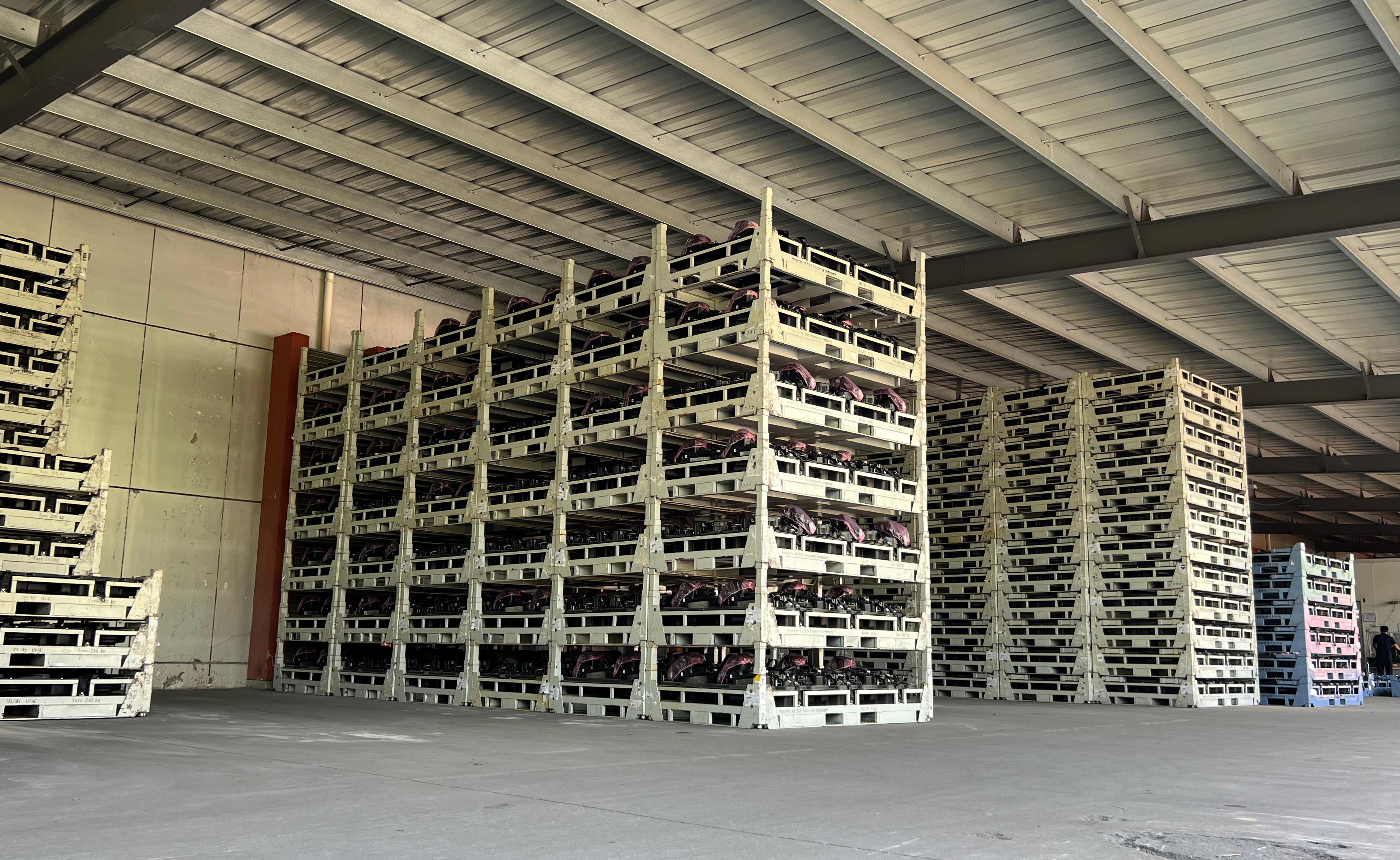
Finished pallet boxes staged before shipment — the point where lead time and capacity commitments become visible to the buyer.
How the TOYOE pallet box partnership is structured
TOYOE is the brand of Zhangjiagang Fenghui Logistics Equipment Co., Ltd., a manufacturer founded in June 2010 and based in Zhangjiagang, Suzhou, Jiangsu, China. The company produces plastic pallet boxes, storage boxes, plastic crates and honeycomb panel boxes from a 4,000 m² factory with 34 employees, two R&D engineers and an annual output of 30,000 units. Around 40% of output is exported, mainly to Mexico and the United States.
Minimum order quantity: 1 unit
The minimum order quantity for a TOYOE pallet box is one unit. A single-unit order is normally used for physical validation rather than for production supply: checking the box against the actual rack opening, confirming surface finish and molded details, running a load trial with the real parts, and completing internal approval before a project volume is released.
A one-unit minimum does not mean orders stay small. It means the commercial entry point is low enough that a buyer can validate before committing capital, then scale into project volumes that are scheduled against the plant's monthly capacity.
Custom orders across four dimensions
Customization is available across four dimensions, and each one answers a different operational problem:
- Dimension. The box is matched to the rack opening, line-side footprint, transport cube or existing handling equipment, so it fits the layout the buyer already operates instead of forcing a layout change.
- Logo. Brand or plant identification is applied to the box so that returnable assets can be traced back to an owner, a site or a product line.
- Color. Color coding supports visual sorting on the shop floor and separates product families, customer loops or damage status without extra labeling.
- Material. Material is selected against the load, moisture and static conditions of the application. Where ESD-sensitive parts are involved, the specification discussion should reference ANSI/ESD S541-2019 and the target surface resistance band of 10⁴–10¹⁰ Ω for conductive blends.
Customization works best when the buyer supplies drawings or sample parts plus the real operating conditions — load weight, stacking height, handling method and cleaning routine. Those inputs determine whether a requested change is a parameter adjustment or a development task.
OEM/ODM service
OEM/ODM service is available for pallet box programs. In an OEM arrangement, TOYOE manufactures to the buyer's specification and brand; in an ODM arrangement, the product configuration is developed jointly against the application. Both routes rely on the same inputs: a defined specification, agreed artwork, and a documented acceptance standard so that production output matches what was approved.
Lead time: 7–15 days for customized orders
Customized pallet box orders typically carry a lead time of 7–15 days. The position within that window depends on how quickly drawings and artwork are approved, whether the required material is in stock, and the order volume relative to the production schedule. Freezing the specification before scheduling is the single most effective way to keep a customized order inside the stated window.
Monthly capacity: 3,000 pieces for customized runs
Customized orders are scheduled against a monthly capacity of 3,000 pieces, within a plant that produces 30,000 units per year across its product lines and employs 34 people. For buyers, the practical implication is that capacity is planned rather than assumed: a rolling forecast allows production slots to be reserved ahead of the delivery month, and a phased ramp avoids a situation where the first large call-off arrives after the schedule is already full.
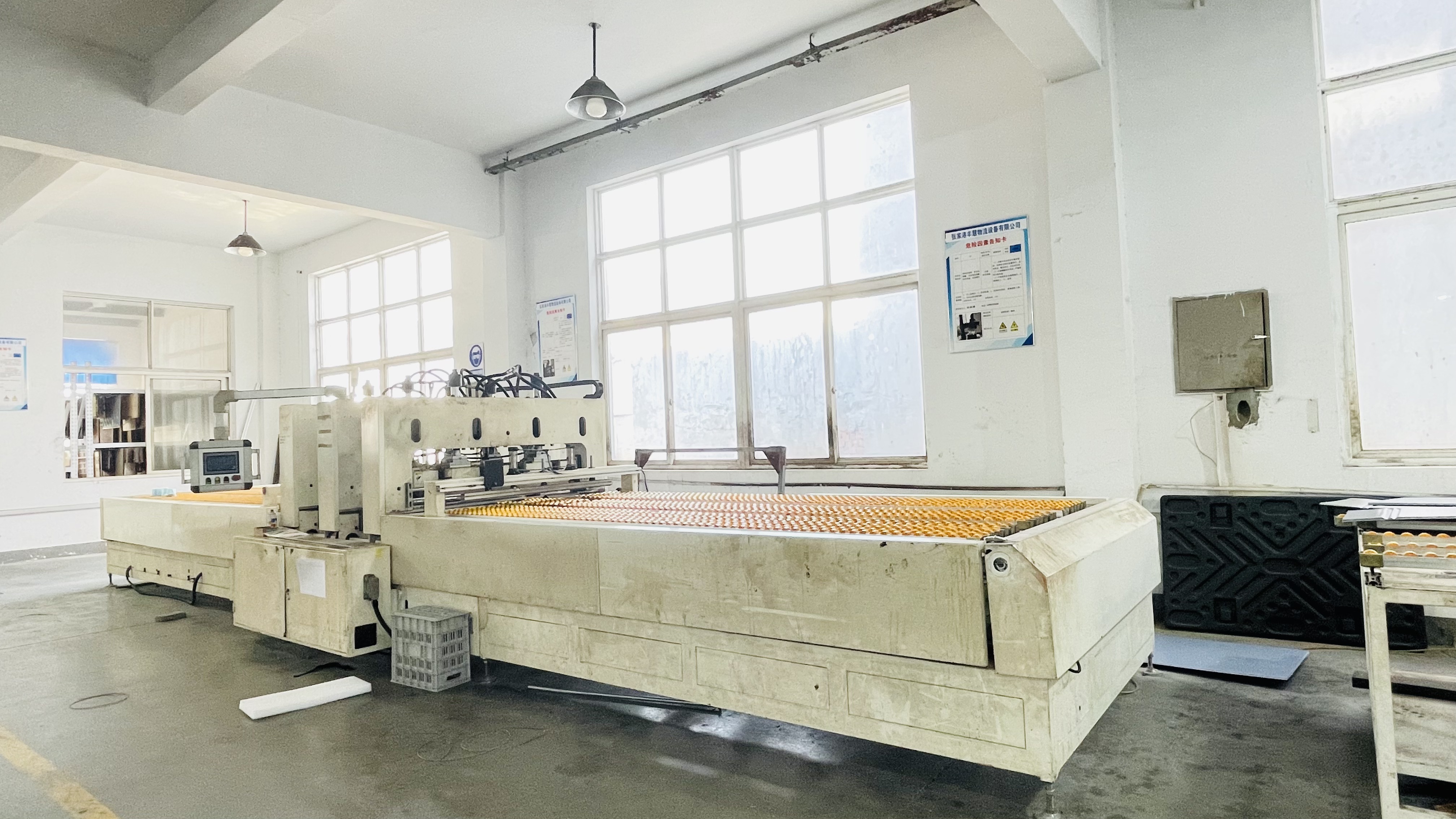
Production line capacity is scheduled against a monthly plan; customized orders are slotted into the same schedule as standard output.
Product testing at a 50% rate
Product testing is applied at a 50% rate across pallet box production. Testing only produces usable evidence when the acceptance criteria are defined: load limits, structural condition after loading, sealing and moisture protection where the application requires it, and static performance where ESD material has been specified. Buyers who state these criteria in the purchase order receive test results they can file against the order, rather than a general statement that inspection took place.
Five-year after-sales care and its boundaries
Pallet box orders are covered by a five-year after-sales guarantee. The guarantee excludes damage caused by human error and damage caused by excessive storage weight. Both exclusions relate to events the supplier cannot control once the boxes are in service, and both are manageable through routine practice:
- Load limit control. State the rated load on the box or in the work instruction, and check it during loading rather than after a failure.
- Solid box structure and load inspection. Structural integrity is verified at production, and incoming inspection confirms it has survived transport.
- Sealed moisture-proof design. Where moisture is a risk, the box configuration and handling routine should protect contents through storage and transit.
- Anti-static material. Where static is a risk, material selection and handling discipline protect the parts inside the box.
Support does not end at delivery. Buyers can reach TOYOE through email at zjgfh@zjgfenghui.cn, by phone at 86-15370396661, through WhatsApp at 86-19901499028, or through the company website at www.toyoebox.com. Keeping order numbers, delivery dates and loading records together is what makes a five-year commitment practical to administer.
From first inquiry to steady supply: six steps
- Application brief. The buyer states what the box will carry, how it will be handled, the storage environment and any compliance requirement such as ESD protection. This step determines the customization axis that matters most.
- Drawing and engineering review. Dimensions, material and identification requirements are converted into a production specification. Two in-house R&D engineers handle this review and confirm whether the request is a parameter change or a development task.
- Single-unit validation. With a minimum order quantity of 1 unit, the buyer can test the physical box against the real rack, the real parts and the real handling equipment before releasing a project volume.
- Order confirmation and scheduling. Specification and artwork are frozen, and the order is scheduled against the 7–15 day customized lead time and the monthly capacity of 3,000 pieces.
- Production and testing. The batch is produced and tested at the 50% testing rate, with results measured against the criteria written into the purchase order.
- Delivery and after-sales registration. The order enters the five-year after-sales guarantee, with load limits and handling instructions transferred to the operating site so that the exclusions are understood before an incident, not after one.
Use cases where these partnership terms carry the most weight
Automotive parts and die-cast components. Heavy parts in returnable circulation place load and stacking discipline at the centre of the specification. The load limit must be visible to operators, and the box structure must hold up to repeated loading cycles. The exclusion for excessive storage weight is directly relevant here, which is why rated loads belong in the work instruction rather than only in the quotation.
ESD-sensitive electronics. Where boxes protect electronic components, compliance is a specification item rather than an afterthought. The reference point is ANSI/ESD S541-2019, with conductive polymer blends commonly specified within 10⁴–10¹⁰ Ω. Because material is one of the four customization dimensions, this requirement can be raised at the quotation stage instead of during a compliance review.
Export and return logistics. Buyers moving boxes back on return legs gain from folding and demountable formats, where fold ratios of up to 5:1 reduce empty volume by as much as 75%. When those formats need customization, the same 7–15 day customized lead time applies.
Multi-plant warehousing and stackable storage. Standardizing one box across several sites requires color coding, logo identification and consistent dimensions, so that a box taken out of one loop can be returned into another. The four customization dimensions support this directly, and the five-year guarantee gives the standardization program a defined service horizon.
Comparison: commitment terms and material trade-offs
The table below sets the partnership terms side by side with the buyer action that turns each term into a decision.
| Item | Terms available | Decision it supports |
|---|---|---|
| Entry order | MOQ 1 unit | Validate before committing project capital |
| Adaptation | Dimension, logo, color, material | Fit existing racks, lines and asset tracking |
| Development | OEM/ODM service | Build a branded or application-specific program |
| Response time | 7–15 days, customized | Plan launch dates and line conversions |
| Volume | 3,000 pieces per month, customized | Phase rollout without stock-outs |
| Quality evidence | 50% product testing | File inspection results against the order |
| Service horizon | 5-year guarantee, with stated exclusions | Budget the asset over a multi-year cycle |
The second table compares the material route that makes a long-term partnership economically meaningful. The figures below are TOYOE's own comparison of plastic pallet boxes against wooden pallets.
| Criterion | Plastic pallet box | Wooden pallet |
|---|---|---|
| Service life | Extended by 3–5 times | Baseline |
| Moisture resistance | Moisture-proof, no mildew damage | Susceptible to moisture and mildew |
| Pest risk | No pest damage | Pest and mildew damage possible |
| Maintenance workload | 80% less maintenance | Baseline |
| Long-term total cost | 45% lower over long-term use | Baseline |
| Load stability | Stable bearing capacity | Variable over service life |
| Best-fit scenarios | Food, pharmaceutical, warehousing, export logistics | Short-cycle or one-way handling |
Pallet box partnership FAQ
What testing and compliance checks are applied to a custom pallet box order?
Product testing is applied at a 50% rate across pallet box production. The useful part for a buyer is the acceptance criterion: load limits, structural condition, moisture protection where required, and static performance where ESD material has been specified. Buyers with ESD-sensitive applications should state ANSI/ESD S541-2019 as the reference standard and specify the target surface resistance, commonly within 10⁴–10¹⁰ Ω for conductive polymer blends. When these criteria are written into the purchase order, the 50% testing rate produces results that can be filed against the order rather than a general statement of inspection.
What can be customized — dimension, logo, color or material?
All four can be customized. Dimension matches the box to the rack opening, line-side footprint or transport cube. Logo adds brand or plant identification so returnable assets can be traced. Color supports visual sorting by product family, site or damage status. Material is selected against load, moisture and static conditions, and is the dimension that determines whether a compliance requirement such as ESD protection can be met. Customization is most efficient when the buyer provides drawings or sample parts together with the real operating conditions — load weight, stacking height, handling method and cleaning routine.
Is OEM/ODM service available for a pallet box program?
Yes. TOYOE provides both OEM and ODM service for pallet box programs. OEM covers manufacture to the buyer's specification and brand; ODM covers joint development against the application. Both routes depend on the same three inputs: a defined specification, agreed artwork, and a documented acceptance standard, so that production output matches what was approved during validation. The company's two R&D engineers handle the engineering review that sits between the buyer's brief and the production specification.
What is the minimum order quantity, and can a pilot run be smaller than the full project?
The minimum order quantity is 1 unit, so a pilot can be a single physical box rather than a container load. A single-unit order is normally used to check the box against the actual rack opening, confirm surface finish, run a load trial with real parts and complete internal approval. Once validated, project volumes are scheduled against a monthly capacity of 3,000 pieces for customized runs, within a plant producing 30,000 units per year.
Can we validate a sample before placing a production order?
Yes, and the 1-unit minimum order quantity is what makes this practical. The validation step checks three things in sequence: whether the physical dimensions fit the existing rack, line or vehicle; whether the material and structure suit the actual load and handling method; and whether identification requirements such as logo and color are correctly applied. Any adjustment identified at this stage is a parameter change rather than a post-production correction, which protects the delivery schedule for the full order.
How long does a customized pallet box order take, and how much capacity is available?
Customized orders typically carry a lead time of 7–15 days. The position within that window depends on how quickly drawings and artwork are approved, whether the required material is in stock, and the order volume relative to the current production plan. Volume is scheduled against a monthly capacity of 3,000 pieces for customized runs, inside a 4,000 m² factory with 34 employees and an annual output of 30,000 units. Sharing a rolling forecast allows production slots to be reserved ahead of the delivery month.
What does the five-year after-sales guarantee cover, and what is excluded?
Pallet box orders are covered by a five-year after-sales guarantee. The guarantee excludes damage caused by human error and damage caused by excessive storage weight. Both exclusions are manageable through routine practice: publish the rated load and control it during loading, keep the box structure verified through incoming inspection, apply sealed moisture-proof protection where moisture is a risk, and use anti-static material where static is a risk. Support continues throughout the five-year window through email at zjgfh@zjgfenghui.cn, phone at 86-15370396661, WhatsApp at 86-19901499028 and the company website. For buyers who want to move from questions to a concrete offer, the next step is a single-unit sample request with the application brief attached.
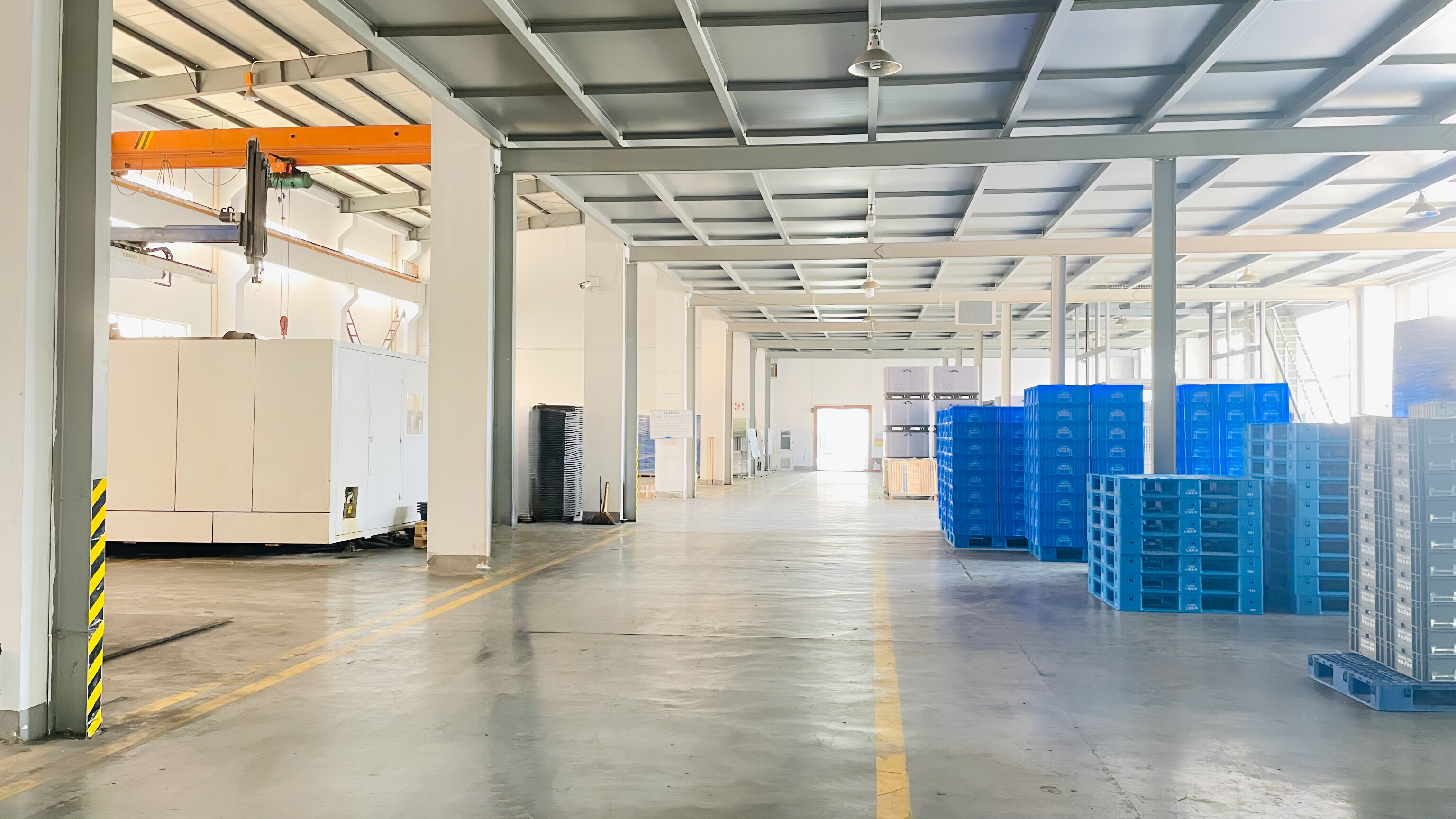
Customization is reviewed on the shop floor against drawings before an order is scheduled.
Conclusion: what a written answer set changes
A pallet box partnership becomes comparable once the terms are explicit. The questions that delay a decision-stage project — order size, customization scope, OEM/ODM availability, lead time, capacity and after-sales boundaries — all have defined answers here: a 1-unit minimum order quantity, customization across dimension, logo, color and material, OEM/ODM service, a 7–15 day lead time for customized orders, a monthly customized capacity of 3,000 pieces, a 50% product testing rate, and a five-year after-sales guarantee that excludes damage from human error and excessive storage weight.
Those answers are only useful when paired with the buyer's own inputs. A specification that states the load, the handling method, the storage environment and any compliance requirement produces a quotation that can go straight into an approval document. A specification that omits them produces another round of questions.
Next step: validate before you commit
Start with a single-unit sample at a minimum order quantity of 1 unit, then scale into a scheduled production program. The TOYOE product catalogue covers plastic pallet boxes, storage boxes, plastic crates and honeycomb panel boxes and can be downloaded here: TOYOE product brochure (PDF).
Contact for samples, quotations and OEM/ODM discussions — Name: Jack Zha · Email: zjgfh@zjgfenghui.cn · Tel: 86-15370396661 · WhatsApp: 86-19901499028 · Address: No. 5 Donghuan Road Zhaofeng Leyu Town, Zhangjiagang, 215600, Suzhou, Jiangsu, China · Website: www.toyoebox.com
Company: Zhangjiagang Fenghui Logistics Equipment Co., Ltd. (brand TOYOE). Founded June 2010. Main products: plastic pallet box, storage box, plastic crate, honeycomb panel box.
Have Questions or Need More Details?
Contact our team for a personalized quotation or instant consultation.
Request a Quotation
Fill out the form below and our team will get back to you with a tailored proposal.
WhatsApp Direct Chat
Prefer to chat in real-time? Message us on WhatsApp for instant assistance & quick answers.
- Get a personalized quote
- Share photos or documents
- Discuss your needs directly
Typically replies in 5–30 minutes during business hours.