Pallet Box Selection for Automotive Parts Logistics Projects: A Scenario-Based Buying Guide

Selecting a pallet box for an automotive parts logistics project is not only a product comparison exercise. It is a project-level decision that must account for the operating environment, handling equipment, part geometry, stacking requirements, and long-term warehouse workflow. In this guide, the focus is on how a buyer can match a pallet box to a real logistics warehousing and packaging project, especially when the working conditions include high humidity, dust, wide temperature range, waterproof requirements, anti-static needs, transportation, warehousing, stacking, and storage.
Why Project-Specific Pallet Box Selection Matters
Automotive parts logistics projects often run 24/7 and involve forklifts, warehouse shelves, and logistics handling equipment. A pallet box that performs well in a clean, low-moisture warehouse may create risk in a facility with significant humidity or dust. In project-oriented buying, the question is not only "which pallet box is the best" but "which pallet box is best for this specific working condition."
For automotive parts storage, standardized stacking, and transportation protection, the pallet box should support stable load-bearing, shock resistance, and moisture-proof performance. The selection process should also consider whether the unit will be used for long-term reusable logistics or for one-time shipment.
Common Project Conditions in Mexico and Similar Markets
A typical application scenario in Mexico involves logistics warehousing and packaging projects with high humidity, dust, and a wide temperature range. These environments require a pallet box that can tolerate moisture and provide consistent structural stability. Waterproof and anti-static characteristics are often relevant because automotive components may include sensitive parts that benefit from static control or protection from contamination.
In such projects, the pallet box is not a standalone product. It must work with forklifts, warehouse shelves, and logistics handling equipment. If the pallet box cannot maintain dimensional stability under load or if its base is not suitable for fork entry, the overall material flow becomes less efficient.
Core Requirements for Automotive Parts Storage
When the project function is automotive parts storage, standardized stacking, and transportation protection, buyers should evaluate several practical factors.
1. Load-Bearing Stability
Automotive parts such as transmission gearboxes and engine-related components can be heavy. A pallet box used in this context should provide stable load-bearing performance. The purpose is not only to support weight but also to keep the parts in a fixed position during movement. If the box deforms or shifts under load, the risk of part collision increases.
2. Shock Resistance
Shock resistance is important when pallet boxes are moved by forklift or when they are loaded and unloaded frequently. In an automotive parts logistics project, the container should help reduce the chance of collision damage to the gearbox or other components.
3. Moisture-Proof Performance
High humidity can affect both the packaging and the metal parts inside. A moisture-proof pallet box helps protect components from condensation and environmental moisture during storage and transit. This is especially relevant in regions with variable temperature and humidity conditions.
4. Standardized Dimensions and Stacking
Standardized dimensions allow the pallet box to be integrated into existing warehouse shelf systems and forklift operations. Stacking is a practical requirement, but it must be compatible with the actual box design and the available warehouse height.
Material Considerations: HDPE, PP, and Honeycomb Board
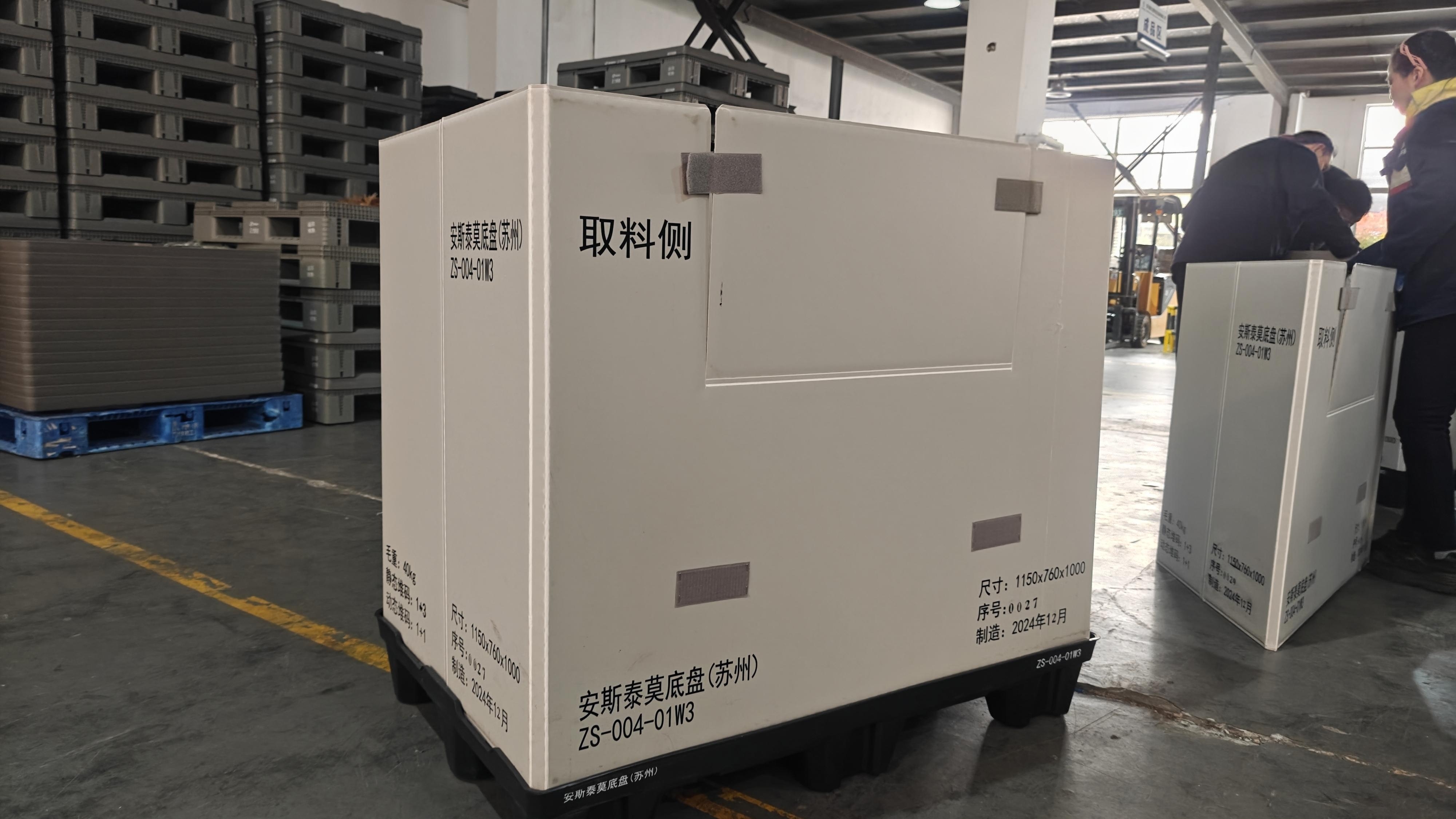
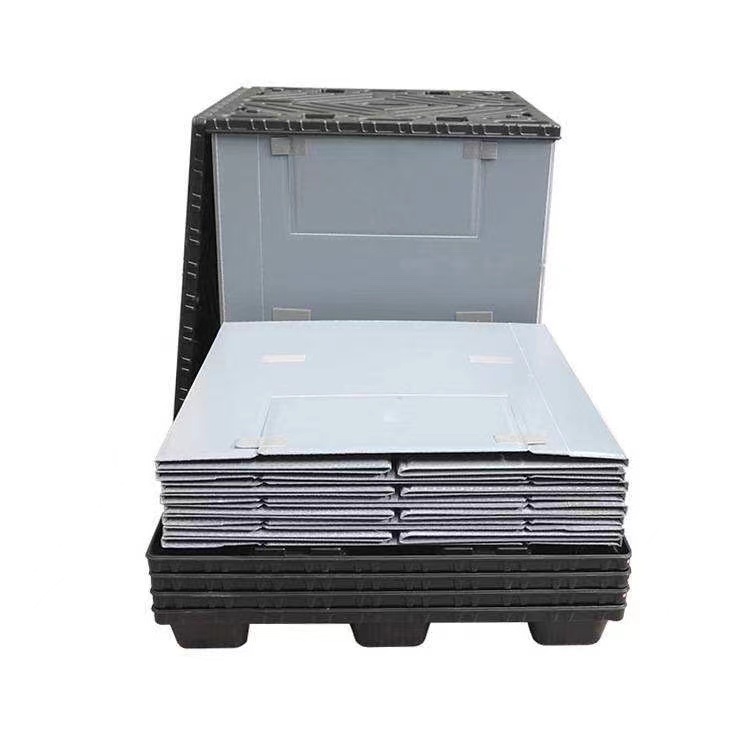
In the TOYOE product range, industrial plastic pallet boxes are offered in materials such as HDPE and PP. These materials are commonly selected for reusable industrial logistics because they provide a durable structure and can be cleaned for repeated use. The products are positioned as recyclable, durable, and nestable, and they can be customized in size, color, and logo printing.
For projects that require both strength and transport protection, a plastic honeycomb board pallet box can be considered. Honeycomb board structures are known in the packaging industry for a high strength-to-weight ratio, which is useful when a project needs strength without excessively increasing the handling weight.
Project Example: Transmission Gearbox Storage
One relevant project case involves an automobile manufacturer in Mexico that needed to store car transmission gearboxes. The client required a solution that could realize standardized storage of auto parts, avoid collision damage of the gearbox, and improve warehouse management efficiency. In this case, the selected pallet box approach focused on high load-bearing capacity, shock resistance, stable structure, and a size that fit the auto transmission gearbox.
This example is useful for buyers because it shows how a pallet box selection is driven by a specific part geometry and a specific warehouse workflow. It is not a generic storage project. The container must correspond to the size and weight of the gearbox, and it must allow the parts to be handled by standard logistics equipment.
How TOYOE Supports Project-Specific Requests
TOYOE is the brand used by Zhangjiagang Fenghui Logistics Equipment Co., Ltd., a Suzhou, China-based manufacturer of plastic pallet boxes, storage boxes, plastic crates, and honeycomb panel boxes. The company's production covers the Suzhou area and serves markets including Mexico and the USA, with an export ratio of 40% according to its corporate profile.
For project-oriented buyers, TOYOE offers OEM/ODM production with customization in dimension, logo, color, and material. The monthly capacity is stated as 3,000 pieces, with a lead time of 7–15 days and an MOQ of 1 unit. This type of information is useful during the research and evaluation stage because it helps a buyer understand the practical feasibility of a custom automotive parts packaging project.
Product Options Relevant to Automotive Logistics
| Product Type | Example Model | Material | Project Relevance |
|---|---|---|---|
| Plastic Pallet Box | 1200*800*1000 Plastic Pallet Box | PP, HDPE | General automotive parts storage and standardized stacking |
| Plastic Honeycomb Panel Box | 1000*800*800 Pallet Box | HDPE, PP | High strength-to-weight ratio for transport protection |
| Storage Pallet Box | 1000*800*800 Pallet Box | HDPE | Reusable storage for controlled warehouse environments |
| Die-Cast Pallet Box for Automotive Engines | 1230*830*1000 Pallet Box | HDPE | Project-specific fit for engine or gearbox components |
The product data lists a capacity range of 100–200L and an enclosed type. The specification is described as multiple specifications or customizable, which is relevant when a project requires a non-standard footprint or a custom inner lining.
Customized Inner Lining and ESD Considerations
For automotive parts logistics, a customized inner lining pallet box can help position parts more precisely. Vacuum-formed inner lining trays are available in the product set, including heavy-duty vacuum-formed inner lining trays, transmission blister inner lining trays, and anti-static blister trays. These linings can be used to separate components, reduce movement, and provide an additional level of protection during handling.
In environments where static discharge is a concern, an ESD pallet box or anti-static inner tray may be evaluated. Anti-static packaging is commonly considered for precision electronics and sensitive automotive parts. The decision should be based on the actual sensitivity of the components and the conditions in the warehouse or production line.
Evaluating Reusable vs. One-Way Packaging
Project buyers often need to choose between reusable and limited-use packaging. A durable plastic pallet box supports reusable logistics, especially in closed-loop flows between a manufacturer, a warehouse, and an assembly site. The TOYOE product specifications emphasize recyclable, durable, and nestable features, which supports returnable packaging programs.
For multi-year projects, the total cost structure is different from purchasing disposable packaging. Buyers should consider cleaning, storage, return logistics, and the expected service life of the box. TOYOE provides a five-year guarantee excluding cases of damage due to human error or excessive storage weight of the product. This type of after-sales statement can be considered when comparing project budgets and risk allocation.
Quality Control and Production Capacity
A project supplier evaluation should include quality control and production consistency. The capability data for TOYOE indicates a quality control level described as 50% test. Buyers should interpret this in the context of the project's inspection requirements and may request additional clarification during the supplier evaluation phase.
The production capacity is listed as 30,000 sets per year, and export markets include the EU and Southeast Asia. The company's main markets are recorded as MEX/USA, which is relevant for buyers planning logistics projects in Mexico or cross-border supply chains in North America.
Decision Checklist for a Pallet Box Logistics Project
During the research and evaluation stage, the following checklist can help a buyer move from general interest to project-specific decisions.
- Confirm the part family to be stored and its geometry, weight, and sensitivity.
- Define the operating environment: humidity, dust, temperature range, and exposure to water or static.
- Verify forklift, shelf, and handling equipment compatibility.
- Decide whether the box will be reused in a closed-loop system or used for limited cycles.
- Confirm stacking height and dimensional constraints in the warehouse.
- Determine whether inner lining, ESD protection, or custom part positioning is required.
- Evaluate material choice, especially HDPE or PP, based on cleaning and durability needs.
- Check the supplier's production capacity, lead time, MOQ, and after-sales terms.
Frequently Asked Questions
Is this pallet box suitable for the logistics and warehousing project environment?
This product is suitable for logistics warehousing and packaging projects. It is designed for waterproof and anti-static environments. This application scenario is common in Mexico, where working conditions may include high humidity, dust, and a wide temperature range.
Can these industrial pallet boxes be customized to the shape of the parts?
Yes. Custom order is accepted, and customization can include dimension, logo, color, and material. The product specifications list size as customized, and multiple specifications can be customized according to project needs.
Can TOYOE supply a project with an MOQ of a few units and acceptable lead time?
According to the supplier capability data, the MOQ is 1 unit and the lead time is 7–15 days. This supports project-based evaluation and initial sample approval before larger orders are placed.
What kind of after-sales support or guarantee is available for pallet boxes?
TOYOE states that the product is guaranteed for five years, excluding cases of damage due to human error or excessive storage weight of the product. Buyers should confirm the exact terms during the inquiry stage.
Where can I get more product information or request a sample?
For more details, you can contact TOYOE directly for product specifications, sample requests, or project-based inquiries. The manufacturer is Zhangjiagang Fenghui Logistics Equipment Co., Ltd., located in Suzhou, Jiangsu, China, with the brand TOYOE and the website www.toyoebox.com. You can also access the company brochure here: Download TOYOE Company Brochure.
Conclusion
A project-specific pallet box decision should start from the operating scenario rather than from a generic best-product list. For automotive parts logistics in conditions such as high humidity and dust, the selected pallet box should support standardized stacking, transportation protection, load-bearing stability, and shock resistance. Material choice, inner lining design, ESD requirements, and reusability should all be evaluated together.
TOYOE offers a relevant option for buyers researching project-based plastic pallet box solutions. With OEM/ODM customization, multiple product types, a stated production capacity of 30,000 sets per year, and export experience including Mexico and the USA, the manufacturer can be considered for automotive parts storage and logistics warehousing projects. Buyers should still validate the specific dimensions, material, and performance requirements with the supplier before final selection.
Have Questions or Need More Details?
Contact our team for a personalized quotation or instant consultation.
Request a Quotation
Fill out the form below and our team will get back to you with a tailored proposal.
WhatsApp Direct Chat
Prefer to chat in real-time? Message us on WhatsApp for instant assistance & quick answers.
- Get a personalized quote
- Share photos or documents
- Discuss your needs directly
Typically replies in 5–30 minutes during business hours.