Solving Storage Collision Damage: Nestable Pallet Boxes for Heavy Machined Parts
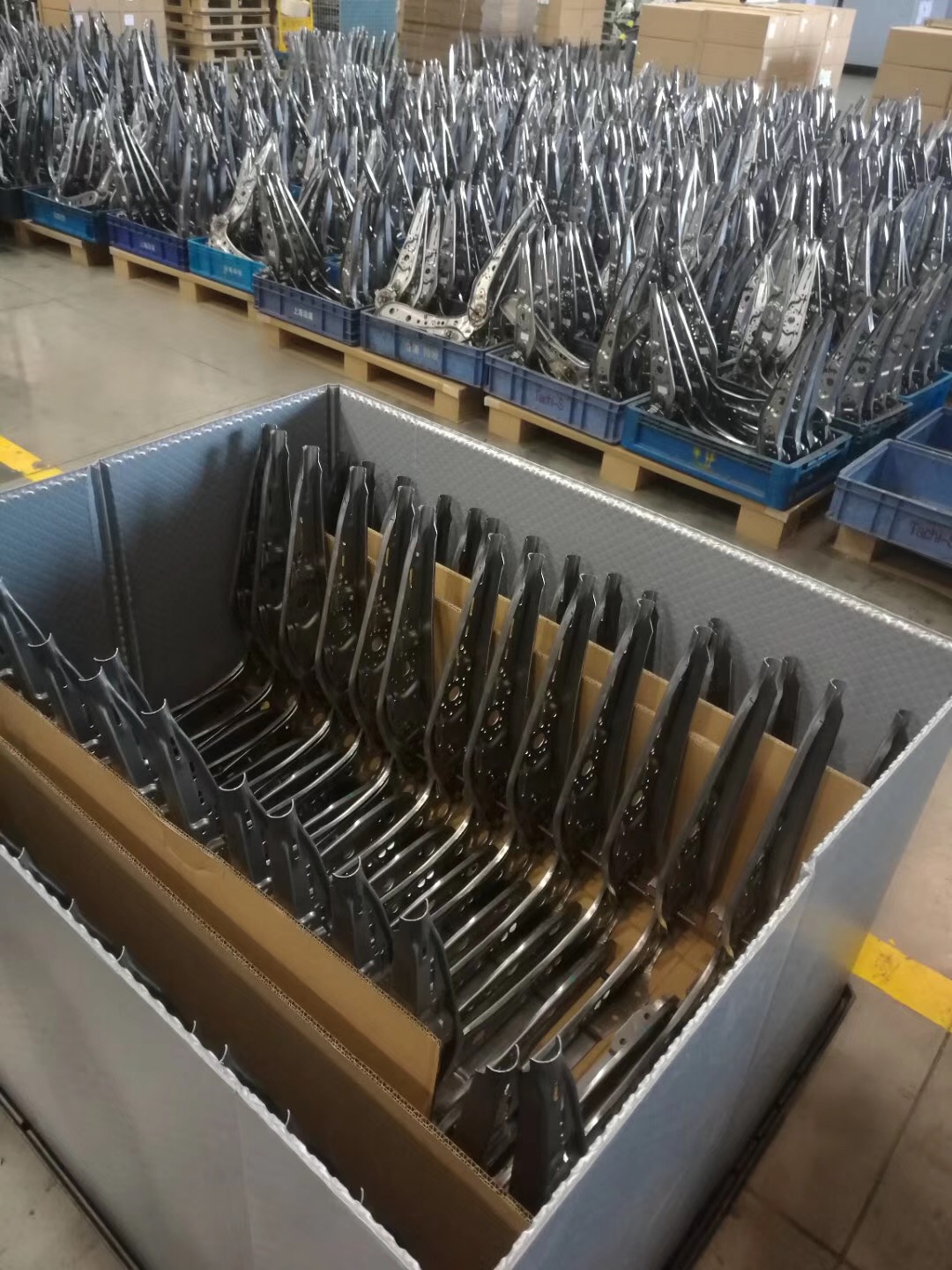
Most collision damage to heavy machined parts is not caused by one dramatic accident. It is caused by parts sitting unprotected on open steel racks, where every put-away, every re-stack and every load shift puts a finished surface in contact with metal, with another part, or with the floor.
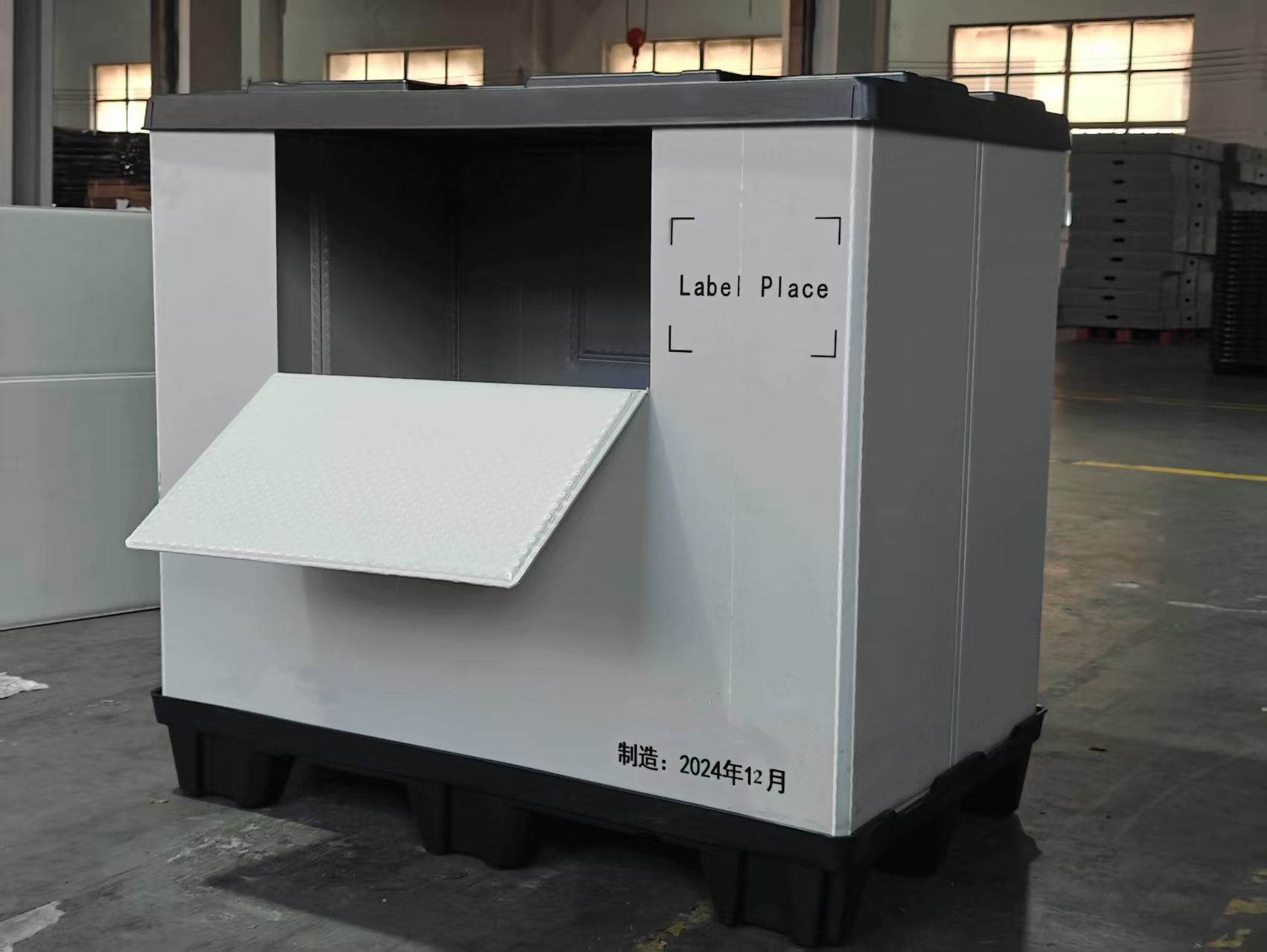
The practical countermeasure is containment rather than extra caution. An enclosed nestable pallet box holds the part in a fixed position, removes the exposed contact points, and gives every load the same footprint. TOYOE — the brand of Zhangjiagang Fenghui Logistics Equipment Co., Ltd., a logistics packaging manufacturer established in 2010 in Suzhou, China — produces enclosed HDPE and PP pallet boxes in 1200×800×1000 mm, 1000×800×800 mm and 1230×830×1000 mm formats for exactly this class of load.
This article explains where rack-based storage damage comes from, what an enclosed nestable box changes, how to specify one for a heavy machined part family, and how automotive plants in Mexico use the format for standardized part storage.
Problem Definition: Where the Damage Comes From
Collision damage in a part store follows a small number of repeatable paths. Naming them makes the countermeasure obvious.
- Forklift tine contact. When a load is unprotected on a rack, a small misalignment during put-away or retrieval moves the tines into the part itself rather than into a load container.
- Beam contact. Machined surfaces that overhang the rack beam touch steel directly. Beams do not flex, and machined edges absorb the whole contact.
- Part-on-part contact. Open storage allows two parts to be stacked or pushed against each other, so the hardest surfaces in the store find each other.
- Load shift during double stacking. An uncontained part is held by position alone. Once it moves a few centimetres, the next handling step is a risk event.
- Dust and moisture on exposed surfaces. An open store leaves machined surfaces exposed to the surrounding air and dust for the whole dwell time.
The human-error dimension is structural, not personal. Open storage turns every put-away into a judgment call made by an operator under time pressure, on a shift that may run 24/7. Two operators can place the same part in two different positions and both are "correct". Once position is a judgment call, damage becomes a probability rather than an exception, and the good placements of experienced staff are not transferable to new staff.
The operational consequences split into two groups. Cosmetic or dimensional damage on a machined surface triggers re-inspection and rework before the part can move downstream. Damage that changes a critical interface turns the part into scrap, and scrap on a late-stage part also puts the assembly schedule at risk. Both outcomes are produced by a storage decision, which means both are addressable by a storage change.
Industry Background: Why Heavy Machined Parts Are a Hard Storage Case
Heavy machined parts — gearbox housings, transmission assemblies, die-cast engine components — combine three properties that make improvised storage expensive. They are heavy, so mishandling transfers force quickly. They have irregular geometry, so no single resting position is stable. And they are already high-value at the moment they enter the store, because machining has already been performed on them.
Unlike small components, these parts are rarely bagged or boxed individually. In many plants they move directly from a machining cell onto a rack, and the rack becomes the de facto packaging. That works until the part is handled repeatedly, double stacked, or stored for a long dwell time in a plant with a demanding climate.
TOYOE's project record for a Mexico logistics warehousing and packaging application describes this environment directly. The working conditions include high humidity, dust and a wide temperature range, with waterproof and anti-static considerations and 24/7 operation. The handling equipment around the load includes forklifts, warehouse shelves and logistics handling equipment. The stated special requirements are moisture-proofing, shock resistance and load-bearing stability, and the required functions are automotive parts storage, standardized stacking and transportation protection.
That combination is the reason plastic pallet boxes have become a standard format in automotive part stores. Plastic crates and boxes classified under HS 392310 are a mature global trade category, and China is the dominant exporter in that code, with an export value of USD 2.33 billion in 2022 according to UN Comtrade data cited by FreightAmigo. A buyer sourcing for a Mexican plant is therefore working with an established product category, not an experimental one — which shifts the decision from "does this format exist" to "which configuration fits my part".
Detailed Solution: What an Enclosed Nestable Pallet Box Changes
TOYOE plastic pallet boxes are enclosed-type units made from HDPE, with PP also available. The standard formats include a 1200×800×1000 mm model and a 1000×800×800 mm model, plus a 1230×830×1000 mm die-cast box used for automotive engine and die-cast part applications. Capacity is 100–200 L across the range, and the boxes are nestable, recyclable and durable.
Enclosure removes the contact path
An enclosed pallet box puts four walls between the part and the environment. Forklift tines meet the box, not the machined surface. Rack beams meet the box base. Adjacent loads meet box walls. The part's position inside the box is decided once, by design, instead of being re-decided at every put-away. That single change is what converts collision damage from a daily probability into an exception that requires an actual handling error.
HDPE durability under continuous industrial handling
HDPE is the reason the enclosure survives the job. A box in a 24/7 automotive store is lifted, set down, stacked and pushed thousands of times, in dust and across a wide temperature range. HDPE construction supports that duty cycle while remaining recyclable at end of life, and PP is available where a different balance of properties is preferred. For heavy loads, the requirement recorded in the Mexico application is load-bearing stability — the box must hold its shape and its stack under a dense machined load, not just contain it.
Customized inner lining fixes the part geometry
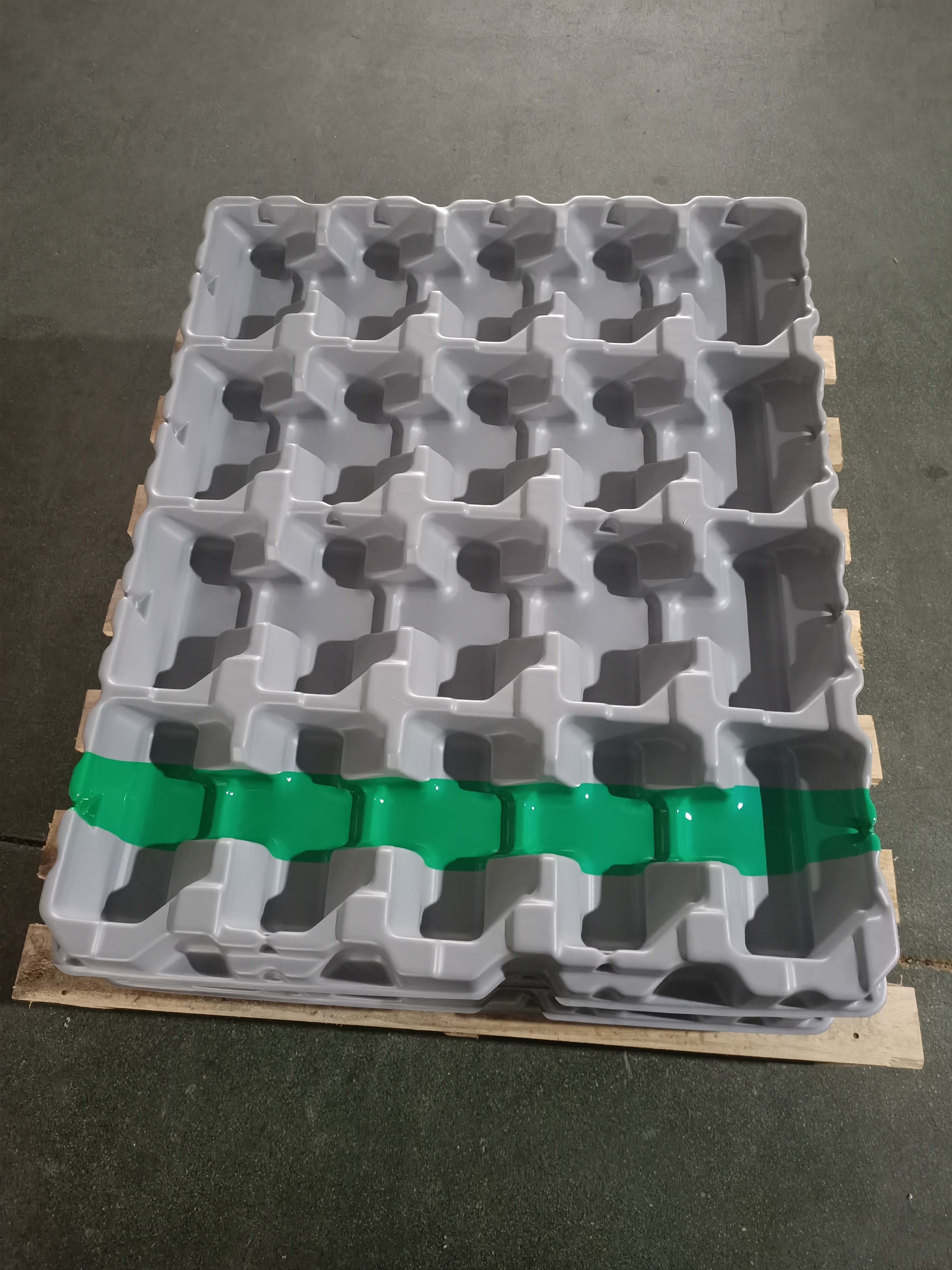
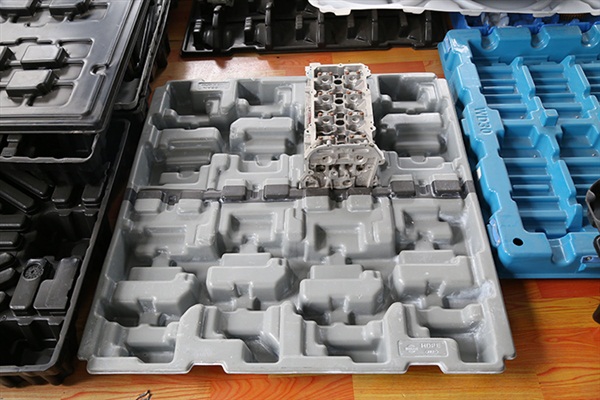
Containment alone is not enough for an irregular casting. TOYOE configures customized inner linings — including vacuum-formed and blister tray designs — so the part sits in a defined cradle rather than on a flat floor. A shaped lining distributes contact across the part's own locating surfaces instead of a single high point, and it prevents the small movements that accumulate into surface damage over repeated handling.
Stable base and stack behaviour
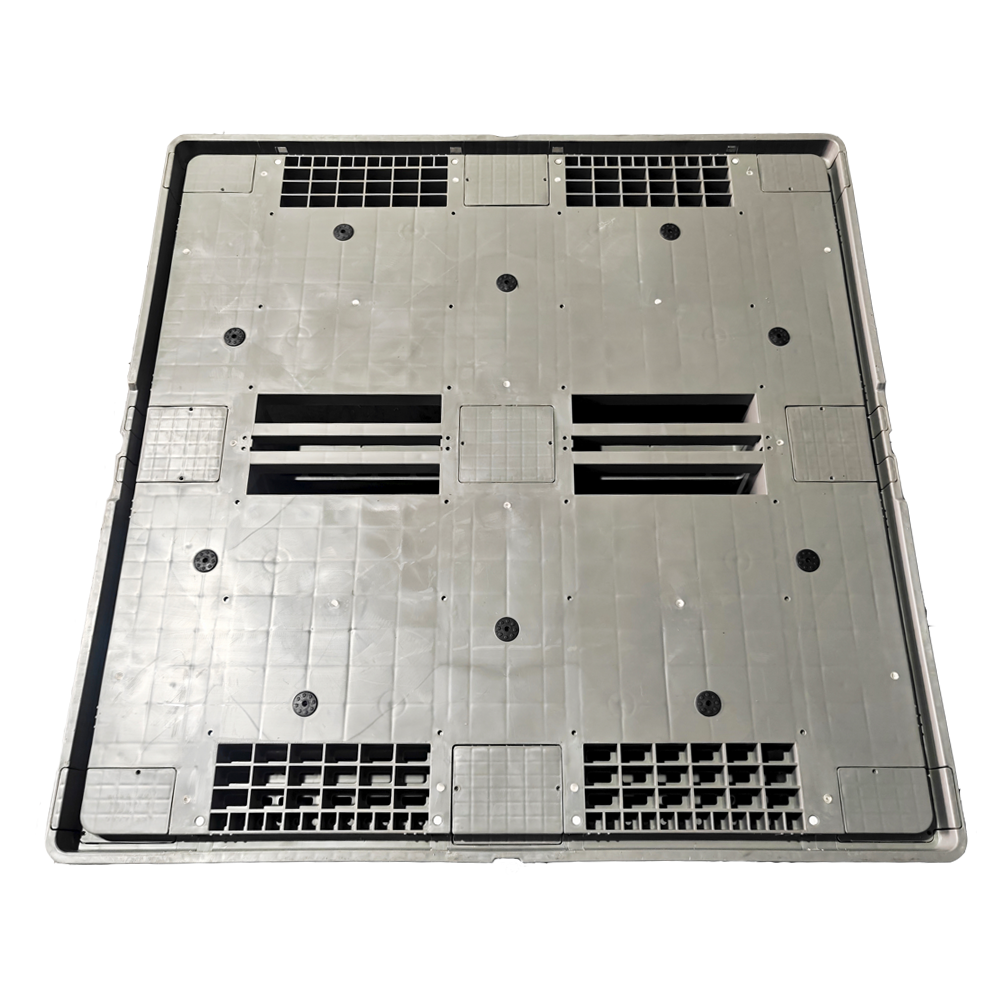
The base design matters as much as the walls. TOYOE supplies pallets with an anti-slip design, which supports stable stacking and reduces movement between boxes in a stack. Combined with a consistent footprint, that stability is what makes standardized stacking possible across a store — the same box behaves the same way on a shelf, in a stack and on a transport lane.
Nesting solves the empty-container problem
Reusable containers create a second logistics problem: what happens to them when empty. Nestable boxes address this directly. Empty units nest into one another, so the space required to hold idle containers drops sharply and return flows become practical. In a plant that receives and ships continuously, that is often the difference between a closed-loop container system and a one-way packaging cost.
Customization available to the buyer
TOYOE accepts custom orders across size, colour and logo, with free logo printing. Specifications can be customized, and multiple standard specifications are available. Samples are accepted, which matters because a machined part family can only be validated by fitting the actual part.
Step-by-Step Breakdown: Specifying a Box for a Heavy Part Family
The sequence below follows the decision order that matters in practice. Each step removes a variable before the next one is fixed.
- Define the part envelope and the damage mode. Record the part's outer dimensions, its locating surfaces and its centre of gravity, then name the failure mode you are solving — surface contact, movement in transit, or stack instability. Different failure modes lead to different box interiors, so this step cannot be skipped.
- Choose the footprint. TOYOE offers 1200×800×1000 mm, 1000×800×800 mm and the 1230×830×1000 mm die-cast format. The 1200×800×1000 model gives the largest of the standard footprints; the 1000×800×800 model is the more compact option; the 1230×830×1000 die-cast box is the format used for automotive engine and die-cast applications. Match the footprint to your rack openings and transport lanes before matching it to the part.
- Fix the material. HDPE is the standard construction, with PP also available. Decide early, because material choice constrains the inner lining design that follows.
- Design the interior around the part. Specify a customized inner lining — vacuum-formed tray or blister tray — that locates the part on its own surfaces. This is the step that converts an enclosed box into a damage-control system.
- Validate with a sample. Fit the real part, load the box as it will be loaded in production, and handle it the way the plant will handle it — forklift, shelf, stack. TOYOE accepts sample orders for this purpose.
- Standardize one model per part family. The objective is that every station, shift and operator works with the same unit. Logo printing and colour customization help separate part families visually, which reduces mis-slotting in a mixed store.
- Plan the empty loop and the export details. Nesting defines how many empties fit on a return truck. For cross-border movement, boxes ship packed in plastic film, originate in Suzhou, China, and are classified under HS code 3923100000.
Use Cases: Where This Configuration Fits
Gearbox and transmission housings
A gearbox housing is heavy, irregular and already finish-machined when it reaches storage. An enclosed box with a shaped lining locates the housing by its own surfaces, keeps the machined faces away from steel, and lets the load stack. This is the case where open-rack storage is most expensive and containment is most valuable.
Die-cast engine and powertrain parts
Die-cast components combine thin sections with machined interfaces, so point loading is the main risk. The 1230×830×1000 mm die-cast pallet box is the TOYOE format designated for automotive engine and die-cast applications, sized for this part class rather than adapted from a general-purpose box.
Automotive part storage in Mexico-based plants
TOYOE's Mexico project record sets out the exact duties a container has to perform in that environment: automotive parts storage, standardized stacking and transportation protection, under high humidity, dust and a wide temperature range, with waterproof and anti-static considerations, across 24/7 operation with forklifts and warehouse shelves. The 1200×800×1000 mm pallet box is the product linked to that application in TOYOE's records.
ESD-sensitive and precision parts
Where stored parts are electrostatic-discharge sensitive, packaging is commonly specified against the ANSI/ESD S541-2019 standard, which applies to packaging used to store, transport and protect ESD-susceptible items through production and distribution. TOYOE's anti-static blister tray and anti-static configurations support this requirement, and the Mexico application record lists anti-static conditions as part of the working environment.
General heavy industry and process fluids
The same enclosed format is specified for storing oil, industrial alcohol, alkali, acid, industrial wastewater and water alongside car parts, and is applied across automobile manufacturing, precision electronics, food cold chain, home logistics, medical and health care and heavy industry. In those applications the benefit is the same: the load is contained by design rather than protected by attention.
Model Comparison: TOYOE Enclosed Pallet Box Formats
The table below compares the three TOYOE formats referenced in this article. All three share the same material family, enclosure type and capacity range; the difference lies in footprint and intended part class.
| Model | Outer dimensions | Material | Capacity | Type | Nestable | Intended part class |
|---|---|---|---|---|---|---|
| Plastic Pallet Box | 1200 × 800 × 1000 mm | HDPE / PP | 100–200 L | Enclosed | Yes | Automotive parts and general heavy industry loads; the format linked to the Mexico storage application |
| Storage Pallet Box | 1000 × 800 × 800 mm | HDPE | 100–200 L | Enclosed | Yes | Compact footprint for smaller part families and tighter rack openings |
| Die-cast Pallet Box | 1230 × 830 × 1000 mm | HDPE | 100–200 L | Enclosed | Yes | Automotive engine and die-cast components |
Shared specification across the range: recyclable, durable and nestable construction; customized size, colour and logo with free logo printing; custom orders accepted; samples accepted; packed in plastic film; origin Suzhou, China; HS code 3923100000.
Frequently Asked Questions
What HS code and shipping details apply to TOYOE pallet boxes?
TOYOE plastic pallet boxes are classified under HS code 3923100000 and originate in Suzhou, China. Boxes are packed in plastic film. Approximately 40% of production is exported, with Mexico and the USA as the major markets, so cross-border shipment of this product category is an established part of the supplier's routine rather than an exception.
Can a pallet box hold heavy gearbox housings without the parts shifting?
Yes, when the interior is configured for the part. TOYOE pallet boxes are enclosed type, made of HDPE with PP also available, with a capacity of 100–200 L and standard formats of 1200×800×1000 mm, 1000×800×800 mm and a 1230×830×1000 mm die-cast model. Custom orders are accepted, and customized inner linings — including vacuum-formed tray and blister tray designs — locate the part on its own surfaces. An anti-slip base design supports stable stacking. The part is held by the box design rather than by operator judgment.
How should a pallet box project be budgeted?
Budget against a defined configuration rather than against a catalogue list, because the box is built to the part. The variables that define the configuration are the model and footprint, the material (HDPE or PP), the inner lining design, colour and logo printing, and the order quantity. Request a quotation with the part envelope, the intended handling equipment and the annual volume, and validate the configuration with a sample before committing to a volume order.
Are samples available before a volume order?
Yes. Samples are accepted on TOYOE pallet box orders. Sampling is the correct way to validate a heavy machined part application, because fit, lining contact and stack behaviour can only be confirmed with the actual part loaded and handled as it will be in production.
What production capacity stands behind delivery schedules?
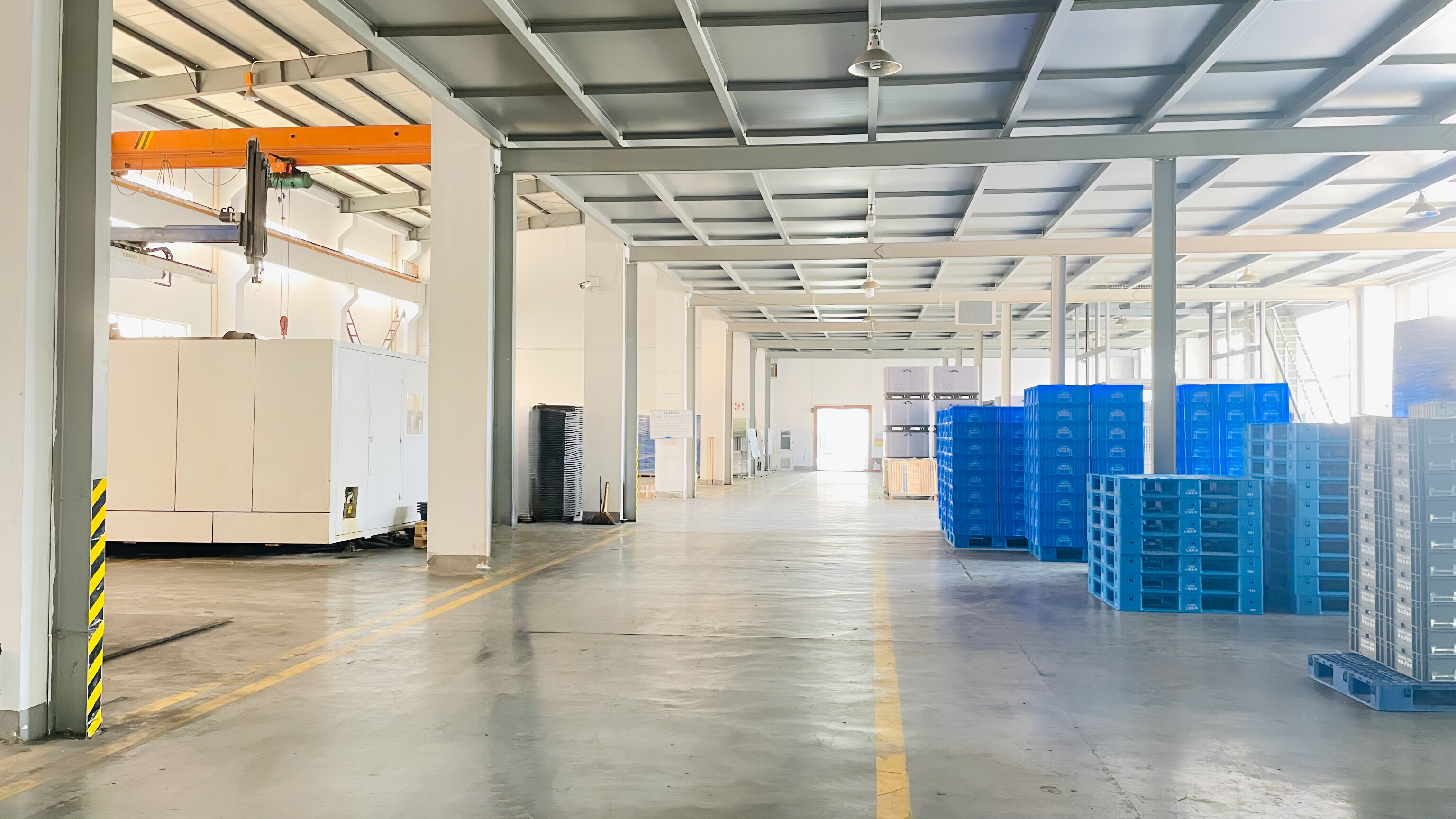
Zhangjiagang Fenghui Logistics Equipment Co., Ltd. was established in 2010 and has 14 years of experience. The manufacturing facility covers 4,000 m², employs approximately 34 staff including a research and development team of 2 engineers, and has an annual production capacity of 30,000 units. Confirm the delivery schedule for your specific configuration and volume with the sales team, and request the product brochure for the full specification set.
Conclusion
Storage collision damage on heavy machined parts is a containment problem before it is a discipline problem. Open steel racks support a load but leave the part's position to be re-decided at every handling step, and that is where tine contact, beam contact and load shift enter the process. An enclosed nestable pallet box removes those contact paths, fixes the part in a shaped lining, and gives every station the same footprint — which is what standardized part storage actually requires.
For automotive plants in Mexico, the configuration is already defined by the working conditions: high humidity, dust, a wide temperature range, 24/7 operation, forklift and shelf handling, with moisture-proofing, shock resistance and load-bearing stability as the stated requirements. TOYOE builds that configuration in HDPE and PP, in 1200×800×1000 mm, 1000×800×800 mm and 1230×830×1000 mm formats, with customized inner linings, nesting for the empty loop, and HS code 3923100000 for cross-border movement.
Next step: validate the box against your part
Send the part envelope, the handling equipment and the target volume, and TOYOE will confirm the model, material and inner lining, then arrange a sample for on-line validation. Product brochure: download the TOYOE catalogue (PDF).
Zhangjiagang Fenghui Logistics Equipment Co., Ltd. (TOYOE)
Email: zjgfh@zjgfenghui.cn · Tel: 86-15370396661 · WhatsApp: +86-19901499028
No. 5 Donghuan Road, Zhaofeng Leyu Town, Zhangjiagang, 215600, Suzhou, Jiangsu, China
Website: www.toyoebox.com
Have Questions or Need More Details?
Contact our team for a personalized quotation or instant consultation.
Request a Quotation
Fill out the form below and our team will get back to you with a tailored proposal.
WhatsApp Direct Chat
Prefer to chat in real-time? Message us on WhatsApp for instant assistance & quick answers.
- Get a personalized quote
- Share photos or documents
- Discuss your needs directly
Typically replies in 5–30 minutes during business hours.