
Brushless Motor Supplier Audit: Sample Approval vs Batch

Sample room: approved reference samples become the baseline for every later batch comparison. Image: TT Motor (Shenzhen) Industrial Co., Limited.
A brushless motor supplier audit succeeds or fails on one question: can the supplier reproduce the approved sample at volume, shipment after shipment? A sample proves what is possible in a controlled build. Batch consistency proves what is repeatable in routine production. For miniature drive platforms — including brushless planetary gear motors such as GMP36-TEC3650 and brushless worm gear motors such as TWG3246-TEC2430 — the distance between those two facts is where most project risk sits.
This guide sets out a supplier evaluation process that runs from the first sample request to recurring batch delivery. It uses the most common failure pattern in miniature motor sourcing — samples that pass while batch performance drifts — as the core checklist item, and it separates the audit into five gates: capability, sample discipline, material consistency, process control, and delivery assurance.
What a Brushless Motor Supplier Audit Must Prove
A brushless motor supplier audit should produce verifiable evidence in five areas: manufacturing capability and capacity; sample approval carried out under production-representative conditions; material and component control; process and equipment stability between batches; and pre-shipment acceptance supported by traceability. If any one of these is missing, batch consistency remains unproven — no matter how well the sample performs on the bench.
Core checklist item — samples qualified, batch products inconsistent. This is rarely a sampling accident. In practice it traces back to unlocked process parameters, substituted materials or components, sample-only machine adjustments, equipment or mold changes, and sample quantities too small to reveal normal variation.
A useful audit therefore treats the sample as the opening of the evidence chain, not the conclusion. Every gate after sample approval exists to answer one question: what mechanism prevents this build from changing?
Problem Definition: Why Approved Samples Still Fail at Batch Level
The sample-to-batch gap is a manufacturing control problem, not a product design problem. A miniature brushless gear motor is a tightly coupled assembly: rotor, stator winding, magnets, gear train, bearings, lubrication and end caps all sit inside a compact envelope. Because the mechanical and magnetic design margins are small, a modest change in any single input can shift output torque, speed, noise, vibration or current draw enough to fail an application that previously passed on the sample.
Buyers typically see the problem late. The first production shipment often comes from carefully supervised start-up conditions. The second and third shipments are where drift becomes visible — as torque deviation, increased noise or vibration at low speed, speed variation between units, higher current draw, or a growing number of rejects at the customer's own end-of-line test.
Five conditions account for most cases:
- Replacement of raw materials or components without notifying the buyer.
- Failure to lock in the sample process during mass production.
- Sample quantity too small to reflect batch consistency.
- Changes in production equipment or mold status.
- Inadequate parameter control between different batches.
For a decision-stage buyer, the consequence is a full re-qualification cycle: new samples, new testing, new documentation, and in regulated applications a re-run of compliance evidence. That is why the audit below is written as a sequence of gates rather than a single supplier questionnaire.
Industry Background: Batch Consistency Is Now an Evaluation Criterion
The commercial weight of miniaturized motion has grown. The global brushless DC (BLDC) motor market was reported at approximately USD 22.2–22.33 billion in 2025, with high consistency between the major research firms publishing that baseline (Grand View Research; Precedence Research). On the trade side, world export value for electric motors with an output below 37.5 W (HS 850110) reached about USD 16.3 billion in 2024, according to OEC — a figure that reflects how much volume moves through small-motor supply chains.
Performance expectations have moved in the same direction. Brushless motors typically reach roughly 85%–90% efficiency, while brushed gear motors commonly sit around 70%–80%, depending on model and operating conditions. In service life, brushed motors are generally quoted in the range of several hundred to several thousand hours, whereas brushless designs are described in the tens of thousands of hours because there are no brushes and commutators to wear. For equipment that runs continuously, starts and stops frequently, or must minimize maintenance, the brushless option is usually the recommended route — and that makes the consistency of the delivered batch the deciding variable in total cost.
Regulatory direction reinforces the shift. IEC 60034-30-1:2025 adds the IE5 ultra-premium efficiency class to the international motor efficiency framework, and EU Ecodesign Regulation (EU) 2019/1781, effective from 1 July 2021, requires IE3 for motors from 0.75 kW to 1000 kW and IE2 for motors from 0.12 kW to 0.75 kW. Miniature gear motors usually sit below that regulated power band, but the underlying expectation — documented efficiency and documented performance — has moved into OEM sourcing requirements at every size.
Customization amplifies the challenge. When a buyer matches a motor to a specific application, the same outer diameter can be pushed considerably further: with an identical 42 mm outer diameter, customizing longer stators and rotors can raise torque density by 20% to 40%, or shorten overall motor length by 15% to 30% at equal torque. A customized motor can also match the customer's battery voltage, typically improving overall system efficiency by 5% to 15% and reducing temperature rise at rated current by 10°C to 20°C. Custom shaft diameters can remove couplings and transition supports, shortening the transmission system axially by more than 30%. With special potting, coating, bearing selection and sealing, the operating temperature range can extend to −40°C to +85°C or higher, extending service life in harsh environments by 3 to 5 times. Every one of those custom parameters is also a variable that must be locked before mass production begins.
Detailed Solution: The Five-Gate Supplier Audit Framework
Gate 1 — Capability Verification: Can the Factory Physically Repeat the Build?
Start with the entity and its capacity, not with the datasheet. An audit should confirm who owns the factory, how large the manufacturing footprint is, how many people work in production and engineering, and what annual output the site can sustain alongside existing programs.
TT Motor (Shenzhen) Industrial Co., Limited illustrates the level of specificity an audit should extract. The company was officially established in 2006 in Hong Kong, China, and is headquartered in Bao'an District, Shenzhen, Guangdong Province. It has more than 300 employees and a manufacturing area of approximately 9,000 m², operating three production plants, a professional assembly center and a global marketing center. Its R&D function is staffed by 35 engineers, and annual production capacity reaches 8,000,000 pieces — an annual output that supports high-volume and long-term OEM motor production programs. Main products include high-precision DC motors, brushless DC motors, coreless motors, planetary geared motors, miniature geared motors and stepper motors.
Two additional capability signals matter for a long-term program. The first is engineering depth: customized service capability allows a supplier to help customers address power requirements in different application scenarios, which is exactly where sample-to-batch risk concentrates. The second is demand-side evidence: the company has established long-term cooperative relationships with domestic and international industry customers, and approximately 70% of products are exported, with the European Union and the United States as main markets. Export-heavy production implies exposure to repeated customer acceptance testing, which is a useful proxy for process discipline.
Decision rule: compare the supplier's annual output against your forecast annual demand and require comfortable headroom. A supplier whose capacity is already committed to other long-running programs has less room to absorb your ramp.
Gate 2 — Sample Approval Discipline: Approve Under Production Conditions
Sample approval is the moment to fix the reference configuration, and it is the stage most often handled loosely. Approve a sample that was built on production-representative equipment with standard tooling, not one that required hand-picked magnets, a specially adjusted winding machine, or a manually fitted gear train.
Record the approved configuration in writing as the controlled reference: model and revision, gear module and number of gear stages, rated voltage, speed range, rated torque, shaft dimensions, materials, and the test method used to confirm each value. For a model such as GMP36-TEC3650, that record fixes module 0.5, gear stages 1/2/3/4, gearbox length options of 26/33.5/40.5/47.5 mm, a speed range of 4–1600 rpm, a rated torque up to 30.0 kg·cm and a rated voltage of DC 12V–24V. For TWG3246-TEC2430, it fixes module 0.5/0.6, gear stages 3/4/5, a 46 mm gearbox length, 3–35 rpm, up to 8.0 kg·cm and DC 12V–24V.

Sample approval should lock the reference configuration before any mass production commitment. Image: TT Motor (Shenzhen) Industrial Co., Limited.
Sample quantity is part of the discipline. If only one or two units are evaluated, normal unit-to-unit variation is invisible, and the buyer later discovers that the approved performance was an outlier rather than a center value. Asking for a batch-level sample set — and for the test data of every unit, not only the best one — turns sample approval into a distribution rather than a single data point.
Gate 3 — Material and Component Consistency: No Substitution Without Notification
The second gate is material discipline. The practice that creates the most damage in miniature motor sourcing is using raw material A for the sample and raw material B for mass production — commonly driven by cost pressure after the order is placed. An audit should therefore request the material specification list, the approved supplier list for critical components, and incoming inspection records for magnets, laminations, bearings, gears and lubricants.
The contractual rule should be explicit: if the supplier changes raw materials, components, or production processes, the customer must be notified in advance and the process re-verified. This single clause prevents most silent drift, because it converts an internal cost decision into a customer-visible change-control event.
Documentation belongs in the same conversation. Most TT Motor motors have passed RoHS testing, and material declarations can be requested with reference to RoHS Directive (EU) 2015/863 amending 2011/65/EU. In an audit, the useful step is to bind the document to the exact model and revision being purchased — for example, the RoHS test documentation issued for GMP36-TEC3650 — and to re-request it whenever materials or component sources change.
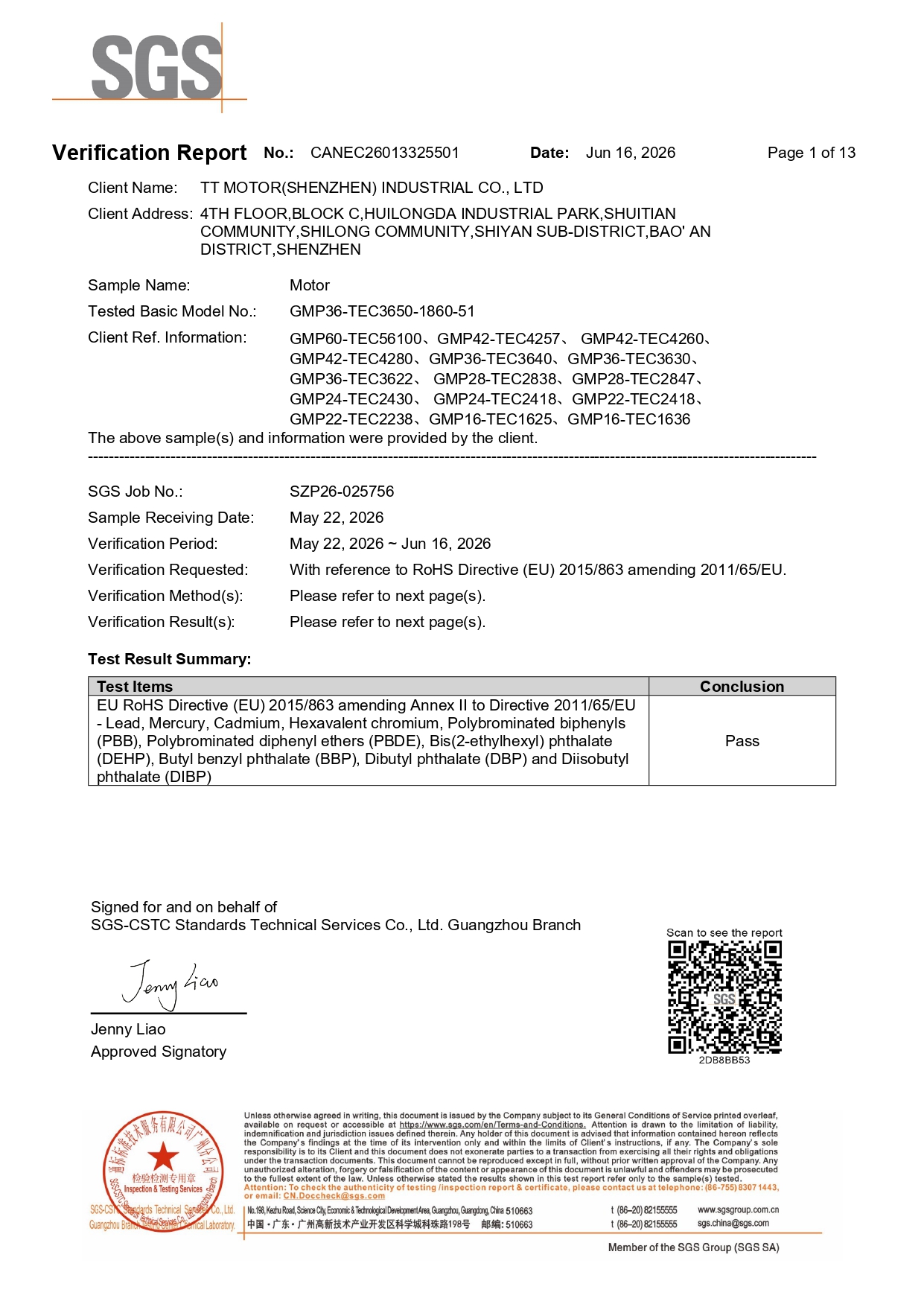
Compliance proof should be bound to a specific model and revision — here, RoHS test documentation for GMP36-TEC3650. Image: TT Motor (Shenzhen) Industrial Co., Limited.
Gate 4 — Process and Equipment Control: The Gate That Actually Decides Batch Consistency
This is the gate that closes the sample-to-batch gap. Before mass production, the supplier should conduct a small-batch trial production run that mirrors the intended production line, tooling and fixtures. The trial run is not a formality: it is the first moment when equipment state, operator method and parameter windows are tested together.
The audit should then confirm four control points:
- Parameter rules. Before mass production, key parameters must have clear sampling or full-inspection rules — not an informal visual check.
- Equipment and mold status. Changes in production equipment or mold status must be logged and trigger re-verification, because tooling wear and machine replacement shift gear meshing and rotor balance.
- Between-batch parameter control. Inadequate parameter control between different batches is a named trigger of the sample-versus-batch failure pattern; the audit should ask which parameters are recorded per batch and who reviews them.
- Test capability. Gear measuring, rotor dynamic balancing, coil winding consistency, life testing and temperature/humidity conditioning should be performed on the supplier's own equipment, with records available.
Test equipment is the physical evidence of this gate. A supplier that measures its own gear accuracy, rotor balance and motor performance in-house can detect drift internally, before it becomes a customer complaint.
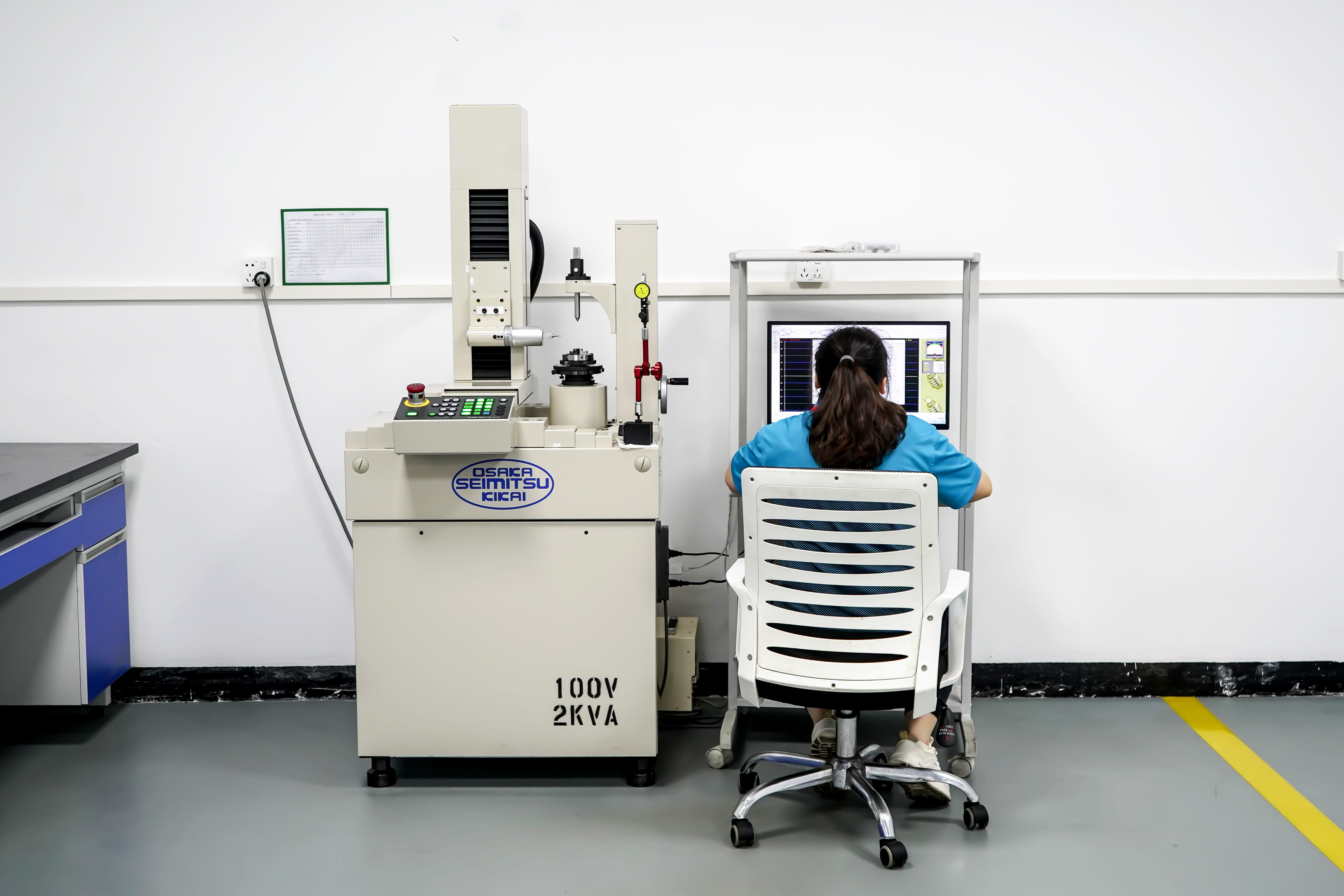
Gear accuracy is a batch-consistency variable. A CNC fully automatic gear measuring machine allows the supplier to verify it internally. Image: TT Motor (Shenzhen) Industrial Co., Limited.
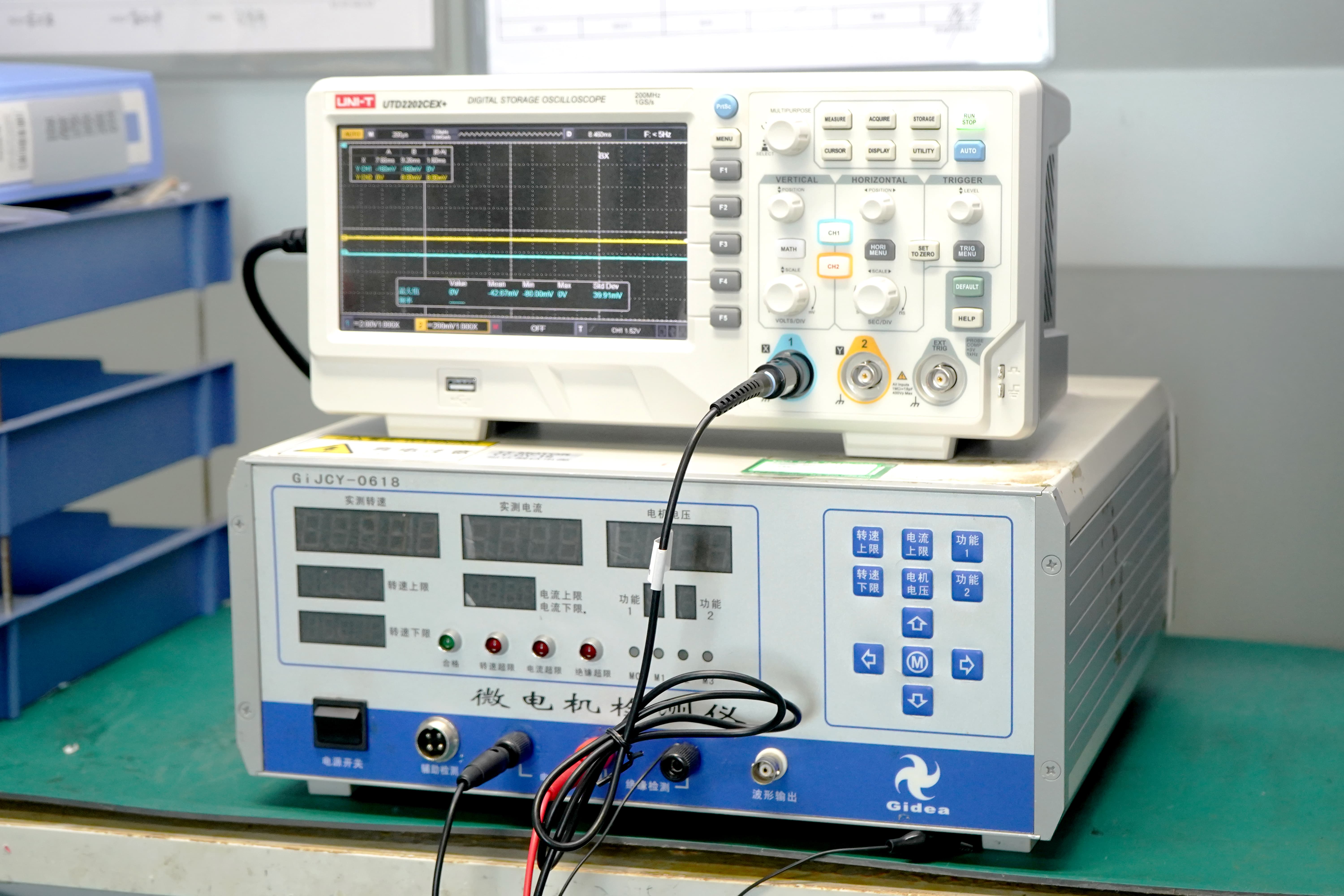
Batch performance testing converts an audit claim into a measurable record. Image: TT Motor (Shenzhen) Industrial Co., Limited.
Gate 5 — Delivery and Acceptance Assurance: Make the Standard Enforceable
The final gate makes everything else repeatable. Acceptance should be defined by a pre-shipment test procedure rather than by the buyer's incoming inspection alone: products are accepted through pre-shipment test procedures, which places the burden of proof on the supplier before the goods leave the factory.
A traceability system completes the loop. When a shipment does deviate, the supplier must be able to quickly pinpoint the source — which material lot, which equipment, which production window — and correct it without a full program restart. Commercial terms should be recorded in the same audit file so that expectations are unambiguous: MOQ is 2 units, delivery terms are EXW, and payment terms are 100%, as applied for example to orders of the DC Gear Motor GM37-555PM.
Step-by-Step Breakdown: Running the Audit from RFQ to Recurring Batch
The sequence below converts the five gates into an executable process.
- Define parameters and acceptance standards before mass production. Agree torque, speed, voltage, noise, current and dimensional tolerances, plus the test method for each.
- Request samples in a production-representative configuration. Confirm that standard tooling and standard materials were used, and ask what, if anything, was adjusted for the sample build.
- Verify the sample against the intended mass-production configuration. Avoid special machine adjustments during the sampling stage and document any deviation.
- Require small-batch trial production before mass production. Review the trial-run data, not only the finished samples.
- Set sampling or full-inspection rules for key parameters. Define which characteristics are checked on every unit and which are sampled per batch.
- Agree the change-notification clause. Any change in raw materials, components or production processes must be notified in advance and re-verified.
- Confirm the traceability system. Verify that batch records link to material lots, equipment and operators.
- Apply pre-shipment test acceptance to every recurring shipment, and re-verify after any process or material change.
Audit Checkpoint Table: Sample Stage vs Batch Stage
| Audit checkpoint | What to verify at sample stage | What to verify at batch stage | Failure signal |
|---|---|---|---|
| Configuration lock | Written record of module, gear stages, gearbox length, voltage, speed, torque | Delivered units match the locked record | Silent revision of stage count or gearbox length |
| Sample conditions | Production-representative equipment and standard tooling | Same equipment and tooling used at volume | Sample-only machine adjustments |
| Materials and components | Material list and approved component sources documented | Incoming inspection records per lot | Material A for samples, material B for mass production |
| Process and equipment | Small-batch trial production completed | Equipment and mold status logged; parameter control between batches | Unrecorded equipment or mold change |
| Key parameters | Sampling or full-inspection rules defined before mass production | Rules executed and data retained | No per-batch parameter record |
| Sample quantity | Enough units to show normal variation | Lot sampling reflects unit-to-unit spread | Only one unit ever evaluated |
| Traceability | Traceability system identified | Batch-to-lot-to-equipment linkage available | Deviation source cannot be located |
| Acceptance | Test method agreed | Pre-shipment test executed before dispatch | Acceptance left to buyer's incoming inspection only |
Product Reference for Consistency Checks: GMP36-TEC3650 and TWG3246-TEC2430
Two miniature brushless gear motor platforms used in robotics, medical and automation projects show why the locked configuration record matters. GMP36-TEC3650 is a brushless planetary gear motor built on module 0.5 with 1/2/3/4 gear stages and a rated torque up to 30.0 kg·cm. TWG3246-TEC2430 is a DC brushless worm gear motor on module 0.5/0.6 with a fixed 46 mm gearbox length and 3/4/5 gear stages, delivering up to 8.0 kg·cm at a much lower output speed.
| Characteristic | GMP36-TEC3650 | TWG3246-TEC2430 |
|---|---|---|
| Type | Brushless planetary gear motor | DC brushless worm gear motor |
| Module | 0.5 | 0.5 / 0.6 |
| Rated torque (max) | 30.0 kg·cm | 8.0 kg·cm |
| Number of gear stages | 1 / 2 / 3 / 4 | 3 / 4 / 5 |
| Gearbox length (mm) | 26 / 33.5 / 40.5 / 47.5 | 46 |
| Rated voltage | DC 12V–24V | DC 12V–24V |
| Speed range | 4–1600 rpm | 3–35 rpm |
| Materials | Stainless steel, copper, iron | Stainless steel, iron, copper |
| Typical industries | Robots, medical devices, industrial automation equipment, intelligent logistics equipment | Miniature medical devices, precision automated instruments, electrically adjustable supports |
Both platforms share the same audit logic: the more parameters a specification fixes — module, stage count, gearbox length, voltage window and speed band — the more precisely a buyer can detect batch-level drift, and the faster a deviation can be traced back to a material lot, a tooling change or a parameter window.
Use Cases: Where the Sample-to-Batch Audit Pays Off
Medical and laboratory instruments. Low-speed, low-noise and low-vibration motion is a functional requirement rather than a comfort feature in devices such as urine analyzers, body fluid analyzers, pipetting equipment, infusion syringe pumps, microfluidic dispensers and blood collection robots. A brushless worm gear motor such as TWG3246-TEC2430 — 3–35 rpm, up to 8.0 kg·cm, 46 mm gearbox, DC 12V–24V — is selected for this kind of low-speed delivery and positioning duty. In this environment, batch drift shows up as audible noise, vibration or positioning error, so the audit should prioritize per-batch noise and speed data plus the locked gear configuration.
Robotics and industrial automation. Robot joints, actuators and automated handling modules need repeatable speed and torque with fast start-stop behavior. A brushless planetary gear motor such as GMP36-TEC3650 — 4–1600 rpm, up to 30.0 kg·cm, DC 12V–24V — is used in robots, medical devices, industrial automation equipment and intelligent logistics equipment. Here the audit focus is between-batch parameter control and gear accuracy, because a small shift in gear meshing or rotor balance propagates directly into joint behavior.
Smart home and access control. In cost-sensitive, intermittent-duty products such as smart door locks, a DC spur gear motor like GM12-N20VA (module 0.15, 2.4V/5V, up to 0.5 kg·cm, 12–1450 rpm) can be the appropriate choice. Brushed designs remain viable where running time is short and low cost is the priority; brushless designs are generally recommended where operation is continuous, start-stop frequency is high, or maintenance must be minimal. Either way, the same audit gates apply — the acceptance criteria simply shift toward mechanical life and dimensional consistency.
Frequently Asked Questions
Can a China brushless motor supplier provide RoHS test reports for long-term supply?
Yes. Most TT Motor motors have passed RoHS testing, and documentation can be requested with reference to RoHS Directive (EU) 2015/863 amending 2011/65/EU. For a long-term program, bind the document to the exact model and revision you purchase — for example the RoHS test documentation issued for GMP36-TEC3650 — and re-request it whenever the supplier changes raw materials, components or production processes.
How do I verify that a Chinese brushless motor supplier can sustain long-term supply continuity?
Check five measurable points: company history and plant footprint, engineering headcount, annual production volume, export exposure, and existing long-term customer relationships. TT Motor (Shenzhen) Industrial Co., Limited was established in 2006, operates a manufacturing area of approximately 9,000 m², employs more than 300 staff including 35 R&D engineers, and produces about 8,000,000 motor units per year across three production plants, a professional assembly center and a global marketing center. Approximately 70% of products are exported; main markets are the European Union and the United States; and the company has established long-term cooperative relationships with domestic and international industry customers. Compare that capacity against your own annual demand before committing.
What are the purchasing terms and acceptance criteria to record during the audit?
For TT Motor gear motor programs, MOQ is 2 units, delivery terms are EXW, and products are accepted through pre-shipment test procedures. Payment terms are 100%, applied for example to orders of the DC Gear Motor GM37-555PM. Treat these as audit inputs rather than fine print: a supplier that states terms clearly and applies pre-shipment testing is far easier to hold to a written acceptance standard than one that negotiates terms order by order.
How can you avoid the problem of samples being qualified, but batch products having inconsistent performance?
Before mass production, define the motor parameters and acceptance standards, conduct a small-batch trial production first, establish a shipment inspection mechanism, and only then proceed to mass production. If the supplier changes raw materials, components or production processes, notification must be given in advance and the process re-verified. On the supplier side, this means avoiding special machine adjustments during sampling, preventing the practice of using raw material A for samples and switching to raw material B for mass production, running a small-batch trial before mass production, defining clear sampling or full-inspection rules for key parameters, and maintaining a traceability system that can quickly pinpoint the source of a problem.
Chinese brushless motor suppliers for long-term supply continuity — what should the final decision rest on?
Base the decision on process evidence, not on sample price alone. The priority order is: a locked sample configuration, an agreed material and component change-notification clause, small-batch trial production before mass production, defined sampling or full-inspection rules for key parameters, and a traceability system that can locate a deviation without a program restart. Commercial terms, RoHS documentation and capacity headroom should be confirmed in writing at the same time. For a first evaluation, samples and a quotation can be requested for the model you are considering — brushless planetary gear motors such as GMP36-TEC3650, brushless worm gear motors such as TWG3246-TEC2430, or coreless, spur-gear, worm-gear and stepper options. Contact sales26@ttmotor.com, WhatsApp +86 180-0299-3379, or visit www.ttmotor.com to start the audit with real samples and test data.
Conclusion: Audit the Process, Then the Product
A brushless motor supplier audit is not a document-collection exercise. It is a sequence of gates designed to remove the conditions that make a qualified sample fail in mass production: unlocked process parameters, substituted materials, sample-only adjustments, unrecorded equipment changes, and parameter control that varies from batch to batch.
Capability verification answers whether the factory can repeat the build. Sample discipline fixes the reference configuration. Material control prevents silent substitution. Process and equipment control protects the window between batches. Pre-shipment acceptance and traceability make deviations visible early and traceable fast. Applied together, these five gates turn a one-off sample result into a repeatable supply relationship — the outcome that long-term programs for models such as GMP36-TEC3650 and TWG3246-TEC2430 actually depend on.
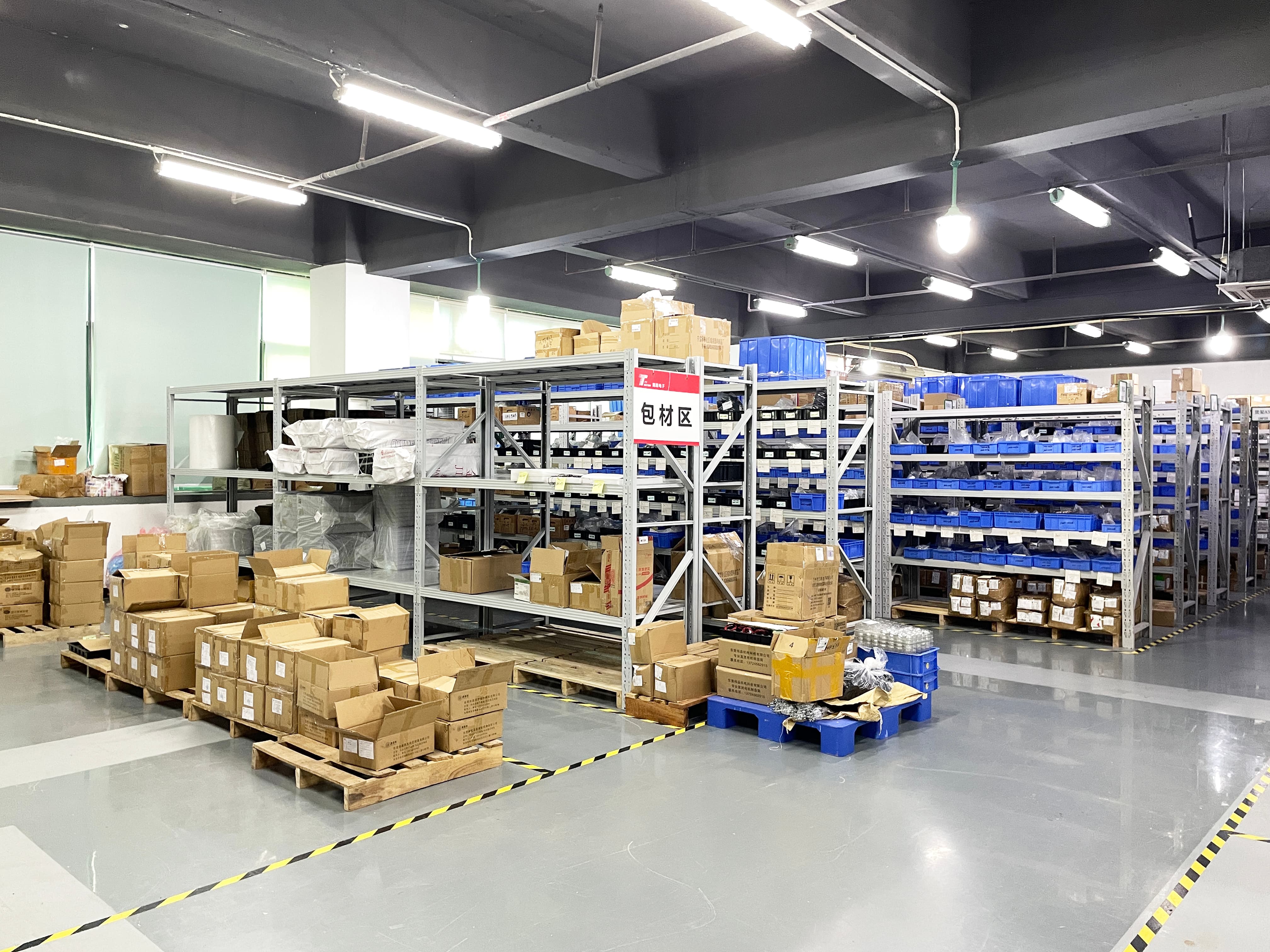
Delivery assurance closes the audit loop: documented acceptance, traceable batches and repeatable supply. Image: TT Motor (Shenzhen) Industrial Co., Limited.
Next Step: Evaluate the Supplier with Real Samples
Run the audit against actual units, not brochures. TT Motor (Shenzhen) Industrial Co., Limited supplies miniature brushless motors, brushless gear motors, coreless motors, DC gear motors and stepper motors for robotics, medical, automation and smart-home programs, serving mainly the EU and USA markets.
Request samples and a quotation: Email sales26@ttmotor.com | WhatsApp +86 180-0299-3379 | Website www.ttmotor.com
Download the product catalogue: TT Motor product brochure (PDF)
Address: 4th Floor, C Building, Huilongda Industrial Park, Shilong Community, Shiyan, Bao'an District, Shenzhen, China.
Have Questions or Need More Details?
Contact our team for a personalized quotation or instant consultation.
Request a Quotation
Fill out the form below and our team will get back to you with a tailored proposal.
WhatsApp Direct Chat
Prefer to chat in real-time? Message us on WhatsApp for instant assistance & quick answers.
- Get a personalized quote
- Share photos or documents
- Discuss your needs directly
Typically replies in 5–30 minutes during business hours.