
Brushless Planetary vs Worm Gear vs Brushed DC Gear for Low-Speed Positioning
Choosing a gear motor for low-speed positioning is not a question of which unit posts the highest peak torque. It is a question of which transmission architecture can hold a position at three to thirty revolutions per minute without creeping, jittering, or drifting over hundreds of thousands of cycles.
Three real options from the TT Motor catalogue sit at the centre of that decision. This article compares them on verified specification, not on marketing description:
- GMP36-TEC3650 — a brushless planetary gear motor with a rated torque of 30.0 kg·cm maximum
- TWG3246-TEC2430 — a brushless worm gear motor with a rated torque of 8.0 kg·cm maximum
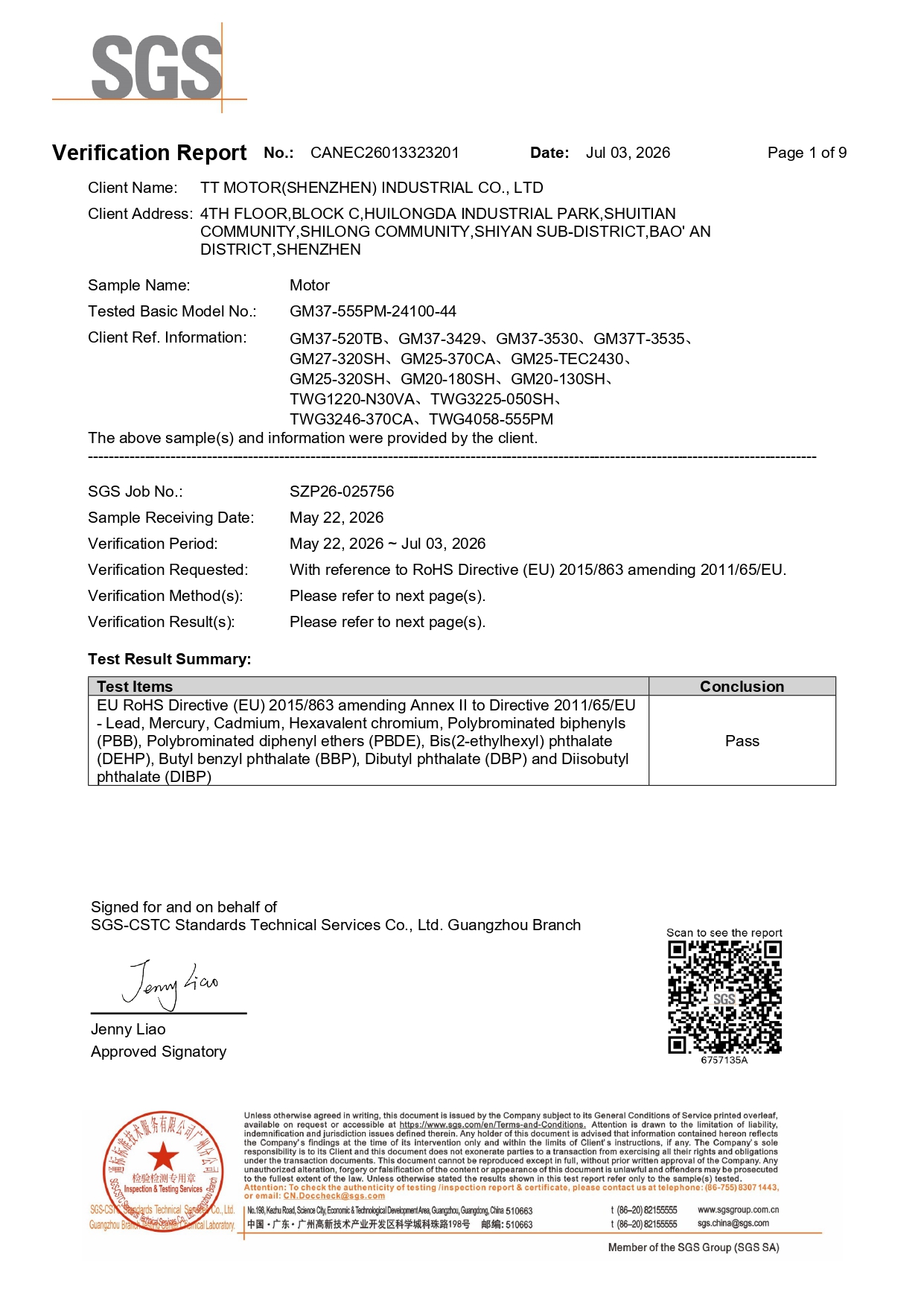
- GM37-555PM — a brushed DC spur gear motor with a rated torque of 8.0 kg·cm maximum
The torque gap is the headline: the brushless planetary unit delivers roughly 3.75 times the rated torque ceiling of the other two. But for low-speed positioning, torque is only the first of five variables that decide whether a design will work in the field.
What Low-Speed Positioning Actually Demands
Low-speed positioning describes an output shaft that must run steadily somewhere between roughly 3 rpm and 35 rpm and then stop on a defined position. That is a different engineering problem from belt-driven conveying at several hundred rpm, and it loads the transmission in ways that a peak-torque figure does not capture.
Five requirements tighten at the same time:
- Holding torque. In most positioning mechanisms, the highest continuous load appears while the axis is stationary or nearly stationary, not while it is moving.
- Cogging and jitter. At very low speed, tooth friction and backlash stop being abstract numbers and become visible position error on the output shaft.
- Commutation quality. A brushless DC motor replaces the mechanical brush-and-commutator pair with electronic commutation. There is no sliding electrical contact, so there is no brush arcing at the commutation point. A brushed DC motor does have that contact by design, and it wears.
- Thermal duty. Low-speed, high-torque operation often means the motor sits near stall, where airflow from the rotor is minimal and heat has fewer paths out.
- Life and repeatability. A positioning axis may be asked to cycle hundreds of thousands of times, and the position accuracy must still hold at the end of that count.
The trade-off worth naming early: architectures that push torque density higher usually do it by sharing load across more gear teeth or by adding reduction stages. Both moves change the gearbox length, and length is often the constraint that decides the design before torque ever does.
Why This Choice Is a Transmission Problem, Not a Motor Problem
The global brushless DC motor market was valued at roughly USD 22.2 billion to 22.33 billion for 2025–2026, according to Grand View Research. Separately, global trade in electric motors with an output below 37.5 watts (HS code 850110) reached USD 16.3 billion in 2024, per OEC data. Both figures describe a large and still-expanding base of small motors being pushed into ever tighter enclosures.
The demand for low-speed positioning, however, does not come from the motor market itself. It comes from the equipment being built around it:
- Robotic joints that must hold an end-effector steady while an external disturbance pushes against it.
- Medical devices — pumps, dosing mechanisms, adjustment axes — that run for long periods and must stay quiet and vibration-free.
- Automation equipment whose sorting and transfer mechanisms start and stop hundreds of times per shift.
All three share a structural property: the motor rarely spends its life at rated speed. It spends it in the low-speed band. Transmission architecture differences that are invisible at 1,000 rpm become dominant at 5 rpm, because backlash, tooth contact ratio, and reduction-stage count all scale their effect inversely with output speed.
TT Motor (Shenzhen) Industrial Co., Limited, a miniature motor manufacturer established in 2006, builds all three of the units compared below. The company operates a 9,000 m² manufacturing area with more than 300 employees, an annual output of 8,000,000 pieces, a monthly production capacity of 800,000 pieces, and an R&D team of 35 engineers. Around 70% of production is exported, with the EU and US as the main markets.
Three Candidate Architectures, Compared on Verified Specification
Option 1: GMP36-TEC3650 — Brushless Planetary Gear Motor
A planetary gearbox distributes load across several planet gears meshing with a central sun gear and an outer ring. Because the load is shared, the same envelope can carry more torque than a single-mesh spur train of comparable size. The GMP36-TEC3650 turns that into a 30.0 kg·cm rated torque ceiling — the highest of the three units here.
GMP36-TEC3650 — verified specification
- Product type: Brushless Planetary Gear Motor
- Module: 0.5
- Rated torque: 30.0 kg·cm (max)
- Number of gear stages: 1 / 2 / 3 / 4
- Gearbox length: 26 / 33.5 / 40.5 / 47.5 mm
- Speed range: 4–1600 rpm
- Rated voltage: DC 12V–24V
- Material: stainless steel, copper, iron
- Applicable industry: robots, medical devices, industrial automation equipment, intelligent logistics equipment
Two numbers define where this unit fits. The 4 rpm lower bound puts it squarely inside the low-speed positioning band, and the 30.0 kg·cm ceiling means it can hold that position against a load the other two cannot carry. The cost is physical: gearbox length reaches 47.5 mm at four stages, and a planetary train with that much reduction needs more axial space than a spur equivalent.
The brushless architecture also removes the brush contact entirely. For a positioning axis that cycles continuously, that means no brush wear as a life-limiting mechanism and no arcing at the commutation point — both of which matter in medical and clean-environment equipment.
Option 2: TWG3246-TEC2430 — Brushless Worm Gear Motor
A worm gearbox turns the drive axis 90 degrees relative to the output shaft. In equipment where the motor cannot sit in line with the axis being driven, that geometry alone can decide the selection.
TWG3246-TEC2430 — verified specification
- Product type: DC Brushless Worm Gear Motor
- Module: 0.5 / 0.6
- Rated torque: 8.0 kg·cm (max)
- Number of gear stages: 3 / 4 / 5
- Gearbox length: 46 mm
- Speed range: 3–35 rpm
- Rated voltage: DC 12V–24V
- Material: stainless steel, iron, copper
- Applicable industry: miniature medical devices, precision automated instruments, electrically adjustable supports
The 3 rpm lower bound is the lowest of the three units, and the 35 rpm ceiling is the most tightly bounded. This is not a general-purpose motor that happens to run slowly; it is a motor designed to live in the low-speed band and nowhere else. That narrowness is the point for applications like miniature medical devices and electrically adjustable supports, where the axis moves slowly, deliberately, and in a controlled envelope.
One engineering detail deserves attention during selection: on a worm drive, the lead angle of the worm relative to the gear determines whether the transmission can be back-driven from the output side. Whether that behaviour is desirable depends entirely on the mechanism — an axis that must be free to be pushed by hand needs a different answer from one that must resist it. For the TWG3246-TEC2430, confirm the specific back-driving behaviour required for your mechanism with the supplier at the design stage, because it is a function of the chosen reduction configuration rather than a single fixed property of the series.
The brushless commutation carries over from the planetary unit: no brush contact, no arcing, and no carbon dust accumulating inside the gearbox over the service life.
Option 3: GM37-555PM — Brushed DC Spur Gear Motor
The brushed DC spur gear motor is the architecture most designs reach for first, because it is the simplest to integrate and the most widely understood.
GM37-555PM — verified specification
- Product type: DC Brush Spur Gear Motor
- Module: 0.5 / 0.6
- Rated torque: 8.0 kg·cm (max)
- Number of gear stages: 2 / 3 / 4 / 5 / 6
- Gearbox length: 19 / 21.5 / 24 / 26.5 / 29 mm
- Speed range: 5–800 rpm
- Rated voltage: DC 12V–24V
- Material: stainless steel, iron, copper
- Applicable industry: smart home, automated equipment, automated production line
The 800 rpm upper bound tells you this unit is not confined to positioning duty — it can serve as a general drive motor that also happens to run slowly when required. Up to six spur gear stages fit into a 29 mm gearbox, making it the most compact of the three in axial length. For a mini gear motor with a space-constrained mounting envelope, that difference is often worth more than a torque margin the application does not need.
The trade-off is inherent to brushed commutation. At low speed and continuous duty, the brush-to-commutator contact is a wearing interface, and it produces electrical noise at the commutation point. In applications where the axis runs for years without service, or where conducted and radiated emissions are tightly constrained, that becomes a design risk rather than a detail.
Step-by-Step Selection Framework for Low-Speed Positioning
The sequence below is ordered so that each step can eliminate an option before the next, more expensive evaluation begins.
- Define holding torque first, motion torque second. Measure or calculate the load the axis must resist while stationary, add your safety margin, then compare against the 30.0 kg·cm, 8.0 kg·cm, and 8.0 kg·cm ceilings. If holding torque exceeds 8.0 kg·cm, the planetary unit is the only one of the three that qualifies.
- Treat minimum speed as a hard gate. If the required output speed is below 5 rpm, the GM37-555PM’s 5 rpm floor disqualifies it outright. If the required speed is below 4 rpm, only the worm gear unit qualifies.
- Decide whether commutation method matters to the system. If the equipment is sensitive to conducted emissions, carbon dust, or brush replacement over the service interval, both brushless units move ahead of the brushed option on architecture alone.
- Check the geometry, not just the volume. The worm gear motor’s output is offset 90 degrees from the input; a planetary or spur unit is in line. A motor that fits the volume but not the mounting orientation is not a fit.
- Confirm gearbox length against the actual stage count you need. Planetary: 26 / 33.5 / 40.5 / 47.5 mm. Spur: 19 / 21.5 / 24 / 26.5 / 29 mm. Worm: 46 mm fixed.
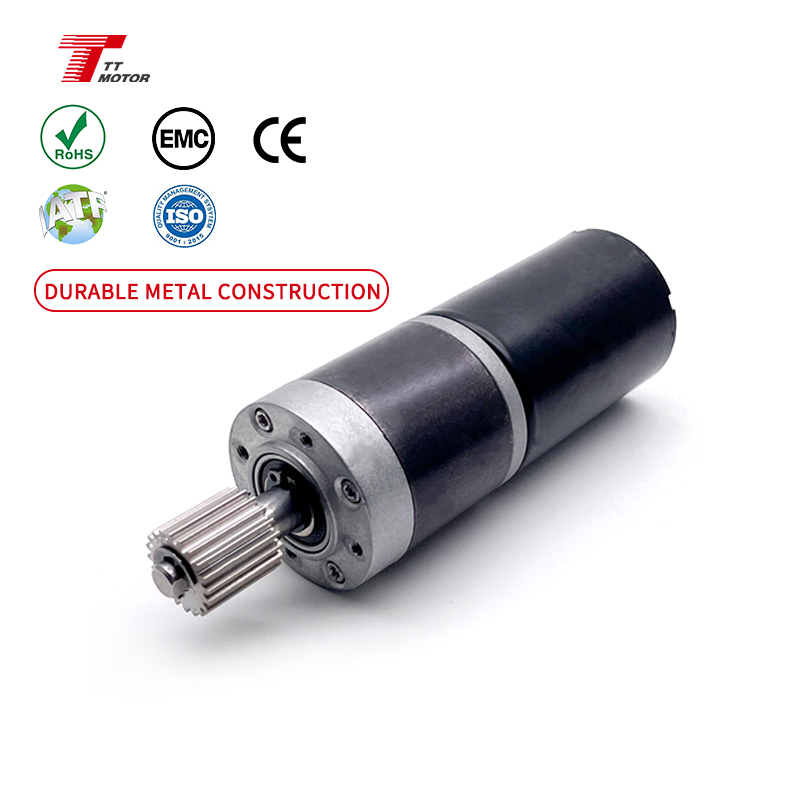
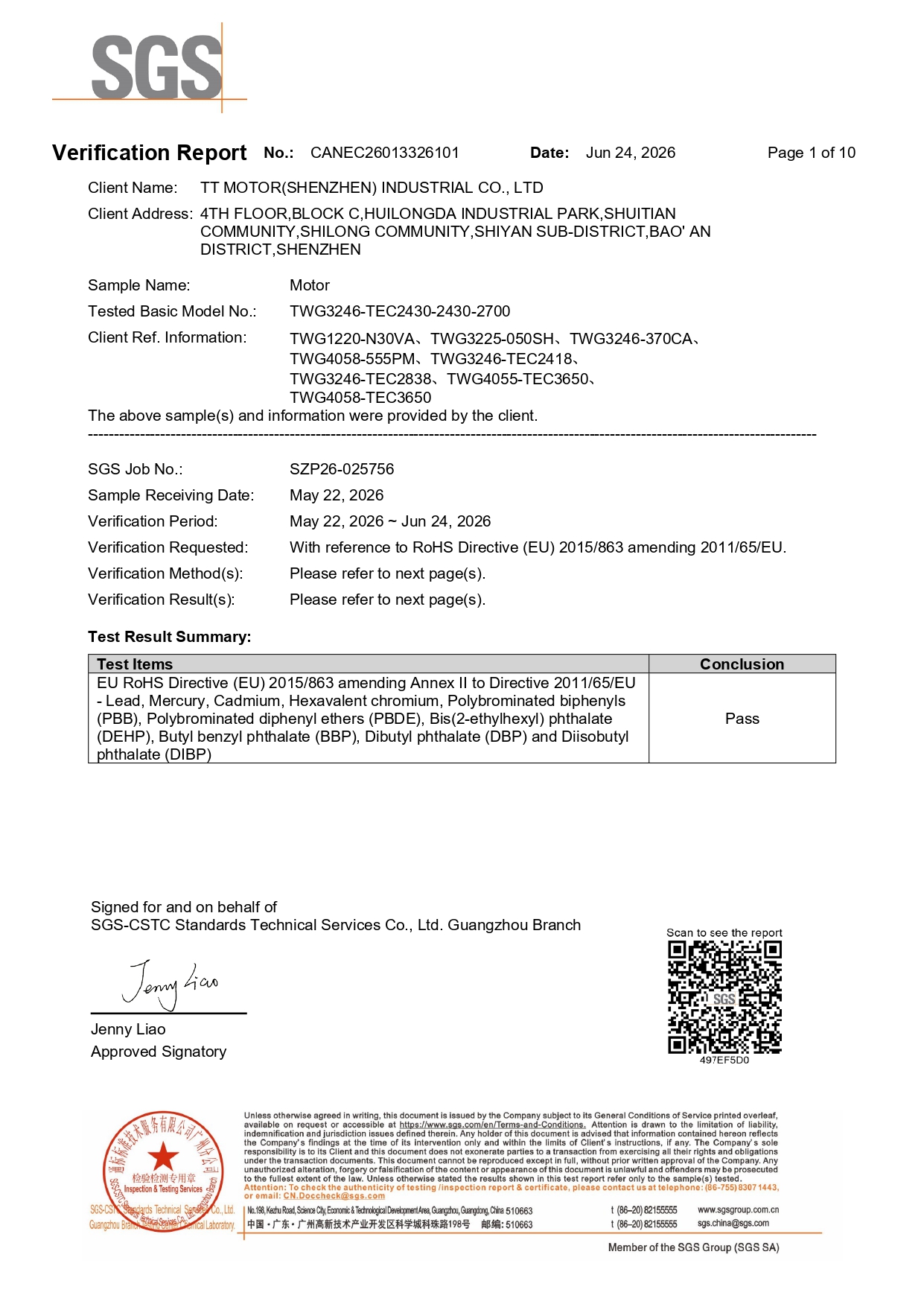
- Verify compliance documentation against the target market. All three models are covered by RoHS compliance testing carried out by SGS with reference to RoHS Directive (EU) 2015/863.
- Validate on a sample before committing to tooling or a production schedule. Rated torque and rated speed are specification values; the behaviour of your specific load, gear ratio, and mounting has to be measured.
Application Fit: Robotics, Medical Devices, and Automation
TT Motor’s field data gives a clearer picture of where each architecture has already proven itself than any specification table can.
Logistics and automation equipment. A US logistics equipment company has used the GMP36-TEC3650 and the GM37-555PM in conveyor and sorting mechanisms, in a project running three years or more and covering 1,000 units. The reported outcome was stable operation under frequent start-stop and load changes, with fast start-stop response, high torque, and good durability cited as the deciding characteristics. This is the case that most directly exercises the planetary unit’s 30.0 kg·cm headroom — repeated start-stop against a load is precisely where a torque ceiling below the requirement shows up as missed steps.
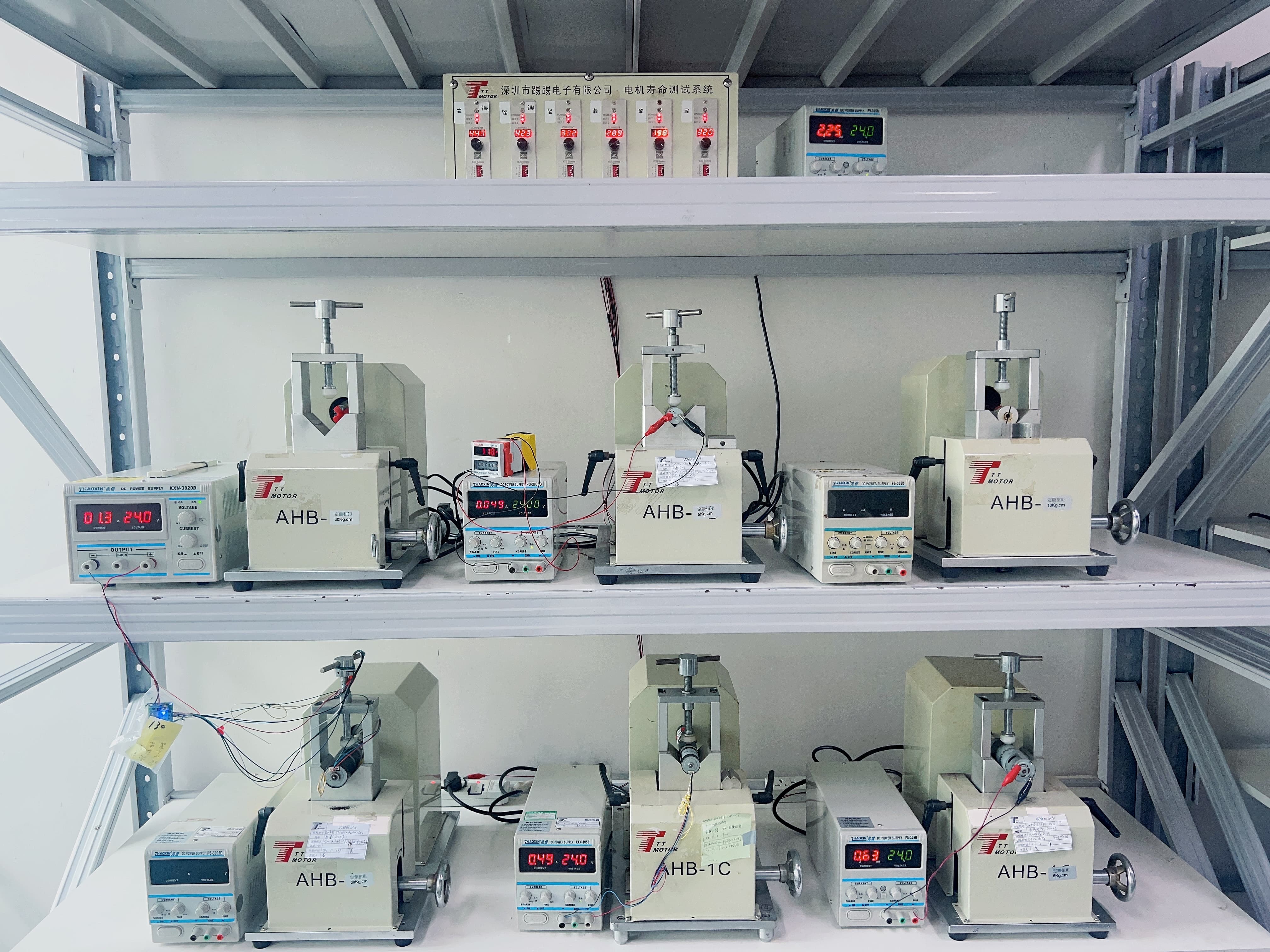
Medical devices. A UK medical device manufacturer has used the GMP36-TEC3650 in a pump application since a project running three years or more, at a scale of 500 to 2,000 units per year. The result reported was stable output under long-term operating conditions with reduced maintenance frequency, on the strength of low noise, low vibration, and long lifespan. The brushed unit’s wearing interface is the reason this class of application tends toward brushless: for a device that runs continuously, eliminating the brush removes a scheduled maintenance event.
Medical and precision instruments at very low speed. The TWG3246-TEC2430 appears in TT Motor’s smart lock reference work, where a US smart lock manufacturer has run 5,000 to 50,000 units per year for five years or more, with small size, high torque, and low noise listed as the key characteristics. The same architecture family serves miniature medical devices, precision automated instruments, and electrically adjustable supports — applications where the axis moves slowly, quietly, and in a fixed geometric relationship to the drive.
Robotics. The GMP36-TEC3650 is listed for robots, medical devices, industrial automation equipment, and intelligent logistics equipment. Robot joints need exactly the combination the planetary brushless unit offers: enough continuous torque to hold a pose, a speed floor low enough for fine positioning, and no brush wear to degrade repeatability over a long cycle count.
Side-by-Side Comparison
| Parameter | GMP36-TEC3650 | TWG3246-TEC2430 | GM37-555PM |
|---|---|---|---|
| Product type | Brushless Planetary Gear Motor | DC Brushless Worm Gear Motor | DC Brush Spur Gear Motor |
| Commutation | Brushless (electronic, no brush contact) | Brushless (electronic, no brush contact) | Brushed (mechanical brush contact) |
| Rated torque (max) | 30.0 kg·cm | 8.0 kg·cm | 8.0 kg·cm |
| Speed range | 4–1600 rpm | 3–35 rpm | 5–800 rpm |
| Rated voltage | DC 12V–24V | DC 12V–24V | DC 12V–24V |
| Gear stages | 1 / 2 / 3 / 4 | 3 / 4 / 5 | 2 / 3 / 4 / 5 / 6 |
| Gearbox length | 26 / 33.5 / 40.5 / 47.5 mm | 46 mm | 19 / 21.5 / 24 / 26.5 / 29 mm |
| Module | 0.5 | 0.5 / 0.6 | 0.5 / 0.6 |
| Material | Stainless steel, copper, iron | Stainless steel, iron, copper | Stainless steel, iron, copper |
| Stated applicable industry | Robots, medical devices, industrial automation equipment, intelligent logistics equipment | Miniature medical devices, precision automated instruments, electrically adjustable supports | Smart home, automated equipment, automated production line |
| RoHS compliance test | CANEC26013325501 (SGS) | CANEC26013326101 (SGS) | CANEC26013325001 (SGS) |
The table makes the shape of the decision visible. The worm unit owns the lowest speed floor. The spur unit owns the shortest gearbox. The planetary unit owns the torque ceiling and the widest usable speed span. No single column wins everything, which is why the selection framework above puts torque and minimum speed ahead of every other criterion.
Compliance, Capacity, and Supply Context
All three models are covered by RoHS compliance testing performed by SGS with reference to RoHS Directive (EU) 2015/863 amending 2011/65/EU, with report numbers shown in the comparison table above. TT Motor’s quality management system is certified to GB/T 19001-2016 / ISO 9001:2015 by DCI under certificate F02926Q00865R402, covering the R&D and manufacture of micromotors (DC gear motor, DC brushless motor), with a validity period from 21 August 2026 to 21 August 2029.
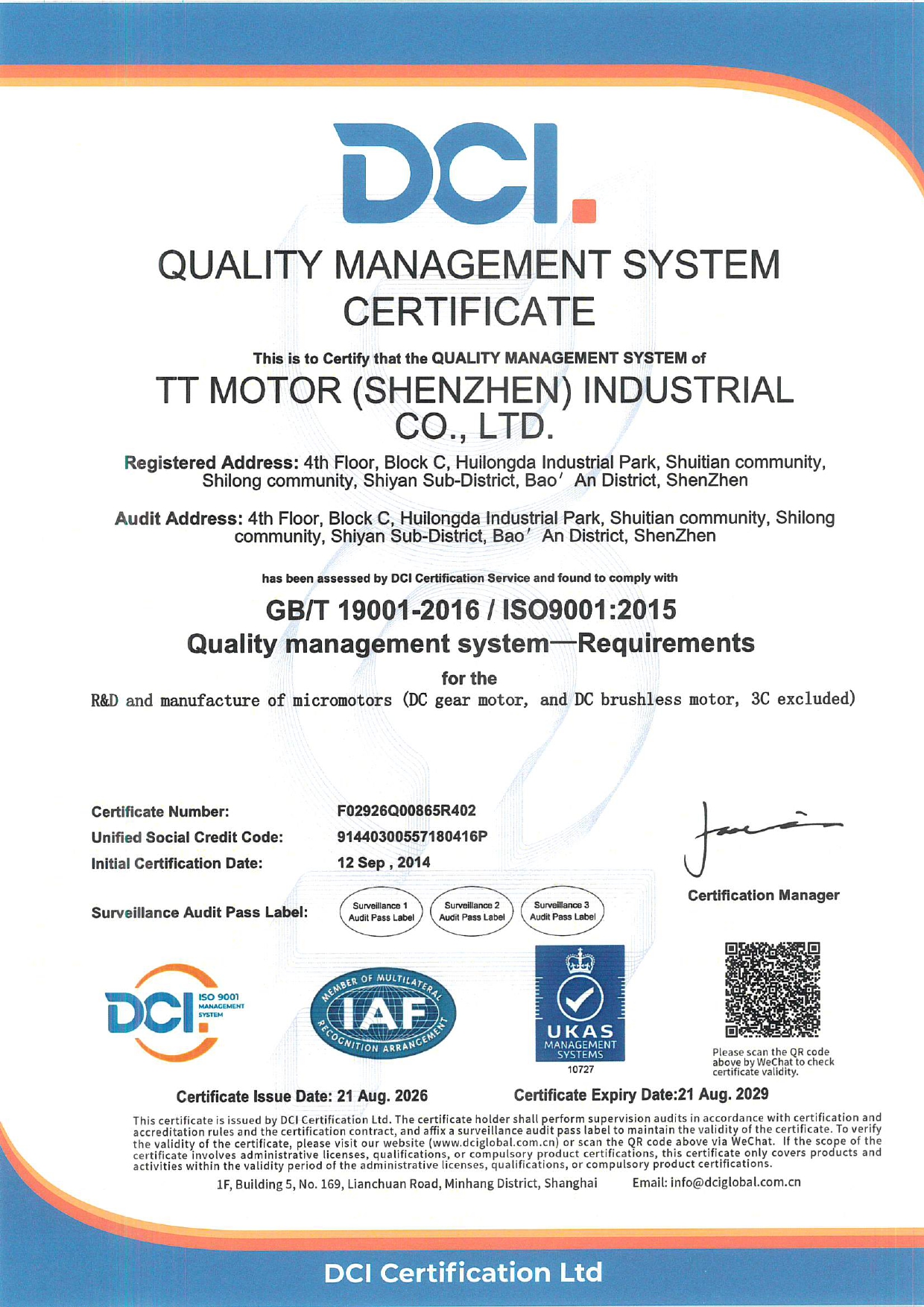
On supply, the manufacturer’s stated monthly production capacity is 800,000 pieces, with a minimum order quantity of 2 pieces. Customization options across the range include shaft, encoder, gearbox, voltage, logo, and speed. Quality control is stated as 100% test, and after-sales technical support is provided remotely. Products are exported to the EU, US, and East Asia markets.
For evaluators comparing a brushless motor path against a brushed one, that combination matters for a practical reason: choosing brushless is not only a performance decision, it changes the compliance and service story. RoHS documentation, ISO-certified manufacturing, and the removal of a wearing brush interface all point the same direction for equipment that must run for years in a regulated market.
Frequently Asked Questions
Are all three of these gear motors RoHS compliant?
Yes. GMP36-TEC3650, TWG3246-TEC2430, and GM37-555PM are each covered by separately issued RoHS compliance test reports from SGS, made with reference to RoHS Directive (EU) 2015/863 amending 2011/65/EU. The report numbers are CANEC26013325501 for the GMP36-TEC3650, CANEC26013326101 for the TWG3246-TEC2430, and CANEC26013325001 for the GM37-555PM. TT Motor’s manufacturing system is additionally certified to ISO 9001:2015 under certificate F02926Q00865R402.
Can a brushless gear motor deliver more torque than a brushed one at low speed?
In this specific comparison, yes, and the margin is large. The brushless planetary GMP36-TEC3650 is rated to 30.0 kg·cm maximum, while the brushed spur GM37-555PM and the brushless worm TWG3246-TEC2430 are both rated to 8.0 kg·cm maximum. The advantage comes from the planetary gear train, which spreads load across multiple planet gears rather than a single mesh. The brushed unit compensates in a different dimension: at 19 to 29 mm, its gearbox is the shortest of the three.
What drives the cost of a customized low-speed gear motor?
Customization across this range covers shaft, encoder, gearbox, voltage, logo, and speed. Each of those changes scope in a different way: a shaft or gearbox change touches mechanical tooling and machining, an encoder addition changes the assembly and wiring content, and a voltage or speed change affects winding and gear-ratio configuration. Because these factors move independently, cost should be quoted against a defined configuration rather than estimated from the base model. TT Motor’s minimum order quantity is stated as 2 pieces, so an initial configured build does not require a full production commitment.
Can I test a sample before placing a bulk order?
Yes. TT Motor supplies samples before bulk production, which is the appropriate way to validate a low-speed positioning choice against your actual load, gear ratio, and mounting geometry. Rated torque and rated speed are specification values measured under defined conditions, so a sample build is what confirms whether the 30.0 kg·cm planetary unit, the 3–35 rpm worm unit, or the 8.0 kg·cm brushed spur unit behaves as your mechanism needs it to.
What are the sample and bulk production lead times?
Standard delivery time is 15–25 days for samples and 30–45 days for bulk orders. Because sample lead time is short relative to typical product development cycles, the sample stage can run in parallel with enclosure and control design rather than blocking it. For teams evaluating brushless planetary versus worm gear versus brushed DC gear for a positioning axis, starting the sample request early is usually the fastest route to a final architecture decision.
Conclusion
Low-speed positioning narrows the field quickly when it is treated as a transmission question rather than a motor question. The GMP36-TEC3650 brushless planetary gear motor wins on torque and on usable speed span, holding 30.0 kg·cm from 4 rpm upward. The TWG3246-TEC2430 brushless worm gear motor wins on the lowest speed floor, at 3 rpm, and on the 90-degree mounting geometry its architecture provides. The GM37-555PM brushed DC spur gear motor wins on compactness, with gearbox lengths from 19 mm to 29 mm, and offers an 800 rpm ceiling that makes it a general drive unit as well as a slow one.
The brushless pair share one property that the brushed unit structurally cannot: electronic commutation means no brush contact, so there is no arcing at the commutation point and no carbon wear interface inside the drivetrain. For a positioning axis that cycles continuously in medical, robotics, or automation equipment, that is often the deciding factor — more so than a torque difference the application may never use.
Start with holding torque, gate on minimum speed, then check gearbox length and mounting orientation. Those four steps resolve most low-speed positioning selections before a sample is ever ordered.
Ready to Validate Your Positioning Axis?
Request a sample of the GMP36-TEC3650, TWG3246-TEC2430, or GM37-555PM and test it against your actual load and gear ratio. TT Motor supports shaft, encoder, gearbox, voltage, logo, and speed customization, with a minimum order quantity of 2 pieces, remote after-sales technical support, and full RoHS and ISO 9001:2015 documentation.
Website: www.ttmotor.com

Have Questions or Need More Details?
Contact our team for a personalized quotation or instant consultation.
Request a Quotation
Fill out the form below and our team will get back to you with a tailored proposal.
WhatsApp Direct Chat
Prefer to chat in real-time? Message us on WhatsApp for instant assistance & quick answers.
- Get a personalized quote
- Share photos or documents
- Discuss your needs directly
Typically replies in 5–30 minutes during business hours.