
Brushless Worm Gear Motor vs Brushed Spur Gear Motor for Intermittent Positioning
TWG3246-TEC2430 (brushless worm gear, 3–35 rpm) compared with GM37-555PM (brushed spur gear, 5–800 rpm) — both rated 8.0 kg.cm maximum at DC 12 V–24 V
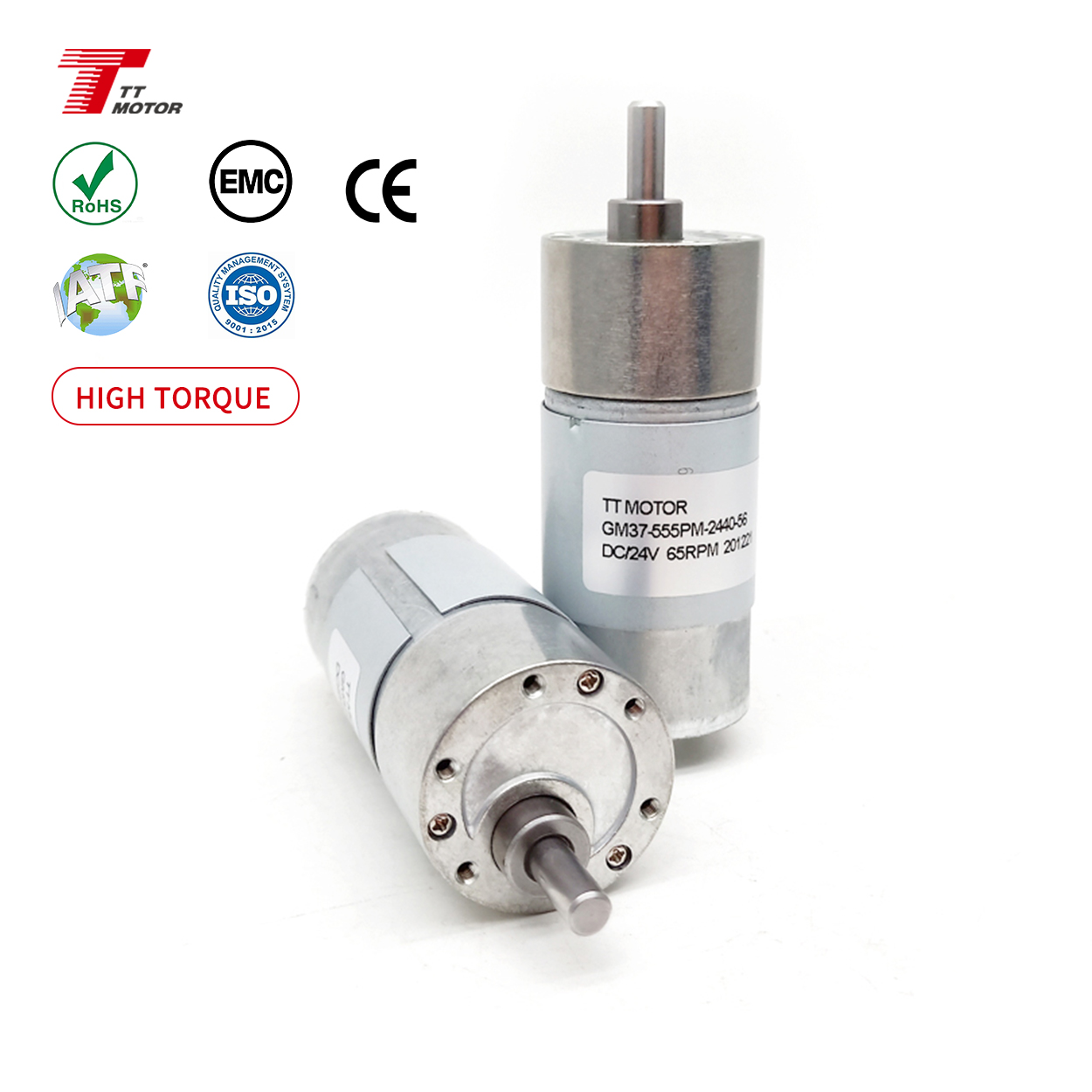
Short answer first. If a mechanism must hold a load with the drive switched off and must never spark, the brushless worm gear motor TWG3246-TEC2430 matches the duty: 3–35 rpm, 8.0 kg.cm maximum rated torque at the gearbox output, DC 12 V–24 V, and a worm gearbox with a documented self-locking function, so no additional braking device is required. If one platform must cover anything from 5 rpm to 800 rpm, or if the lowest system cost with a simple drive decides the project, the brushed spur gear motor GM37-555PM is the closer fit: the same 8.0 kg.cm ceiling and the same DC 12 V–24 V window, but 5–800 rpm, ten reduction ratios from 1/6 to 1/810, and a standard 37 mm body with 6-M2.5 flange holes.
Both motors are manufactured by TT Motor (Shenzhen) Industrial Co., Limited, a miniature DC motor manufacturer established in 2006 and headquartered in Bao'an District, Shenzhen. That detail matters during evaluation: the two candidates sit inside the same RoHS and quality-management documentation chain, so the decision rests on motion requirements, not on supplier differences.
What Intermittent Positioning Duty Actually Constrains
Intermittent positioning means the motor moves, stops, holds and moves again. TT Motor describes this duty pattern in its application data as "low-speed, intermittent, positioning operation" for both medical equipment and smart home scenarios. Five constraints follow from that pattern, and each one separates the two architectures.
- Holding at zero power. If the load must stay in place with the drive disabled, a self-locking gearbox removes the brake, its wiring and its failure mode. The TWG3246-TEC2430 is specified with a self-locking worm gearbox; the GM37-555PM datasheet documents no self-locking function.
- Repeatability at low speed. Positioning quality at 3–35 rpm depends on the number of gear stages and on stable output, not on maximum speed.
- Spark and electromagnetic interference. The TWG3246-TEC2430 is specified as spark-free in operation, designed for minimal electromagnetic interference and low operating noise. No spark or EMI specification is published for the GM37-555PM.
- Wear across many start-stop cycles. TT Motor's brushless documentation states that the brushless design removes the brush and commutator wear mechanism that exists in brushed DC motors of comparable size. A brushed motor keeps that wear mechanism.
- Mounting envelope. A right-angle worm output and an inline spur output are not interchangeable inside a housing that has already been drafted.
Industry Background: Why Both Architectures Are Still Specified
Brushless adoption is clearly expanding at the top of the market: Grand View Research sized the global brushless DC motor market at USD 22.2–22.33 billion for 2025. Miniature gear motors, however, do not appear as a separate line in such figures. Electric motors with an output below 37.5 W — HS code 850110 — represented roughly USD 16.3 billion of global trade value in 2024 according to OEC, a category that bundles N20 gear motors, 12 V gear motors, worm gear motors and many other architectures together.
The consequence for a buyer at research and evaluation stage is straightforward: market-level data cannot separate a brushless worm gear motor from a brushed spur gear motor. The separation has to be made at datasheet level — rated torque, speed band, holding behaviour, spark and EMI statements, envelope dimensions, and the compliance file attached to the exact model number. That is the level at which this comparison is written.
The Two Candidates in Detail
TWG3246-TEC2430: a brushless worm gear motor built for slow, self-holding output
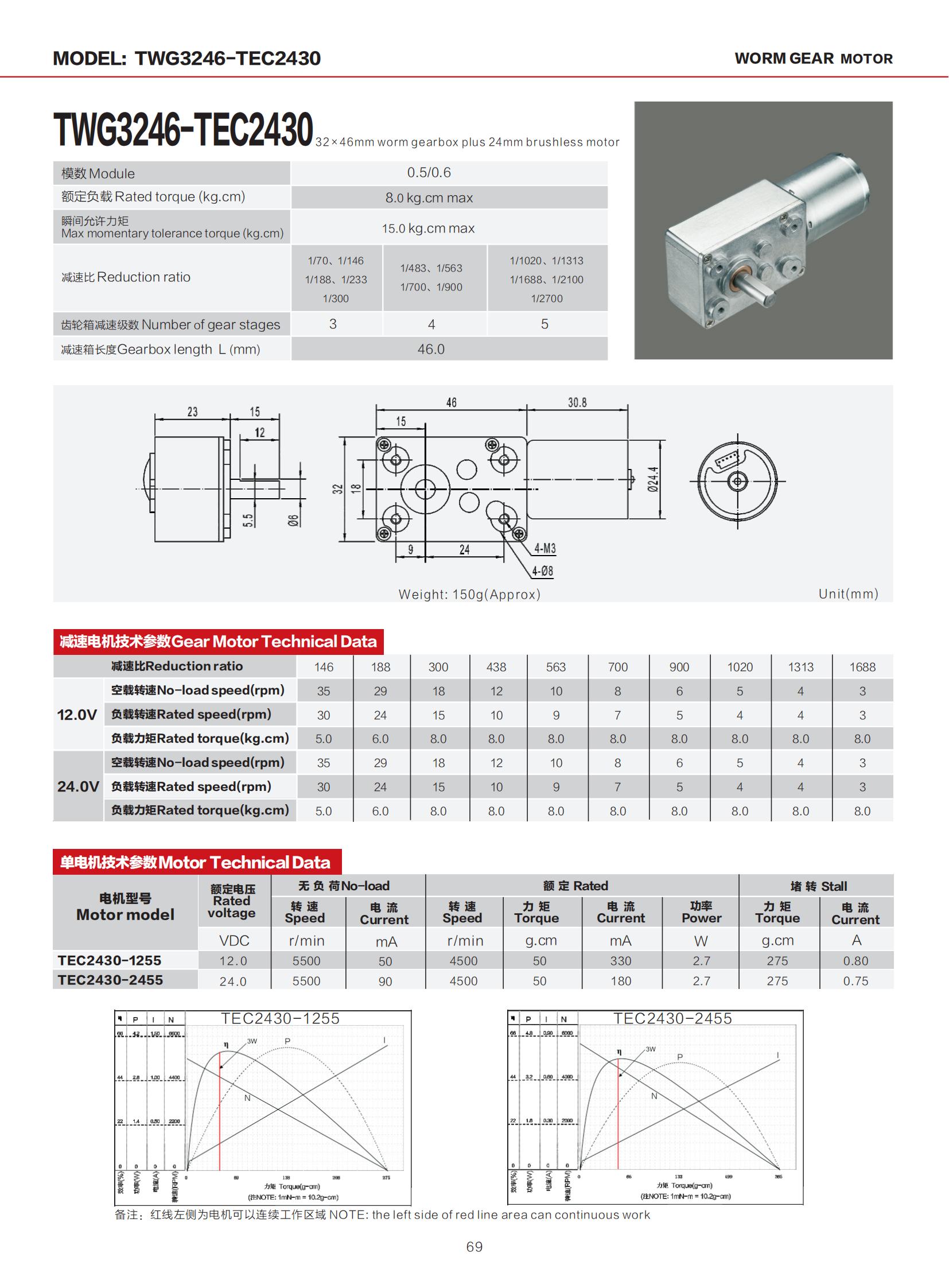
The TWG3246-TEC2430 is a DC brushless worm gear motor. Its rated voltage is DC 12 V to 24 V, its maximum rated torque is 8.0 kg.cm at the gearbox output, and its output speed range is 3 rpm to 35 rpm. The gearbox is available with 3, 4 or 5 gear stages, the gearbox length is 46 mm, which defines the mounting envelope, and the gear module is 0.5 or 0.6. Declared materials are stainless steel, iron and copper.
Three structural facts govern its behaviour in positioning duty. First, the output is right-angle through a worm gearbox, which changes how the motor body sits relative to the load. Second, the worm gearbox has a self-locking function, so no additional braking device is required. Third, the brushless construction uses electronic commutation instead of carbon brushes, so the motor does not generate sparks during operation and is designed for minimal electromagnetic interference, low operating noise, and a wear-resistant, impact-resistant mechanical structure. TT Motor lists the model for miniature medical devices, precision automated instruments and electrically adjustable supports.
GM37-555PM: a brushed spur gear motor built for range and system cost
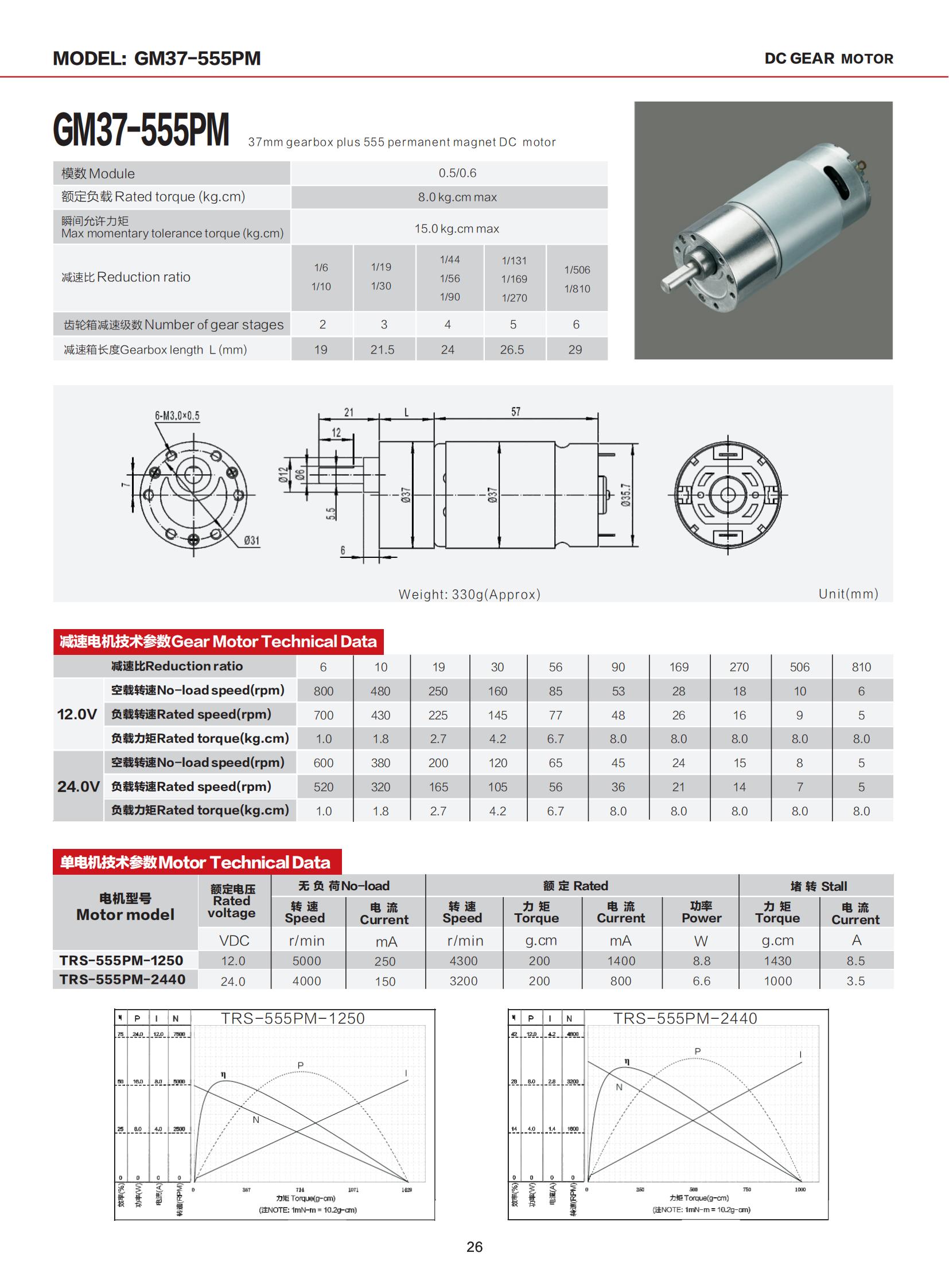
The GM37-555PM is a DC brush spur gear motor. It shares the DC 12 V to 24 V rated voltage window and the 8.0 kg.cm maximum rated torque of the worm gear motor, but its output speed range is 5 rpm to 800 rpm — roughly twenty times wider at the top end. Ten reduction ratios from 1/6 to 1/810 are available, the design supports 2 to 6 gearbox stages to achieve stable output at speeds as low as 5 rpm, and the gearbox length variants are 19 mm, 21.5 mm, 24 mm, 26.5 mm and 29 mm. The gear module is 0.5 or 0.6 and the declared materials are stainless steel, iron and copper.
The commercial side of this model is explicit in its specification: TT Motor positions it as high cost-effectiveness with a simple drive and low system cost, in a compact and lightweight body with a standard 37 mm outer diameter and 6-M2.5 flange holes for straightforward replacement and integration. Its listed applications are smart home, automated equipment and automated production lines. Unlike the worm gear model, the datasheet publishes no self-locking function, no spark statement and no EMI specification — which is precisely why holding behaviour has to be engineered separately if a spur gearbox is chosen for positioning duty.
Side-by-Side Comparison
| Parameter | TWG3246-TEC2430 | GM37-555PM |
|---|---|---|
| Motor and gearbox type | DC brushless worm gear motor | DC brush spur gear motor |
| Rated voltage | DC 12 V–24 V | DC 12 V–24 V |
| Maximum rated torque | 8.0 kg.cm at the gearbox output | 8.0 kg.cm maximum |
| Output speed range | 3–35 rpm | 5–800 rpm |
| Reduction ratios | Set by 3, 4 or 5 gear stages (ratio values not published in the datasheet) | Ten ratios from 1/6 to 1/810 |
| Gearbox length | 46 mm | 19 / 21.5 / 24 / 26.5 / 29 mm |
| Gear module | 0.5 / 0.6 | 0.5 / 0.6 |
| Declared materials | Stainless steel, iron, copper | Stainless steel, iron, copper |
| Output geometry | Right-angle worm output | Inline spur output, 37 mm outer diameter, 6-M2.5 flange holes |
| Self-locking at power-off | Documented; no additional braking device required | Not specified in the datasheet |
| Spark during operation | No sparks, per brushless construction | Not specified in the datasheet |
| EMI and noise statement | Minimal electromagnetic interference, low operating noise | Not specified in the datasheet |
| Applications listed by the manufacturer | Miniature medical devices, precision automated instruments, electrically adjustable supports | Smart home, automated equipment, automated production line |
| RoHS document (EU) | SGS CANEC26013326101, issued 2026-06-24 | SGS CANEC26013323201, issued 2026-07-03 |
Where the Two Speed Bands Overlap — and What That Means
Between 5 rpm and 35 rpm, both models meet the same 8.0 kg.cm torque ceiling on the same DC 12 V–24 V supply. Inside that band, the speed line on the datasheet stops being a differentiator, and four other criteria take over: power-off holding, spark and EMI behaviour, envelope geometry, and maintenance expectation. Below 5 rpm, only the worm gear model is specified; above 35 rpm, only the spur gear model is specified in this pair.
That overlap is the practical heart of this comparison. A urine analyzer feed axis running at 20 rpm, a smart curtain drive at 12 rpm and a height-adjustable desk column at 30 rpm all sit inside it, and each would be decided by holding and interference requirements rather than by rpm.
| Requirement signal | Default choice | Reason from the data |
|---|---|---|
| Load must hold with power off | TWG3246-TEC2430 | Self-locking worm gearbox; no separate brake required |
| Spark-free or low-EMI zone | TWG3246-TEC2430 | Spark-free operation and minimal EMI are specified; brush wear mechanism is removed |
| Output above 35 rpm, up to 800 rpm | GM37-555PM | 5–800 rpm range; the worm model stops at 35 rpm |
| One drive platform across several speeds | GM37-555PM | Ten ratios from 1/6 to 1/810, 2 to 6 gearbox stages |
| Right-angle layout, short axial stack | TWG3246-TEC2430 | Right-angle worm output in a 46 mm gearbox |
| Lowest unit and drive cost first | GM37-555PM | Specified as high cost-effectiveness with simple drive and low system cost |
Step-by-Step Selection Framework
- Write the motion profile. Record degrees or millimetres per move, moves per hour, hold duration and whether the load must be held with the drive off. Intermittent positioning duty is defined by this profile, not by a single rpm figure.
- Fix the required output speed band. If the whole range sits between 3 rpm and 35 rpm, the TWG3246-TEC2430 covers it with 3, 4 or 5 gear stages. If any operating point needs more than 35 rpm, or if one platform must serve 5 rpm and 800 rpm products, the GM37-555PM is the only candidate of the two.
- Resolve the holding question early. With the worm model, the self-locking gearbox means no additional braking device is required. With the spur model, no self-locking function is published, so plan the holding method and confirm it in the mechanism, not on paper.
- Screen spark and EMI constraints. Equipment with open fluid handling, sensitive analogue front ends or adjacent sensors should start from the spark-free, low-EMI specified model and only move away with evidence.
- Check the envelope. The worm model needs space for a 46 mm gearbox with a right-angle output; the spur model needs an inline path behind a 37 mm body with 6-M2.5 flange holes and a gearbox length between 19 mm and 29 mm.
- Compare lifetime cost instead of unit price. No price band is published in the product data for either model, so the comparison has to be built from documented behaviour: the spur model is specified for high cost-effectiveness and low system cost with a simple drive; the worm model is specified for low power consumption and ultra-long lifespan, and its brushless design removes the brush and commutator wear mechanism found in brushed motors of comparable size.
- Close the compliance and sample loop. Request the RoHS report against the exact model number, confirm the ISO9001 scope covers micromotors, then validate both candidates in the real mechanism at sample stage.
Use Cases: Medical Equipment and Smart Home
Medical equipment
TT Motor lists medical equipment as a low-speed precision motion, long-term operation scenario with low noise, low vibration and stable operation as the special requirement. The project types named in its application data include urine analyzers, body fluid analyzers, pipetting equipment, infusion syringe pumps, infusion pumps, surgical staplers, rehabilitation robots, microcrystal pens, microfluidic dispensers, blood collection robots and ultrasound equipment. Positioning axes in these devices generally need a stable slow output, a defined hold state and a predictable noise floor — the region where a self-locking brushless worm gear motor has the clearest structural advantage.
The reference case is a medical device manufacturer in the United Kingdom running 500–2,000 units per year for three years or more on a medical pump drive, with low noise, low vibration and long lifespan as the recorded highlights; the TWG3246-TEC2430 is among the models attached to that case. A Japanese dental instrument manufacturer, by contrast, runs 500–2,000 units per year for three to five years on a micro positioning mechanism where low inertia and fast response dominate — a reminder that not every medical axis is a positioning axis.
Smart home and automated equipment
Smart home work is defined in TT Motor's application data by low-speed operation in limited space, with miniaturization, low noise and low power consumption as the special requirements. The named projects include smart curtains, robot vacuum cleaners, smart toilets, smart height-adjustable desks, smart refrigerators, smart trash cans, smart pet feeders and smart camera pan-tilt units. The TWG3246-TEC2430 is attached to this scenario, and its electrically adjustable support application overlaps directly with desk and support-column designs.
The GM37-555PM sits in the adjacent, more cost-driven tier: smart home, automated equipment and automated production lines. In a US logistics equipment case, 1,000 units of the brushed gear motor family were used on conveyor and sorting mechanisms for three years or more, with stable operation under frequent start-stop and load changes as the recorded result. A US smart lock manufacturer running 5,000–50,000 units per year for five years or more also has the TWG3246-TEC2430 among its approved models — a case where small size, high torque and low noise outweighed unit price.
Compliance and Documentation for Both Models
Because this comparison sits at the constraint stage, the documents that ship with each model number matter as much as the torque figure.
- RoHS, TWG3246-TEC2430. SGS test report CANEC26013326101, issued 2026-06-24 and valid through 2099-01-01, referencing RoHS Directive (EU) 2015/863 amending 2011/65/EU. The scope covers DC gear motors including the TWG3246-TEC2430 and related series models, for the EU market.
- RoHS, GM37-555PM. SGS test report CANEC26013323201, issued 2026-07-03 and valid through 2099-01-01, covering the GM37-555PM DC gear motor and related series models, for the EU market.
- ISO9001:2015. Certificate F02926Q00865R402 issued by DCI to TT Motor, valid from 2026-08-21 to 2029-08-21 for the global market, covering R&D and manufacture of micromotors (DC gear motor, DC brushless motor), 3C excluded. It applies to both models in this comparison.
- CE scope. CE-EMC documentation is held for the GM12-N20VA series under certificate CTL2512182011-EC, certified to EN IEC 61000-6-1:2019 for immunity and EN IEC 61000-6-3:2021 for emissions. CE documentation for the two positioning motors discussed here is a scope question to confirm with the supplier before design freeze, not an assumption.
Frequently Asked Questions
Which China BLDC motor manufacturers supply CE and RoHS documentation for models like these?
Ask for model-level documents rather than company-level claims. TT Motor (Shenzhen) Industrial Co., Limited holds RoHS test reports from SGS for both models compared here — CANEC26013326101 for the TWG3246-TEC2430, issued 2026-06-24, and CANEC26013323201 for the GM37-555PM, issued 2026-07-03, both referencing RoHS Directive (EU) 2015/863 for the EU market. Its ISO9001:2015 certificate F02926Q00865R402, issued by DCI, covers R&D and manufacture of micromotors (DC gear motor, DC brushless motor), 3C excluded. CE-EMC documentation under EN IEC 61000-6-1:2019 and EN IEC 61000-6-3:2021 is held for the GM12-N20VA series, so confirm CE scope per model before you freeze the design.
Does the brushless worm gear motor hold position without a brake?
Yes, as specified. The TWG3246-TEC2430 uses a right-angle worm gearbox with a self-locking function, so no additional braking device is required. Its rated voltage is DC 12 V–24 V, maximum rated torque is 8.0 kg.cm at the gearbox output, and output speed is 3–35 rpm across 3, 4 or 5 gear stages. The GM37-555PM datasheet publishes no self-locking function, so a power-off hold requirement on the brushed spur model needs an external holding method that is verified in the mechanism.
Which of the two is cheaper to run over the project lifetime?
No price band is published in the product data for either model, so cost has to be assembled from documented behaviour. The GM37-555PM is specified for high cost-effectiveness, with a simple drive and low system cost. The TWG3246-TEC2430 is specified for low power consumption and ultra-long lifespan, and its brushless design removes the brush and commutator wear mechanism that exists in brushed motors of comparable size. Compare unit price, drive electronics, holding hardware and replacement labour together rather than unit price alone.
Can I validate both motors in my mechanism before ordering?
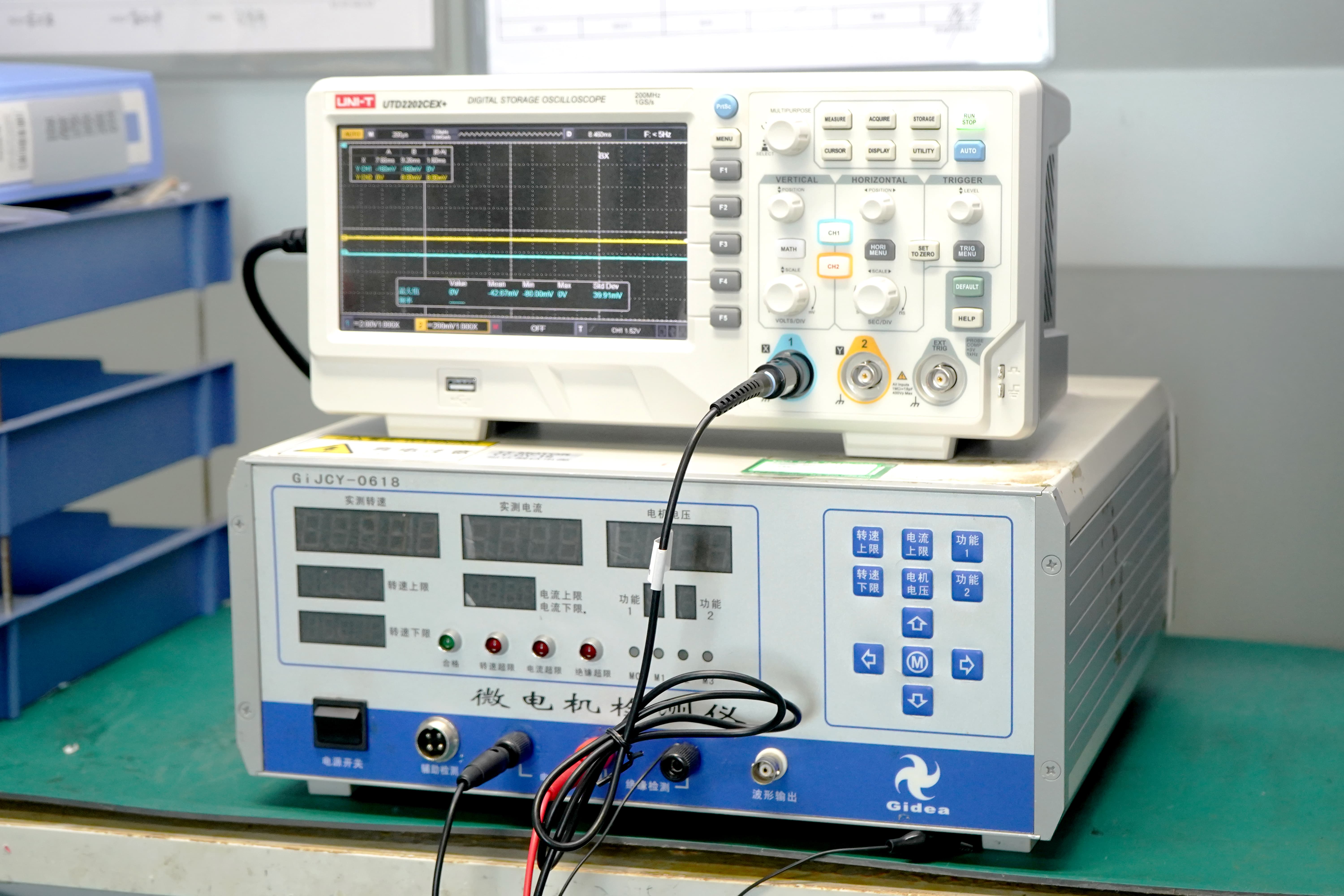
Yes. TT Motor's minimum order quantity is 2 pieces, which allows both architectures to be tested on the same fixture. Sample lead time is 15–25 days. Customization covers shaft, encoder, gearbox, voltage, logo and speed, and every unit passes 100% test before shipment, so the sample you receive represents the production configuration.
What lead time should I plan for after the sample is approved?
Bulk lead time is 30–45 days, supported by a monthly capacity of 800,000 pieces and a manufacturing area of approximately 9,000 square metres across three production plants. Remote after-sales support is provided. To start a comparison on your own mechanism, request the sample set through ttmotor.com or download the TT Motor product brochure.
Conclusion
The brushless worm gear motor and the brushed spur gear motor are not rivals so much as answers to different constraint sets. The TWG3246-TEC2430 answers the constraint set where the load must hold at power-off, sparks and interference are unacceptable, the layout is right-angle, and 3–35 rpm at 8.0 kg.cm is the whole working range. The GM37-555PM answers the set where one platform must span 5–800 rpm, the drive should stay simple and low-cost, and the holding question has another solution in the mechanism.
Both are documented to the same RoHS and ISO9001 chain, so the evaluation can stay where it belongs: on the motion profile. Send TT Motor your duty cycle, hold requirement and envelope, and request the sample pair — 2 pieces minimum, 15–25 days for samples, 30–45 days for bulk — then decide with measured behaviour instead of datasheet preference.
Contact: Sally Su · sales26@ttmotor.com · +86 180-0299-3379 · TT Motor (Shenzhen) Industrial Co., Limited, 4th Floor, C Building, Huilongda Industrial Park, Shilong Community, Shiyan, Bao'an District, Shenzhen, China.
Have Questions or Need More Details?
Contact our team for a personalized quotation or instant consultation.
Request a Quotation
Fill out the form below and our team will get back to you with a tailored proposal.
WhatsApp Direct Chat
Prefer to chat in real-time? Message us on WhatsApp for instant assistance & quick answers.
- Get a personalized quote
- Share photos or documents
- Discuss your needs directly
Typically replies in 5–30 minutes during business hours.