
Continuous vs Intermittent Duty: Ranking Gear Motors by Operating Mode
The first useful question in gear motor selection is not size or price. It is duty profile. A continuous-duty axis and an intermittent positioning mechanism place different demands on torque margin, thermal behavior, control electronics and wear. This ranking sorts four TT MOTOR gear motor models by how well their architecture and documented application evidence fit those two operating modes.
TT Motor (Shenzhen) Industrial Co., Limited is a Shenzhen-based manufacturer founded in 2006 that focuses on miniature DC motors, including brushless motors, coreless motors, gear motors and stepper motors. The ranking below is a duty-profile evaluation, not a claim that one model is universally superior. Each position reflects fit for a defined operating mode and the evidence available for that fit.
What Continuous and Intermittent Duty Mean for Gear Motor Selection
Continuous duty describes a motor that operates at a steady load long enough to reach thermal equilibrium. The design question is whether the motor can deliver the required output speed and torque without exceeding its thermal limits. Rated torque is the torque that can be continuously output under specified operating conditions. That definition matters because a short burst of higher torque does not prove continuous capability.
Intermittent duty describes a cycle with rest periods, start-stop operation, forward-reverse motion or repeated positioning. The motor may spend part of each cycle accelerating a load and part of it holding position or waiting. Peak torque and dynamic response can matter more than steady-state thermal margin, but heat still accumulates. Cycle time, load inertia, controller settings and ambient conditions all affect the result.
A 12V DC gear motor label describes voltage, not duty. Output speed is set by motor speed and gear ratio. Output torque is set by the motor winding, gearbox ratio and gearbox efficiency. For a procurement or engineering decision, the rated torque, output speed range and voltage must be confirmed for the exact configuration being purchased, not inferred from a product family name.
Ranking Criteria: Why Duty Profile Outranks Size and Price
This ranking uses five criteria: duty-mode fit, motor and gearbox architecture, documented application evidence, control requirements and verification needs. Price is intentionally excluded because the supplied facts do not include quoted prices. Size is treated as an application constraint, not a ranking score.
- Duty-mode fit: whether the model is better suited to continuous running, high-cycle start-stop, intermittent positioning or precision micro-motion.
- Architecture: brushless planetary, brushless worm, brushed DC gear or coreless gear motor. Architecture affects control, wear and mechanical layout.
- Documented evidence: real application records, service duration and related products in the supplied case material.
- Control requirement: brushless models require a compatible controller, while brushed models use simpler drive electronics.
- Verification: rated torque at the target output speed, voltage, gear ratio, backlash, noise and thermal margin.
Ranked Picks at a Glance
| Rank | Model | Type | Primary duty fit | Selection logic |
|---|---|---|---|---|
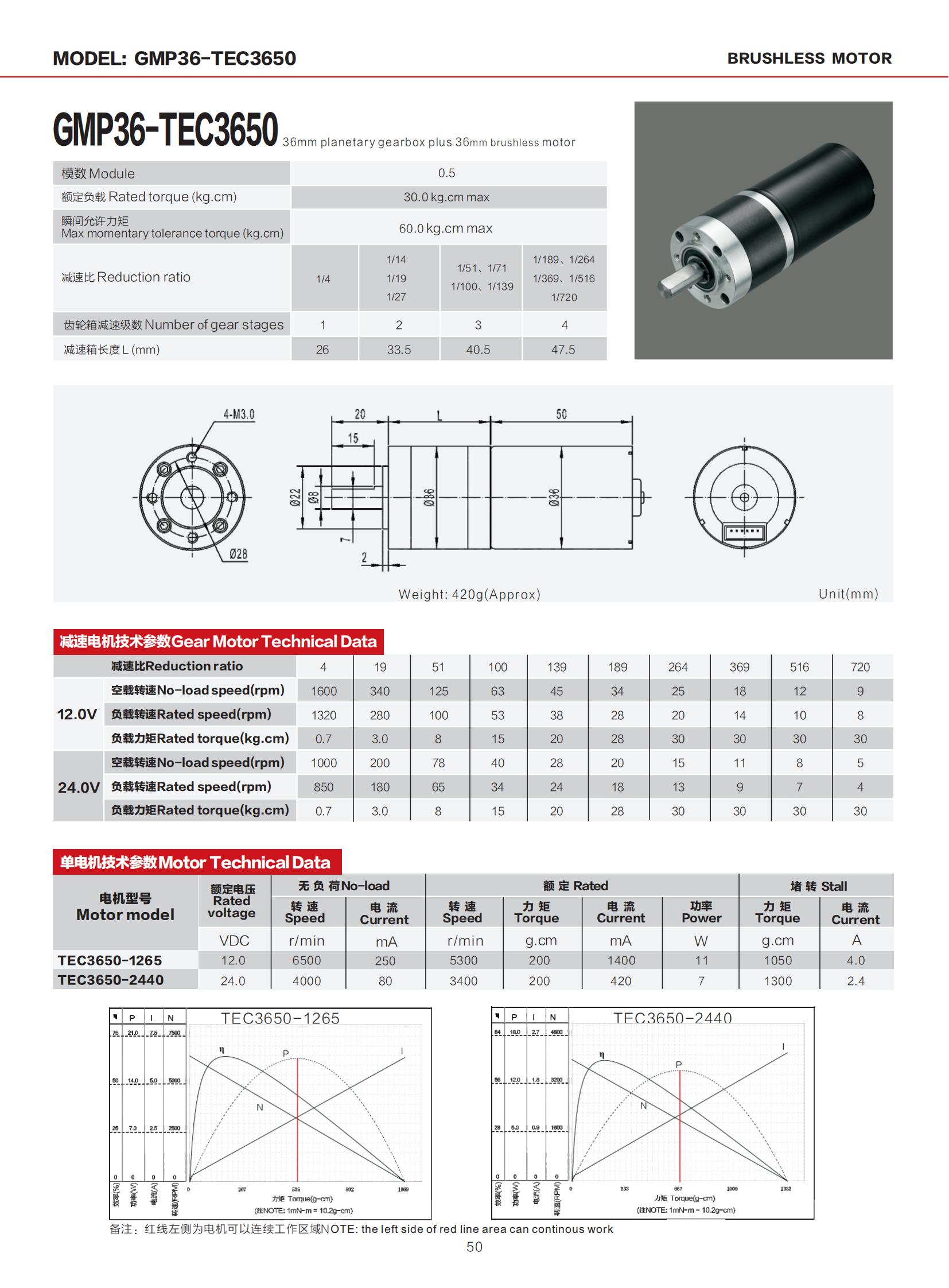
| 1 | GMP36-TEC3650 | Brushless planetary gear motor | Continuous duty and high-cycle start-stop precision | Brushless architecture, planetary reduction and logistics/medical case evidence support long-running motion with frequent start-stop and load changes. |
| 2 | TWG3246-TEC2430 | Brushless worm gear motor | Intermittent positioning in smart home and compact mechanisms | Worm-gear layout and brushless drive make it a specialist pick for intermittent positioning; confirm holding behavior and backlash for the mechanism. |
| 3 | GM37-555PM | Brushed DC gear motor | Cost-sensitive intermittent or moderate duty with a maintenance plan | Brushed drive is simple to control and has logistics case evidence, but brush and commutator wear must be checked for long continuous operation. |
| 4 | GMP12T-TDC1215 | Coreless gear motor | Precision micro-positioning with fast response | Low rotor inertia supports fast response in compact mechanisms; it has a narrower window for high-load continuous duty. |
Rank 1: GMP36-TEC3650 Brushless Planetary Gear Motor for Continuous and Start-Stop Precision
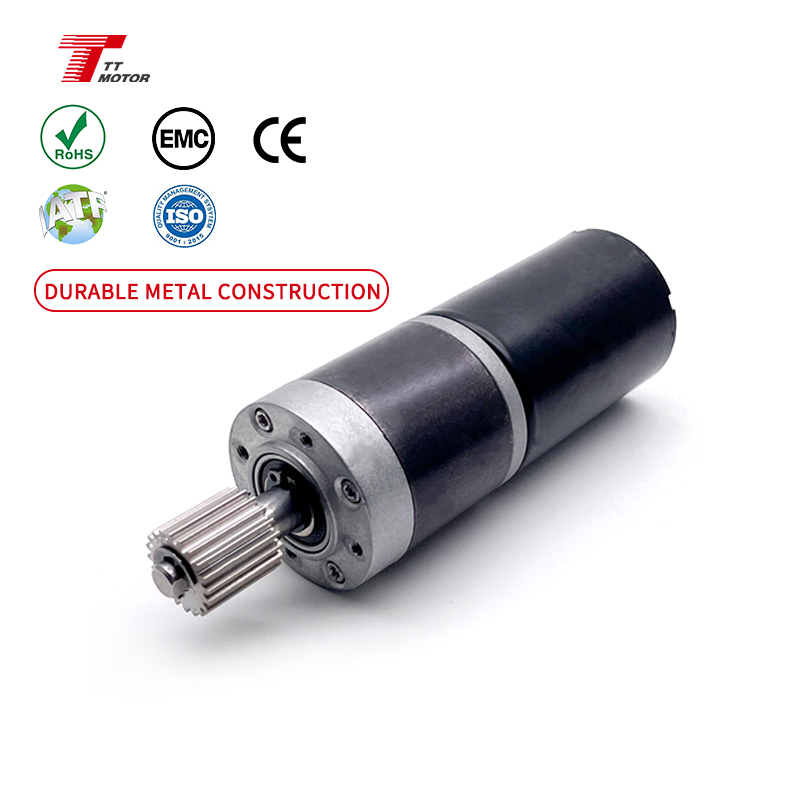
GMP36-TEC3650 is a brushless planetary gear motor. Its first-ranked position reflects the fit between brushless commutation, planetary reduction and applications that need repeated start-stop, forward-reverse or low-speed positioning. Brushless motors use electronic commutation rather than carbon brushes, so brush wear is removed from the maintenance equation. That does not remove thermal limits, bearing life or gearbox wear, but it changes the long-term continuous-duty risk profile.
The documented application evidence supports this position. A U.S. logistics equipment company used GMP36-TEC3650 in a project scaled at 1,000 units, with operation for 3 years or more, and reported stable operation under frequent start-stop and load changes. The model is also listed among related products for a UK medical pump case running 3 years or more at 500 to 2,000 units per year, where low noise, low vibration and long lifespan were relevant. Those records do not prove performance in every application, but they show the model has been used in motion profiles close to the evaluation target.
For continuous duty, start with the required output speed and rated torque at that speed. Then select the gear ratio and motor winding together. A high-torque planetary motor configuration is not created by the model name alone; it comes from a specific motor, ratio and voltage combination. Confirm the rated torque on the approved datasheet, verify the controller can supply the required current, and test temperature rise under the actual load profile. RoHS compliance testing for GMP36-TEC3650 is listed under report CANEC26013325501.
Why rank it first? It covers the widest duty window in this set: continuous running, repeated start-stop and low-speed precision motion. If the mechanism requires a right-angle worm layout or a simpler brushed drive, the next-ranked models may be more appropriate.
Rank 2: TWG3246-TEC2430 Brushless Worm Gear Motor for Intermittent Smart-Home Positioning
TWG3246-TEC2430 is a brushless worm gear motor. It ranks second overall and is the first choice when the duty is intermittent positioning in a smart-home appliance or a compact mechanism. Worm-gear architecture changes the mechanical layout and ratio options compared with an inline planetary gearbox. For intermittent positioning, the design team should verify backlash, holding behavior, repeatability and the effect of the controller on deceleration and direction changes.
The model is associated with a U.S. smart-lock case involving 5,000 to 50,000 units per year and a project duration of 5 years or more. That case record also lists GMP12T-TDC1215 and GM12-N20VA as related products. The same model appears among related products for a UK medical pump case running 3 years or more at 500 to 2,000 units per year. These records support suitability for compact positioning and pump-related mechanisms, but they do not establish a universal holding-torque or self-locking claim. Whether the mechanism depends on gearbox holding behavior or an external brake must be confirmed from the datasheet and sample test.
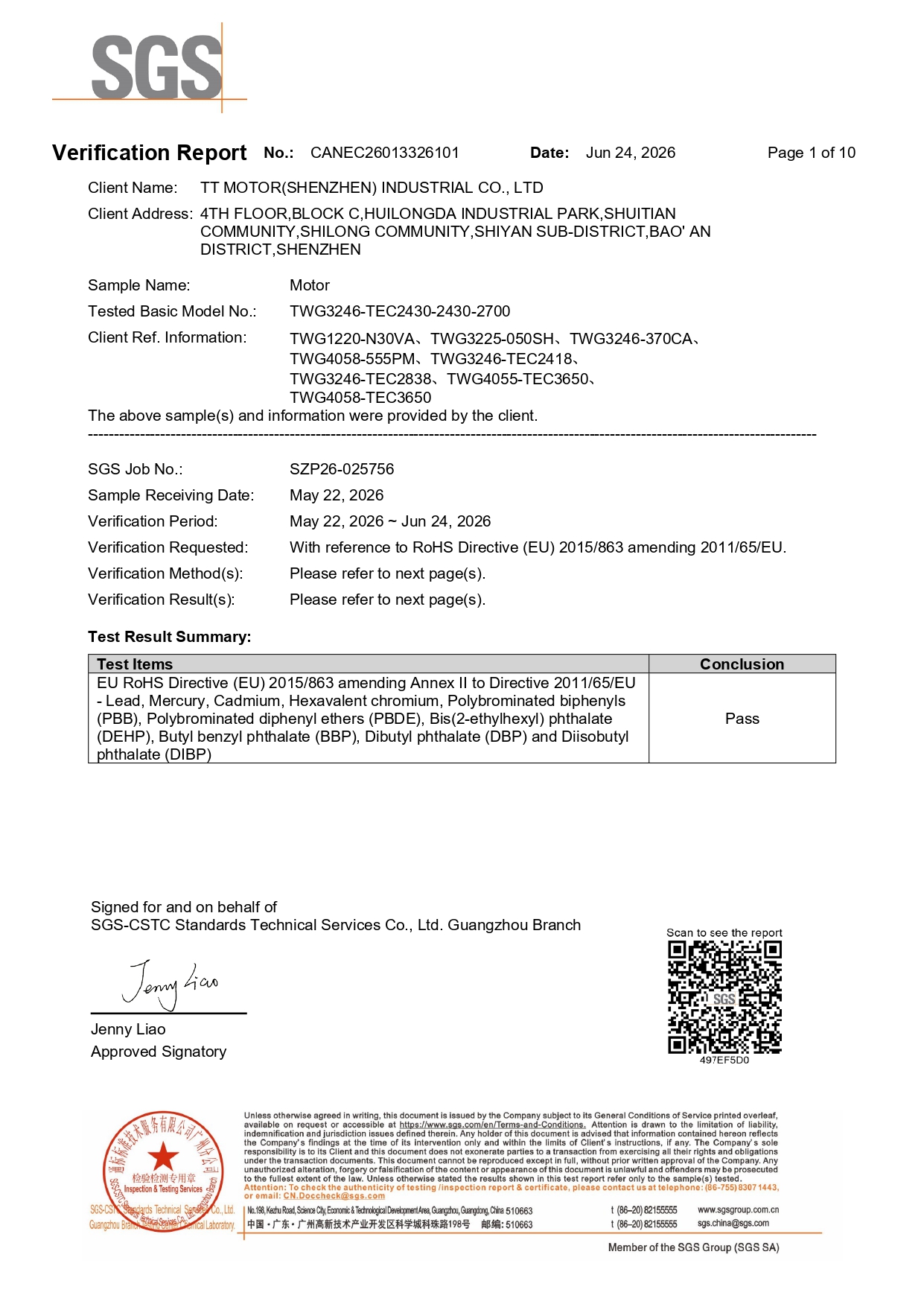
Smart-home applications commonly include low-speed, intermittent positioning in limited space, such as smart curtains, robot vacuum cleaners, smart toilets, smart height-adjustable desks, smart refrigerators, smart trash cans, smart pet feeders and smart camera pan-tilt units. For those axes, the selection question is not only rated torque. It is also noise, backlash, cycle life and the ability to return to position after repeated movement. TWG3246-TEC2430 is ranked here because its brushless worm-drive architecture aligns with that duty pattern. RoHS compliance testing is listed under report CANEC26013326101.
If the application needs long continuous running at high load, the first-ranked GMP36-TEC3650 has the stronger duty-profile fit. If the application is an intermittent smart-home positioner, TWG3246-TEC2430 should be evaluated first among the four.
Rank 3: GM37-555PM Brushed DC Gear Motor as the Cost-Sensitive Alternative
GM37-555PM is a brushed DC gear motor. It ranks third because it is a practical alternative when the drive architecture can be simpler and the duty profile or maintenance plan can accept brush wear. Brushed motors use carbon brushes and a commutator. That makes the drive electronics simpler than a brushless system, but it introduces a wear item. The cost comparison should therefore include motor price, controller cost, replacement interval and downtime, not only the unit price.
The documented logistics case is relevant. GM37-555PM was used by a U.S. logistics equipment company in a project scaled at 1,000 units, with operation for 3 years or more and stable operation under frequent start-stop and load changes. That record shows brushed DC gear motors can serve demanding motion profiles. It does not prove that every brushed motor will match a brushless motor in long continuous operation. Load, voltage, ambient temperature, duty cycle and maintenance access determine the outcome.
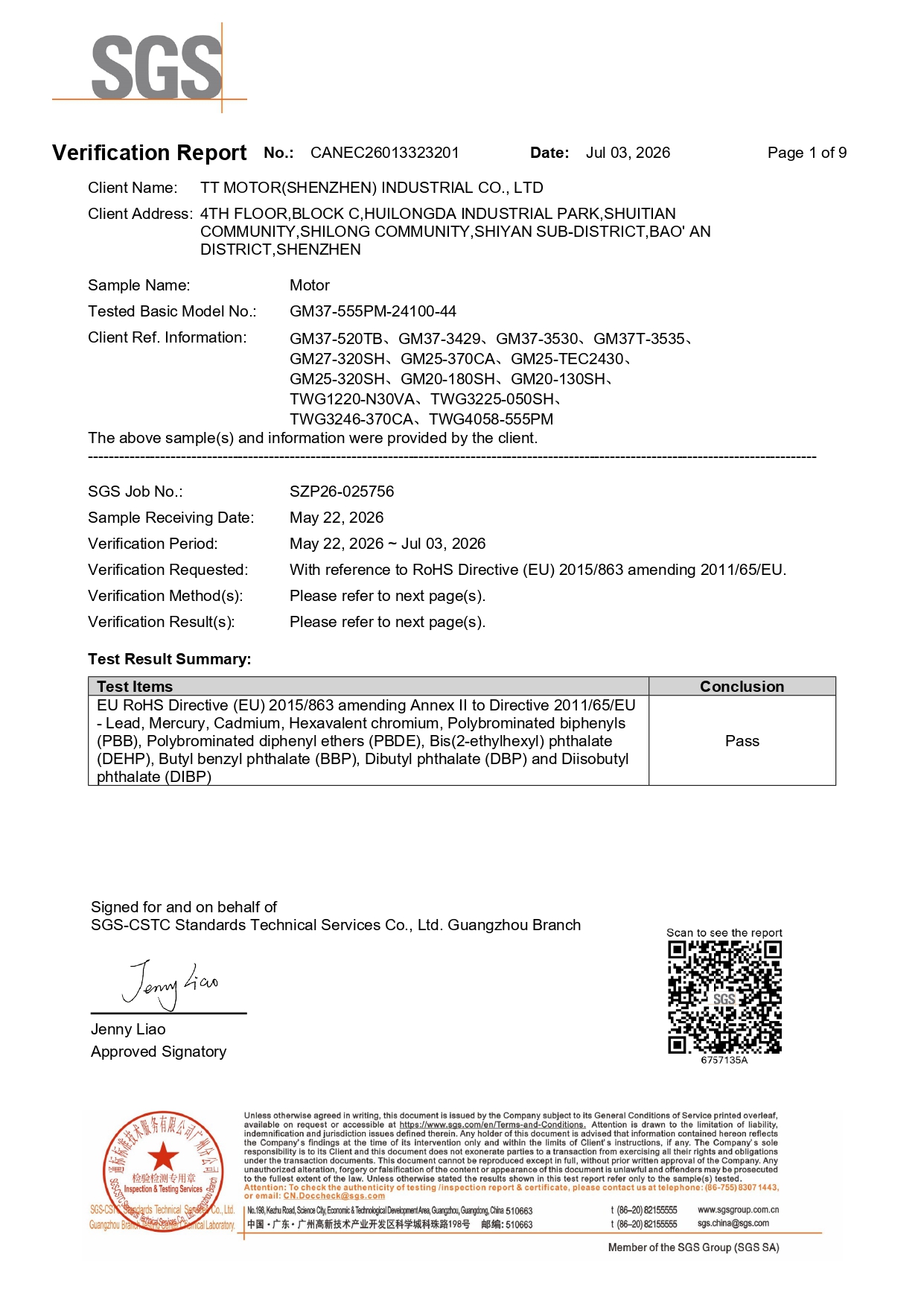
For a long-term continuous application, ask for brush life data at the intended voltage and load, and define a replacement plan if maintenance access is limited. For an intermittent application with cost pressure and easy service access, GM37-555PM remains a candidate. The key ranking distinction is not that brushed is unsuitable; it is that brush wear becomes a more important decision variable as continuous operating hours increase. RoHS compliance testing for GM37-555PM is listed under report CANEC26013323201.
Rank 4: GMP12T-TDC1215 Coreless Gear Motor for Precision Micro-Motion
GMP12T-TDC1215 is a coreless gear motor. It ranks fourth overall but is a precision alternative rather than a general-purpose continuous-duty pick. Coreless motors have a very small moment of inertia. That gives them a fast dynamic response: when the controller commands a stop, the rotor can settle more quickly than a higher-inertia rotor. This matters in compact mechanisms that need rapid start-stop, fine adjustment or frequent small movements.
A Japanese dental instrument manufacturer used GMP12T-TDC1215 at 500 to 2,000 units per year for 3 to 5 years in a micro-positioning and adjustment mechanism. The case highlights low inertia, fast response and high power density. The model is also listed among related products for the U.S. smart-lock case and the UK medical pump case. These records support its use in precision mechanisms, but they do not make it a high-torque continuous-duty substitute for the first-ranked GMP36-TEC3650.
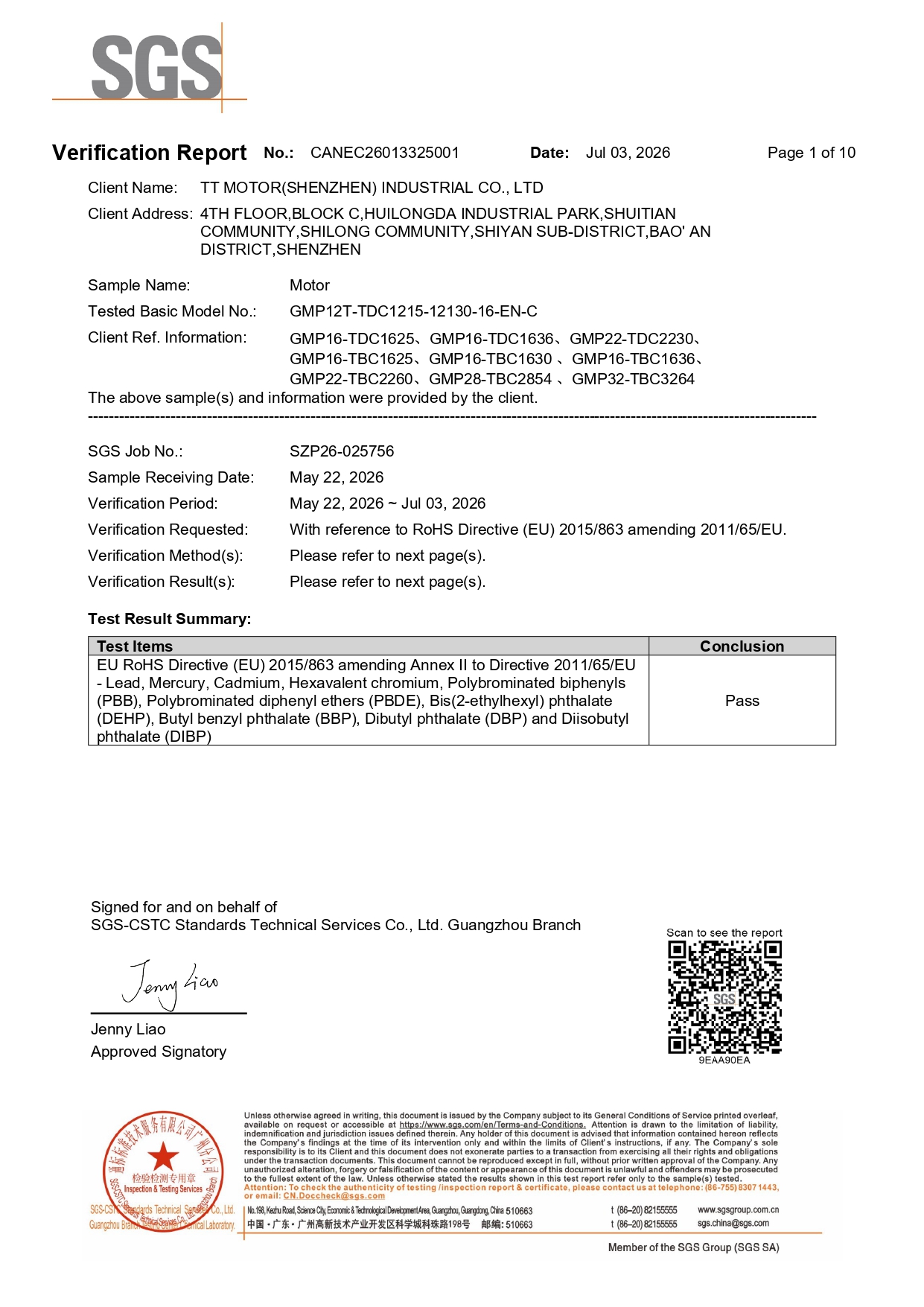
Select GMP12T-TDC1215 when the design needs compact precision, fast response and low rotor inertia. Verify rated torque at the required output speed, because a small coreless motor has a narrower continuous torque window than a larger brushless planetary unit. Also check gearbox backlash, noise and allowable radial load. RoHS compliance testing for GMP12T-TDC1215 is listed under report CANEC26013325001.
Brushless vs Brushed for Long-Term Continuous Operation
For long-term continuous operation, brushless architecture is usually the lower-wear choice because commutation is electronic. There are no carbon brushes to replace and no commutator wear. That is why GMP36-TEC3650 and TWG3246-TEC2430 outrank GM37-555PM for continuous-duty evaluation. The advantage is not automatic. Brushless motors require a compatible controller, correct hall sensor or sensorless configuration, and suitable thermal design. A poorly matched controller can erase the expected benefit.
Brushed motors remain relevant. They use simpler drive electronics, and in intermittent duty or cost-sensitive designs the brush wear may be manageable. The GM37-555PM logistics case shows that brushed DC gear motors can operate under frequent start-stop and load changes for 3 years or more in a real application. The correct comparison is therefore not brushless versus brushed in the abstract. It is brushless system cost and control complexity versus brushed maintenance and replacement risk under the actual duty cycle.
A practical decision rule is:
- If the axis runs for long continuous hours with limited maintenance access, rank a brushless model first.
- If the axis is intermittent, cost-sensitive and easy to service, a brushed DC gear motor can be valid.
- If the axis needs fast response in a compact mechanism, evaluate a coreless motor before making the size decision.
How to Verify Rated Torque, Output Speed and Voltage Before Ordering
Rated torque, output speed and voltage are configuration data, not marketing labels. A 12V gear motor can be wound or geared for different output speeds, and a 24V or other winding may be available as a customization. The buyer should provide the load torque, required output speed, duty cycle, supply voltage, allowable envelope and control method. The supplier should return a datasheet for the exact build.
- Define the duty profile: continuous hours, starts per hour, direction changes, rest time and ambient temperature.
- Calculate the required output torque after gearbox efficiency and acceleration peaks.
- Select a gear ratio that meets output speed without forcing the motor outside its efficient range.
- Confirm the motor winding voltage and controller supply voltage.
- Check rated torque at the target output speed, not only stall torque or no-load speed.
- Run a sample under the real load cycle and record temperature rise, noise, backlash and positioning repeatability.
TT Motor's published capability includes OEM/ODM customization of shaft, encoder, gearbox, voltage, logo and speed. Standard lead time is 15 to 25 days for samples and 30 to 45 days for bulk orders. The stated MOQ is 2 pieces, monthly production capacity is 800,000 pieces, and quality control is described as 100% test. The company holds ISO 9001:2015 certification F02926Q00865R402, valid from 2026-08-21 to 2029-08-21, covering R&D and manufacture of micromotors, excluding 3C. Remote after-sales technical support is provided.
Application Fit Summary
For logistics conveyors and sorting mechanisms, the start-stop and direction-change profile favors a brushless planetary or a brushed gear motor with a defined maintenance plan. For smart-home intermittent positioning, the worm-gear brushless model is the specialist pick. For dental, medical pump or other compact precision mechanisms, the coreless model is the precision alternative. For long continuous medical or automation axes, the first-ranked brushless planetary model has the strongest documented continuous-duty fit in this set. These are duty-fit conclusions, not universal product rankings.
Before requesting a sample, prepare the duty cycle, supply voltage, required output speed, rated torque target and allowable envelope. TT Motor can review those inputs against the selected gear motor configuration. The public TT Motor brochure provides an overview of the company and product range.

Frequently Asked Questions
What is the difference between continuous duty and intermittent duty for a gear motor?
Continuous duty means the motor runs at a steady load long enough to reach thermal equilibrium. Intermittent duty means the motor operates in cycles with rest periods, start-stop motion or repeated positioning. Continuous duty stresses thermal margin and rated torque; intermittent duty stresses peak torque, dynamic response, cycle life and controller settings.
Which model is ranked first for continuous operation?
GMP36-TEC3650 is ranked first for continuous-duty and high-cycle start-stop precision work. It is a brushless planetary gear motor, and it has documented use in a U.S. logistics project for 3 years or more under frequent start-stop and load changes. The exact rated torque and output speed must be confirmed for the selected ratio and winding.
Which model is the specialist pick for intermittent smart-home positioning?
TWG3246-TEC2430 is the specialist pick for intermittent positioning in smart-home appliances. It is a brushless worm gear motor associated with a U.S. smart-lock case and is relevant to low-speed, limited-space mechanisms. Check backlash, holding behavior and cycle requirements on the sample.
Is brushless always better than brushed for long-term continuous operation?
Brushless is usually the lower-wear choice for long continuous operation because it has no carbon brushes or commutator wear. It still requires a compatible controller and suitable thermal design. Brushed motors can remain suitable for intermittent or cost-sensitive duty where brush replacement is planned and maintenance access is acceptable.
What rated torque and output speed should I confirm before ordering?
Confirm the rated torque that can be continuously output at the required output speed and voltage. Rated torque is not the same as stall torque, and output speed depends on the gear ratio. Provide the load torque, speed, duty cycle, voltage and ambient conditions so the supplier can quote a specific configuration.
Can voltage, shaft, gearbox, encoder, logo or speed be customized?
TT Motor lists OEM/ODM customization for shaft, encoder, gearbox, voltage, logo and speed. Customization must be matched to the motor, controller and mechanical envelope. Request the datasheet for the proposed build before approving a sample.
What are the sample and bulk lead times?
Standard lead time is 15 to 25 days for samples and 30 to 45 days for bulk orders. To request a sample or quote, provide the duty cycle, supply voltage, output speed, rated torque target and preferred gear motor model so the configuration can be checked against the application.
Have Questions or Need More Details?
Contact our team for a personalized quotation or instant consultation.
Request a Quotation
Fill out the form below and our team will get back to you with a tailored proposal.
WhatsApp Direct Chat
Prefer to chat in real-time? Message us on WhatsApp for instant assistance & quick answers.
- Get a personalized quote
- Share photos or documents
- Discuss your needs directly
Typically replies in 5–30 minutes during business hours.