
How to Read Brushless Gear Motor Specs: Torque, Speed, Stages, and Backlash
A parameter-by-parameter reading guide built on published data for the TT Motor GMP36-TEC3650
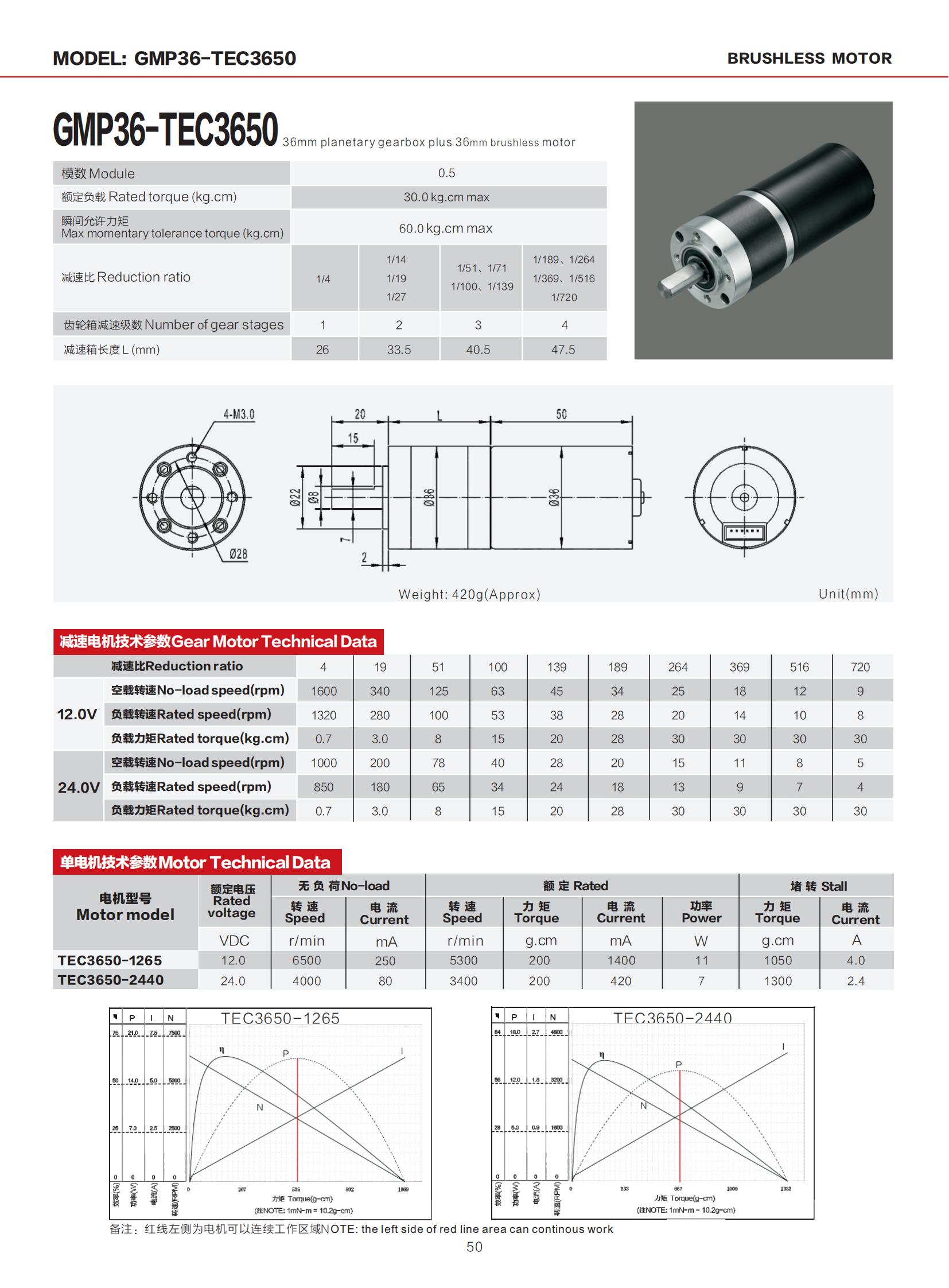
Published specification sheet for the GMP36-TEC3650 brushless planetary gear motor.
A brushless gear motor datasheet is not one promise — it is a set of limits. Four values decide whether a motor fits your design: the rated voltage band, the output speed range, the maximum rated torque, and the number of gearbox stages. A fifth value, transmission backlash, decides how accurately the motor can hold a position once it gets there.
This guide decodes all five, using one published specification as the worked example: the GMP36-TEC3650, a brushless planetary gear motor from TT Motor (Shenzhen) Industrial Co., Limited. TT Motor is a Shenzhen-based manufacturer of miniature precision motors, established in 2006, whose product lines include brushless DC motors, coreless motors, planetary geared motors, miniature geared motors, stepper motors and high-precision DC motors. Its motors are used in industrial automation, intelligent robots, medical equipment, precision instruments, smart homes, automotive electronics and unmanned equipment.
Problem Definition: Why Brushless Gear Motor Specifications Are Hard to Compare
Almost every supplier lists torque, speed and voltage. The difficulty is that the same three words are measured under different conditions, and the two specifications that matter most for positioning work are often missing entirely.
Torque is reported at a point, not across a curve. A figure such as 30.0 kg.cm is described as the maximum rated torque — the torque that can be continuously output under specified operating conditions. It is not the torque available at every speed, and it is not a stall figure. A buyer who designs a mechanism around the peak number and runs it at high speed will find the motor does not behave as the spec sheet seemed to promise.
Speed ranges describe a family, not a single unit. When a datasheet lists a wide range such as 4 rpm to 1600 rpm, that range comes from combining different reduction ratios inside the same gearbox family. One motor at one ratio delivers one narrow slice of that band. The useful question is never "what is the speed range?" but "which configuration gives me the speed I need at the torque I need?"
Length and backlash are usually buried or absent. Housing length is often reported as gearbox length only, while the real constraint is the total stack from mounting flange to shaft tip. Backlash — the small lost motion at the output when the input reverses — is frequently left off the sheet altogether, even though it decides whether a positioning axis repeats accurately.
The buyer's rule: compare motors only on figures measured the same way — maximum rated torque at rated voltage, output speed at the shaft, gearbox length and total length in millimetres, and a stated value for backlash or positioning repeatability.
Industry Background: Why the Reading Skill Matters More Than It Used To
Brushless motor supply has grown into a large, globally traded category, and that scale is precisely why specification literacy is now a purchasing skill rather than an engineering courtesy.
Grand View Research values the global brushless DC motor market at roughly USD 22.2 to 22.33 billion in 2025, with a forecast window running to 2033. Trade data tells a similar story at the small end of the range: the OEC reports global trade in electric motors with an output below 37.5 watts (HS code 850110) at about USD 16.3 billion in 2024. Miniature motors move in very high volumes, which means a buyer is typically choosing between many suppliers who all quote the same parameter names.
Regulation is moving in parallel but rarely reaches this segment. IEC 60034-30-1:2025 introduced the IE5 ultra-premium efficiency class, and EU Ecodesign Regulation 2019/1781 sets minimum efficiency requirements for motors in the 0.12 kW to 1000 kW band. Miniature gear motors sit far below that regulated power range, so they are generally not classified by these schemes. That leaves the datasheet itself as the buyer's main protection — there is no efficiency label to fall back on.
Construction is also shifting the maintenance calculation. In a brushless (BLDC) motor, electronic commutation replaces carbon brushes, so brush wear is eliminated and regular brush replacement is not required. For the GMP36-TEC3650, the manufacturer states that service life is typically tens of thousands of hours. For a machine designer, that changes the question from "how often do we service the motor?" to "does the rest of the mechanism last as long as the motor?"
Detailed Solution: The GMP36-TEC3650 Specification, Line by Line
The GMP36-TEC3650 is classified as a brushless planetary gear motor and belongs to the DC brushless gear motor category. Structurally, it combines a brushless motor with a same-diameter planetary gearbox: the motor and the gearbox share a 36 mm outer diameter, which keeps the assembly square rather than stepped, so it fits into a straight cylindrical cavity inside the equipment.
Specification snapshot — GMP36-TEC3650
- Rated voltage: DC 12 V to 24 V (customizable within that range)
- Output speed range: 4 rpm to 1600 rpm
- Maximum rated torque: 30.0 kg.cm
- Gearbox stages: 1, 2, 3 or 4
- Gearbox length options: 26 mm, 33.5 mm, 40.5 mm, 47.5 mm
- Overall length: 26 mm to 47.5 mm, depending on the number of reduction stages
- Reduction ratios: ten ratios from 1/4 to 1/720
- Gear module: 0.5
- Output shaft: 8 mm diameter solid shaft; mounting flange with four M3 holes
- Net weight: 420 g; materials: stainless steel, copper, iron
Rated Voltage: DC 12 V to 24 V — and What "Customizable" Actually Means
The rated voltage range is DC 12 V to 24 V, and the rated voltage can be customized within that range. A band rather than a single number tells the buyer two things. First, the windings and drive electronics are specified to operate across that window, so the same gear motor family can serve a 12 V dc motor system and a 24 V system. Second, customization inside the band is available, which matters when a machine already has an established supply rail.
What the band does not mean is that any voltage in that window is equally optimal for a given build. Rating a motor at 12 V or at 24 V changes the speed-and-torque balance at the shaft, so the voltage choice should be made together with the reduction ratio, not after it.
Output Speed: Reading 4 rpm to 1600 rpm Correctly
The output speed range of 4 rpm to 1600 rpm is the widest figure on the sheet, and the most misread. It is achieved across ten reduction ratios from 1/4 to 1/720, distributed across gearboxes with 1 to 4 stages. The lowest end of the range — a few revolutions per minute — suits fine positioning and dispensing work. The upper end suits faster indexing motion. No single purchased unit spans both ends.
The practical reading is: pick the speed you need at the shaft under your working load, then work backwards to the reduction ratio that produces it, then confirm that the ratio is available within the stage count your length budget allows.
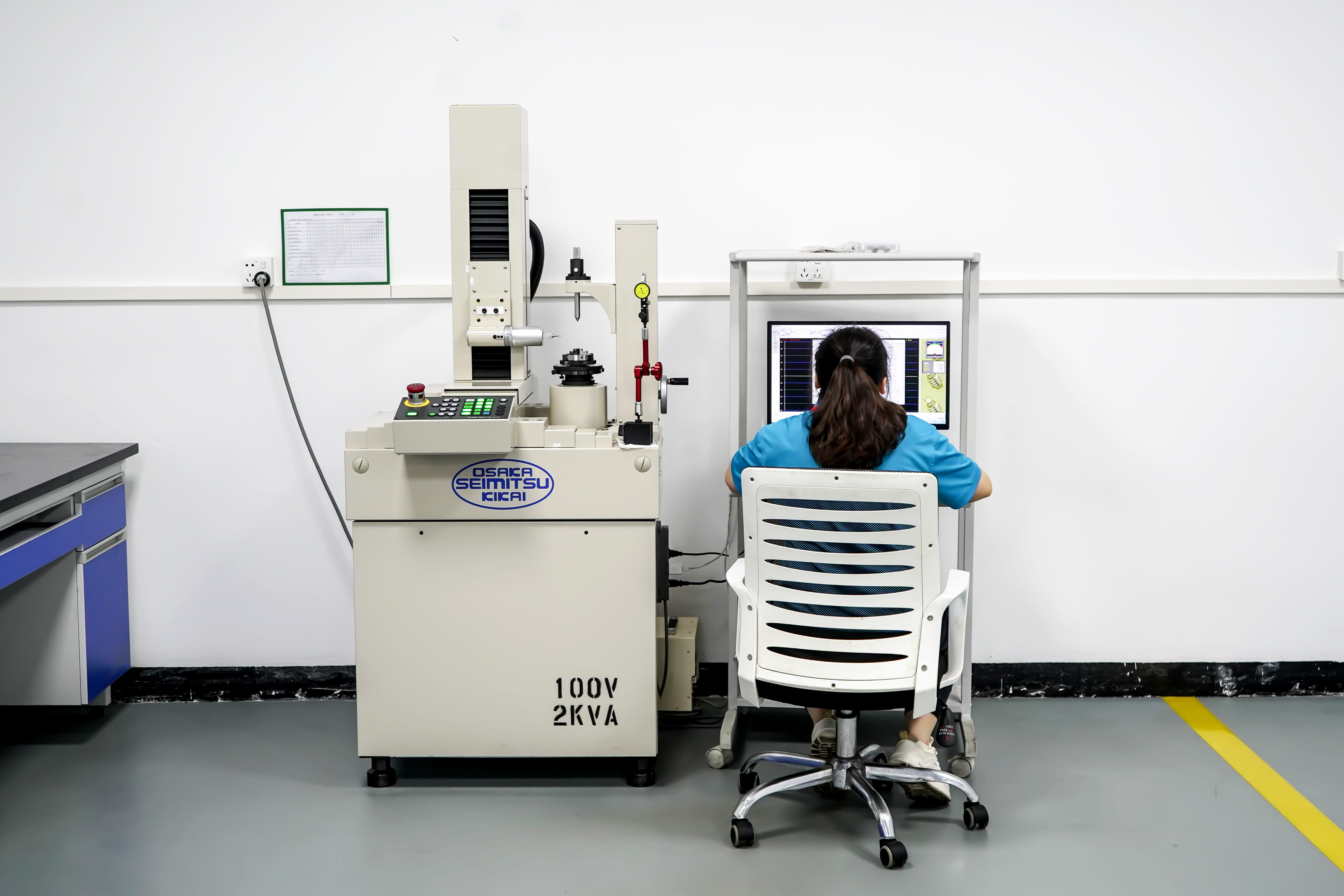
Gear geometry verification equipment used in miniature gear motor production — precision here is what limits transmission backlash.
Maximum Rated Torque: 30.0 kg.cm at the Output Shaft
Rated torque is the torque that can be continuously output under specified operating conditions. For the GMP36-TEC3650, that ceiling is 30.0 kg.cm. The product specification notes that the design leaves a margin for short-term heavy-load impacts, which is relevant for applications where a mechanism occasionally meets resistance — a jam, a heavy start, or an end-stop.
Three habits keep torque figures honest. Ask whether the value is rated or stall torque. Ask at what voltage it was measured. And never compare a high torque planetary motor claim against a competing figure without confirming both were measured at the output shaft rather than the motor shaft — a gearbox multiplies torque, so the two numbers describe different points in the same system.
Gearbox Stages and Length: 1, 2, 3 or 4 Stages in 26, 33.5, 40.5 and 47.5 mm
The gearbox is available in 1, 2, 3 or 4 stages, with gearbox length options of 26 mm, 33.5 mm, 40.5 mm and 47.5 mm, and overall length running from 26 mm to 47.5 mm depending on the number of reduction stages. More stages mean more reduction and more torque multiplication — and more length. That is the central trade-off in every dc planetary gear motor selection.
Because the motor and gearbox share the same 36 mm diameter, adding stages does not make the assembly wider. It only makes it longer, and only within the 26 mm to 47.5 mm envelope. For a designer working inside a fixed housing, that is a much easier constraint to plan around than a stepped design where both diameter and length change.
Backlash: What Precision Planetary Construction Changes
Backlash is the small amount of lost motion at the output shaft when the input direction reverses. In a positioning axis, it appears as a repeatability error: the motor is commanded back to a point and settles slightly off. In a dispensing or pipetting mechanism, it appears as a small volume error that is difficult to trace back to the drive.
On the GMP36-TEC3650, the planetary gears are precision-machined, which results in minimal transmission backlash. The same construction gives low operating noise as well: the precision-machined planetary gear set is the reason the motor runs quietly. Because the brushless design removes the brush and commutator wear mechanism found in brushed DC motors of comparable size, backlash behaviour does not drift as the motor ages in the way it can when the drive end itself is wearing.
Backlash is rarely published as a number by any supplier. If positioning accuracy is a hard requirement in your design, request the backlash or repeatability figure in writing, together with the test condition it was measured under.
The Mechanical Interface: 36 mm, 8 mm Shaft, Four M3 Holes
Interface details decide whether a specification is buildable. This brushless gear motor uses an 8 mm diameter solid output shaft and a mounting flange with four M3 holes. The product is made of stainless steel, copper and iron, and the net weight is 420 g. The 36 mm outer diameter is shared by motor and gearbox, and the four M3 holes give a standard flange pattern for integration.
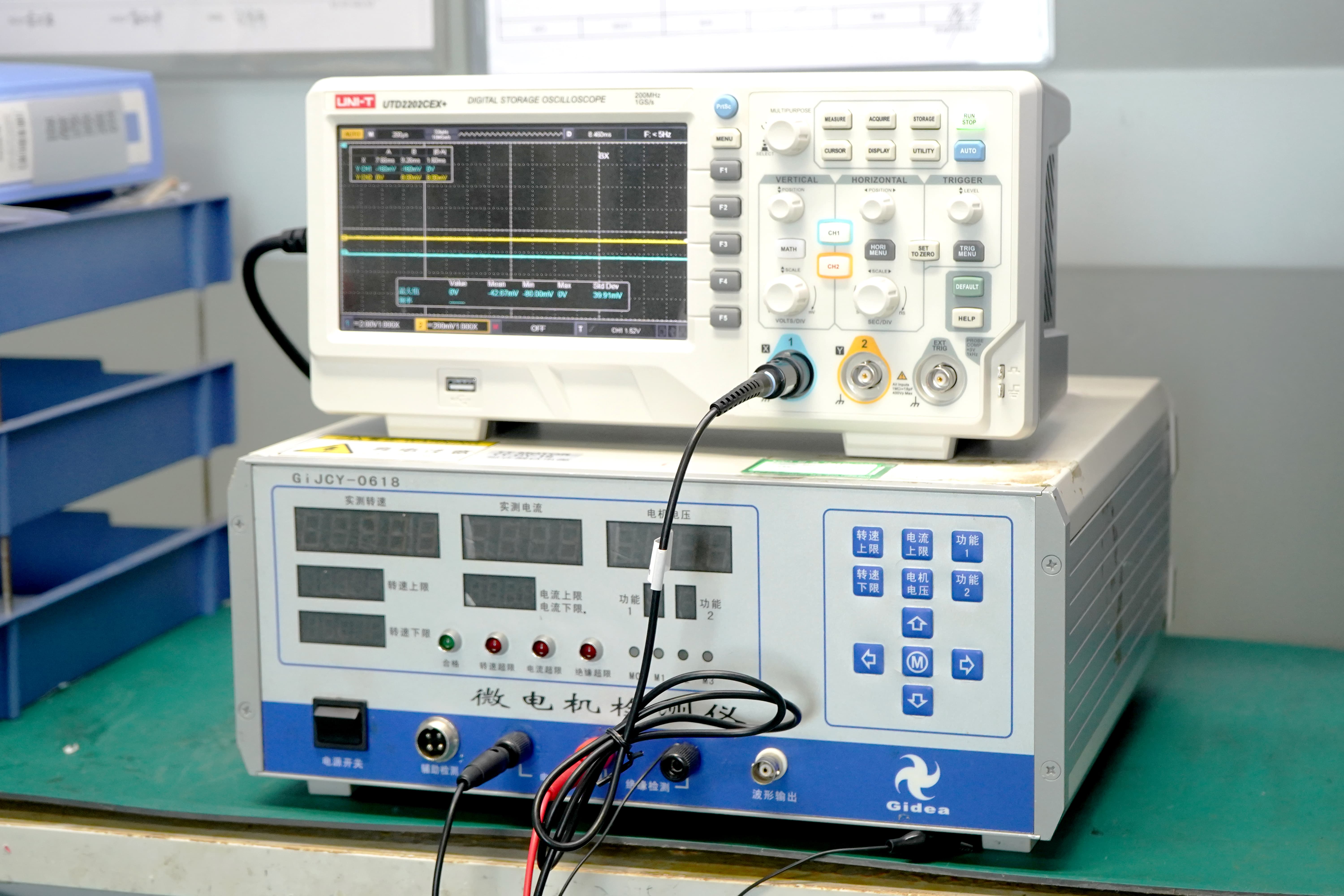
Performance verification of miniature motors — the stage where a quoted speed, torque and current draw is confirmed against the build.
Step-by-Step: How to Read Any Brushless Gear Motor Spec Sheet
The following sequence applies to any dc brushless gear motor, not only to the example here. Working in this order prevents the most common mistake, which is choosing a motor on torque alone and discovering the geometry or the speed does not fit.
- Start from the load, not the motor. Calculate the torque required at the output shaft — the force your mechanism must move multiplied by the distance from the shaft centre — then add allowance for friction and acceleration. Only then compare that number against the maximum rated torque, which for the GMP36-TEC3650 is 30.0 kg.cm.
- Fix the output speed you need under load. Datasheet speed ranges such as 4 rpm to 1600 rpm describe the whole family. Convert your requirement into a target speed at the shaft, not at the motor.
- Match the voltage band to your supply. DC 12 V to 24 V with customization available inside the range covers the two most common industrial and battery supply levels. Confirm the voltage and the drive settings, since both affect the shaft output.
- Use the reduction ratio to close the torque–speed gap. Ten ratios from 1/4 to 1/720 are available on this gearbox family. Higher reduction gives more torque at lower speed; the stage count (1 to 4) determines how much reduction is possible inside your length budget.
- Check the mechanical envelope. Gearbox length 26 to 47.5 mm, overall length following the stage count, 36 mm shared diameter, 8 mm shaft, four M3 flange holes, 420 g. Confirm the flange pattern and shaft against your existing bracket before anything else is locked.
- Ask for backlash and noise figures where positioning matters. Precision-machined planetary gears deliver minimal transmission backlash and low operating noise; if your application depends on repeatability, put the requirement in the specification rather than assuming it.
- Validate with a sample before committing a production build. A datasheet defines limits; a sample proves them in your mechanism, with your load and your controller.
Use Cases: Where These Parameters Matter Most
The GMP36-TEC3650 is intended for the robotics, medical device, industrial automation equipment and intelligent logistics equipment industries, and is designed for use in compact robotic and automation equipment scenarios. In each of those settings, a different parameter dominates the buying decision.
Robotics and compact automation. The same-diameter 36 mm body and the 26 mm to 47.5 mm length range let a joint or actuator assembly stay slim. Torque margin and backlash determine how much payload the axis can carry without losing position.
Medical devices. Low noise and minimal transmission backlash matter more than raw speed in low-speed precision motion. The absence of brush wear also supports long-term operation without scheduled brush replacement.
Industrial automation equipment. Repeatable indexing and positioning benefit from a gearbox whose backlash does not drift, plus a rated torque figure that can be compared directly against the load calculation.
Intelligent logistics equipment. Compact drives in conveying, sorting and handling modules need a small envelope, a defined flange pattern and a service life that matches the rest of the machine.
Different duties call for different architectures. A worm gear motor such as the TWG3246-TEC2430 turns the output through a right angle at very low speed. A brushed spur gear motor such as the GM37-555PM suits smart home and automated production line equipment. A small N20 gear motor such as the GM12-N20VA fits space-critical, low-torque assemblies. The table below places them next to the brushless planetary unit so the differences in stage count, length and torque become visible.
Comparison Table: Four Gear Motor Configurations Side by Side
| Model | Architecture | Rated voltage | Max rated torque | Speed range | Gear stages | Gearbox length (mm) |
|---|---|---|---|---|---|---|
| GMP36-TEC3650 | Brushless planetary gear motor (DC brushless gear motor) | DC 12 V–24 V | 30.0 kg.cm | 4–1600 rpm | 1 / 2 / 3 / 4 | 26 / 33.5 / 40.5 / 47.5 |
| TWG3246-TEC2430 | Brushless worm gear motor (right-angle output) | DC 12 V–24 V | 8.0 kg.cm | 3–35 rpm | 3 / 4 / 5 | 46 |
| GM37-555PM | Brushed spur gear motor (DC gear motor) | DC 12 V–24 V | 8.0 kg.cm | 5–800 rpm | 2 / 3 / 4 / 5 / 6 | 19 / 21.5 / 24 / 26.5 / 29 |
| GM12-N20VA | Brushed spur gear motor (N20 gear motor series) | 2.4 V / 5 V | 0.5 kg.cm | 12–1450 rpm | 2 / 4 / 5 / 7 | 9 / 12 |
Read the table by column, not by row. Stage count and gearbox length track together in every architecture — more reduction always costs length. Torque and speed move in opposite directions within each family. Voltage band narrows as the motor gets smaller: the N20 series runs at 2.4 V or 5 V, while the 36 mm brushless planetary family runs from DC 12 V to 24 V with ten ratios available.
Frequently Asked Questions
What does a rated voltage range of DC 12 V to 24 V mean for a brushless gear motor?
It means the motor is specified to operate anywhere within that band, and the rated voltage can be customized inside it. For the GMP36-TEC3650, this covers the two most common supply levels used in automation, robotics and battery-powered equipment, so the same gearbox family can serve both. The voltage you choose still affects output speed and torque at the shaft, so it should be selected together with the reduction ratio rather than treated as a free variable.
How much torque can a brushless planetary gear motor deliver?
On this model the maximum rated torque is 30.0 kg.cm at the output shaft, measured as continuously available torque under specified operating conditions. The product specification also notes margin for short-term heavy-load impacts. The figure applies to the output shaft, after the gearbox has multiplied motor torque, so it should never be compared directly against a motor-shaft torque number from another supplier.
How do I decide how many gearbox stages I need?
Choose the lowest stage count that still delivers the torque you need at the output speed you need. The GMP36-TEC3650 offers 1, 2, 3 or 4 stages with ten reduction ratios from 1/4 to 1/720; additional stages add gearbox length — 26, 33.5, 40.5 or 47.5 mm — and raise the total assembly length from 26 mm to 47.5 mm. If your housing has a fixed depth, the length budget often decides the stage count before the torque calculation does.
What is transmission backlash and how is it reduced?
Backlash is the lost motion at the output shaft when the input reverses, and it shows up as positioning error in reversing axes. In the GMP36-TEC3650, the planetary gears are precision-machined, which results in minimal transmission backlash and low operating noise. Because the brushless structure removes brush and commutator wear, the drive end does not introduce the same wear-driven variation that brushed DC motors of comparable size can. Suppliers rarely publish backlash as a number, so request it in writing if repeatability is critical.
Can I evaluate this motor with a sample before ordering?
Yes. Sample evaluation is the standard way to confirm that a datasheet limit matches real behaviour in your mechanism, load and controller. TT Motor (Shenzhen) Industrial Co., Limited can be reached at sales26@ttmotor.com or +86 180-0299-3379, with WhatsApp at +86 18002993379, to arrange a sample and discuss voltage customization within DC 12 V to 24 V.
Conclusion: The Datasheet Is the Engineering Contract
Reading a brushless gear motor specification is mostly a matter of knowing which question each number answers. Rated voltage DC 12 V to 24 V answers "will this run on my supply?" The 4 rpm to 1600 rpm range answers "which configuration do I order?" The 30.0 kg.cm maximum rated torque answers "how much load can this carry?" The 1 to 4 stages and the 26 mm to 47.5 mm length range answer "will this fit?" And minimal transmission backlash from precision-machined planetary gears answers the question that decides whether the axis repeats.
For the GMP36-TEC3650, those answers sit inside a 36 mm same-diameter body weighing 420 g, with an 8 mm solid shaft and a four-hole M3 flange, intended for robotics, medical device, industrial automation and intelligent logistics equipment. For the buyer, the last step is always the same: take the numbers you have just read, put them against your load calculation, and prove them with a sample before the design is frozen.

Next Step: Sample, Quote or Full Catalog
If you are specifying a brushless planetary gear motor for robotics, medical devices, industrial automation or intelligent logistics equipment, request a sample or a configuration quote. Voltage can be customized within DC 12 V to 24 V, and gearbox stage and length options are selectable.
Email: sales26@ttmotor.com | Tel: +86 180-0299-3379 | WhatsApp: +86 18002993379
Website: www.ttmotor.com | Brochure: download the miniature motor product brochure (PDF)
Sales contact: Sally Su | Address: 4th Floor, C Building, Huilongda Industrial Park, Shilong Community, Shiyan, Bao'an District, Shenzhen, China
All specifications quoted in this article refer to published product data for the GMP36-TEC3650, TWG3246-TEC2430, GM37-555PM and GM12-N20VA gear motors. Market figures are attributed to Grand View Research (2025 brushless DC motor market) and OEC (HS 850110 trade value, 2024). Selection decisions should always be confirmed against a physical sample in the target application.
Have Questions or Need More Details?
Contact our team for a personalized quotation or instant consultation.
Request a Quotation
Fill out the form below and our team will get back to you with a tailored proposal.
WhatsApp Direct Chat
Prefer to chat in real-time? Message us on WhatsApp for instant assistance & quick answers.
- Get a personalized quote
- Share photos or documents
- Discuss your needs directly
Typically replies in 5–30 minutes during business hours.