
Low-Speed Positioning: Coreless, BLDC Planetary, Worm Gear or Brushed
Motor selection · Evaluation to execution
For low-speed positioning, the deciding question is rarely the motor type alone. It is how much torque the output shaft must hold at a slow speed, whether sparks and carbon dust are acceptable at the point of motion, and how much of the reduction you are willing to seal inside one housing. In the four-model set compared here, the brushless planetary GMP36-TEC3650 covers up to 30.0 kg.cm across 4–1600 rpm and carries the highest torque; the brushless worm TWG3246-TEC2430 covers the slowest window at 3–35 rpm with up to 8.0 kg.cm and no-spark electronic commutation; the coreless GMP12T-TDC1215 is a direct DC drive at 2 kg.cm across 8–5000 rpm with no gearbox in the drive path; and the brushed spur GM37-555PM reaches up to 8.0 kg.cm between 5 and 800 rpm as the lowest-cost construction of the four.
All four are part of the miniature DC motor range from TT Motor (Shenzhen) Industrial Co., Limited, a Shenzhen-based manufacturer of miniature DC motors founded in 2006 that produces brushless, coreless, gear and stepper motors for robotics, medical device and automation projects, with roughly 70% of output exported to the EU and US. Because the four models share one production and documentation base, the comparison below is a genuine like-for-like selection problem rather than a comparison of unrelated suppliers.
Why low-speed positioning splits four ways
Low-speed positioning means driving a load at an output speed that is slow enough for the mechanism to stop, hold or index at a defined point — in practice from about 3 rpm up to several hundred rpm, depending on the mechanism. At those speeds three constraints stop being independent:
- Torque at the output. The load does not care about motor speed. It cares about the torque available after reduction, including friction, acceleration and any static holding force.
- Position quality. At low speed, small torque disturbances show up as visible position error. Cogging from a slotted iron rotor, backlash in stacked gear stages, and the resolution of the control loop all feed into the same error budget.
- Duty and commutation. A mechanism that indexes twice a minute and one that runs for hours both look like low-speed positioning on paper, but they place very different demands on brush wear, heat and electromagnetic interference.
The common failure in motor selection is choosing by motor speed instead of output speed. A fast, small motor with a long reduction can hit the same 20 rpm as a worm gear motor, but the gearbox now carries far more torque, backlash accumulates across more stages, and the integration envelope grows. Working from the output shaft backwards is the only sequence that keeps the four constructions comparable.
Industry background: what the market data and standards do and do not tell you
The commercial context explains why buyers now demand model-level evidence instead of category claims. Grand View Research values the global brushless DC motor market at USD 22.2–22.33 billion in 2025, and OEC trade data for HS 850110 (electric motors under 37.5 W) records USD 16.3 billion of global trade in 2024. The miniaturised end of that market is where coreless, planetary, worm and spur constructions compete most directly.
Efficiency regulation, by contrast, does not resolve miniature selection. IEC 60034-30-1:2025 introduced the IE5 ultra-premium efficiency class, and EU Ecodesign Regulation (EU) 2019/1781 sets IE3 for 0.75–1000 kW and IE2 for 0.12–0.75 kW from 1 July 2021. Both frameworks are written for mains-powered industrial machines in the kilowatt range, far above the output of the motors discussed here. They therefore do not substitute for project-level acceptance criteria on miniature gear motors — which is exactly why documentation requests (RoHS reports, ISO 9001 scope) and sample validation carry more weight than an efficiency label in this segment.
What each construction means in practice
Brushless planetary: GMP36-TEC3650, up to 30.0 kg.cm, 4–1600 rpm
A planetary gearbox splits load across several planet gears that share the same ring gear, so torque is distributed rather than carried by a single gear pair. That is why this model reaches the highest figure in the set, up to 30.0 kg.cm, while still offering a 4–1600 rpm window: the same frame can be configured for a fast travel move or a slow positioning move.
Electronic commutation removes brushes and commutator contact. The practical consequences are lower mechanical wear, less heat generation and low electromagnetic interference compared with a brushed motor of similar size. In the manufacturer’s own comparison of brushless and brushed motors, brushed units are described as having a lifespan of approximately several hundred to several thousand hours, against tens of thousands of hours for brushless designs, with brushed motors also producing sparks and carbon dust during operation.
The limitation is positional, not electrical. Each planetary stage contributes its own backlash, and multi-stage reductions accumulate it. Backlash is not a single catalogue number and should be requested per gearbox configuration, then verified on the sample. Where a project needs both high torque and tight position, that verification step is not optional.
Brushless worm gear: TWG3246-TEC2430, 3–35 rpm, up to 8.0 kg.cm
A worm mesh achieves a large reduction in a single stage, which is why this model reaches the slowest output window in the set, 3–35 rpm, without stacking planetary stages. The layout also turns the drive through the gearbox, which helps when the envelope is flat rather than long. Torque stays moderate at up to 8.0 kg.cm.
Commutation is electronic, so the motor produces no brush sparks and no carbon dust at the commutation point. For equipment where the motor sits near a fluid path, a sensor or a contained mechanism, that characteristic is often the reason this construction is chosen before torque is even calculated. Sliding contact in the worm mesh generally costs efficiency compared with spur or planetary stages, and continuous operation should be checked thermally rather than assumed. Depending on lead angle, a worm drive may also resist back-driving, but this must be confirmed for the specific design and not assumed from the gear type.
Coreless: GMP12T-TDC1215, 2 kg.cm, 8–5000 rpm, direct DC drive
A coreless rotor has no slotted iron core, so rotor mass and inertia drop sharply. The manufacturer describes the result directly: coreless motors use a coreless rotor design with lower moment of inertia, enabling faster starting, braking and speed changes. Low inertia also means very low cogging, which is valuable when the mechanism must settle quickly at a position rather than hunt around it.
The trade-off is torque and reduction. At 2 kg.cm this model suits light mechanisms, and because the drive is direct, there is no gearbox backlash to budget for — but also no torque multiplication. Running at the low end of the 8–5000 rpm range means operating the motor itself slowly, which is viable for light loads and rapid cycling rather than for heavy static holding.
Brushed spur: GM37-555PM, up to 8.0 kg.cm, 5–800 rpm
A parallel-shaft spur reduction paired with a conventional brushed rotor is the simplest and usually the least expensive way to reach 5–800 rpm at up to 8.0 kg.cm. Control is straightforward, and the construction is well understood by most mechanical design teams.
The limits are wear-related. Brushes and commutator wear mechanically, generate carbon dust, and produce sparks and electromagnetic interference in operation. The manufacturer’s own guidance is explicit: long running time, high start-stop frequency and long life requirements point to brushless, while low cost and short running time point to brushed. A brushed spur gear motor is therefore a rational choice for intermittent positioning in cost-sensitive equipment, and a poor choice where dust, spark or maintenance access is a constraint.
A seven-step selection sequence
The sequence below is ordered so that each decision narrows the field before the next one is applied. Skipping ahead is what produces over-specified motors or under-sized gearboxes.
- Convert the requirement into output-side numbers. Calculate the torque needed at the output shaft, including friction, acceleration and any holding force, plus the slowest speed the mechanism must sustain. Compare that torque against the 30.0 kg.cm, 8.0 kg.cm, 2 kg.cm and 8.0 kg.cm figures above — not against motor torque.
- Set the spark and dust boundary. If the motor sits in a fluid path, a sealed enclosure or a clean environment, brushless commutation is the entry condition, which immediately removes the brushed spur option and keeps the planetary and worm brushless models in play.
- Decide whether the load must hold position. A mechanism that must resist being pushed back needs a construction whose behaviour is confirmed in that direction; a mechanism that simply indexes between stops does not. This is where worm and planetary behaviour must be checked on the sample rather than inferred.
- Quantify the backlash budget. Add up the position tolerance of the mechanism, the sensor resolution and the acceptable settling error. If the remaining allowance is small, prefer fewer gear stages, and request the backlash figure for the exact configuration being quoted.
- Match the duty cycle to the construction. Continuous operation favours brushless; high start-stop frequency favours brushless and low-inertia rotors; short intermittent duty with tight cost targets can justify brushed. Confirm the thermal behaviour at the actual mounting condition rather than at free air.
- Lock the integration details before quoting. Shaft, encoder, gearbox, voltage, logo and speed are all listed customization items, so a 12 V DC winding for a 12v gear motor requirement should be specified on the order rather than inferred from a model name. Minimum order quantity is 2 pieces, which allows a genuine evaluation build rather than a paper comparison.
- Agree the acceptance evidence. Quality control follows a 100% test procedure, all units undergo 100% testing as part of production inspection, and pre-shipment testing is required for the GMP36-TEC3650. Agree the parameter set and acceptance criteria before mass production, run a small-batch trial first, and require advance notification if raw materials, components or processes change.
Where each option fits: robotics, medical devices and automation
Robotics and actuators. Joint drive modules need torque at slow speed and predictable behaviour during repeated start-stop. The brushless planetary GMP36-TEC3650 is the natural starting point at up to 30.0 kg.cm; the coreless GMP12T-TDC1215 is the better fit for light end-effectors and adjustment axes where response speed matters more than torque.
Medical devices and laboratory equipment. Pumps, analysers, pipetting equipment and dispensing mechanisms combine low speed, low noise and long operating hours, and often cannot tolerate sparking near a fluid path. The brushless worm TWG3246-TEC2430 addresses the slowest of those motions, while the brushless planetary covers higher-torque actuation and the coreless model covers fine adjustment. Reported medical use of these models includes pump drive, dosing and positioning mechanisms.
Automation equipment. Conveyors, sorting mechanisms and indexing stations usually tolerate more backlash than instruments but demand durability under frequent start-stop and load change. Both the brushless planetary and the brushed spur models are documented in conveyor and sorting duty, which is a useful reminder that one machine can use different constructions on different axes.
Compact mechanisms. Where the envelope is smaller than the 37 mm-class frames above, a mini gear motor in the n20 form factor such as the GM12-N20VA covers light-load positioning inside smart locks and small mechanisms, with RoHS report CANEC26005990201 and CE EMC certificate CTL2512182011-EC covering that series. Gear material and bearing type are separate specifications and should be confirmed per configuration when shock loads are expected.
Side-by-side comparison table
| Model and construction | Output speed | Maximum output torque | Commutation | Continuous duty fit | Positioning character | Typical fit |
|---|---|---|---|---|---|---|
| GMP36-TEC3650 — brushless planetary gear motor | 4–1600 rpm | up to 30.0 kg.cm | Electronic, no brushes | Strong: low wear, low heat, low EMI | High torque; backlash accumulates across planetary stages, so request the figure per configuration | Robot joints, actuators, conveyor and sorting |
| TWG3246-TEC2430 — brushless worm gear motor | 3–35 rpm | up to 8.0 kg.cm | Electronic, no-spark | Strong: suited to slow, continuous motion | Slowest single-stage reduction; mesh efficiency and back-driving behaviour to be confirmed per design | Medical pumps, dosing, quiet low-speed indexing |
| GMP12T-TDC1215 — coreless motor, direct DC drive | 8–5000 rpm | 2 kg.cm | Brushed, coreless rotor | Suited to rapid cycling with light loads | No gearbox backlash and very low cogging, but no torque multiplication | Dental and handheld instruments, fine adjustment axes |
| GM37-555PM — brushed spur gear motor | 5–800 rpm | up to 8.0 kg.cm | Brushed, mechanical | Limited: brush wear, carbon dust, sparks, EMI | Simple parallel-shaft reduction; backlash per gear pair to be confirmed | Intermittent positioning, cost-sensitive secondary axes |
Reading the table: torque and speed figures define the mechanical envelope, but the duty and positioning columns define whether the model survives three years in the application. A model that wins on torque can still lose on backlash, and a model that wins on cost can still lose on maintenance access.
FAQ
- Which RoHS and quality documents cover these four motors?
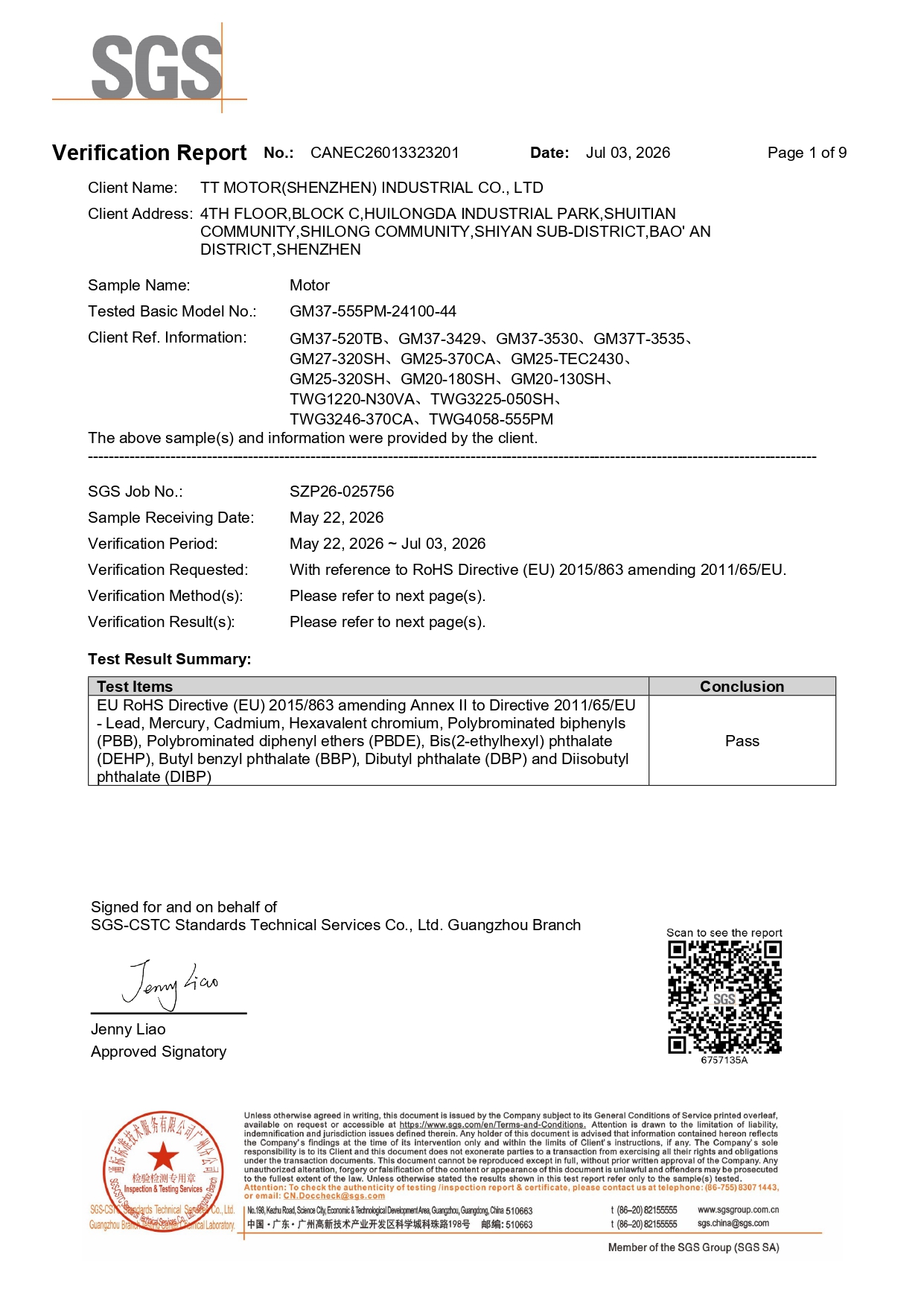
- Each model has its own SGS RoHS compliance test report referencing RoHS Directive (EU) 2015/863 amending 2011/65/EU: GMP36-TEC3650 — CANEC26013325501, issued 10 April 2026; TWG3246-TEC2430 — CANEC26013326101, issued 24 June 2026; GMP12T-TDC1215 — CANEC26013325001, issued 3 July 2026; GM37-555PM — CANEC26013323201, issued 3 July 2026. Quality management is covered by ISO 9001:2015 certificate F02926Q00865R402 issued by DCI, valid from 21 August 2026 to 21 August 2029, with a scope of R&D and manufacture of micromotors (DC gear motor, DC brushless motor).
- Can these motors be adapted to a custom mechanism?
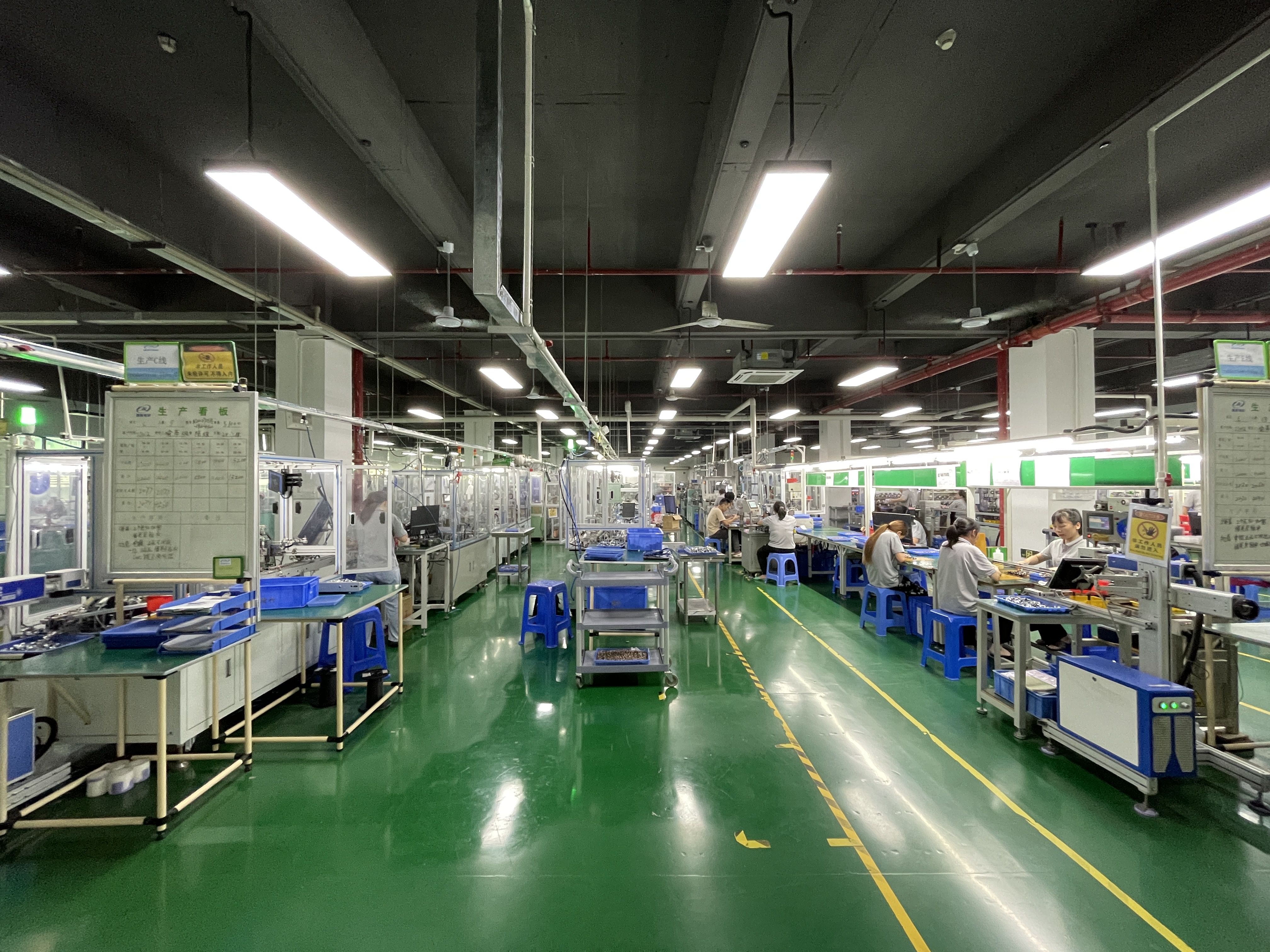
- Yes. The manufacturer provides OEM and ODM production services, with both modes available at the factory for custom orders. Listed customization items are shaft, encoder, gearbox, voltage, logo and speed, which covers the usual integration changes for low-speed positioning: an encoder for closed-loop control, a modified shaft or gearbox ratio for the mechanism, and a specific winding voltage. Production runs on a 100% test procedure, and the R&D team comprises 35 engineers across a 9,000 square metre manufacturing area.
- What is the minimum order quantity and what commercial terms apply?
- Minimum order quantity is 2 pieces, which applies to evaluation builds and small custom orders. Delivery terms are EXW, payment terms are 100%, and acceptance is based on pre-shipment test. Because the MOQ allows a handful of units, the practical budget question is not tooling volume but how many configurations you need to test before freezing the design.
- Can I validate a sample before committing to a batch?
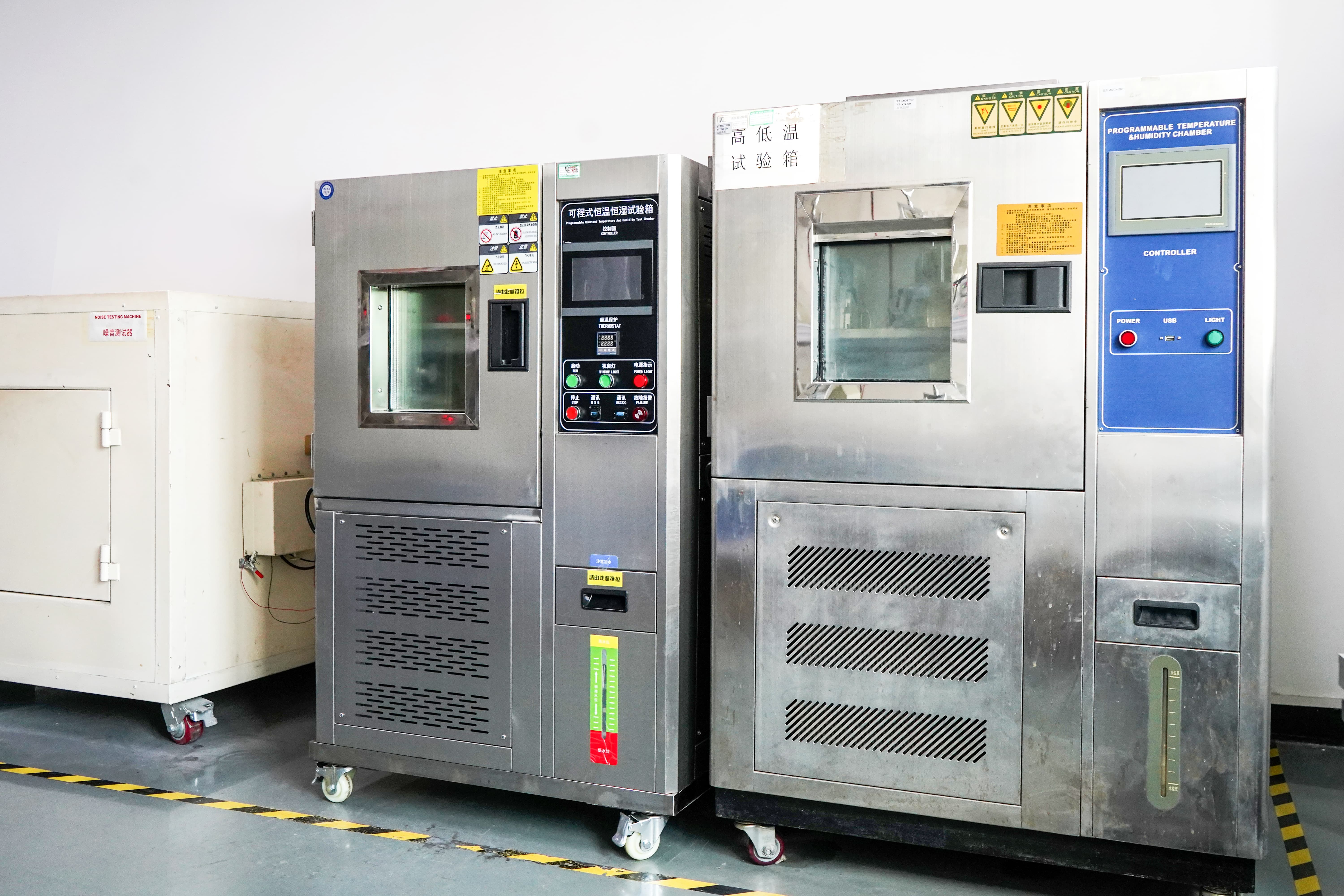
- Yes, and the sequence matters more than the sample itself. Sample lead time is 15–25 days. Before mass production, motor parameters and acceptance standards should be defined, a small-batch trial production run completed, and a shipment inspection mechanism established. Pre-shipment testing is required for the GMP36-TEC3650. If raw materials, components or production processes change, the supplier notifies the customer in advance and the process is re-verified.
- What is the lead time for bulk orders?
- Bulk lead time is 30–45 days, against 15–25 days for samples, with monthly capacity of 800,000 pieces and annual output of 8,000,000 pieces. Batch consistency is protected by 100% testing of production output, pre-shipment testing for the GMP36-TEC3650, and advance notification of any material or process change. If you want to start with a sample of the GMP36-TEC3650, the TWG3246-TEC2430, the GMP12T-TDC1215 or the GM37-555PM, you can send the load, speed and duty details and request a sample or quotation.
Conclusion
The four constructions do not compete on one axis. The brushless planetary GMP36-TEC3650 wins where torque at slow speed is the binding constraint, up to 30.0 kg.cm across 4–1600 rpm. The brushless worm TWG3246-TEC2430 wins where the output must turn at 3–35 rpm quietly and without sparks. The coreless GMP12T-TDC1215 wins where response and simplicity matter more than torque, at 2 kg.cm with no gearbox in the drive path. The brushed spur GM37-555PM wins where the duty is intermittent, the cost target is tight and sparks are not a constraint, at up to 8.0 kg.cm and 5–800 rpm.
The selection discipline is the same in every case: calculate at the output shaft, treat spark tolerance and backlash as entry conditions rather than preferences, and confirm duty behaviour with a tested sample instead of a datasheet comparison. Because all four models come from one manufacturer with model-specific RoHS reports, ISO 9001 scope, 100% testing and a 2-piece minimum order, the comparison can be closed on hardware rather than on claims.
Next step: sample and specification review
Send the output torque, slowest speed, duty cycle and spark constraint for your mechanism, and TT Motor can match the request against the GMP36-TEC3650, TWG3246-TEC2430, GMP12T-TDC1215 or GM37-555PM, and quote a configuration with the matching RoHS report.
Product catalogue: TT Motor exhibition brochure (PDF) · Website: www.ttmotor.com · WhatsApp: +86 180-0299-3379 · Email: sales26@ttmotor.com
Contact: Sally Su, TT Motor (Shenzhen) Industrial Co., Limited, 4th Floor, C Building, Huilongda Industrial Park, Shilong Community, Shiyan, Bao’an District, Shenzhen, China.

Have Questions or Need More Details?
Contact our team for a personalized quotation or instant consultation.
Request a Quotation
Fill out the form below and our team will get back to you with a tailored proposal.
WhatsApp Direct Chat
Prefer to chat in real-time? Message us on WhatsApp for instant assistance & quick answers.
- Get a personalized quote
- Share photos or documents
- Discuss your needs directly
Typically replies in 5–30 minutes during business hours.