
Top Bulk Matcha Picks for 2026: A Certification-Led Recommendation List
Bulk matcha buyers in 2026 are not short of grade names. They are short of evidence. This list ranks the ten product families in TangMist Matcha's KM range — KM1 through KM10 — using documented certification coverage as the primary filter, with pesticide residue, heavy metal and raw-material variation controls as the supporting risk filter. Every certification reference below can be quoted, checked and filed: Halal coverage under certificate HP 6785 CH across KM1–KM5, EU Organic for KM2 through ECOCERT SAS CN-BIO-154 (certificate CN-BIO-154-0003930.2025.001), HACCP under CQC 001HACCP2300121 across KM7–KM10, GMP under Intertek SZ2511G3 for KM4 and KM5 in the USA market, ISO 22000 under CQC 001FSMS2300111 documented against product code 7755, and Kosher under Star-K (WXF44CWI).
At a glance: the 2026 certification-led ranking
The order below reflects documented certification depth first, destination-market alignment second and application fit third. It is a documentation ranking, not a sensory ranking — where two families carry identical coverage, the tie note tells you how to choose.
- KM2 — Halal (HP 6785 CH) + EU Organic (ECOCERT SAS CN-BIO-154, CN-BIO-154-0003930.2025.001)
- KM10 — HACCP (CQC 001HACCP2300121) + ISO 22000 (CQC 001FSMS2300111, product code 7755)
- KM4 — Halal (HP 6785 CH) + GMP (Intertek SZ2511G3, USA market)
- KM5 — Halal (HP 6785 CH) + GMP (Intertek SZ2511G3, USA market)
- KM9 — HACCP (CQC 001HACCP2300121)
- KM8 — HACCP (CQC 001HACCP2300121)
- KM7 — HACCP (CQC 001HACCP2300121)
- KM3 — Halal (HP 6785 CH)
- KM1 — Halal (HP 6785 CH)
- KM6 — not listed inside either documented coverage group in this review; confirm scope in writing or step to KM5 / KM7
Problem definition: the bulk matcha decision is a documentation problem
Ceremonial, culinary, latte and beverage grade are commercial shorthand. They are not a harmonised global specification, and two suppliers can use the same word for material that behaves differently in a café blender or a chocolate line. That is why grade vocabulary alone rarely survives a compliance review: a buyer cannot file the word 'ceremonial'.
What a buyer can file is a certificate number, an issuing body, and the product scope that number covers. In 2026 the destination-market rules made this gap sharper. Under EU Regulation (EC) No 396/2005, Maximum Residue Limits for clothianidin and thiamethoxam were set at 0.01 mg/kg effective March 2026 — a level that pushes any EU-bound matcha programme to ask for residue documentation before purchase orders, not after arrival. In the United States, the FDA requires Food Facility Registration and FSVP documentation for imported matcha powder, and a Section 122 duty of 10% on CIF value took effect in February 2026, which changes landed cost and rewards suppliers who already hold the paperwork.
So the workable sourcing question is not 'which matcha tastes best?' It is: which matcha family already carries the documentation my market requires, at the grade my application needs? That is the question this list answers, family by family.
Industry background: why certification scope became a 2026 buying filter
Demand-side signals explain why documentation moved to the front of the buying process. Organic-certified matcha contributed approximately 41% of total global market demand in 2025, and organic matcha is described as the fastest-growing segment with an expected CAGR of 12.68% through 2033 (SNS Insider). On the industrial side, culinary grade accounted for 56.4% of global market share in 2026, driven by food and beverage manufacturing (Market Data Forecast). In other words, most bulk volume now moves through industrial channels where specification documents, not tasting notes, decide the order.
Supply-side structure reinforces the same conclusion. The global supplier landscape includes established names such as Aiya Co. Ltd, ITO EN LTD, Marukyu Koyamaen and DoMatcha (Fortune Business Insights), alongside Chinese producers that now serve a large share of export volume. For a buyer, brand recognition in that list says little about whether a specific SKU in a specific facility carries the certificate your market accepts. Certification scope narrows the field quickly.
The ranking method: three filters and one tie-break rule
Each KM family was assessed against three filters. The framework is deliberately narrow so that two buyers looking at the same list reach the same shortlist.
- Filter 1 — Documented certification coverage. How many certification frameworks cover this product family, and can each be tied to a certificate or registration number (Halal HP 6785 CH; EU Organic ECOCERT SAS CN-BIO-154; HACCP CQC 001HACCP2300121; GMP Intertek SZ2511G3; ISO 22000 CQC 001FSMS2300111; Kosher Star-K WXF44CWI)?
- Filter 2 — Destination-market alignment. EU Organic for EU-bound organic programmes; GMP for the USA market; HACCP and ISO 22000 for retail and food-service programmes that audit food-safety management systems.
- Filter 3 — Risk-control documentation readiness. Two questions decide this filter: can pesticide residue and heavy metal testing be conducted according to product specification and destination-market requirements, with supporting documentation available where applicable; and how is raw-material variation controlled between batches — through raw-material review, product specification control and batch consistency management, with in-house lab testing plus random batch inspection.
Tie-break rule: where families carry the same number of documented frameworks, the higher grade tier or the more compliance-intensive application ranks first. Because that rule produces genuinely close calls, ranks 3–4, 5–7 and 8–9 should be read as tied groups rather than as a quality verdict.
The ranked bulk matcha picks for 2026
1. KM2 — Functional Grade, 800–1000 mesh: Halal + EU Organic
KM2 ranks first because it is the only KM family in this review with documented EU Organic coverage: ECOCERT SAS CN-BIO-154, certificate number CN-BIO-154-0003930.2025.001. It also sits inside the Halal coverage held under HP 6785 CH. Two frameworks, one of them destination-specific for Europe, is the strongest combination available in the range for a buyer who must answer an EU importer's compliance questionnaire.
The product itself is an upgraded functional grade at 800–1000 mesh, positioned for nutrition products, functional foods and powdered nutrition formulations. That makes it the natural starting point for organic-certified nutrition powders, private label blends and EU retail lines where the organic claim is part of the label. Best fit: EU importers, private label nutrition brands, supplement formulators.
2. KM10 — Ultra Ceremonial Plus, 1500–1800 mesh: HACCP + ISO 22000
KM10 pairs HACCP coverage under CQC 001HACCP2300121 with ISO 22000 under CQC 001FSMS2300111, documented against product code 7755 — the code that corresponds to KM10 in the KM range. Food-safety management certification is the framework that retail audits and larger food-service accounts ask for first, and having both HACCP and ISO 22000 in scope puts KM10 at the top of the ceremonial end.
At 1500–1800 mesh it is the finest tier in the range, developed for traditional preparation, tea ceremony, luxury matcha brands and high-end retail. Best fit: premium and luxury matcha brands, traditional preparation lines, high-end retail products that need dual food-safety frameworks and top-of-range material.
3. KM4 — Culinary Plus, 800–1200 mesh: Halal + GMP (USA market)
KM4 carries Halal coverage under HP 6785 CH plus GMP certification under Intertek SZ2511G3 for the USA market. For US-bound food manufacturing, GMP documentation is a practical filter: it speaks to the manufacturing environment a buyer's quality team will be asked about during supplier approval.
KM4 is a Culinary Plus grade used in chocolate, beverages, desserts and premium food products, including fat-based and confectionery formulations where matcha must hold its flavour and visual identity. Best fit: US-importing food manufacturers, chocolate and confectionery producers, premium dessert brands.
4. KM5 — Beverage Grade, 1000–1200 mesh: Halal + GMP (USA market)
KM5 carries the same documented combination as KM4 — Halal under HP 6785 CH and GMP under Intertek SZ2511G3 for the USA market — and is listed here as effectively tied with rank 3. The distinction is application, not certification.
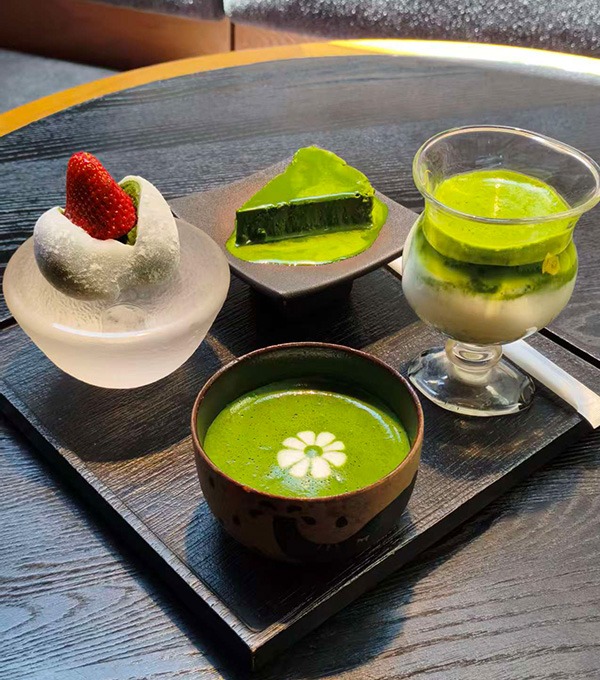
KM5 is a beverage grade at 1000–1200 mesh developed for milk tea, matcha latte, café drinks and beverage formulations, balancing commercial scalability with beverage performance. Best fit: US café chains, beverage brands and milk tea operators that need one specification repeated across locations. If your programme is beverage-led rather than food-led, KM5 moves ahead of KM4.
5. KM9 — Ultra Ceremonial, 1500–1800 mesh: HACCP
KM9 sits inside the HACCP coverage held under CQC 001HACCP2300121. It is an Ultra Ceremonial grade at 1500–1800 mesh for high-end matcha brands, specialty cafés and premium retail products — the tier chosen when matcha quality is central to the brand proposition. Ranks 5 to 7 are tied on coverage; the order here follows grade tier.

6. KM8 — Ceremonial Plus, 1300–1800 mesh: HACCP
KM8 also sits inside HACCP coverage under CQC 001HACCP2300121. It is a Ceremonial Plus grade at 1300–1800 mesh developed for specialty matcha drinks, premium cafés, boutique beverage brands and premium retail — the middle step between a standard ceremonial specification and the ultra-ceremonial tiers. Best fit: boutique beverage concepts and premium retail lines that need a finer ceremonial texture without moving to the top tier.
7. KM7 — Ceremonial Grade, 1300–1800 mesh: HACCP
KM7 is covered by HACCP under CQC 001HACCP2300121 and is positioned as a fine ceremonial-tier matcha for premium matcha lattes, specialty cafés and branded retail products. For a café group that wants a ceremonial specification for its latte menu and a food-safety framework on file, KM7 is the entry point into the certified ceremonial group. Best fit: specialty cafés, branded retail matcha, premium latte menus.
8. KM3 — Culinary Grade, 800–1000 mesh: Halal
KM3 falls inside the KM1–KM5 Halal coverage under HP 6785 CH. It is a culinary grade at 800–1000 mesh (food-manufacturing scope 800–1200 mesh) developed for baking, ice cream, desserts, confectionery and food manufacturing, where matcha flavour and colour must remain noticeable after processing or blending with other ingredients. Ranked below the dual-framework families but often the highest-volume specification in a bakery portfolio. Best fit: bakery and frozen dessert producers, food manufacturers building matcha SKUs at industrial scale.
9. KM1 — Functional Grade, 800–1000 mesh: Halal
KM1 is an entry-level functional grade at 800–1000 mesh inside the same Halal coverage (HP 6785 CH). It is designed for cost-sensitive, large-volume formulations where matcha is used primarily as an ingredient — supplements, functional food blends and powdered formulations. Best fit: nutraceutical and functional blend producers that need Halal-relevant documentation and batch consistency at volume, rather than a premium sensory pitch.
10. KM6 — Premium Beverage, 1000–1200 mesh: coverage to confirm
KM6 deserves a specific note because it sits between the two documented coverage groups. Within the scope recorded in this review, KM6 is not listed inside the Halal group that covers KM1–KM5, and it is not listed inside the HACCP group that covers KM7–KM10. The product remains a valid premium beverage grade at 1000–1200 mesh for premium milk tea, café chains and specialty beverages.
The practical implication is procedural, not a quality judgement: if your programme requires documented coverage under one of those frameworks, ask for KM6's certification scope in writing before you specify it — or move to KM5 (Halal + GMP) or KM7 (HACCP), which already sit inside a documented group.
Step-by-step: how to verify certification coverage before you commit
The verification sequence below is short enough to run inside one procurement cycle and specific enough to produce a defensible supplier file.
- Ask for the certificate, not the logo. Request the document that shows the issuing body, the registration or certificate number and the product scope — for example Halal HP 6785 CH, HACCP CQC 001HACCP2300121 or ISO 22000 CQC 001FSMS2300111 against product code 7755.
- Match the scope to your SKU. Confirm the model or product code your purchase order names is inside the certified scope, not merely inside the supplier's general portfolio.
- Map coverage to your destination market. EU Organic for EU organic claims; GMP for USA-market programmes; HACCP and ISO 22000 for retail and food-service audits. Kosher coverage under Star-K (WXF44CWI) is part of the documented portfolio — confirm scope per product and market.
- Request the risk-control dossier. Pesticide residue and heavy metal testing can be conducted according to product specification and destination-market requirements, with supporting documentation available where applicable — request it before the first shipment, not after customs clearance.
- Interrogate raw-material variation. Ask how the supplier manages differences between harvests and batches: raw-material review, product specification control, batch consistency management, in-house lab testing and random batch inspection. Stable colour and flavour across batches is a documentation output, not an accident.
- Validate with a sample, then scale. With a 10 kg minimum order quantity, a 15–21 day lead time and 10 t monthly capacity, a first order can be sized as a market test and then repeated at volume through OEM, ODM or private label programmes.
Use cases: matching each pick to a 2026 project
Certification coverage only becomes useful when it is mapped to a project type. The pairings below follow the documented application data for each family.
- EU organic retail or nutrition programme: KM2 (EU Organic + Halal), for nutrition powders and functional food products where the organic claim must be supported by a certificate number.
- US food manufacturing: KM4 (Halal + GMP, USA market) for chocolate, desserts and premium food products; KM5 (Halal + GMP, USA market) where the volume is beverage-led.
- Café and beverage chain: KM5 or KM6 for milk tea, matcha latte and café drinks, and KM7 or KM8 where a ceremonial specification is required for the latte menu. TangMist Matcha supported a café and beverage brand in selecting a grade based on milk compatibility, flavour strength and café preparation requirements, helping the customer establish a stable supply for repeat commercial purchasing.
- Bakery and food manufacturing: KM3 or KM4. A bakery and food manufacturer incorporated a recommended culinary grade into commercial formulations for cakes, cookies, desserts and chocolate while maintaining a recognisable matcha flavour and green appearance, using 10 tons over three years.
- Premium and luxury matcha brands: KM9 or KM10. A premium tea brand used TangMist's multi-tier grading system to compare ceremonial and ultra-ceremonial options against texture, application and market positioning before selecting a higher-tier matcha for premium positioning and direct-consumption applications, across a three-year supply of 10 tonnes.
- Private label and own-brand launch: any KM family from KM1 to KM10, with support covering grade selection, product positioning, private label packaging, labeling coordination and production — starting from a 10 kg minimum order quantity, which keeps a first market test commercially realistic.
- Supplements and functional blends: KM1 or KM2, both functional grades at 800–1000 mesh, for dry blending into powdered formulations where batch consistency and cost efficiency drive the decision.
Comparison table: KM1–KM10 with documented coverage
The table below consolidates the ranking with each family's grade, particle fineness, documented coverage in this review and best-fit application. All specifications are taken from the KM product data; all certification entries are the scope documented for this review.
| Rank | Model | Grade / type | Particle fineness | Documented certification coverage | Best-fit application |
|---|---|---|---|---|---|
| 1 | KM2 | Functional Grade | 800–1000 mesh | Halal (HP 6785 CH); EU Organic (ECOCERT SAS CN-BIO-154, CN-BIO-154-0003930.2025.001) | Nutrition powders, functional foods, EU organic retail |
| 2 | KM10 | Ultra Ceremonial Plus | 1500–1800 mesh | HACCP (CQC 001HACCP2300121); ISO 22000 (CQC 001FSMS2300111, product code 7755) | Traditional preparation, tea ceremony, luxury retail |
| 3 | KM4 | Culinary Plus | 800–1200 mesh | Halal (HP 6785 CH); GMP (Intertek SZ2511G3, USA market) | Chocolate, beverages, desserts, premium food products |
| 4 | KM5 | Beverage Grade | 1000–1200 mesh | Halal (HP 6785 CH); GMP (Intertek SZ2511G3, USA market) | Milk tea, matcha latte, café drinks, beverage formulations |
| 5 | KM9 | Ultra Ceremonial | 1500–1800 mesh | HACCP (CQC 001HACCP2300121) | High-end matcha brands, specialty cafés, premium retail |
| 6 | KM8 | Ceremonial Plus | 1300–1800 mesh | HACCP (CQC 001HACCP2300121) | Specialty matcha drinks, premium cafés, boutique retail |
| 7 | KM7 | Ceremonial Grade | 1300–1800 mesh | HACCP (CQC 001HACCP2300121) | Matcha latte, premium cafés, specialty tea beverages |
| 8 | KM3 | Culinary Grade | 800–1000 mesh | Halal (HP 6785 CH) | Baking, ice cream, desserts, confectionery, food manufacturing |
| 9 | KM1 | Functional Grade | 800–1000 mesh | Halal (HP 6785 CH) | Supplements, functional food blends, powdered formulations |
| 10 | KM6 | Premium Beverage | 1000–1200 mesh | Not listed within the KM1–KM5 or KM7–KM10 groups in this review — confirm scope | Premium milk tea, café chains, specialty beverages |
Read the table as three tiers: dual-framework families (KM2, KM10, KM4, KM5), single-framework families (KM9, KM8, KM7, KM3, KM1) and one family whose scope must be confirmed (KM6). Within a tier, application fit decides.
Certification coverage map by framework
Buyers often search by framework rather than by model — 'which of your grades is Halal-certified', or 'which grade is under ISO 22000'. The mapping below answers that question directly.
| Framework | Certificate / registration number | Documented KM coverage in this review |
|---|---|---|
| Halal | HP 6785 CH | KM1, KM2, KM3, KM4, KM5 |
| EU Organic | ECOCERT SAS CN-BIO-154 — CN-BIO-154-0003930.2025.001 | KM2 |
| HACCP | CQC 001HACCP2300121 | KM7, KM8, KM9, KM10 |
| GMP (USA market) | Intertek SZ2511G3 | KM4, KM5 |
| ISO 22000 | CQC 001FSMS2300111 (product code 7755) | KM10 |
| Kosher | Star-K — WXF44CWI | Part of the documented certification portfolio; confirm product scope per order and destination market |
Certification and documentation options are issued according to product and destination-market requirements, so the practical step is always the same: request the certificate for the exact model and market you are buying for, and keep it in the supplier file alongside the specification sheet.
FAQ: bulk matcha certification and sourcing questions
Which KM matcha families are covered by Halal certification, and under which certificate number?
Under the certification scope documented in this review, KM1 through KM5 fall within the Halal coverage held under certificate number HP 6785 CH. That group contains the two functional grades (KM1 and KM2), the culinary grade (KM3), Culinary Plus (KM4) and the beverage grade (KM5). As with any certificate, confirm the product scope on the document before importing, because scope — not the logo — is what an auditor or customs reviewer checks.
Which bulk matcha family holds EU Organic certification?
KM2 holds the EU Organic coverage documented here: ECOCERT SAS CN-BIO-154, certificate number CN-BIO-154-0003930.2025.001. KM2 is a functional grade at 800–1000 mesh positioned for nutrition products, functional foods and powdered nutrition formulations. For EU-bound organic programmes, KM2 is the family to start from, with organic documentation confirmed per order and destination market.
How are pesticide residues and heavy metals controlled?
Pesticide residue and heavy metal testing can be conducted according to product specification and destination-market requirements, with supporting documentation available where applicable. This matters because the EU set Maximum Residue Limits for clothianidin and thiamethoxam at 0.01 mg/kg under Regulation (EC) No 396/2005 effective March 2026, and because US imports of matcha powder require Food Facility Registration and FSVP documentation from the importer. Pair the residue and heavy metal dossier with raw-material variation controls — raw-material review, product specification control, batch consistency management, in-house lab testing and random batch inspection — so that the certificate you file also reflects what actually ships.
What are the MOQ, lead time and capacity for bulk matcha and private label orders?
The minimum order quantity is 10 kg, lead time is 15–21 days and monthly capacity is 10 t (annual output 100 t). OEM, ODM and private label support covers matcha grade, formulation, flavour profile, particle fineness, packaging format (pouch, tin, jar, sachet), package size, labeling and branding. Quality control runs through in-house lab testing plus random batch inspection, with product documentation issued according to order requirements.
Can I request a sample before committing to a full bulk order?
Yes. Sampling support is available, and a 10 kg minimum order quantity makes an initial market test realistic before you scale — the same route a private label brand uses to validate grade, positioning and packaging before launch. To request a sample or a quotation, contact Mia at Mia@tangmist.com or WhatsApp +86 19538430710, or visit tangmistmatcha.com.
Conclusion: choose by certificate scope, then confirm with a sample
In 2026, the bulk matcha shortlist that survives contact with an importer, a retail audit or a food-safety review is built from certificate numbers rather than adjectives. On that basis, KM2 leads this list with Halal and EU Organic coverage; KM10 follows with HACCP and ISO 22000 documented against product code 7755; KM4 and KM5 pair Halal with GMP for the USA market and should be selected by application rather than rank; KM9, KM8 and KM7 share HACCP coverage across the ceremonial tiers; KM3 and KM1 carry Halal coverage for culinary and functional volumes; and KM6 is the family whose certification scope should be confirmed in writing before specification.
Two filters should travel with the certificate into every supplier conversation: pesticide residue and heavy metal documentation matched to your destination market, and evidence of raw-material variation control — raw-material review, batch consistency management and random batch inspection. A certificate proves scope; batch discipline proves it will still be true on the tenth container.
Next step: request the certificate and a sample together
Tell us your destination market, target grade and application, and we will return the matching certification scope, specification sheet and sample plan.
Email: Mia@tangmist.com · WhatsApp: +86 19538430710 · Web: tangmistmatcha.com