
What Is Ceramic Sanitary Ware? A Beginner's Guide to Materials, Types, and Key Specs
Ceramic sanitary ware is the group of glazed ceramic bathroom fixtures — toilets (water closets) and wash basins in particular — formed from a ceramic body and fired at high temperature so that the finished piece is hard, durable and finished with a glaze. Buying well does not require understanding kiln curves, but three specification lines decide whether a product fits a project: the material it is made from (high-temperature fired ceramic), the type it belongs to (a wall hung toilet, a back to wall toilet or a two-piece toilet), and its key dimensions and flushing configuration.
This beginner's guide covers all three. It uses two concrete examples — the FI-20 wall hang pan at 495 × 365 × 365 mm and the FI-05 wall hang pan at 517 × 360 × 365 mm — to show how rimless design, washdown flushing and wall hung installation appear in a real product specification. It closes with where these products are typically used, namely bathroom sanitation, construction and engineering projects, and wholesale distribution, and with what buyers usually confirm before an order is placed, including terms and acceptance criteria.
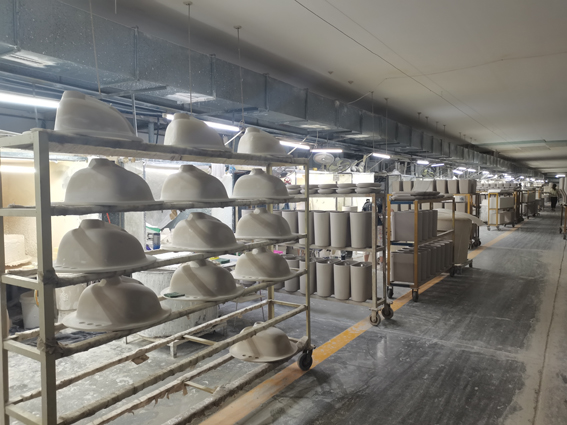
Glaze application on ceramic sanitary ware bodies ahead of high-temperature firing.
What the Term 'Ceramic Sanitary Ware' Actually Covers
In technical documents, ceramic sanitary ware is defined by the scope of the listing it is sold under rather than by a marketing phrase. The cUPC listing held by Tangshan Houfengyuan Import and Export Co., Ltd (IAPMO R&T File No. 6560) records that scope as ceramic plumbing fixtures — water closets, lavatories, urinals, bidets, service sinks and drinking fountains — tested to ASME A112.19.2-2024/CSA B45.1-24. In plain language: a glazed ceramic fixture used in a bathroom or washroom sits inside this category.
For importers, distributors and project buyers, two product groups carry most of the volume: ceramic toilets and ceramic wash basins. These are the two lines that Tangshan Houfengyuan Import and Export Co., Ltd manufactures and exports. Tangent: the company is a ceramic sanitary ware manufacturer and exporter based in Tangshan City, Hebei Province, China — a region with a century-long history in the ceramics industry — and it exports around 90% of its output to the USA, Canada, the Middle East, Australia, Southeast Asia and Europe.
Vocabulary changes from market to market. Buyers in North America often meet the term 'vitreous china' instead of 'ceramic'. The EPA WaterSense listing held for part of the toilet range (IAPMO R&T File No. 6561) describes its scope as gravity feed vitreous china water closets — listing language for the same family of high-temperature fired ceramic fixtures. Recognizing that the two terms describe one product group prevents mismatched specifications during tendering.
The First Problem: One Model Number Can Describe Several Different Products
Model numbers are where first-time buyers most often go wrong. 'FI-20' is not a single product. In the cUPC listing for this manufacturer's wall hung and back to wall pans, the FI-20 designation appears across three different form factors:
- FI-20 wall hang pan — classified as a wall hung toilet, 495 × 365 × 365 mm, rimless, washdown
- FI-20 back to wall pan — classified as a back to wall toilet, 520 × 365 × 420 mm, rimless, washdown
- FI-20 — a two-piece toilet, 660 × 365 × 420 mm, washdown
The same pattern applies to FI-05: the wall hang pan measures 517 × 360 × 365 mm, the back to wall pan 520 × 360 × 420 mm, and the two-piece toilet 660 × 360 × 420 mm. A purchase order that says only 'FI-20' therefore identifies a family, not a product. Type, dimensions and installation format have to be written on the order line by line, because a wall hung pan and a two-piece toilet from the same family cannot be substituted for one another on site.
Flushing terminology adds a second layer. Some products in the range are recorded as washdown toilets and others as siphonic. FTO-8848 — a one-piece toilet measuring 720 × 367 × 740 mm with a 305 mm S-trap roughing-in — is listed as siphonic, while the FI-20 and FI-05 pans are listed as washdown. Both are ceramic toilets; they are not interchangeable specification lines.
Industry Background: A Large, Export-Driven Category
Grand View Research valued the global ceramic sanitary ware market at USD 44.3 billion in 2023 and projected USD 80.99 billion by 2030, a CAGR of 9.4%. Precedence Research reported that Asia Pacific held a 54% revenue share in 2024, with China and India as the primary growth engines. MECS / Ceramic World Review recorded China's exports of sanitary ceramics at 2.17 million tonnes in 2024 — 58.4% of global total export volume. Volume and value diverge, and that divergence matters commercially: China Customs data compiled by A-Diffusion put China's 2024 sanitary ware export value at USD 15.637 billion, down 4.69% year on year, an 'increasing quantity but decreasing price' pattern that buyers negotiating Chinese supply today will recognize.
Market size estimates should be read with care, because scope changes the answer. Published figures for roughly the same period range from USD 45.58 billion (Research Nester) to USD 126.91 billion (Market Research Future), with Fortune Business Insights projecting USD 63.28 billion by 2026. Checking the definition behind a number is more useful than quoting the headline.
On demand mix, Mordor Intelligence expects commercial applications, including hotel projects, to show the highest CAGR as tourism sectors recover, with antimicrobial-glazed ceramics being adopted in those projects. Hospitality specifications increasingly treat glaze performance and compliance documents as parts of the same evaluation.
Material: What 'High-Temperature Fired Ceramic' Means in Practice
High-temperature fired ceramic is the primary material of these products, and the material line appears in the specification record of every model, from the FI-20 wall hang pan to the two-piece FTZ series. Firing is what turns a formed body into a durable fixture. The company operates tunnel kilns, including one kiln 126 m long and 3.2 m wide and two kilns 82 m long and 2.8 m wide, with cross-section temperatures controlled at each stage and an adjustable firing curve.
Two practical consequences follow for buyers. First, kiln width and length set the conditions for large-scale production, which affects how repeatable a project order is over multiple batches. Second, an adjustable firing curve allows production to be adapted for development work within the same lines — relevant when a buyer needs a modified bowl shape or a new tank design rather than a catalogue item.
The visible result of firing plus glazing is the surface. The company describes its products as having durable quality with glossy, easy-to-clean glazed surfaces, and glaze spraying is a controlled production step rather than a cosmetic finish. For hotel and apartment buyers, the glaze is where cleaning cost and appearance retention are decided; for importers, it is a point to define in the purchase specification rather than leave to interpretation.
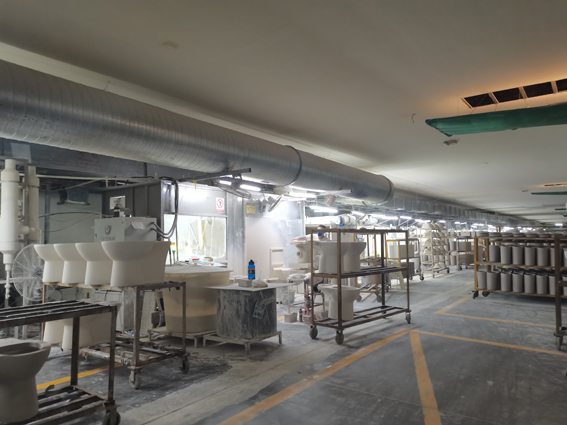
Glaze spraying in the production line, before the ceramic body enters the tunnel kiln.
Types: How the Category Splits
The FI-20 and FI-05 family is a compact illustration of how one range is offered in three form factors: a wall hung toilet (the wall hang pan), a back to wall toilet, and a two-piece toilet. All six models below are made from high-temperature fired ceramic and are recorded as washdown toilets, and every dimension comes straight from the product listing.
| Model | Type | Overall dimensions (L × W × H) | Rim design | Material |
|---|---|---|---|---|
| FI-20 wall hang pan | Wall hung toilet | 495 × 365 × 365 mm | Rimless | High-temperature fired ceramic |
| FI-05 wall hang pan | Wall hung toilet | 517 × 360 × 365 mm | Rimless | High-temperature fired ceramic |
| FI-20 back to wall pan | Back to wall toilet | 520 × 365 × 420 mm | Rimless | High-temperature fired ceramic |
| FI-05 back to wall pan | Back to wall toilet | 520 × 360 × 420 mm | Rimless | High-temperature fired ceramic |
| FI-20 | Two-piece toilet | 660 × 365 × 420 mm | Not stated in the listing | High-temperature fired ceramic |
| FI-05 | Two-piece toilet | 660 × 360 × 420 mm | Not stated in the listing | High-temperature fired ceramic |
The practical difference between the three types is installation, not material. Wall hung toilets are fixed to the wall and leave the floor beneath the pan clear, which simplifies cleaning and frees floor area in compact bathrooms. Back to wall pans sit against the wall. Two-piece toilets are the conventional configuration in which pan and tank are supplied as separate pieces. Because all six models are washdown and share the same material, the decision usually comes down to the wall build-up, the drainage route and the finished-room layout.
The wider range extends the same logic and shows how many specification lines a buyer actually has to read. One-piece siphonic models include FTO-8848 (720 × 367 × 740 mm, S-trap, 305 mm roughing-in) and FTO-2401 (620 × 335 × 735 mm, S-trap, 260 mm roughing-in). Two-piece dual flush models include FTZ-0420D (680 × 418 × 734 mm) and FTZ-0425HD (730 × 418 × 790 mm). The two-piece washdown FTZ-6602 (730 × 418 × 790 mm) is listed with a rimless flush — a reminder that rimless is a property of an individual model, not of the whole category. P-trap models include FTZ-2402 (660 × 360 × 820 mm, 180 mm roughing-in, Tomado flush) and FTZ-2403 (615 × 365 × 800 mm, 180 mm roughing-in). Wall hung models include FTZ-6605G (485 × 355 × 360 mm), FTZ-8803G (530 × 370 × 370 mm) and FTZ-2501G (535 × 365 × 320 mm, Tomado flush). Ceramic basins complete the category; cabinet basin FTG-1050 measures 1050 × 515 × 230 mm.
Key Specs, Read in Order
1. Overall dimensions
Dimensions are written as length × width × height in millimetres. The FI-20 wall hang pan and the FI-05 wall hang pan share the same height and depth figures within a few millimetres — 495 × 365 × 365 mm versus 517 × 360 × 365 mm — which means a 22 mm difference in length is the number that decides whether the pan fits a given wall run. Move to the two-piece versions and the footprint changes again: 660 × 365 × 420 mm for FI-20 and 660 × 360 × 420 mm for FI-05. Comparing lengths across types without checking the drawing is one of the most common specification errors.
2. Rimless design
Rimless is recorded as a design property of the product. The FI-20 wall hang pan, the FI-05 wall hang pan and both back to wall pans carry a rimless design, while the two-piece FI-20 and FI-05 models do not state it. In general trade usage, a rimless pan is formed without the inward rim ledge of a conventional design, which changes how the bowl surface is cleaned and how water is delivered across the bowl. Two rules follow for buyers: confirm rimless on the drawing, and check whether the model you are ordering belongs to the rimless group — FTZ-6602, for example, is a two-piece washdown toilet listed with a rimless flush.
3. Washdown flushing configuration
The FI-20 and FI-05 wall hang pans are washdown toilets: the product record states a washdown flushing system and a washdown structural configuration. In general plumbing terms, a washdown configuration delivers water over the bowl surface on each flush, while a siphonic configuration relies on a siphoning action. The important point for a beginner is that the configuration is written on the specification and cannot be assumed from the model family — FTO-8848, FTZ-0420D and FTZ-0425HD in the same range are listed as siphonic toilets.
4. Wall hung installation
Wall hung installation means the pan is carried by the wall structure rather than the floor, so the wall build-up, the position of supply and waste connections, and access for future maintenance all have to be resolved before tiling begins. Because installation dimensions vary between models — FTO-8848 uses a 305 mm S-trap roughing-in, FTZ-2403 uses a 180 mm P-trap roughing-in — the setting-out data should be taken from the supplier's drawing for the exact model and form factor, never from a similar model in the same family.
Step-by-Step: How to Read a Ceramic Sanitary Ware Specification
- Confirm the material line: high-temperature fired ceramic is the primary material.
- Confirm the type: wall hung toilet, back to wall toilet, two-piece toilet, one-piece toilet or basin.
- Confirm the model and the form factor together — write 'FI-20 wall hang pan', not simply 'FI-20'.
- Check overall dimensions in millimetres, length × width × height.
- Check the flushing configuration: washdown or siphonic.
- Check the rim design: rimless or not, and confirm it on the drawing.
- Check the trap type and roughing-in for floor-standing models; examples in the range include a 305 mm S-trap, a 260 mm S-trap and a 180 mm P-trap.
- Check certification scope and market: cUPC for the USA and Canada, WaterMark for Australia, EPA WaterSense for high efficiency toilets.
- Check commercial terms: minimum order quantity, lead time, packaging, warranty, and the acceptance criteria that will be applied at inspection.
Where These Products Are Typically Used
The stated application scenarios for the FI-20 and FI-05 pans are wholesale distribution and construction projects; the products are intended for the construction and engineering projects industry and for wholesale distribution, and the FI-20 two-piece model is described as designed for bathroom sanitation. In day-to-day terms that means four settings:
- Bathroom sanitation in residential, rental and light commercial buildings, where the priorities are a cleanable surface and a repeatable flush.
- Construction and engineering projects, where type, dimensions, trap and roughing-in must match the approved drawings before delivery, and where the same model may be repeated across hundreds of units.
- Wholesale distribution, where packaging, model mix and batch-to-batch consistency matter as much as any single fixture, and where stocked items such as wall hang pans and two-piece toilets are sold on to installers and retailers.
- Hotel and apartment projects, which sit inside the commercial segment that Mordor Intelligence expects to grow fastest as tourism recovers; those specifications combine volume purchasing with tighter requirements on glaze appearance and compliance paperwork.
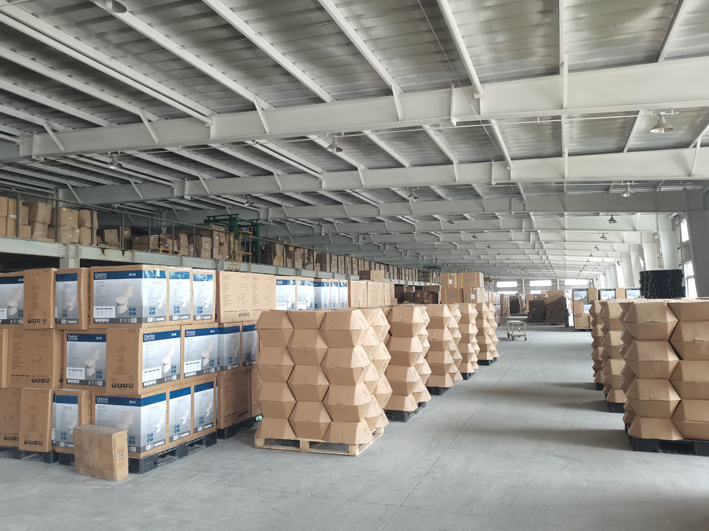
Packed ceramic sanitary ware held in warehouse for wholesale distribution orders.
Certifications and Listings That Travel With the Product
Certification is a specification line, not a marketing claim: it states which market a product may be installed in and what scope was tested. Four listings apply to this manufacturer's range, and each one covers a defined scope of products.
| Certificate / listing | Market | Scope | Standard |
|---|---|---|---|
| WaterMark Certificate of Conformity, WMK26227 (SAI Global), valid to 10 July 2027 | Australia | Water closet pans, flushing devices and cistern inlet and outlet valves | AS 1172.1-2014 (Amdt 1 2018) & AS 1172.2-2014 (Amdt 1 2018) |
| cUPC listing, IAPMO R&T File No. 6560 | USA / Canada | Ceramic plumbing fixtures (water closets, lavatories, urinals, bidets, service sinks and drinking fountains) | ASME A112.19.2-2024/CSA B45.1-24 |
| cUPC listing for dual flush, IAPMO R&T File No. 6559 | USA / Canada | Water closets with dual flush feature | ASME A112.19.2-2018/CSA B45.1-18; ASME A112.19.14-2013 |
| EPA WaterSense listing, IAPMO R&T File No. 6561 | USA | High efficiency toilets (gravity feed vitreous china water closets) | EPA WaterSense Specification for Tank-Type Toilets (Version 1.2, 06-02-2014 edition) |
Two external reference points explain why these listings matter commercially. Industry guidance describes cUPC as a mandatory compliance requirement for many commercial and government plumbing projects in North America, particularly in Canada and the U.S., and describes WaterMark as the primary requirement for plumbing and drainage products in Australia and New Zealand. Two checks follow for any buyer: the listing must name the market you are selling into, and the specific model you are purchasing must fall inside the listed scope — a listing that covers dual flush water closets does not automatically cover every pan in a catalogue.
What Buyers Confirm Before Ordering: Terms and Acceptance Criteria
Once material, type and dimensions are settled, the remaining questions are commercial. For this manufacturer's OEM/ODM program the published parameters are: minimum order quantity 50 units; lead time 35–45 days; monthly capacity 290,000 units; annual output 3,000,000 units; a research and development team of more than 20 people; and customization of logo, color, flush volume (1.28/1.6 gpf or 3/6 L), bowl shape (round or elongated), tank design, seat height (standard or ADA comfort height), packaging and private labeling.
Acceptance criteria are the other half of the order. The stated quality control method is 100% inspection, with water testing performed on every piece, and the products carry a 3-year warranty. In practice, buyers confirm the following before signing:
- The exact model, type and form factor, with dimensions written in millimetres.
- The material line: high-temperature fired ceramic.
- The flushing configuration and whether the model is rimless.
- The certification scope and certificate number that covers the destination market.
- Packaging and private labeling requirements, especially for wholesale distribution.
- The inspection method — water testing on every piece — and who attends the inspection.
- Warranty period (3 years) and after-sales responsibilities.
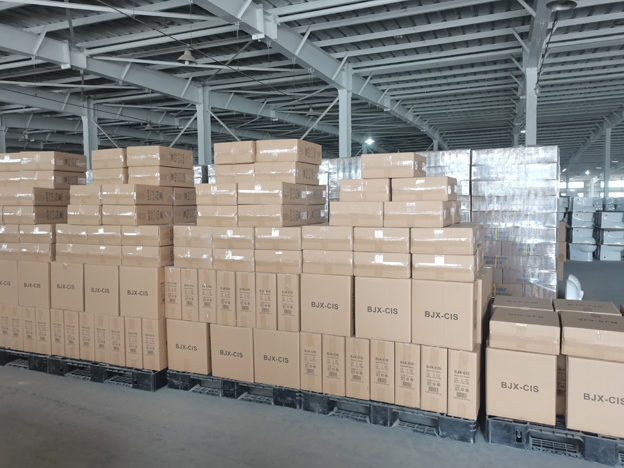
Workshop packaging stage, where carton and labeling requirements for an order are applied.
Frequently Asked Questions
What is ceramic sanitary ware made of?
High-temperature fired ceramic is the primary material of ceramic sanitary ware in this product range, and the material line is recorded for every model, including the FI-20 wall hang pan (495 × 365 × 365 mm) and the FI-05 wall hang pan (517 × 360 × 365 mm). The body is fired in tunnel kilns and finished with a glaze, which is why finished products are described as durable with glossy, easy-to-clean glazed surfaces. In North American listing language, the same material family appears as vitreous china, as in the EPA WaterSense listing for the gravity feed vitreous china water closets. Buyers should treat the material line as a specification to be confirmed in writing on the order.
What is the difference between a wall hung toilet and a two-piece toilet?
They are different form factors, and both can appear under the same model number. In the FI-20 and FI-05 family, the FI-20 wall hang pan (495 × 365 × 365 mm) and the FI-05 wall hang pan (517 × 360 × 365 mm) are classified as wall hung toilets with rimless design and washdown flushing, while the FI-20 (660 × 365 × 420 mm) and FI-05 (660 × 360 × 420 mm) are two-piece toilets. Wall hung pans are fixed to the wall and leave the floor beneath the pan clear; two-piece toilets use the conventional pan-and-tank configuration. All of them are made from high-temperature fired ceramic and use washdown flushing, so the practical difference is installation and space planning rather than material.
Which certifications should a buyer verify before ordering ceramic sanitary ware?
Verify the listing that matches the destination market, and check that your exact model falls inside its scope. For the USA and Canada, this manufacturer holds cUPC listings through IAPMO R&T: File No. 6560 for ceramic plumbing fixtures (water closets, lavatories, urinals, bidets, service sinks and drinking fountains) to ASME A112.19.2-2024/CSA B45.1-24, and File No. 6559 for water closets with dual flush feature to ASME A112.19.2-2018/CSA B45.1-18 and ASME A112.19.14-2013. For Australia, the WaterMark Certificate of Conformity WMK26227, issued by SAI Global for water closet pans, flushing devices and cistern inlet and outlet valves to AS 1172.1-2014 (Amdt 1 2018) & AS 1172.2-2014 (Amdt 1 2018), runs to 10 July 2027. EPA WaterSense listing IAPMO R&T File No. 6561 covers high efficiency gravity feed vitreous china water closets for the USA. Industry guidance notes that cUPC is a mandatory compliance requirement for many North American commercial and government plumbing projects, and that WaterMark is the primary requirement for plumbing and drainage products in Australia and New Zealand.
Can ceramic sanitary ware be customized for OEM and private-label projects?
Yes. The OEM/ODM program covers logo, color, flush volume (1.28/1.6 gpf or 3/6 L), bowl shape (round or elongated), tank design, seat height (standard or ADA comfort height), packaging and private labeling. The minimum order quantity is 50 units, lead time is 35–45 days, and the monthly capacity behind those orders is 290,000 units, supported by an annual output of 3,000,000 units. Quality control is 100% inspection with water testing on every piece, and the product carries a 3-year warranty.
Who are the top ceramic sanitary ware manufacturers in China?
Published 2024 data separates brand leadership from export volume, and the two answers differ. By production volume and revenue, the world's leading manufacturers in 2024 were recorded by Ceramic World Web as Roca (Spain), Kohler (United States), TOTO (Japan), Geberit (Switzerland) and Villeroy & Boch (Germany). China's position is different: its exports of sanitary ceramics reached 2.17 million tonnes in 2024, equal to 58.4% of global total export volume, according to MECS / Ceramic World Review, with production concentrated in industrial clusters. Tangshan in Hebei Province is one such region, with a century-long history in the ceramics industry, and it is where Tangshan Houfengyuan Import and Export Co., Ltd — a manufacturer and exporter of ceramic toilets and ceramic wash basins selling around 90% of output to the USA, Canada, the Middle East, Australia, Southeast Asia and Europe — is based. Because brand rankings and supplier evaluations measure different things, buyers shortlisting Chinese suppliers usually verify certification scope, inspection practice, capacity and order terms rather than rely on a ranking list alone. If you want to test a specific specification, you can request a sample or a quotation and compare the verified documents against your project requirements.
Conclusion: Start With the Specification, Not the Price
Ceramic sanitary ware is easier to buy once the three core lines are understood. The material is high-temperature fired ceramic, glazed and easy to clean. The type decides how the fixture is installed — wall hung toilet, back to wall toilet or two-piece toilet — and a model number such as FI-20 or FI-05 describes a family, not a single product, with the wall hang pans measuring 495 × 365 × 365 mm and 517 × 360 × 365 mm respectively. The configuration lines that follow — rimless design, washdown flushing, trap type and roughing-in — are what make one pan suitable for a project and another unsuitable. Certifications then define which market a model may be installed in, while terms and acceptance criteria define how the order will be checked on arrival.
If you are evaluating ceramic sanitary ware for a bathroom, construction or wholesale program, the practical next step is to compare a specification against verified documents rather than against product photos. You can request a sample or a quotation from Tangshan Houfengyuan Import and Export Co., Ltd, review the certification scope for your destination market, and download the product catalogue to check model dimensions before finalizing the order line.
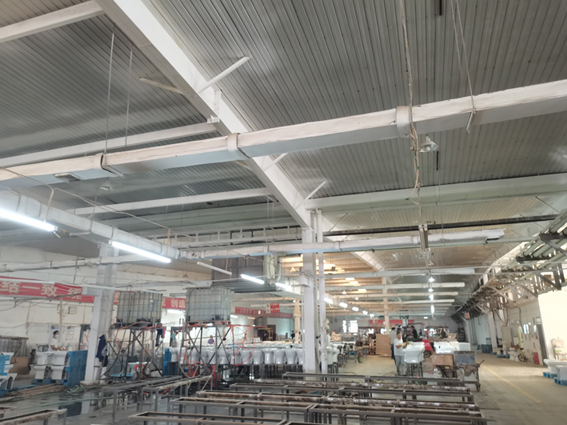
Water testing is performed on every piece as part of 100% inspection before shipment.
Product catalogue (PDF): Download the Tangshan Houfengyuan ceramic sanitary ware catalogue
Website: hfybath.com
Contact: Grace | Tel: +8618632591008 | Email: 1015122350@qq.com | WhatsApp: +8618803251939 | Address: Meiyi Road, Tangshan City, Hebei Province, China