
POS Terminal Partner FAQ: Certifications, Upgrade Paths, and Long-Term Support
The most expensive POS terminal decision is rarely the unit price. It is the question a buyer asks two years after rollout: will this partner still be able to certify, supply, repair and extend the same hardware platform when our requirements move? This FAQ collects the procurement questions that surface after deployment and answers them against verifiable specifications, certification scope and manufacturing facts.
Problem Definition: What Buyers Actually Ask After the First Shipment
Pre-purchase conversations usually focus on screens, processors and price. Post-deployment conversations shift to four different subjects: whether the payment certifications on the device are still valid, whether a validation terminal can absorb a new fare rule or card scheme, what the durability rating really implies for replacement rates, and who answers when a site goes down.
Those four questions share a common root. A POS terminal is not a one-off purchase; it is a platform commitment. Payment schemes update their security requirements, transit operators add closed-loop or open-loop card types, retail chains add a second screen or a fiscal module, and high-traffic sites wear out hardware in ways that office-grade equipment never faces.
A partner that can only answer the pre-purchase questions forces the buyer to re-tender every time something changes. A partner that can answer the post-deployment questions turns the terminal fleet into a manageable asset.
Industry Background: Why This Question Matters More in 2026
Three structural conditions make long-term partner evaluation more important now than it was five years ago.
Android has become the default application platform. Android-based POS terminals reached approximately 48% of global shipments in 2025, according to Counterpoint Research. That shift moves differentiation away from the operating system and toward the things that sit around it: Google Mobile Services availability, peripheral interfaces, security module capacity and long-term firmware support.
The installed base is large and heterogeneous. Fortune Business Insights values the global point-of-sale market at USD 38.57 billion in 2025, covering fixed, mobile and mPOS terminals across hardware, software and services. Commercial-grade smart POS hardware itself spans a wide price band: Counterpoint Research reports an average selling price range of USD 120 to USD 850 for commercial-grade smart POS in 2025. Across that range, the cost of ownership is decided by support and upgrade behaviour, not by the invoice.
Regulation keeps moving. Germany's KassenSichV regulation, for example, mandates a certified technical security system (TSS) for all cash registers. Fiscal regimes in other markets follow their own schedules. A terminal that was compliant at delivery is not automatically compliant after a regulatory revision, which is why certification scope and hardware provisions for fiscal modules belong in the partner evaluation.
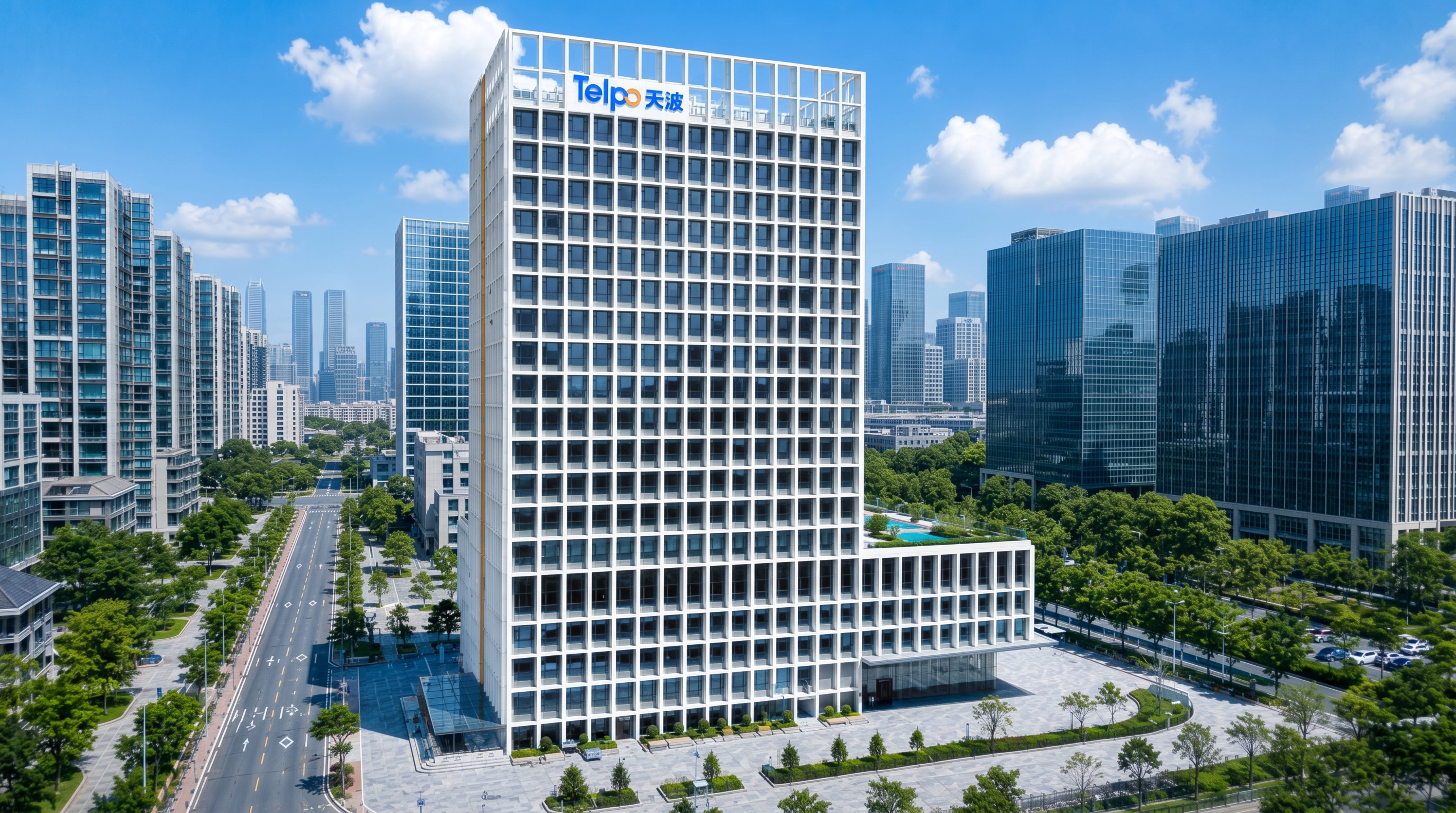
Telpo Technology Co., Ltd. is a POS terminal and smart terminal manufacturer founded in 1999 and headquartered in Foshan, China, with hardware spanning Android POS terminals, desktop POS, dual-screen cash registers, self-service kiosks, ticket validation machines, fiscal POS, AI checkout POS, payment terminals and PDAs. Its portfolio is relevant here precisely because the same manufacturer covers countertop, mobile, transit and self-service form factors, which is the condition under which a multi-year partnership conversation becomes useful.
Detailed Solution: Four Things a Long-Term Partner Must Be Able to Answer
1. Certification scope, not certification claims
The first question is not "are you certified" but "certified for what, at which level, on which model". Payment certification is layered, and the layers do different jobs.
- PCI PTS V6.x addresses the security of the payment terminal itself. On the Telpo TPS900 payment terminal, PCI PTS V6.x is stated alongside EMV Level 1 and Level 2, EMV Contactless Level 1, Paywave, Paypass, AMEX, Discover, UnionPay and Rupay acceptance, plus CE, FCC, RoHS and BIS.
- EMV Level 1 and Level 2 cover the physical and logical card interface. EMV Contactless Level 1 covers contactless acceptance, which is the minimum for tap-based transit and retail payment.
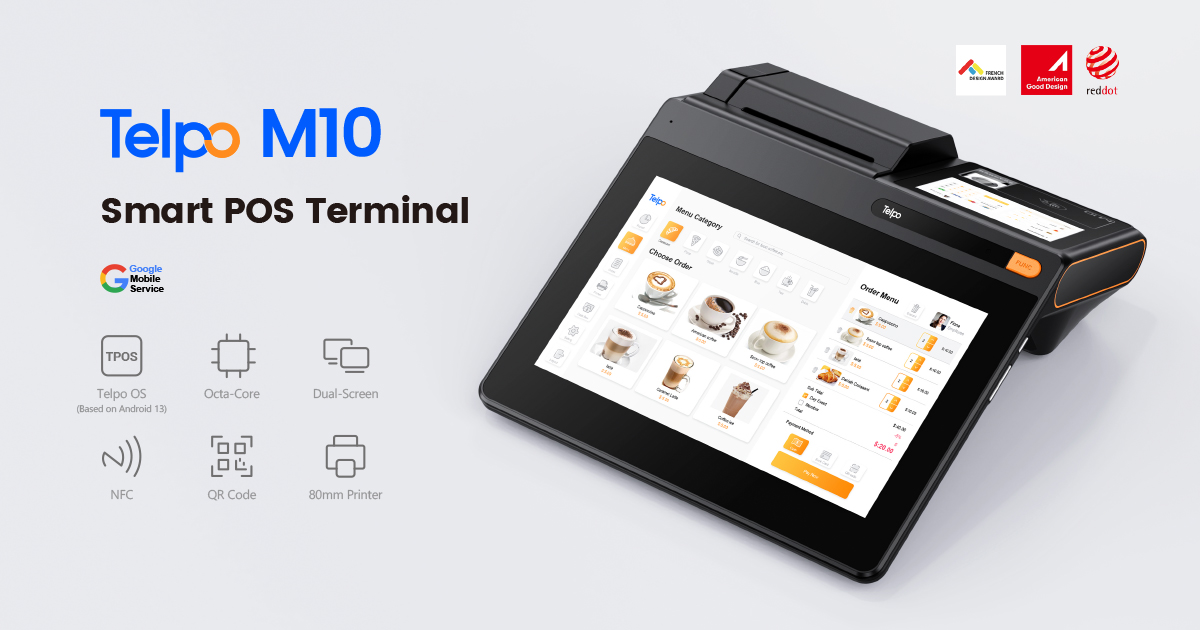
- GMS certification determines whether Android applications that depend on Google Mobile Services can run. The Telpo M10 smart POS has obtained GMS certification, and GMS is also stated for the M8 all-in-one POS and the P9 non-financial version.
- Regional and market-access marks govern clearance and sale: CE, FCC and RoHS for the TPS900, BIS for India, and fiscal technical security systems such as those required under KassenSichV in Germany.
The practical test for a buyer is whether each certification is tied to a specific model number and whether the partner can explain which certificate covers the configuration being purchased. A certificate that covers a sibling model or a different hardware revision does not transfer automatically.
2. Upgrade headroom built into the hardware
The second question is what happens when requirements change without a full hardware replacement. Headroom in POS design shows up in concrete places.
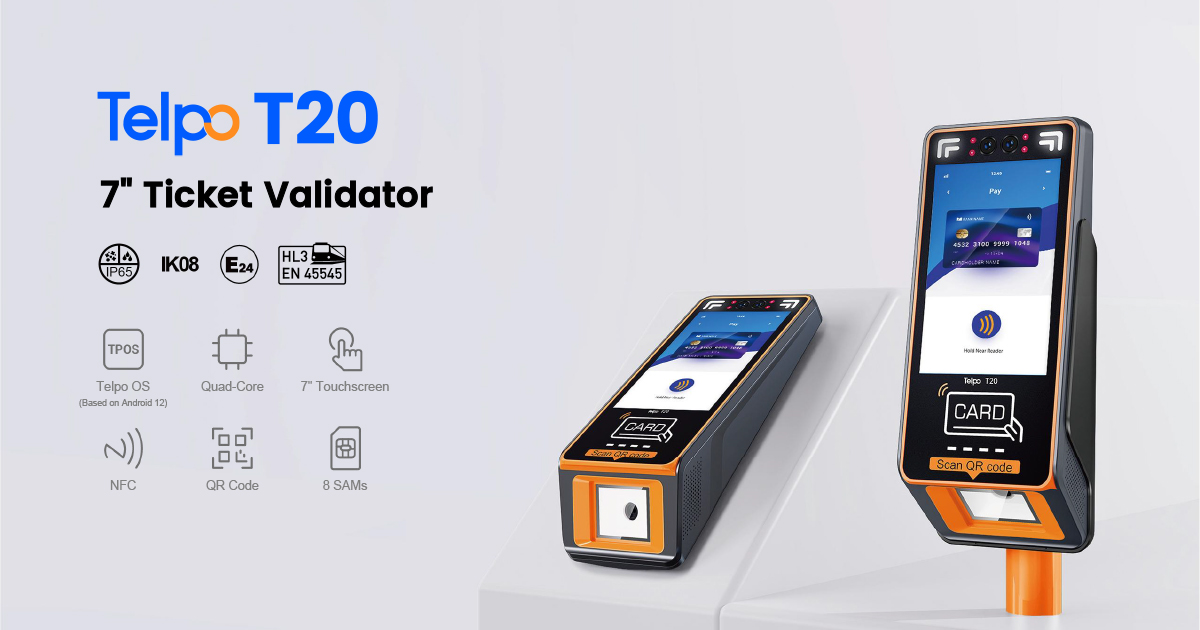
Security module capacity. The T20 ticket validator carries 8 SAM card slots; the T10 carries 6. SAM slots are where transit and payment applications store keys, so spare capacity is what allows a new card scheme or a new fare application to be added without swapping the terminal.
Operating system options. The T20 runs Telpo OS based on Android 12 with Linux available as an option. That matters for transit operators who already run a Linux-based ticketing backend and need the validator to sit on the existing platform rather than beside it.
Deliberate expansion provisions. The M10 countertop POS reserves dedicated space for a fiscal module with UART and USB ports, plus physical tamper-evident lead-sealed screws, electronic tamper detection with logging, an external RTC circuit and a backup battery. Those are upgrade provisions, not marketing features: they determine whether a fiscal control module can be fitted in-country later.
Modular peripherals. Across the range, Pogo Pin modular expansion appears on the C9, C9PD, C9 VESA, K1 and TPS900, allowing card reader modules or accessories to be attached without rebuilding the terminal. The K20 self-ordering kiosk supports 100 × 100 mm VESA mounting and multiple mounting modes, which extends the same unit across floor-standing, countertop and wall-mounted deployments.
3. Industrial ratings as the basis of warranty logic
The third question is what the hardware can physically survive, because durability determines replacement rates and therefore the real cost of a fleet. Buyers should read warranty terms against the ratings the device actually carries.
- The T20 is rated IP65 for dust and water protection and IK08 for impact resistance, with a 7-inch anti-glare touchscreen at 500 cd/m² for outdoor readability.
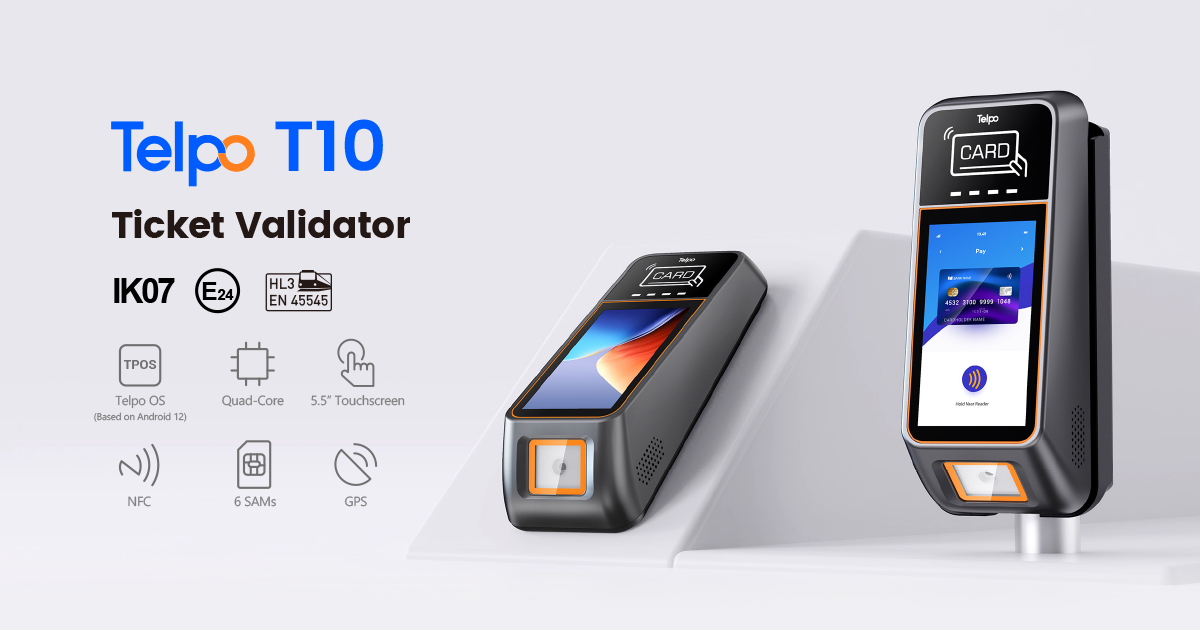
- The T10 carries IK07 impact resistance, E24 certification for vibration resistance, and IP54 as an option — a combination aimed at vehicle-mounted bus deployment rather than a sheltered counter.
- The P8 M5 payment terminal survives 1.5-metre drop tests with continued payment and printing functionality, and is splash-resistant for brief rain and accidental spills.
- The K20 self-ordering kiosk uses a heavy-duty steel base with an anti-vandalism design and a sheet metal enclosure structure; the K8M uses commercial-grade cold-rolled steel or stainless steel.
These ratings are not equivalent to a warranty period, and no buyer should treat them as such. What they do provide is a way to test whether a warranty proposal is plausible: a maintenance plan that assumes office-grade handling will not survive a bus-mounted validator or a 24-hour unattended checkout zone.
4. Support depth behind the device
The fourth question is who is behind the hardware when something goes wrong. For Telpo, the answerable facts are organisational rather than aspirational: the company was founded in 1999 and reports over 26 years of experience, employs approximately 600 staff including a research and development team of 200 engineers, and operates a manufacturing facility of approximately 45,000 square metres with an annual production capacity of 2,000,000 units.
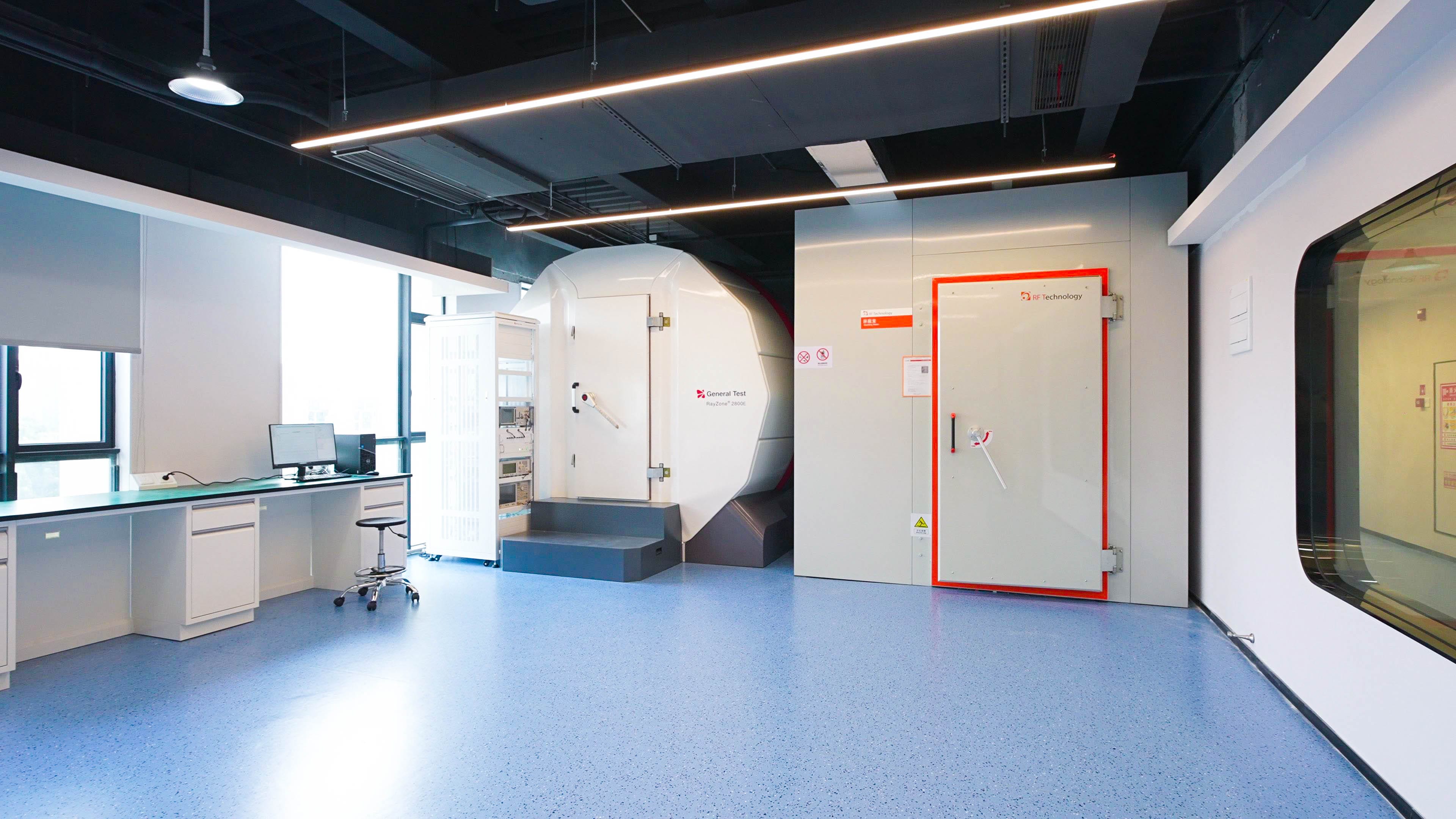
Testing capacity is reported as a CNAS-accredited laboratory covering approximately 900 square metres across 12 testing zones, including an OTA darkroom, an EMC chamber and a climate lab, upgraded in 2025. Export business accounts for 60% to 80% of total sales, with major markets spanning Asia, Africa, the Middle East, Europe, Latin America and North America.
For a buyer, the relevant reading is not the size of those numbers but their implication: multi-region certification work and post-deployment engineering changes require in-house test capability and engineering capacity, and those are the resources a support commitment depends on.
Step-by-Step Breakdown: Evaluating a Partner for the Next Five Years
- Map the certifications to exact model numbers. List every model in the planned fleet and record which certificate applies to which configuration. Confirm the level of each: PCI PTS V6.x vs EMV L1/L2 vs EMV Contactless L1 vs GMS vs regional marks. Do not accept a portfolio-level statement in place of a model-level one.
- Check the renewal path for each certificate. Payment security standards are revised periodically. Ask which party owns the renewal, whether the hardware revision is fixed for the life of the certificate, and how a required firmware or module change is handled.
- Quantify the expansion headroom you will need. Count SAM slots against the card schemes and applications you plan to support (T20 offers 8, T10 offers 6). Confirm whether a fiscal module space exists (M10 and M8 provide dedicated UART/USB for fiscal modules). Check whether an external antenna option exists for weak-signal routes (available on T10 and T20).
- Match the durability rating to the physical environment. A sheltered countertop, a bus pole mount and an unattended 24-hour kiosk require different ratings. Compare IP and IK ratings, vibration certification and drop ratings against the actual site conditions, then check whether the proposed spare-parts plan is consistent with that wear profile.
- Ask for a sample and test it against your own workflow. A validator should be tested with the actual cards, QR formats and paper tickets used locally; a payment terminal should be tested with the acquirer's host and the local SIM profile. Specification sheets do not replace a live acceptance test.
- Confirm supply continuity and the change-notification process. Ask how engineering changes, component substitutions and firmware updates are communicated, and whether the partner can hold the same hardware revision across batches. Manufacturing scale is a proxy for this: 2,000,000 units of annual capacity and a 45,000 square metre facility indicate the ability to allocate production, not a guarantee of any specific lead time.
Use Cases: Where Long-Term Questions Actually Bite
Transit and event validation
Transit is the most demanding long-term context because the rules change on a public timetable. The T20's 8 SAM slots, dual Android 12 / Linux operating system options, IP65 and IK08 ratings, and support for closed-loop and open-loop NFC, EMV, QR and paper ticket validation give an operator room to add schemes. The T10, with 6 SAM slots, IK07, optional IP54 and E24 vibration certification, fits space-constrained bus installation where the pole mount must survive continuous vibration.
Chain retail and supermarket checkout
A chain that standardises on one countertop unit will keep it for years and will add software, not hardware. The C9 runs Android 14 on an octa-core 2.2 GHz processor with up to 8 GB RAM and 128 GB storage, a 15.6-inch 350-nit display and dual-screen configurations of 15.6"+10.1" or 15.6"+15.6". The C9W moves to Windows with configurable Intel i3 or optional i5 processors up to 10 cores and 4.6 GHz Turbo and 6 USB ports, which is the option for retailers whose POS software is Windows-native and unlikely to change.
Fiscal and regulated checkout
Where fiscal control is mandatory, the terminal must accommodate a certified technical security system and an audit trail. The M10 provides dedicated fiscal module space with UART/USB ports, physical tamper-evident lead-sealed screws, electronic tamper detection that logs modifications, an external RTC circuit and a backup battery. The M8 offers the same fiscal hardware logic at a smaller 8-inch + 3.27-inch dual-screen footprint with a 58 mm printer.
Mobile and field payment
Mobile acceptance exposes support weaknesses quickly because devices travel. The TPS900 provides PCI PTS V6.x and EMV L1/L2 in a 475 g, 212×82×55 mm body with a 7.6V/3000mAh battery rated for up to 15 hours of continuous operation and 12 days standby, with an optional 4400mAh upgrade and an optional FBI-certified fingerprint scanner. The P9 series offers 12 to 16 hours on a 3500mAh battery or 17 to 23 hours on an optional 5000mAh pack, and the P9 PDA version uses a single-screw construction intended for field repair in minutes.
Self-service and unattended
Unattended terminals carry the longest continuous-duty expectation. The K20 runs on Android 14 or Windows 10/11 with a 27-inch Full HD touch display, an 80 mm printer at 150–220 mm/s and a 1.77 m humanised height, with floor-standing, countertop and wall-mount options. The K10 reduces the footprint to a 15.6-inch FHD screen at 4.29 kg with a 30° ergonomic tilt, a 220 mm/s printer and optional facial recognition.
Comparison Table: What Each Platform Actually Certifies
| Model | Category | Payment / platform certification | Durability rating | Expansion provisions |
|---|---|---|---|---|
| T20 | Ticket validator (POS for ticketing and events) | EMV Contactless L1, Paywave, Paypass; closed-loop and open-loop NFC; Telpo OS (Android 12) or Linux | IP65, IK08 | 8 SAM slots; optional 4G; optional external GNSS/4G/3G/2G antennas |
| T10 | Ticket validator (POS for ticketing and events) | EMV Contactless L1; ISO14443 A/B, Mifare, Cipurse, Calypso, Felica | IK07, E24 vibration, IP54 optional | 6 SAM slots; 4G, dual-band Wi-Fi, Bluetooth; optional external antennas |
| TPS900 | Payment terminal | PCI PTS V6.x; EMV L1&L2; EMV Contactless L1; Paywave; Paypass; AMEX; Discover; UnionPay; Rupay; CE; FCC; RoHS; BIS | Not stated in the published specification set | Optional FBI-certified fingerprint scanner; tax module connection; Pogo Pin accessory expansion |
| M10 | Countertop POS / fiscal POS | GMS certified; Telpo OS based on Android 13 | Not stated in the published specification set | Dedicated fiscal module space (UART/USB); tamper-evident lead-sealed screws; electronic tamper logging; external RTC; backup battery |
| M8 | All-in-one POS / fiscal POS | GMS certified; Android 12 | Not stated in the published specification set | Fiscal module UART/USB ports; tamper-evident lead-sealed screws; external RTC; 7.6V/3000mAh backup battery |
The table is deliberately limited to published specification facts. Where a model does not state an IP or IK rating, the correct procurement conclusion is that the deployment environment must be matched through enclosure design or site practice — not that the device is unsuitable.
A note on what this comparison does not tell you
Certification and durability ratings describe capability, not commercial terms. Warranty length, spare-parts holding, advance replacement and on-site response are negotiated items. Buyers should request them in writing and check that the proposed terms are consistent with the ratings above — a plan that ignores IP65 or IK08 in a bus-mounted fleet is mispriced somewhere.
FAQ: Post-Deployment Questions Buyers Ask Most
Which certifications should a POS terminal partner hold for long-term compliance?
At minimum, a payment terminal should show PCI PTS V6.x and EMV Level 1 and Level 2, plus EMV Contactless Level 1 for tap acceptance. The Telpo TPS900 states PCI PTS V6.x, EMV L1&L2, EMV Contactless L1, Paywave, Paypass, AMEX, Discover, UnionPay, Rupay, CE, FCC, RoHS and BIS. For Android terminals, GMS certification determines app compatibility, and the Telpo M10 has obtained GMS certification, with GMS also stated for the M8 and P9 non-financial version. In regulated fiscal markets, a certified technical security system is a separate requirement — Germany's KassenSichV, for example, mandates a certified TSS for all cash registers. Buyers should confirm that each certificate names the exact model and configuration being purchased.
Can T10 and T20 deployments be scaled as transit validation requirements change?
The scope for change is built into security module capacity, operating system options and interfaces rather than into field-swappable processors. The T20 provides 8 SAM card slots, runs Telpo OS based on Android 12 with Linux as an option, supports closed-loop and open-loop NFC as well as EMV, QR and paper ticket validation, and offers optional 4G and optional external GNSS/4G/3G/2G antennas. The T10 provides 6 SAM slots, 4G, dual-band Wi-Fi and Bluetooth, and the same optional external antenna provision. Adding a card scheme or a fare application is therefore a matter of available SAM capacity and software, while changing the display, printer or radio would require a different model.
What drives cost over a multi-year POS terminal deployment?
Counterpoint Research reports an average selling price of USD 120 to USD 850 for commercial-grade smart POS hardware in 2025, so unit price alone is a poor comparison basis across form factors. Over a multi-year deployment, cost is driven by four things: the certification work required for each market, the expansion modules needed later (fiscal module, card reader module, fingerprint scanner), the replacement rate implied by the durability rating of the chosen model, and the spare-parts and support terms. A cheaper unit that lacks fiscal module space or sufficient SAM slots usually costs more once the first requirement change arrives.
How can we validate a POS terminal supplier before committing to a long-term programme?
Start with a sample tested against your own workflow: the actual cards and QR formats for a validator, the acquirer host and local SIM profile for a payment terminal. In parallel, verify that the supplier's test and engineering resources are in-house. Telpo reports a research and development team of 200 engineers within a workforce of approximately 600 staff, and a CNAS-accredited laboratory of approximately 900 square metres across 12 testing zones, including an OTA darkroom, an EMC chamber and a climate lab. For suppliers that serve multiple regions, check whether the certifications claimed for your market are already held on the model you are buying, since export exposure across Asia, Africa, the Middle East, Europe, Latin America and North America is what makes multi-region certification routine rather than exceptional.
What supports lead times and supply continuity after the first batch?
Continuity depends on production capacity, component planning and change notification rather than on a quoted number of weeks. Telpo operates a manufacturing facility of approximately 45,000 square metres with an annual production capacity of 2,000,000 units, and export business accounts for 60% to 80% of total sales. Buyers should ask how engineering changes and firmware updates are communicated, whether the same hardware revision can be held across batches, and which spare parts are recommended for the deployment environment. To review the full hardware range before that conversation, the Telpo products brochure for payment and retail covers the terminal families discussed here, and sample or quotation requests can be sent to business@telpo.com.
Conclusion: The Partnership Is Decided by the Second Requirement Change
A POS terminal fleet is a long-lived asset inside a short-cycling technology and regulatory environment. The partner that matters is the one that can answer the second requirement change: a new card scheme that needs another SAM slot, a fiscal regulation that needs a certified module fitted in-country, a bus route that needs a validator to survive vibration and weather, or an app that needs GMS on the terminal.
Those answers are verifiable before signature. They live in model-level certification scope, spare security and expansion capacity, durability ratings that match the site, and in-house engineering and test resources. Buyers who evaluate on those four points are choosing a platform, not a purchase order.
Next Step: Review the Platform Against Your Deployment
Telpo Technology Co., Ltd. has manufactured smart terminals since 1999, covering Android POS terminals, countertop and dual-screen cash registers, fiscal POS, payment terminals, ticket validators, self-service kiosks and handheld devices.
Request a sample, a configuration-specific quotation, or the product catalogue: Download the Telpo product brochure · Email business@telpo.com · Website www.telpo.com.cn
Have Questions or Need More Details?
Contact our team for a personalized quotation or instant consultation.
Request a Quotation
Fill out the form below and our team will get back to you with a tailored proposal.
WhatsApp Direct Chat
Prefer to chat in real-time? Message us on WhatsApp for instant assistance & quick answers.
- Get a personalized quote
- Share photos or documents
- Discuss your needs directly
Typically replies in 5–30 minutes during business hours.