
Android POS Terminal & Kiosk Compliance Guide: Certifications, Standards, and Regions
Android POS Terminal & Kiosk Compliance Guide: Certifications, Standards, and Regions
Compliance is not one certificate. For Android POS terminals and self-service kiosks it is a stack of layered requirements — market access, payment security, software ecosystem, fiscal tax control, and environmental durability — and the required mix changes with the target region and the deployment scenario. A terminal approved for card payments in one market can still fail a fiscal audit in another. A kiosk that satisfies market-access marking is not automatically qualified for a bus fleet. This guide separates those layers, shows where Telpo's product documentation already carries evidence, and explains how to write compliance into purchasing terms so the hardware delivered matches the region it is deployed into.
What Counts as “Compliant” for an Android POS Terminal or Kiosk
A compliant Android POS terminal or self-service kiosk is one that holds the market-access, payment-security, software, fiscal, and durability approvals demanded by the specific country and the specific deployment scenario it will operate in. There is no universal “POS certification.” The same hardware can be fully compliant for a convenience store in one market and non-compliant for a transit fleet in another, because the two deployments trigger different requirement sets.
This distinction is the single most common source of mismatched hardware. Compliance is therefore best treated as a procurement specification problem, not a sales-cycle talking point: it belongs in the purchase order, alongside MOQ and lead time, as a set of named standards and verifiable evidence.
Problem Definition: Where Compliance Mismatches Actually Come From
Across POS terminal and kiosk procurement, three failure patterns repeat.
1. Layer confusion
A buyer confirms one mark and assumes the rest are covered. Market-access marking, payment security approval, software-ecosystem status, and fiscal tax-control compliance answer different questions and are issued by different bodies. Confirming one says nothing about the others. A model can carry a recognised electrical-safety and EMC mark and still have no payment scheme approval at all.
2. Region drift
A model qualified for a first market is re-ordered for a second market without re-checking the requirement set. Payment scheme brand coverage, radio and EMC approvals, and fiscal regimes are region-specific and evolve. Germany is a clear example: the KassenSichV regulation mandates a certified technical security system (TSS) for all cash registers, according to fiskaly's 2026 country-by-country review of European fiscalisation rules. Hardware without the corresponding capability is simply not deployable there.
3. The acceptance gap
Certification is discussed during evaluation and then never written into the order. When units arrive, the buyer has no agreed evidence set to check against and no defined remedy. The gap is contractual, not technical — and it is the easiest of the three to close.
Industry Background: Why Android and Kiosk Compliance Is Getting More Complex
Android has moved from an alternative platform to the default one in smart terminals. Counterpoint Research reported that Android-based POS terminals reached approximately 48% of global shipments in 2025. That shift pulls compliance into new territory: an Android terminal is not only a payment device, it is a managed software endpoint, which introduces application-ecosystem requirements that a closed legacy terminal never faced.
Google Mobile Services (GMS) certification is the clearest example. Telpo confirmed GMS certification for its M10 smart POS in company documentation published in 2024, and the same status is listed for the M8 Android POS and the P9 non-financial handheld. For buyers, GMS status determines whether standard retail, loyalty, and payment applications can be installed and updated through normal channels — a deployment question that sits parallel to, and separate from, payment scheme approval.
Scale is also relevant. Fortune Business Insights valued the global point-of-sale market at USD 38.57 billion in 2025. Within that market, regional divergence means one model rarely serves every market without modification.
Telpo Technology Co., Ltd. is a Chinese manufacturer of AI-driven smart terminals — Android POS terminals, payment terminals, self-service kiosks, ticket validators, biometric devices, and PDAs — founded in 1999 and headquartered in Foshan, Guangdong. Its terminals are exported to more than 100 countries across Asia, Africa, the Middle East, Europe, Latin America, and North America, which makes its portfolio a practical reference point for how compliance requirements differ by region and scenario.
The Five Compliance Layers Buyers Should Keep Separate
Every POS terminal or kiosk specification can be organised into five layers. Keeping them separate prevents the layer confusion described above.
- Market access and electrical/EMC. The approvals required to legally place the product on a given market — for example CE, FCC, RoHS, and BIS, all of which are listed in Telpo's TPS900 payment terminal documentation.
- Payment security. Terminal-level and kernel-level approvals such as PCI PTS, EMV L1&L2, and EMV Contactless L1, plus the individual contactless scheme brands the device is approved for.
- Software ecosystem. Whether the Android build is GMS-certified, which determines application availability, update paths, and long-term software support.
- Fiscal and tax control. Local tax-authority requirements that need physical hardware provision — a fiscal module interface, tamper evidence, and an accurate audit clock.
- Environmental and durability. Ingress protection, impact resistance, and vibration standards that determine whether the device survives its physical environment.

Telpo's Compliance-Relevant Evidence Across the Portfolio
Compliance evidence at Telpo is documented per model rather than per brand, which is the correct granularity for procurement. The following facts are drawn from the company's own product documentation.
Payment security evidence
The TPS900 smart payment POS lists PCI PTS V6.x, EMV L1&L2, EMV Contactless L1, PayWave, PayPass, AMEX, Discover, UnionPay, and RuPay, alongside CE, FCC, RoHS, and BIS for market access. The P8 M5 and P9 mobile payment terminals process magnetic stripe, EMV chip, NFC contactless, and QR code payments with receipt printing and GPS-stamped transactions, and support PCI PTS 6.x and EMV L1&L2. The TPS900 documentation also states that an optional FBI-certified fingerprint scanner is available for identity verification in KYC scenarios.
Fiscal and tax-control evidence
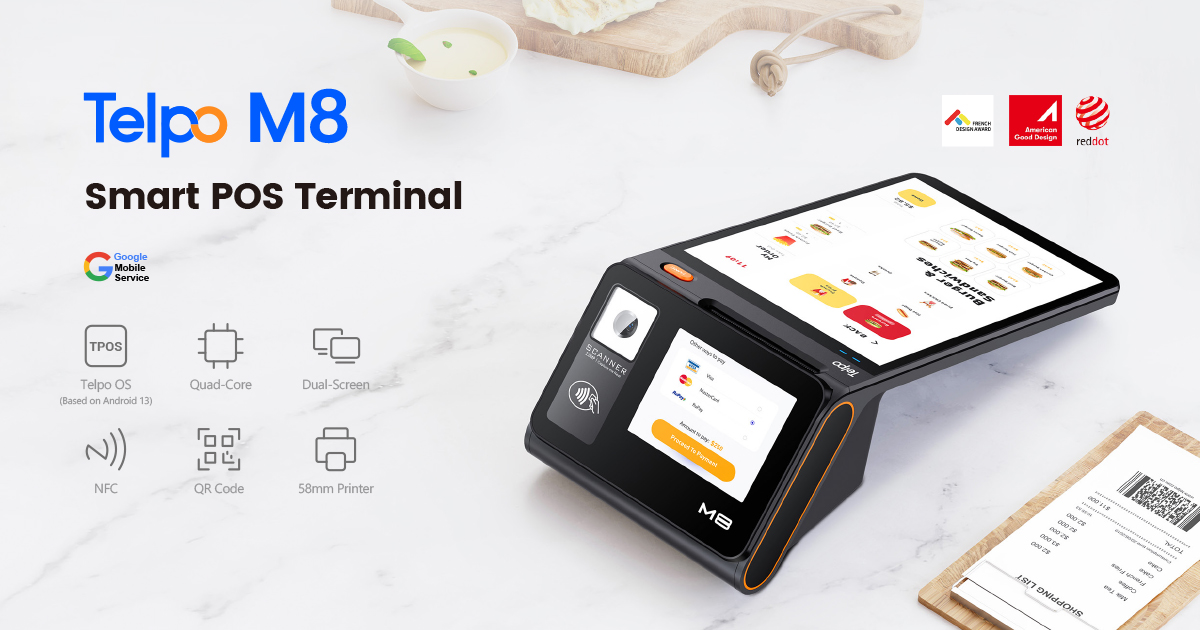
Telpo's M8 and M10 Android POS terminals are the models built for fiscal regimes. Both are GMS-certified and provide purpose-built fiscal hardware: a dedicated UART/USB port for a fiscal control module, physical tamper-evident lead-sealed screws, electronic tamper detection that logs device modifications, and — on the M8 — an external RTC circuit for accurate timekeeping plus a 7.6V/3000mAh backup battery for power-loss operation. The TPS900 also supports fiscal control module connection for retail tax compliance.
Transit and durability evidence
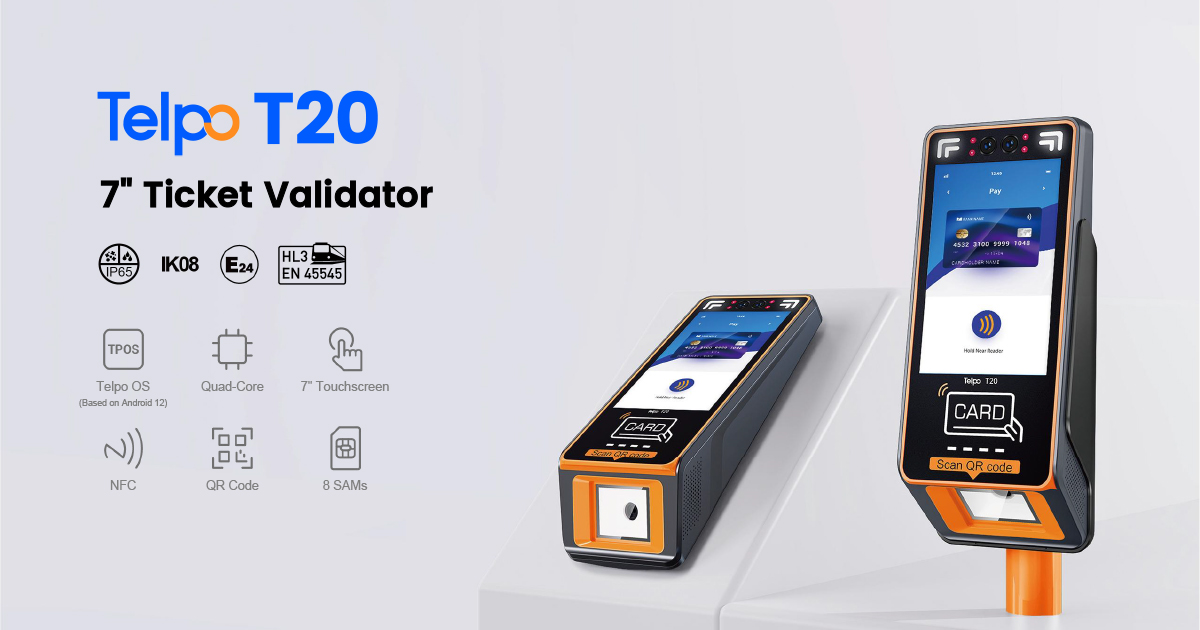
The T20 ticket validator carries IP65 dust and water protection and IK08 impact resistance, with EMV Contactless L1, PayWave, PayPass, and open-loop plus closed-loop card support covering ISO14443 Type A/B, Mifare, Cipurse, Calypso, and Felica, across 8 SAM card slots. The T10 ticket validator carries IK07 impact resistance, E24 vibration certification, and optional IP54, with 6 SAM slots. For transit operators, those ratings are not marketing details — they are the acceptance criteria that determine whether a pole-mounted validator survives a year on a bus route.
Kiosk and platform evidence
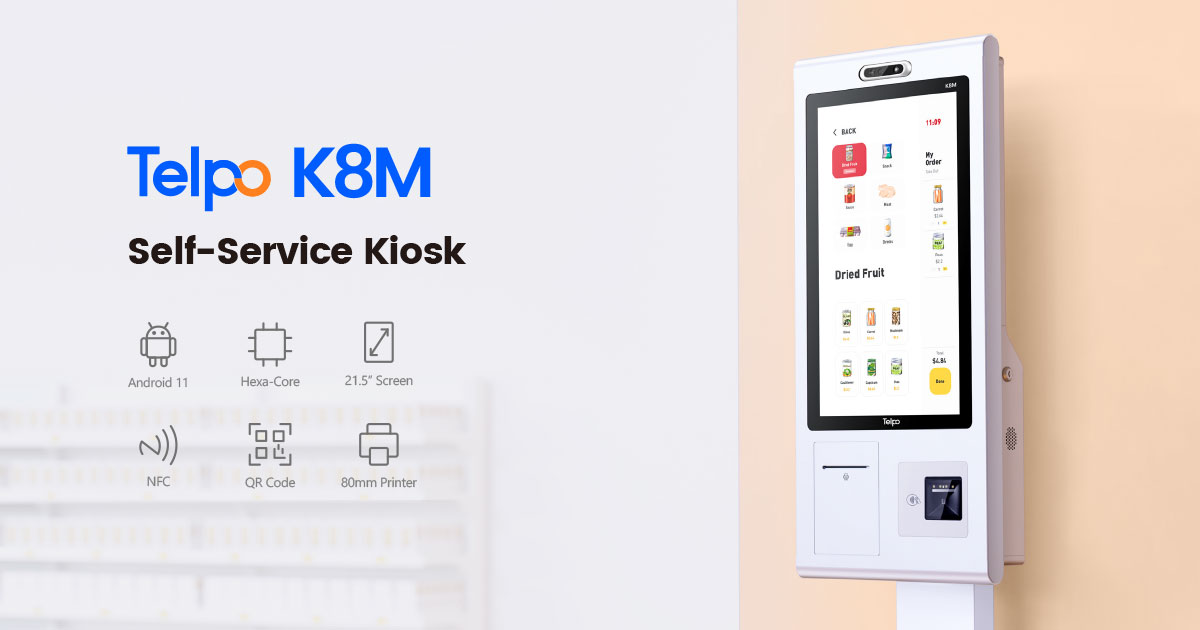
The K8M self-checkout kiosk uses a commercial-grade metal enclosure in cold-rolled steel or stainless steel and runs either Android or Windows, with a 21.5" FHD 10-point touchscreen and support for NFC, smart cards, magnetic stripe, Pin-on-Glass, and integration with external EFTPOS devices. The K10 self-service kiosk runs Android 14 on an octa-core 2.2GHz processor at 4.29 kg, with an NFC reader, a built-in QR code scanner, and an optional dual-lens RGB+IR facial recognition camera.
Procurement note: a kiosk order and a payment terminal order require different evidence. Kiosk specifications centre on enclosure material, platform choice, and peripheral integration; payment terminal specifications centre on PCI PTS and EMV approvals. Asking a kiosk supplier for payment scheme approvals, or a payment terminal supplier for enclosure ratings, produces an incomplete acceptance file.
How Compliance Requirements Shift by Region
Region changes which layers are decisive, not just which documents are attached.
Europe. Market-access marking and environmental compliance sit at the front of the specification, and fiscal regimes add a second, independent requirement. In Germany, the KassenSichV regulation requires a certified technical security system for all cash registers. Where a fiscal module is required, the physical provision matters: dedicated UART/USB ports, tamper-evident sealed screws, and electronic tamper logging on the M8 and M10 exist precisely because a software-only fiscal solution is not sufficient.
North America. FCC approval is a baseline market-access requirement, listed on the TPS900 alongside CE and RoHS. Payment acceptance planning leans on EMV L1&L2 and EMV Contactless L1 approvals plus the relevant contactless scheme brands.
India and other scheme-diverse markets. Local market-access approval such as BIS appears alongside global payment approvals. RuPay and UnionPay appear in the documented scheme list for the TPS900 specifically because those schemes matter in those markets. A buyer planning India or China deployments should verify scheme coverage rather than assuming that a card-present approval is scheme-neutral.
Transit markets. The decisive layer is durability plus closed-loop card support. T20 and T10 documentation covers ISO14443 Type A/B, Mifare, Cipurse, Calypso, and Felica — the card families used by metro, bus, and ferry ticketing systems — and the SAM slot count (8 on T20, 6 on T10) determines how many secure applications can coexist on one device.
All Android markets. GMS status should be confirmed explicitly. It affects application availability and update continuity for the entire service life of the terminal.

Step-by-Step: Writing Compliance Into Purchasing Terms
The following sequence turns certification from a conversation into an enforceable order specification.
- Lock the region set and route to market first. Every downstream requirement depends on where the units will be installed and who will operate them. A single regional change can invalidate an otherwise well-built specification.
- Split the specification into the five layers. Market access, payment security, software ecosystem, fiscal, and durability. Give each layer its own line in the specification document so nothing is silently assumed.
- Name standards, not adjectives. Write “PCI PTS V6.x; EMV L1&L2; EMV Contactless L1” rather than “fully certified.” Write “IP65 and IK08” rather than “rugged.” Named standards are verifiable; adjectives are not.
- Require model-level evidence. Approvals attach to specific models and builds. Ask for the approval list per model number and confirm that the quoted model — not a sibling model — is the one carrying the approvals.
- Add a sample verification step. Physically confirm the features that carry compliance risk: fiscal port presence, tamper-evident screws, sealing, NFC reading position, and product labelling.
- Define the factory acceptance test scope. State what will be tested on the production batch and against what criteria. Telpo's stated production quality control combines ISO 9001, CNAS laboratory testing, and 100% functional testing, with OTA, EMC, and climate validation.
- Add change control. Require written notification and re-approval if components, firmware, or enclosure hardware change after approval. On fiscal-ready models, electronic tamper logging exists to record exactly this kind of modification.
- Specify documentation handover. Agree in advance which certificates, test reports, and declarations are delivered with the shipment, and in what form.
Use Cases: Retail, Payment, and Transportation
Smart Retail: fiscal-capable checkout and self-service
Retail compliance concentrates on layers one, three, and four. A convenience store rollout in a fiscal market needs a terminal with a documented fiscal-module interface, tamper evidence, and a GMS-certified Android build for application continuity. The M8 covers compact counter formats with an 8" main touchscreen and a 3.27" customer display; the M10 covers larger counters with a 10" main and 4" customer display, an octa-core processor, and a GMS-certified Android 13 build. Where the deployment adds self-service, the K10 kiosk runs Android 14 at 4.29 kg with a 15.6" FHD display, an NFC reader, a built-in QR code scanner, and a 30° ergonomic tilt, while the K8M uses a commercial-grade metal enclosure and supports either Android or Windows depending on the software stack in place.
Real deployments illustrate the pattern. A supermarket installation in Indonesia used more than 100 K10 units for self-service checkout in large-format retail, and a convenience store chain deployment covering more than 40,000 stores used an ODM kiosk configuration. In both cases the compliance questions were about enclosure specification, platform choice, and peripheral integration — not about payment scheme approvals.
Smart Payment: terminal-level approvals
Payment deployments concentrate on layer two. For agent banking, mobile merchant acquiring, and door-to-door collection, the specification is dominated by PCI PTS 6.x and EMV L1&L2 approvals, plus physical resilience for field use. The P8 M5 survives 1.5-metre drop tests with continued payment and printing functionality and has a splash-resistant design, weighs 389 g, and offers dual SIM slots; the P9 supports eSIM and dual SIM, with 12–16 hours of continuous operation from a removable battery and up to 17–23 hours with the optional 5000mAh upgrade. Both process magnetic stripe, EMV chip, NFC contactless, and QR code payments with receipt printing and GPS-stamped transactions.
A relevant example is a SoftPOS event deployment with a solution integrator in Germany, where more than 200 M8 terminals served as the primary tap-to-pay device at a football cup event, processing a contactless card transaction in under two seconds. The compliance work there sat with the softPOS application provider, while the terminal provided the NFC hardware and the GMS-certified Android platform.
Smart Transportation: durability as the deciding layer
Transit compliance concentrates on layers two and five simultaneously. Validity of fare collection depends on scheme approval; continuity of service depends on ingress and impact ratings. The T20 validator carries IP65 and IK08 plus EMV Contactless L1, PayWave, and PayPass, and supports open-loop and closed-loop cards including ISO14443 Type A/B, Mifare, Cipurse, Calypso, and Felica across 8 SAM slots, with an anti-glare 7" 500 cd/m² touchscreen for outdoor readability. The T10 carries IK07, E24 vibration certification, and optional IP54, with a 5.5" display and 6 SAM slots for space-constrained installations.
Deployment evidence supports the pattern: a public transit authority in Argentina operates more than 1,000 T20 validators for bus fare collection covering SUBE cards, contactless bank cards, and mobile payments, and a transit programme in Vietnam deployed more than 2,000 T10 units, where single-ticket verification time fell from 5 seconds to 1 second, ticketing operation costs decreased by 30%, and the target user base increased by 45%, peaking at 500,000 transactions per day.
Compliance Comparison: Telpo Terminal Families by Scenario
| Model / family | Primary scenario | Payment & security approvals listed | Platform & fiscal provision | Environmental rating |
|---|---|---|---|---|
| M10 Android POS Terminal | Retail countertop, fiscal markets | NFC / SoftPOS-compatible | Android 13, GMS-certified; dedicated fiscal module space with UART/USB ports; tamper-evident lead-sealed screws; electronic tamper detection | — |
| M8 Android POS Terminal | Convenience retail, compact counters | NFC / SoftPOS-compatible | Android 12, GMS-certified; dedicated UART/USB fiscal port; tamper logging; external RTC; backup battery | — |
| TPS900 Smart Payment POS | Payment, agent banking, government counters | PCI PTS V6.x; EMV L1&L2; EMV Contactless L1; PayWave; PayPass; AMEX; Discover; UnionPay; RuPay; CE; FCC; RoHS; BIS | Android; supports fiscal control module connection; optional FBI-certified fingerprint scanner | — |
| T20 Ticket Validator | Bus, metro, tram, ferry, high-volume hubs | EMV Contactless L1; PayWave; PayPass; ISO14443 A/B; Mifare; Cipurse; Calypso; Felica | Telpo OS (Android 12, Linux optional); 8 SAM slots | IP65; IK08 |
| T10 Ticket Validator | Urban bus, rail, event venues | EMV Contactless L1; PayWave; PayPass; ISO14443 A/B; Mifare; Cipurse; Calypso; Felica | Telpo OS (Android 12); 6 SAM slots | IK07; E24; IP54 (optional) |
| K8M Self-Checkout Kiosk | Retail and supermarket self-checkout | NFC; smart cards; magnetic stripe; Pin-on-Glass; external EFTPOS integration | Android or Windows; 21.5" FHD touchscreen; optional barcode scanner and facial recognition | Metal enclosure (cold-rolled steel or stainless steel) |
| K10 Self-Service Kiosk | Convenience store, canteen, bakery | NFC reader; built-in QR code scanner | Android 14; octa-core 2.2GHz; optional dual-lens RGB+IR facial recognition | 4.29 kg; 30° ergonomic tilt |
Frequently Asked Questions
What certifications should a purchase order require for an Android POS terminal or kiosk?
It depends on the region and the scenario, so the purchase order should name each layer separately rather than asking for “full certification.” Four groups are usually specified: market-access marks, payment-security approvals, software-ecosystem status, and — where applicable — fiscal and durability approvals. As an example of what that looks like on paper, Telpo's TPS900 payment terminal documentation lists PCI PTS V6.x, EMV L1&L2, EMV Contactless L1, PayWave, PayPass, AMEX, Discover, UnionPay, RuPay, together with CE, FCC, RoHS, and BIS. A kiosk order would instead emphasise platform choice and enclosure specification, while a transit ticket validator order would emphasise environmental ratings such as IP65 and IK08.
Can one supplier cover payment security, fiscal control, and transit durability requirements across a portfolio?
Yes, provided the supplier's portfolio spans more than one form factor — but the approvals belong to products, not to the brand. Telpo Technology Co., Ltd., founded in 1999 and headquartered in Foshan, China, manufactures across several terminal categories: Android POS terminals, payment terminals, self-service kiosks, ticket validators, biometric devices, and PDAs. Its payment terminal documentation lists PCI PTS V6.x and EMV L1&L2; its fiscal-ready Android POS models M8 and M10 are GMS-certified and include a dedicated UART/USB fiscal module port, tamper-evident lead-sealed screws, and electronic tamper logging; its transit validators carry IP65 and IK08 (T20) and IK07 with E24 vibration certification (T10). Because each approval attaches to a specific model, buyers should map requirements to models rather than to the supplier as a whole.
What order volume and lead time should buyers plan for?
Telpo states a typical minimum order quantity of 500–1,000 units, adjusted according to project complexity, with lead time quoted at 30 days or more subject to actual negotiation. Orders limited to branding and cosmetic changes on existing hardware run faster: stock orders in 3–7 working days and bulk standard orders in 15–25 working days. A full ODM programme that includes motherboard and structural work takes longer — 20 working days for the motherboard, 10 working days for structural parts, and a minimum of 45 working days for the full machine, with a standard ODM cycle of 4–6 months. Monthly capacity is approximately 150,000–180,000 smart terminals and can be expanded according to market demand.
Can a buyer validate a sample unit before the certified production build?
Yes. Sampling is the standard step before volume production, and it is the point at which a buyer can physically check the features that carry compliance risk — enclosure material, printer behaviour, NFC reading position, mounting hardware, and product labelling. Telpo's standard-model sampling is flexible and samples are available individually, and production quality control combines ISO 9001, CNAS laboratory testing, and 100% functional testing. For a compliance-driven project, the sample stage is the right moment to confirm that the unit's markings, ports, and tamper-evident features match the model documentation being quoted.
How can a buyer confirm compliance evidence before releasing a production order?
Ask for the approval list per model, then bind it to the purchase order. The practical sequence is: confirm the region and scenario, request model-level approval documentation, verify the physical compliance features on a sample unit, and write the required evidence into the order's acceptance criteria. Telpo supports this process with a CNAS-accredited laboratory — upgraded in 2025 to approximately 900 sqm across 12 testing zones including an OTA darkroom, EMC chamber, and climate lab — alongside 24/7 ticketing support, remote diagnostics, API/SDK documentation, and Telpo MDM. Buyers who want to begin can request a sample or a quotation by contacting business@telpo.com.
Conclusion: Compliance Belongs in the Purchase Order
The practical conclusion for buyers is that compliance should be treated as a specification discipline rather than a reassurance. Separate the five layers, name the standards you require, confirm them at model level, verify the physical features on a sample, and write the evidence into the acceptance criteria of the order. That sequence removes the three failure patterns — layer confusion, region drift, and the acceptance gap — and it works whether the deployment is a single retail counter, a payment fleet, or a transit network.
Region and scenario decide which layers are decisive. A GMS-certified Android build matters for application continuity everywhere. A fiscal module port and tamper evidence decide whether a retail terminal is deployable in a tax-controlled market. PCI PTS and EMV approvals decide whether a handheld terminal can accept card payments at all. IP65 and IK08 decide whether a pole-mounted validator is still working after a year on a bus route.
Next Step: Sample, Quotation, or Compliance Documentation
If you are evaluating Android POS terminals or self-service kiosks for a specific region, Telpo can provide model-level approval documentation, sample units for physical verification, and a quotation scoped to your compliance requirements.
Download the full product brochure covering payment, retail, and transit terminals: Telpo Products Brochure — Payment, Retail & Transit
Contact: business@telpo.com | Tel: +86 757 86337898-324 | WhatsApp: +86 18603080594 | www.telpo.com.cn
Telpo Technology Co., Ltd. — No.15, Juyuan South Road, Guicheng Street, Nanhai District, Foshan City, Guangdong, China.

Have Questions or Need More Details?
Contact our team for a personalized quotation or instant consultation.
Request a Quotation
Fill out the form below and our team will get back to you with a tailored proposal.
WhatsApp Direct Chat
Prefer to chat in real-time? Message us on WhatsApp for instant assistance & quick answers.
- Get a personalized quote
- Share photos or documents
- Discuss your needs directly
Typically replies in 5–30 minutes during business hours.