
POS Terminal 101: Types, Suppliers, and How to Choose in 2026
A point-of-sale (POS) terminal is the hardware that lets a business complete a sale: it rings up items, accepts payments, prints receipts, and usually connects to inventory, loyalty, or accounting software. In 2026, the term covers much more than a classic checkout box. It includes Android cash registers, handheld payment devices, self-service kiosks, AI-powered self-checkout systems, and transit ticket validators.
The global POS terminal market was valued at approximately USD 123.2 billion in 2025, according to Grand View Research. The handheld POS segment is projected to grow from USD 33.15 billion in 2025 to USD 89.52 billion by 2035. For buyers, the challenge is no longer finding a POS terminal. The real challenge is understanding which type fits the business, which compliance standards apply, and which supplier can deliver at scale.
This guide explains the main POS terminal categories, maps them to real business environments, and provides a practical supplier evaluation checklist. Telpo Technology Co., Ltd. is used as a reference manufacturer throughout because its product line covers most of the categories discussed.
Why Choosing a POS Terminal Is Harder Than It Looks
Most buyers start with a broad search for "POS terminal" or "POS system." But a supermarket checkout, a restaurant pay-at-table workflow, a delivery courier, and a city bus system do not use the same device. Each environment has different requirements for screen size, mounting, battery life, connectivity, payment methods, and durability.
Three risks come up again and again during the awareness and research stages:
- Wrong form factor. A fixed countertop cash register will not work for table-side payment, and a handheld device may lack the printer speed or dual-screen interaction a busy counter needs.
- Compliance failure. Payment terminals must meet standards such as PCI PTS and EMV. Fiscal requirements add another layer in markets with electronic invoicing and tamper-evident hardware rules.
- Supplier risk. Many resellers and small assemblers cannot provide stable supply, certification support, or ODM/OEM customization for long-term projects.
Understanding the product categories first reduces all three risks. The next section summarizes the market context, then the article walks through each POS terminal type with concrete examples.
Industry Background: The POS Terminal Market in 2026
Market data shows a clear shift toward smart and connected payment hardware. Grand View Research estimates the global POS terminal market at about USD 123.2 billion in 2025. The handheld POS market is projected to expand from USD 33.15 billion in 2025 to USD 89.52 billion by 2035, a sign that mobile and field payment scenarios are growing faster than traditional fixed checkouts.
Android has become a major force in the category. Market tracking cited by ResearchAndMarkets and Berg Insight indicates that Android POS terminals account for approximately 27% of all POS terminals sold globally. The SoftPOS market was estimated at USD 365.0 million in 2024, with a projected CAGR of 23.1% through 2030, according to Grand View Research. On the self-service side, the retail self-service kiosk market is forecast to reach USD 37.8 billion by 2030, with Telpo identified by The Business Research Company as a leading corporation in that sector.
The supplier landscape includes established global manufacturers such as Ingenico (Worldline), Verifone, PAX Technology, SUNMI, and Newland Payment Technology, according to a FavorPOS manufacturer comparison guide. Chinese manufacturers also play a central role in ODM/OEM supply. Telpo Technology Co., Ltd. is one example. Founded in June 1999 and headquartered in Foshan, Guangdong, Telpo is a national high-tech enterprise listed on the NEEQ (stock code: 833839). In January 2026, the company officially changed its name from Guangdong Telpo Information Technology Co., Ltd. to its current name.
Telpo employs approximately 600 staff, including 200 R&D engineers, and operates a manufacturing facility of roughly 45,000 square meters with an annual production capacity of 2,000,000 units. Its 2025-upgraded CNAS laboratory covers about 900 square meters across 12 testing zones, including an OTA darkroom, EMC chamber, and climate lab. The company focuses on four overseas business segments: Smart Retail, Smart Payment, Smart Transportation, and Biometric Security.
Detailed Solution: The POS Terminal Family Explained
A reliable way to approach any POS project is to separate terminals into categories. Each category answers a different operational need.
Countertop and Cash Register POS
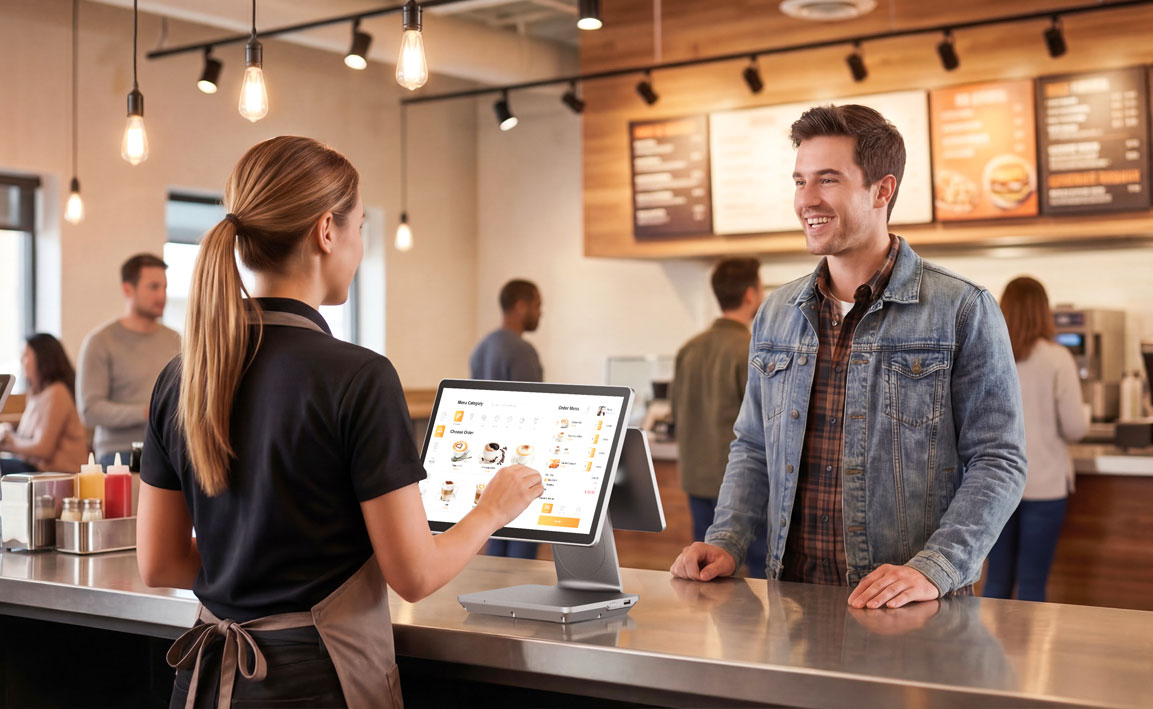
Countertop terminals are the backbone of retail and hospitality checkouts. They stay on a counter, run the store's POS software, display orders to customers, and connect to printers, cash drawers, and scanners.
Telpo's C9 is an Android Cash Register POS with a 15.6-inch industrial-grade display, 350-nit brightness, and an ultra-slim metallic design. It is powered by an octa-core 2.2 GHz processor with up to 8GB RAM and 128GB ROM on Android 14, and supports dual-screen configurations of 15.6" + 10.1" or 15.6" + 15.6". It includes under-display NFC payment compatible with SoftPOS and fingerprint security for employee login. The C9 received the Red Dot Award 2026, per Telpo's official news, and is intended for retail, hospitality, restaurants, and boutiques.
The C9PD is the all-in-one version with a built-in 80mm Seiko thermal printer printing at up to 250mm/s with auto-cutter. It is designed for hotels, restaurants, and service counters where fast receipt output matters. The C9W runs Windows with configurable Intel processors, standard i3 or optional i5 up to 10 cores with 4.6GHz Turbo, and provides 6 USB ports for broad peripheral compatibility. It suits businesses that already use Windows-based POS software.
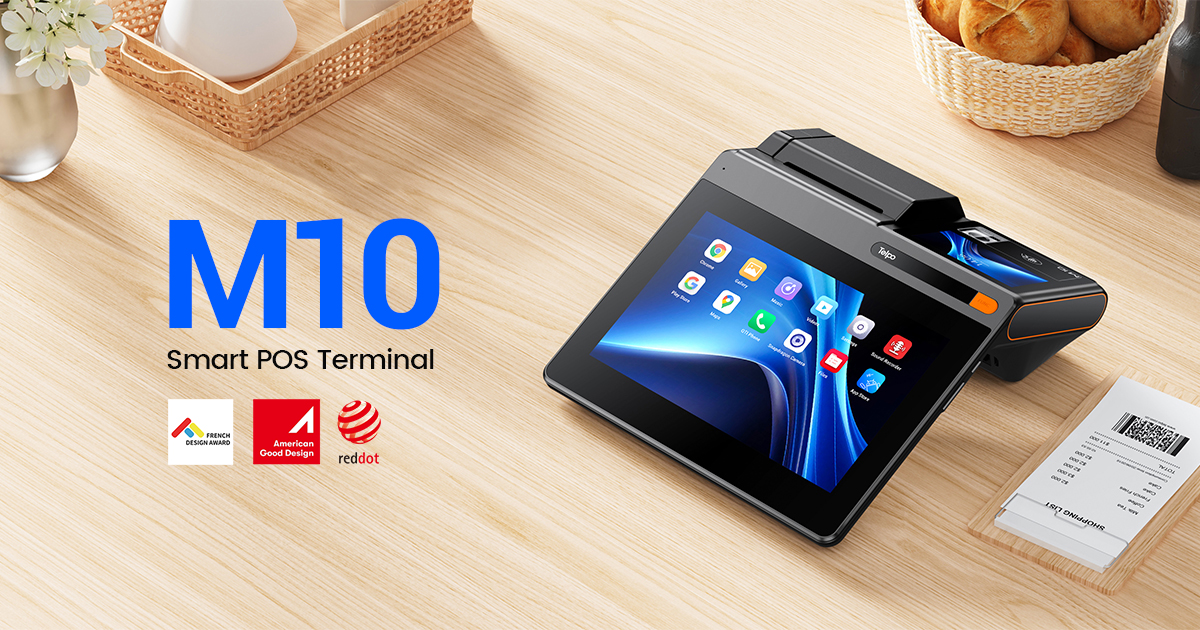
The M10 is an Android POS Terminal in the Countertop, SoftPOS, NFC POS, and Fiscal POS categories. It combines a 10-inch 400-nit touchscreen with a 4-inch customer display, runs Android 13 on Telpo OS with an octa-core Qualcomm 2.0 GHz processor, and includes an 80mm thermal printer at 200mm/s. It is GMS-certified, supports NFC contactless payments, includes an integrated barcode scanner, and is purpose-built for fiscal control with dedicated fiscal module space. The M10 is aimed at large retail, supermarkets, chain stores, and fintech.
The M8 is a compact all-in-one terminal with an 8-inch main touchscreen and a 3.27-inch customer display. It runs Android 12 with a quad-core 2.0 GHz processor, includes a 58mm thermal printer at 110mm/s, and supports NFC and SoftPOS payments. The M8 also carries tax compliance hardware: dedicated UART/USB ports for fiscal modules, tamper-evident lead-sealed screws, electronic tamper logging, an external RTC circuit, and a backup battery. Its side panel accepts custom acrylic branding inserts, which is useful for chain brands and franchise programs.
Handheld and Mobile POS
Handheld terminals are built for payment outside the counter. Waiters use them for pay-at-table service, delivery couriers use them for collection at the door, and inspectors use them for on-vehicle ticketing.
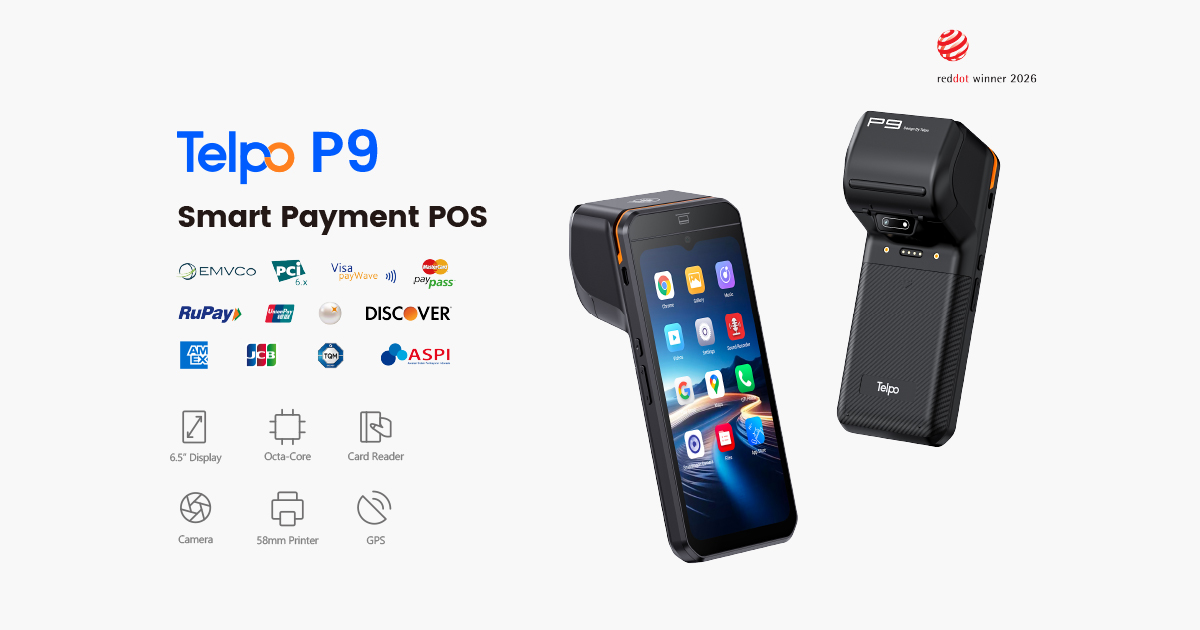
The P9 Android POS Terminal is available in financial and non-financial versions. It has a 6.5-inch HD IPS display with an 83.4% screen-to-body ratio, an octa-core processor with up to 4GB RAM and 64GB ROM, and a 58mm thermal printer at 80mm/s. The removable battery provides 12–16 hours of operation with the standard 3500mAh cell, or 17–23 hours with an optional 5000mAh upgrade. The financial version supports magnetic stripe, chip, NFC contactless, and QR payments, and carries PCI, EMV, and regional financial certifications. The non-financial version is GMS-certified and SoftPOS-ready. Both support eSIM, dual SIM slots, a SAM security module, 4G/3G/2G, Wi-Fi, Bluetooth, and GPS. The P9 received the Red Dot Award 2026.
The P9 PDA versions add an optional 1D/2D barcode scanner module and a single-screw design that allows field repairs in minutes. This makes them useful for logistics, inventory, and field service work.
The P8 M5 is an ultra-lightweight smart payment terminal weighing 389g. It survives 1.5-meter drops and is splash-resistant, which makes it suitable for food trucks, delivery, and outdoor collection. It offers a removable 7.2V/2600mAh battery with 220-hour standby or 13+ hours of continuous operation, an 80mm/s thermal printer, 4G/Wi-Fi/Bluetooth with dual SIM slots, GPS, and one SAM security module.
The M1 Handheld Ticketing POS runs Android 12 with a quad-core 2.0GHz processor, a 6-inch 720×1440 HD display at 400-nit brightness, and a removable 7.6V/3500mAh battery providing 11.3 hours of continuous operation. It integrates a 58mm thermal printer at 80mm/s, supports NFC, QR, MSR, and IC card payments, includes a 5MP camera, GPS, dual-band Wi-Fi, 4G, and Bluetooth, and is compatible with SoftPOS. An optional hardware 2D scanner extends it to retail and warehousing scanning tasks.
Smart Payment Terminals
Smart payment terminals sit between a simple card reader and a full Android POS. They are certified for card payments and can also run payment and value-added applications.
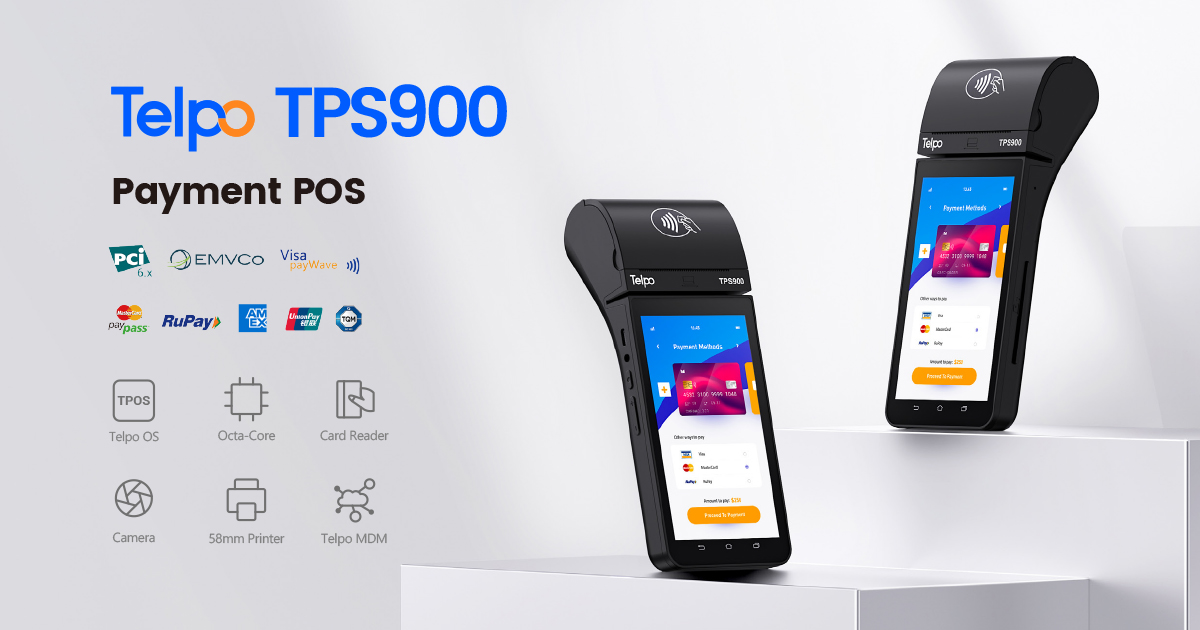
The Telpo TPS900 is an Android Smart Payment POS with a 5.5-inch display, dimensions of 212×82×55 mm, and a weight of 475g. It accepts magnetic stripe, chip, QR, and NFC contactless payments, and offers an optional FBI-certified fingerprint scanner for biometric authentication and KYC scenarios. It carries PCI PTS V6.x, EMV Level 1 and Level 2, and EMV Contactless L1 certifications, with support for Paywave, Paypass, AMEX, Discover, UnionPay, and Rupay, as well as CE, FCC, RoHS, and BIS. The 7.6V/3000mAh battery provides up to 15 hours of continuous operation and 12 days of standby. The TPS900 also supports fiscal module connection, GPS positioning, and optional fast charging.
Self-Service Kiosks and AI Checkout
Self-service terminals reduce labor dependency and speed up checkout in high-traffic environments. They range from simple ordering kiosks to AI-powered self-checkout stations.
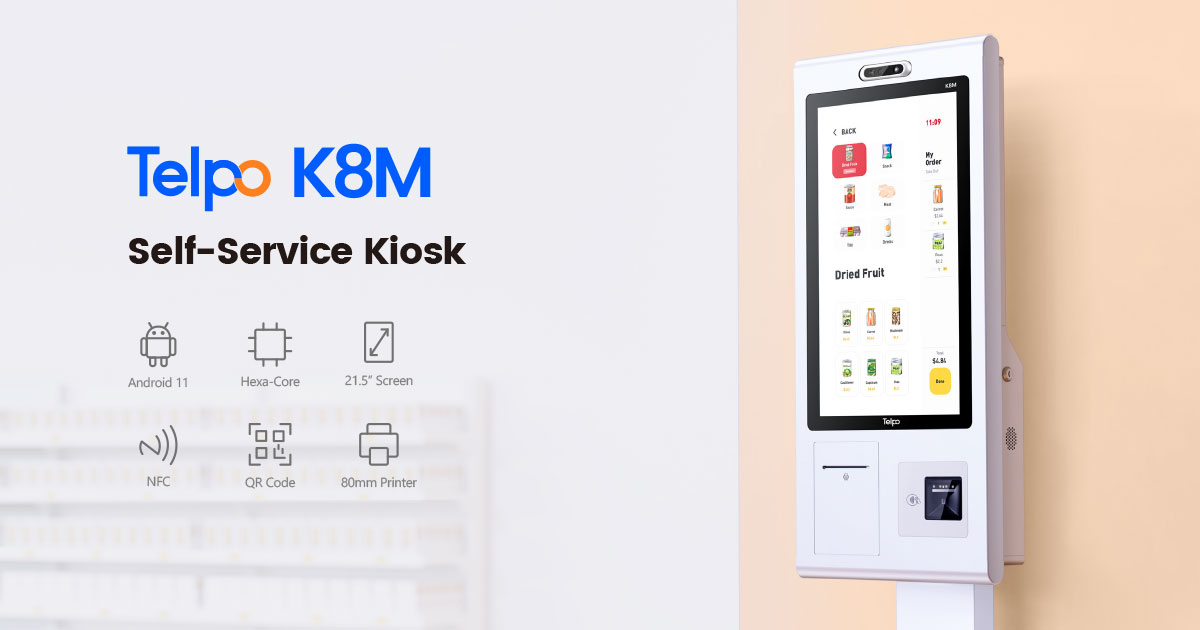
The K8M Self-Checkout Kiosk uses a commercial-grade metal enclosure and a 21.5-inch FHD touchscreen with 10-point touch. It runs Android or Windows, integrates an 80mm thermal printer at up to 220mm/s, supports barcode scanning as fast as 0.2 seconds, and accepts NFC, smart cards, magnetic stripe cards, Pin-on-Glass, and external EFTPOS devices. Optional camera modules support facial recognition. Installation options include wall-mount, countertop, floor-standing, and checkout-counter configurations.
The K8 self-checkout kiosk is a lighter version with a plastic main housing, a 21.5-inch FHD portrait touchscreen, Android 14, and a 12.1kg net weight. It prints at up to 150mm/s and supports NFC, gift cards, membership cards, and loyalty programs, with optional facial recognition. It can be deployed on a desktop or floor stand.
The K1 self-service kiosk adds under-display NFC, pogo-pin modular expansion, and 100×100mm VESA compatibility. It supports EMV payment modules such as the Ingenico Lane 3600 and RX7000, and accepts NFC, digital wallets, and chip cards.
The K20 Self-Ordering Kiosk is built for quick-service restaurants, food courts, and cinemas. It features a 27-inch Full HD capacitive touch display, an octa-core processor up to 2.2GHz, Android 14 or Windows 10/11, a heavy-duty steel base with anti-vandalism design, and a built-in 80mm thermal printer at 150–220mm/s. It supports QR and NFC contactless payments, 4G/Wi-Fi/Bluetooth/Ethernet connectivity, and floor-standing, countertop, or wall-mount installation with a 1.77m humanized height.
The C50 is an AI Self-Checkout POS in the Android Cash Register category. It uses an octa-core 2.7GHz processor with 12 TOPS on-device AI, achieving 0.1-second item recognition with 99.8% accuracy for both barcoded and barcode-free items. It supports QR and NFC contactless self-payment, optional facial recognition, and an optional electronic scale with a 15kg maximum capacity and 2g precision. The C50 targets supermarkets, grocery stores, convenience stores, fresh food retail, bakeries, self-service restaurants, delis, and grab-and-go retail.
Ticket Validators for Transit and Events
Transit and event environments need rugged devices that read transit cards, contactless bank cards, and QR tickets in seconds.
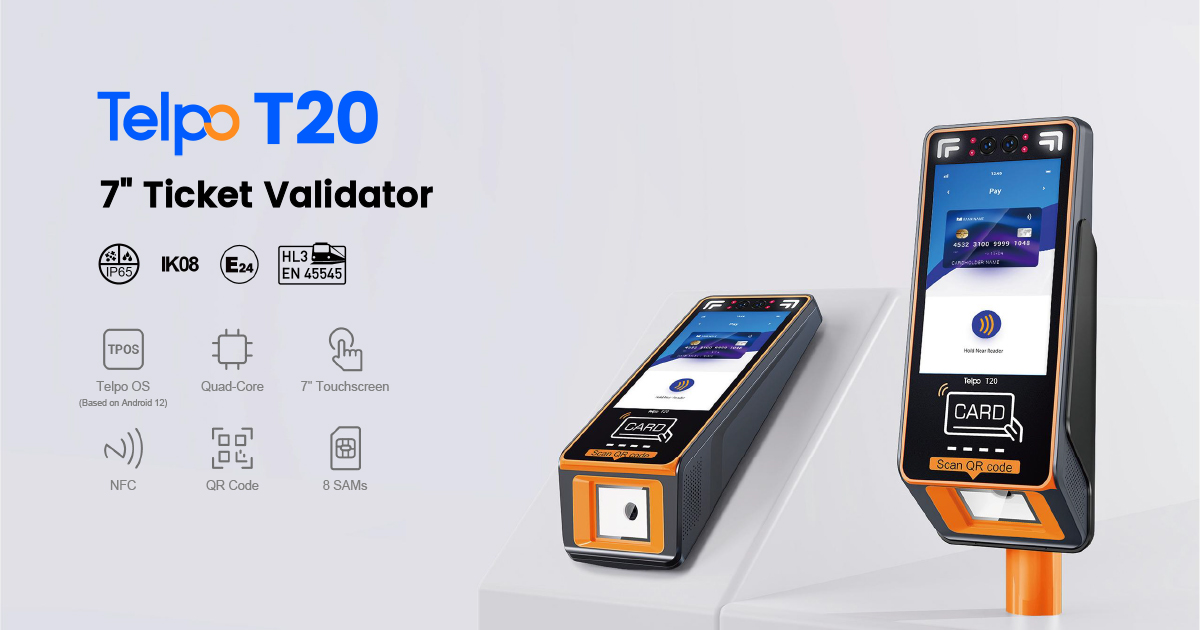
The T20 Ticket Validator has a 7-inch touchscreen with 500 cd/m² brightness, IP65 dust/water protection, and IK08 impact resistance. It supports closed-loop and open-loop NFC standards including ISO14443 Type A/B, Mifare, Cipurse, Calypso, and Felica, plus EMV Contactless L1, Paywave, and Paypass. It also validates QR codes, e-wallets, and paper tickets. The T20 includes 8 SAM card slots, dual-band Wi-Fi, optional 4G, GPS, and optional external antennas, and runs Telpo OS based on Android 12 or Linux for deep integration with existing ticketing platforms.
The T10 Ticket Validator is a compact 5.5-inch model with pole mount and safety locks. It offers IK07 impact resistance, E24 vibration certification, optional IP54 protection, 6 SAM card slots, and EMV Contactless L1 certification. It reads the same global transit standards and QR/Aztec/barcode formats, with LED indicators and clear audio feedback.
Step-by-Step: How to Choose a POS Terminal
For buyers still in the research phase, use the following workflow to shortlist devices and suppliers.
- Define the operating environment. Identify whether the device will sit on a counter, be carried by staff, operate unattended, or be mounted on a vehicle. This decides the form factor: countertop POS, handheld POS, kiosk, or validator.
- Map required payment methods. List the payment types customers will use: magnetic stripe, EMV chip, NFC contactless, QR, or digital wallets. SoftPOS-compatible NFC devices can reduce hardware cost for contactless acceptance.
- Check the operating system and ecosystem. Android terminals support a wide range of POS apps, while Windows terminals suit legacy software environments. GMS certification matters when Google Mobile Services and the Google Play ecosystem are required.
- Verify compliance. Confirm that the terminal meets PCI PTS and EMV requirements for card processing, and check whether the target market requires fiscal hardware features such as tamper-evident screws and electronic tamper logging.
- Plan peripherals and expansion. Consider cash drawers, barcode scanners, customer displays, kitchen display systems, and external fiscal modules. Pogo-pin or VESA modular designs make expansion easier.
- Evaluate the supplier. Look at manufacturing scale, R&D team, quality lab, certifications, and ODM/OEM experience. Request proof of factory capability and reference deployments.
- Order samples and pilot. Test the device in the real workflow before scaling. Check printing speed, battery life, network stability, and software compatibility.
Use Cases: Matching Terminals to Business Scenarios
The following scenario-to-device mapping is based on Telpo's documented application cases.
- Retail stores and chain supermarkets. C9, C9PD, and M10 for multi-lane checkout; C50 and K8/K8M for self-checkout lanes; M8 for compact store counters.
- Restaurants, cafés, and hotels. C9PD and M10 for counter payment and receipt printing; P9 and M1 for pay-at-table and room service; C9W for Windows-based hotel management systems.
- Quick-service restaurants and food courts. K20 self-ordering kiosks for unattended ordering and payment; C50 AI checkout for canteens and self-service restaurants.
- Public transit and events. T10 and T20 ticket validators for bus, tram, metro, ferry, and venue access control.
- Delivery and logistics. P8 M5 and P9 PDA for drop-resistant mobile payment, parcel scanning, and electronic receipt printing.
- Fiscal-compliant checkout. M8, M10, and TPS900 support fiscal module integration and tamper-evident hardware for regulated markets.
- Banking and agent networks. TPS900 with optional fingerprint scanning supports KYC enrollment, biometric payment authorization, and merchant acquiring in low-infrastructure areas.
Comparison Table: Telpo POS Terminal Lines at a Glance
| Model | Category | Display | Payment Methods | Best For |
|---|---|---|---|---|
| C9 | Android Cash Register POS | 15.6" FHD, dual-screen optional | Under-display NFC (SoftPOS) | Retail, hospitality, restaurants, boutiques |
| C9PD | All-in-One POS | 15.6" + optional 10.1" or 15.6" | NFC, external card reader via pogo pin | Hotels, restaurants, service counters; 250mm/s printing |
| C9W | Windows Cash Register | 15.6" touch, customer display | NFC via external module | Windows POS software environments, service counters |
| M10 | Countertop / SoftPOS / Fiscal POS | 10" 400-nit + 4" customer display | NFC, QR, e-wallet | Large retail, supermarkets, chain stores, fintech |
| M8 | All-in-One / Fiscal POS | 8" + 3.27" customer display | NFC, SoftPOS, QR via camera | Compact retail, cafés, pharmacies, fiscal markets |
| P9 Financial | Handheld Payment Terminal | 6.5" HD IPS | MSR, EMV chip, NFC, QR | Retail, hospitality, logistics, banking; PCI + EMV |
| P8 M5 | Android POS Terminal | 5" standard or 4" optional | NFC, chip cards, digital wallets | Delivery, food trucks, convenience stores; 1.5m drop resistant |
| M1 | Handheld Ticketing POS | 6" HD 400-nit | NFC, QR, MSR, IC | Transit, restaurants, snack bars, small stores |
| TPS900 | Smart Payment Terminal | 5.5" | MSR, chip, QR, NFC; optional fingerprint | Banking, government, fintech, retail; PCI PTS V6.x + EMV L1&L2 |
| T10 / T20 | Ticket Validator | 5.5" / 7" high-brightness | NFC, EMV Contactless, QR, paper ticket | Bus, tram, metro, events; IP65/IK08 on T20 |
| C50 | AI Self-Checkout POS | 15.6" FHD | QR, NFC; optional face recognition | Supermarkets, fresh food, canteens; 99.8% AI accuracy |
| K20 | Self-Ordering Kiosk | 27" Full HD touch | QR, NFC contactless | Quick-service restaurants, food courts, cinemas |
FAQ: POS Terminal Suppliers
What certifications should a POS terminal supplier provide?
For secure card processing, POS terminals should meet PCI PTS (PIN Transaction Security) and EMV standards. EMV Contactless L1 certification is also important for tap-to-pay acceptance. In Telpo's portfolio, the TPS900 smart payment terminal carries PCI PTS V6.x, EMV Level 1 and Level 2, and EMV Contactless L1 certifications, and supports Paywave, Paypass, AMEX, Discover, UnionPay, and Rupay. The T10 and T20 ticket validators are EMV Contactless L1 certified for transit payments. Buyers should verify the certifications required for their target market before ordering.
What types of POS terminals do suppliers offer?
A full-line supplier offers countertop and cash register POS, handheld and mobile POS, smart payment terminals, self-service kiosks, AI self-checkout systems, and specialized ticket validators. Telpo's portfolio includes the C9, C9PD, C9W, M10, and M8 countertop models; the P9, P8 M5, and M1 handheld terminals; the TPS900 payment terminal; the K1, K8, K8M, and K20 self-service kiosks; the C50 AI self-checkout POS; and the T10 and T20 ticket validators for transit and events.
How do you evaluate a POS terminal manufacturer's capability?
Check indicators such as years in business, factory area, R&D headcount, annual output, and quality testing infrastructure. Telpo Technology Co., Ltd. was founded in 1999, employs about 600 staff including 200 R&D engineers, operates an approximately 45,000 sqm manufacturing facility with an annual capacity of 2,000,000 units, and upgraded its CNAS laboratory in 2025 to about 900 sqm across 12 testing zones. Product design recognition such as the Red Dot Award 2026 received by Telpo's C9 and P9 terminals is another sign of product maturity.
What should you look for in a POS terminal supplier?
Look for a supplier that covers the full hardware range, supports ODM/OEM customization, provides compliance-ready devices, and has the manufacturing scale for long-term supply. Telpo focuses on four overseas business segments — Smart Retail, Smart Payment, Smart Transportation, and Biometric Security — with exports accounting for 60% to 80% of total sales across Asia, Africa, the Middle East, Europe, Latin America, and North America. When requesting a quotation, include your business scenario, expected volumes, and target market compliance requirements.
How can I request a POS terminal sample or quote?
Contact the supplier directly with your use case and volume. Telpo's team can be reached at business@telpo.com, by phone at +86 757 86337898-324, or via WhatsApp at +86 18603080594. A downloadable product brochure is available for reference. Including your deployment environment, payment methods, and estimated quantity helps the supplier recommend the right configuration, certification package, and lead time.
Conclusion
A POS terminal is not a single product. It is a family of devices that serve different checkout workflows — from fixed retail counters and restaurant tables to unattended kiosks, delivery routes, and transit gates. In 2026, buyers have access to a wide range of options, but the quality of the decision depends on matching the device type to the environment, verifying compliance, and choosing a supplier with real manufacturing depth.
Telpo Technology Co., Ltd. offers one of the broader hardware portfolios in the market, backed by a 45,000 sqm factory, 200 R&D engineers, an annual capacity of 2,000,000 units, and a CNAS-accredited laboratory. Its product line covers every category discussed in this guide, with ODM/OEM customization, global certifications, and documented deployments across retail, hospitality, transportation, and government services.
Next step: If you are evaluating POS terminal suppliers, download the Telpo Products Brochure (Payment & Retail) or contact the team at business@telpo.com. Include your target market, business scenario, and estimated volumes to get a faster, more accurate quotation.
Have Questions or Need More Details?
Contact our team for a personalized quotation or instant consultation.
Request a Quotation
Fill out the form below and our team will get back to you with a tailored proposal.
WhatsApp Direct Chat
Prefer to chat in real-time? Message us on WhatsApp for instant assistance & quick answers.
- Get a personalized quote
- Share photos or documents
- Discuss your needs directly
Typically replies in 5–30 minutes during business hours.