
POS Terminal Technical Guide: Understanding Octa-Core Processors and Battery Life
POS Terminal Technical Guide: Understanding Octa-Core Processors and Battery Life
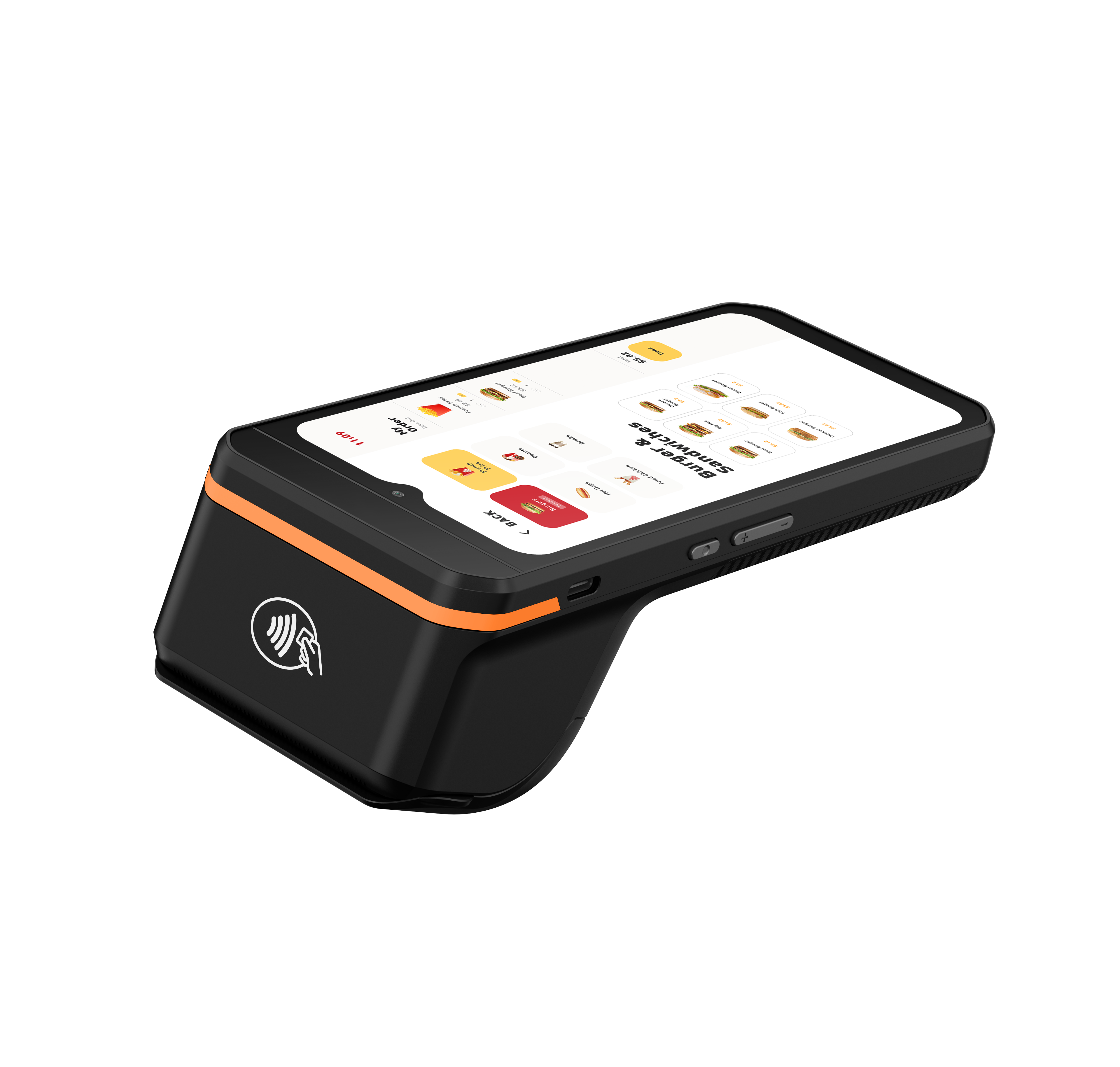
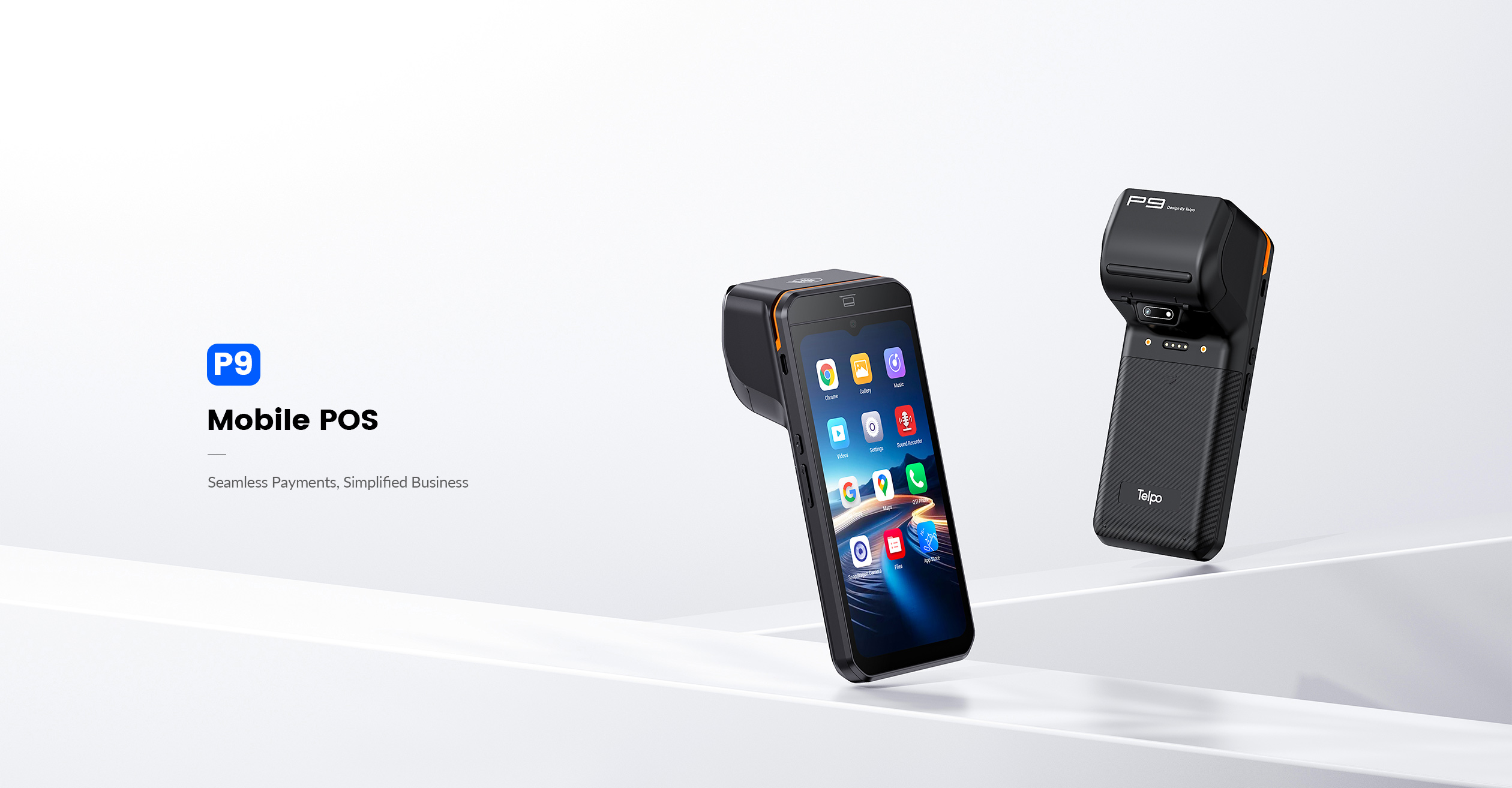
Two hardware specifications set the practical ceiling of a smart POS terminal: the processor and the battery. On the Telpo P9 series, an octa-core processor paired with up to 4GB RAM and 64GB ROM runs the payment application, receipt printing and business software on a single handheld device, while the standard removable 3,500mAh battery is rated for 12 to 16 hours of continuous operation — rising to 17 to 23 hours with the optional 5,000mAh pack. Those two numbers explain why the P9 family is deployed in pay-at-table hospitality, retail checkout and field sales work, where a terminal has to stay responsive and powered from opening to close.
This guide is written for buyers in the research stage who need to read a POS terminal datasheet critically. It breaks down what the octa-core platform and battery specification of the P9 series actually consist of, how those figures translate into transaction throughput and uptime, and how to match the right configuration to a retail, hospitality, logistics or field-sales workflow before committing to a rollout.
Problem Definition: Why "Octa-Core" and "3500mAh" Resist Comparison
Most POS terminal datasheets state a core count and a battery capacity without stating the workload either figure was measured against. Two assumptions usually follow: more cores means faster payments, and a bigger milliamp-hour rating means a longer shift. Neither assumption holds up in a real deployment.
Payment authorization time is governed mainly by the network, the acquiring host and the card scheme. What the terminal's compute platform controls is everything surrounding the transaction: how quickly the payment app launches, whether a dual-screen or SoftPOS workflow runs without lag, whether printing a receipt holds up the queue, and whether background tasks such as cloud sync or remote device management compete with the checkout screen. In the same way, a battery rating is only meaningful under stated conditions — receipt printing frequency, display brightness, cellular versus Wi-Fi use and GPS activity all move real-world runtime.
That is why the useful question for a buyer is not which terminal carries the largest number, but which processor-and-battery combination matches the work the device will perform. The rest of this guide uses the P9 series as a concrete reference point for making that comparison, because its specification separates the two variables cleanly: an octa-core compute platform, a removable battery with a documented runtime range, and a printer that sits between them in terms of power draw.
Industry Background: Portable Terminals Are Where Payment Hardware Is Growing
The commercial context matters because portable, battery-powered terminals are no longer a niche category. Published third-party estimates place a substantial share of payment hardware growth in handheld and Android-based devices:
- Grand View Research values the global point-of-sale (POS) terminal market at approximately USD 123.2 billion in 2025.
- The handheld POS segment is projected to grow from USD 33.15 billion in 2025 to USD 89.52 billion by 2035, according to Market Research Report.
- Android POS terminals accounted for approximately 27% of all POS terminals sold globally as of 2022/2024 tracking, per ResearchAndMarkets / Berg Insight.
- Grand View Research estimates the SoftPOS market at USD 365.0 million in 2024, with a projected CAGR of 23.1% through 2030.
These figures should be read with care. Different research houses define the POS market differently — some include software and services, some count only hardware, and SoftPOS estimates diverge sharply depending on whether transaction value or software revenue is being measured. The direction of travel is consistent even when the absolute numbers are not: more transactions are being processed on battery-powered, Android-based devices that support NFC contactless, QR and SoftPOS.
Against that demand sits a fixed compliance baseline. POS terminals must comply with PCI PTS (PIN Transaction Security) and EMV standards for secure chip processing, which is why certification evidence belongs next to any processor or battery claim on a datasheet. For a buyer, the practical implication is that compute headroom and battery runtime have become purchase criteria rather than footnotes: they determine how many payment methods a single device can accept, how long it can run unattended, and how much application software it can carry without slowing the checkout line.
Detailed Solution: What the P9 Series Octa-Core Platform and Battery Contain
The Telpo P9 series is a handheld Android platform that exists in two product families: a financial version (Smart Payment Terminal) and a non-financial version (Android POS Terminal), each available in a standard handheld form and a slimmer PDA form. All four variants are classified as mobile terminals, which is what makes their processor and battery specifications the deciding factors in most deployments.
1. Compute: octa-core processor with up to 4GB RAM and 64GB ROM
The P9 financial and non-financial versions run on an octa-core processor with up to 4GB RAM and 64GB ROM. That memory configuration is the part buyers most often overlook. A payment terminal is not running a single foreground application: it is running the payment application, a receipt-printing pipeline, contactless or SoftPOS handling, QR scanning through the built-in camera, and background services such as transaction upload and ODM or Telpo MDM device management. Memory capacity determines how many of those processes stay resident instead of being reloaded each time a cashier switches screens.
2. Display and interaction
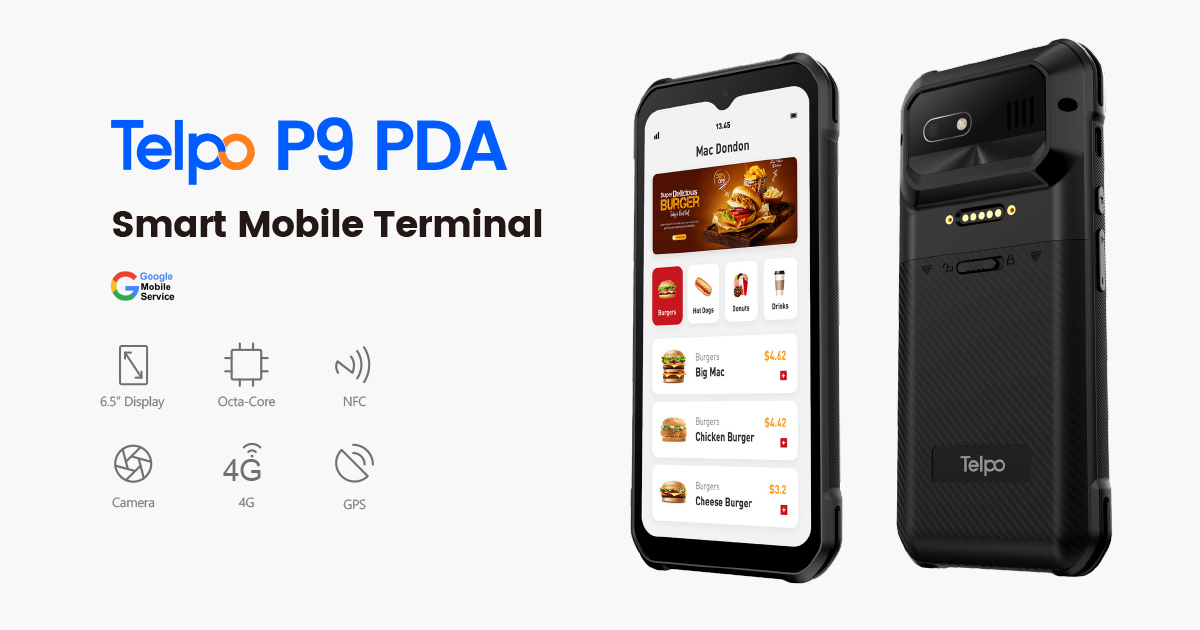
The P9 handheld models use a 6.5-inch HD IPS display with an 83.4% screen-to-body ratio and a 1400:1 contrast ratio; the P9 PDA variants use a 6.5-inch HD IPS panel with an 83.3% screen-to-body ratio and a 1750:1 contrast ratio. Variant options extend the platform beyond a single configuration: a customer-display version with a 2-inch IPS screen, a fingerprint version for KYC compliance work, and a PDA version for inventory and logistics. The P9 handhelds measure 21.3 mm in profile, while the PDA versions are 16.4 mm thick for extended single-hand carrying.
3. Receipt printing as a throughput component
The P9 handheld versions integrate a 58mm thermal printer rated at 80mm/s with a dust-proof design. Printing is often the slowest physical step in a cash register workflow, so a printer specification belongs in the same conversation as the processor: a fast application that waits on a slow printer produces the same queue. The PDA variants are documented with an optional 1D/2D barcode scanner module and do not list an integrated printer in their specification, which suits scan-first tasks such as stock counts, ticket inspection and parcel handling.
4. Power: 3,500mAh standard, 5,000mAh optional, both removable
This is the specification most directly tied to uptime. The P9 handheld uses a removable battery that provides 12 to 16 hours of continuous operation with the standard 3,500mAh pack, or 17 to 23 hours with the optional 5,000mAh upgrade. The P9 PDA variants use advanced power management with a deep-sleep mode rated for up to 12 hours of continuous operation. Because the battery is removable rather than sealed, a shift that runs longer than a single charge can be covered by a battery swap instead of a charging break — a configuration detail that matters more than the raw milliamp-hour figure in multi-shift retail, hospitality and field operations.
5. Connectivity and security layers
All P9 variants support 4G/3G/2G cellular, Wi-Fi and Bluetooth, with built-in GPS positioning for location-stamped transactions and fleet management. Dual SIM slots plus eSIM support and a SAM security module are part of the platform, and the PDA versions specifically emphasise eSIM multi-network switching for cross-border or multi-carrier operations. In the field, network resilience is a battery issue as well as a connectivity issue: a terminal that repeatedly hunts for signal draws more power than one holding a stable connection.
6. Payment, software and certification variants
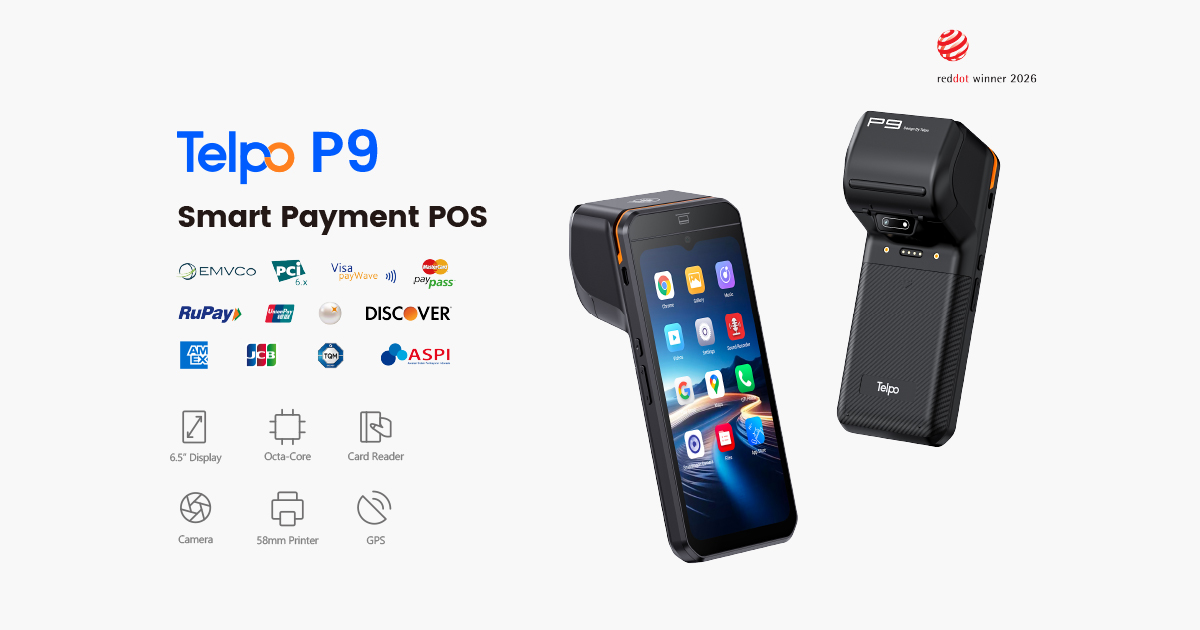
The financial version of the P9 accepts magnetic stripe cards, smart cards, NFC contactless, QR codes and digital wallets, and is documented as meeting international payment compliance standards including PCI, EMV and regional financial regulations. The non-financial version is a SoftPOS-ready NFC and QR terminal with full Google Mobile Services (GMS) certification for Android application compatibility. Design and serviceability are part of the same platform: the P9 received a Red Dot Award in 2026, and the PDA construction uses a single-screw design so field repairs can be completed in minutes rather than requiring a depot return.
Step-by-Step Breakdown: Matching Processor and Battery Specs to a Deployment
The following sequence is a practical evaluation order for buyers comparing handheld POS terminals. It works with any vendor's datasheet, but the P9 series is used here to show what a complete answer looks like.
- Define the transaction profile first. List the payment methods the terminal must accept in each location — magnetic stripe, EMV chip, NFC contactless, QR or digital wallet — and how often a receipt must be printed. A financial P9 and a non-financial SoftPOS P9 handle different payment sets, so this step determines which variant is even eligible.
- Size the compute platform against the software stack. Count the applications the device will run: payment app, inventory or loyalty software, MDM agent, and any tax or fiscal module integration. An octa-core processor with up to 4GB RAM and 64GB ROM gives headroom for concurrent workloads; a quad-core platform is adequate for lighter, single-purpose use.
- Convert battery capacity into shift hours, not milliamp-hours. Use the documented runtime range as the starting point — 12 to 16 hours on the standard 3,500mAh P9 battery, 17 to 23 hours with the 5,000mAh pack — then adjust downward for heavy printing, high screen brightness or continuous cellular use. Check whether the battery is removable, because that determines whether a long shift can be covered by a swap.
- Treat the printer as part of the throughput budget. Confirm print speed and paper width (the P9 handhelds use a 58mm printer at 80mm/s) and whether the deployment needs printing at all. For ticketing, inventory or delivery scanning, a PDA configuration without a printer may be the better fit.
- Plan the network fallback path. Confirm cellular bands, Wi-Fi and Bluetooth support, plus dual SIM, eSIM and GPS. For cross-border fleets, eSIM switching reduces the risk of a device being unusable on arrival in a new market.
- Verify certification and software compatibility for the target market. Payment deployments require PCI and EMV compliance documentation, and Android deployments that depend on Google services require GMS certification. Confirm these against the exact model variant quoted, not the product family.
- Validate with a sample before volume rollout. Run the terminal through a real shift: print volume, screen-on time, cellular use and application load. Battery ratings and processor specifications are manufacturer figures, and the only reliable test is the workload the device will actually face.
Use Cases: Where Octa-Core Performance and Battery Runtime Change the Workflow
Retail and convenience store checkout
In retail, lottery, supermarket and warehouse environments, the P9 non-financial version handles SoftPOS-ready NFC payment and QR scanning through the built-in camera, printing receipts on the integrated 58mm printer. The relevant specification here is not peak processor speed but sustained responsiveness: the terminal must keep the checkout screen live while payment, printing and inventory sync run together, which is where up to 4GB RAM and 64GB ROM matter most.

Hospitality: pay-at-table, poolside and event venues
Table-side restaurant, poolside bar, event venue and room service deployments use the P9 and P9 PDA to bring the payment terminal to the guest. The operational constraint is battery continuity across a full service period, which is why the 12 to 16 hour standard runtime and the 17 to 23 hour optional pack are specified alongside the device's single-hand grip, built-in GPS and optional 2-inch IPS customer sub-display. Practical accessories include a charging dock or cradle for countertop returns between shifts.
Field sales, agent banking and door-to-door collection
Mobile merchant acquiring and agent banking work places the terminal in outdoor, variable-infrastructure conditions. The financial P9 handles magnetic stripe, chip, NFC and QR payment with GPS location-stamped transactions, and its financial certification covers PCI, EMV and regional regulations. In these environments the battery specification and the GPS radio are the two variables that most often shorten a working day.

Logistics, delivery and mobile inventory
For courier and last-mile work, the P9 PDA combines parcel barcode scanning with electronic receipt printing and payment collection, synchronising order status over 4G with GPS verification of the delivery address. Inventory and warehouse projects use the same PDA platform with an optional 1D/2D scanner module, where the single-screw construction allows field repair in minutes if a device is dropped or damaged during a shift.
Comparison Table: Battery and Compute Across Telpo Portable Terminals
The table below places the P9 series next to other Telpo portable terminals so that processor and battery specifications can be compared on the same terms. All values are taken from Telpo product specifications.
| Model | Form factor | Processor / memory | Battery | Rated continuous operation |
|---|---|---|---|---|
| P9 financial version (Smart Payment Terminal) | Handheld, 21.3mm, 58mm printer | Octa-core; up to 4GB RAM / 64GB ROM | Removable 3,500mAh standard; optional 5,000mAh | 12–16 hours (standard); 17–23 hours (optional pack) |
| P9 non-financial version (Android POS Terminal) | Handheld, 21.3mm, 58mm printer | Octa-core; up to 4GB RAM / 64GB ROM | Removable 3,500mAh standard; optional 5,000mAh | 12–16 hours (standard); 17–23 hours (optional pack) |
| P9 PDA financial version | Slim handheld, 16.4mm | Octa-core | — | Up to 12 hours (deep-sleep power management) |
| P9 PDA non-financial version | Slim handheld, 16.4mm | Octa-core | — | Up to 12 hours (deep-sleep power management) |
| TPS900 (Smart Payment POS) | Handheld, 58mm printer | Octa-core | 7.6V / 3,000mAh standard; optional 4,400mAh | Up to 15 hours; 12 days standby |
| M1 (Handheld Ticketing POS) | Handheld, 58mm printer | Quad-core 2.0GHz | Removable 7.6V / 3,500mAh | 11.3 hours; 16 hours standby |
| P8 M5 (Android POS Terminal) | Handheld, 389g | — | Removable 7.2V / 2,600mAh | 13+ hours; 220 hours standby |
A dash indicates that the value is not published in Telpo's product specification for that model. All runtime figures are manufacturer ratings; actual performance depends on printing volume, display brightness, cellular usage and GPS activity, and should be validated against the intended workload.
FAQ
What certifications should a handheld POS terminal carry before deployment?
PCI PTS (PIN Transaction Security) and EMV are the baseline standards for secure chip and PIN processing on payment terminals, and buyers should confirm them against the exact model variant quoted rather than the product family. Within the Telpo P9 series, the financial version is documented as meeting international payment compliance standards including PCI, EMV and regional financial regulations, while the non-financial version carries GMS certification for Google application compatibility. Market-specific requirements vary, so certification evidence should be checked for each target country before ordering.
Does an octa-core processor in a POS terminal actually make checkout faster?
An octa-core processor with up to 4GB RAM and 64GB ROM raises the terminal's throughput ceiling rather than the speed of the payment network. On the Telpo P9, it allows the payment application, a 58mm printer rated at 80mm/s, SoftPOS NFC, QR scanning and background cloud or device-management tasks to run concurrently without the checkout screen stalling. Payment authorization latency itself depends mainly on connectivity and the acquiring host, so processor and memory specifications should be matched to the software workload the terminal will carry, not treated as a standalone speed claim.
How long does the P9 battery last, and when does the 5,000mAh upgrade make sense?
The Telpo P9 handheld uses a removable battery rated for 12 to 16 hours of continuous operation with the standard 3,500mAh pack, and 17 to 23 hours with the optional 5,000mAh upgrade; the P9 PDA variants are rated for up to 12 hours using deep-sleep power management. Because runtime falls with heavy receipt printing, high screen brightness and continuous cellular use, the upgrade is most relevant to full-service hospitality shifts, field sales routes and any deployment where charging windows are unreliable. The removable design also allows a mid-shift battery swap instead of a charging pause.
How should buyers evaluate POS terminal suppliers on hardware specifications?
Ask for documented values rather than headline numbers: the processor and memory configuration, the battery model with its rated runtime, printer speed and paper width, connectivity options including cellular bands and eSIM, and certification evidence for the target market. Supplier scale and process discipline support those answers over the life of a deployment — Telpo Technology Co., Ltd. was founded in 1999, employs approximately 600 staff including an R&D team of 200 engineers, and operates a manufacturing facility of approximately 45,000 sqm with an annual production capacity of 2,000,000 units, supporting ODM branding and remote device management through Telpo MDM.
Can battery life and transaction speed be validated before committing to a rollout?
Yes. Sample validation is the only reliable way to confirm that a documented rating holds under a specific workload, and it also lets a buyer confirm the correct variant — financial or non-financial, standard or PDA, fingerprint or customer-display — before volume ordering. Buyers who want to run that test on P9 hardware can request a sample or quotation from Telpo at business@telpo.com, by phone at +86 757 86337898-324, or via WhatsApp at +86 18603080594.
Conclusion
Processor and battery specifications are the two variables that determine whether a smart POS terminal keeps up with a checkout line and survives a full working day. On the Telpo P9 series, that translates into concrete numbers: an octa-core processor with up to 4GB RAM and 64GB ROM for concurrent payment, printing and application workloads; a 6.5-inch HD IPS display with a 1400:1 contrast ratio on the handheld versions; a 58mm thermal printer rated at 80mm/s; and a removable battery delivering 12 to 16 hours of continuous operation on the standard 3,500mAh pack, or 17 to 23 hours with the optional 5,000mAh upgrade.
The evaluation discipline matters more than any single figure. Define the transaction profile, size the compute platform against the software stack, convert battery capacity into shift hours, treat the printer as part of the throughput budget, confirm network fallback and certification, and then validate with a sample under a real workload. Applied in that order, a POS terminal specification becomes a procurement decision rather than a list of numbers.
Next step: validate the specification against your workload
Telpo Technology Co., Ltd. supplies Android POS terminals, payment terminals, dual-screen cash registers, self-service kiosks, ticket validators, biometric terminals and PDAs to customers across more than 100 countries, with ODM customization from product concept through certification and manufacturing.
Request a sample, a quotation or the full product brochure at business@telpo.com · +86 757 86337898-324 · WhatsApp +86 18603080594. Product range and specifications: www.telpo.com.cn
Download the Telpo product brochure (payment & retail terminals): Telpo Products Brochure — Payment & Retail V4 (PDF)