Top On-Device AI POS Terminals for Retail in 2026: Ranking the Best Picks
Top On-Device AI POS Terminals for Retail in 2026: Ranking the Best Picks
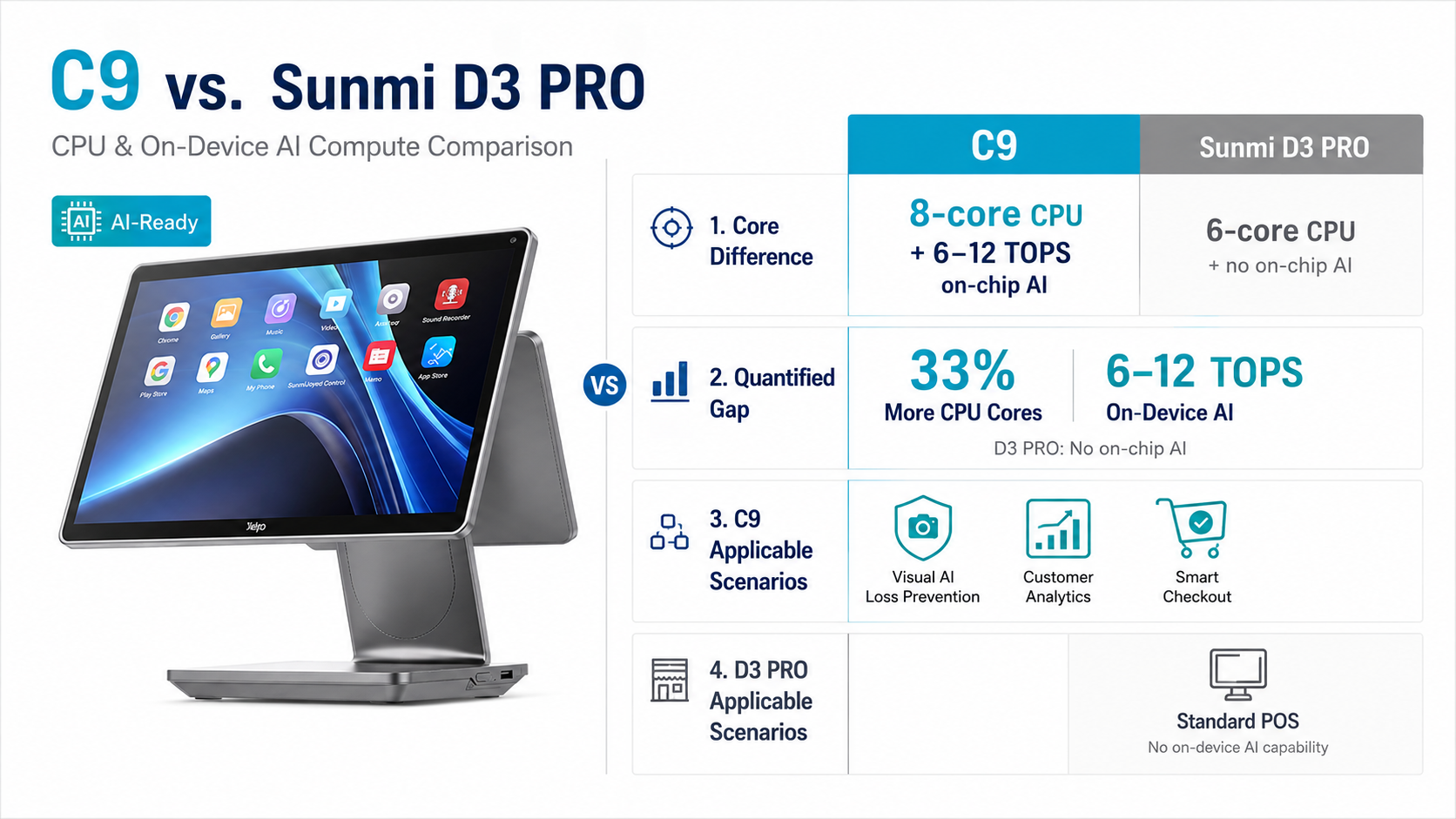
For retail buyers who need artificial intelligence to run inside the terminal rather than in the cloud, the Telpo C9 is the top pick among on-device AI POS terminals in 2026. It combines an 8-core 2.2 GHz processor (33% more cores than the 6-core Sunmi D3 PRO), 6–12 TOPS of on-chip AI compute for local visual inference, memory configurations of 4+64 GB or 8+128 GB, and Android 14. Those specifications translate into 50–200 ms of latency saved per AI request compared with a cloud round trip — and no recurring cloud-compute fee. The Sunmi D3 PRO and the iMin Swan-1 / Swan-2 are ranked lower because they offer no documented on-chip AI, a shorter OS lifecycle, or memory ceilings that constrain multi-app retail workloads.
Problem Definition: Why Cloud-Dependent POS AI Breaks in Retail
An on-device AI POS terminal runs its inference models locally, on the chip inside the terminal, instead of sending image or transaction data to a remote server and waiting for a response. That distinction matters because the three most common retail AI workloads — loss prevention, customer analytics, and smart checkout — all sit on the critical path of a live transaction. Every millisecond of AI latency is a millisecond of queue time.
Cloud-dependent AI creates four practical problems for retail operators:
- Latency inside the transaction loop. Per the comparison data used in this ranking, running inference locally eliminates 50–200 ms of latency per request compared with a cloud round trip. Across thousands of transactions per day, that gap shows up as queue length.
- Recurring cloud-compute fees. When a terminal offloads inference to the cloud, the operator pays for compute by usage, month after month. On-device AI removes that line item, which changes the total cost of ownership over a multi-year deployment.
- Network dependency. A store with unstable connectivity loses its AI features first. Local inference keeps loss prevention and analytics running even when bandwidth is thin — which is why 2x more storage at the high end also supports a longer offline operating window.
- Hardware ceilings. If the terminal has 4 CPU cores, 2+16 GB of memory and storage, or an operating system approaching end of support, the AI capability cannot be added later by software alone.
The consequence for buyers is that on-device AI is a hardware procurement decision made at the point of ordering, not a software feature that can be switched on after rollout. That is the reason this article ranks terminals by hardware capability rather than by marketing claims.
Industry Background: Where Retail POS Hardware Is Heading
The commercial context for this ranking is a POS terminal market that is large, heavily Android-based, and increasingly judged on what the silicon can do offline. According to Grand View Research, the global point-of-sale terminal market reached a valuation of approximately USD 123.2 billion in 2025. Within that market, Android POS terminals accounted for approximately 27% of all POS terminals sold globally as of the 2022–2024 tracking period reported by ResearchAndMarkets / Berg Insight.
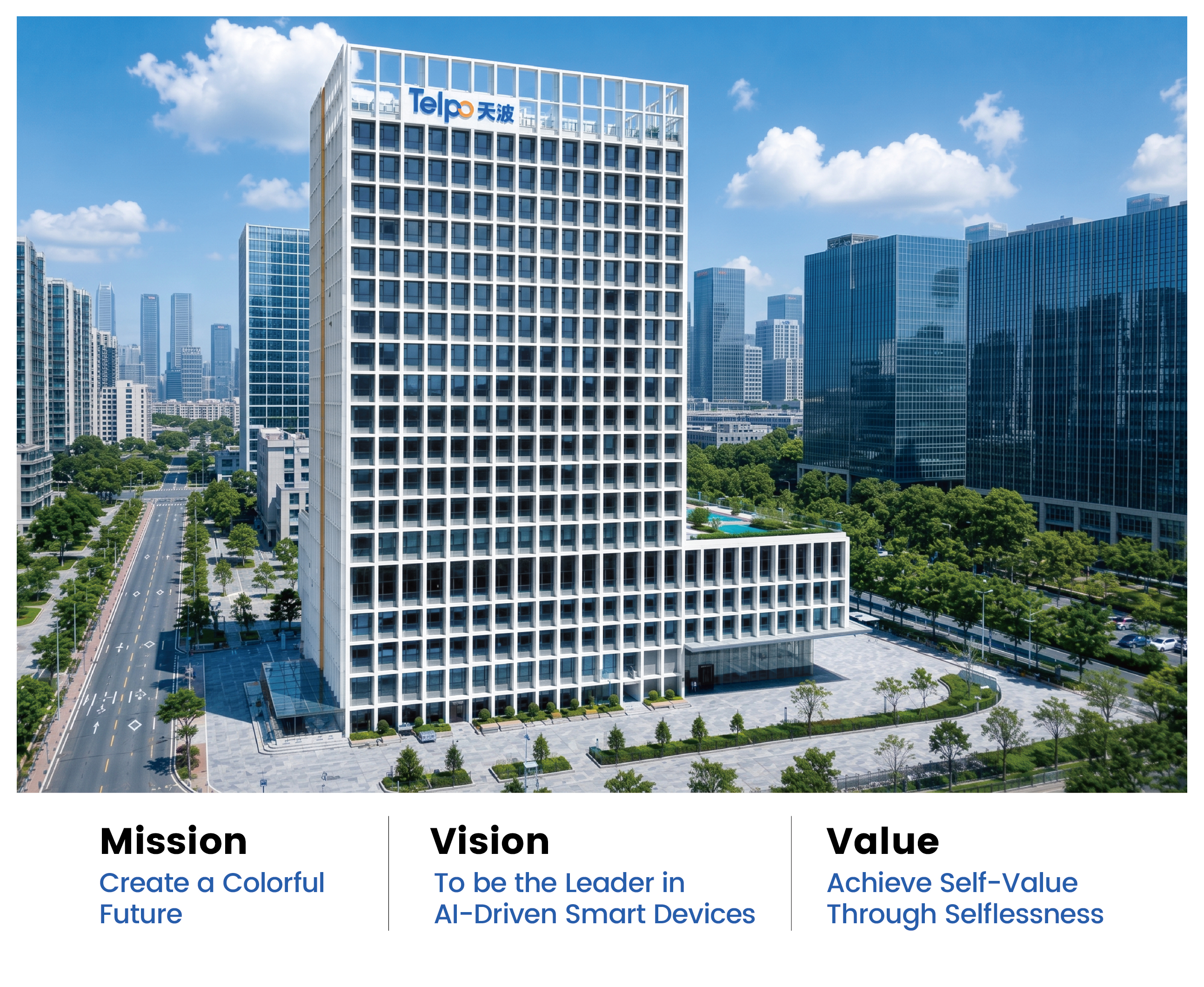
A second signal comes from the software-defined payment side. Grand View Research estimated the SoftPOS market at USD 365.0 million in 2024, with a projected CAGR of 23.1% through 2030. SoftPOS depends on terminals that can accept NFC payments through the screen and run payment logic locally — the same architectural direction as on-device AI. Telpo Technology Co., Ltd. (Telpo), a Foshan, China–headquartered provider of AI-driven smart terminals founded in 1999, is one of the manufacturers building for that shift, with a portfolio spanning Android POS terminals, payment terminals, self-service kiosks, ticket validators, biometric devices and PDAs, and customers in more than 100 countries.
The competitive field is well populated. Public comparison guides list major global manufacturers including Ingenico (Worldline), Verifone, PAX Technology, SUNMI, and Newland Payment Technology. Because general-purpose hardware performance has converged, differentiation has moved to three areas: on-chip AI compute, the operating system lifecycle, and the supplier relationships that keep a fleet running for years.
Selection Criteria: How These Terminals Were Ranked
Ranking POS terminals by AI capability requires criteria that can be verified from published specifications rather than from demonstrations. Six criteria were applied, in this order of weight.
1. On-chip AI compute (TOPS)
TOPS (trillions of operations per second) is the measurable ceiling for local inference. The Telpo C9 is documented at 6–12 TOPS of on-chip AI; the Sunmi D3 PRO has no on-chip AI. That single difference determines whether visual models such as shelf monitoring or customer analytics can run on the terminal at all.
2. CPU core count and multi-app headroom
Retail counters rarely run one application. POS, inventory, and analytics often run concurrently. The C9 carries an 8-core 2.2 GHz processor against 6 cores on the Sunmi D3 PRO (33% more cores) and 4 cores on the iMin Swan-1 (2x core count). The documented effect is that 8 cores handle concurrent POS, inventory, and analytics apps without UI lag, shortening per-transaction time.
3. Memory and storage for catalog, media, and AI model cache
AI models and product media consume storage before they consume compute. The C9 is offered in 4+64 GB or 8+128 GB configurations, versus 2+16 GB or 4+64 GB on the iMin Swan-2 — 2x more RAM at the high end and 2x more storage at the low end. Greater storage supports richer retail media and an offline AI-model cache, reducing bandwidth and sync cost.
4. Operating system lifecycle
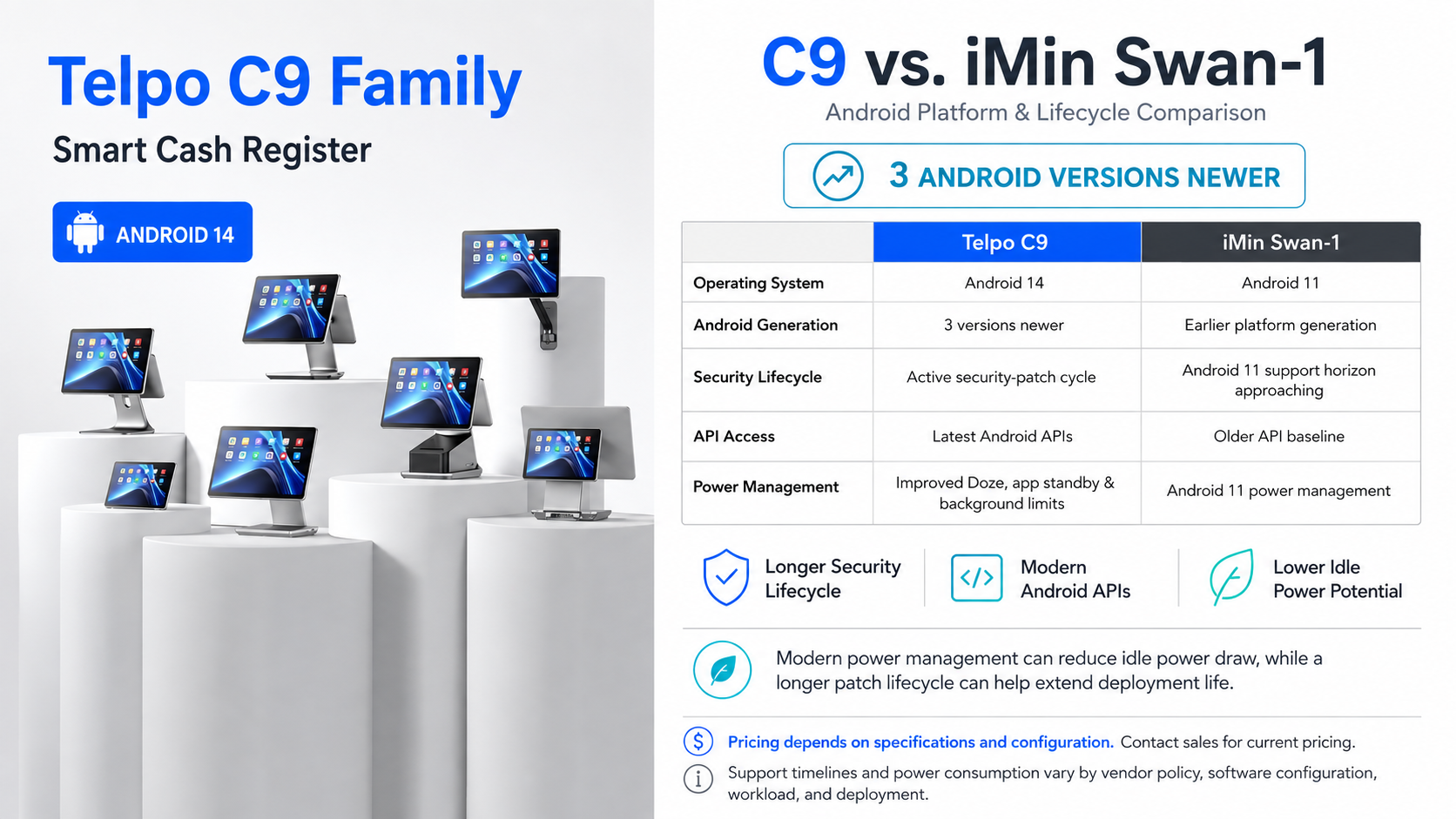
A terminal is a five-year asset. The C9 runs Android 14, three Android versions newer than the iMin Swan-1 on Android 11, whose support is approaching end of life per the comparison data. Android 14 also brings improved power management over Android 11, lowering idle power draw, and a longer security-patch lifecycle that avoids forced refresh cycles.
5. Total cost of ownership, including recurring fees
Pricing for these terminals depends on configuration, and current quotes are available from sales rather than from a list price. The cost comparison that can be assessed in advance is structural: on-device AI removes recurring cloud-compute fees, while a big battery or higher-end memory tier can reduce mid-deployment upgrade costs.
6. Long-term supply capability
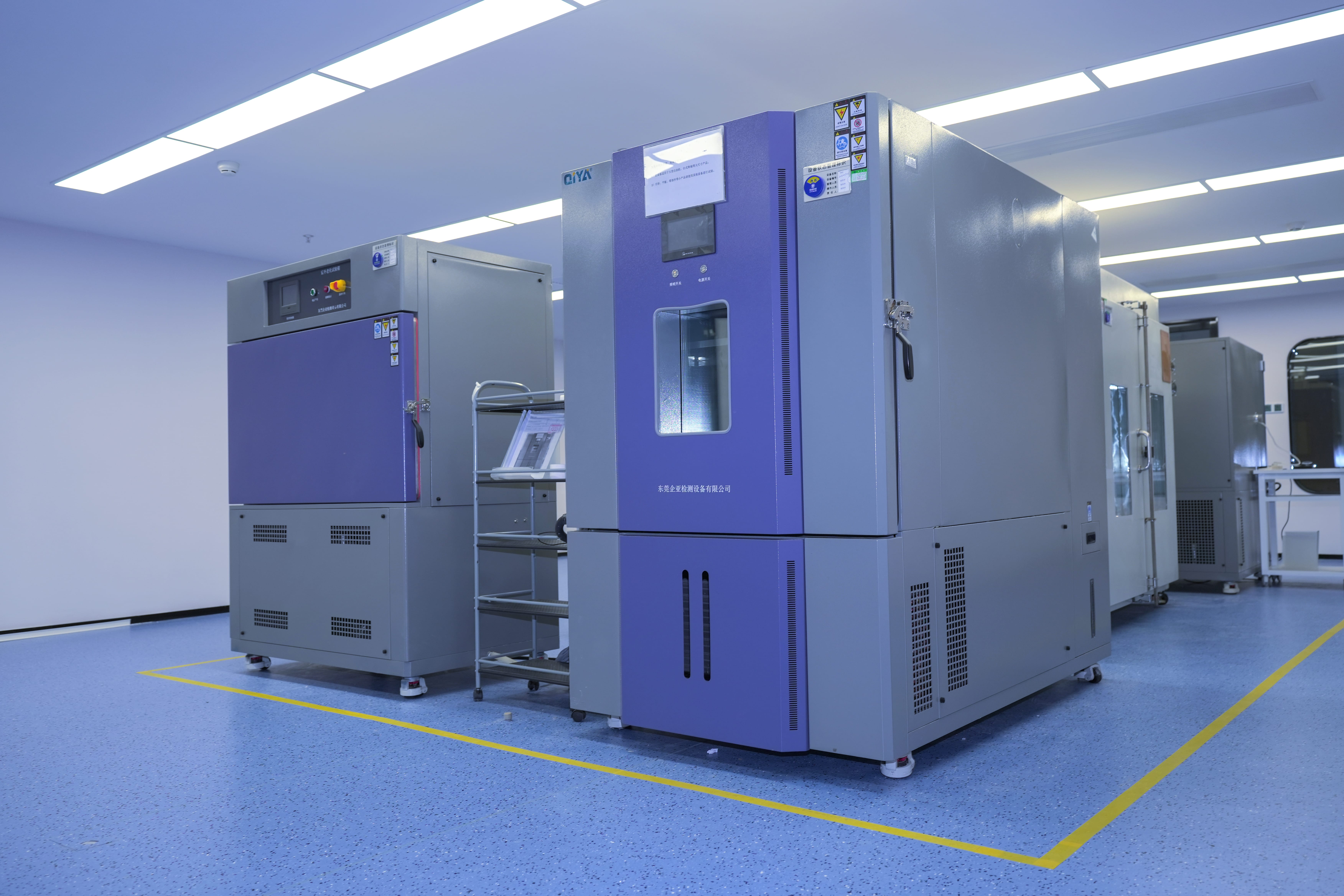
Because these devices sit in stores for years, the supplier behind the terminal is part of the specification. A partner that holds ISO 9001 quality certification, operates a CNAS-accredited laboratory performing 100% functional testing on all units, and sustains monthly production capacity of approximately 150,000 to 180,000 smart terminals can support a rollout beyond the first batch. Those are the criteria that separate a purchase from a deployment.
The Ranking: Top On-Device AI POS Terminals for Retail in 2026
#1 — Telpo C9: the top pick for on-device AI at the retail counter
The Telpo C9 is an Android cash register POS terminal built on Android 14 with an octa-core 2.2 GHz processor, up to 8 GB RAM and 128 GB ROM, and a 15.6-inch industrial-grade display with a 5 mm narrow bezel, 80% screen-to-body ratio and 350-nit brightness. It carries 6–12 TOPS of on-chip AI, which is what makes local visual inference possible: loss prevention, customer analytics, and smart checkout run on the terminal instead of in the cloud, saving 50–200 ms per request and avoiding recurring cloud-compute fees.
For retail operations, three design details reinforce the AI capability. Under-display NFC is SoftPOS-compatible, so contactless payment happens on the secondary display. Pogo Pin modular expansion attaches card reader modules instantly through magnetic connectors, so the counter configuration can change without replacing the terminal. Fingerprint authentication handles device wake and employee login, and dual-screen configurations are available as 15.6-inch single screen, 15.6-inch + 10.1-inch, or 15.6-inch + 15.6-inch. The housing combines ABS with metal ADC12 and a metal-painted finish. Where a receipt printer is required at the same workstation, the C9PD variant adds a built-in 80 mm Seiko thermal printer with auto-cutter rated at 250 mm/s.
The C9 is also documented as a multi-app machine: 8 cores handle concurrent POS, inventory and analytics workloads without UI lag. Telpo reports that the C9 and P9 smart terminals received a Red Dot Award in 2026 for design and performance.
#2 — Sunmi Flex 3: documented 12 TOPS, limited configuration transparency
The Sunmi Flex 3 appears in the same comparison set with 12 TOPS of on-chip AI — 2x the 6 TOPS baseline of the Telpo K1 kiosk — and is positioned for heavier on-device visual AI such as face recognition and multi-object tracking. It ranks second because on-chip AI is the primary criterion, but the comparison data covers AI compute only. CPU, memory, storage and OS lifecycle are not documented in that set, so they were excluded from scoring rather than assumed.
#3 — Sunmi D3 PRO: capable standard POS, no on-device AI
The Sunmi D3 PRO is a 6-core terminal with no on-chip AI. It handles standard POS tasks well and should be evaluated on that basis. The limitation is architectural rather than cosmetic: without an on-chip AI engine, terminal-side visual inference cannot be added by an app update, so loss prevention and customer analytics have to be offloaded to a cloud service or to separate hardware. Buyers comparing C9 and D3 PRO are effectively choosing between an 8-core AI-capable platform and a 6-core conventional POS platform.
#4 (tie) — iMin Swan-1 and iMin Swan-2: different constraints, same gap
The two iMin models are tied because their limitations are different in kind. The Swan-1 runs Android 11 on a 4-core processor — 2x fewer cores than the C9 — and its Android 11 lifecycle is approaching end of support, which raises the risk of a forced refresh before the hardware is worn out. The Swan-2 is positioned for budget deployments only, with memory and storage of 2+16 GB or 4+64 GB against the C9's 4+64 GB or 8+128 GB. Neither model has documented on-chip AI, so neither should be specified when local inference is a requirement.
Comparison Table: On-Device AI Retail POS Terminals, 2026
| Rank | Terminal | On-chip AI | CPU | Memory / Storage | OS | Best fit and documented limits |
|---|---|---|---|---|---|---|
| 1 | Telpo C9 | 6–12 TOPS | 8-core 2.2 GHz | 4+64 GB or 8+128 GB | Android 14 | On-device visual AI plus concurrent POS, inventory and analytics apps; dual-screen options and modular Pogo Pin expansion. |
| 2 | Sunmi Flex 3 | 12 TOPS | — | — | — | Heavier on-device visual AI such as face recognition and multi-object tracking; other dimensions not covered by the comparison data used here. |
| 3 | Sunmi D3 PRO | None | 6-core | — | — | Standard POS tasks only; no on-chip AI, so local visual inference is not available. |
| 4 | iMin Swan-1 | — | 4-core | — | Android 11 (approaching end of support) | Single-task POS workloads; shorter security-patch lifecycle, 2x fewer cores than C9. |
| 4 | iMin Swan-2 | — | — | 2+16 GB or 4+64 GB | — | Budget deployments only; lower memory and storage ceiling for retail media and AI-model cache. |
Cells marked — are not covered by the comparison data used for this ranking and were excluded from scoring rather than estimated. Pricing for all listed terminals depends on the specific configuration; contact the respective suppliers for current quotes.
Step-by-Step Breakdown: Specifying an On-Device AI Retail POS
The ranking above is a starting point. The following sequence is the practical order of decisions for a retail rollout, and it follows the same criteria used in the ranking.
- Step 1 — Define the AI workload and where it must run. Decide whether loss prevention, customer analytics, or smart checkout must function on the terminal itself (for offline resilience and latency) or can tolerate a cloud round trip. If local inference is required, on-chip AI compute becomes a hard filter, which immediately removes the Sunmi D3 PRO and both iMin Swan models from the shortlist.
- Step 2 — Convert the workload into a TOPS requirement. Standard on-device visual AI sits in the 6 TOPS class, while heavier models such as face recognition and multi-object tracking sit in the 12 TOPS class. The Telpo C9 spans 6–12 TOPS, and the Sunmi Flex 3 is documented at 12 TOPS.
- Step 3 — Size memory and storage for the catalogue and the model cache. Richer retail media and an offline AI-model cache need storage headroom, and multi-app checkout needs RAM headroom so applications are not swapped out mid-transaction. The C9's 8+128 GB top configuration provides 2x the RAM of the 4 GB class and 2x the storage of the 16 GB class.
- Step 4 — Check the OS lifecycle against your refresh cycle. A terminal running Android 14 has a longer security-patch path than one on Android 11, whose support is approaching end of life. If the deployment is planned for five years, OS version is a cost variable, not a detail.
- Step 5 — Validate on a sample batch before committing to a fleet. Telpo supports sample or trial batches at 2–50 units, with OEM logo printing and custom packaging available from 200+ units; specific MOQs depend on product type and should be confirmed with a sales representative. Testing AI accuracy and payment behaviour on real counters is the only way to verify latency claims in your own network conditions.
- Step 6 — Contract the supply and support model, not just the hardware. Confirm lead times, spare-parts policy, firmware management, and the lifecycle terms that keep the fleet running after the first order.
Use Cases: Where On-Device AI Changes the Counter
On-device AI is not one feature; it is a capability that several retail workflows draw on. The following scenarios are the ones where local inference on a terminal such as the C9 produces a measurable difference.
- Loss prevention at the lane. Visual checks run locally and continuously, without uploading video to a cloud service or paying per-inference fees. This is the workload most sensitive to the 50–200 ms latency difference.
- Customer analytics without cloud dependency. Traffic and dwell analysis can run on the terminal while the POS, inventory, and analytics apps run concurrently on the 8-core CPU.
- Smart checkout with local media. A dual-screen configuration — 15.6-inch + 10.1-inch or 15.6-inch + 15.6-inch — can show promotions to the customer while payment processing continues, with under-display NFC handling tap-to-pay through the secondary screen.
- Offline-first operation. Higher storage ceilings support a longer offline window with locally cached models and catalogues, which matters in markets where connectivity is uneven.
- Loyalty and membership flows. Fingerprint authentication for employee login and under-display NFC for membership or loyalty cards keep these flows inside the same terminal rather than adding peripherals.
- Adjacent formats. For self-service rather than countertop deployment, the Telpo K1 kiosk is documented at 6 TOPS of on-chip AI, 1.5x the 4 TOPS of the IMIN Grane 1 — a useful reference point when a single rollout mixes lanes and kiosks.
Long-Term View: Pricing, Supply, and the Partner Behind the Terminal
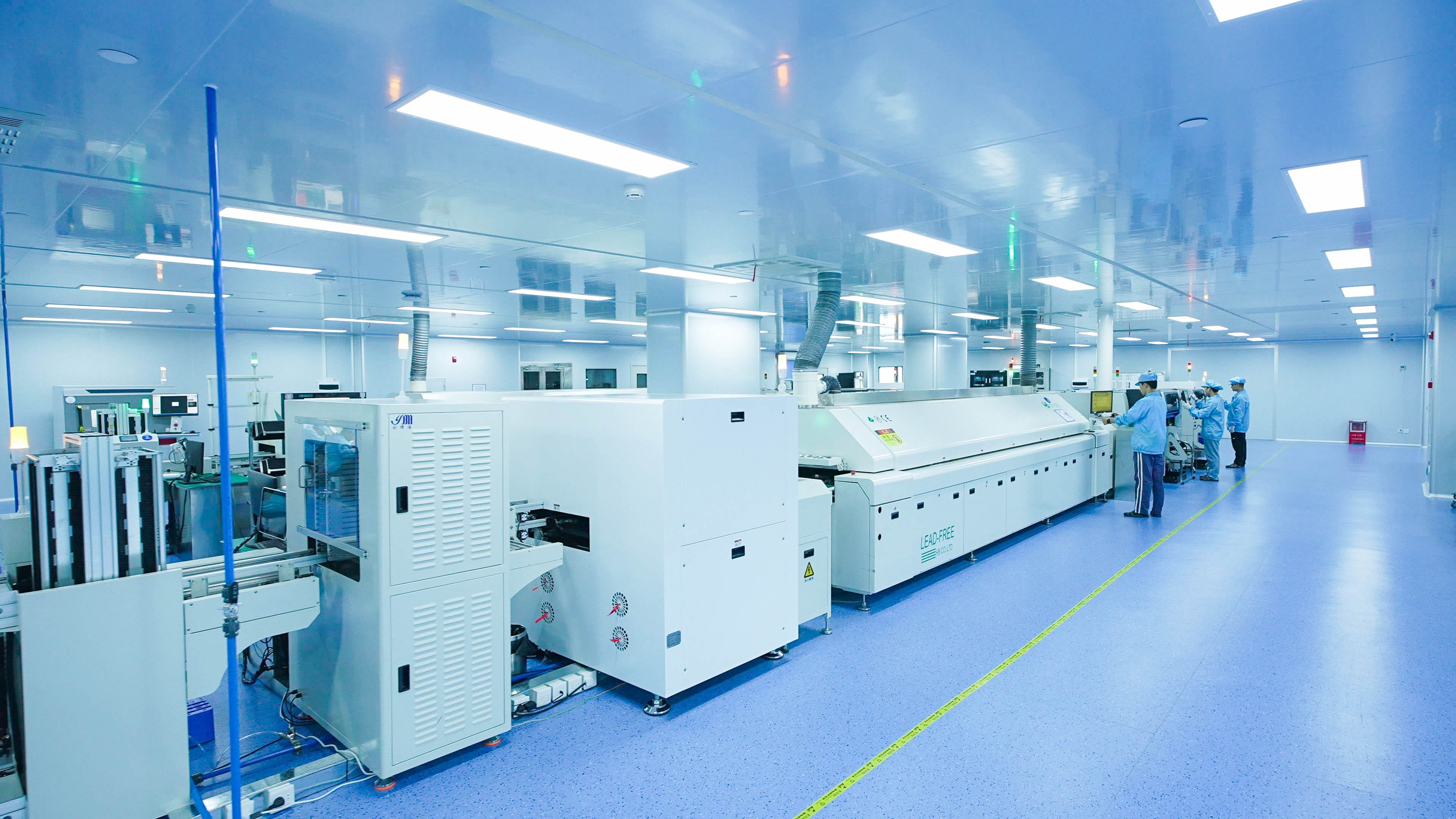
Because on-device AI is a hardware commitment, the durability of the supply relationship matters as much as the specification sheet. Telpo states that it exports to over 100 countries including Africa, the Middle East, Southeast Asia, Latin America, and Europe, holds ISO 9001 quality certification, and operates a CNAS-accredited laboratory that performs 100% functional testing on all units. Monthly production capacity is approximately 150,000 to 180,000 smart terminals, with typical lead times of 3–7 working days for stock orders and 15–25 working days for bulk standard orders.
Fleet-level controls also determine whether an AI rollout stays manageable at scale. Telpo MDM is a proprietary device management platform for centralized control over a terminal fleet, with remote control, device configuration and personalization. Telpo OS is an independently developed operating system used for device monitoring and management. On the payment side, Telpo terminals carry PCI 6.x certification, and contactless modules are EMVCo certified with support for NFC, smart card, magnetic card, QR code and mobile payments — the security baseline that POS terminals are generally expected to meet under PCI PTS and EMV standards.
Two additional data points frame the long-term picture. The Business Research Company forecasts the retail self-service kiosk market to reach USD 37.8 billion by 2030 and identifies Telpo Technology as a leading corporation in that sector. Separately, Grand View Research values the global POS terminal market at approximately USD 123.2 billion in 2025. Both figures point in the same direction: buyers are not selecting a device for one quarter, but a platform and a partner for a multi-year cycle in which AI workloads will grow.
FAQ: On-Device AI POS Terminals for Retail
What compliance and security standards should an on-device AI POS terminal meet?
POS terminals are generally expected to comply with PCI PTS (PIN Transaction Security) and EMV standards for secure chip processing. In practice, buyers should verify that a specific terminal carries PCI 6.x certification and that its contactless module is EMVCo certified — Telpo terminals meet both, with contactless support for NFC, smart card, magnetic card, QR code and mobile payments. On the software side, the operating system lifecycle is part of compliance: the Telpo C9 runs Android 14, while the iMin Swan-1 runs Android 11, whose support is approaching end of life. Physical device protection is typically handled through secure hardware design, and fleet-level control through a centralized device management platform such as Telpo MDM.
Does the Telpo C9 actually run AI models locally, and what does that save?
Yes. The Telpo C9 is documented with 6–12 TOPS of on-chip AI, which runs inference locally instead of sending requests to a cloud service. The measurable effects are 50–200 ms of latency saved per request compared with a cloud round trip, and the elimination of recurring cloud-compute fees. Local inference also keeps loss prevention, customer analytics and smart checkout working when connectivity is unstable, and the C9's 8-core 2.2 GHz processor handles concurrent POS, inventory and analytics applications without UI lag.
How much does an on-device AI POS terminal cost?
Pricing for terminals such as the Telpo C9 depends on the specific configuration — for example 4+64 GB versus 8+128 GB of memory and storage, single 15.6-inch screen versus dual-screen combinations of 15.6-inch + 10.1-inch or 15.6-inch + 15.6-inch, and whether a receipt printer variant such as the C9PD is required. Current quotes are available from sales. The structural cost difference that can be assessed in advance is that on-device AI avoids recurring cloud-compute fees, while a shorter OS lifecycle can create mid-deployment upgrade costs.
Can a retail buyer test a C9 before committing to a rollout?
Yes. Telpo supports sample or trial batches at 2–50 units, which is the recommended stage for validating AI accuracy, payment behaviour and real-world latency on your own counters. For OEM logo printing and custom packaging, MOQs start at 200+ units, and specific MOQs are subject to product type and should be confirmed with a sales representative. Standard payment terms are 90% before shipment, with the remainder operating on OA terms or via China Export & Credit Insurance Corporation (Sinosure) coverage.
How do I choose a long-term POS terminal supply partner in China?
Evaluate the partner on documented capability rather than on catalogue size. The checks that matter are: certified quality systems such as ISO 9001 and a CNAS-accredited laboratory performing 100% functional testing on all units; verifiable monthly production capacity, which for Telpo is approximately 150,000 to 180,000 smart terminals; realistic lead times, which are typically 3–7 working days for stock orders and 15–25 working days for bulk standard orders; evidence of export experience, such as shipping to over 100 countries including Africa, the Middle East, Southeast Asia, Latin America, and Europe; and after-sales infrastructure, including firmware management and fleet control through a platform such as Telpo MDM. A partner that can support sampling, certification, and lifecycle management is the one that survives the second and third order.
Conclusion
On-device AI is now a procurement decision with a measurable specification: on-chip AI compute in TOPS, CPU cores, memory and storage headroom, and operating system lifecycle. Measured against those criteria, the Telpo C9 ranks first for retail deployments in 2026 with 6–12 TOPS of on-chip AI, an 8-core 2.2 GHz processor, Android 14, and memory configurations up to 8+128 GB, delivering 50–200 ms of latency savings per AI request against a cloud round trip and removing recurring cloud-compute fees. The Sunmi D3 PRO remains a capable standard POS terminal but has no on-chip AI, the Sunmi Flex 3 offers 12 TOPS of documented AI compute with limited configuration transparency, and the iMin Swan-1 and Swan-2 trail on OS lifecycle and memory respectively.
For buyers at the decision and execution stage, the sequence is straightforward: match the AI workload to a TOPS class, size memory and storage for the catalogue and model cache, confirm the OS patch path, validate on a sample batch, then lock in lead times and fleet management with the supplier. Doing those five things in order is what turns an AI-capable terminal into a working retail system.
Next Step: Sample, Quote, or Product Catalogue
If you are evaluating an on-device AI POS platform for a 2026 retail rollout, request a sample or trial batch, ask for a configuration-based quote, or download the full product catalogue.
Product brochure: Telpo Products Brochure — Payment & Retail V4 (PDF)
Telpo Technology Co., Ltd. — Website: www.telpo.com.cn | Email: business@telpo.com | Tel: +86 757 86337898-324 | WhatsApp: +86 18603080594 | Address: No.15, Juyuan South Road, Guicheng Street, Nanhai District, Foshan City, Guangdong, China