
Waste Incineration System: 50–250 TPD Sourcing from China
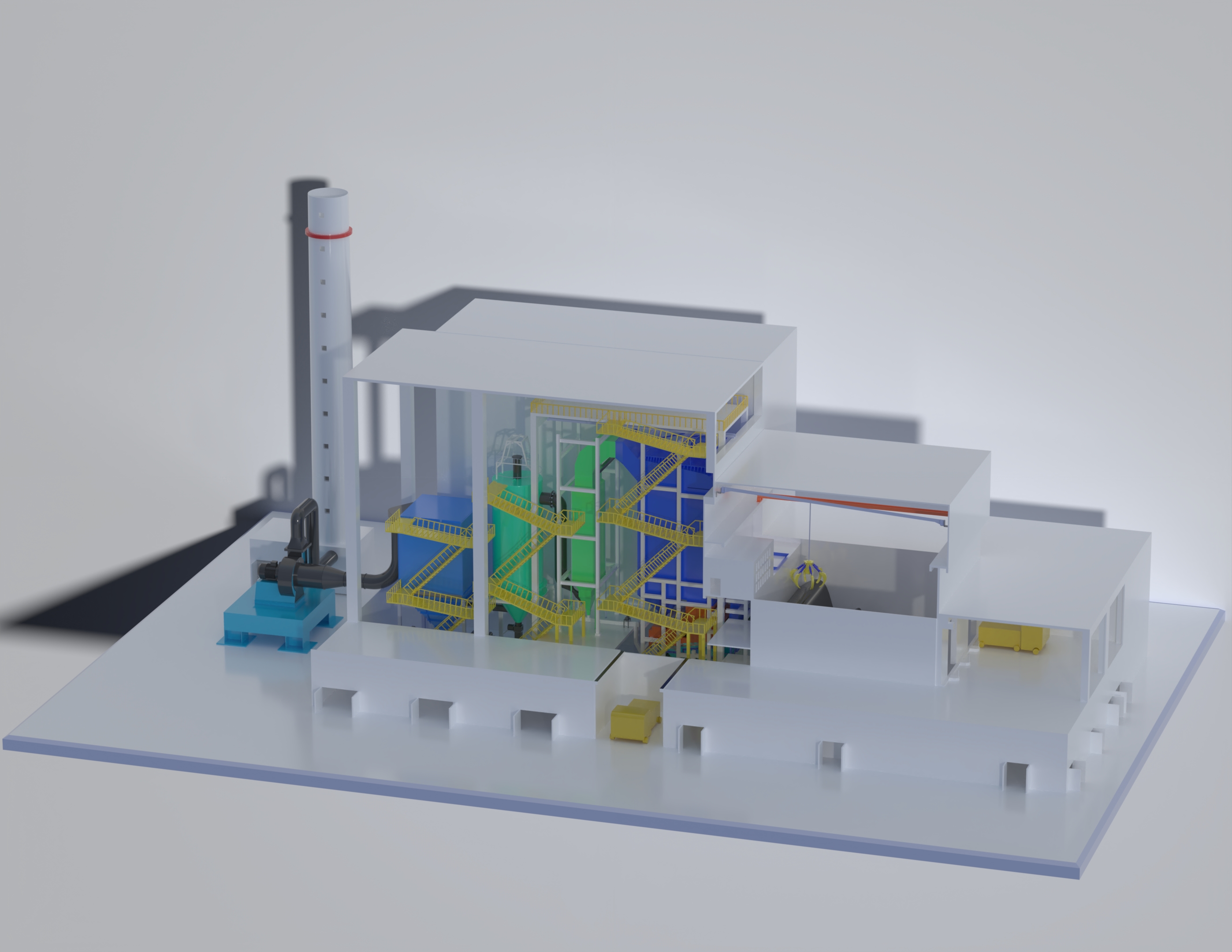
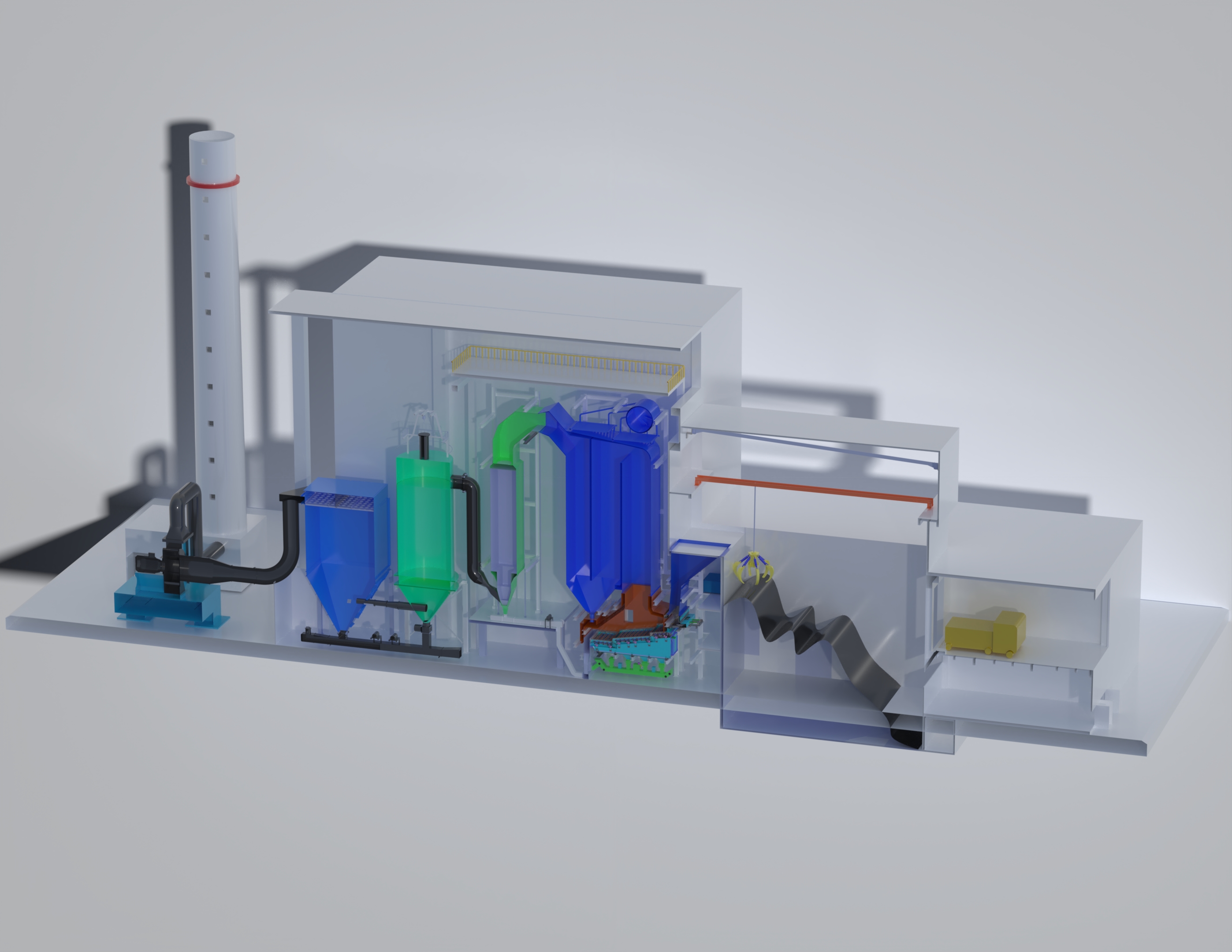
A 50–250 TPD waste incineration system from a Chinese manufacturer is normally a complete process line rather than a single furnace. It combines a hydraulic feeder, a three-stage reciprocating grate, a secondary combustion chamber designed for 850 °C and at least two seconds of flue gas residence time, ash and slag removal, optional heat recovery, and a flue gas treatment train sized to the emission limits of the destination market. Manufacturers in this capacity band serve township and county-level municipal waste projects, industrial parks and decentralised sites where long-distance transport of waste is impractical.
For a buyer at the research stage, the useful question is not “which company sells this capacity”. It is narrower: which manufacturers can document combustion control, emission performance against a named standard, a defined supply boundary and a service model — and which publish a capacity figure with nothing behind it. This guide sets out how that evaluation works, using Tenor Low Carbon New Energy Technology (Liaoning) Co., Ltd. and its Tenor Waste Incineration System range as a worked reference.
Why 50–250 TPD projects are a separate sourcing problem
Waste-to-energy procurement below roughly 250 tonnes per day behaves differently from utility-scale procurement, and four constraints explain most of the difficulty.
1. The waste stream is decentralised and variable
Small and medium systems are typically installed where waste is generated, not where a large plant would be economical. Tenor’s technical documentation notes that around 80% of county towns in China collect less than 200 tonnes of waste per day, and that long-distance centralised transport can cost two to three times the cost of local incineration. That economic logic drives demand for local disposal — but it also means the incoming waste is unsegregated municipal solid waste with fluctuating calorific value and moisture, which is a combustion-design problem before it is an equipment-selection problem.
2. Capacity is quoted in two incompatible units
Chinese and most Asian tenders quote tonnes per day (TPD). European regulation works in tonnes per hour, because the NOx limit value under Directive 2010/75/EU distinguishes plants by a nominal capacity threshold of 6 t/h. Six tonnes per hour corresponds to approximately 144 t/d at nominal continuous operation — a figure that sits inside the 50–250 TPD band and splits it into two regulatory sub-segments. A buyer who specifies “150 TPD” without stating the hourly rating is inviting an offer that may be engineered against a different regulatory regime than expected.
3. “EU compliant” is a scope statement, not a property of the equipment
A furnace cannot be compliant on its own. Compliance is produced by the combination of combustion conditions, residence time, reagent injection, filtration and validated monitoring. When a supplier states that a system meets EU emission standards, the statement is only meaningful if it names the reference conditions — dry gas, 273 K, 101.3 kPa, corrected to 11% O₂ — the averaging period, and the individual pollutant limits it is guaranteeing.
4. Wear parts and service determine lifecycle cost
Grate plates operate in the hottest and most abrasive part of the process. A capacity-matched system with a short grate life converts a low capital price into a high operating cost. Tenor publishes an annual grate plate damage rate of ≤1% for its heat-resistant, wear-resistant cast steel grate, and a heat loss on ignition of ≤5% — figures a buyer should ask to see evidenced, because they are the practical difference between two apparently similar offers.
Industry background: what regulators and buyers now expect
Europe’s waste-to-energy market was valued at USD 19.83 billion in 2025 and estimated at USD 21.26 billion in 2026, with projections to USD 37.11 billion by 2034, according to Market Data Forecast’s 2026 market report. Whatever the precision of such forecasts, the direction is consistent: thermal treatment capacity with energy recovery continues to be built and, more importantly for equipment suppliers, retrofitted.
Three regulatory instruments shape what a system must physically contain.
- Directive 2010/75/EU (Industrial Emissions Directive), Annex VI Part 3 sets binding air emission limit values for waste incineration plants, and Chapter IV sets the mandatory operating condition of 850 °C for at least two seconds after the last injection of combustion air.
- Commission Implementing Decision (EU) 2019/2010 establishes BAT conclusions for waste incineration. BAT-associated emission levels are permitting benchmarks and must not be presented as identical to the Annex VI limit values — they are separate instruments used at permit review.
- GB 18485-2014 is the Chinese mandatory pollution control standard for municipal solid waste incineration, including a dioxin limit of 0.1 ng TEQ/Nm³. It uses its own averaging periods and reference oxygen content, so Chinese and EU limits cannot be described as equivalent without a clause-by-clause comparison.
Monitoring is regulated with the same rigour as emissions. EN 14181:2014 defines the quality assurance levels QAL1, QAL2 and QAL3 plus annual surveillance testing for automated measuring systems; the EN 15267 series defines certification of those systems. In practice this makes the online emission monitoring system a certification-driven sub-system, not a commodity add-on — legally usable emission data depends on the monitoring package being installed, calibrated and surveilled to that framework.
Marine and shipboard units sit outside this land-based framework entirely. Shipboard incinerators are subject to IMO type-approval under resolution MEPC.244(66), the 2014 standard specification for shipboard incinerators. Island waste treatment systems that are installed on land fall under the applicable national or regional land-based regime; only the vessel-mounted variant falls under the IMO route. Buyers should confirm which regime applies before comparing offers.
What a complete 50–250 TPD waste incineration system contains
A specification for this capacity band resolves into six sub-systems. Each one has a failure mode that shows up years after commissioning if it is under-scoped at the quotation stage.
Combustion: three-stage reciprocating grate and the 3T+E process
The Tenor design uses a three-stage reciprocating mechanical grate in which drying, combustion and burnout each have an independent hydraulic drive and independent air chambers, allowing segmented air distribution and stroke adjustment per stage. This is the mechanism that lets the system absorb calorific value fluctuation in unsegregated municipal waste instead of relying on auxiliary fuel. Combustion is completed under the 3T+E principle — temperature of at least 850 °C, residence time above two seconds, turbulence, and excess oxygen — which is the condition the dioxin limit depends on.
Heat recovery: electricity, steam and hot water
Recovered heat can be used for steam supply, district heating or power generation, with the waste heat boiler treated as a defined option rather than an afterthought. For EU projects there is a legal dimension to this choice: Directive 2008/98/EC uses the R1 energy efficiency formula to decide whether an incineration plant performing energy recovery qualifies as a recovery operation, with thresholds of 0.65 for installations permitted after 31 December 2008 and 0.60 for earlier installations. R1 is a legal classification formula, not a plant thermal efficiency metric, and it should not be compared with boiler or electrical efficiency figures. Its practical effect is that compliant designs tend towards integrated heat recovery rather than incineration-only configurations.
Flue gas treatment and online emission monitoring
The abatement chain required to hold the Annex VI limits is a multi-stage one. Tenor configurations specify deacidification, bag filter dust collection and activated carbon adsorption, with an online emission monitoring system available as part of the scope. Acid gas removal addresses HCl and SO₂; sorbent injection and filtration address heavy metals and dioxins; combustion control addresses CO and the dioxin formation window. NOx control generally combines combustion tuning with reagent injection or catalytic reduction, and the correct choice depends on the limit that applies to the plant’s capacity band and status. On the monitoring side, ask how the CEMS will satisfy QAL2 and the annual surveillance test regime — this is an acceptance cost, not a commissioning formality.
Ash handling, modular build and supply boundary
Bottom ash leaves the furnace through an ash hopper and slag-removal system; whether ash is handled dry or through a wet bottom ash removal system is a configuration item to be fixed in the technical offer rather than assumed. Construction strategy is the other major variable. Tenor uses modular construction — factory prefabrication combined with on-site assembly — which shortens installation time compared with traditional cast-in-place construction. Supply scope can range from the grate body alone to a full EPC package including civil coordination, installation, commissioning and operator training, so the boundary must be written down before prices are compared.
A worked example: Tenor Waste Incineration System
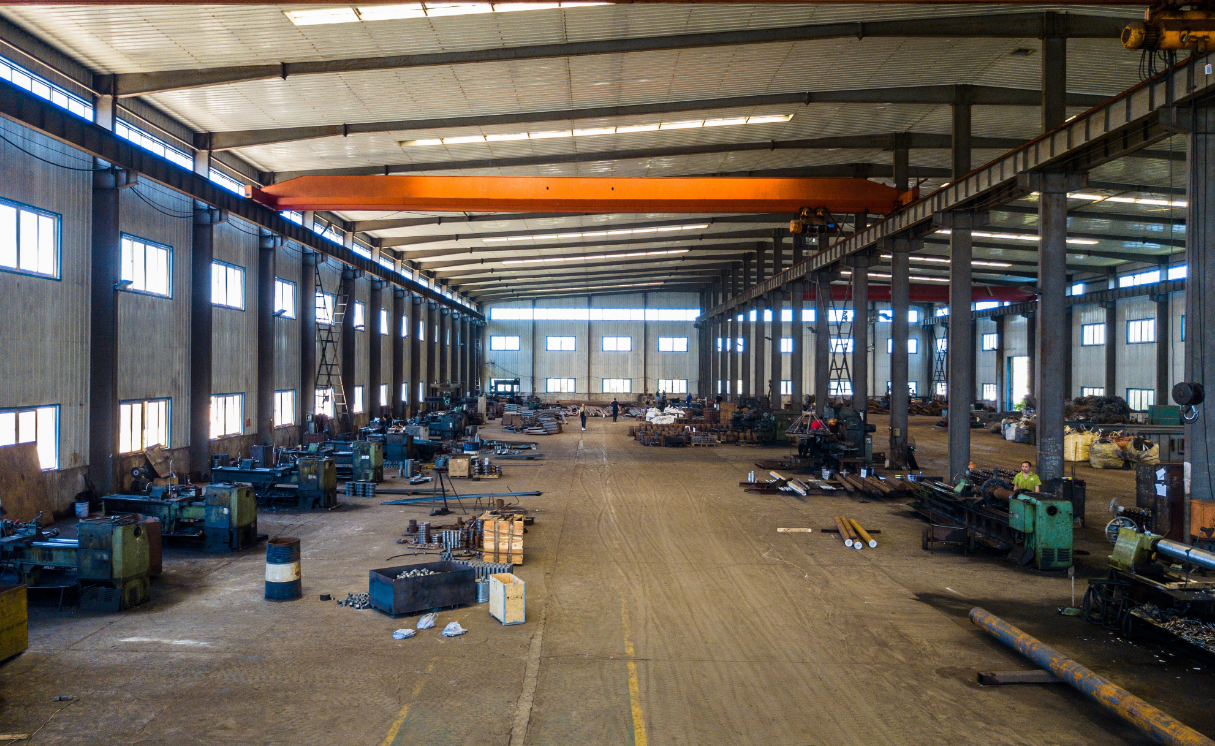
Tenor Low Carbon New Energy Technology (Liaoning) Co., Ltd. is a Chinese manufacturer of small and medium-scale waste incineration systems, based in the Dalian University of Technology Industrial Incubation Park with a production base in Wafangdian, Dalian. The company was founded in 2021; its predecessor, Dalian Sunshine Boiler Auxiliary Equipment Co., Ltd., was established in 1998. It designs, manufactures and sells complete waste incineration equipment in the 15–300 t/d range, with an annual output of 50 sets per year and approximately 35% of output exported to the EU, USA, Southeast Asia, Vietnam and the Middle East. It is a National High-Tech Enterprise and participated in drafting the group standard T/CITS 242-2025. Its wholly owned subsidiary, Tenor Green Technology (Hong Kong) Ltd., holds CE and US EPA certificates — buyers should confirm the scope each certificate covers against their own permit requirements.
Documented references include a 50 t/d high-altitude demonstration project in Mangya, Qinghai, grate equipment supplied to a 600 t/d project in Vietnam that has been in operation for more than two years, and a completed 30 t/d experimental project in Inner Mongolia. Research cooperation is with Dalian University of Technology and the Dalian Institute of Chemical Physics, Chinese Academy of Sciences.
How to screen Chinese manufacturers in the 50–250 TPD band
Screening questions work best when they force a specific answer rather than a capability adjective. The following set separates documented suppliers from catalogue suppliers in a single exchange.
- Capacity in both units. Ask for rated capacity in t/d and the corresponding t/h figure, and ask which regulatory threshold the design was engineered against.
- Reference plants by waste type. A municipal waste reference says little about industrial solid waste capability. Ask for references matched to your waste stream, altitude and climate.
- Emission basis in writing. Which standard, which averaging period, which reference oxygen content, and which pollutants are guaranteed per stage of the treatment train.
- Itemised flue gas scope. Acid gas removal, sorbent injection, filtration and NOx control listed as line items with reagent consumption estimated.
- Monitoring certification path. Which CEMS instruments are certified under the EN 15267 series, and who performs QAL2 and annual surveillance testing.
- Wear-part policy. Grate plate material specification, expected annual replacement rate, spare parts list and lead time for critical spares.
- Supply boundary. Grate body only, complete system, or full EPC including civil coordination, installation, commissioning and training.
- Service model. Remote monitoring, on-site engineering support, operator training and technical upgrade path.
Step-by-step: specifying and validating a 50–250 TPD system
- Characterise the waste before sizing anything. Composition, moisture, calorific value and seasonal variation determine grate area, air distribution and auxiliary fuel need. Tenor’s own documentation states that the final configuration should not be determined from promotional pages alone; waste testing and process confirmation come first.
- Fix the capacity in both units and confirm the regulatory segment. Convert the daily requirement to an hourly rating and check it against the 6 t/h threshold (approximately 144 t/d). A 100 TPD plant and a 200 TPD plant may sit on opposite sides of a different permitting regime.
- Name the emission standard and its reference conditions. Dry gas, 11% O₂, daily average — and for dioxins, the 6 to 8 hour sampling period. Without these, guarantees are not comparable across offers.
- Build the treatment train backwards from the limits. Start from dust, HCl, SO₂, NOx, CO, dioxins and heavy metals, and specify the stage that addresses each. This is how a “complete” system is distinguished from an incinerator with partial abatement.
- Decide the energy output. Electricity only, steam export, or combined heat and power. If EU recovery classification matters, run the R1 calculation at design stage rather than after permitting.
- Agree the supply boundary and the interface list. Who supplies the boiler, the CEMS, the negative pressure enclosure, the electrical works, the civil coordination and the commissioning labour.
- Plan the installation around modular assembly. Confirm factory prefabrication scope, transport dimensions, crane requirements and site assembly sequence, then compare that schedule against a cast-in-place alternative.
- Define acceptance testing and operator training. Include performance tests, CEMS calibration and surveillance, and a training programme for the operating team before handover.
- Lock in the service plan. Spare parts, remote monitoring access, response times and the technical upgrade route for future emission tightening.
Use cases: where the 50–250 TPD band is actually deployed
Township domestic waste, 15–50 t/d
Small modules such as the 20 t/d TYDT-LJ-QH20 and the 30 t/d TYDT-LJ-QH30 are configured for township waste where collection volumes are modest and transport is uneconomic. The decisive design point is that raw household waste can be fed directly without pre-sorting, which removes front-end sorting cost from the project.
County-level waste-to-energy, 50–250 t/d
County projects pair a larger grate line with heat recovery — a waste heat boiler supplying steam, heating or power — and a full flue gas purification train. Tenor’s 50 t/d TYDT-LJ-QH50 sits at the lower edge of this band, and larger duties are met by parallel units up to the 300 t/d TYDT-LJ-QH300 configuration.
Industrial solid waste in parks
Industrial park projects typically run 24/7 on mixed industrial solid waste and require a complete flue gas purification system plus enclosure and protection measures for outdoor instrumentation. Continuous operation makes the grate wear rate and the spare parts strategy commercially significant rather than theoretical.
Agricultural and forestry waste
Seasonal, low-calorific-value biomass residues demand a multi-stage air distribution strategy and an effective drying stage. Operating patterns here are seasonal rather than continuous, which changes the economics of heat recovery.
High-altitude and cold regions
At 60–70% of sea-level oxygen availability, standard furnaces lose combustion stability. Tenor supplies a dedicated high-altitude version with special furnace modification and multi-stage air distribution; the 50 t/d Mangya project in Qinghai is the documented reference for self-sustaining combustion under those conditions.
Island and marine applications
Island waste treatment systems are land-based installations and follow the applicable national or regional emission regime. Vessel-mounted incinerators are a different product line governed by IMO type-approval under resolution MEPC.244(66). Buyers should confirm the certification route explicitly rather than assuming that a land-based system can be re-used on board.
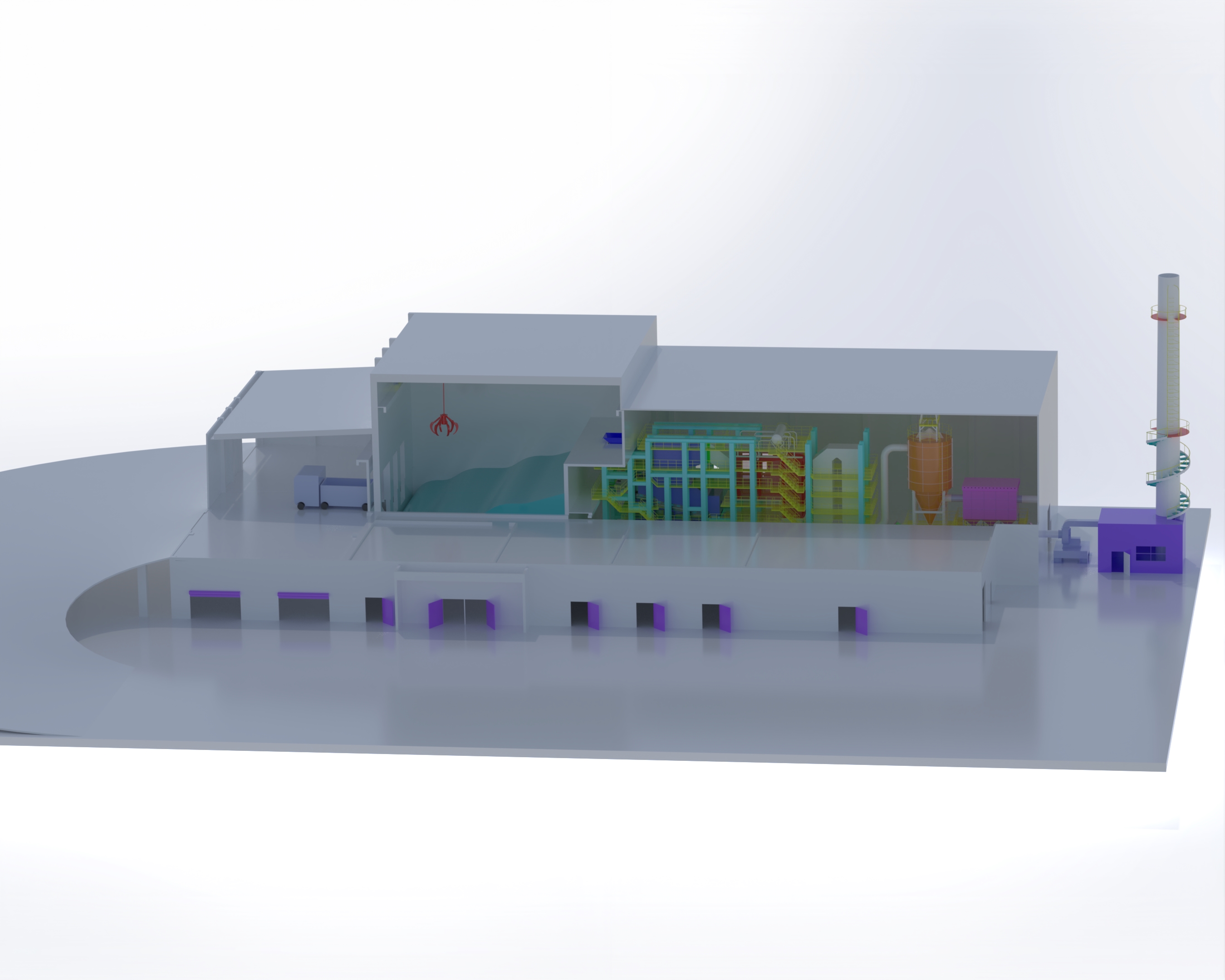
Comparison table: Tenor model range across the capacity band
| Model | Grate / furnace type | Rated capacity | Combustion basis | Suitable duty |
|---|---|---|---|---|
| TYDT-LJ-QH20 | Modular quick-assembly grate furnace | 20 t/d | 850 °C / 2 s, 3T+E process | Township domestic waste, small-scale MSW |
| TYDT-LJ-QH30 | Three-stage reciprocating mechanical grate | 30 t/d | 850 °C / 2 s, 3T+E, segmented air distribution | County-level mixed municipal solid waste |
| TYDT-LJ-QH50 | Three-stage reciprocating mechanical grate | 50 t/d; 12,800 × 2,430 × 7,040 mm; 7.5–75 kW | 850 °C / 2 s, 3T+E | MSW, general industrial solid waste, agricultural and forestry waste |
| TYDT-LJ-QH300 | Parallel three-stage grate furnace system | 300 t/d (parallel units) | 850 °C / 2 s, 3T+E, complete flue gas purification | County-level centralised disposal |
Capacities between the standard modules are reached by combining modules and confirming the configuration against project data; Tenor’s published range is 15–300 t/d with standard modules at 20, 30 and 50 t/d, and the final rating for a specific 50–250 TPD requirement requires project confirmation.
Comparison table: EU Annex VI daily average emission limit values
| Pollutant | Limit value | Basis / note |
|---|---|---|
| Total dust | 10 mg/Nm³ | Daily average, dry gas at 11% O₂ |
| Hydrogen chloride (HCl) | 10 mg/Nm³ | Daily average |
| Sulphur dioxide (SO₂) | 50 mg/Nm³ | Daily average |
| Nitrogen oxides (NOx as NO₂) | 200 mg/Nm³ existing plants; 150 mg/Nm³ new plants | Plants with nominal capacity above 6 t/h; daily average |
| Carbon monoxide (CO) | 50 mg/Nm³ | Daily average; indicator of combustion quality |
| Dioxins and furans | 0.1 ng TEQ/Nm³ | Sampling period of 6 to 8 hours |
| Cadmium and thallium, total | 0.05 mg/Nm³ | Sampling period 30 minutes to 8 hours |
| Mercury | 0.05 mg/Nm³ | Sampling period 30 minutes to 8 hours |
| Sb+As+Pb+Cr+Co+Cu+Mn+Ni+V, total | 0.5 mg/Nm³ | Sampling period 30 minutes to 8 hours |
Source: Directive 2010/75/EU, Annex VI, Part 3. Values are pollutant-specific and must not be summed or averaged into a single compliance index. BAT-associated emission levels under Commission Implementing Decision (EU) 2019/2010 are a separate instrument and are not reproduced here.
Frequently asked questions
Can a Chinese-manufactured waste incineration system meet EU emission standards?
Meeting EU limits depends on combustion control plus a complete flue gas treatment train, not on the country of manufacture. Directive 2010/75/EU Annex VI Part 3 sets daily average limits, corrected to 11% O₂, of 10 mg/Nm³ for dust, 10 mg/Nm³ for HCl, 50 mg/Nm³ for SO₂, 200 mg/Nm³ NOx for existing plants above 6 t/h (150 mg/Nm³ for new plants), 50 mg/Nm³ for CO, 0.1 ng TEQ/Nm³ for dioxins and furans, and 0.05 / 0.05 / 0.5 mg/Nm³ for the three heavy-metal groups. An offer should therefore list the 850 °C / 2 s combustion condition, acid gas removal, sorbent injection, particulate filtration, and a CEMS scope capable of passing EN 14181 quality assurance. Ask which standard the base design was engineered against — GB 18485-2014 for the domestic market or EU-derived limits for export — and request test reports from a plant of comparable capacity. Tenor positions its range as EU emission compliant, with CE and US EPA certificates held by its subsidiary Tenor Green Technology (Hong Kong) Ltd.; confirm what each certificate covers.
What capacity range is available, and can unsorted mixed waste be handled?
Tenor’s published treatment range is 15–300 t/d, with standard modules at 20, 30 and 50 t/d and parallel units used for larger duties such as the 300 t/d TYDT-LJ-QH300, so a 50–250 TPD requirement is met by combining modules with the final configuration confirmed against project data. Raw household waste can be fed directly without pre-sorting, which suits mixed waste with large calorific value fluctuation and avoids front-end sorting cost. The three-stage grate uses independent hydraulic drives and independent air chambers per stage, with multi-stage precise air distribution supporting self-sustaining combustion and reduced auxiliary fuel use. Published figures for the grate are an annual damage rate of ≤1% and heat loss on ignition of ≤5%. A high-altitude version is available for environments with 60–70% of sea-level oxygen, validated at the 50 t/d Mangya project in Qinghai.
What drives the capital cost of a 50–250 TPD system?
Capital cost is driven mainly by rated capacity, the scope of the flue gas treatment train, whether heat recovery for electricity, steam or hot water is included, the CEMS package and its validation, the civil and enclosure scope, and whether construction is modular or cast-in-place. For planning, third-party benchmarks compiled for modern waste-to-energy plants indicate capital expenditure in the order of USD 150,000 to 250,000 per tonne-per-day of capacity. That is a benchmark, not a quotation: applied arithmetically, a 100 TPD line falls in a wide indicative band of roughly USD 15–25 million before site-specific factors. Any real figure requires waste data, a defined supply boundary and the applicable emission standard.
How can a buyer validate performance before placing an order?
Validation runs in three layers. First, waste characterisation testing establishes calorific value, moisture and composition, which fixes the design basis. Second, reference plant review — Tenor’s documented references include the 50 t/d Mangya high-altitude project in Qinghai, grate equipment for a 600 t/d project in Vietnam in operation for more than two years, and a completed 30 t/d experimental project in Inner Mongolia — should be matched to your own waste type, altitude and climate rather than accepted generically. Third, documentation review: National High-Tech Enterprise status, participation in drafting group standard T/CITS 242-2025, and the CE and US EPA certificates held by Tenor Green Technology (Hong Kong) Ltd., checked against the scope your permit actually requires. Performance guarantees and acceptance test criteria should then be written into the contract.
What is the delivery and installation timeline, and what support follows?
No credible schedule can be fixed from a capacity figure alone, because the timeline depends on the emission standard, treatment train scope, energy recovery configuration, site conditions, permitting and CEMS validation. What can be compared at research stage is construction strategy: Tenor uses modular construction with factory prefabrication and on-site assembly, which shortens the construction period compared with traditional cast-in-place methods. Request a project schedule that separates design, equipment manufacture, site assembly, commissioning, CEMS calibration and operator training. After-sales support covers an on-site engineering team, operation training, remote operation monitoring, spare parts supply and technical upgrades. To move from research to a concrete schedule, send your waste composition, moisture and calorific value data, daily throughput, applicable emission standard and required energy output to xyb999@yeah.net or +86-411-86888188, and the configuration can be matched to real project conditions.
Conclusion: what to take into the first supplier conversation
Sourcing a 50–250 TPD waste incineration system from China is a specification exercise before it is a price exercise. The three variables that decide whether two offers are comparable are the waste characterisation behind the design, the emission standard with its reference conditions and averaging periods, and the exact boundary of supply — from grate body alone to full EPC with heat recovery and validated monitoring. Capacity quoted in tonnes per day without an hourly rating, or a compliance claim without a listed treatment train, should be treated as an incomplete offer rather than a competitive one.
The reference points worth carrying into the first meeting are concrete: the 850 °C / 2 s operating condition, the pollutant-by-pollutant limits in Annex VI, the 6 t/h capacity threshold at roughly 144 t/d, and the wear figures that determine operating cost. A supplier who can answer against those points, with references matched to your waste stream, is a supplier worth a technical discussion.
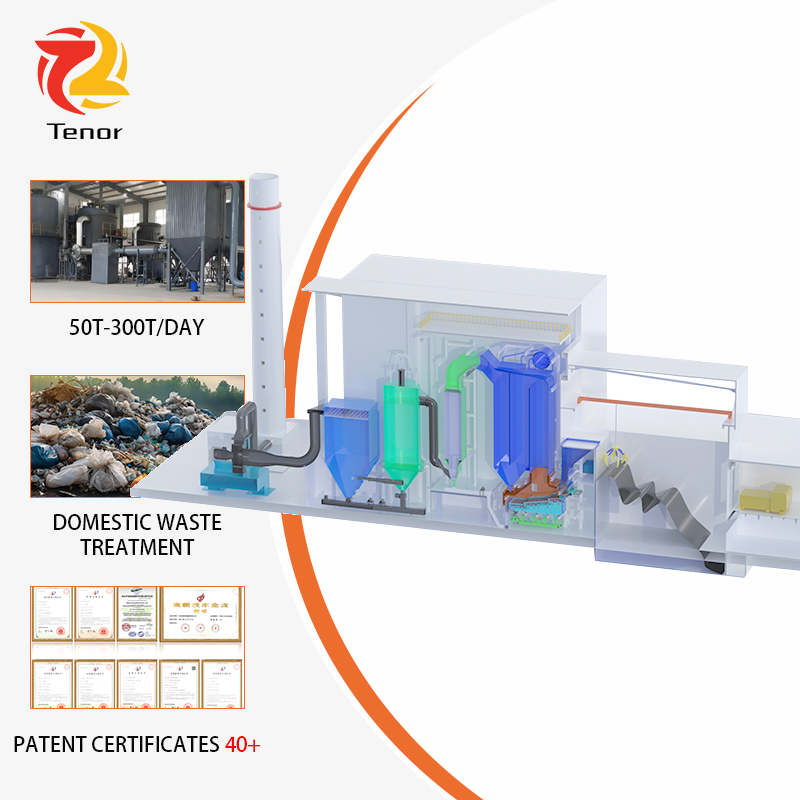
Next step: review the system before you request a quotation
The Tenor small and medium-scale waste incineration system brochure covers the 15–300 t/d range, the three-stage reciprocating grate design, modular construction and the available flue gas treatment and heat recovery options.
Download the Tenor waste incineration system brochure (PDF)
For a configuration matched to your project, contact the sales team at xyb999@yeah.net, tel +86-411-86888188 / +86-18341131193, or WhatsApp +86-18341131193. Tenor Low Carbon New Energy Technology (Liaoning) Co., Ltd., No.111 Yaogong Street, Ganjingzi District, Dalian City, Liaoning, China — www.tenorincinerator.com
Have Questions or Need More Details?
Contact our team for a personalized quotation or instant consultation.
Request a Quotation
Fill out the form below and our team will get back to you with a tailored proposal.
WhatsApp Direct Chat
Prefer to chat in real-time? Message us on WhatsApp for instant assistance & quick answers.
- Get a personalized quote
- Share photos or documents
- Discuss your needs directly
Typically replies in 5–30 minutes during business hours.