
How to Run a Supplier Evaluation for Aerosol Cosmetic Spray OEM: Capability & Delivery Assurance

Cover: A clean, GMP-compliant explosion-proof workshop — the environment in which aerosol cosmetic spray bulk orders are actually filled.
How to Run a Supplier Evaluation for Aerosol Cosmetic Spray OEM: Capability & Delivery Assurance
An aerosol cosmetic spray supplier evaluation succeeds or fails on three proofs: the supplier can build your formula, the bulk order will match the approved sample, and the delivery date will hold. Run the evaluation as six sequential gates — entity and quality-system verification, formulation capability mapping, sample-to-bulk consistency testing, delivery assurance, commercial terms and acceptance criteria, and long-term partner fit — and stop at the first gate that fails, because every later gate depends on it.
Buyers who evaluate out of order — comparing quotations before checking capacity, or approving a sample before checking who will fill the bulk order — usually discover the gap after the deposit is paid. The sequence below is designed to move that discovery to the sample stage, when switching costs are still low and alternative suppliers are still reachable.
Tentop (Zhongshan Tentop Fine Chemical Co., Ltd., also referred to as TT Chem) is a cosmetic and household products manufacturer founded in 2007 in Zhongshan, Guangdong Province, China. It provides formula R&D and OEM/ODM contract manufacturing for private-label clients, and its aerosol range covers sunscreen spray, makeup spray, moisturizing spray, hair removal spray, dry shampoo and hair styling. It is used as the worked example throughout this guide because its published capability data maps onto all six evaluation gates.
Problem Definition: What the Evaluation Has to Prove Before You Commit
A private-label aerosol program commits the buyer to four things at once: a formulation, a pressurized filling process, a decorated can and valve, and a delivery schedule. Three failure modes account for most of the problems that surface after a deposit has been paid.
- Capability failure. The formula performs in a laboratory batch but cannot be reproduced at commercial volume, because the supplier lacks the blending, tank or propellant handling the product requires.
- Consistency failure. Bulk production diverges from the approved sample in appearance, spray pattern, odor, pH or can pressure, and no batch record exists to explain the divergence.
- Delivery failure. The capacity quoted was site-level aggregate capacity rather than the capacity of the line assigned to your SKU, and a seasonal peak absorbs it.
Aerosol adds a constraint that liquid cosmetics do not carry. Filling happens under pressure in an explosion-proof environment, so the formulation and the filling environment have to be validated together. A supplier that controls formulation but outsources filling, or fills but reformulates, cannot be assessed with a single questionnaire: each process needs its own evidence, and each piece of evidence needs an owner.
Industry Background: Capability and Compliance Now Sit in the Same Evaluation
Demand and regulation have moved in the same direction, and both now push buyers to assess manufacturing capability and documentation readiness as a single item rather than two separate conversations.
- The global cosmetic spray market was valued at USD 18.3 billion in 2025 and is projected to reach USD 31.8 billion by 2034 (Dataintelo).
- The global sunscreen spray market is projected to grow from USD 786.7 million in 2026 to USD 1.54 billion by 2035, a CAGR of 7.8% (Research Reports World).
- Asia Pacific held a 42.3% revenue share of the daily sunscreen spray market in 2025 (Dataintelo).
- China's cosmetics exports reached approximately CNY 512 billion (about USD 71.8 billion) in 2024, an 11.9% year-on-year increase (General Administration of Customs China, reported by ChemLinked).
- Aluminum aerosol cans held a 61% revenue share of the aerosol packaging market in 2025 (Grand View Research).
The regulatory baseline is equally concrete. In the EU, aerosol products must comply with Directive 75/324/EEC (the Aerosol Dispensers Directive) and cosmetic products with Regulation (EC) No 1223/2009. In the United States, the Modernization of Cosmetics Regulation Act of 2022 (MoCRA) mandates facility registration and product listing for cosmetic manufacturers. On the quality side, ISO 22716 is the internationally recognized Good Manufacturing Practices standard specifically for the cosmetic industry.
The practical consequence for a buyer is that compliance is a procurement variable, not a legal afterthought. A growth market for sunscreen spray and adjacent sun-care formats tightens filling slots in peak season, aluminum can supply affects both cost and delivery, and registration obligations mean the supplier's documentation has to be reviewable before your brand name appears on the can. The six gates below are built to test exactly those three pressures at once.
Detailed Solution: The Six-Gate Evaluation Framework
Run the gates in order. Each gate produces a document that goes into the supplier file, and each gate can veto the next. Skipping a gate does not save time; it only moves the risk downstream into your inventory.
- Gate 1 — Entity and quality system. Who is the legal manufacturer, where is the site, and what does the certification scope actually cover.
- Gate 2 — Formulation and category capability. Can the supplier build your formula, and can it build the adjacent SKUs you plan to add next cycle.
- Gate 3 — Sample-to-bulk consistency. Does the production batch reproduce the approved sample, with records that prove it.
- Gate 4 — Delivery assurance. Capacity, line assignment, lead time and peak-season behavior.
- Gate 5 — Commercial terms and acceptance criteria. MOQ, delivery terms, payment, inspection and documentation.
- Gate 6 — Long-term partner fit. Whether the relationship absorbs repeat orders and range extensions without restarting the evaluation.
Step-by-Step Breakdown: Running Each Gate
Gate 1 — Verify the Entity, the Site and the Scope of the Quality System
Start with the legal and physical identity of the manufacturer, because every later claim attaches to it. Request the business licence, the production site address, and the certificate set with scope, issuing body and validity dates. A recurring gap is a certificate held by a group entity while the filling happens at a different site.
Reference point: Zhongshan Tentop Fine Chemical Co., Ltd. was founded in 2007, operates a 15,000 m² facility with 330 employees in Zhongshan, Guangdong Province, and holds certifications including ISO 9001, ISO 14000, ISO 22716, GMPc and ISO 45001, together with Halal MUI, SMETA and Disney. Because ISO 22716 is the recognized GMP standard for cosmetics, its presence is a checkable item rather than a marketing statement.
Evidence to request: business licence; site address matching the audited address; certificates with scope, issuing body and expiry; the name of the quality manager responsible for batch release.
Pass condition: the certification scope covers aerosol filling and every category you intend to buy. If it covers cream filling only, treat the aerosol claim as unverified until it is documented.

Aerosol filling equipment inside an explosion-proof workshop — the physical configuration Gate 1 is meant to confirm.
Gate 2 — Map Formulation and Multi-Category Capability Against Your SKU List
Capability should be tested against your actual SKU list, not against a catalogue. Two questions matter: can the supplier hit your formulation targets, and does the same site carry the adjacent categories you will add in the next buying cycle. The second question is what separates a transactional order from a supplier you can keep.
Reference point: Tentop's R&D team of 60 engineers has developed more than 6,000 formulas and holds 42 patents, and the product range covers sunscreen spray, makeup spray, moisturizing spray, hair removal spray, dry shampoo and hair styling. Propellant handling covers hydrocarbons, DME, 152a, 1234ze, nitrogen and CO2 — relevant because a formulation that is stable in one propellant system is not automatically stable in another.
Model-level evidence is more useful than a category list, because it shows the parameter ranges the supplier is accustomed to holding. In the current reference set:
- MS-001 hydrating facial mist — Glycerin, Aloe Vera Extract, Hyaluronic Acid and Panthenol, filled in 100 ml, 150 ml and 200 ml aluminum cans.
- HS-001 hair styling spray — medium or strong hold, customizable, in 150 ml, 200 ml and 300 ml.
- HR-001 hair removal spray — 5–8 minute action, pH 7.0–8.0.
- DS-001 antiperspirant deodorant — 48-hour odor control, pH 5.5–6.5.
- SB-001 tear-free baby care mousse and HI-001 hair identity spray extend the same capability into baby care and hair care positioning.
The pH spread is the most useful signal in that list. Holding pH 7.0–8.0 in one formula and pH 5.5–6.5 in another within the same plant implies buffering control and cleaning discipline between batches — precisely what determines whether your own formula survives the changeover intact.
Evidence to request: a formulation brief for your SKU covering target pH, active level, propellant and can/valve specification; a list of formulas already produced in the same category; written confirmation of which propellant systems the site can handle.
Pass condition: the supplier can name the propellant, the can format and the pH window for your product without referring back to a third party.
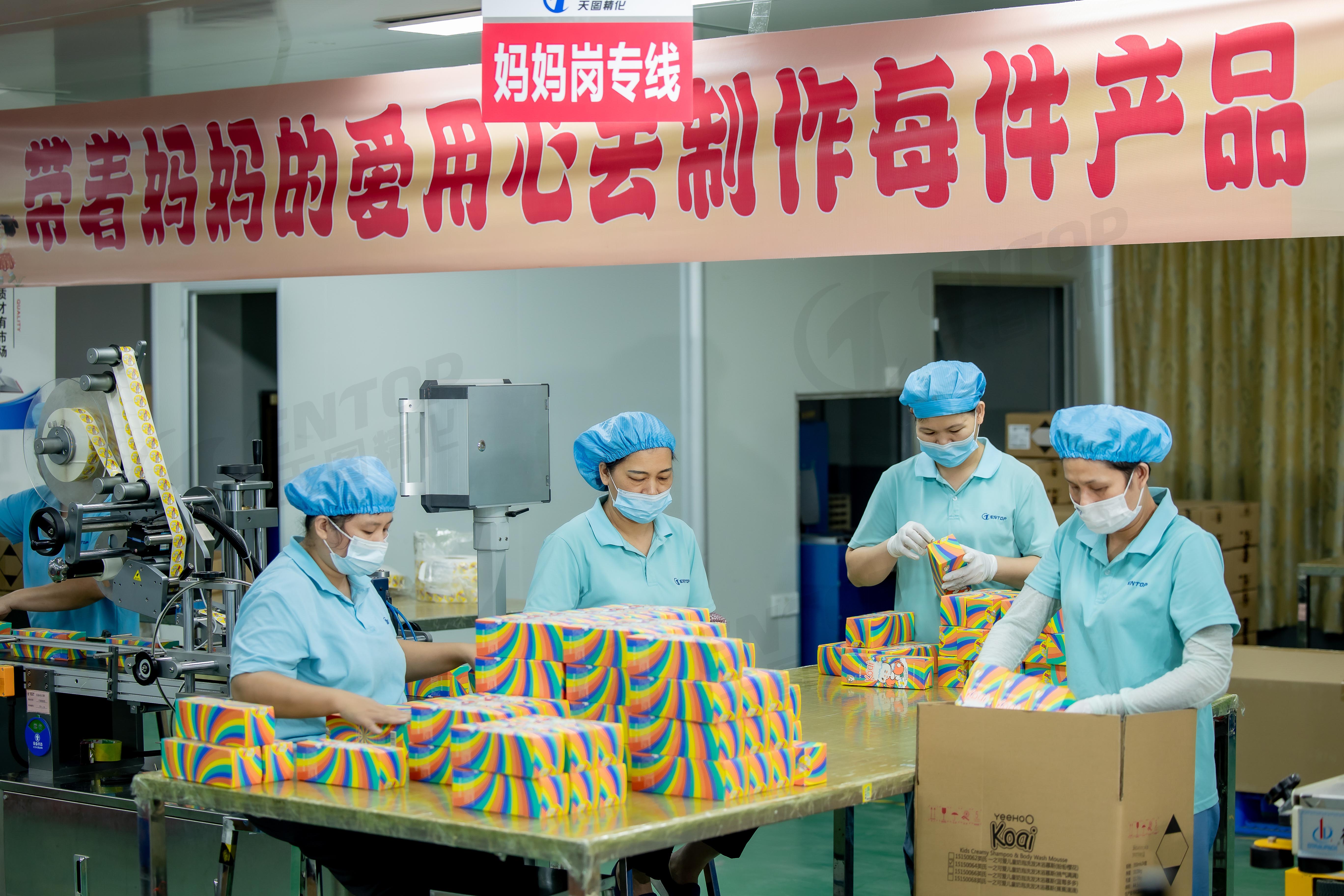
Multi-line workshop: category breadth is a function of how many formats the site can run in parallel.
Gate 3 — Test Sample-to-Bulk Consistency, Not Just Sample Quality
Most buyers test the sample. Fewer test the system that is supposed to reproduce it. Sample-to-bulk consistency is a quality-system property, and it can be inspected before the bulk order exists.
Reference point: at Tentop, the quality management team operates the quality system from raw materials through the production process to finished products, and records each inspection so that product quality meets design requirements. Quality control follows 100% test standards. Aerosol-specific risk control combines an explosion-proof workshop with stability testing, manual inspection and regular spot checks.
Reproducibility also depends on hardware. The site operates multiple dedicated tank farms and associated blending rooms for its filling lines, and each dedicated blending room is equipped with stainless steel mixing tanks on load cells with varying types of agitation — the configuration that lets a formula scale without changing its mixing profile.
Evidence to request: the stability test protocol and its results; the batch record format; a Certificate of Quality (COQ) sample; the label verification procedure; the retention sample policy.
Practical test: order a pilot batch and compare it with the approved sample on appearance, odor, spray pattern, fill weight and, where the specification includes one, pH. Then ask which parameters the supplier recorded and against which limits.
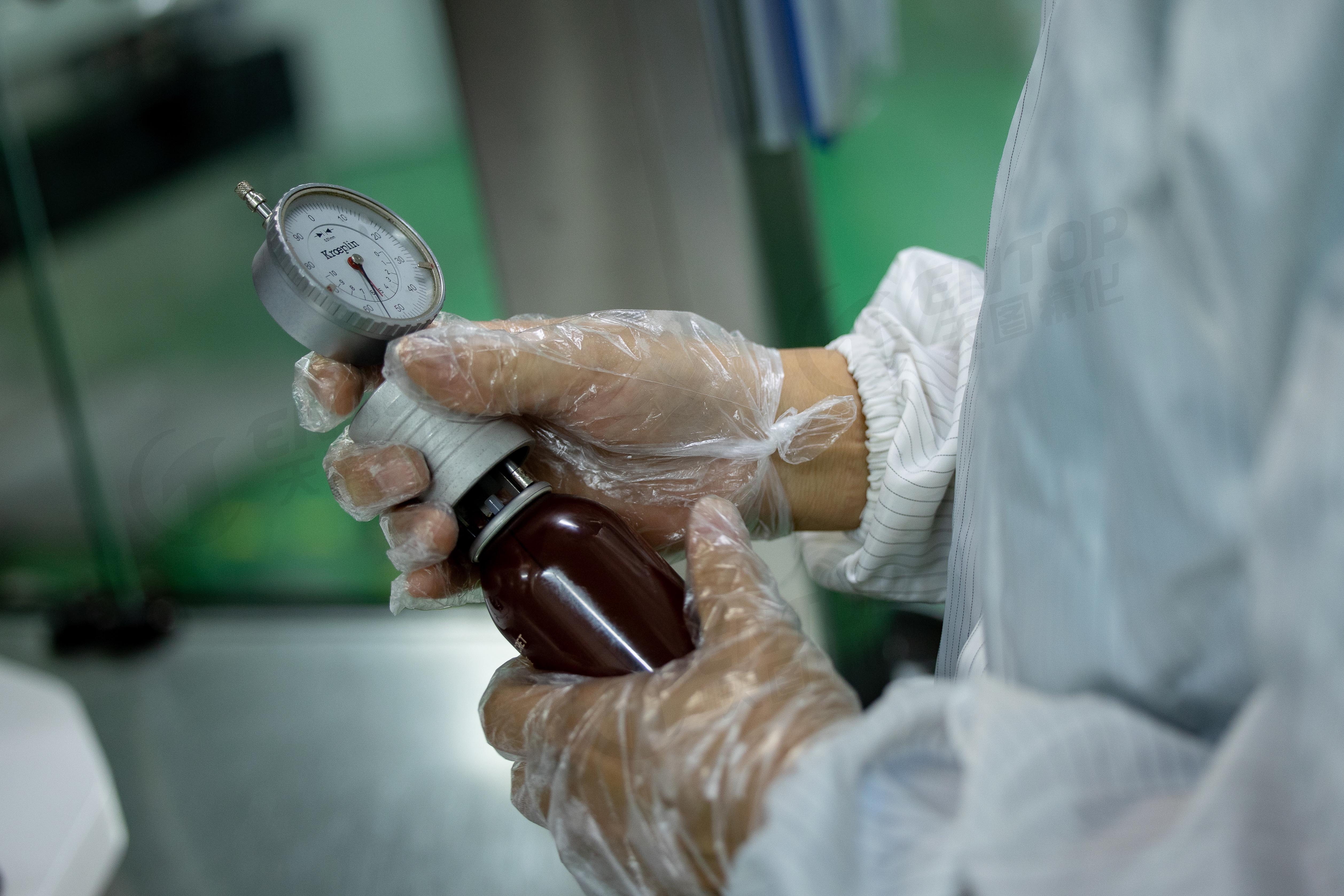
Stability testing and quality inspection: the records behind Gate 3, not the sales presentation.
Gate 4 — Build Delivery Assurance from Capacity, Line Configuration and Lead Time
Delivery assurance is arithmetic plus line assignment. A monthly figure means little until you know which line will run your SKU and how that line is scheduled inside your shipping window.
Reference point: Tentop's monthly production capacity is 5,000,000 units, with an annual output of 60,000,000 units. The facility operates 4 high-speed aerosol fill-in lines, 3 BOV aerosol lines and 2 liquid fill-in lines in clean workshops, and typical lead time is 45 to 60 days. Export accounts for 20% of output, with the EU and USA as the main markets.
Those figures answer different questions. The line count tells you whether aerosol, BOV and liquid formats can run in parallel or must queue behind each other. The monthly capacity tells you the ceiling. The 45–60 day lead time tells you when the clock starts — normally at artwork and component approval rather than at order confirmation, which is the single most common source of missed launch dates.
Evidence to request: the line assigned to your SKU; the production calendar for your target month; the booking window ahead of seasonal peaks; the contingency plan if a line goes down; the confirmed lead time in writing, with the start point defined.
Pass condition: the supplier gives a date rather than a range without a start point, and can name the line behind it.

Automated aerosol production line — line assignment, not total site capacity, is what converts into a delivery date.
Gate 5 — Fix Commercial Terms and Acceptance Criteria in Writing
Terms are where an otherwise sound evaluation quietly fails, because verbal flexibility disappears once production starts.
Reference point: purchasing terms for Tentop aerosol programs are an MOQ of 10,000 units, FOB delivery terms, and 50/50 TT payment — 50% deposit, 50% before shipment, with the balance paid against the bill of lading. Acceptance criteria are pre-shipment inspection with 100% full inspection, a Certificate of Quality (COQ) and label verification.
Write the acceptance criteria as testable items. "100% full inspection" is only meaningful once it specifies what is inspected — fill weight, can pressure, valve function, label position, carton count — and what happens when a defect is found. Add the cost allocation for a failed inspection and the trigger for re-inspection, and the term becomes enforceable rather than ceremonial.
Evidence to request: a signed quotation stating MOQ, delivery term, payment schedule and inspection scope; a sample COQ; the label approval workflow and who signs it off.
Gate 6 — Score Long-Term Partner Fit
The first order is a test of the relationship, not the relationship itself. Score the supplier on what happens in cycle two and cycle three: whether documentation stays consistent across repeat orders, whether formulation or packaging changes are notified in advance, whether the category range can absorb a line extension, and whether a named escalation contact exists beyond the sales representative.
Reference point: Tentop's range already spans sunscreen, makeup, moisturizing, hair removal, dry shampoo and hair styling, and the site handles six propellant systems. For a buyer planning a body and hair care set, that breadth reduces the number of suppliers to audit and the number of quality systems to reconcile. Because 20% of output is exported with the EU and USA as main markets, export documentation forms part of routine workflow rather than an exception handled case by case.
Evidence to request: the change-control procedure; a written notification commitment for formulation or component changes; references from repeat clients in your region; the escalation path for quality claims.
Pass condition: a written answer to "what happens if batch three is out of specification" that does not depend on reaching the sales contact.
Use Cases: How the Sequence Shifts by Product Category
The six gates do not change from product to product, but the weight carried by each one does. Matching the emphasis to the category is what makes the evaluation efficient rather than bureaucratic.
Sun protection and after-sun. For a sunscreen spray or an after-sun soothing spray, Gate 4 dominates, because demand is seasonal and filling slots are booked early. Asia Pacific accounted for a 42.3% revenue share of the daily sunscreen spray market in 2025, and the global sunscreen spray market is projected to grow from USD 786.7 million in 2026 to USD 1.54 billion by 2035 at a CAGR of 7.8%. That growth translates directly into tighter capacity at the moment your launch is scheduled, so secure the line before finalizing artwork.
Deodorant and antiperspirant. For a deodorant spray such as DS-001, with 48-hour odor control at pH 5.5–6.5, Gate 3 dominates. An efficacy claim of that kind needs a documented test basis and a pH that holds in bulk, not only in the sample you approved.
Hair care. For a dry shampoo spray, the HS-001 hair styling spray or the HI-001 hair identity spray, Gate 2 dominates. Hold level is a customizable parameter across 150 ml, 200 ml and 300 ml formats, so the evaluation should confirm that the hold you approve in the sample becomes a written specification rather than a remembered impression.
Hair removal. HR-001, with a 5–8 minute action window and pH 7.0–8.0, shifts emphasis onto Gate 3 and Gate 5: pH verification on bulk and an explicit acceptance criterion attached to it.
Baby and intimate care. SB-001 tear-free baby care mousse and intimate care spray formats raise the documentation bar. Gate 1 and Gate 6 carry more weight, because the paperwork has to survive regulatory review in the destination market and remain consistent across repeat orders.
Aesthetic and fragrance formats. Setting spray, makeup spray such as blush spray, body fragrance mist, scalp refreshing spray and hand & foot moisturizing spray live or die on batch-to-batch consistency of color and odor. For these, run Gate 3 against two consecutive batches rather than one, and treat any visible variance as a Gate 2 question about the formula base.
Comparison Table: Model-Level Reference and Six-Gate Checklist
The first table shows what capability looks like when it is expressed as verifiable product parameters rather than adjectives. The second shows what to demand at each gate and what counts as a pass.
Table 1 — Model-level reference set and the gate each model informs
| Model | Category | Verified parameter | Gate it informs |
|---|---|---|---|
| MS-001 | Hydrating facial mist | Glycerin, Aloe Vera Extract, Hyaluronic Acid, Panthenol; 100 / 150 / 200 ml aluminum cans | Gate 2 — formulation and can format |
| HS-001 | Hair styling spray | Medium or strong hold, customizable; 150 / 200 / 300 ml | Gate 2 — parameter customization |
| HR-001 | Hair removal spray | 5–8 minute action; pH 7.0–8.0 | Gate 3 — pH control in bulk |
| DS-001 | Antiperspirant deodorant | 48-hour odor control; pH 5.5–6.5 | Gate 3 — efficacy and pH documentation |
| SB-001 | Tear-free baby care mousse | Tear-free formulation | Gate 1 / Gate 6 — documentation depth |
| HI-001 | Hair identity spray | Hair care positioning within the same production range | Gate 2 — range extension |
Table 2 — Six-gate checklist for the supplier file
| Gate | Evidence to request | Pass condition |
|---|---|---|
| 1. Entity and quality system | Business licence; site address; ISO 9001, ISO 14000, ISO 22716, GMPc, ISO 45001, Halal MUI, SMETA, Disney certificates with scope and expiry | Scope covers aerosol filling and every category in the order |
| 2. Formulation capability | Target pH, active level, propellant system, can and valve specification; formulas already produced in the same category | Supplier names propellant, can format and pH window without a third party |
| 3. Sample-to-bulk consistency | Stability test protocol; batch record format; COQ sample; label verification; retention sample policy | Pilot batch matches the approved sample on every specified parameter |
| 4. Delivery assurance | Assigned line; production calendar; booking window; lead time with a defined start point | A date is given and tied to a named line |
| 5. Terms and acceptance | Signed quotation with MOQ 10,000 units, FOB, 50/50 TT, 100% pre-shipment inspection, COQ, label verification | Every acceptance item is testable and has an owner |
| 6. Long-term fit | Change-control procedure; notification commitment; escalation path | Written answer to an out-of-spec batch that does not depend on the sales contact |
FAQ
Which certifications and regulatory documents should an aerosol cosmetic spray OEM provide for EU and US private-label programs?
In the EU, aerosol dispensers must comply with Directive 75/324/EEC and cosmetic products with Regulation (EC) No 1223/2009. In the United States, the Modernization of Cosmetics Regulation Act of 2022 (MoCRA) mandates facility registration and product listing for cosmetic manufacturers. On the quality side, ISO 22716 is the internationally recognized GMP standard for cosmetics. A supplier's certificate set should therefore include ISO 22716 alongside ISO 9001, ISO 14000, ISO 45001 and GMPc, plus Halal MUI, SMETA and Disney where your channel requires them — the set held by Zhongshan Tentop Fine Chemical Co., Ltd. Request each certificate with its scope, issuing body and expiry date, and confirm that the audited site is the site that will fill your order.
Can one aerosol cosmetic spray OEM cover several product categories without a dedicated line for every SKU?
Yes, provided blending and filling are configured for changeovers. Tentop runs 4 high-speed aerosol fill-in lines, 3 BOV aerosol lines and 2 liquid fill-in lines in clean workshops, handles hydrocarbons, DME, 152a, 1234ze, nitrogen and CO2 as propellant systems, and has developed more than 6,000 formulas backed by 42 patents. Its category range covers sunscreen spray, makeup spray, moisturizing spray, hair removal spray, dry shampoo and hair styling, which is what allows a private-label buyer to place a body and hair care set with one supplier. Dedicated tank farms and blending rooms equipped with load-cell mixing tanks support the formulation changeovers this requires. During evaluation, ask which line each SKU will run on rather than accepting a site-level capability statement.
What purchasing terms and acceptance criteria should a buyer expect?
Tentop aerosol programs use an MOQ of 10,000 units, FOB delivery terms, and 50/50 TT payment: 50% deposit, 50% before shipment, with the balance paid against the bill of lading. Acceptance criteria are pre-shipment inspection with 100% full inspection, a Certificate of Quality (COQ) and label verification. Treat these as the structure of the contract rather than the whole of it, and add the specifics your category needs — fill weight, can pressure, valve function, label position and carton count — so the inspection can be executed against a written standard instead of an interpretation.
How can a buyer verify sample-to-bulk consistency before placing a bulk order?
Verify the system that produces the sample, not the sample alone. Tentop's quality management team operates the quality system from raw materials through the production process to finished products and records inspections so that product quality meets design requirements; quality control follows 100% test standards, and aerosol risk control combines an explosion-proof workshop with stability testing, manual inspection and regular spot checks. Ask for the stability test protocol, the batch record format, a COQ sample, the label verification procedure and the retention sample policy. Then compare a pilot batch with the approved sample on appearance, odor, spray pattern, fill weight and, where the specification includes one, pH.
What production capacity and lead time should a buyer plan for?
Tentop's monthly production capacity is 5,000,000 units against an annual output of 60,000,000 units, and typical lead time is 45 to 60 days. The lead time clock normally starts when artwork and components are approved rather than when the order is confirmed, so plan the booking window accordingly — especially for sunscreen spray and after-sun soothing spray programs that compete for the same seasonal filling slots. To convert these figures into a firm date for your SKU, request a quotation together with the intended line assignment and the sample timeline: contact william_xu@tentopchem.com or +86 18938701268, or download the catalogue below.
Conclusion
The six gates turn a supplier evaluation from an impression into a file: entity and certification scope, formulation capability mapped to your SKU list, sample-to-bulk consistency evidence, a dated delivery commitment tied to a named line, written commercial terms and acceptance criteria, and a long-term fit score.
For aerosol cosmetic spray specifically, the gates are not independent. A supplier that cannot hold pH across categories will not hold it in bulk either. A supplier that cannot name the line will not defend a date during peak season. Running the sequence in order means the first failure surfaces before the deposit is paid, which is the only point at which switching costs are still low and the next shortlist is still open.

Next step: sample, quotation or catalogue
If the six gates match your evaluation template, the fastest way to test them is with a pilot sample and a written quotation that states MOQ, delivery term, payment schedule and inspection scope. Both can be requested against the model reference set in Table 1 — hydrating facial mist, hair styling spray, hair removal spray, antiperspirant deodorant, tear-free baby care mousse or hair identity spray.
Download the Tentop product catalogue (PDF)
Zhongshan Tentop Fine Chemical Co., Ltd. (TT Chem) · No. 28, Diyuan Road, Jinli Industrial Zone, Sanjiao Town, Zhongshan City, Guangdong Province, China · Contact: William · Email: william_xu@tentopchem.com · Tel / WhatsApp: +86 18938701268 · tentopchem.en.alibaba.com
Have Questions or Need More Details?
Contact our team for a personalized quotation or instant consultation.
Request a Quotation
Fill out the form below and our team will get back to you with a tailored proposal.
WhatsApp Direct Chat
Prefer to chat in real-time? Message us on WhatsApp for instant assistance & quick answers.
- Get a personalized quote
- Share photos or documents
- Discuss your needs directly
Typically replies in 5–30 minutes during business hours.