
Moisturizing Spray vs. Sunscreen Spray: Which Aerosol Base Fits Your OEM Line?

Moisturizing Spray MS-001 - a hydrating facial mist built on Glycerin, Aloe Vera Extract, Hyaluronic Acid and Panthenol in a 100 ml / 150 ml / 200 ml aluminum aerosol can.
Two aerosol products can leave the same filling line looking identical - same aluminum can, same actuator, same three-year shelf life - and still be governed by entirely different rules. Tentop's Moisturizing Spray (MS-001) and Sunscreen Spray (SC-001) are exactly that pair. Choosing between them is one of the first structural decisions a skincare OEM buyer makes when building or extending an aerosol cosmetic spray line, and it is a decision that is usually made too late, after a formula brief has already been written.
The short answer is this. MS-001 is a cosmetic hydration aerosol: Glycerin, Aloe Vera Extract, Hyaluronic Acid and Panthenol, packed in 100 ml, 150 ml and 200 ml aluminum cans, with Deep Hydration, Soothing, Refreshing and Non-greasy as its declared features. SC-001 is a UV-protection aerosol: Avobenzone, Homosalate and Octocrylene as UV actives, declared as SPF 50+ Broad Spectrum with UVA/UVB Protection, Water-resistant and Non-greasy, carrying 80 minutes of water resistance, packed in 150 ml, 200 ml and 300 ml aluminum cans. If your product sells a routine step, MS-001 is the lower-friction base. If your pack carries an SPF number, SC-001 is the base - and the compliance load follows that number, not the can.
Problem Definition: What Actually Separates the Two Aerosol Bases
Buyers frequently frame this as a formula preference: hydrating versus protective. In practice, the decision is driven by three constraints that sit outside the formula, and all three appear before a single gram of concentrate is blended.
1. Regulatory class and claim substantiation
A hydrating facial mist is treated as a cosmetic product in most markets. A sunscreen aerosol is not. In the United States, the Modernization of Cosmetics Regulation Act of 2022 (MoCRA) mandates facility registration and product listing for cosmetic manufacturers, as published by the U.S. Food and Drug Administration. In the European Union, aerosol dispensers must comply with Directive 75/324/EEC (the Aerosol Dispensers Directive) alongside Cosmetic Regulation (EC) No 1223/2009, as set out by the European Commission. ISO 22716 remains the internationally recognized Good Manufacturing Practice standard written specifically for the cosmetic industry, per the International Organization for Standardization.
2. The evidence burden attached to each claim type
MS-001's declared benefits - deep hydration, soothing, refreshing - are qualitative cosmetic claims supported by a humectant and botanical profile. SC-001's claims are numerical: SPF 50+, broad spectrum, 80-minute water resistance. A number printed on pack has to be defended with documentation in every market where the product is listed. That single difference changes sample cycles, testing budgets and launch calendars more than any texture choice will.
3. Pack economics and consumption occasion
The two bases are offered in different size ranges, and the ranges are not arbitrary. MS-001 runs 100 ml / 150 ml / 200 ml, which maps to handbag, travel and desk-side misting. SC-001 runs 150 ml / 200 ml / 300 ml, which maps to full-body coverage, beach bags and family use, where more product is dispensed per application. When two products share a factory but not a consumption pattern, the pack sizes are the tell.
Industry Background: Why Both Formats Are Growing at the Same Time
Both SKUs sit inside a cosmetic spray category that Dataintelo valued at USD 18.3 billion in 2025 and projects to reach USD 31.8 billion by 2034. The growth is not distributed evenly across the two segments, and that unevenness matters when a brand owner is deciding which base to launch first.
Protection formats are growing faster on headline demand. The global sunscreen spray market alone is projected by Research Reports World to expand from USD 786.7 million in 2026 to USD 1.54 billion by 2035, a CAGR of 7.8%. Regionally, Asia Pacific held a 42.3% revenue share of the daily sunscreen spray market in 2025, driven by UV-protection awareness in Australia and East Asia, according to Dataintelo.
Supply and sourcing patterns reinforce the same picture. China's cosmetics exports reached approximately CNY 512 billion - about USD 71.8 billion - in 2024, an 11.9% year-on-year increase, according to the General Administration of Customs China as reported by ChemLinked. On the packaging side, aluminum aerosol cans held a 61% revenue share of the aerosol packaging market in 2025, supported by premium appeal and recyclability, per Grand View Research. The major global suppliers of aerosol packaging and valves include Ball Corporation, AptarGroup and Lindal Group, as catalogued by Mordor Intelligence.
The practical reading for an OEM buyer: sun care delivers stronger category momentum but a heavier regulatory file, while hydration delivers a lower-friction first launch that is less seasonal and faster to iterate. Most brand owners who carry both do not treat them as substitutes - they treat them as two different portfolio roles filled by the same filling partner.
Detailed Solution: How Tentop Produces Both SKUs on One Aerosol Platform
Zhongshan Tentop Fine Chemical Co., Ltd. (TT Chem) is a cosmetic and household care contract manufacturer founded in 2007, operating a 15,000 m2 facility with 330 employees and an annual output of 60,000,000 units. Its R&D team of 60 engineers has developed more than 6,000 formulas and holds 42 patents, and the company runs dedicated tank farms and blending rooms for its filling lines, with stainless steel mixing tanks on load cells supporting multiple concentrate filling and special formulation blending.
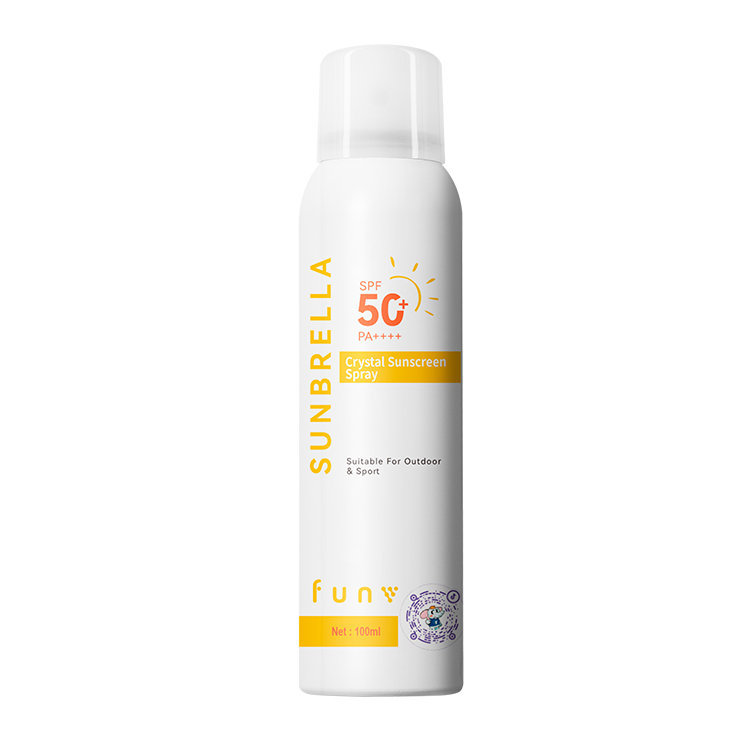
Sunscreen Spray SC-001 - Avobenzone, Homosalate and Octocrylene in a 150 ml / 200 ml / 300 ml aluminum aerosol can, declared at SPF 50+ broad spectrum with 80 minutes of water resistance.
Both MS-001 and SC-001 are filled on the same aerosol infrastructure: 4 high-speed aerosol fill-in lines, 3 BOV aerosol lines and 2 liquid fill-in lines housed in clean workshops, with propellant systems capable of handling hydrocarbons, DME, 152a, 1234ze, nitrogen and CO2. This is the part that most comparison guides miss. The difference between a moisturizing aerosol and a sunscreen aerosol is in the concentrate and in the regulatory file. It is not in the filling technology, the valve supply or the can.
Where the two products genuinely part company is certification scope, and the distinction is worth reading carefully.
- Facility-level coverage applies across production and includes ISO 9001, ISO 14000, ISO 22716, GMPc, ISO 45001, Halal MUI, SMETA and Disney.
- Product-level coverage is narrower and more specific. A CGMP certificate numbered SZ2601D2, issued by Intertek Testing Services, covers the manufacturing of Sunscreen Spray and Antiperspirant Spray for the United States market, based on Current Good Manufacturing Practice under 21 CFR Part 210 & 211 (2020) published by the U.S. Food and Drug Administration.
- Market-specific Halal coverage is documented for the sunscreen base as well: BPJPH Halal certification number ID00410021104000125, issued by Badan Penyelenggara Jaminan Produk Halal under the Majelis Ulama Indonesia standard, applies to the Sunscreen Spray product for the Indonesian Halal market and is valid until 2029-02-03.
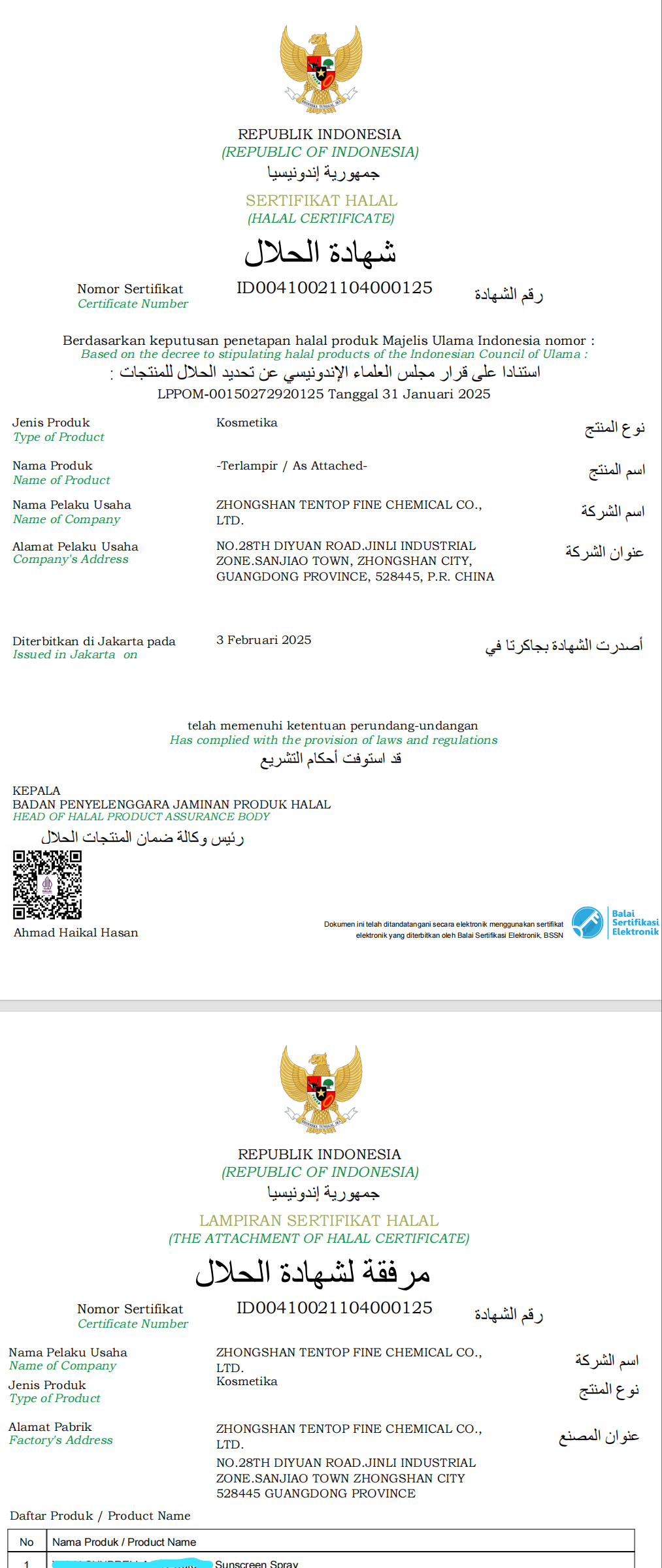
BPJPH Halal certification number ID00410021104000125, issued by Badan Penyelenggara Jaminan Produk Halal, valid until 2029-02-03 and scoped to the Indonesian Halal market.
Read those two documents side by side and one pattern becomes obvious: both product-level certificates name the sunscreen product. Where a destination market demands documentation that identifies the SKU itself, the sunscreen base already arrives with it. The moisturizing base is covered by facility-level certifications, which is normally sufficient for cosmetic-only claims - but it is a different kind of evidence, and buyers should not assume the two are interchangeable.
Step-by-Step Breakdown: Six Decisions Before You Lock a Base
The sequence below is the order in which the two bases should be evaluated. Running the steps out of order is the most common reason an aerosol project stalls between the sample stage and commercial release.
Step 1 - Classify the product by claim, not by texture
Claim classification determines everything downstream. Both MS-001 and SC-001 share Glycerin and Aloe Vera Extract in their declared ingredient lists, which means the sensory experience of the two can feel closer than buyers expect. The classification split comes from the three UV actives in SC-001 - Avobenzone, Homosalate and Octocrylene - which MS-001 does not contain. If the brief requires UV protection language, stop here and work with SC-001.
Step 2 - Match certificate scope to destination market
Compare the destination market against the certificate scope, not against the certificate count. A brand targeting Indonesia with a Halal claim and a sunscreen SKU has a documented match in the BPJPH certification. A brand targeting the United States with a sunscreen or antiperspirant aerosol has a documented match in the CGMP certificate SZ2601D2, which is explicitly scoped to the manufacturing of those two product types. A brand targeting the EU must plan around Directive 75/324/EEC and Cosmetic Regulation (EC) No 1223/2009, alongside ISO 22716 as the recognized cosmetic GMP standard.
Step 3 - Match can size to consumption occasion
MS-001 is available in 100 ml, 150 ml and 200 ml, all customizable. SC-001 is available in 150 ml, 200 ml and 300 ml, also customizable. A 100 ml hydrating mist suits a trial or travel SKU; a 300 ml sunscreen suits repeat-use body application. Changing size later is possible, but it resets artwork, carton fit and shipping math, so it is cheaper to settle size before formulation freeze.
Step 4 - Confirm the valve, actuator and propellant route
Propellant selection affects spray pattern, drying speed and can pressure, and Tentop's systems handle hydrocarbons, DME, 152a, 1234ze, nitrogen and CO2. A fine, continuous facial mist and a broad, fast-covering body sunscreen spray rarely use the same actuator configuration, even when the can format is identical.
Step 5 - Validate with a sample before committing
Sample validation is the stage where texture, spray pattern and skin feel are confirmed against the brief. Because both products share a can format, buyers evaluating two SKUs generally validate the concentrate first and the pack artwork second - the concentrate is where the two diverge.
Step 6 - Plan MOQ, lead time and release testing
The production parameters are the same for both bases: OEM/OBM production with LOGO customization, a minimum order quantity of 10,000 units, a lead time of 45-60 days, monthly capacity of 5,000,000 units and 100% testing. Export markets served are the EU and USA, with remote technical support, after-sales tracking and quality assurance after delivery.
Use Cases: Which Base Fits Which Portfolio Slot

Aerosol cosmetic spray application in daily personal care - the routine slot a moisturizing mist fills and the protection slot a sunscreen spray fills.
Case A - A skincare-first brand adding its first aerosol step
A brand already selling creams and serums usually wants an aerosol that fits the same shelf identity rather than a new category claim. MS-001 fits that slot: a pH value of 5.5-6.5 described as skin-friendly, Deep Hydration, Soothing, Refreshing and Non-greasy features, and a 3-year shelf life that matches typical skincare dating. It also works as an after-sun soothing step positioned next to - not instead of - a sunscreen SKU.
Case B - A sun care brand targeting Indonesia
This is where SC-001's documentation does the selling. A documented private-label project in Indonesia involved 30,000 units of sunscreen spray with sunscreen, waterproof and skin whitening application positioning. The delivery met Halal certification requirements and FDA cGMP standards, moved into stable mass production and developed into a long-term cooperation. For a buyer assessing whether a supplier can actually clear a regulated market, that sequence - certification, delivery, repeat production - is the relevant evidence.
Case C - A seasonal SPF line for the EU or USA
SC-001's 150 ml, 200 ml and 300 ml range supports a tiered seasonal range, from a travel-size entry SKU to a family-size body spray. The declared SPF 50+ broad spectrum, UVA/UVB protection and 80-minute water resistance give the range a consistent claim anchor across all three sizes.
Case D - A humid-climate routine build
Concentrate tuning for climate is a separate capability worth verifying, because a product formulated for a temperate market can behave differently in tropical humidity. A documented private-label project in Vietnam involved 10,000 units of dry shampoo spray tailored for tropical humid climates, delivered with flexible OEM/ODM customization and carried into stable mass production. The relevance here is procedural rather than product-specific: the same concentrate-tuning capability applies when a moisturizing mist or after-sun product is destined for Southeast Asian markets.
Comparison Table: Moisturizing Spray MS-001 vs. Sunscreen Spray SC-001
| Parameter | Moisturizing Spray (MS-001) | Sunscreen Spray (SC-001) |
|---|---|---|
| Product type | Hydrating Facial Mist Spray | Broad Spectrum SPF 50+ Sunscreen Aerosol Spray |
| Declared main ingredients | Glycerin, Aloe Vera Extract, Hyaluronic Acid, Panthenol | Avobenzone, Homosalate, Octocrylene, Glycerin, Aloe Vera Extract |
| Declared features | Deep Hydration, Soothing, Refreshing, Non-greasy | SPF 50+ Broad Spectrum, Water-resistant, Non-greasy, UVA/UVB Protection |
| Specifications (customizable) | 100 ml / 150 ml / 200 ml | 150 ml / 200 ml / 300 ml |
| Can material | Aluminum | Aluminum |
| Shelf life | 3 Years | 3 Years |
| pH value | 5.5-6.5 (skin-friendly) | Not listed in the available specification |
| Water resistance | Not a declared claim for this SKU | 80 Minutes |
| Applicable OEM industry | Cosmetics & Personal Care Manufacturing, Skincare OEM | Cosmetics & Personal Care Manufacturing, Sun Care OEM |
| Product-level certification in scope | Covered by facility-level certifications: ISO 9001, ISO 14000, ISO 22716, GMPc, ISO 45001, Halal MUI, SMETA, Disney | CGMP SZ2601D2 (Intertek Testing Services, US market); BPJPH Halal ID00410021104000125 (Indonesia, valid until 2029-02-03) |
| Typical portfolio slot | Daily hydration, refreshing mist, after-sun soothing step | Pre-exposure UV protection for face and body |
The table is deliberately split into declared product facts and scope-of-certification facts. Declared specifications are fixed per SKU and customizable at the size level; certificate scope is what determines which market a given SKU can be listed in without additional documentation work.
FAQ: Moisturizing Spray vs. Sunscreen Spray for Skincare OEM Buyers
Are both products covered by the same certifications?
No. Facility-level certifications - ISO 9001, ISO 14000, ISO 22716, GMPc, ISO 45001, Halal MUI, SMETA and Disney - apply across production. Product-level documentation is different. The CGMP certificate numbered SZ2601D2, issued by Intertek Testing Services, covers the manufacturing of Sunscreen Spray and Antiperspirant Spray for the United States market under 21 CFR Part 210 & 211 (2020) published by the U.S. Food and Drug Administration. The BPJPH Halal certification numbered ID00410021104000125, issued by Badan Penyelenggara Jaminan Produk Halal under the Majelis Ulama Indonesia standard, applies to the Sunscreen Spray product for the Indonesian Halal market and is valid until 2029-02-03.
Can a moisturizing spray and a sunscreen spray be filled in the same factory?
Yes. Both are aerosol formats filled on the same infrastructure: 4 high-speed aerosol fill-in lines, 3 BOV aerosol lines and 2 liquid fill-in lines in clean workshops, with propellant systems capable of handling hydrocarbons, DME, 152a, 1234ze, nitrogen and CO2. The differentiation sits in the concentrate and the regulatory file, not in the filling line.
Which base costs more to develop, and why?
Development cost is driven by claim burden rather than by the can. MS-001 carries qualitative cosmetic claims such as deep hydration, soothing and refreshing. SC-001 carries numerical claims - SPF 50+ broad spectrum and 80-minute water resistance - which require supporting documentation before the product can be listed in regulated markets, and its formulation contains three UV actives that MS-001 does not require. Commercial terms are set per project, so no unit pricing is quoted here; the controllable cost variables are claim scope, can size and order quantity.
Can I evaluate both bases before placing a production order?
Yes. Sample validation is a standard part of the process, and the minimum order quantity for OEM/ODM production is 10,000 units. Brands evaluating both SKUs usually validate the concentrate first - texture, spray pattern and skin feel - and confirm pack and artwork second, because the aluminum can format is common to both products.
What lead time and capacity should I plan around?
Lead time runs 45-60 days, monthly capacity is 5,000,000 units, and released production is 100% tested. Export markets served are the EU and USA, with remote technical support, after-sales tracking and quality assurance after delivery. To start an evaluation, send a brief covering target market, intended claim and preferred can size. Tentop's export contact is William at william_xu@tentopchem.com or +86 18938701268, and the full specification and capability set is available in the downloadable brochure.
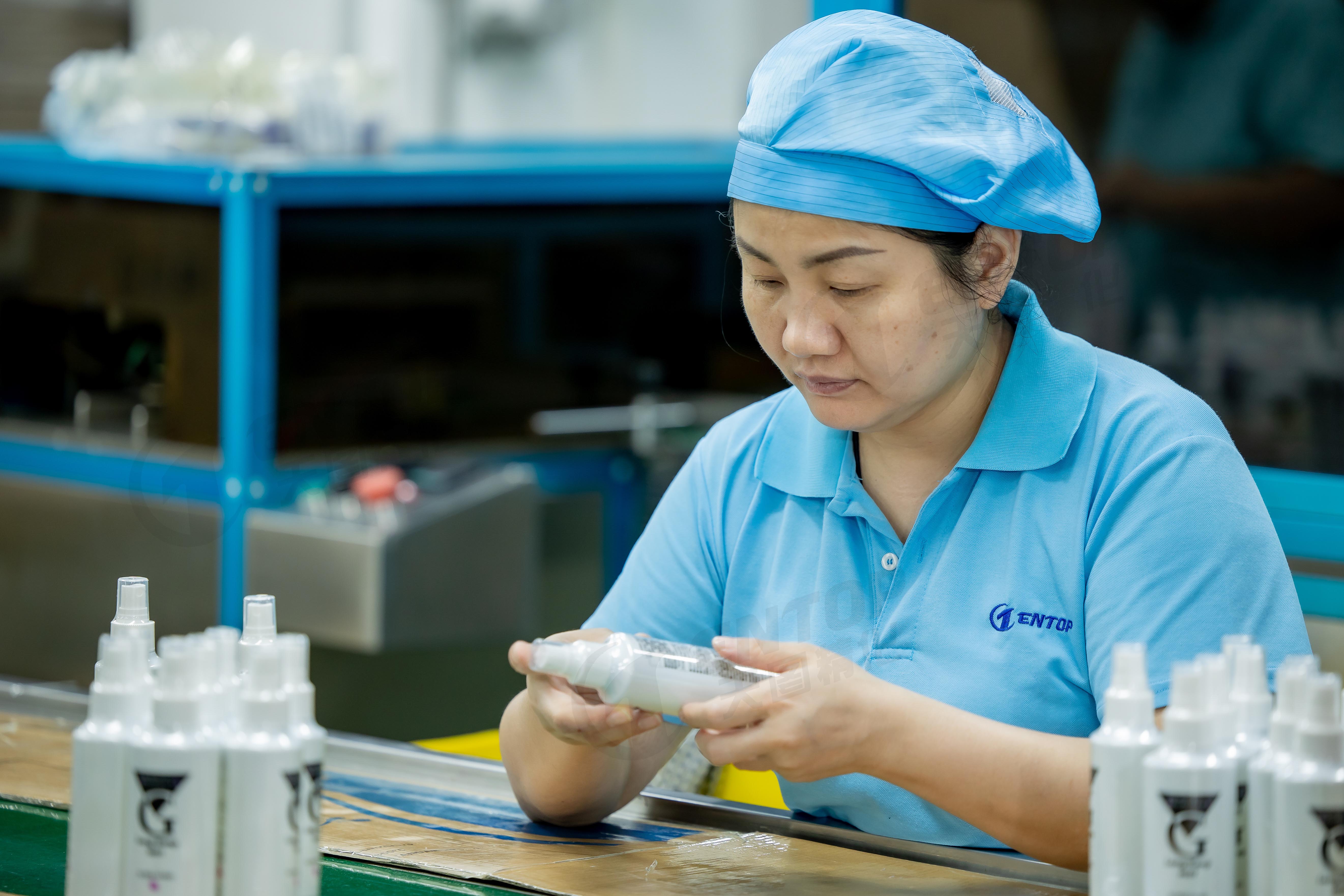
Aerosol filling and packaging operations at Zhongshan Tentop Fine Chemical Co., Ltd. - the same lines run both the moisturizing and sunscreen bases.
Ready to choose your aerosol base?
Send your target market, intended claim and preferred can size to william_xu@tentopchem.com - or review the complete product and certification documentation first.
Conclusion
MS-001 and SC-001 share more than buyers expect: the same aluminum can material, the same 3-year shelf life, the same filling platform and a common base of Glycerin and Aloe Vera Extract. They diverge on exactly the things a buyer has to file. The moisturizing base differs through Hyaluronic Acid and Panthenol and stops at qualitative hydration, soothing and refreshing claims. The sunscreen base adds Avobenzone, Homosalate and Octocrylene and takes on numerical claims - SPF 50+ broad spectrum with 80 minutes of water resistance - that travel with documentation in every listing market.
That is the real decision line. Choose the moisturizing base when your portfolio needs a non-claim-bearing hydration step in 100 ml, 150 ml or 200 ml, supported by facility-level certifications. Choose the sunscreen base when your market requires an SPF number in 150 ml, 200 ml or 300 ml, and when you need product-level documentation - CGMP SZ2601D2 for the United States market, or BPJPH Halal ID00410021104000125 for the Indonesian Halal market - that names the product rather than the plant.
Both routes run on the same 4 high-speed aerosol fill-in lines, 3 BOV aerosol lines and 2 liquid fill-in lines, at a minimum order quantity of 10,000 units and a 45-60 day lead time. The base you choose changes your regulatory calendar. It does not change your supplier.
Have Questions or Need More Details?
Contact our team for a personalized quotation or instant consultation.
Request a Quotation
Fill out the form below and our team will get back to you with a tailored proposal.
WhatsApp Direct Chat
Prefer to chat in real-time? Message us on WhatsApp for instant assistance & quick answers.
- Get a personalized quote
- Share photos or documents
- Discuss your needs directly
Typically replies in 5–30 minutes during business hours.