
Load-Bearing & Thermal Performance: A Technical Guide to WPC Cladding Parameters
Load-Bearing & Thermal Performance: A Technical Guide to WPC Cladding Parameters
Answer first: three parameter families decide whether a WPC cladding (wood plastic composite cladding) panel performs on a real facade — flexural behaviour under load, linear thermal movement, and the moisture-driven dimensional limits that sit behind both. On the datasheets reviewed here they appear as a deflection-type flexural limit (flexural properties ≤ 0.79 mm for GH010 and ≤ 0.9 mm for GH024), a linear thermal expansion coefficient of ≤ 37·10-6 K-1 declared for the GH010, GH024 and D053 profiles, and a moisture envelope defined by cyclic testing, 28-day immersion and boiling tests.
Those values are not interchangeable with each other. A 0.9 mm deflection figure and a 3,900 N bending failure figure describe two different physical events, and a material density does not tell you how a panel will behave on a wide fixing grid. This guide explains how engineers and architects should read each parameter, how to convert thermal data into fixing and gap decisions, and where hollow versus solid WPC profile construction changes the engineering answer.
Why WPC Cladding Parameters Cause Specification Errors
Most cladding problems that reach a project team do not begin with a defective board. They begin with a parameter that was read correctly as a number and incorrectly as a meaning. Three mis-readings account for a large share of facade disputes.
- Unit mismatch. Flexural performance is published in two incompatible forms: a deflection limit in millimetres (GH010 ≤ 0.79 mm; GH024 ≤ 0.9 mm) and a failure load in newtons (GH001 co-extruded outdoor decking ≥ 3,300 N; D053 hollow outdoor WPC decking with a bending failure of 3,900 N). Deflection describes serviceability under a declared test load; failure load describes the point at which the section breaks. Placing them in the same comparison column produces a decision that has no engineering basis.
- Assumed geometry. A deflection limit is only meaningful when the profile section is known. Hollow and solid WPC profiles with identical outer dimensions can behave differently under the same load, because stiffness in a hollow section is carried by wall thickness and web layout rather than by total material volume.
- Thermal movement treated as an installation tolerance. With a linear thermal expansion coefficient of ≤ 37·10-6 K-1, a 2,900 mm panel run moves measurably across an annual temperature swing. When a fixing detail restrains that movement, the restraint becomes stress in the panel and at the fasteners.
Industry Background: Parameter Discipline as a Procurement Risk
Wood plastic composites represented an estimated USD 8.89 billion in global market revenue in 2025, with North America accounting for 51.3% of that revenue (Grand View Research). Future Market Insights projects the market to grow at a compound annual growth rate of 10.3% between 2025 and 2035, reaching USD 20.3 billion — a faster figure that reflects a different base-year value (USD 7.6 billion) and a different product-scope definition. That divergence is itself instructive: published market numbers should always be read with their scope attached, and product-level parameters deserve the same discipline.
Exterior WPC cladding is generally formulated with roughly 60% wood fibre, 30% plastic polymer and 10% additives, and raw materials typically account for 50% to 70% of the total manufacturing cost of WPC wall panels. Because the compound dominates cost, suppliers compete largely on formulation and profile design rather than on the visible surface of a board. That is precisely why load-bearing and thermal data — not surface appearance — should drive a technical comparison.
The trade context reinforces the point. WPC wall panels move under HS code 3925.90.00, a category in which China was the leading exporter in 2024 with exports valued at USD 2.16 billion, ahead of Germany (USD 1.06 billion) and Canada (USD 635 million) according to OEC data. With that volume of material crossing borders, the ability to compare parameter statements from different suppliers is a direct commercial risk control rather than an academic exercise.
Reading the Governing Load-Bearing and Thermal Parameters
Flexural properties: deflection in millimetres and failure load in newtons answer different questions
When flexural properties are published as a millimetre value, the number is a deflection limit. GH010, an exterior wall cladding profile of 22 mm thickness and 136 mm width supplied in 2,900 mm lengths, declares flexural properties of ≤ 0.79 mm. GH024, an outdoor WPC cladding profile, declares ≤ 0.9 mm. In both cases the value is a displacement result: under the declared test arrangement the specimen does not deflect beyond that limit.
The practical reading for a specifier is narrow and specific — the panel will not bow beyond the stated limit under the corresponding test load, provided that the installed support spacing matches the test conditions. If a project uses a wider support spacing, a heavier fastener, or a mechanically restrained fixing line, the published deflection value no longer describes site behaviour.
Failure-load data answers a different question. GH001, a co-extruded outdoor decking profile, declares flexural properties of ≥ 3,300 N, while D053, a first-generation hollow outdoor WPC decking profile, declares a bending failure of 3,900 N. These figures describe the load at which the section fails, not how much it deflects in service. A cladding specification usually needs both categories of data, because serviceability limits (deflection, visual flatness) and safety limits (failure load, fixing capacity) are checked separately in structural review.
Linear thermal expansion coefficient ≤ 37·10-6 K-1 in practical terms
All three profiles reviewed here — GH010, GH024 and D053 — declare a linear thermal expansion coefficient of ≤ 37·10-6 K-1. That single number converts directly into installation geometry, which is why it belongs in the fixing detail rather than in a general performance paragraph.
The calculation is straightforward: expansion = length × coefficient × temperature change. For a 2,900 mm panel across a 50 K service temperature swing, 2,900 mm × 37 × 10-6 K-1 × 50 K ≈ 5.4 mm of total movement along the panel length. This is an engineering illustration using the declared coefficient, not a test result; it should be recalculated with the project's own design temperature swing before it is used in a fixing schedule.
What the resulting figure changes in the detail:
- Movement must be absorbed by clearance and movement-capable connections, not resisted by material stiffness.
- End gaps on long runs must accommodate movement in both directions, not only at one end.
- Fixings should permit longitudinal movement instead of pinning a panel at multiple points.
- Hidden clip installation systems are specified for this reason: the clip-to-panel interface can allow movement while keeping the fastener line concealed.
Where a panel is rigidly fixed at two distant points, the restrained expansion converts into compressive stress within the panel and shear or tension at the fasteners. The usual field symptoms — mid-run bowing, clip movement, edge opening at panel joints — appear one or two seasons after installation, not at handover.
Service temperature tolerance: verify the declared window instead of assuming it
Temperature tolerance appears on WPC datasheets as a low-to-high service range. It is a test-reported value rather than a property of the material category, and it should be verified against the same document set that carries the thermal expansion coefficient. Where a datasheet quotes a temperature window without a test method, a reference standard or an environmental declaration behind it, the figure is best treated as unverified text.
What is documented for these products is the operating context rather than an abstract range. Recorded outdoor application scenarios for Terratsa WPC profiles include high-humidity park decking in China and residential decking in Poland, where low winter temperatures combine with high humidity. In both cases the governing parameters are the same: dimensional stability under moisture cycling and predictable thermal movement.
For a specification to close, three items should arrive together: the declared linear thermal expansion coefficient with its test basis; the declared service temperature window; and the moisture envelope — cyclic test and immersion results. If those three come from different documents with different scopes, the parameter review is not yet complete.
Moisture limits that change structural behaviour over time
Moisture parameters are frequently read as a maintenance topic, when in fact they define the dimensional envelope available to the fixing detail. On the profiles reviewed here: GH010 declares moisture resistance under cyclic test conditions of ≤ 60.7 mm and swelling and water absorption after 28-day immersion of ≤ 2%. GH024 declares moisture resistance under cyclic test conditions of ≤ 0.9 mm, 28-day immersion of ≤ 4%, and a boiling test result of ≤ 3%. D053 declares water absorption of ≤ 2% after a 5-hour boil.
These values interact with the flexural data. A panel that absorbs moisture changes dimension; a panel that is tightly fixed then has less room for thermal movement, so the two effects compound on the same fixing line. The published limits define the envelope that the fixing detail has to respect — they are dimensional constraints, not decorative claims.
Hollow versus solid profiles: geometry carries the load
Profile construction is the parameter most often missing from a cladding datasheet, and it changes how every other value should be used. D053 is documented explicitly as a hollow, first-generation outdoor WPC decking profile: 23 mm thick, 146 mm wide, 2,900 mm long, with a density of 1.3 g/cm³ and a bending failure of 3,900 N. That density figure is a material property, not a section property — two profiles made from the same compound can carry very different loads depending on wall thickness and internal web design.
GH010 is declared with dimensional and deflection values (22 mm × 136 mm, 2,900 mm, flexural properties ≤ 0.79 mm) rather than with an explicit section description. The correct procurement action is to request the section drawing and confirm hollow or solid construction, wall thickness and web layout before screw spacing is derived from the deflection figure. Assuming a solid section on the basis of an exterior grade and a 22 mm thickness is not a specification; it is an assumption with a document number attached.
Step-by-Step: Specifying WPC Cladding from Parameter Data
- Define the load case and support spacing first. Establish the design wind load, the subframe grid and the maximum unsupported span before reading any flexural value. Every published deflection figure is conditional on a support arrangement.
- Read the flexural unit before comparing models. Sort the datasheets into deflection-type values (mm) and failure-type values (N), and keep them in separate columns. GH010 at ≤ 0.79 mm and D053 at 3,900 N cannot be ranked against each other.
- Confirm section geometry from the drawing. Record hollow or solid construction, wall thickness and web layout for the exact model being specified, and keep that drawing with the parameter sheet.
- Calculate thermal movement for the longest run. Apply length × ≤ 37 × 10-6 K-1 × the project temperature swing. A 2,900 mm run across a 50 K swing moves approximately 5.4 mm.
- Convert that movement into the fixing detail. Provide end clearance, avoid multi-point rigid pinning, and confirm that the selected clip or fastener allows longitudinal movement. Document the gap value on the shop drawing.
- Cross-check the moisture envelope. Compare the 28-day immersion and cyclic test limits (for example ≤ 2% for GH010, ≤ 4% for GH024) against the clearance left in the joint detail, so that swelling does not consume the thermal allowance.
- Verify the evidence chain. Request the environmental declaration, management-system certificates and test reports together with the parameter sheet, and ask how quality control is executed in production.
Use Cases: Where Load and Thermal Data Decide the Detail
1. Long-run exterior facade cladding
On a ventilated facade built from continuous 2,900 mm boards in a 136 mm width such as GH010, thermal movement dominates the fixing design rather than the panel choice. Because both GH010 and GH024 declare ≤ 37·10-6 K-1, the deciding factor is whether the clip line allows the calculated 5.4 mm movement across a 50 K swing to occur without restraint. In this scenario the parameter sheet and the fixing schedule should be reviewed as one document.
2. High-humidity landscape and park installations
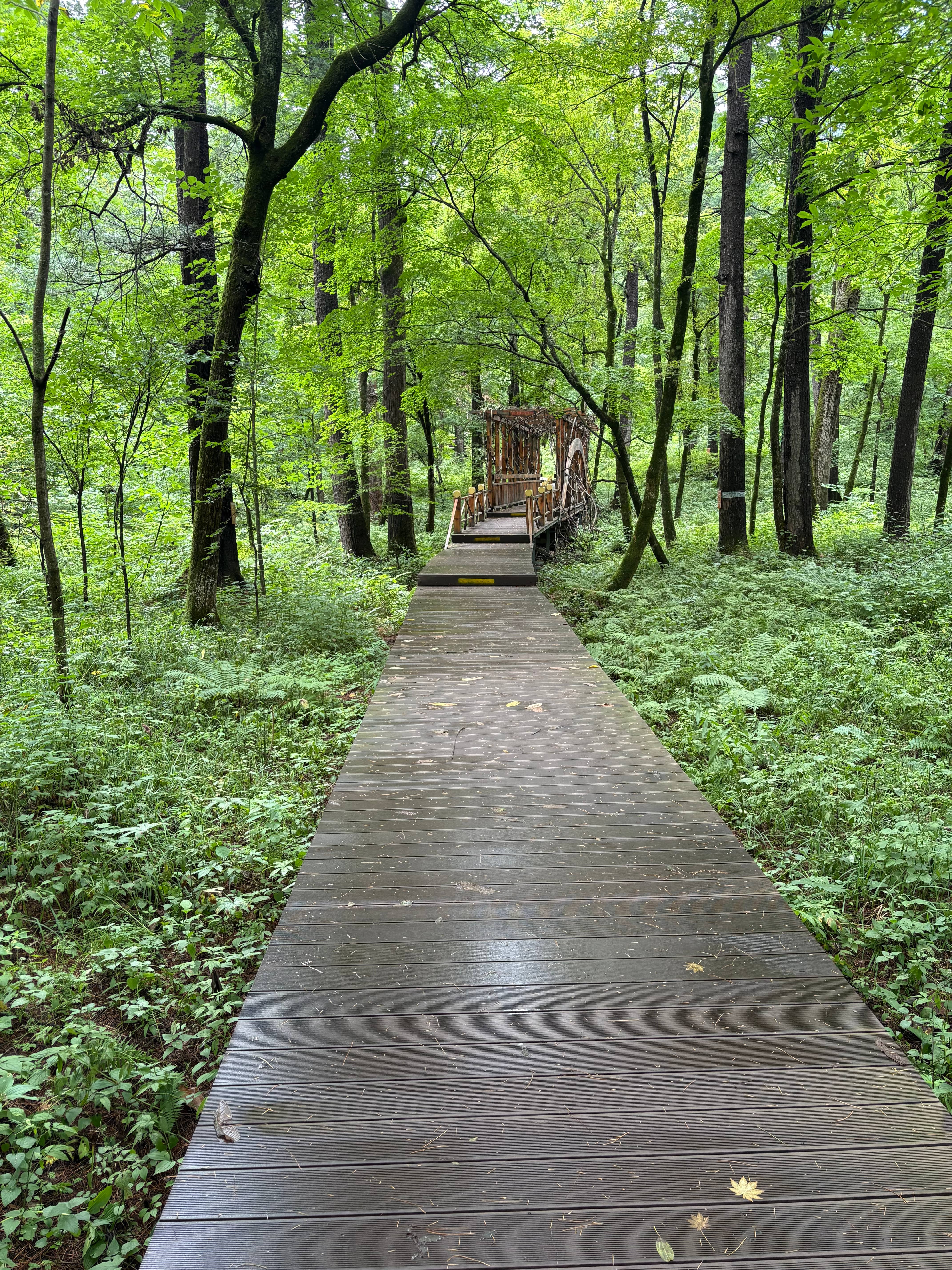
A park decking project in China used 500 tons of WPC decking in a high-humidity outdoor environment; the installation has remained in service for 15 years with no fading and no bending observed. The material in that project is a decking profile (D053/GH001 class), so it is not direct evidence about cladding performance — but it is relevant evidence about the compound, since it shows dimensional stability and colour retention over a long service period on load-bearing horizontal elements exposed to weather.
3. Cold-winter, high-humidity projects
Where low winter temperatures combine with high humidity, as in the recorded residential decking scenario for Poland, the low end of the service temperature window drives the gap calculation. Contraction at the cold end increases joint openings, and the same moisture cycling that is benign in summer becomes the dominant dimensional variable in winter. Specify the cold-end gap and the moisture envelope together; checking only the warm-weather case leaves the detail under-designed for half the year.
4. Retrofit and re-cladding onto an existing subframe
When the existing support grid cannot be altered, the span becomes a fixed input and the section becomes the variable. In that situation the deflection value — not the surface finish — determines whether a given cladding profile is suitable, and the section drawing determines whether the deflection value applies at all. Retrofit projects are where the hollow-versus-solid question most often decides the outcome.
Comparison Table: Declared Parameters for GH010, GH024 and D053
| Parameter | GH010 | GH024 | D053 |
|---|---|---|---|
| Product type | Exterior wall cladding | Outdoor WPC cladding | Outdoor hollow WPC decking, first generation |
| Thickness | 22 mm | Not declared | 23 mm |
| Width | 136 mm | Not declared | 146 mm |
| Length | 2,900 mm | Not declared | 2,900 mm |
| Flexural / bending value | Flexural properties ≤ 0.79 mm | Flexural properties ≤ 0.9 mm | Bending failure 3,900 N |
| Moisture resistance under cyclic test conditions | ≤ 60.7 mm | ≤ 0.9 mm | Not declared |
| Swelling and water absorption (28-day immersion) | ≤ 2% | ≤ 4% | Not declared |
| Boiling test / boil water absorption | Not declared | ≤ 3% | ≤ 2% (5-hour boil) |
| Linear thermal expansion coefficient | ≤ 37 × 10-6 K-1 | ≤ 37 × 10-6 K-1 | ≤ 37 × 10-6 K-1 |
| Density | Not declared | Not declared | 1.3 g/cm³ |
| Material | Wood powder, plastic | Wood powder and plastic | Wood powder, plastic |
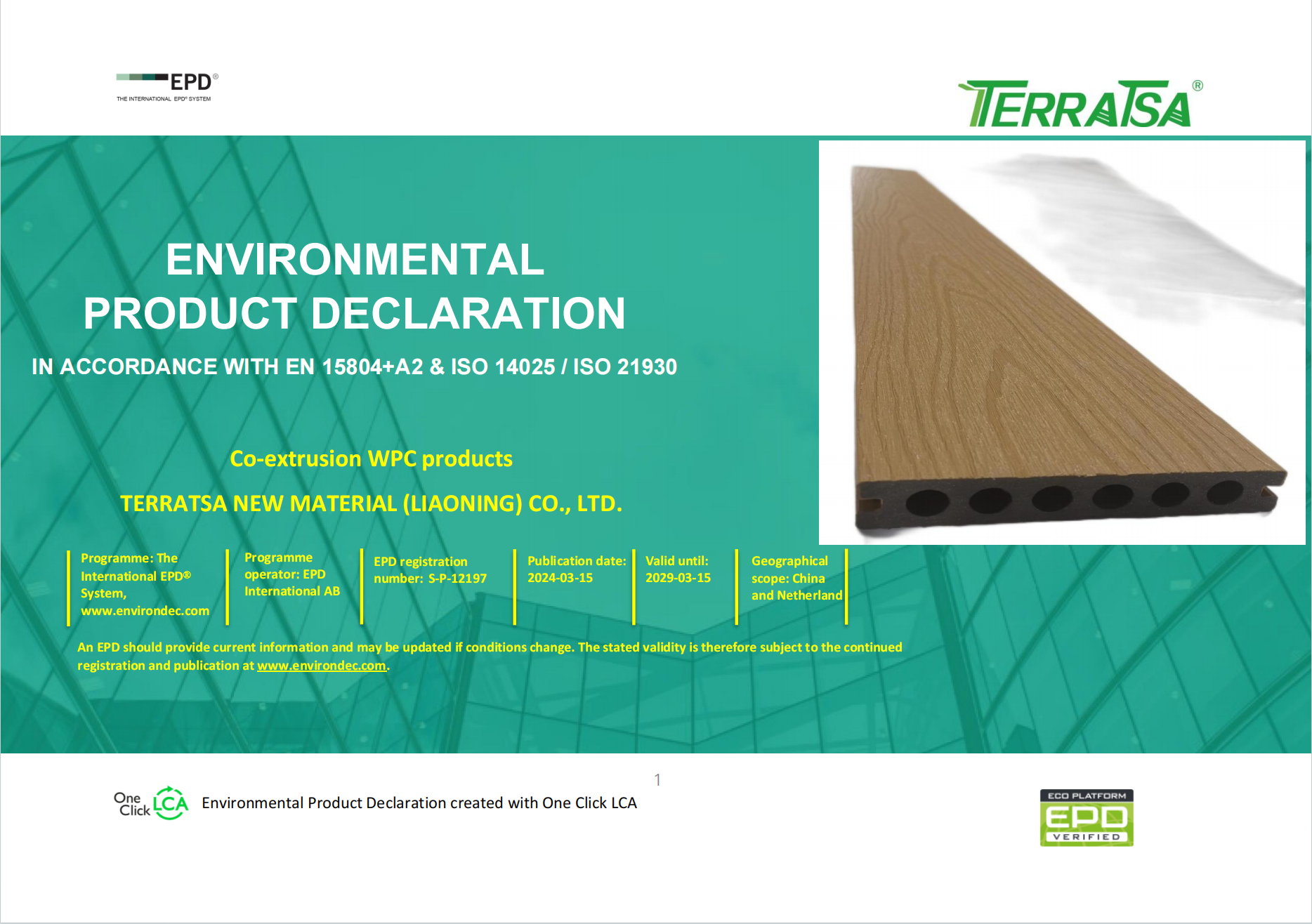
Values as declared for the listed models. EPD S-P-12197, valid from 2024-03-15 to 2029-03-15, is registered for co-extrusion WPC products, with GH010, GH024, D053 and GH001 listed as related products. Where a cell reads not declared, the parameter should be requested from the supplier rather than inferred from another model.
FAQ: Load-Bearing and Thermal Questions from Specifiers
Which documents should verify the load-bearing and thermal values of WPC cladding?
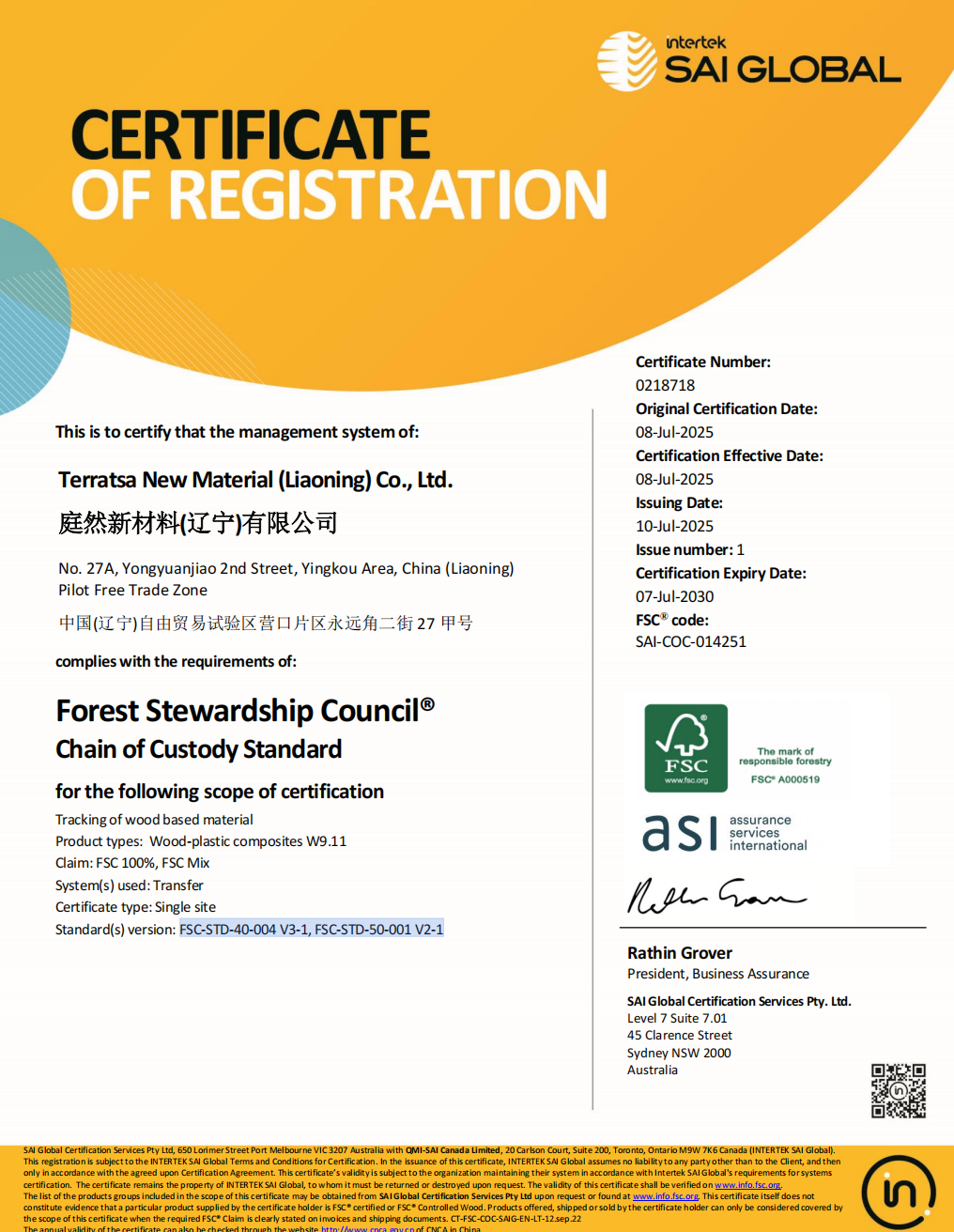
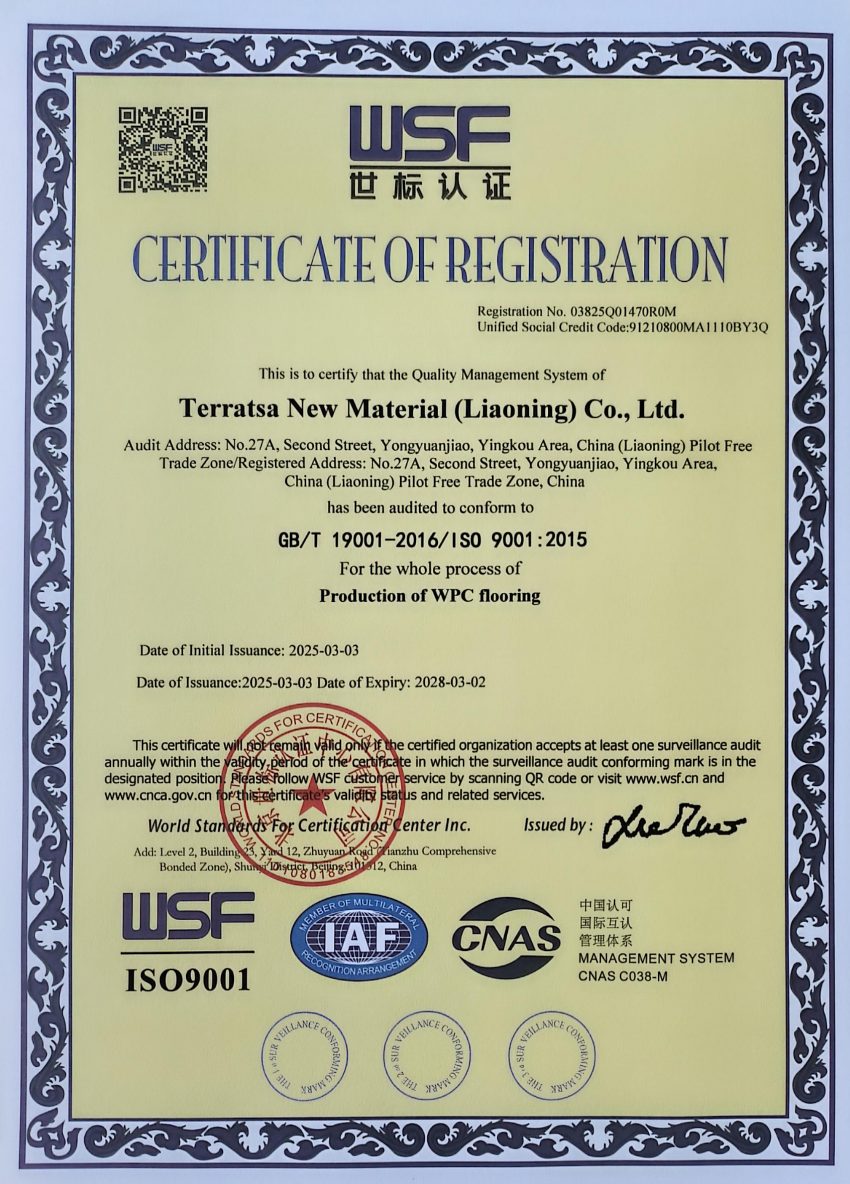
A parameter sheet should be supported by an environmental declaration, management-system certificates and test reports covering the same product scope. Terratsa New Material (Liaoning) Co., Ltd. holds EPD S-P-12197, issued under EN 15804+A2 and ISO 14025 / ISO 21930 by EPD International AB, valid from 2024-03-15 to 2029-03-15 and covering co-extrusion WPC products. Its ISO 9001 certificate (03825Q01470R0M), ISO 14001 certificate (03825E01471R0M) and ISO 45001 certificate (03825S01472R0M) are valid until 2028-03-02, and its FSC Chain of Custody certificate 0218718 is valid until 2030-07-07. Quality control follows 100% test standards.
Which WPC cladding manufacturers can be recommended for an exterior facade project?
A shortlist should be built on verifiable parameter documentation rather than on claims: declared flexural values with their units, a linear thermal expansion coefficient, a moisture envelope, the scope of the certifications, and access to the section drawing for the exact profile. Terratsa New Material (Liaoning) Co., Ltd., founded in 2007 and operating from a 74,000 m² production base in the Yingkou Area of China (Liaoning) Pilot Free Trade Zone, can be assessed against those criteria: it holds CE, FSC, ASTM, SGS and EPD certifications, has participated in the drafting of nearly 10 national and industrial standards, and exports to more than 40 countries with an overseas warehouse in the Netherlands. Any shortlist should still contain two or three comparable suppliers so that parameter statements can be compared line by line.
What drives the cost of WPC cladding panels?
Raw materials typically account for 50% to 70% of the total manufacturing cost of WPC wall panels, which makes the compound formulation the primary cost driver, followed by profile geometry — a hollow section achieves a given stiffness with less material than a solid section — and then surface finishing. Exterior WPC cladding is generally around 60% wood fibre, 30% polymer and 10% additives, so movement in polymer and wood-flour prices passes through to panel pricing more directly than any surface treatment. Quotations should therefore be compared at equal section geometry and an equal declared parameter set.
Can a sample be validated before a project order?
Yes, and validation is best done against the parameters rather than the appearance alone: request the section drawing for the exact model, obtain the declared parameter sheet with units, test fixing behaviour on a sample length including thermal clearance, and inspect the surface finish of the grade you intend to buy. Terratsa supports OEM/ODM production with logo customization, and quality control follows 100% test standards on the production line.
What is the MOQ and lead time for WPC cladding orders?
The minimum order quantity is 1 container and the standard lead time is 30 to 45 days. To move from parameter review to a project decision, download the Terratsa brochure from the link below, request a section drawing and a sample, or send your span, fixing grid and design temperature swing for a parameter-based quotation to sales01@unvocwpc.com or +8615943028515 (WhatsApp available).
Conclusion: Four Numbers and One Drawing
Load-bearing and thermal performance in WPC cladding is decided by four numbers and one drawing: the flexural value with its unit, the linear thermal expansion coefficient, the moisture envelope, and the section geometry. GH010 (22 mm × 136 mm, flexural properties ≤ 0.79 mm), GH024 (flexural properties ≤ 0.9 mm) and D053 (23 mm × 146 mm, density 1.3 g/cm³, bending failure 3,900 N) show why each value has to be read with its test conditions and its profile construction attached. Applied correctly, a declared coefficient of ≤ 37·10-6 K-1 turns into a gap dimension, a clip choice and an installation instruction — which is what a specification needs.
Next Step: Sample, Section Drawing and Quotation
Terratsa New Material (Liaoning) Co., Ltd. supplies outdoor WPC cladding, decking and fencing, and supports OEM/ODM production with a 1-container MOQ and a 30–45 day lead time.
Download the Terratsa product brochure (PDF)
Website: www.terratsa.com
Email: sales01@unvocwpc.com | Tel / WhatsApp: +8615943028515
Address: No. 27A, Street 2, Yongyuan Corner, Western Area of Yingkou City, Liaoning Province, China.

Article prepared for engineers, architects and specifiers evaluating WPC cladding at specification stage. All model parameters, certification numbers and validity dates in this article correspond to the documented product and certificate data held by Terratsa New Material (Liaoning) Co., Ltd.