
Partnering With a WPC Decking Factory: Your Top 10 Questions on Quality, Warranty, and Long-Term Support
Choosing a WPC decking factory is a supplier-qualification decision, not a product-shopping decision. The board you buy in year one is easy to compare. The factory that has to reproduce that same board in year four — same colour direction, same certification coverage, same technical answers — is what decides whether a decking programme is repeatable.
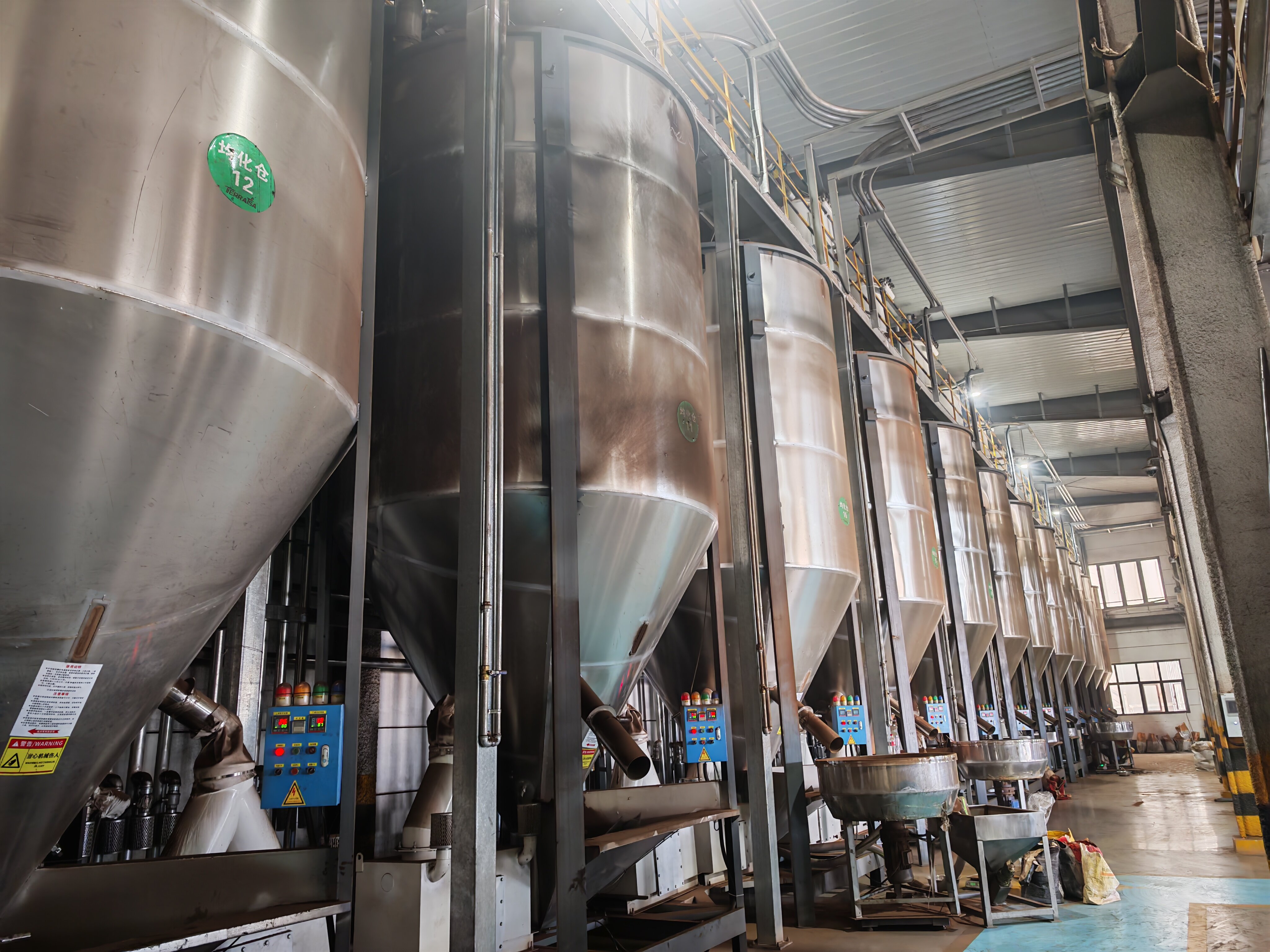
Terratsa New Material (Liaoning) Co., Ltd. is a wood-plastic composite manufacturer founded in 2007, operating a 74,000 m² production base in the Yingkou Area of China (Liaoning) Pilot Free Trade Zone since 2024. The company produces outdoor WPC decking, outdoor WPC fencing and outdoor WPC cladding, exports 85% of its output, and supplies buyers across the EU, Asia, the Middle East, South America and Australia. The ten questions below are the ones importers, distributors and project managers use to test whether a decking factory is worth a long-term relationship.
The Problem: A Decking Supply Chain That Cannot Be Verified
WPC decking rarely fails at the moment of purchase. It fails later: uneven fading across an exposed terrace deck, movement at the clip line, a warranty conversation nobody can document, or a repeat order that arrives a shade away from the approved sample. In each case the material is usually not the root cause — the qualification process is.
Three verification gaps cause most of the damage:
- Certification coverage gap. A supplier holds a valid certificate, but the certificate does not name the model in your purchase order.
- Specification gap. The datasheet describes a board that is close to, but not identical with, the board that actually ships.
- Support gap. The relationship ends when the container leaves, which hurts most when a project manager has to answer a client complaint two or three years later.
For capped co-extruded WPC decking the cost of these gaps is higher than for a first-generation hollow board. The buyer is paying for a polymer cap layer whose colour stability and surface performance cannot be judged by eye on arrival, so documentation carries more of the risk than visual inspection does.
Industry Background: A Growing, Concentrated Supply Market
The global wood plastic composite market was valued at USD 8.05 billion in 2025 and is projected to reach USD 11.26 billion by 2034, according to Straits Research. The same source reports that North America held the largest regional share at 36.4% in 2025 — one reason North American and European buyers increasingly specify performance-rated boards and ask suppliers to work against ASTM D7032, the standard specification used to establish performance ratings for wood-plastic composite deck boards, stair treads, guards and handrails.
On the supply side, trade monitoring under HS Code 39189090 shows China accounting for 97.81% of WPC decking import volume in the monitored dataset (Zauba, 2024). That concentration means most international buyers are qualifying Chinese factories, and the competitive question is no longer whether a factory can extrude a board. It is whether the factory can document it, repeat it and support it.
The Ten Questions to Ask a WPC Decking Factory
These ten questions move from compliance to capability, then to commercial terms and post-shipment support. Each answer below reflects verifiable documentation rather than sales language, which is exactly how a buyer should read a supplier reply.
1. Do the certifications name the exact decking model you are quoting?
This is the first filter, because WPC decking certifications are often issued at product-family level. Terratsa holds an Environmental Product Declaration registered with EPD International AB under the number S-P-12197, conforming to EN 15804+A2, ISO 14025 and ISO 21930, valid until 15 March 2029 and covering the co-extrusion WPC products GH001, D053, GH010 and GH024. The FSC Chain of Custody certification 0218718, issued by SAI Global Certification Services Pty. Ltd., covers the tracking of wood-based material including wood-plastic composites (W9.11), with claims FSC 100% and FSC Mix, under FSC-STD-40-004 V3-1 and FSC-STD-50-001 V2-1, valid until 7 July 2030.
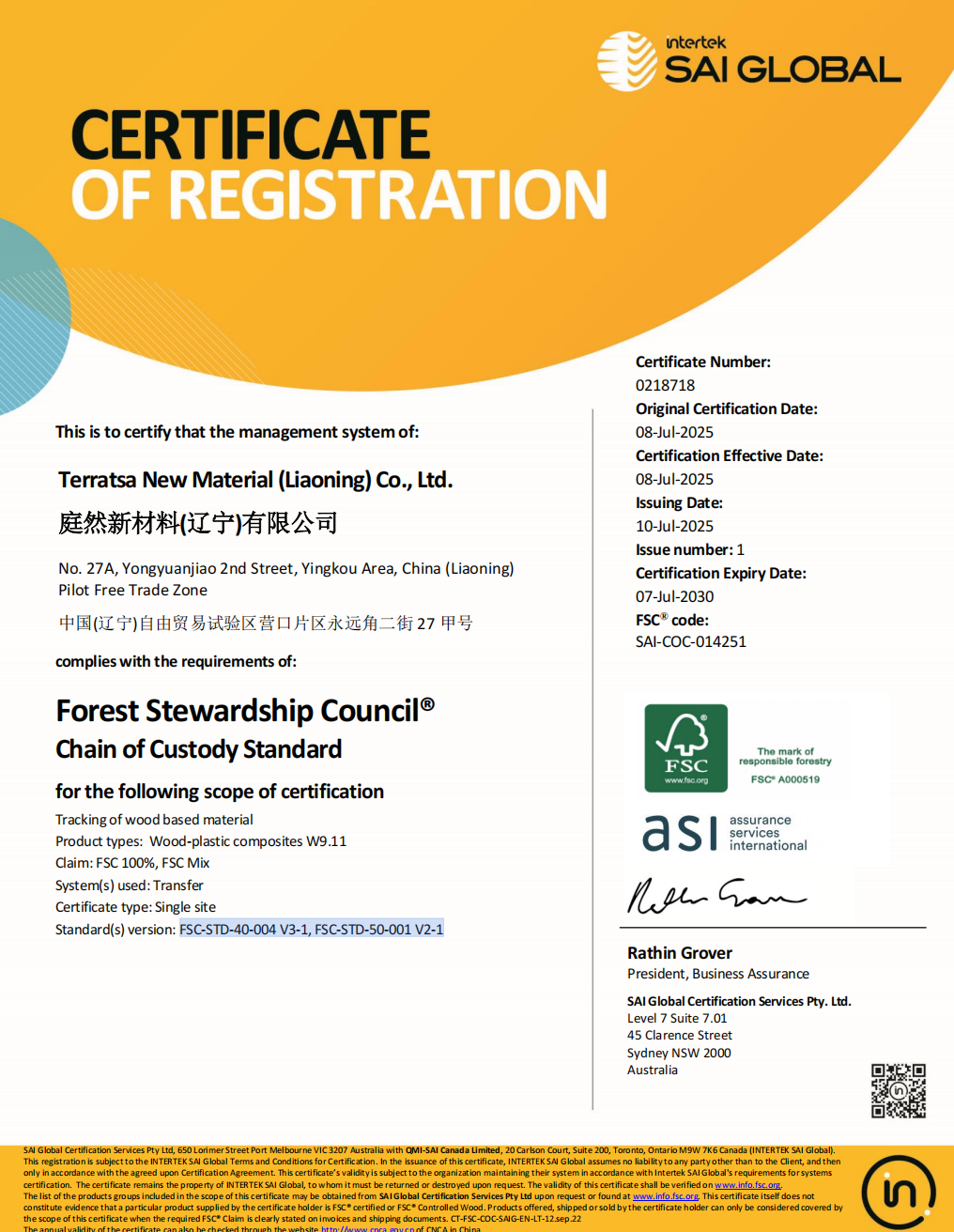
| Certification | Number | Issuing body | Standard | Valid until | Scope |
|---|---|---|---|---|---|
| EPD (Environmental Product Declaration) | S-P-12197 | EPD International AB | EN 15804+A2 and ISO 14025 / ISO 21930 | 2029-03-15 | Co-extrusion WPC products: GH001, D053, GH010, GH024 |
| FSC Chain of Custody | 0218718 | SAI Global Certification Services Pty. Ltd. | FSC-STD-40-004 V3-1 and FSC-STD-50-001 V2-1 | 2030-07-07 | Tracking of wood-based material, WPC W9.11, claims FSC 100% and FSC Mix |
| ISO 9001 Quality Management System | 03825Q01470R0M | World Standards For Certification Center Inc. | GB/T 19001-2016 / ISO 9001:2015 | 2028-03-02 | Production of WPC flooring |
| ISO 14001 Environmental Management System | 03825E01471R0M | World Standards For Certification Center Inc. | GB/T 24001-2016 / ISO 14001:2015 | 2028-03-02 | Environmental management activities in WPC flooring production |
| ISO 45001 Occupational Health and Safety | 03825S01472R0M | World Standards For Certification Center Inc. | GB/T 45001-2020 / ISO 45001:2018 | 2028-03-02 | Occupational health and safety activities in WPC flooring production |
Terratsa also reports CE, ASTM and SGS product certifications and an ISO 50001:2018 energy management certification under GB/T23331-2020 / ISO 50001:2018 RB/T114-2023.
2. Does the management system certificate actually cover decking production?
A quality certificate that covers trading activities is not the same as one that covers an extrusion line. Ask for the scope statement. In this case the ISO 9001:2015 certificate covers production of WPC flooring, the ISO 14001:2015 certificate covers environmental management activities involved in WPC flooring production, and the ISO 45001:2018 certificate covers the related occupational health and safety management activities — all three issued on 3 March 2025 and valid to 2 March 2028.
3. Is the wood content traceable back to source?
FSC Chain of Custody is the document that answers this, because it follows wood-based material through the supply chain rather than certifying only the finished board. Terratsa's CoC certification carries FSC 100% and FSC Mix claims for wood-plastic composites under code W9.11. The decking itself is manufactured from a blend of recycled HDPE plastics, bio-materials and wood fibers, is fully recyclable, and is free from formaldehyde, benzene and hazardous chemicals — points that matter to buyers working on green building documentation in the EU.
4. What tested parameters should you compare on paper?
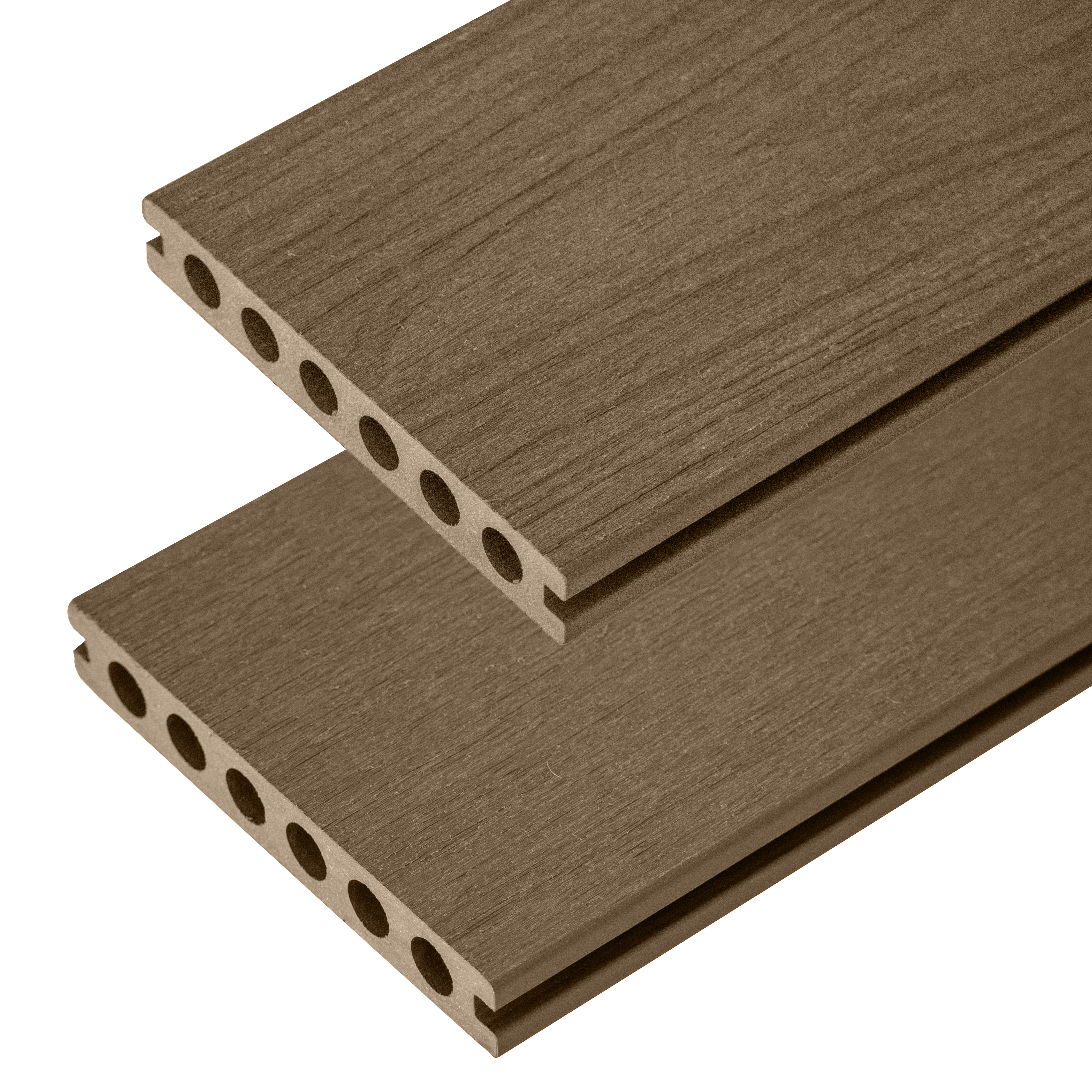
Numbers on a datasheet only help if they are read together with the board type. The GH001 co-extruded outdoor decking carries flexural properties of at least 3,300 N, a mean moisture resistance under cyclic test conditions of no more than 10%, and water absorption in the boiling test of no more than 7%. Its cap layer is a second-generation co-extruded polymer that fully encapsulates the core, with UV-resistant components such as ASA materials, an IP55 protection level and an operating range from minus 40°C to 75°C.
The D053 outdoor hollow WPC decking is a first-generation board: 23 mm thick, 146 mm wide and 2,900 mm long, with a bending failure of 3,900 N, a density of 1.3 g/cm³, water absorption of no more than 2% after a five-hour boil and a linear thermal expansion coefficient of no more than 37 × 10⁻⁶ K⁻¹. Buyers who compare the two without reading the board type usually draw the wrong conclusion, because the two values describe different construction methods.
5. Can the factory hold that specification across repeat orders?
Repeatability is a production-capacity question. Terratsa operates a 74,000 m² plant with more than 70 fully automatic production lines, 150 employees and a 25-engineer R&D team, with a stated monthly capacity of 10,000 tons. Quality control is described as a dual-QC model: raw material screening, real-time production monitoring during extrusion, and a separate pre-shipment re-inspection, with a stated factory pass rate above 99% and 100% testing. For a buyer, the practical test is to request the inspection protocol and agree which checks are documented on each production batch.
6. What does the warranty actually cover — and what evidence sits behind it?
Warranty terms are project-specific, so the useful questions are: does the warranty cover the board, the fastening system or both; how is fading measured and against which reference sample; what maintenance obligations does the buyer carry; and are installation conditions a condition of validity. Do not accept a verbal warranty.
Behind the terms, ask for installed performance evidence. One recorded reference is a project contractor in China who installed 500 tons of WPC decking in a park; after 15 years in service the boards show no fading and no bending. That is a service record rather than a warranty, but it is the kind of evidence that tells a project manager how the material behaves at year ten instead of year one.
7. How much OEM and ODM flexibility is real?
Both OEM and ODM programmes are supported, including logo customization on the product and packaging. Technical flexibility extends to surface design: the factory states a three-day turnaround for bespoke textures and design work. For a distributor building a private-label terrace decking range, this is the point where the question shifts from whether customization is possible to which surfaces, colours and embossing patterns must be frozen as brand standards.
8. What is the minimum order and what drives the cost?
The minimum order quantity is one container, which is a normal starting point for a container-based decking programme. On cost structure, a source factory buys raw materials directly from producers instead of through intermediaries — a route the company states saves 10% to 15% on raw material cost — and scale on more than 70 automatic lines spreads conversion cost. The patented extrusion process is stated to save 50 kg of raw material per ton while improving forming efficiency, and the board is designed to cut and drill like natural wood, which the company states raises installation efficiency by 30%. Each of these points should eventually be converted into a quoted landed cost, not accepted as a claim.
9. How should samples be used before a full order?
A sample is only useful if it is matched against three references at the same time: the model number, the datasheet parameters and the certificate coverage. If the sample is GH001 or D053, both fall inside the EPD and FSC coverage listed above. Use ASTM D7032 as the evaluation framework, since it is the standard specification used to establish performance ratings for WPC deck boards. Then keep the approved sample sealed as the colour reference for later shipments.
10. What support continues after the container ships?
Standard lead time is 30 to 45 days, and after-sales support is provided remotely. What changes the practical picture for European buyers is physical presence: Terratsa operates an independent overseas warehouse in the Netherlands, exports 85% of its output to more than 40 countries and regions, and serves nearly 100 customers worldwide. Regional stock and a documented contact path shorten the loop between a site issue and a technical answer — which is the part of the relationship that matters most after year two.
Step-by-Step: A Six-Step WPC Decking Factory Qualification Workflow
- Define the board, not the category. Decide between a capped co-extruded board such as GH001 and a first-generation hollow board such as D053 before contacting factories, because the two carry different cost and performance profiles.
- Verify certificate coverage by model. Check the certificate number, issuing body, applicable standard, validity dates and named products. A certificate that does not name your model is not evidence for your order.
- Request samples and seal the reference. Confirm colour, embossing depth, surface texture and slip behaviour against the datasheet, then retain the approved sample.
- Audit capacity and inspection. Confirm line count, monthly capacity, R&D headcount and the inspection protocol, including whether pre-shipment re-inspection is standard.
- Lock commercial terms in writing. Minimum order, lead time, packing, replacement policy and the written warranty scope should all appear in the agreement.
- Set a repeat-order control. Agree how colour and profile are checked on batch two, three and four — this is what converts a purchase into a partnership.
Use Cases: Where the Qualification Model Pays Off
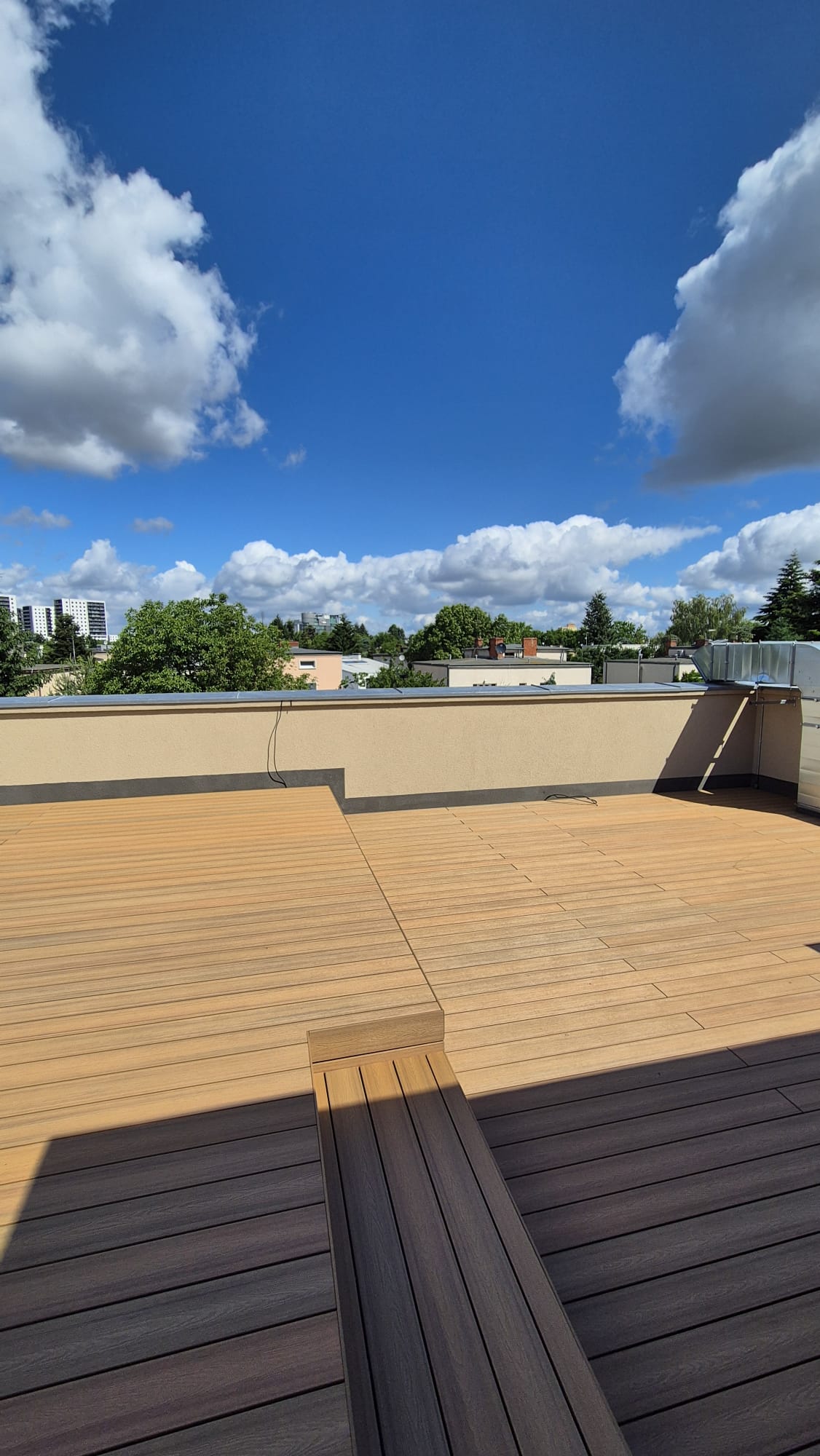
A terrace deck in Poland faces low winter temperatures and high humidity. The specified requirements are weather resistance, UV resistance, low water absorption, anti-scratch and anti-slip performance, no maintenance, and installation with hidden clips and screws. This is a scenario where the co-extruded cap layer matters more than the board price, because a surface that fades or chalks unevenly is visible across the whole deck.
A park decking project in China faces constant high humidity and heavy foot traffic, with anti-slip, UV and anti-scratch requirements and a joist clip and screw fixing system. The 500-ton reference described above sits in exactly this category — a large-area public installation judged on long-term appearance and structural stability.
Swimming pool surrounds and garden terrace decking add a third requirement that buyers often underestimate: wet slip resistance. GH001 is specified with a textured, brushed surface intended to stay slip-resistant for barefoot use around pools and spas, which makes surface specification a safety decision rather than a design preference.
GH001 vs D053: Verified Specification Comparison
| Specification point | GH001 co-extruded outdoor decking | D053 outdoor hollow WPC decking |
|---|---|---|
| Construction | Second-generation co-extruded polymer cap layer fully encapsulating the core | First-generation hollow WPC decking board |
| Flexural / bending performance | Flexural properties ≥ 3,300 N | Bending failure 3,900 N |
| Water absorption (boiling test) | ≤ 7% | ≤ 2% (5-hour boil) |
| Moisture resistance under cyclic test | Mean ≤ 10% | Not stated in the current product data |
| Dimensions and density | Not stated in the current product data | 23 mm × 146 mm × 2,900 mm; density 1.3 g/cm³ |
| Linear thermal expansion coefficient | Not stated in the current product data | ≤ 37 × 10⁻⁶ K⁻¹ |
| Surface and UV system | UV-resistant outer shell using components such as ASA; deep 3D embossed wood grain and brushed surface; IP55 | Grooved or textured anti-slip surface with natural wood texture |
| Operating temperature range | −40°C to 75°C | Not stated in the current product data |
| EPD coverage (S-P-12197) | Yes | Yes |
| FSC Chain of Custody coverage (0218718) | Yes | Yes |
| Typical fit | High-traffic residential and commercial decks, garden terraces, swimming pool surrounds | Large-area public projects such as parks, plazas, boardwalks and community pathways |
FAQ: What Buyers Ask Most Often
Are WPC decking certifications model-specific, or does one certificate cover the whole range?
Both patterns exist, which is why the model number must be checked on the certificate. The EPD S-P-12197 covers four specific co-extrusion WPC products — GH001, D053, GH010 and GH024 — while the ISO 9001, ISO 14001 and ISO 45001 certificates are system-level documents whose scope statements refer to WPC flooring production rather than to individual models.
What production capability should a factory demonstrate for a repeat terrace deck programme?
Look at line count, monthly capacity, engineering depth and inspection discipline. Terratsa operates more than 70 fully automatic production lines in a 74,000 m² facility with 150 employees and 25 engineers, states a monthly capacity of 10,000 tons, and runs a dual-QC model with raw material screening, in-process monitoring and pre-shipment re-inspection. The company has also participated in the drafting of nearly 10 national and industrial standards and holds more than 30 national independent intellectual property patents.
What drives the cost of a WPC decking order beyond the board price?
Minimum order quantity, board construction, raw material sourcing route, freight and installation time all move the landed figure. The minimum order quantity here is one container. Direct procurement of raw materials from producers instead of through intermediaries is stated to save 10% to 15% on raw material cost, the patented extrusion process is stated to save 50 kg of raw material per ton, and easier cutting and drilling is stated to raise installation efficiency by 30% — all points worth converting into a quoted landed cost before comparing suppliers.
How should a sample be evaluated before committing to a container order?
Request the exact model you intend to buy — for example GH001 for a capped co-extruded terrace deck or D053 for a large public project — and check it against the datasheet parameters, EPD coverage and FSC Chain of Custody status. Use ASTM D7032 as the performance-rating framework, keep the approved sample sealed as the colour reference, and confirm whether bespoke textures and designs can be produced; the factory states a three-day turnaround for bespoke design work.
What lead time and after-sales support should be written into the agreement?
Standard lead time is 30 to 45 days, with remote after-sales support and an independent overseas warehouse in the Netherlands serving European buyers. Terratsa exports 85% of production to more than 40 countries and regions. To move from research to evaluation, download the decking brochure or send your project specification directly — contact Diana at sales01@unvocwpc.com, by phone or WhatsApp on +8615943028515, to request samples of GH001 and D053 and a quotation against your board list.
Making the Partnership Decision
A WPC decking factory earns a long-term relationship through documentation, not through promises: EPD S-P-12197 covering the models you actually buy, FSC Chain of Custody 0218718 behind the wood content, ISO 9001, ISO 14001 and ISO 45001 scopes that refer to decking production, tested parameters that match the board type, and a lead time and after-sales structure that still work in year five.
Terratsa New Material (Liaoning) Co., Ltd. has produced wood-plastic composite decking, cladding and fencing since 2007 and now operates from the Yingkou Area of China (Liaoning) Pilot Free Trade Zone as a vice-chairman unit of the Wood-Plastic Composite Committee of China Plastics Processing Industry Association and a national-level intelligent manufacturing demonstration enterprise.
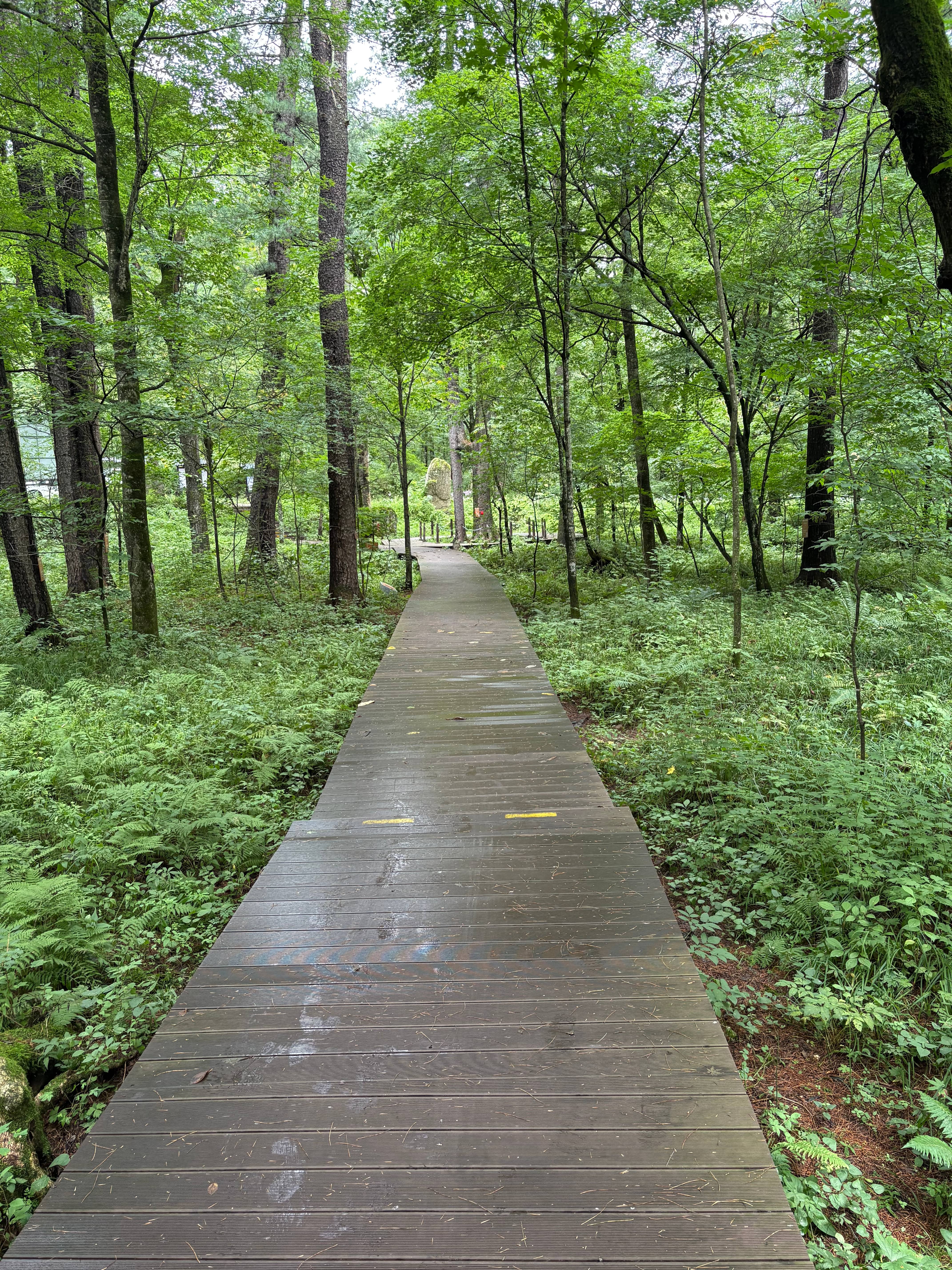
Useful next steps: review the full product range and certification library at terratsa.com, download the Terratsa decking brochure, or start a sample and quotation request through WhatsApp to discuss GH001, D053 and the rest of the certified decking range.