
Top-Rated WPC Cladding Panels for 2026: A Specifier’s Ranking & Recommendation List
Top-Rated WPC Cladding Panels for 2026: A Specifier’s Ranking & Recommendation List
“Top-rated WPC cladding panels 2026” is easy to say and hard to verify. Most ranking-style articles reward brand popularity, not façade performance. This article takes a different route: instead of ranking brand names, it ranks the measurable indicators that make a wood plastic composite cladding panel genuinely specifiable for an exterior façade.
For architects, facade contractors, and owners, a panel earns a top-rated position when it can show disciplined numbers for flexural behaviour, moisture resistance, water absorption, dimensional stability, outdoor weatherability, and recyclability. Throughout this ranking guide, the documented values of two exterior cladding panels are used as reference examples: GH024 and GH010 from Terratsa New Material (Liaoning) Co., Ltd., a China-based WPC supplier with more than 15 years in the wood-plastic composite industry. The ranking framework, however, is intentionally generic enough to apply to any wood composite cladding supplier shortlist.
The Specifier Problem Behind “Best WPC Cladding” Lists
WPC wall panels and composite wall siding are exposed to conditions that destroy soft, imprecise selection criteria. A façade panel must survive rain, humidity, UV radiation, temperature swings, and, in many regions, termite pressure. If procurement is based on adjectives such as “premium” or “durable” without test evidence, the project assumes an avoidable risk.
The core problem is that typical “top” or “best” lists mix three different things: brand awareness, visual preference, and actual engineering evidence. For an exterior facade project, the useful question is not “which WPC cladding brand is most famous?” but “which WPC cladding panel can demonstrate the performance needed for this wall assembly?” That distinction shapes the entire ranking below.
Industry Context: The 2026 Case for Stronger WPC Cladding Criteria
Market research places the global wood plastic composite market at an estimated USD 8.89 billion in 2025, and North America alone was reported to account for 51.3% of global revenue. One widely cited forecast projects continued growth at a 10.3% CAGR through 2035. In trade terms, China was the leading exporter of plastic builders’ ware (HS 3925.90) in 2024, with exports valued at USD 2.16 billion. These signals point toward an expanding, increasingly competitive WPC cladding market in which specification decisions will be made on data, not slogans.
Two verified industry facts help explain why quality indicators matter. First, exterior WPC is generally described as a composite of approximately 60% wood fibre, 30% plastic polymer, and 10% additives. Second, raw material costs typically account for 50–70% of total WPC wall panel manufacturing cost. When cheap materials dominate cost structure, the measurable behaviours of the panel—stiffness, moisture uptake, expansion—become the most reliable window into what a supplier actually put inside the board.
What Should Be Ranked: The Quality Indicator Framework
A specifier cannot see additives, cap-layer quality, or wood fibre treatment by looking at a photo. What can be compared is test data. The following ranking indicators are organised from structural stability through environmental safety, and each is matched with documented product evidence.
1. Flexural Behaviour and Load Deflection
Flexural performance indicates how much a cladding panel deflects under load. In the product documentation used for this ranking, GH024, an outdoor WPC cladding model made of wood powder and plastic, reports flexural properties of ≤ 0.9 mm. The exterior wall cladding model GH010 reports flexural properties of ≤ 0.79 mm. Lower documented movement is generally a positive sign for a stiff, dimensionally stable panel. When a supplier cannot provide a flexural figure, the panel should not be treated as top-rated by this criterion.
2. Moisture Resistance Under Cyclic Test Conditions
Moisture resistance under cyclic test conditions simulates repeated wet-dry exposure, which is closer to real façade weather than a single immersion test. The GH024 panel reports moisture resistance under cyclic test conditions of ≤ 0.9 mm. The GH010 exterior wall cladding panel, with dimensions of 22 mm × 136 mm × 2900 mm, reports a value of ≤ 60.7 mm under the cyclic test conditions specified in its documentation. Specifiers should always ask whether a number came from a cyclic test or a simple soak test before treating it as evidence.
3. Swelling and Water Absorption After Immersion
Long-term water uptake affects warping, joint gaps, and surface integrity. In the comparison used here, GH024 reports swelling and water absorption after 28 days immersion of ≤ 4%, and GH010 reports ≤ 2%. GH024 also reports a boiling test result of ≤ 3%, an aggressive check of surface-and-core stability. A panel that reports low water absorption after 28 days, rather than only after a short soak, provides more convincing evidence for exterior wall cladding use.
4. Thermal Dimensional Stability
Outdoor facades expand and contract with temperature. Both GH024 and GH010 document a linear thermal expansion coefficient of ≤ 37·10⁻⁶ K⁻¹. That shared figure sets a clear benchmark: for a panel to be in the top tier of this 2026 ranking, the supplier should be able to state its expansion coefficient in the same order of magnitude. Facade systems in climates with strong seasonal temperature swings should treat this indicator as mandatory.
5. Outdoor Durability: UV, Water, and Biological Resistance
Top-rated exterior cladding should resist fading, moisture damage, and biological attack. The GH010 panel is documented as waterproof and moisture-proof, with UV resistance and anti-fade properties; it is also described as resistant to termites, mould, and mildew. The GH024 profile is marketed as 100% waterproof and moisture-proof, anti-termite, and resistant to cracking and fading. For specifiers, the relevant ranking point is simple: if a supplier cannot state anti-fade and anti-termite behaviour, the panel cannot claim to be an outdoor WPC cladding product.
6. Environmental Safety and Recyclability
Environmental credentials moved from “nice to have” to core specification criteria. GH010 is described as fully recyclable, free from formaldehyde and benzene, and made from recycled plastics and reclaimed wood fibres. GH024 is described as eco-friendly and formaldehyde-free, produced from recycled wood fibres and plastics. The supplier-level evidence strengthens this indicator: Terratsa reports international certifications including CE, FSC, ASTM, SGS, and EPD, plus management system certifications such as ISO 9001, ISO 14001, ISO 45001, and ISO 50001.
7. Supplier Verification Rather Than Brand Claims
Ranking a panel is incomplete without ranking the evidence behind it. Terratsa states that it operates a 74,000-square-metre facility equipped with more than 70 fully automatic production lines, supported by an R&D team of 25 engineers within a workforce of about 150 employees. The company also reports more than 30 national independent intellectual property patents and involvement in drafting nearly 10 national and industrial standards. For the 2026 specifier, these facts matter because they describe who is responsible for quality control, test consistency, and long-term supply reliability.
Step-by-Step: How to Apply the Ranking to a Real Facade Shortlist
The ranking framework becomes useful only when translated into a repeatable specification workflow. Use the following six-step sequence during the Research and Evaluation phase.
- Step 1 – Classify the panel. Confirm whether the product is described as outdoor WPC cladding, composite wall siding, exterior facade cladding, or an interior system. For example, GH024 is classified as outdoor WPC cladding, while GH010 is classified as exterior wall cladding.
- Step 2 – Collect the numerical spec sheet. Request flexural properties, cyclic moisture resistance, 28-day water absorption, boiling test results, and linear thermal expansion coefficient.
- Step 3 – Compare like-for-like numbers. A panel reporting ≤ 0.9 mm flexural deflection and ≤ 4% swelling after 28 days, like GH024, can be compared directly with a panel reporting ≤ 0.79 mm and ≤ 2%, like GH010.
- Step 4 – Check outdoor durability claims. UV resistance, anti-fade behaviour, waterproof performance, and termite resistance should be stated in the same document as the dimensional data.
- Step 5 – Review environmental documentation. Look for recyclability, absence of formaldehyde and benzene, recycled content, and third-party certifications such as CE, FSC, ASTM, SGS, or EPD.
- Step 6 – Add supplier context. Automation level, R&D staff, patent counts, and export markets are not standalone proof of panel quality, but they help explain how consistently a factory can reproduce test results across large orders.
Use Cases: Which Panel Earns the Top Spot in Which Scene
Ranking indicators become decision rules when paired with the project environment. The references below show how a specifier might translate the data into a use-case recommendation.
Exterior Residential Facades in Humid Climates
For homes in regions with long rainy seasons and high humidity, waterproof and moisture-proof behaviour ranks above decorative finish. GH024, as an outdoor WPC cladding panel with a fluted profile and anti-termite characteristics, matches the scene of a ventilated facade that must stay clean and stable without frequent maintenance.
Commercial Facades Where Dimensional Precision Is Critical
For a building envelope with large panel runs, dimensional stability and low deflection become decisive. GH010, a 22 mm-thick exterior wall cladding panel with flexural properties of ≤ 0.79 mm and 28-day water absorption of ≤ 2%, offers the kind of documentation a façade contractor needs before fixing long boards to an aluminium sub-frame.
Projects Targeting Recycled Content and Certifiable Green Building
When a project must document recycled content and healthy material chemistry, panels described as fully recyclable and free from formaldehyde and benzene carry the advantage. GH010 sits in this category because its material is described as recycled plastics and reclaimed wood fibres.
Comparison Table: The 2026 Ranking Evidence Snapshot
The table below summarises the documented indicators used to compare two reference panels in this article. All values are organisational or third-party reported figures from the reviewed product documentation.
| Ranking Indicator | GH024 – Outdoor WPC Cladding | GH010 – Exterior Wall Cladding |
|---|---|---|
| Panel classification | Outdoor WPC cladding | Exterior wall cladding |
| Material | Wood powder and plastic | Wood powder and plastic; recycled plastics and reclaimed wood fibres |
| Dimensions | Fluted wall panel profile | 22 mm × 136 mm × 2900 mm |
| Flexural properties | ≤ 0.9 mm | ≤ 0.79 mm |
| Moisture resistance under cyclic test conditions | ≤ 0.9 mm | ≤ 60.7 mm |
| Swelling and water absorption, 28 days immersion | ≤ 4% | ≤ 2% |
| Boiling test | ≤ 3% | Not stated in reviewed specification |
| Linear thermal expansion coefficient | ≤ 37·10⁻⁶ K⁻¹ | ≤ 37·10⁻⁶ K⁻¹ |
| Outdoor durability claims | Waterproof, moisture-proof, anti-termite, anti-fade, anti-cracking | Waterproof, moisture-proof, UV-resistant, anti-fade, anti-termite, anti-fungal |
| Environmental profile | Eco-friendly, formaldehyde-free, recycled wood fibres and plastics | Fully recyclable, free from formaldehyde and benzene, recycled content |
Interpretation note: these two profiles are treated as reference examples of the ranking criteria, not as a comprehensive market census. Specifiers are encouraged to ask every supplier for the same data fields.
Technical Indicators with Installation and Service Implications
Two additional quality signals deserve inclusion in a 2026 ranking. First, installation systems matter to long-term facade behaviour. GH010 is described as compatible with hidden fastener systems and sub-frame assemblies, which helps architects achieve a clean, uninterrupted exterior line and simplifies future board replacement. Second, manufacturing breadth is a service indicator: Terratsa’s main product lines include outdoor WPC decking, outdoor WPC fencing, and outdoor WPC cladding, which means the same supplier is responsible for the full production chain rather than only assembling finished boards.
Recommendation: What the 2026 Ranking Should Push Specifiers Toward
After filtering panels by flexural data, cyclic moisture resistance, 28-day water absorption, and linear thermal expansion, the ranking points to a clear recommendation: prioritise fully recyclable WPC cladding panels that use a second-generation co-extruded polymer cap layer. The economic logic is direct—while first-generation WPC remains relevant for tight-budget, short-horizon projects, second-generation co-extrusion effectively addresses surface weathering, colour fade, and maintenance anxiety over a longer service life. That is why the 2026 recommendation list should place co-extruded, recyclable profiles above commodity boards that lack surface-cap documentation.
For specifiers using this ranking as a supplier brief, the practical shortlist should contain only suppliers who can provide the numerical documentation shown in the comparison table, state the presence or absence of a co-extruded cap layer, and prove environmental claims through third-party certification.
FAQ: WPC Cladding Suppliers
Question: WPC cladding suppliers—what should I verify before choosing a source?
A top-rated WPC cladding supplier should be evaluated on documentation, not branding. First, request the same measurable indicators used in this ranking: flexural properties, cyclic moisture resistance, swelling and water absorption after 28 days immersion, boiling test results, and linear thermal expansion coefficient. Second, ask about outdoor durability features such as UV resistance, anti-fade behaviour, waterproof construction, and termite resistance. Third, check whether the product is described as fully recyclable and free from formaldehyde and benzene, and whether the supplier holds verifiable certifications such as CE, FSC, ASTM, SGS, or EPD. Fourth, investigate the factory behind the panel; a manufacturer such as Terratsa New Material (Liaoning) Co., Ltd. demonstrates the value of production depth with its 74,000-square-metre facility, more than 70 fully automatic production lines, 25 engineers in R&D, and international export record across Europe, Asia, the Middle East, South America, and Australia. Finally, treat sample panels and direct communication with the factory as the natural next step before specification.
Conclusion
Top-rated WPC cladding for 2026 is not a popularity award; it is an evidence standard. The panels that deserve a place on a specifier’s ranking list will show low flexural deflection, controlled response to cyclic moisture testing, low 28-day water absorption, a published thermal expansion coefficient, and credible anti-fade, anti-termite, and environmental documentation. Panels that cannot produce these indicators should be moved further down the list, regardless of brand strength.
A final decision rule summarises the ranking: because façade problems are expensive to correct after installation, the 2026 recommendation is to prioritise fully recyclable panels with a second-generation co-extruded polymer cap layer, and to require test values such as those documented for GH024 and GH010 before the panel is fixed to a wall.
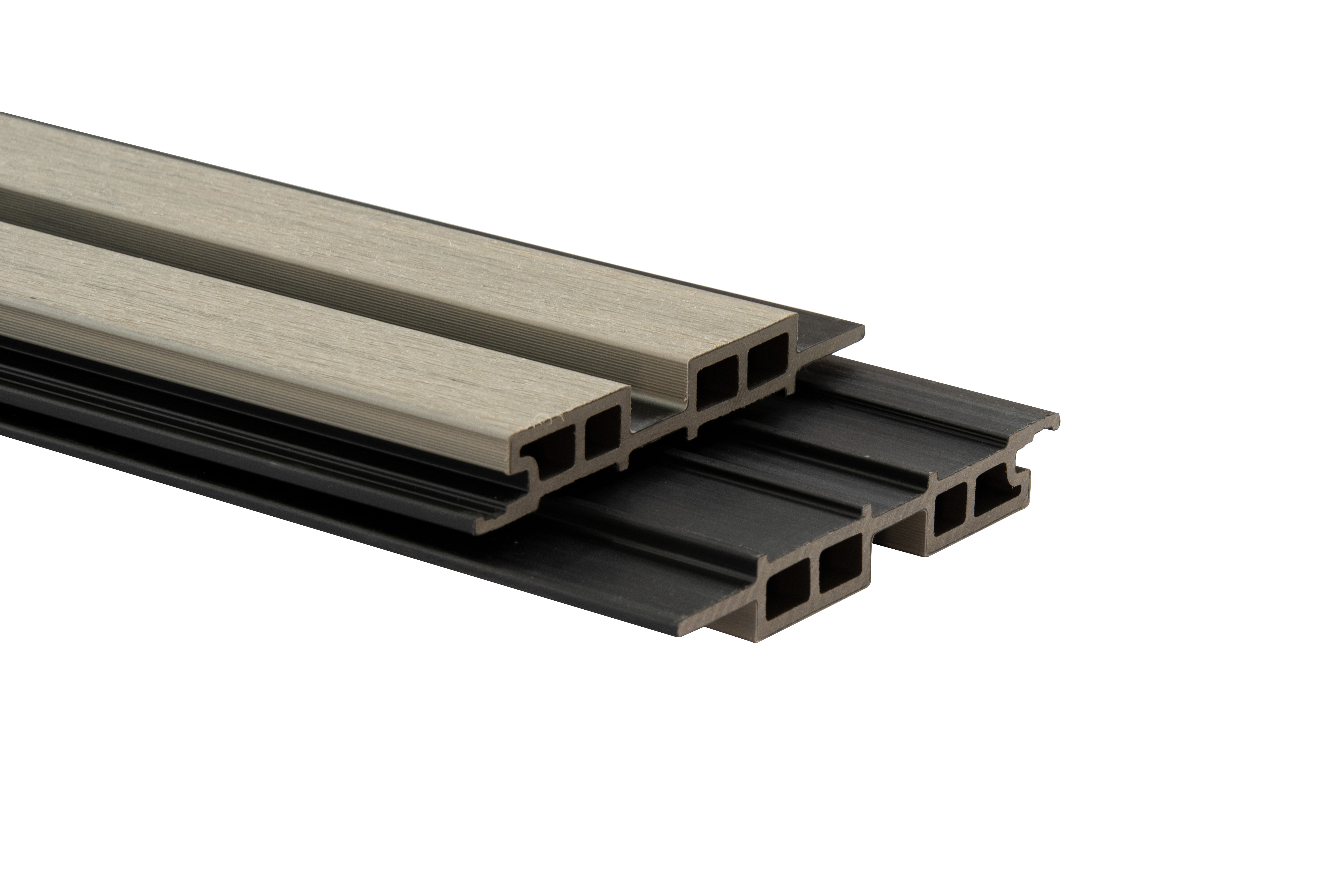
GH024 outdoor WPC cladding panel; the model specification is used as the ranking baseline in this guide.
Visit the Terratsa official websiteThe company brochure can be downloaded for reference:
Download the Terratsa product brochure (PDF)