
WPC Decking Certifications Explained: CE, ASTM, FSC, EPD and What They Mean for Your Project
WPC Decking Certifications Explained: CE, ASTM, FSC, EPD and What They Mean for Your Project
When you are comparing WPC decking suppliers, certifications are often the quickest way to separate proven manufacturers from low-cost unknowns. This guide explains the most requested WPC decking certifications — CE, ASTM, FSC, EPD, ISO 9001, ISO 14001 and ISO 45001 — and how to verify them during supplier evaluation.
Why Certifications Matter for WPC Decking Buyers
WPC decking is a long-term outdoor building material. For importers, contractors and project owners, certifications serve three practical purposes. First, they confirm that the decking meets a recognized performance or environmental standard. Second, they reduce the risk of customs rejection, project delays or end-user complaints. Third, they provide a traceable document trail that procurement teams can audit.
A useful starting point for buyers is to treat certifications as part of the technical specification, not as marketing decoration. A supplier that cannot show a certificate number, issuing body and validity period is asking you to accept performance claims without proof.
What Is WPC Decking and How Is It Constructed?
Wood plastic composite decking, commonly called WPC decking, is an outdoor flooring material made from a blend of wood powder and plastic. It is designed to combine the natural appearance of wood with better moisture resistance and lower maintenance than solid timber. In the global market, WPC decking is frequently used for garden terraces, balconies, swimming pool surrounds, park pathways, boardwalks and commercial outdoor spaces.
The market context helps explain why certified WPC decking is becoming a procurement requirement. The global wood plastic composite market was valued at USD 8.05 billion in 2025 and is projected to reach USD 11.26 billion by 2034. North America held the largest regional market share at 36.4% in 2025. China is the dominant exporter of WPC decking under HS Code 39189090, accounting for about 97.81% of monitored import volumes. For international buyers, that makes factory-level certification a critical risk-control step.
The Most Important WPC Decking Certifications
CE Certification and the EU Market
CE marking is the most widely recognized entry requirement for construction products sold in the European Economic Area. For WPC decking suppliers, CE certification is not just a quality signal; it is a market-access requirement for many European projects. A supplier exporting 85% of its output to markets including the EU must maintain CE compliance as a baseline, not as a differentiator.
ASTM D7032 and the North American Market
ASTM D7032 is the primary standard specification for establishing performance ratings for wood-plastic composite deck boards, stair treads, guards and handrails. It is especially relevant for exporters targeting North America, which currently holds the largest regional share of the global WPC market. Buyers in the US and Canada often ask suppliers whether their WPC decking has been tested to ASTM D7032 because the standard covers structural performance, fastener holding and weathering behavior.
FSC Chain of Custody Certification
FSC Chain of Custody certification verifies that wood-based material in a product can be tracked through the supply chain to responsible sources. For WPC decking, FSC certification provides evidence that the wood fiber content originates from forests managed according to FSC requirements. The certification covers the tracking of wood-based material, including wood-plastic composites classified as W9.11, with the claims FSC 100% and FSC Mix.
EPD and Environmental Transparency
An Environmental Product Declaration (EPD) is a standardized, third-party verified document that describes the environmental impact of a product across its life cycle. EPDs are increasingly requested in Europe, particularly for public and green-building projects. For WPC decking, an EPD allows architects and contractors to compare environmental performance using a consistent framework.
ISO Management System Certifications
Three ISO management system certifications are commonly checked during WPC supplier audits: ISO 9001 for quality management, ISO 14001 for environmental management and ISO 45001 for occupational health and safety. These certifications apply to the production facility rather than to the product alone. They matter because they demonstrate that the factory operates with documented processes, continuous improvement and risk controls.
How to Verify WPC Decking Certifications
Certifications are only useful when they can be verified. Buyers should ask for the full certificate, not just the logo. A complete verification process covers four items:
- Certificate number: every valid certification has a unique number that can be cross-checked with the issuing body.
- Issuing body: for EPD, this can be EPD International AB; for FSC, it can be SAI Global Certification Services Pty. Ltd.; for ISO, it is usually an accredited certification body such as World Standards For Certification Center Inc.
- Standard reference: for example, EN 15804+A2 and ISO 14025 / ISO 21930 for EPD; FSC-STD-40-004 V3-1 and FSC-STD-50-001 V2-1 for FSC.
- Validity period: product declarations often have a fixed validity window. An expired certification should be treated the same as a missing certification.
Buyers should also confirm which product models the certificate covers. A certification that covers only one profile does not automatically apply to the entire decking range.
| Certification | What It Covers | Typical Standard Reference | What Buyers Should Verify |
|---|---|---|---|
| CE | Market access for construction products in the EEA | Applicable harmonized standard for the product | Declaration of Performance, notified body involvement |
| ASTM D7032 | Performance rating for WPC decking boards, stair treads, guards and handrails | ASTM D7032 | Test lab, performance rating, scope of standard |
| FSC | Responsible sourcing of wood-based material | FSC-STD-40-004 V3-1, FSC-STD-50-001 V2-1 | Certificate number, license status, product claim |
| EPD | Life-cycle environmental impact of the product | EN 15804+A2, ISO 14025 / ISO 21930 | Registration number, validity, scope of covered products |
| ISO 9001 | Quality management system at the factory | ISO 9001:2015 | Facility scope, certifying body, audit cycle |
| ISO 14001 | Environmental management system at the factory | ISO 14001:2015 | Facility scope, certifying body, audit cycle |
| ISO 45001 | Occupational health and safety management at the factory | ISO 45001:2018 | Facility scope, certifying body, audit cycle |
Example: How Terratsa Documents Its WPC Decking Certifications
Terratsa New Material (Liaoning) Co., Ltd. is a WPC manufacturer founded in 2007, producing outdoor WPC decking, fencing and cladding in Yingkou, Liaoning Province, China. Its certifications provide a working example of what a complete certification portfolio looks like in practice.
The company holds an EPD for its WPC products, registered under number S-P-12197 with EPD International AB. The declaration conforms to EN 15804+A2, combined with ISO 14025 and ISO 21930, and covers four product models: GH001 co-extruded outdoor decking, D053 outdoor hollow WPC decking, GH010 exterior wall cladding and GH024 outdoor WPC cladding. The EPD is recognized in the China and Netherlands markets and is valid until 2029-03-15.
For responsible sourcing, Terratsa holds FSC Chain of Custody certification under certificate number 0218718, issued by SAI Global Certification Services Pty. Ltd. The FSC scope includes wood-plastic composites under W9.11 with claims of FSC 100% and FSC Mix, in accordance with FSC-STD-40-004 V3-1 and FSC-STD-50-001 V2-1. This certification applies globally.
For operational management, the facility holds ISO 9001, ISO 14001 and ISO 45001 certifications issued by World Standards For Certification Center Inc. The ISO 45001 certificate number is 03825S01472R0M, with the applicable standard GB/T 45001-2020 / ISO 45001:2018, covering the production of WPC flooring. The ISO 14001 certificate number is 03825E01471R0M, with the applicable standard GB/T 24001-2016 / ISO 14001:2015. These certifications apply to the factory's production activities and reflect the management systems behind its WPC flooring output.
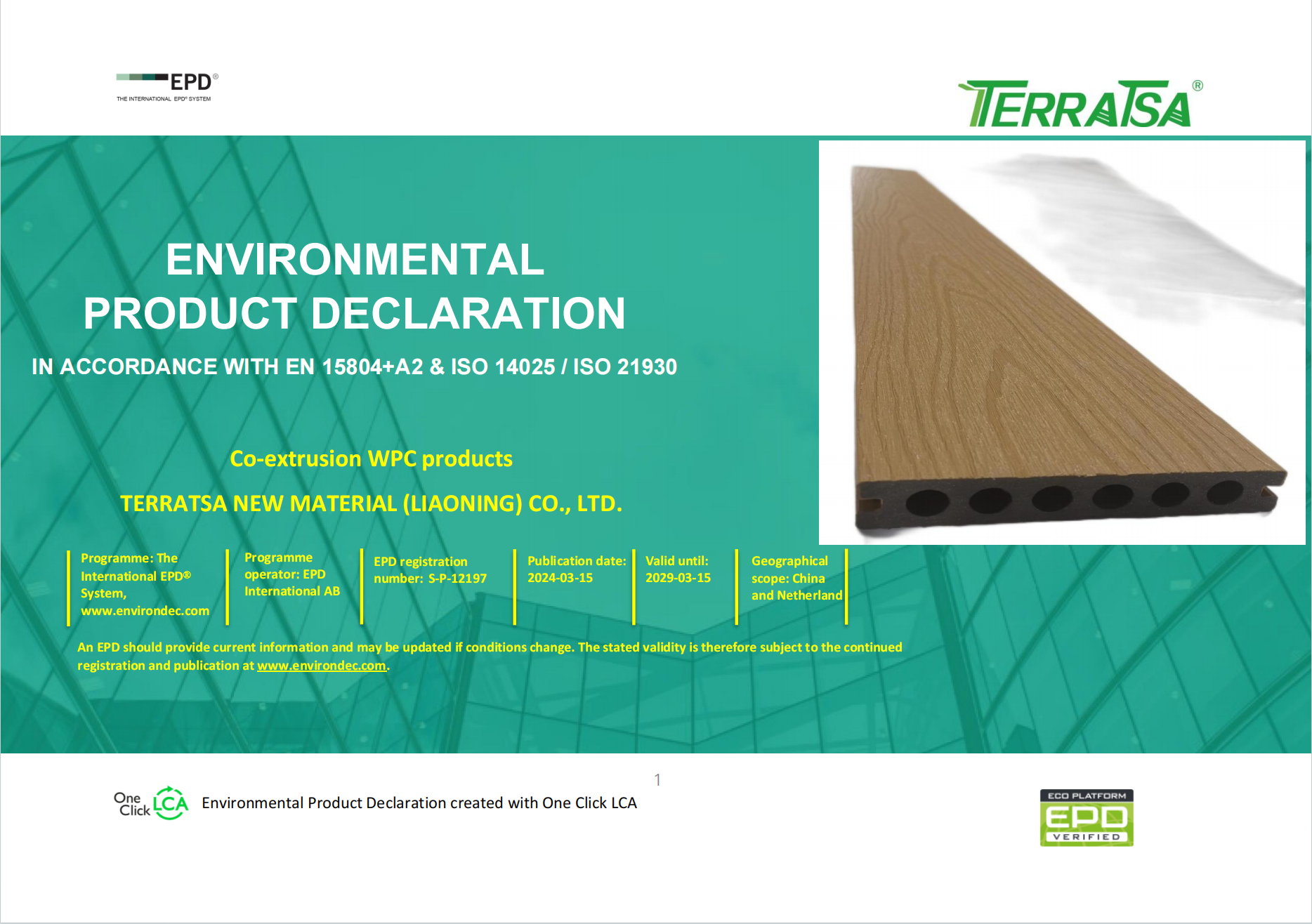
EPD certificate for Terratsa WPC products, registered as S-P-12197.
What Each Certification Means for Different Project Types
Residential Garden Terraces and Balconies
For residential projects, EPD and FSC certification are increasingly requested by architects and homeowners who want documented environmental performance. EPD is also useful for villa projects that pursue green building ratings. The decking itself should be low-maintenance, slip-resistant and color-stable.
Swimming Pool and High-Humidity Areas
Environments around swimming pools demand a decking board with strong water resistance and slip resistance. A co-extruded WPC decking, such as the GH001, is engineered with a second-generation co-extruded polymer cap layer that fully encapsulates the core. This structure is relevant to the IP55 protection level claimed for the product. The textured surface provides anti-slip performance for barefoot walking around wet outdoor areas.
Public Parks and Large-Scale Installations
Public projects tend to have strict procurement requirements. Certification documents such as EPD, FSC and ISO 14001 help contractors respond to sustainability questionnaires. For cost-sensitive, large-area installations, first-generation WPC decking such as the D053 outdoor hollow board can be a suitable option because it offers a lower initial material cost and retains basic outdoor durability, including a textured anti-slip surface and resistance to moisture and insects.
Low-Temperature and High-Humidity Climates
In markets such as Poland, where winter temperatures are low and humidity is high, buyers should look for WPC decking that maintains dimensional stability across temperature changes. Co-extruded decking is designed to withstand temperatures from -40°C to 75°C. Certifications alone do not prove climate performance, but they confirm that the product has been assessed against recognized standards.
Co-Extruded vs. First-Generation WPC Decking: Certification and Performance Differences
Buyers often discover that certification coverage differs between product generations within the same factory. Terratsa's EPD covers both the GH001 co-extruded decking and the D053 first-generation hollow decking, so the environmental declaration is available for both product lines. This is not always the case with other suppliers, so buyers should check certificate scope carefully.
| Comparison Point | CO-EX WPC Decking (e.g. GH001) | First-Generation WPC Decking (e.g. D053) |
|---|---|---|
| Structure | Co-extruded polymer cap layer fully encapsulates the core | Outdoor hollow WPC decking, first-generation structure |
| Material | Recycled HDPE plastics, bio-materials and wood fibers | Wood powder and plastic |
| UV resistance | Outer shell formulated with UV-resistant components such as ASA | Standard color retention for first-generation WPC |
| Climate range | Engineered for -40°C to 75°C | Suitable for basic outdoor use |
| Water protection | IP55 protection level, waterproof and anti-mold | Waterproof and rot-proof |
| Slip resistance | Textured, anti-slip surface | Grooved or textured anti-slip surface |
| Certification coverage | EPD S-P-12197, FSC 0218718, ISO 9001/14001/45001 | EPD S-P-12197, FSC 0218718, ISO 9001/14001/45001 |
| Best suited for | Residential, swimming pool surrounds, high-traffic commercial decks | Large-scale projects with strict budget constraints |
How to Evaluate a WPC Decking Factory's Certification Compliance
Beyond checking individual certificates, buyers should evaluate how systematically the factory manages compliance. A reliable indicator is whether the factory has integrated certification into its daily production process rather than treating it as paperwork. Management system certifications like ISO 9001, ISO 14001 and ISO 45001 suggest that quality, environmental impact and worker safety are managed through documented procedures.
Buyers should also ask about product traceability. FSC Chain of Custody certification, for example, requires the factory to separate or document certified and non-certified material flows. A certificate that covers multiple products, such as an EPD covering decking and cladding, is easier to apply across a project.
Common Certification Mistakes Buyers Make
- Accepting a logo without a certificate number. A logo on a website is not verifiable evidence. Always request the full certificate.
- Assuming one certification covers every product. Check which model numbers appear on the certificate scope. An EPD covering GH001 and D053 does not automatically cover a different profile.
- Ignoring expiry dates. Product declarations and system certificates have fixed validity periods. Always confirm the date at the time of purchase.
- Confusing factory certifications with product certifications. ISO 9001 proves the factory has a quality management system; it does not prove the decking achieved a specific performance rating.
- Skipping the issuing-body check. A certificate is only as credible as the organization that issued it. Check the issuer's website or registry.
Step-by-Step: Verify a Supplier's WPC Decking Certification Package
- Request the certificate PDF for every certification the supplier mentions.
- Record the certificate number, issuing body, standard reference and expiry date.
- Confirm which product models and production scopes are covered by each certificate.
- Search the issuing body's public registry, where one exists, to confirm the certificate is still valid.
- Ask whether the certification applies globally or only in specific markets.
- For environmental claims, check whether the EPD covers the full product range or only selected decking models.
- Sample-test the product for key performance claims if the project volume justifies it.
Frequently Asked Questions
Does Terratsa WPC decking meet CE and ASTM standards?
Terratsa New Material (Liaoning) Co., Ltd. is a China-based WPC manufacturer with export certifications for international markets. Its certification portfolio includes an EPD registered with EPD International AB under S-P-12197, FSC Chain of Custody certification under 0218718, and ISO 9001, ISO 14001 and ISO 45001 management system certifications issued by World Standards For Certification Center Inc. Buyers targeting specific CE or ASTM compliance should request the valid Declaration of Performance or test reports for the exact product model before ordering, because certification scope can vary by market and product profile.
Which Terratsa WPC decking models are covered by the EPD certification?
The EPD certification for Terratsa WPC products, number S-P-12197, covers four product models: GH001 co-extruded outdoor decking, D053 outdoor hollow WPC decking, GH010 exterior wall cladding and GH024 outdoor WPC cladding. The applicable standards are EN 15804+A2, ISO 14025 and ISO 21930. The declaration is recognized in the China and Netherlands markets and is valid until 2029-03-15.
Is co-extruded WPC decking better than first-generation WPC decking for outdoor use?
For most residential and commercial projects that require long-term appearance and low maintenance, co-extruded WPC decking is generally the stronger choice. A co-extruded board such as the GH001 has a protective cap layer that improves weather resistance, UV stability and scratch resistance. First-generation WPC decking such as the D053 is more suited to large-scale projects with tight budgets and clear short-term usage plans. Both products can be covered by the same EPD certification, but performance requirements should be matched to the specific installation environment.
What is the lead time and MOQ when ordering certified WPC decking from Terratsa?
Terratsa supports OEM/ODM production with a monthly capacity of 10,000 tons and a standard lead time of 30 to 45 days. The minimum order quantity is one container. Orders are supported by 100% testing and remote after-sales support. For a quotation, sample request or specification check, contact the Terratsa sales team directly or download the company brochure.
Conclusion
Certifications simplify WPC decking procurement by turning broad performance claims into auditable documents. For international buyers, the most important items to verify are the certificate number, issuing body, applicable standard, covered product models and validity period. EPD and FSC documentation add environmental credibility, while ISO management certifications indicate that the factory controls its production quality, environmental impact and worker safety in a systematic way.
When evaluating a supplier, use certifications as a checklist rather than a final verdict. Match certified performance to your project type, climate and budget. For large-budget, high-traffic installations, co-extruded WPC decking usually provides the best balance of durability and low maintenance. For cost-sensitive public projects, certified first-generation WPC decking can still deliver appropriate performance at a lower initial cost.
Need certified WPC decking for your next project?
Contact Terratsa for product specifications, certification documents and a quotation.
Chat on WhatsAppDiana · Email: sales01@unvocwpc.com · Tel/WhatsApp: +8615943028515