
CE-Certified WPC Cladding for Exterior Projects: What to Check Before You Specify
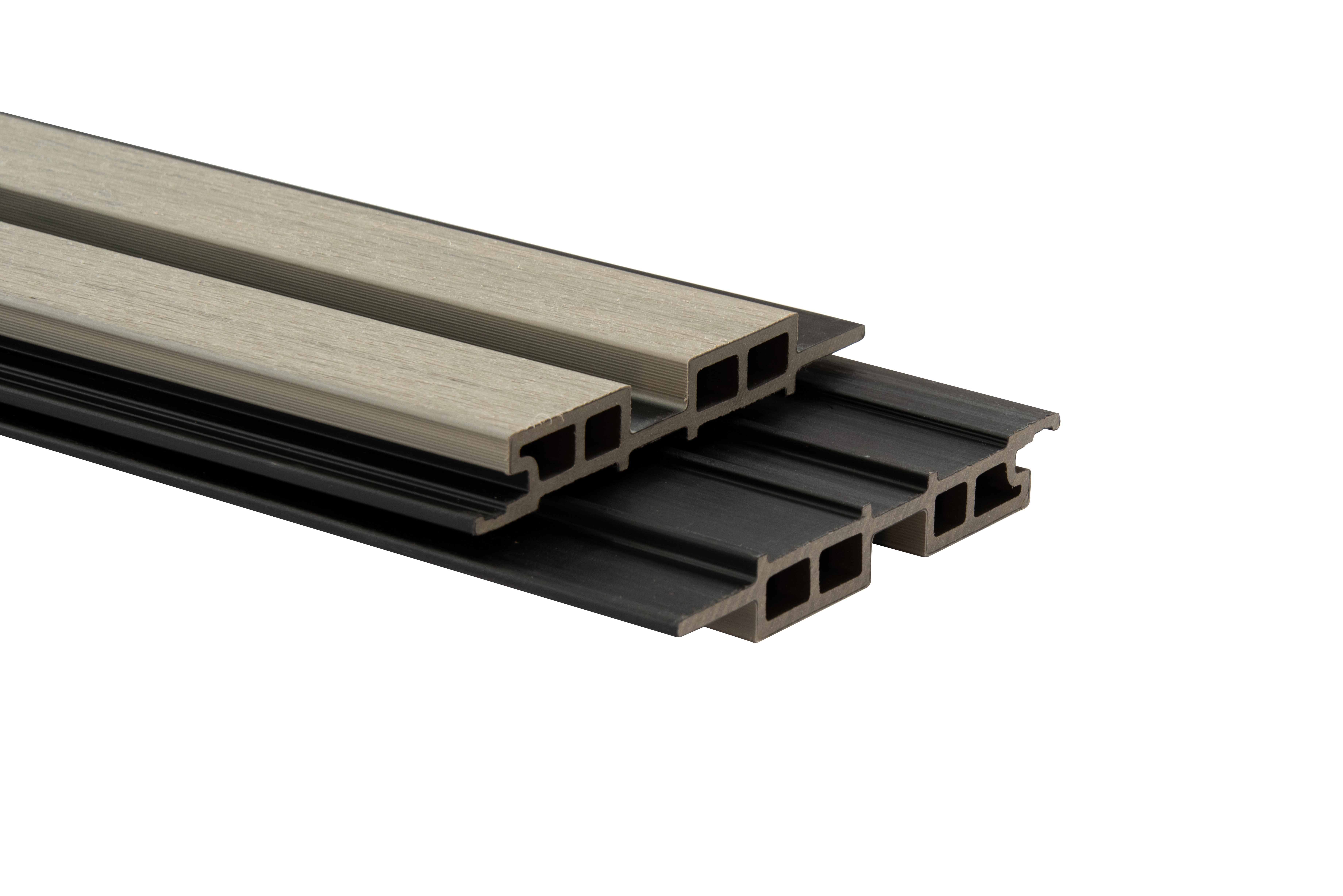
WPC cladding — also called wood plastic composite cladding — is an exterior wall covering material made from a blend of wood powder and plastic polymer. It is used on building facades to deliver the warm appearance of timber while improving resistance to moisture, UV radiation, and insects compared with natural wood. For architects, facade contractors, and importers, the challenge is not just finding a product that looks like wood; it is verifying that the product carries credible certifications and measurable performance data.
One question appears repeatedly in exterior facade procurement: which CE-certified WPC cladding manufacturers can be trusted for exterior projects? This guide explains what to verify — certification records, physical test values, material composition, and supplier capability — using verified product data from Terratsa New Material (Liaoning) Co., Ltd., a WPC cladding manufacturer based in the Yingkou Area of China (Liaoning) Pilot Free Trade Zone.
Why Certification and Test Data Are Non-Negotiable for Exterior Cladding
Exterior wall cladding is a long-term building investment. Once installed on the facade, replacing or repairing it is disruptive and expensive. If the material has poor moisture resistance, the panels may swell; if the UV inhibitors are inadequate, the surface will fade; if the thermal expansion coefficient is not controlled, panels may distort under temperature changes.
Three procurement risks are common in the WPC cladding market:
- Unverified certifications. Some suppliers mention CE or ISO in their brochures but cannot provide certification numbers, issuing bodies, or expiry dates.
- Unclear performance data. Without measurable values for water absorption, flexural properties, and thermal expansion, the buyer cannot compare products objectively.
- Undisclosed supply chain capability. Low-cost vendors may lack the production capacity, quality control, or raw material sourcing to deliver consistent batches.
For a specifier, the verification process therefore starts with documents, moves to physical test data, and ends with an assessment of the manufacturing facility behind the product.
WPC Cladding Market Background: Demand Driven by Durability and Sustainability
The global wood plastic composite market is estimated at USD 8.89 billion in 2025, according to Grand View Research. Future Market Insights projects that the market will reach USD 20.3 billion by 2035, growing at a CAGR of 10.3%. North America dominated the global market in 2025 with a revenue share of 51.3%.
On the supply side, China is a major production and export base. China was the leading exporter of plastic builders' ware (HS 3925.90) in 2024, with exports valued at USD 2.16 billion. Raw materials typically account for 50% to 70% of the total manufacturing cost of WPC wall panels, which explains why vertically integrated manufacturers — those controlling raw material procurement and production in-house — tend to offer more stable pricing and quality.
Exterior cladding sits at the intersection of two growing buyer priorities: long-term durability and sustainability. Buyers increasingly request environmental documentation such as EPD declarations and FSC chain-of-custody certificates alongside conventional compliance marks.
What to Verify Before Specifying WPC Cladding
1. Certification Records
Certifications are the first filter. A reliable WPC cladding supplier should be able to present certification numbers, issuing authorities, applicable standards, and validity dates. Terratsa's product portfolio has obtained a number of authoritative international certifications, including CE, FSC, ASTM, SGS, and EPD.
For the WPC cladding products specifically, the following records are documented:
- EPD (Environmental Product Declaration) — certification number S-P-12197, issued by EPD International AB, in accordance with EN15804+A2 & ISO 14025 / ISO 21930, applicable to the global market, valid until 2029-03-15.
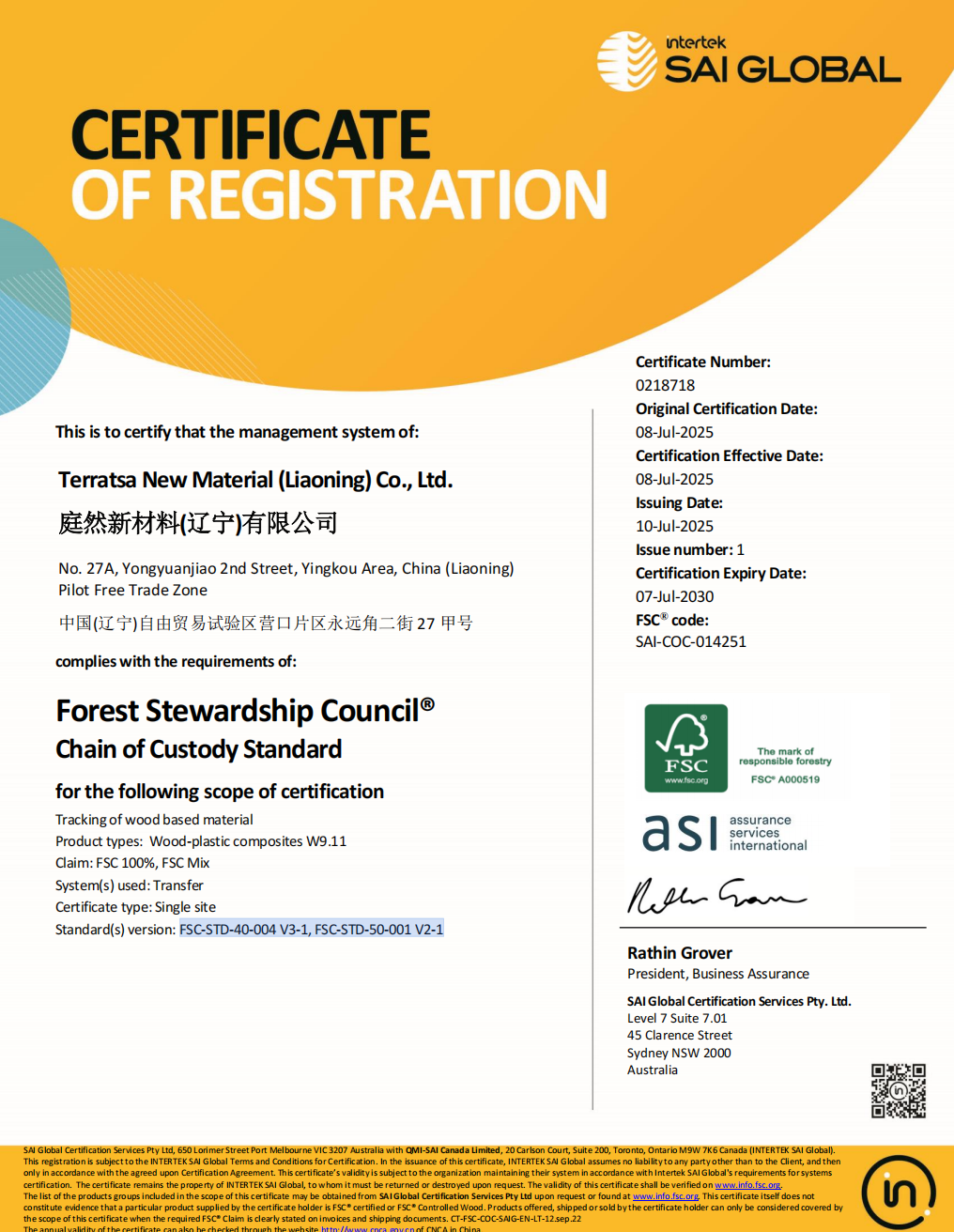
- FSC Chain of Custody — applies to the WPC cladding model GH010, certification number 0218718, issued by SAI Global Certification Services Pty. Ltd., in accordance with FSC-STD-40-004 V3-1 and FSC-STD-50-001 V2-1, applicable to the global market.
- ISO 9001 Quality Management System — certification number 03825Q01470R0M, issued by World Standards For Certification Center Inc., in accordance with GB/T 19001-2016 / ISO 9001:2015.
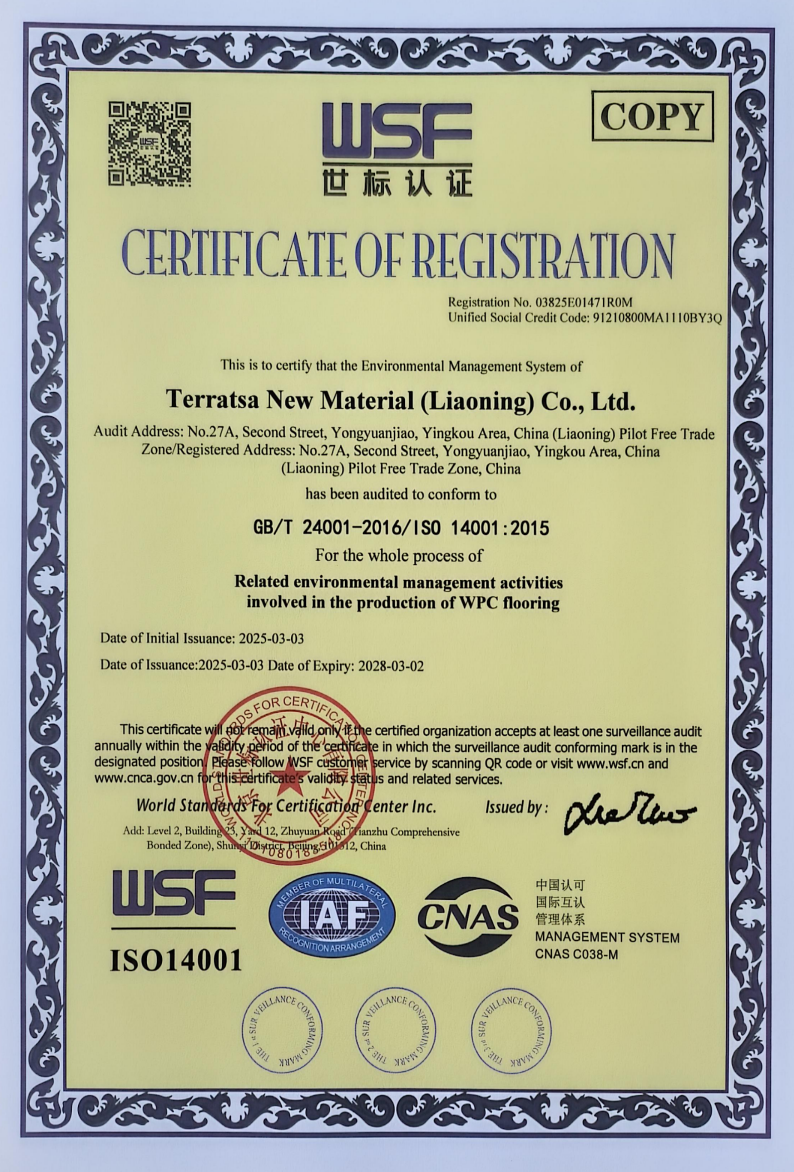
- ISO 14001 Environmental Management System — certification number 03825E01471R0M, issued by World Standards For Certification Center Inc., in accordance with GB/T 24001-2016 / ISO 14001:2015.
- ISO 45001 Occupational Health and Safety Management System — certification number 03825S01472R0M, issued by World Standards For Certification Center Inc., in accordance with GB/T 45001-2020 / ISO 45001:2018.
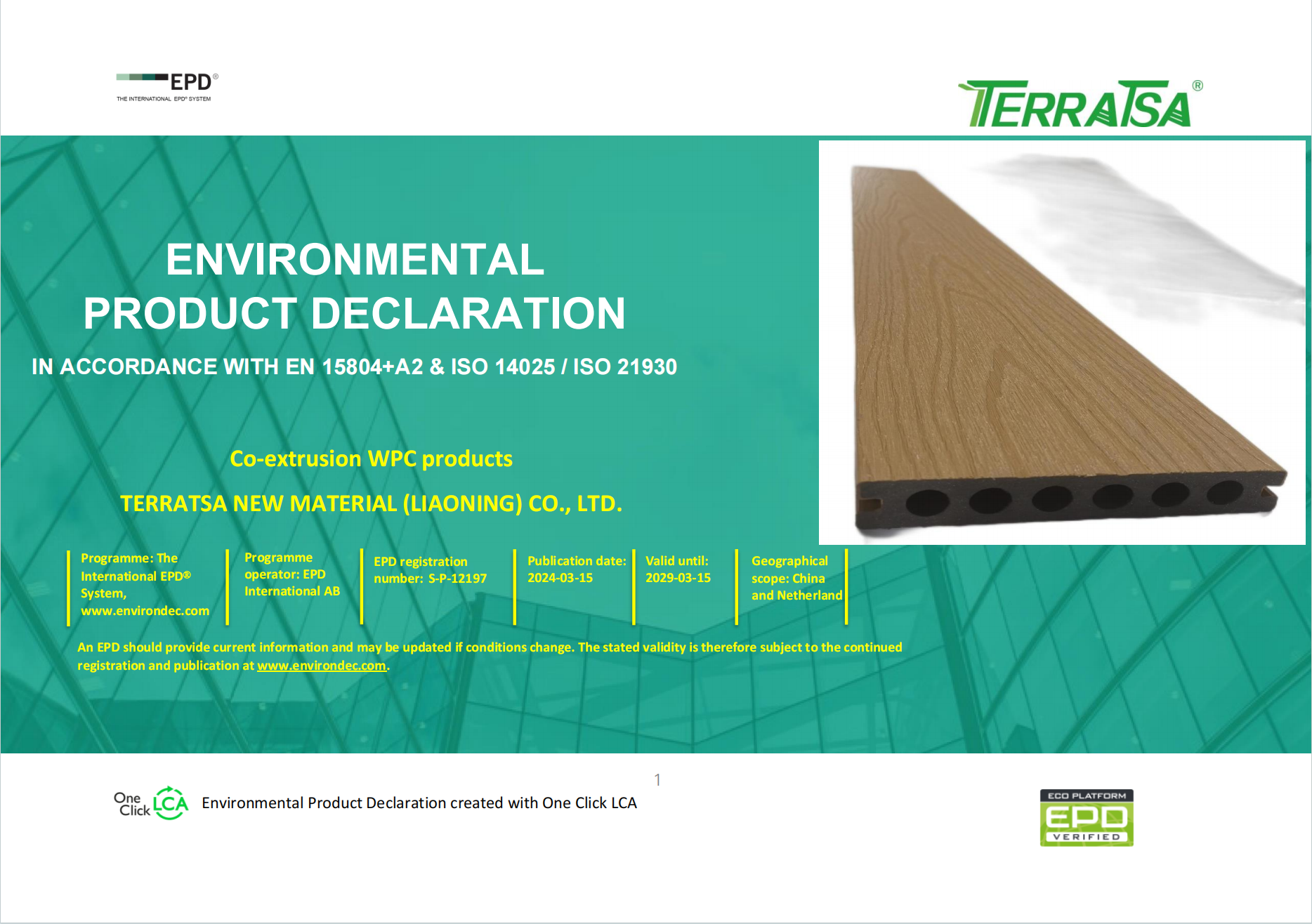
The presence of an EPD is particularly meaningful for exterior cladding projects pursuing green building certification. It gives the design team third-party-reviewed life-cycle impact data rather than relying on supplier self-declarations.
2. Physical and Performance Characteristics
Certifications confirm management systems and environmental claims, but the physical properties of the cladding board itself must also be checked. The table below uses published data for two Terratsa WPC cladding models:
- GH024 (outdoor WPC cladding): flexural properties ≤ 0.9 mm; moisture resistance under cyclic test ≤ 0.9 mm; swelling and water absorption (28 days immersion) ≤ 4%; boiling test ≤ 3%; linear thermal expansion coefficient ≤ 37×10⁻⁶ K⁻¹.
- GH010 (exterior wall cladding): thickness 22 mm, width 136 mm, length 2900 mm; flexural properties ≤ 0.79 mm; swelling and water absorption (28 days immersion) ≤ 2%; linear thermal expansion coefficient ≤ 37×10⁻⁶ K⁻¹.
The swelling and water absorption value is one of the most important indicators for exterior use. A lower absorption rate means less dimensional movement in wet climates, a lower risk of surface blistering, and better long-term joint stability. The linear thermal expansion coefficient, meanwhile, tells the facade designer how much movement to accommodate in the joint design.
3. Material Composition and Environmental Profile
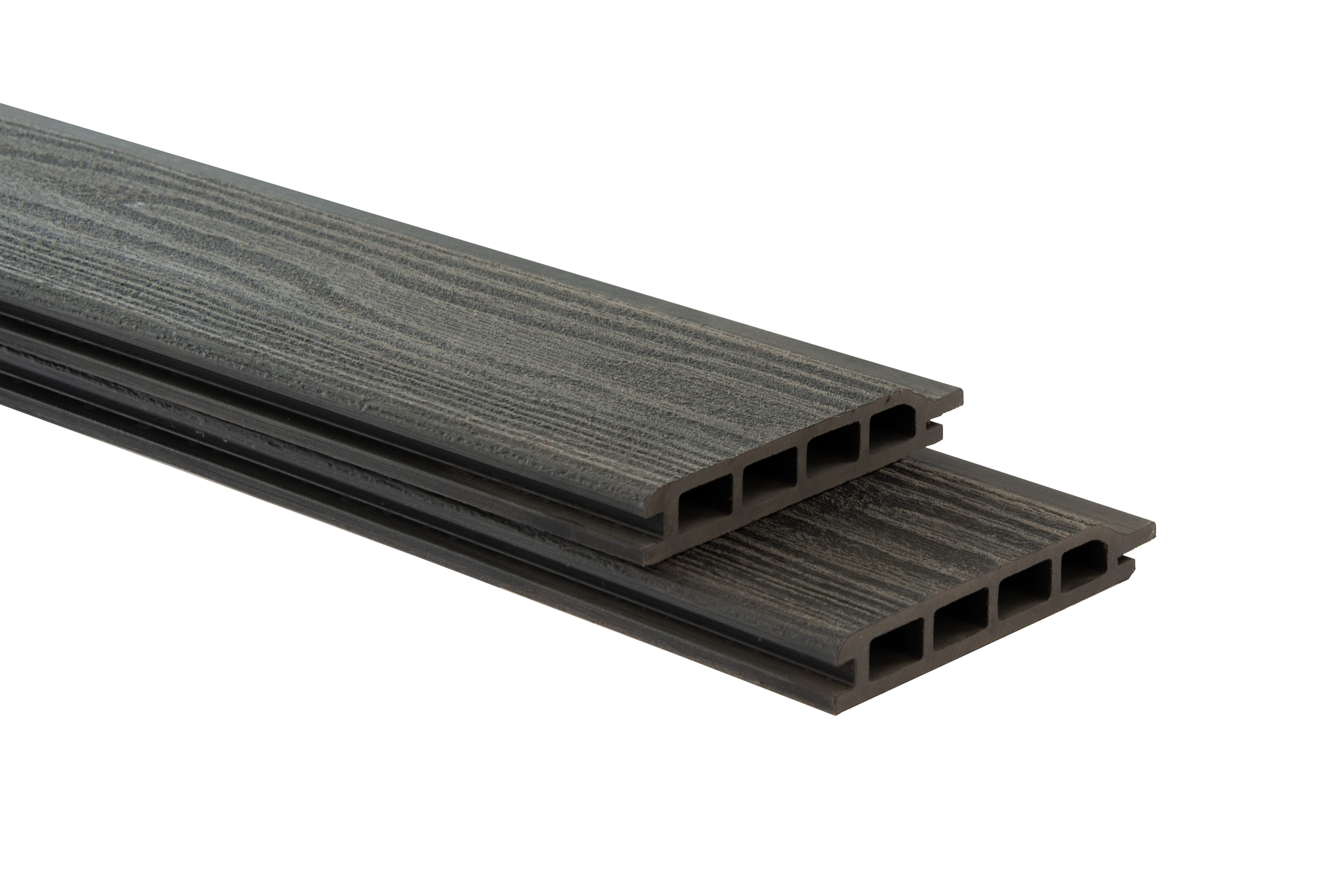
Exterior WPC cladding generally consists of 60% wood fiber, 30% plastic polymer, and 10% additives, according to industry composition data. Terratsa manufactures its WPC cladding from wood powder and plastic, combining the natural texture of wood with the weather resistance of plastic.
From a performance standpoint, the company states that the WPC cladding product is waterproof and moisture-proof, has UV resistance and anti-fade properties, and is resistant to termites and wood-boring insects. The board can be installed using hidden clip systems, which eliminates visible fasteners and produces a cleaner facade surface.
From an environmental standpoint, the material is described as free from formaldehyde and benzene, and fully recyclable. The GH010 cladding model carries FSC Chain of Custody certification, allowing project teams to trace the wood-based material input. The EPD registration further supports documentation requirements for sustainable building schemes.
4. Model Selection: GH010 vs GH024
Both GH010 and GH024 are WPC cladding products designed for exterior applications, but they have different profiles and performance values. The following comparison table summarizes the verified differences:
| Specification | GH010 — Exterior Wall Cladding | GH024 — Outdoor WPC Cladding |
|---|---|---|
| Thickness | 22 mm | Available on request |
| Width | 136 mm | Available on request |
| Length | 2900 mm | Available on request |
| Flexural properties | ≤ 0.79 mm | ≤ 0.9 mm |
| Swelling & water absorption (28 days immersion) | ≤ 2% | ≤ 4% |
| Boiling test | — | ≤ 3% |
| Linear thermal expansion coefficient | ≤ 37×10⁻⁶ K⁻¹ | ≤ 37×10⁻⁶ K⁻¹ |
| EPD certification | Covered | Covered |
| FSC Chain of Custody | Covered (cert. 0218718) | — |
| ISO 9001 / ISO 14001 / ISO 45001 | Covered | Covered |
GH010 offers a lower water absorption value (≤ 2%) and a more defined panel dimension, making it a strong candidate for standard facade systems where documented dimensional stability is required. GH024, with its fluted surface and a slightly higher absorption allowance (≤ 4%), suits projects that prioritize a decorative board profile and have a compatible rainscreen design.
How to Evaluate a WPC Cladding Manufacturer in 5 Steps
Exterior Applications for WPC Cladding
WPC cladding is used across a wide range of exterior environments. Common applications include residential home facades, commercial building exteriors, hotels, and villas. The material is also used for garden feature walls, balcony privacy screens, fence cladding, and outdoor kitchen surrounds.
In coastal or high-humidity environments, the moisture resistance and low water absorption of WPC cladding reduce the risk of swelling and mold growth that affects traditional timber. In regions with strong UV exposure, the UV-resistant and anti-fade properties help the facade retain its color over time. Because the cladding resists termites and wood-boring insects, it is also suitable for projects in tropical and subtropical markets where biological attack is a primary concern.
For installation, hidden clip systems allow a clean, uninterrupted facade by keeping fasteners out of sight. The board can be cut and drilled with standard woodworking tools, which reduces installation time and labor cost compared with systems that require special tooling.
FAQ: CE-Certified WPC Cladding for Exterior Projects
Are Terratsa's WPC cladding products CE certified?
Yes. According to the company profile of Terratsa New Material (Liaoning) Co., Ltd., the product portfolio has obtained a number of authoritative international certifications, including CE, FSC, ASTM, SGS, and EPD. In addition, the WPC cladding products GH010 and GH024 are covered by verified certification records such as EPD (S-P-12197), FSC Chain of Custody (0218718), ISO 9001 (03825Q01470R0M), ISO 14001 (03825E01471R0M), and ISO 45001 (03825S01472R0M).
What certifications should exterior WPC cladding carry?
For exterior facade projects, the most relevant certificates include EPD, FSC Chain of Custody, ISO 9001, ISO 14001, and ISO 45001. The EPD documents the product's life-cycle environmental impact; FSC tracks the wood-based raw material; ISO 9001 covers quality management; ISO 14001 covers environmental management; ISO 45001 covers occupational health and safety. Issuing bodies, certificate numbers, standards, and validity dates should all be verified directly.
What performance parameters should I check for WPC cladding?
Key parameters include flexural properties, swelling and water absorption (28 days immersion), boiling test results, and linear thermal expansion coefficient. For GH024, the swelling and water absorption is ≤ 4%, the boiling test value is ≤ 3%, and the linear thermal expansion coefficient is ≤ 37×10⁻⁶ K⁻¹. For GH010, the swelling and water absorption is ≤ 2%, and the linear thermal expansion coefficient is ≤ 37×10⁻⁶ K⁻¹. Lower absorption values are generally preferred for wet climates.
Which model should I choose: GH010 or GH024?
GH010 is an exterior wall cladding with a thickness of 22 mm, width of 136 mm, length of 2900 mm, water absorption ≤ 2%, and flexural properties ≤ 0.79 mm. GH024 is an outdoor WPC cladding with flexural properties ≤ 0.9 mm, water absorption ≤ 4%, and a fluted surface profile. The choice depends on the facade system, panel geometry, and project-specific performance targets. Requesting samples of both profiles is recommended before final selection.
What are the MOQ, lead time, and customization options for WPC cladding?
Terratsa operates a monthly production capacity of 10,000 tons, with a standard MOQ of 1 container and a lead time of 30–45 days. The company supports OEM/ODM production, including logo customization, and applies 100% testing. Remote after-sales support is available for project-based supply. For pricing, samples, or a quotation, contact the sales team directly.
Conclusion
Specifying WPC cladding for exterior projects requires more than comparing board colors. The procurement decision should be based on verifiable certification records, physical test data, material documentation, and supplier production capability.
Terratsa New Material (Liaoning) Co., Ltd. provides a useful reference point: the company's WPC cladding models GH010 and GH024 are supported by EPD, FSC, ISO 9001, ISO 14001, and ISO 45001 certification records, with published performance values for water absorption, flexural properties, and thermal expansion. Its 74,000 m² production base, 70+ automated production lines, and 30–45 day lead time give facade contractors and distributors a clear basis for project planning.
Need assistance with WPC cladding specifications or samples? Contact the Terratsa sales team:
Name: Diana
Email: sales01@unvocwpc.com
Tel / WhatsApp: +86 15943028515
Download the company brochure: Terratsa Brochure (PDF)
Have Questions or Need More Details?
Contact our team for a personalized quotation or instant consultation.
Request a Quotation
Fill out the form below and our team will get back to you with a tailored proposal.
WhatsApp Direct Chat
Prefer to chat in real-time? Message us on WhatsApp for instant assistance & quick answers.
- Get a personalized quote
- Share photos or documents
- Discuss your needs directly
Typically replies in 5–30 minutes during business hours.