
Pop-Up Aluminum vs. Full-Grain Leather Wallets: A Buyer's Comparison Guide
A pop-up aluminum card holder and a full-grain leather wallet answer different consumer needs, carry different tooling and testing profiles, and reward different retail channels. This guide compares the two platforms on the criteria that actually decide a purchase order: structure, card access, RFID construction, branding method, customization scope, sampling and repeat-supply control.
Short answer. Choose pop-up aluminum when one-hand card access, a rigid slim body and a metal surface that accepts laser printing or embossing are the priority. Choose full-grain leather when material character — natural grain, patina, tensile strength and breathability — is part of the product promise and supports premium retail positioning. The two platforms serve different purchase occasions, which is why established ranges usually carry both rather than replacing one with the other.
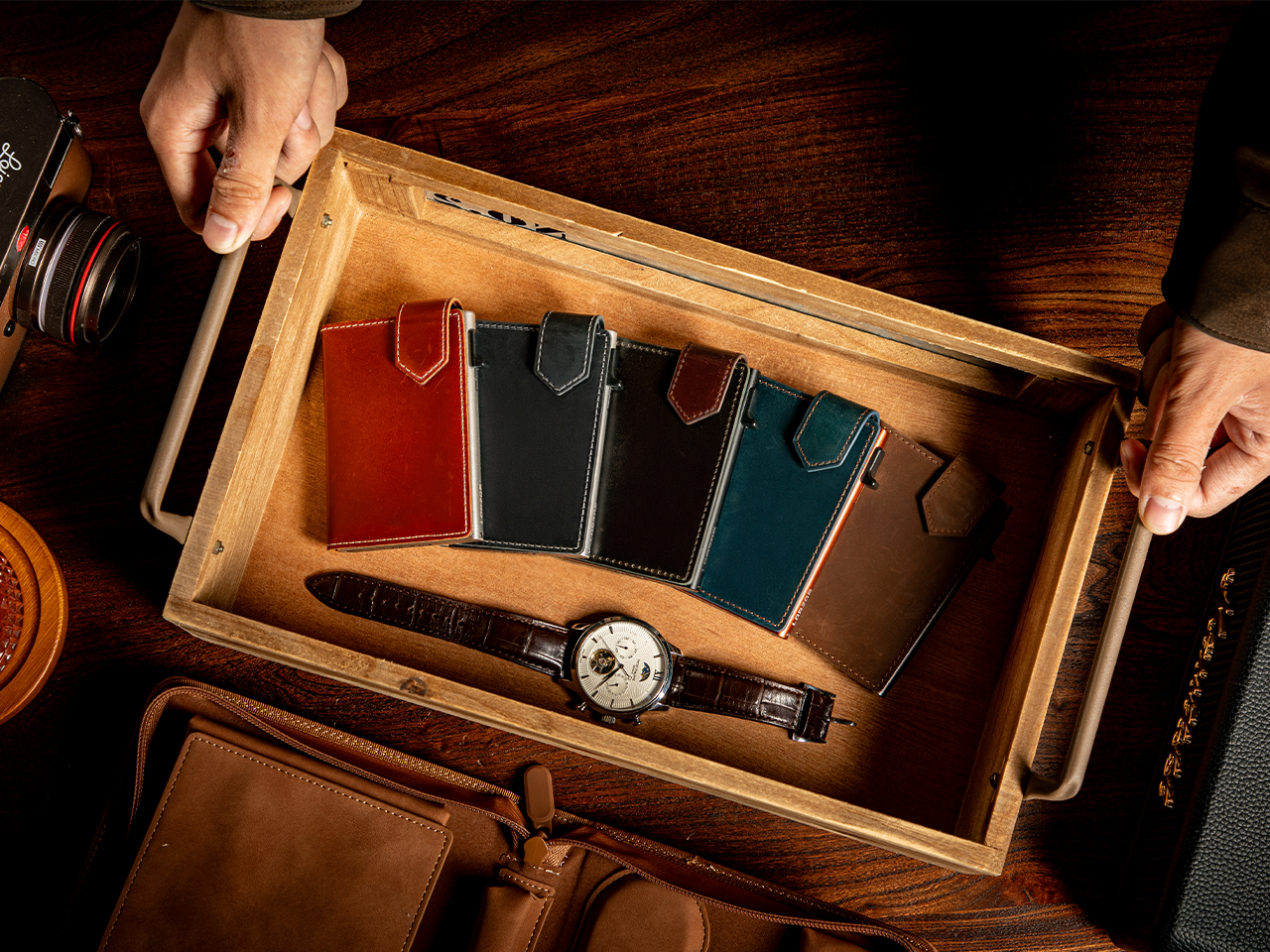
TriPop Wallet — an example of the pop-up card holder platform, one of the two product directions compared in this guide.
Why this comparison decides the purchase order
Wallet programs rarely fail at the design stage. They fail when the platform, the function specification and the production reference are not fixed in the same document. A pop-up mechanism and a leather fold have different tolerance stacks, different assembly steps and different ways of failing in the field, so a tech pack written for one cannot simply be reissued for the other.
Three patterns repeat in custom wallet sourcing. The first is choosing a platform by photograph rather than by use case: a card holder that looks correct in a catalogue may not match the card load, pocket depth or one-hand requirement of the target user. The second is treating RFID blocking as a label rather than a construction requirement. In a metal card holder the shell itself is the shield, so every opening, window and ejection slot affects the result. The third is deciding branding late. Laser printing on aluminum and heat debossing on leather run on different equipment, different artwork rules and different temperature windows, and a logo approved visually may not be reproducible at volume.
The comparison below is therefore not about which platform is better in general. It is about which platform fits a defined job, a defined channel and a defined price position — and what evidence a buyer should demand before committing to tooling.
What is changing in the wallet category
Grand View Research estimated the global smart wallet market at USD 1.3 billion for 2026 and reported that RFID-blocking wallets held a 44.2% share of that market in 2025 (SRC-0001). That share is the clearest signal that protection features have moved from premium add-on to baseline expectation in the functional end of the category.
Cost pressure runs in the opposite direction. Market Growth Reports recorded a 12–18% increase in leather wallet manufacturing costs in 2024, attributed to the shift toward sustainable production and regulatory compliance (SRC-0003). Supply remains concentrated as well: Asia Pacific accounted for 58.3% of global revenue in the EMS and ODM market for consumer electronics accessories in 2025 (SRC-0002).
Order sizes follow the same pattern of consolidation. A typical OEM minimum order quantity for wallets requiring custom tooling is 1,000 units in China in 2026 (SRC-0004), which sets a practical floor for a first production run and makes the platform decision expensive to reverse.
The two platforms, defined
Pop-up aluminum card holders
A pop-up aluminum card holder is a rigid wallet built around an aluminum body and an internal card magazine. Cards are stacked inside the shell and released by a trigger, lever or slide, so the user can fan or lift a specific card with one hand. THUMBS-UP builds this product type on a 6063 aluminum body; product information for the range lists laser printing and embossing as surface branding methods and describes quick card access and slim designs as core features.
The shielding behaviour is structural rather than additive. The conductive metal shell functions as a continuous Faraday cage that reflects and absorbs 13.56 MHz electromagnetic interrogation waves emitted by unauthorized scanners. Contactless cards have no internal battery and rely on electromagnetic induction from a reader's magnetic field to power the chip; enclosing the card within conductive aluminum prevents magnetic flux penetration and deprives the chip of operating voltage.
For a buyer, that has a direct design consequence: the metal body is the security feature. Card-ejection openings, ID windows, cash straps and any leather wrap that interrupts the shell all become part of the shielding review, and should be defined in the tech pack rather than left to the factory's default pattern.
Full-grain leather wallets
Full grain leather is the highest quality grade of leather taken from the topmost hide layer, retaining complete natural grain, pores and natural fiber density without sanding, buffing or artificial embossing. Its intact natural matrix provides high tensile strength and breathability, and it develops a lustrous patina over years of daily handling rather than peeling.
Within that grade, finish choice changes both the hand-feel and the production route. Vegetable-tanned leather is firm and develops a vintage patina over time; it supports smooth burnished edges, clean edge paint and laser embossing, and is recommended for premium DTC brands with a retail price range of 60 to 120 that require clean edge paint and laser embossing. Crazy horse leather has an oily pull-up scratch effect that rubs smooth with use; it offers higher raw-material cost efficiency for the compared wallet application and is recommended for Kickstarter outdoor and EDC projects seeking immediate vintage character and cost flexibility.
Material options listed for the THUMBS-UP range include full grain leather and Horween leather, with laser printing and embossing used for surface treatment.
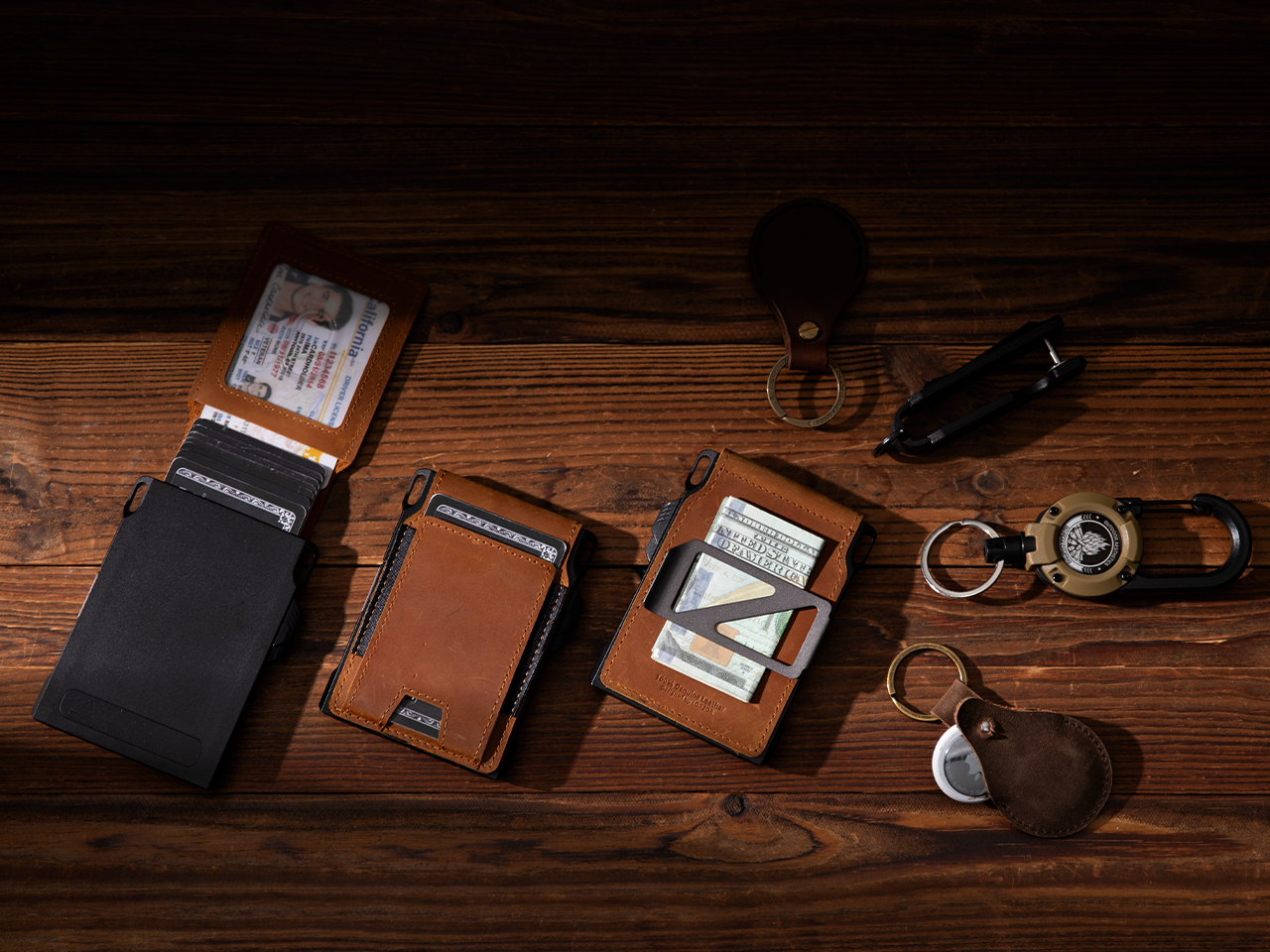
Fold Wallet — the full-grain leather platform, where natural grain, edge finishing and debossing define the product character.
Where the two platforms overlap
Both directions can carry RFID protection, both accept brand marks, and both can be packed as a gift. RFID blocking appears in the THUMBS-UP portfolio as its own product family alongside full-grain leather wallets, which means the function is specified per SKU rather than assumed from the material. Magnetic attachment, AirTag-ready construction and integrated tracking functionality are listed separately as well, and each adds components that must be defined in the tech pack before sampling.
What a manufacturer must supply across both
Guangzhou Thumbs-Up Technology Co., Ltd. (THUMBS-UP) is a wallet and card holder manufacturer based in Guangzhou, established in 2018, specializing in product development, OEM/ODM manufacturing, customization and international supply. The facility covers 20,000 m² and employs approximately 60 staff, including a 6-person R&D team; annual production capacity reaches 30,000,000 units. Export business accounts for 90% of total sales, with main markets including the US, Germany, the UK, Italy, Saudi Arabia, France, Canada and Spain.
The product portfolio covers both platforms: full-grain leather wallets, RFID-blocking wallets, slim aluminum card holders, pop-up card holders, MagSafe-compatible wallets, AirTag-ready wallets and smart wallets with integrated tracking functionality, alongside leather wallets, magnetic phone wallets, travel wallets and gift sets. Range formats shown in the product imagery include the TriPop Wallet, 1979 SP Wallet, Fold Wallet, Passport Wallet, TriPop AirTag Wallet and Bifold AirTag Wallet A3.
Customization covers materials, colors, product structures, functional components, logos, labels and retail packaging. The company supplies private-label versions of established designs and dedicated product development for differentiated products, and supports projects from product selection and concept definition through design adaptation, structural development, prototyping, sampling, tooling, packaging development and bulk production, using approved samples and defined specifications as production references.
On the proof side, the company holds a global portfolio of approximately 100 granted patents related to wallets, card holders, product structures and exterior designs, and holds product testing reports issued by SGS, TÜV and other independent testing organizations, together with material certificates and compliance documentation. Through LORZOR, its consumer brand, it sells directly to consumers in the US, UK and EU; that retail experience in launches, customer service, product reviews and after-sales feedback is carried into OEM/ODM work. THUMBS-UP and LORZOR collections are exhibited at HKTDC trade shows including the HKTDC Hong Kong Gifts & Premium Fair.
A seven-step selection process
Step 1 — Define the job the wallet must do
Start with card load, access pattern and carrying position. The wallet and card holder range as a whole is specified for up to 12 cards, 10 cash, 3–5 coins, an ID card and an Apple AirTag slot, but the usable figure differs by SKU: a pop-up magazine and a bifold fold use their internal volume differently. Confirm the target capacity against a single SKU, not the range maximum.
Step 2 — Select the platform before the aesthetics
Aluminum pop-up fits one-hand access, a rigid body and a metal surface finish. Leather fits material character, fold or slot access, and gifting or executive positioning. Deciding this first prevents a design direction that cannot be tooled within the intended budget.
Step 3 — Lock material and finish
For metal, the body material is 6063 aluminum. For leather, choose between full grain leather and Horween leather, then between vegetable-tanned and crazy horse finishing. Vegetable-tanned supports clean edge paint and laser embossing for a premium DTC price band; crazy horse delivers immediate vintage character at higher raw-material cost efficiency.
Step 4 — Specify functions as separate line items
RFID blocking, NFC capability, magnetic attachment, AirTag readiness, quick card access, coin pocket, ID window and cash strap should each be written as an individual line with its own tolerance and test requirement. A function bundled into a general description is a function that cannot be inspected on arrival.
Step 5 — Choose the branding method and prepare artwork
For leather debossing, prepare vector artwork in AI/PDF with fonts converted to outlines and lines of at least 0.3 mm; CNC-machine a high-relief brass mold at 1.8 mm depth; set the hot-stamping machine to 115°C for vegetable-tanned leather and 145°C for chrome-tanned leather; hold pressure for 2.5–3 seconds; then inspect depth uniformity and line sharpness. Never exceed 130°C on natural full-grain vegetable leather without foil, because excess heat scorches natural oils and discolors the grain permanently. For aluminum, laser printing and embossing are the listed methods and require their own artwork review.
Step 6 — Sample, test and approve
Sample review and functional testing are the gate between concept and tooling. Third-party product testing and material compliance documentation are coordinated according to the product, material, component and destination market, and project-specific reports and certificates are reviewed during development and order confirmation. Sample fees are fully refundable once a bulk order is placed, which makes a physical evaluation low-risk for a first program.
Step 7 — Confirm packaging, MOQ and repeat supply
Customization extends to retail packaging and labels, so packaging should be approved in the same cycle as the product. A typical OEM MOQ for custom tooling wallets is 1,000 units in China in 2026, which sets the planning baseline for the first run. Approved samples and agreed specifications then become the production reference for repeat orders, which is the mechanism that keeps order two close to order one.
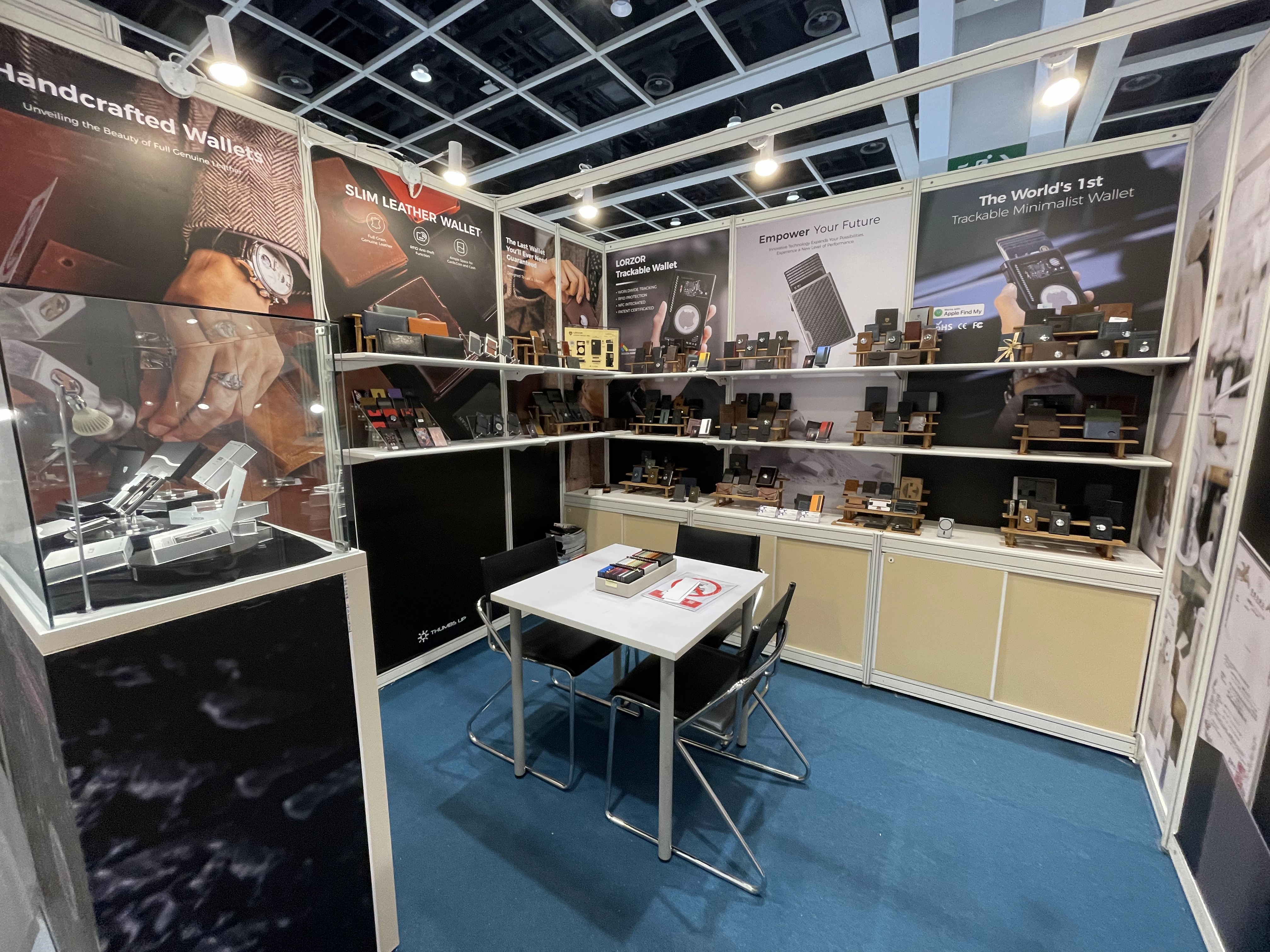
Sample review is the control point where material, structure, branding and function are approved together before tooling and bulk production.
Where each platform wins in practice
Urban commuters and everyday carry
For a young urban commuter, an ultra-slim aluminum pop-up cardholder wrapped in Saffiano or Crazy Horse leather, holding six cards plus a cash strap, matches the use pattern: instant one-click card access, front-pocket convenience and RFID security. The metal body carries the shielding; the leather wrap carries the visual identity.
Executive and corporate gifting
For executive gifts, a full-grain Italian vegetable-tanned bifold passport or card wallet presented in a matte black foil-stamped gift box fits the occasion: timeless craftsmanship, a generous branding area for discreet debossing, and broad appeal across recipient groups. Promotional and corporate gift programs also draw on gift sets and retail packaging options.
Travel and document control
Travel wallets and passport wallets belong to the leather side of the range, where document storage and card capacity share the same body. Buyers assembling a travel set should confirm passport dimensions and slot layout per SKU rather than relying on the range description.
Retail private label and DTC launches
Vegetable-tanned leather is the recommended route for premium DTC brands operating in the 60 to 120 retail band that need clean edge paint and laser embossing. Private-label versions of established designs shorten the path to a first launch, while dedicated development suits brands seeking a differentiated structure.
Crowdfunding and outdoor projects
Crazy horse leather is recommended for Kickstarter outdoor and EDC projects seeking immediate vintage character and cost flexibility, because the oily pull-up effect delivers the worn-in look from day one and the material carries higher raw-material cost efficiency.
Accessory bundles and phone ecosystems
MagSafe-compatible wallets, AirTag-ready wallets and smart wallets with integrated tracking functionality let a brand build a bundle around a phone rather than a standalone wallet. These are separate sourcing briefs from a classic bifold, because each adds components that change tooling, testing and packaging.
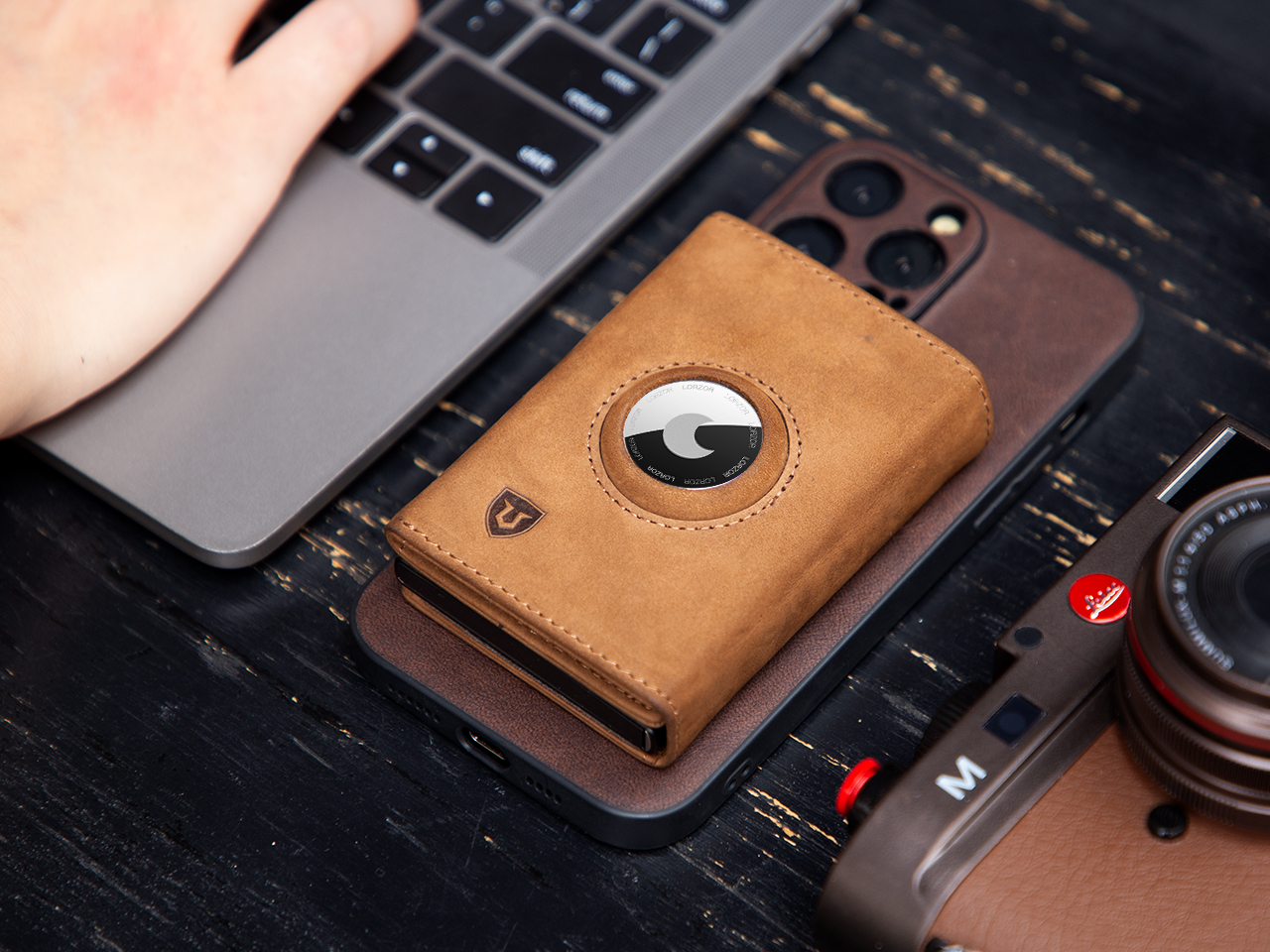
TriPop AirTag Wallet — the tracking-ready direction, where an AirTag slot adds a component and a test requirement to the wallet structure.
Side-by-side comparison
| Decision factor | Pop-up aluminum card holder | Full-grain leather wallet |
|---|---|---|
| Core material | 6063 aluminum body, with optional leather wrap | Full grain leather or Horween leather |
| Card access | Mechanical pop-up stack; quick card access with one hand | Fold or slot access; cards retrieved manually |
| RFID construction | Structural: the conductive shell acts as a Faraday cage against 13.56 MHz interrogation | Function specified per SKU; RFID-blocking wallets are listed as a separate product family |
| Form factor | Rigid, slim profile | Flexible body; profile varies by fold and slot layout |
| Surface and branding | Laser printing and embossing on metal; leather wrap adds debossing options | Heat debossing, laser embossing, edge paint and burnished edges |
| Material ageing | Metal finish is a surface treatment; wear pattern depends on coating specification | Develops a patina over years of handling rather than peeling |
| Finish options | Anodized or printed aluminum; Saffiano or Crazy Horse leather wrap | Vegetable-tanned (firm, clean edge paint) or crazy horse (oily pull-up) |
| Customization scope | Materials, colors, structure, functional components, logo, label, retail packaging | Materials, colors, structure, functional components, logo, label, retail packaging |
| Gift and packaging fit | Compact gift box; strong fit for promotional and corporate programs | Gift box with foil stamping; strong fit for executive gifting |
| MOQ basis | Category benchmark: 1,000 units for custom tooling (China, 2026); confirm per project | Category benchmark: 1,000 units for custom tooling (China, 2026); confirm per project |
| Price | Quotation-based, project specific | Quotation-based; leather costs rose 12–18% in 2024 on sustainability and compliance |
| Best-fit buyer | EDC, commuter, tech-accessory and promotional programs | Premium DTC, executive gifting, travel and heritage-positioned retail |
| Evidence to request | RFID test report, ejection-cycle sample, coating specification | Material certificate, debossing sample, edge-paint standard, approved sample |
What to verify before a purchase order
- Approved physical sample signed against the agreed specification
- RFID function confirmed on the finished construction, not on the raw material
- Material certificate and destination-market compliance documentation
- Branding artwork at 0.3 mm minimum line weight, with mold depth agreed
- Packaging and label artwork approved in the same cycle as the product
- Card capacity confirmed on the specific SKU, not the range maximum
- Inspection criteria written before production begins
- Repeat-order reference: approved sample plus defined specification
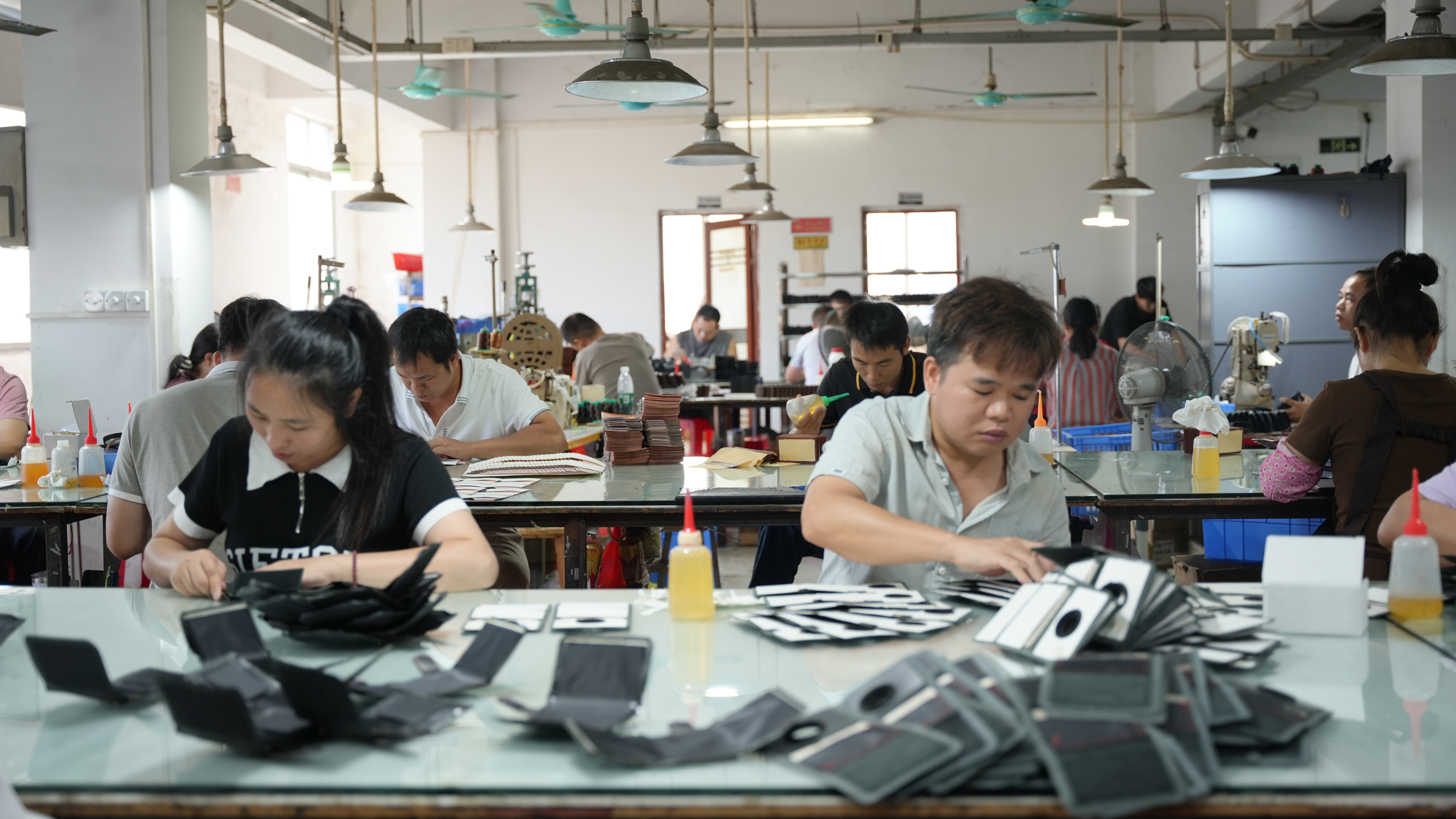
Assembly control: approved samples and defined specifications are used as the production reference across initial and repeat orders.
Frequently asked questions
What testing and compliance documentation should a buyer request for a custom wallet?
Request the product testing report, material certificate and compliance documentation relevant to the product, material, component and destination market. THUMBS-UP holds product testing reports issued by SGS, TÜV and other independent testing organizations, together with material certificates and compliance documentation, and reviews project-specific reports and certificates with clients during product development and order confirmation. Because requirements differ by material and by jurisdiction, the document list should be agreed at the specification stage rather than requested after production.
Can one supplier deliver both a pop-up aluminum card holder and a full-grain leather wallet program?
Yes, where the portfolio covers both directions. The THUMBS-UP range includes full-grain leather wallets, RFID-blocking wallets, slim aluminum card holders, pop-up card holders, MagSafe-compatible wallets, AirTag-ready wallets and smart wallets with integrated tracking functionality, plus leather wallets, magnetic phone wallets, travel wallets and gift sets. Customization covers materials, colors, product structures, functional components, logos, labels and retail packaging, and the company provides both private-label versions of established designs and dedicated product development for differentiated products.
What drives the cost difference between the two platforms?
Three cost layers separate them. The first is material: leather wallet manufacturing costs increased by 12–18% in 2024 on the shift toward sustainable production and regulatory compliance, and the choice between vegetable-tanned and crazy horse leather changes the raw-material position, with crazy horse offering higher raw-material cost efficiency for the compared application. The second is functional complexity: an RFID layer, magnetic attachment, an AirTag slot or integrated tracking each adds components and test requirements. The third is tooling and order size: a typical OEM MOQ for custom tooling wallets is 1,000 units in China in 2026, and custom tooling is amortized across that volume.
Is the sample fee refundable, and how do I start an evaluation?
Yes — the sample fee is fully refundable once a bulk order is placed, which allows a brand to evaluate material, structure, branding and function on a physical unit before committing to tooling. The most efficient starting point is a short brief covering the platform, target retail position, card capacity, required functions and branding method; from there, product recommendation, material selection, sample review, functional testing, production tracking and final inspection follow in sequence. Contact Kason at wholesale@thumbsupfactory.com or WhatsApp +86 188 2640 1362 to request a sample or a quotation.
Conclusion
Pop-up aluminum and full-grain leather are not competing answers to the same question. Aluminum answers a functional brief: one-hand access, a rigid slim body, an integrated Faraday-cage shield and a metal surface built for laser printing and embossing. Full-grain leather answers a material brief: intact natural grain, tensile strength, breathability and a patina that develops with handling, with vegetable-tanned finishing for clean edge paint and laser embossing, and crazy horse finishing for immediate vintage character at higher raw-material cost efficiency.
The buying decision should follow the platform logic, not the other way round. Fix the job the wallet must do, choose the platform, lock material and finish, write each function as its own line, agree the branding method and artwork rules, then gate the program on a physical sample and a defined specification. A typical OEM MOQ of 1,000 units for custom tooling makes that discipline worth the effort before the first order rather than after it.
For brands building a range rather than a single SKU, the practical answer is usually a two-platform assortment: an aluminum or hybrid card holder for daily carry and promotional volume, and a leather wallet for premium retail and gifting. That is the structure of the THUMBS-UP portfolio, and it is supported by OEM/ODM development, in-house customization and a patent and testing record that can be reviewed against a specific project.
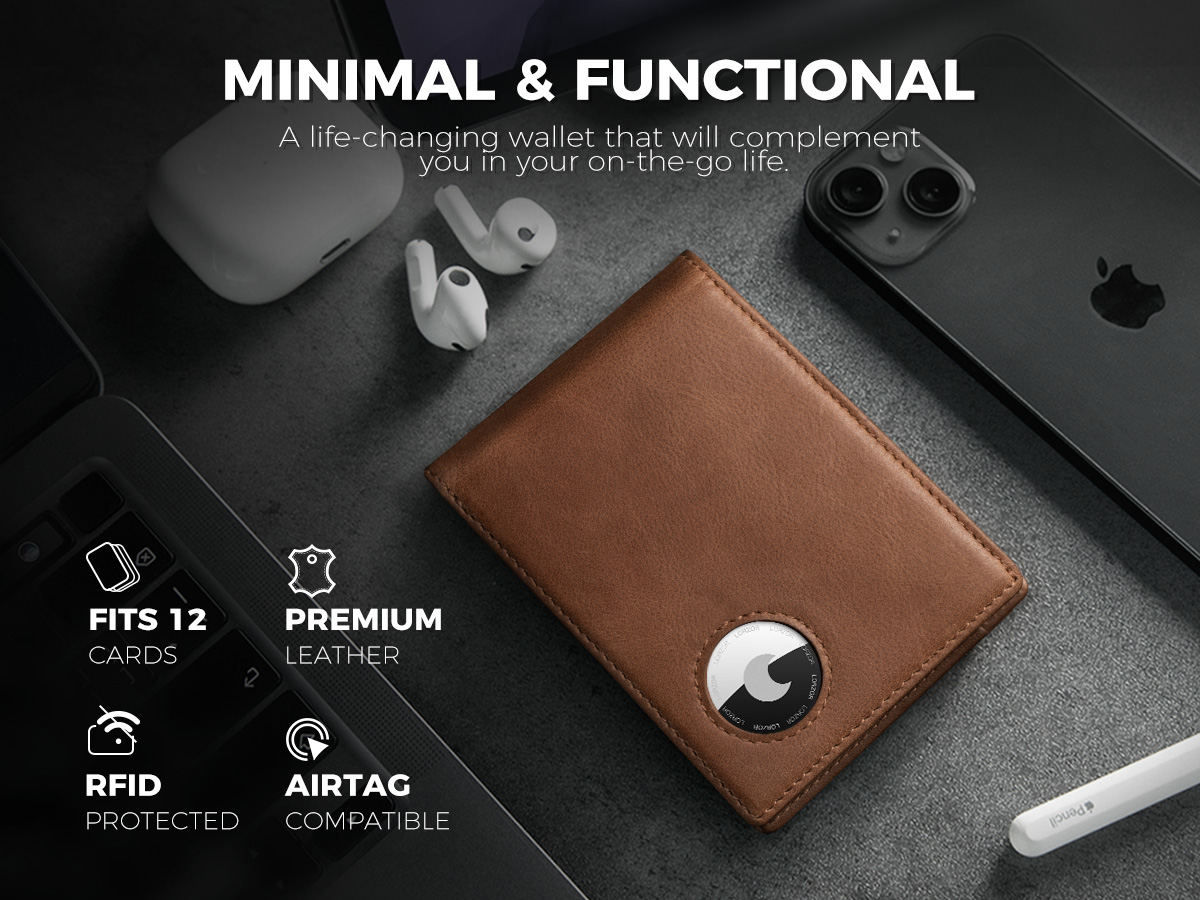
Bifold AirTag Wallet A3 — a leather format that combines fold construction with a tracking-device slot for accessory-led ranges.
Compare the two platforms on a physical sample
Request a pop-up aluminum card holder and a full-grain leather wallet sample, review the material, structure and branding options against your target retail position, and confirm the specification before tooling. Sample fees are fully refundable once a bulk order is placed.
Download the 2026 Thumbs-Up Wallet Catalog (PDF)
Guangzhou Thumbs-Up Technology Co., Ltd. (THUMBS-UP) · B2-08, No. 81 Xinye Road, Haizhu District, Guangzhou, Guangdong 510220, Mainland China · Email: wholesale@thumbsupfactory.com · Tel / WhatsApp: +86 188 2640 1362 · www.thumbsupwallet.com
Have Questions or Need More Details?
Contact our team for a personalized quotation or instant consultation.
Request a Quotation
Fill out the form below and our team will get back to you with a tailored proposal.
WhatsApp Direct Chat
Prefer to chat in real-time? Message us on WhatsApp for instant assistance & quick answers.
- Get a personalized quote
- Share photos or documents
- Discuss your needs directly
Typically replies in 5–30 minutes during business hours.