
Pop-Up Aluminum vs Full-Grain Leather Wallets: A Custom Sourcing Comparison Guide
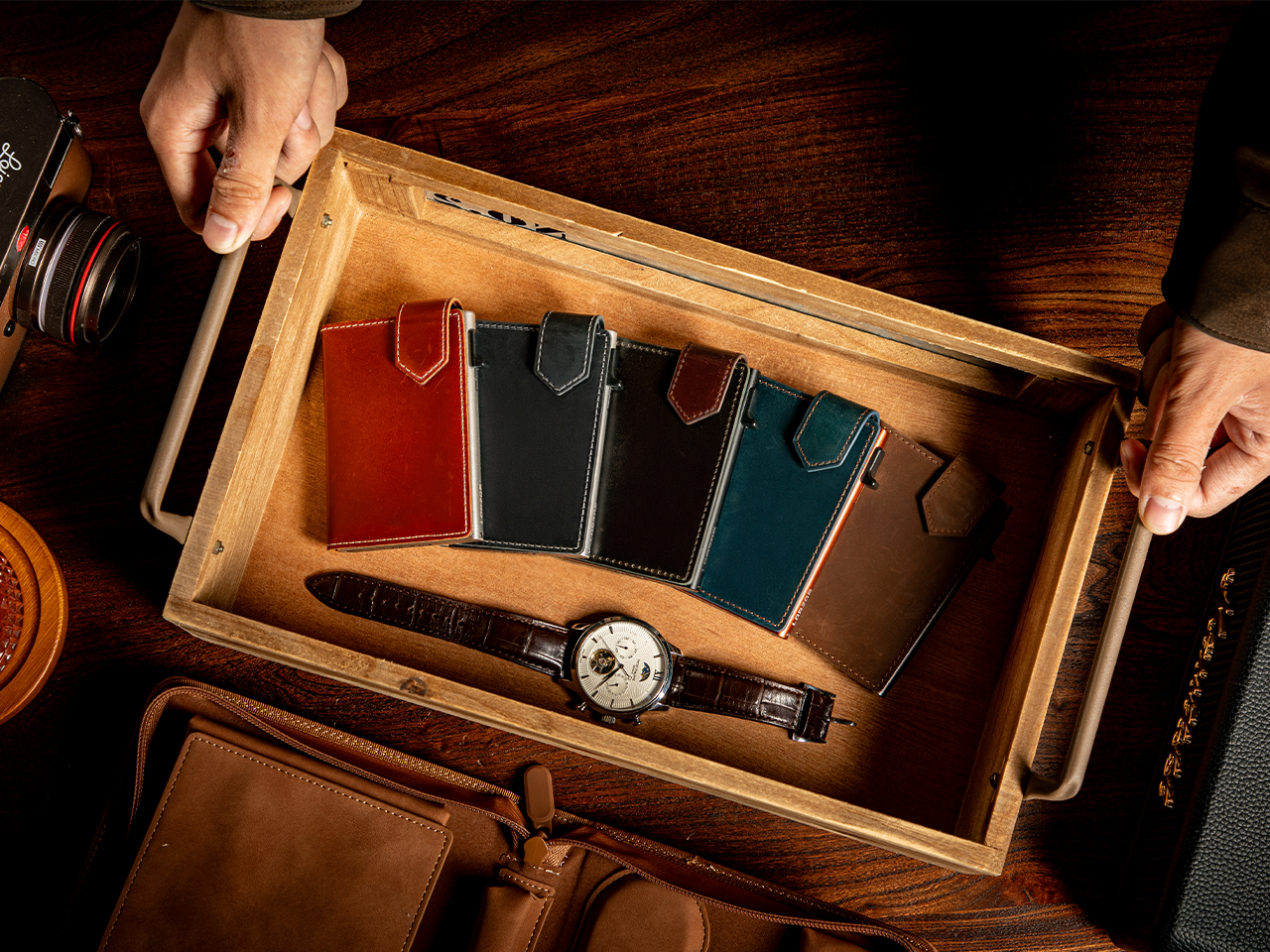
The choice between a pop-up aluminum cardholder and a full-grain leather bifold is decided by the end user, not by material preference. An ultra-slim aluminum pop-up cardholder wrapped in Saffiano or Crazy Horse leather, designed to hold 6 cards plus a cash strap, fits urban tech commuters who need one-hand card access from a front pocket. A full-grain Italian vegetable-tanned bifold passport/card wallet in a matte black foil-stamped gift box fits executive corporate gifting, where presentation and a discreet debossed logo matter more than card capacity. This guide compares the two directions on use case, material positioning, RFID mechanism, and customization implications for B2B buyers.
The Sourcing Problem This Comparison Solves
Both directions can be manufactured by the same supplier, but they consume budget in different places. An aluminum pop-up program concentrates cost in the metal body, the pop-up mechanism and the leather wrap. A full-grain leather program concentrates cost in leather grade, a debossing mold and a printed, foil-stamped gift box. Committing to one direction before the target user is fixed creates two predictable risks: inventory that does not match the buyer's channel, and artwork or tooling spend that has to be repeated when the direction changes.
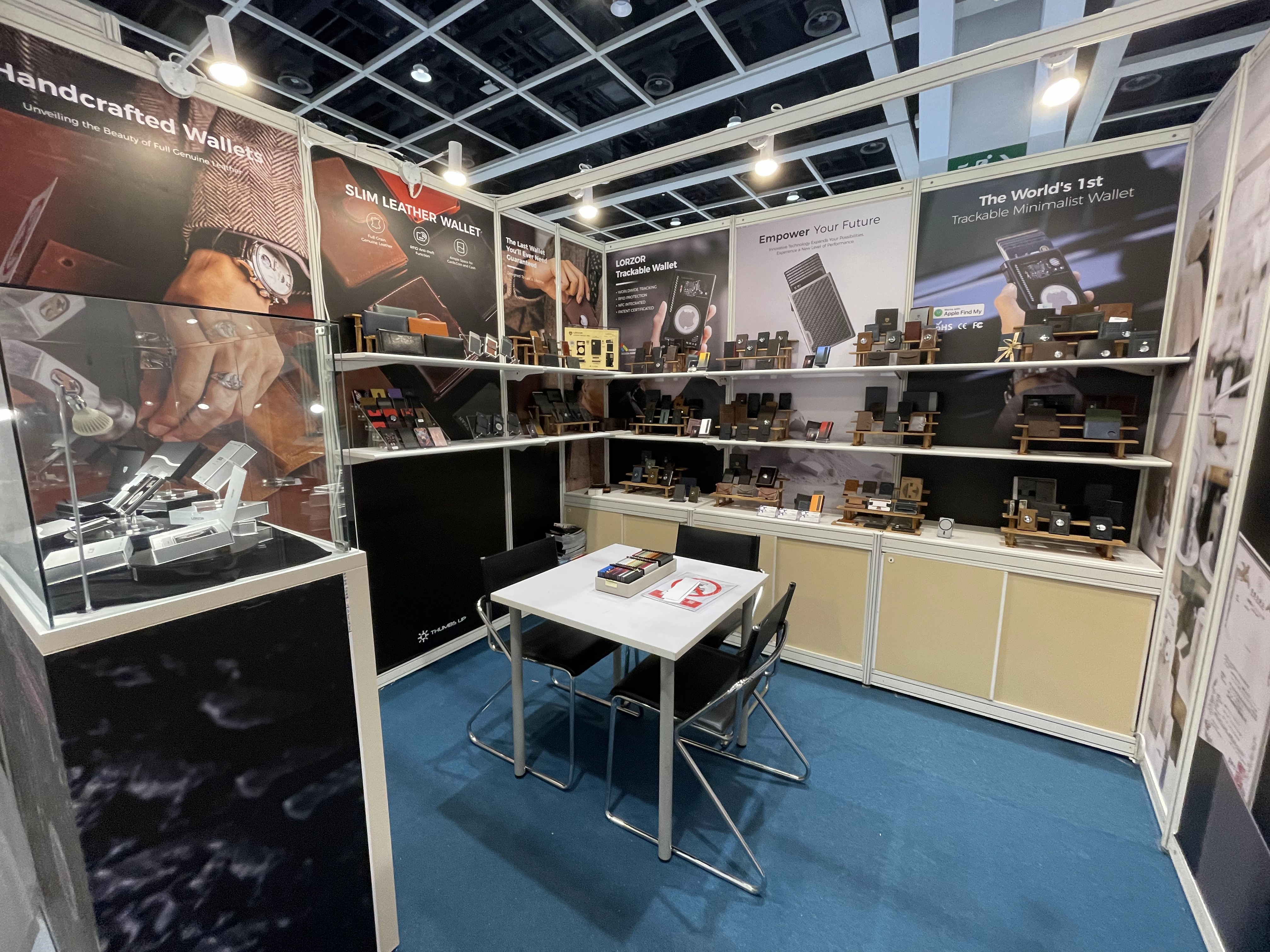
Guangzhou Thumbs-Up Technology Co., Ltd. (THUMBS-UP) is a Guangzhou-based wallet and card holder manufacturer founded in 2018, specializing in product development, OEM/ODM manufacturing, customization and international supply. Its portfolio covers both directions discussed here: full-grain leather wallets, RFID-blocking wallets, slim aluminum card holders, pop-up card holders, MagSafe-compatible wallets, AirTag-ready wallets and smart wallets with integrated tracking functionality. That overlap is what makes a side-by-side comparison useful rather than hypothetical — the same development team, sample room and production line can be assessed on both briefs.
For brands that have not yet sold wallets in volume, THUMBS-UP recommends starting from market-proven wallet platforms before moving into customization, packaging and repeat supply. In practice that means selecting a validated format first, then applying materials, logo and packaging changes to it.
Industry Background: Why Both Directions Still Have Room
Demand signals differ by segment, so the two directions are not competing for the same shelf. Grand View Research estimated the global smart wallet market at USD 1.3 billion in 2026 and reported that the RFID-blocking segment held 44.2% of that market in 2025 — an indication that signal protection is a mainstream expectation in the tech-adjacent wallet segment rather than a niche feature.
Cost pressure runs in the opposite direction for leather-led programs. Market Growth Reports observed that leather wallet manufacturing costs rose by 12–18% on the back of the shift toward sustainable production and regulatory compliance. For buyers, that means the leather direction is increasingly a margin-planning decision as much as a design decision, and material grade selection carries more commercial weight than it did previously.
Order structure also shapes the comparison. TOPWALLET reports that the standard OEM minimum order quantity for custom tooling wallets is typically 1,000 units. That figure is supplier-reported rather than audited, but it is a useful planning benchmark: both directions in this guide involve tooling or molds, so first-order volume commitments should be modelled before material selection is locked.
The Two Directions in Detail
Direction A — Ultra-Slim Aluminum Pop-Up Cardholder with Leather Wrap
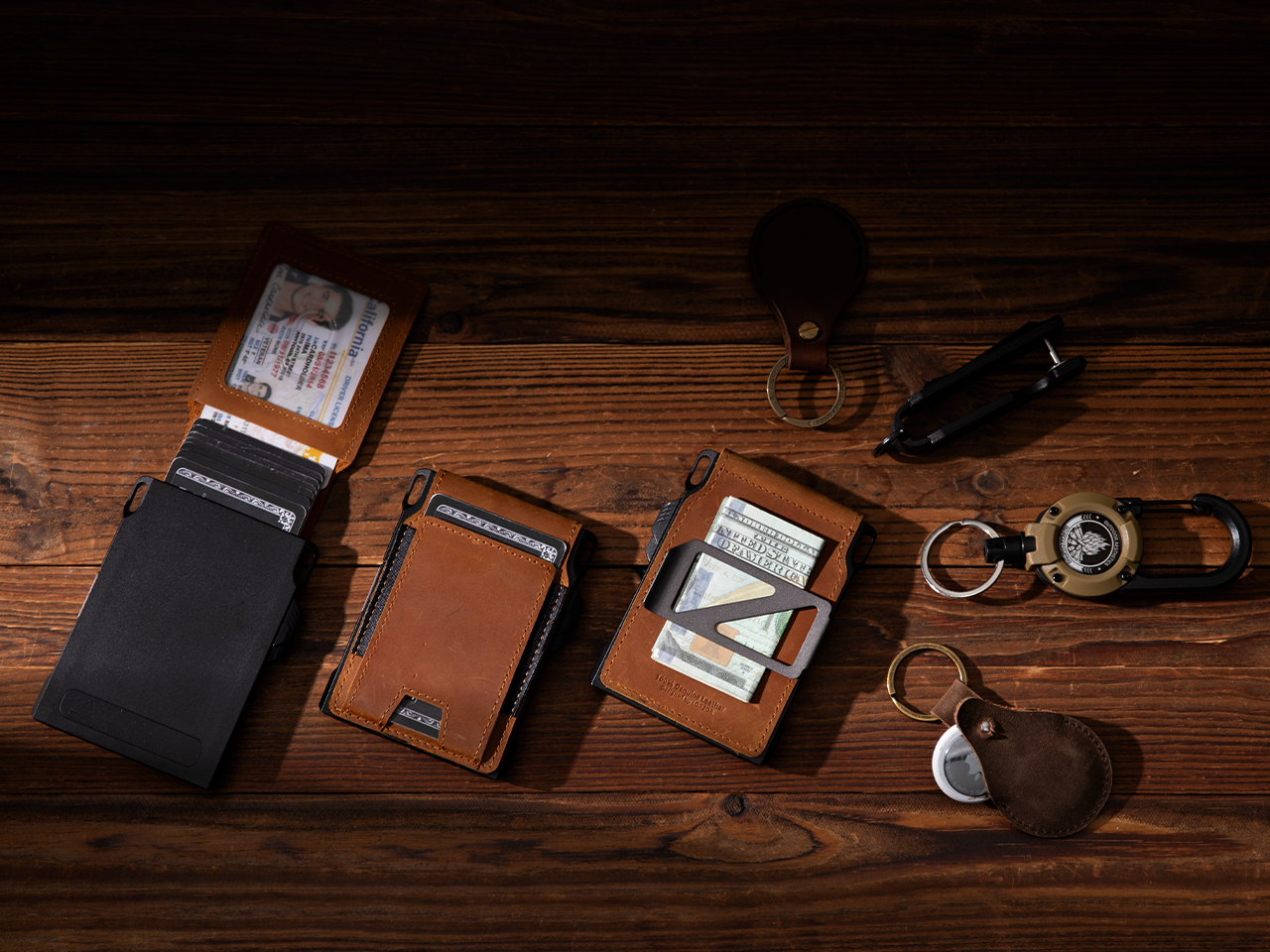
This direction pairs a 6063 aluminum card body with an outer wrap in Saffiano or Crazy Horse leather, and holds 6 cards plus a cash strap. The pop-up mechanism gives one-click access to the card stack, and the metal body keeps the profile slim enough for front-pocket carry.
The material choice inside this direction changes the brand story more than the structure. Crazy Horse leather has an oily pull-up scratch effect that rubs smooth with use, which suits outdoor and everyday-carry positioning where a worn-in look is an asset. It also offers higher raw-material cost efficiency for this wallet application, which matters when the aluminum body already absorbs a large share of unit cost.
Direction B — Full-Grain Italian Vegetable-Tanned Bifold Passport/Card Wallet
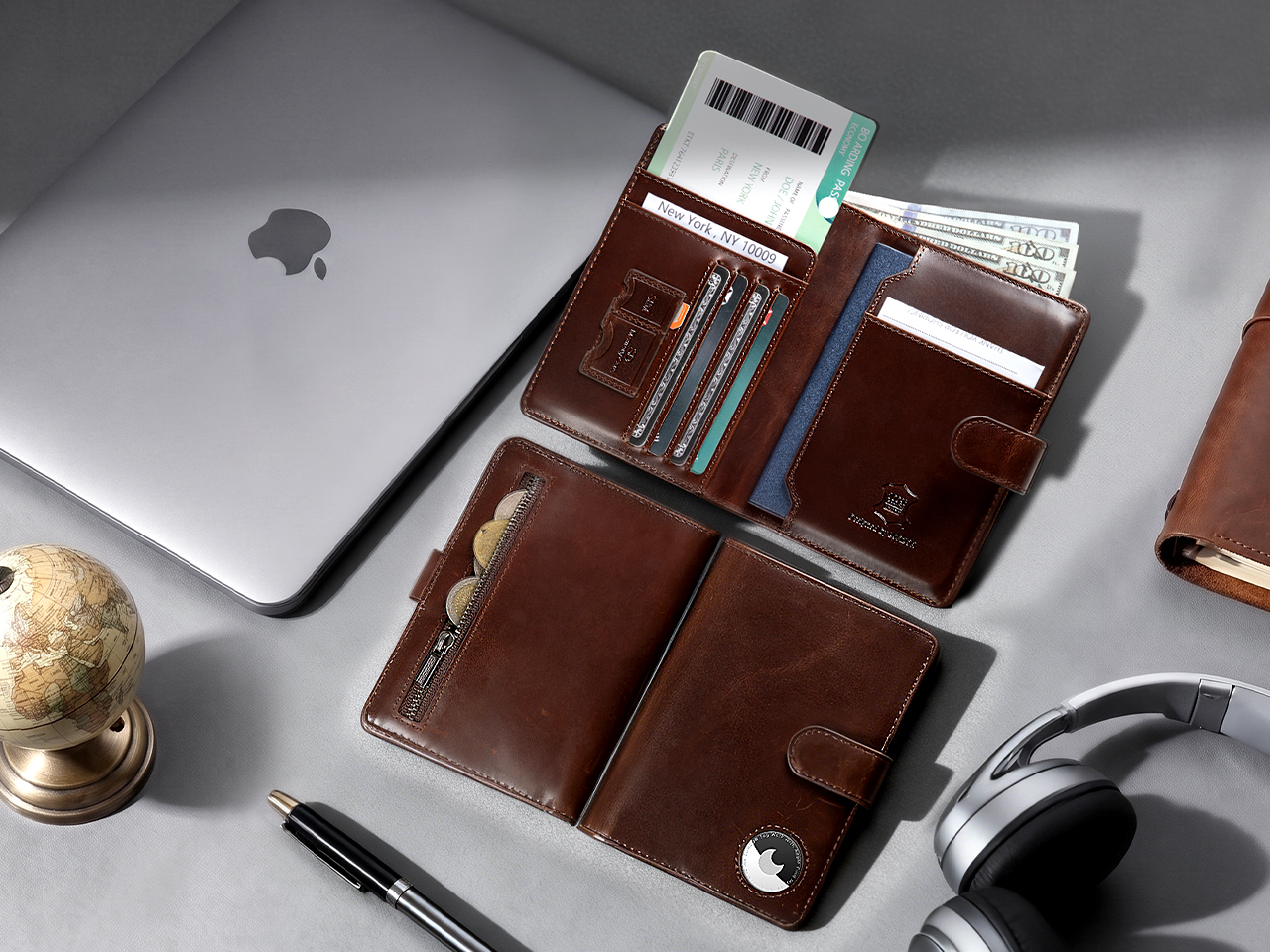
This direction is built around full-grain Italian vegetable-tanned leather in a bifold passport/card configuration, delivered in a matte black foil-stamped gift box. It is the presentation-led option: the wallet is opened in front of the recipient, so edge finishing, grain consistency and a clean deboss carry the perceived value.
Full grain leather is the highest quality grade of leather taken from the topmost hide layer. It retains complete natural grain, pores and natural fiber density without sanding, buffing or artificial embossing. That intact natural matrix provides high tensile strength and breathability, and it develops a lustrous patina over years of daily handling rather than peeling. These are the properties that justify the grade in a gift context, where the object is expected to age well rather than wear out.
Vegetable-tanned leather behaves differently again: it is firm and develops a vintage patina over time, and it supports smooth burnished edges, clean edge paint and laser embossing. Material guidance positions vegetable-tanned leather for premium DTC brands retailing in a 60 to 120 price band that require clean edge paint and laser embossing — a useful reference point when setting the retail architecture for this direction.
How the Two RFID Mechanisms Differ
The aluminum direction blocks by construction. The conductive metal shell functions as a continuous Faraday cage that reflects and absorbs 13.56 MHz electromagnetic interrogation waves emitted by unauthorized scanners. Contactless cards have no internal battery and rely on electromagnetic induction from the reader's field to power the chip. Enclosing the card within conductive aluminum prevents magnetic flux penetration, depriving the chip of operating voltage. In this direction, shielding is a property of the body itself and does not depend on an added layer.
The leather direction requires an explicit blocking specification. RFID blocking is listed as a build option within the THUMBS-UP range, and a bifold achieves it through the construction specified per project rather than through the leather itself. Buyers should define the blocking requirement in the technical brief and confirm it on the approved sample, because leather alone is not a conductive material.
Procurement note: a feature list is not a performance record. Whether the requirement is Faraday-cage shielding in aluminum or an integrated blocking layer in leather, the functional claim should be verified against the approved sample and the documentation package agreed for the destination market.
Customization Implications: Logo, Artwork and Packaging
Customization options across the range include materials, colors, product structures, functional components, logos, labels and retail packaging. What changes between the two directions is the logo process and the amount of artwork discipline it demands.
On leather, heat debossing is the standard route for a premium mark. The artwork requirement is strict: vector artwork in AI or PDF with fonts converted to outlines and lines no thinner than 0.3 mm. A high-relief brass mold is CNC-machined at 1.8 mm depth, and the hot-stamping machine is set at 115 °C for vegetable-tanned leather and 145 °C for chrome-tanned leather, with pressure held for 2.5 to 3 seconds before depth uniformity and line sharpness are inspected. Natural full-grain vegetable leather should never exceed 130 °C without foil, because excess heat scorches natural oils and permanently discolors the grain. Buyers who send raster files or live fonts should expect a redraw step before a mold can be cut.
On the aluminum direction, the leather wrap carries laser printing or embossing, and the logo area competes with a much thinner surface and a curved edge. Artwork still needs to be vector, but the practical constraint is placement: the mark has to sit on a narrow band without interfering with the pop-up travel.
Packaging is where the two directions diverge most sharply. The executive direction specifies a matte black foil-stamped gift box, which adds a print and foil pass, a separate approval cycle and its own volume commitment. The commuter direction typically uses retail packaging suited to shelf or e-commerce presentation, which can be customized through the same packaging development process but carries a different cost structure.
Step-by-Step: Running the Comparison as a Sourcing Process
The two directions can be evaluated in a single development cycle if the sequence is fixed before sampling starts. The workflow below follows the process THUMBS-UP applies across product recommendation, material selection, sample review, functional testing, production tracking and final inspection, with the exact workflow confirmed per customer requirement.
- Step 1 — Fix the end user and occasion. Write one sentence describing who carries the wallet and when. Urban commuter with contactless payment in a transit environment and executive gift recipient at a corporate event are two different briefs and should not share a spec sheet.
- Step 2 — Choose the product structure, not the material. Pop-up aluminum cardholder with cash strap, or bifold passport/card wallet. Structure determines tooling, mechanism and packaging volume; material can be varied afterwards at lower cost.
- Step 3 — Select the leather with the finish process in mind. Saffiano for a structured, resistant surface, Crazy Horse for a pull-up character with higher raw-material cost efficiency, or full-grain Italian vegetable-tanned leather where firm hand, burnished edges and clean edge paint are the point.
- Step 4 — Specify the RFID architecture explicitly. Aluminum body as a Faraday cage against 13.56 MHz interrogation, or an integrated blocking build in the leather bifold. Record the requirement in the technical brief so it can be checked at sample review.
- Step 5 — Prepare artwork before mold discussion. Vector AI or PDF, fonts converted to outlines, lines at least 0.3 mm. Confirm deboss depth (1.8 mm brass mold) and the temperature window that applies to the chosen leather.
- Step 6 — Approve the sample against a written standard. Check stamping depth uniformity, line sharpness, edge finishing, pop-up travel and card retention on the physical sample rather than on a rendering.
- Step 7 — Lock packaging in parallel with the sample. The matte black foil-stamped gift box must be proofed at the same time as the wallet, because foil registration and board grade affect the unboxing result and the delivery schedule.
- Step 8 — Convert the approved sample into a production reference. Approved samples and defined product specifications are used as production references to support consistency across initial and repeat orders.
Use Cases: Which Direction Fits Which Program
The range is intended for retail, gifts and premiums, fashion accessories and everyday carry applications, and is available for brand selection, customization, packaging and repeat supply. Within that scope, the two directions map to distinct programs.
- Urban tech commuter retail and EDC brands. The aluminum pop-up cardholder suits buyers whose customers pay by phone or contactless card and want a slim front-pocket carry with one-click access. Crazy Horse leather supports an outdoor or worn-in brand voice at a lower material cost point.
- Executive corporate gifting and incentive programs. The full-grain vegetable-tanned bifold passport/card wallet in a matte black foil-stamped gift box suits annual gifts, board-level tokens and client recognition, where the debossed logo and the box carry most of the message.
- Travel and passport-led assortments. A bifold passport/card configuration covers travel document storage, which pairs naturally with the travel wallet and passport holder formats in the same range.
- Promotional and premium gifting at volume. Where unit volume is high and personalization is simple, the aluminum direction reduces the number of finishing steps per unit compared with a debossed leather gift set.
- Brands extending into accessory bundles. Magnetic phone wallets, MagSafe-compatible cardholders and AirTag-ready formats can be developed alongside either direction, so a single brief can produce a small family rather than a single SKU.
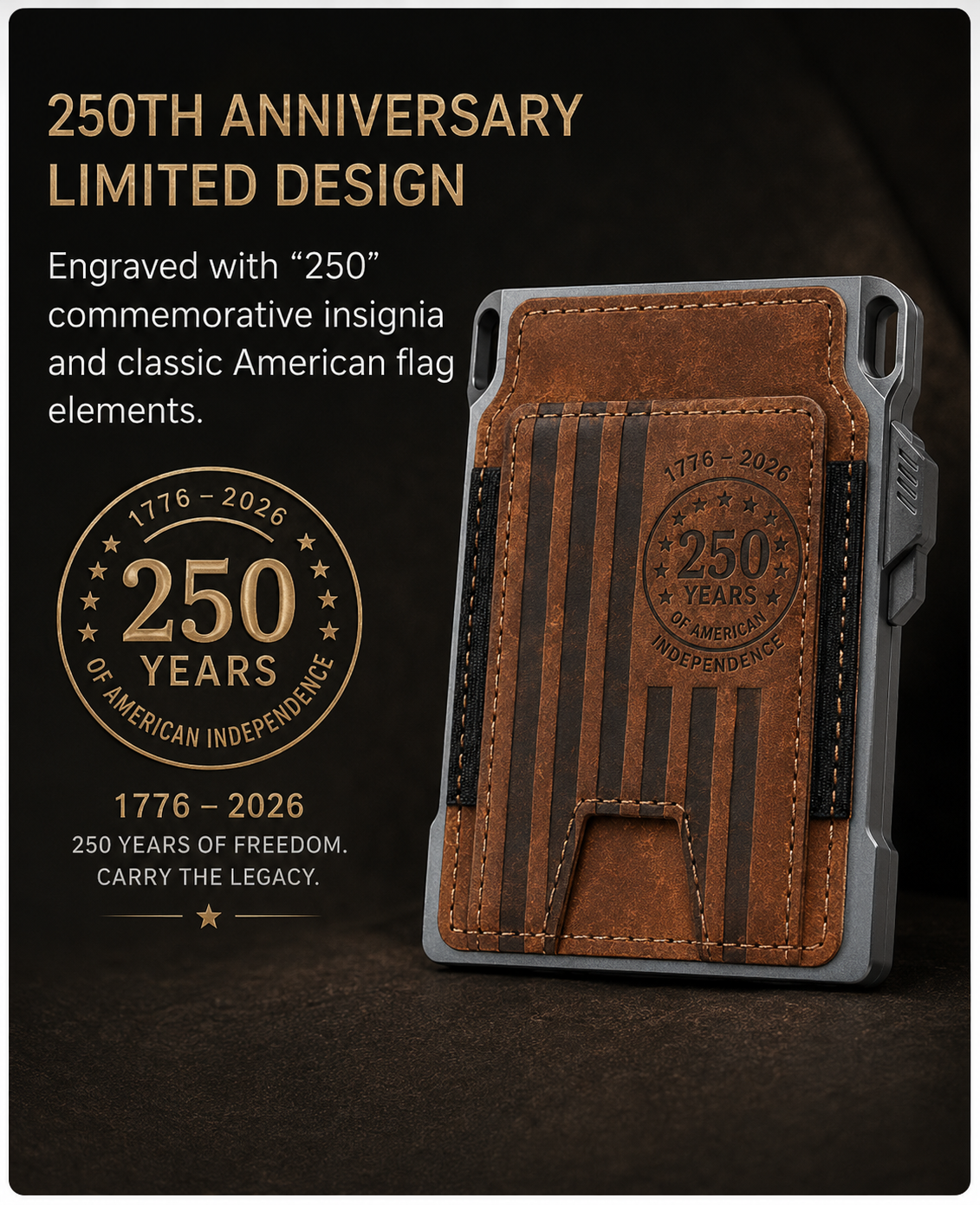
Format precedent inside the range includes the TriPop Wallet, 1979 SP Wallet, Fold Wallet, Passport Wallet, TriPop AirTag Wallet and Bifold AirTag Wallet A3 — a mix of metal-body and leather-body constructions that shows both directions can be sourced from one development team. Capacity varies by format: the pop-up configuration discussed here holds 6 cards plus a cash strap, while the wider range supports configurations up to 12 cards, 10 cash, 3–5 coins, an ID window and an AirTag slot depending on design.
Comparison Table: Aluminum Pop-Up vs Full-Grain Leather Bifold
| Dimension | Aluminum pop-up cardholder | Full-grain leather bifold |
|---|---|---|
| Best-fit end user | Urban tech commuter; front-pocket carry, one-click card access | Executive gift recipient; presentation-led, opened in front of the recipient |
| Core construction | 6063 aluminum card body with pop-up mechanism, wrapped in Saffiano or Crazy Horse leather | Full-grain Italian vegetable-tanned leather, bifold passport/card configuration |
| Capacity in the specified build | 6 cards plus cash strap | Bifold card and passport document storage; slot layout fixed at development |
| RFID mechanism | Conductive aluminum shell as a continuous Faraday cage against 13.56 MHz interrogation | Requires an integrated blocking build specified per project; confirm on approved sample |
| Logo methods | Laser printing or embossing on the leather wrap | Heat debossing with CNC brass mold; laser embossing also supported on vegetable-tanned leather |
| Artwork requirement | Vector AI or PDF, fonts outlined, lines ≥ 0.3 mm | Vector AI or PDF, fonts outlined, lines ≥ 0.3 mm |
| Process parameters | Confirmed per material and placement at sample stage | 115 °C for vegetable-tanned, 145 °C for chrome-tanned, 2.5–3 s dwell; never above 130 °C on natural full-grain vegetable leather without foil |
| Packaging | Retail or e-commerce packaging, customized through packaging development | Matte black foil-stamped gift box |
| Main cost drivers | Aluminum body, pop-up mechanism, leather wrap | Full-grain leather grade, deboss mold, foil-stamped box, edge finishing |
| Retail positioning reference | Tech accessory and EDC assortment; Crazy Horse offers higher raw-material cost efficiency | Vegetable-tanned leather is positioned for premium DTC brands in a 60 to 120 price band |
| Sampling | Sample fee fully refundable once bulk order is placed | Sample fee fully refundable once bulk order is placed |
Frequently Asked Questions
What compliance and testing documentation can a buyer request for either direction?
THUMBS-UP holds product testing reports issued by SGS, TÜV and other independent testing organizations, together with relevant material certificates and compliance documentation. Documentation is provided according to the product, material, component and destination market, and project-specific reports and certificates are reviewed with the client during product development and order confirmation. Buyers should request the document set that matches their own market requirements rather than assuming a single package covers every destination.
Can one supplier produce both an aluminum pop-up cardholder and a full-grain leather bifold?
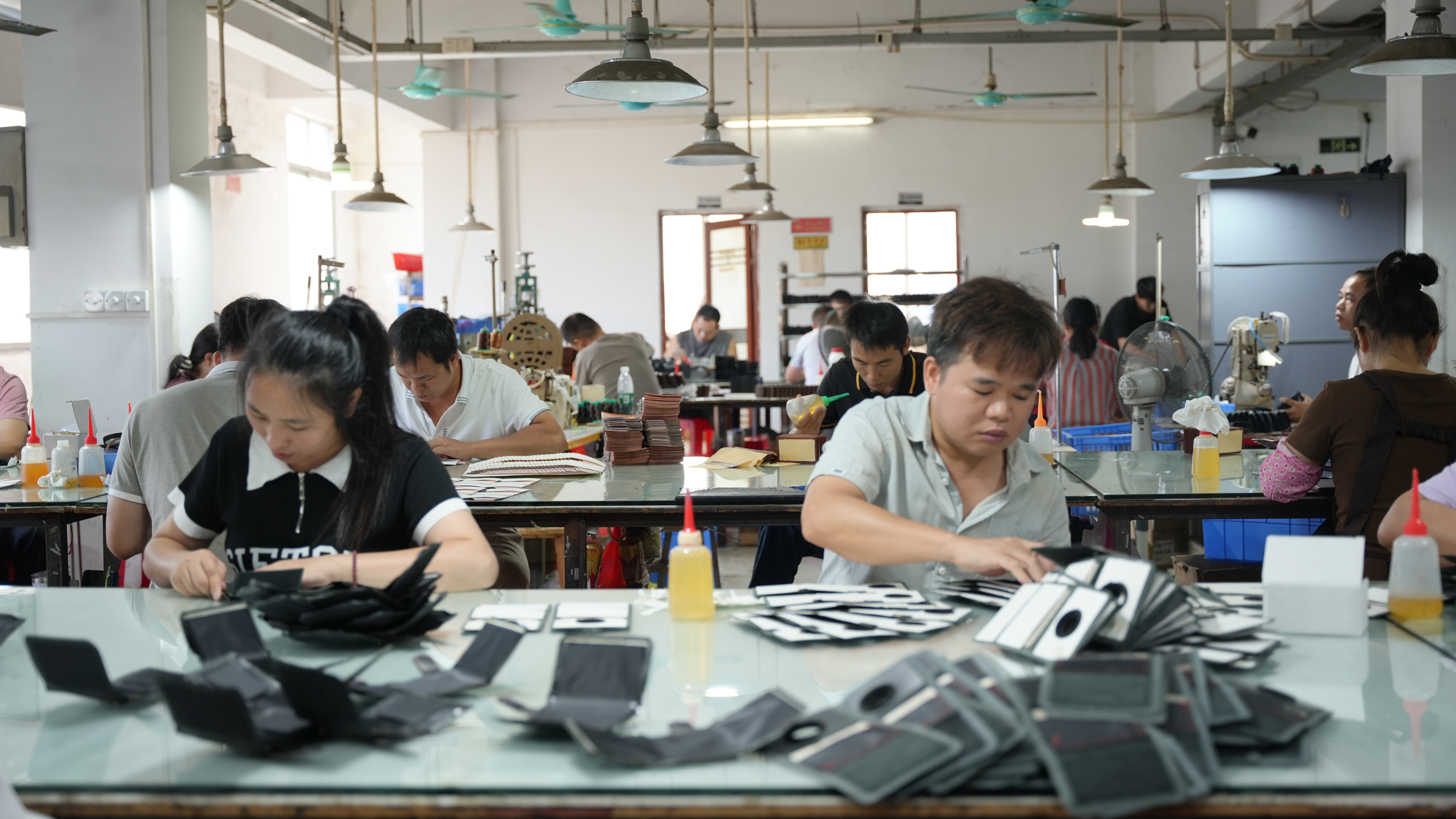
Yes. The THUMBS-UP portfolio covers full-grain leather wallets, RFID-blocking wallets, slim aluminum card holders, pop-up card holders, MagSafe-compatible wallets, AirTag-ready wallets and smart wallets with integrated tracking functionality. The company was founded in 2018, operates a 20,000 m² manufacturing facility with approximately 60 staff and a 6-person R&D team, and reports annual production capacity of 30,000,000 units with exports accounting for 90% of total sales. OEM/ODM services cover product definition, design adaptation, structural engineering, sample development, tooling coordination, material selection, logo application, packaging customization and bulk production.
What drives the cost difference between the two directions?
The aluminum direction concentrates cost in the 6063 aluminum body, the pop-up mechanism and the leather wrap. The leather direction concentrates cost in full-grain leather grade, a CNC brass deboss mold, edge finishing and a matte black foil-stamped gift box. Material selection also moves the number: Crazy Horse leather offers higher raw-material cost efficiency for this wallet application, while vegetable-tanned leather supports clean edge paint and laser embossing. For order planning, third-party sources report that the standard OEM minimum order quantity for custom tooling wallets is typically 1,000 units, and that leather wallet manufacturing costs rose 12–18% amid the shift to sustainable production and regulatory compliance; both figures are external benchmarks and should be replaced with project-specific quotations.
Is the sample fee refundable?
Yes. The sample fee is fully refundable once a bulk order is placed. Sampling should still be treated as a defined approval gate: the physical sample is checked for deboss depth uniformity and line sharpness, edge finishing, pop-up travel and card retention before it becomes the production reference for both initial and repeat orders.
How are artwork approval and production scheduling sequenced before bulk order?
Artwork comes first, because a deboss mold cannot be cut from a raster file or live font. Buyer artwork must arrive as AI or PDF with fonts converted to outlines and lines at least 0.3 mm; the mold is then CNC-machined at 1.8 mm depth and the stamping temperature is set to the leather — 115 °C for vegetable-tanned, 145 °C for chrome-tanned, 2.5 to 3 seconds of pressure. Sample review, functional testing, production tracking and final inspection follow, with the exact workflow and delivery milestones confirmed per customer requirement and per target market. Buyers comparing the two directions can request a sample and a quotation for their shortlisted direction through wholesale@thumbsupfactory.com or WhatsApp +86 188 2640 1362.
Conclusion
The comparison resolves on one question: who opens the wallet, and in front of whom. If the answer is a commuter paying by phone with one hand on a train platform, the aluminum pop-up cardholder with a Saffiano or Crazy Horse wrap, 6-card capacity and a cash strap is the shorter path to a working product — the aluminum body delivers RFID shielding by Faraday-cage construction, and the format is already familiar to tech accessory buyers. If the answer is an executive receiving an annual gift with a debossed logo, the full-grain Italian vegetable-tanned bifold in a matte black foil-stamped gift box does the job that a metal cardholder cannot, because the value is in grain grade, edge finishing and presentation.
Three practical rules make the decision cheaper to execute. Choose structure before material, so tooling and packaging volume are not repeated. Specify the RFID mechanism in writing, because aluminum blocks by construction while leather requires a defined blocking build. And prepare vector artwork with outlined fonts before mold discussion, since deboss temperature and artwork format are the two most common causes of a failed first sample.
Next Step: Compare Both Directions on One Sample Request
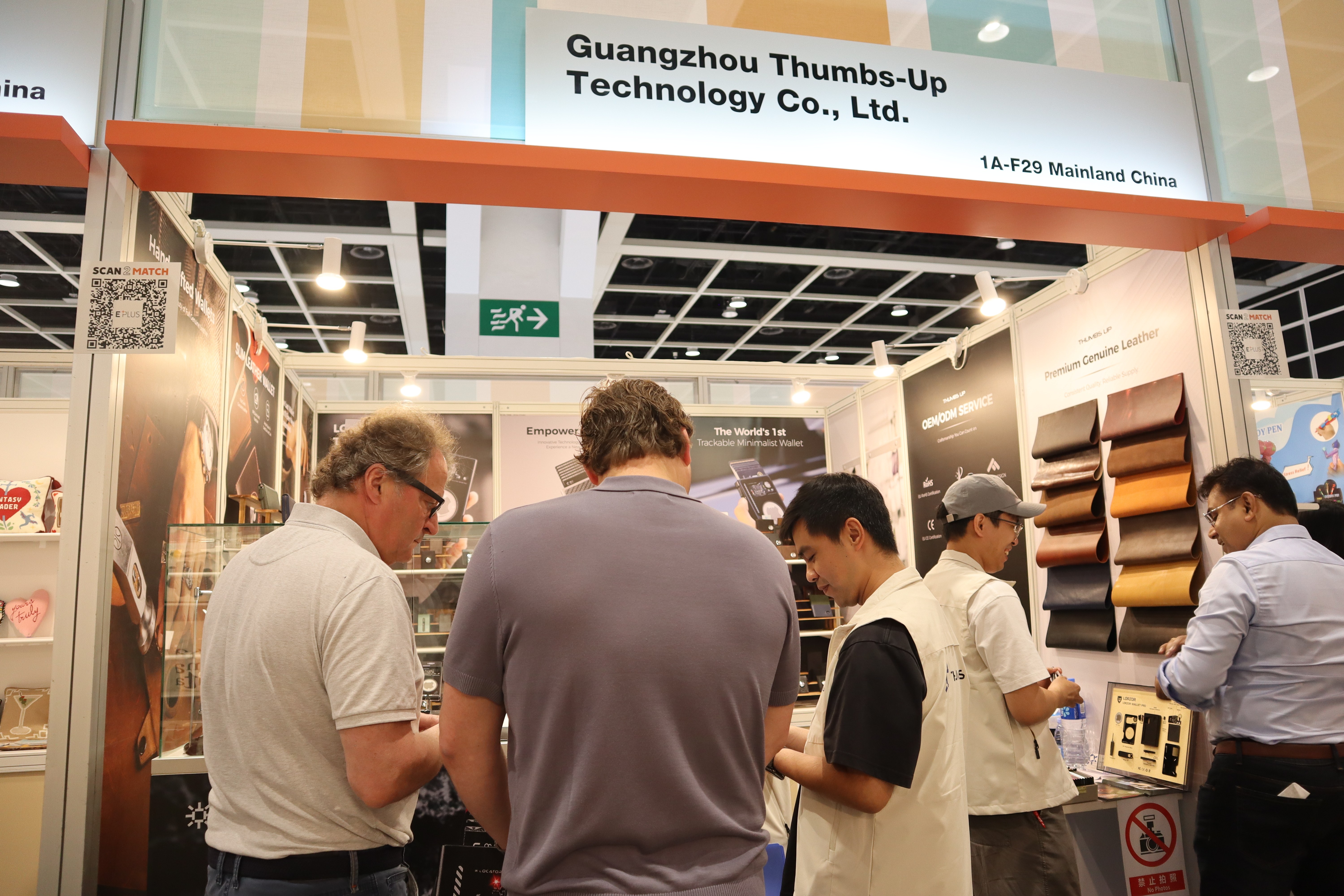
Guangzhou Thumbs-Up Technology Co., Ltd. supports private-label versions of established designs and dedicated product development for differentiated products, with customization across materials, colors, structures, functional components, logos, labels and retail packaging. Sample fees are fully refundable once a bulk order is placed.
Download the product catalog: 2026 Product Catalog — Thumbs-Up Wallet (PDF)
Website: www.thumbsupwallet.com · Email: wholesale@thumbsupfactory.com · Tel / WhatsApp: +86 188 2640 1362 · Address: B2-08, No. 81 Xinye Road, Haizhu District, Guangzhou, Guangdong 510220, Mainland China
Have Questions or Need More Details?
Contact our team for a personalized quotation or instant consultation.
Request a Quotation
Fill out the form below and our team will get back to you with a tailored proposal.
WhatsApp Direct Chat
Prefer to chat in real-time? Message us on WhatsApp for instant assistance & quick answers.
- Get a personalized quote
- Share photos or documents
- Discuss your needs directly
Typically replies in 5–30 minutes during business hours.