
Navigating Global Standards: What Motorized Valve Compliance Really Means
Compliance for a motorized valve is not a single certificate. It is a stack of verifiable layers — electrical safety, material restrictions, ingress protection, pressure class, supply compatibility and factory documentation — and every layer has to match the exact model, size and voltage being installed.
That distinction matters most in the middle of a purchase. A valve family may be certified while the specific size, actuator voltage or flange class on the order line sits outside the certificate’s stated scope. The same gap appears across borders: a specification that satisfies a German municipal project, a United States building-automation retrofit or a Japanese process line differs in electrical supply, mechanical interface and document set, even when the underlying valve belongs to the same product family.
This guide separates motorized valve compliance into its operating layers, maps those layers against what changes in the United States, the United Kingdom, Germany and Japan, and works through a concrete example — the CTB flange butterfly valve from Tianfei high-tech.
Tianjin Tianfei High-tech Valve Co., Ltd. (Tianfei high-tech) is a Tianjin-based electric valve manufacturer established on 16 March 2009 and a national high-tech enterprise under Tianjin Jinfeng Technology Investment Group. The company develops, manufactures and sells intelligent valves and metering instruments, focuses on intelligent energy management and control, exports approximately 70% of its output, and serves markets across Europe and the Americas, South America, Central America, South-East Asia and East Asia. Product documentation and certifications are published at minimotorizedvalve.com.
Why “Compliant” Is Not a Checkbox
Four separate ideas get compressed into the single word “compliant”, and each one fails differently.
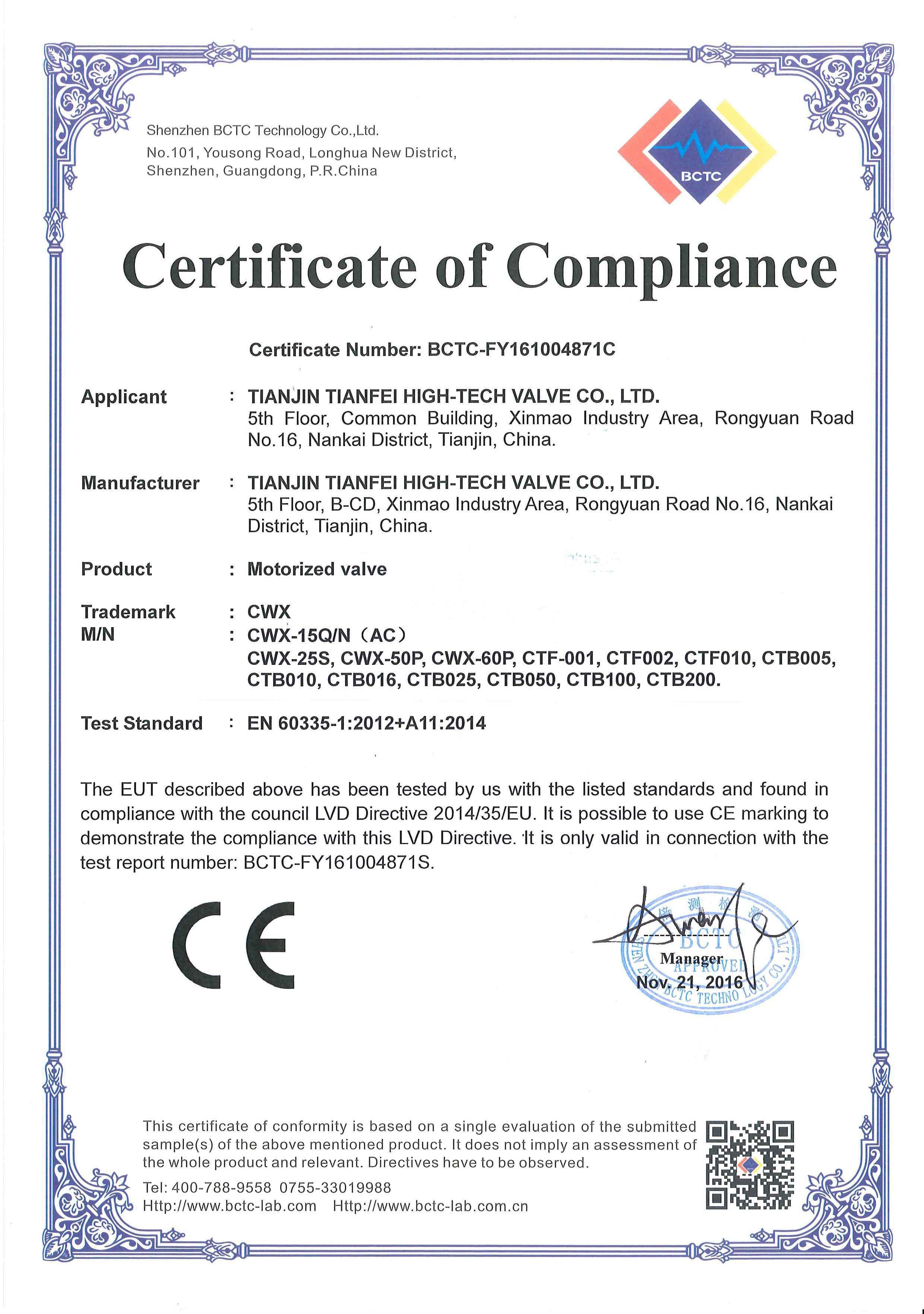
The mark versus the standard. A CE mark on a datasheet says nothing on its own. What carries information is the standard the product was tested against. For Tianfei high-tech’s motorized valve range, the CE Certificate of Compliance is issued against EN 60335-1:2012+A11:2014 — the general safety requirements for electrical appliances.
The family versus the model. Certificate scopes are written as model lists, not product categories. The CE Certificate of Compliance BCTC-FY161004871C names motorized valve models including CWX-15Q/N (AC), CWX-25S, CWX-50P, CWX-60P, CTF-001, CTF002, CTF010, CTB005, CTB010, CTB016, CTB025, CTB050, CTB100 and CTB200. A size or actuator outside that list is not covered by that document alone.
The document versus the performance. A certificate records that a defined test was passed under defined conditions. It does not tell you whether a DN300 wafer butterfly valve and a DN500 flanged butterfly valve behave identically at 1.6 MPa in a seawater line. Torque, response behaviour, leakage integrity and service life come from the technical specification and the application data, not from the certificate.
One market versus another. Safety standards, supply voltages, flange drilling and thread forms differ by region. A document package assembled for one market is a starting point elsewhere, never a finished answer.
Why the Compliance Burden Keeps Growing
Two market figures explain the direction of travel. The global ball valve market was valued at USD 14.8 billion in 2025 and is projected to reach USD 22.82 billion by 2034 (Straits Research). Over an overlapping period, the global electric valve actuators market reached USD 4.8 billion in 2025 with a CAGR of 5.8% (Dataintelo). The actuator layer — the electrical and control portion of a motorized valve — is expanding faster than the valve body market, which is consistent with the ongoing replacement of manually operated valves by electrically actuated units.
That shift carries a compliance consequence. Every electrified valve introduces an electrical assembly, additional material content, a control interface and an ingress-protection question. Procurement teams that once evaluated a valve on body material and pressure class now review a document set alongside it.
Customs vocabulary adds a further layer. Motorized valves with self-contained electric or hydraulic actuators are classified under HS Code 848180, a broad heading covering many valve types. Classification confirms a trade category; it does not confirm compliance, and it should not be used in place of a certificate of compliance.
The Six Layers of Motorized Valve Compliance
Treat compliance as a stack rather than a gate. Each layer answers a separate question, and each produces a separate document.
Layer 1 — Electrical safety of the complete assembly
This layer covers the valve body plus actuator as a single electrical product: insulation, temperature rise, mechanical hazards and fault behaviour. For Tianfei high-tech, the CE Certificate of Compliance BCTC-FY161004871C was issued by Shenzhen BCTC Technology Co., Ltd. against EN 60335-1:2012+A11:2014, with a scope spanning the motorized valve models listed above. The practical instruction for a buyer is simple: open the certificate and find the order line’s model inside the scope.
Layer 2 — Material and substance restrictions
European RoHS 2.0 compliance is verified against the IEC 62321 series of test standards. Tianfei high-tech holds two Certificates of Compliance from Shenzhen CCTI Technology Co., Ltd.: CCTI-2021112302C covering the CWX-25S series, including CWX-25S, CWX-60P, CWX-15Q/N, CWX-20P, CWX-50P and the water leakage detection valve; and CCTI-2021112301C covering the CTF-001 series mini large-torque electric valve and the CTF-001 smart water valve. Both were issued on 30 November 2021.
Substance restriction sits alongside a separate material decision. Body materials across the range include brass, SS304, cast iron and PVC — for example, cast iron/SS304 in the CTB family and PVC in the CTF-001 PVC valve for acid and alkali media. Material selection is an application judgement; RoHS is a market-access requirement. They are not interchangeable.

Layer 3 — Ingress protection
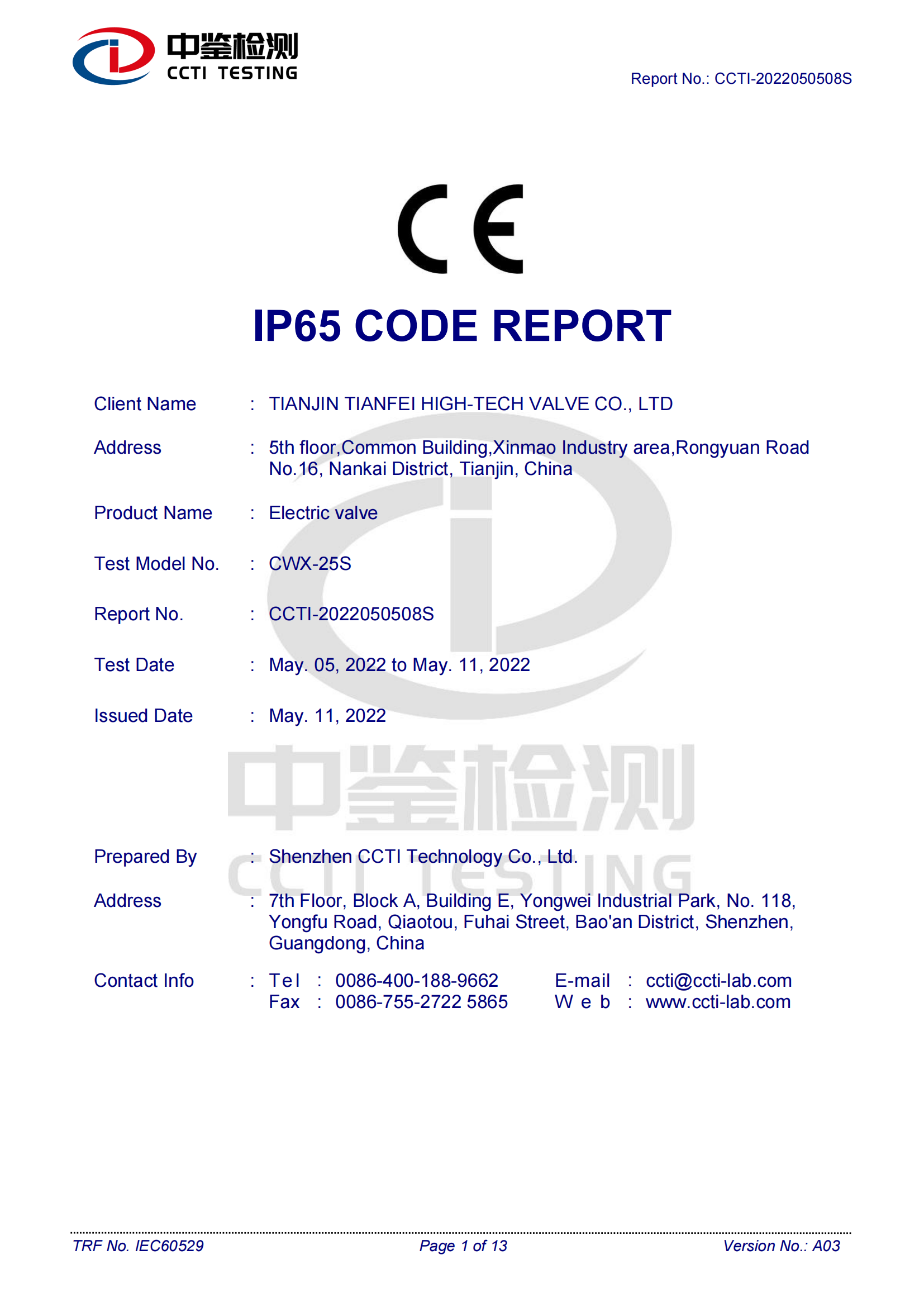
Ingress protection is assessed under IEC 60529. Tianfei high-tech holds IP65 Code Report CCTI-2022050508S, issued by CCTI TESTING on 11 May 2022 for the electric valve CWX-25S. Ratings across the wider range are documented at product level: IP65 for CWX-15N, CWX-15S, CWX-20P, CTF-001 and CTF-001 PVC; IP67 for the CTB flange butterfly valve, CTB wafer butterfly valve, CTB ball valve, CWX-25S and CWX-60P; IP54 for the WiFi Smart Water Valve; and IP44 for the WLAV leak alarm valve and the wired and wireless water leak detection sensors.
The nuance is worth stating plainly: a test report issued for one model does not transfer automatically to another. What the report demonstrates is that the manufacturer can produce and document to the standard. Each model’s rating should be confirmed against its own specification.
Layer 4 — Pressure class, flange drilling and mechanical interface
This is the layer where a technically compliant valve can still fail to install. The CTB flange butterfly valve is offered in DN50–DN500 with flanged connections at PN6, PN10 or PN16, a working pressure of ≤1.6 MPa and a cast iron/SS304 body. PN6, PN10 and PN16 are not interchangeable labels: they define the pressure–temperature rating and the bolt-hole pattern the valve must mate with. A valve correct for a PN10 line will not necessarily bolt to a PN16 flange.
In North American catalog practice, the equivalent interface conversation is thread form — NPT and NPTF threads and socket-connect fittings are listed for motorized ball valves. Interface detail belongs on the purchase order, not in a note.
Layer 5 — Supply voltage and control signal
Voltage configuration is a compliance variable, not a convenience. The CTB flange butterfly valve operates at AC220V or DC24V. Beyond that, publicly listed catalogs show how wide the commercial spread is: 24V AC, 24V DC, 120V AC and 240V AC options appear in distributor listings; a sanitary electric valve family lists DC12V through AC380V; and another catalog lists 12VDC, 24VDC and 120VAC across assemblies from 1/4 inch to 2 inch. Within the Tianfei high-tech range, the CWX-15N is available in AC220V, DC12V or DC24V, and the CTF-001 accepts AC85–265V or DC9–24V.
Control signal sits in the same layer. The CTB wafer butterfly valve and the CWX-60P 2-way valve offer modulating control at 4–20 mA and 0–10 V in addition to on/off operation, which determines how the valve is commissioned and what the building or plant controller expects.
Layer 6 — Management systems, traceability and legal identity
The final layer is the paperwork that makes a supplier auditable. Tianfei high-tech operates under Business License Unified Social Credit Code 91120116684732498U, holds Trademark Registration No. 34646543 in Class 7 with validity to 6 August 2029, and holds Invention Patent Certificate No. 3754970 (Patent No. ZL 2018 1 1623664.8) for a flow control valve capable of closing instantly, valid to 28 December 2038.
Management system certification spans three areas: GB/T 19001-2016 / ISO 9001:2015 certificate 04620Q15496R1S from Beijing Head International Certification Co., Ltd., covering the development, design and production of electric valves; GB/T 24001-2016 / ISO 14001:2015 certificate 19522E39814R0S; and GB/T 45001-2020 / ISO 45001:2018 certificate 19522S39815R0S, both from Beijing Kun Biao Certification & Inspection Co., Ltd. Management system certificates carry defined validity periods, so the routine is simple: request the current, in-date copy rather than accepting a historic scan.

What Changes Between the US, UK, German and Japanese Markets
Four variables drive regional difference: electrical supply class, mechanical interface, documentation and market-access regime, and application-specific approval. The valve body can be identical while the specification package is not.
United States
North American supply classes and thread forms differ from European defaults. Commercial catalogs list 24V AC, 24V DC, 120V AC and 240V AC options, together with NPT, NPTF or socket-connect fittings. A valve configured at AC220V with PN-rated flanges is therefore not the default US specification. The two fields to lock first are the supply class (commonly 120V AC or 24V DC) and the thread form. Application-specific approvals, such as water-contact approval for potable-water service, are project requirements that must be confirmed model by model rather than assumed from a family certificate.
United Kingdom
UK projects generally work from European (EN) derived technical practice, so an EN 60335-1-based safety certificate and RoHS documentation are a natural starting point in a technical file. Because the UK maintains its own market-access framework, the buyer should confirm which current documentation the supplier can provide for UK placement, instead of assuming an EU-facing pack is sufficient. The safe approach is to list the required documents in the enquiry and have the supplier confirm each one in writing.
Germany
German specifications are documentation-intensive and explicit about mechanical detail. Flanged valves are expected to carry a declared pressure class and DN range; the CTB flange butterfly valve covers DN50–DN500 with PN6/PN10/PN16 flanging, ≤1.6 MPa working pressure and IP67 protection. Buyers typically want the datasheet, the certificate scope page and the test basis reviewed together, and will cross-check that the DN on the order line appears inside the certificate’s model list. Where an application involves seawater, cooling water or heavy-industry duty, material and protection class are reviewed alongside the documents.
Japan
Japan operates on its own low-voltage supply conventions and JIS-based interface practice, which differ from both North American and European norms. Neither the supply class nor the flange and thread interface should be assumed from a European or US specification. The verification routine is the same, but it has to be run from the beginning: confirm the supply class, confirm the interface standard, and confirm whether the required certification can be supplied for the exact model.
Case Study: The CTB Flange Butterfly Valve Compliance Profile
The CTB flange butterfly valve is a useful example because its specification touches every compliance layer at once.
- Valve type: flanged motorized butterfly valve
- Size range: DN50–DN500
- Supply: AC220V / DC24V
- Actuator torque: 30–500 N·m
- Connection: flanged, PN6 / PN10 / PN16
- Ingress protection: IP67
- Working pressure: ≤1.6 MPa
- Body material: cast iron / SS304
- Typical industries: municipal water and wastewater, power plant cooling, marine seawater, heavy industry
Two details in that list are the ones a buyer should copy into a specification. First, the pressure class is declared per connection rather than implied — PN6, PN10 and PN16 are named, so the pipeline’s flange pattern can be matched directly. Second, the CE certificate scope names CTB005, CTB010, CTB016, CTB025, CTB050, CTB100 and CTB200 as distinct entries. The safety documentation is therefore structured around a defined size ladder rather than a single reference model, which is the shape a procurement team wants: certificate scope that maps onto the ordering matrix.

A field example shows how the layers combine. A large European municipal water group in France deployed 10,000 units for on/off control and flow regulation across municipal water supply and drainage networks, sewage treatment plants and smart water automation systems. The customer inspected the factory in October 2024 and approved the production and quality control system; the order was signed in November 2024 and delivered within three months, with on-site installation guidance, commissioning training and remote technical support. Reported operational outcomes include 4–20 mA regulation with a response time of ≤ 0.5 s and flow control error below ±2%, zero leakage and zero major failures across more than 16 months of operation, remote monitoring with fault diagnosis and automatic alarm reducing maintenance cost by 40%, and more than 120,000 kWh of electricity saved annually through low-power design. The deployment is stated to be fully compliant with EU standards and French water industry requirements.
Read that example as a document-and-performance case rather than a promotional one. Its compliance value is that specification, certificates and performance data were accepted together by a European municipal buyer — the category of customer least likely to take a certificate at face value.
Step-by-Step: A Pre-Order Compliance Verification Routine
Run these seven steps before a purchase order is released. Each one closes a specific gap.
- Fix the specification before the supplier search. Write down DN size, supply voltage, control mode (on/off or modulating), connection standard, pressure class and required ingress protection. Suppliers can only confirm compliance against a defined target.
- Match certificate scope to the exact model. Open the certificate and locate the model number on the order line inside the scope list. A family-level statement is not sufficient.
- Read the standard, not the mark. Record which standard was tested — EN 60335-1:2012+A11:2014 for electrical safety, the IEC 62321 series for RoHS 2.0, IEC 60529 for ingress protection — and confirm relevance to the destination market.
- Check the pressure class against the pipeline, not the datasheet alone. PN6, PN10 and PN16 define both rating and bolt pattern. Confirm the flange drilling matches the installed pipeline before ordering.
- Confirm the supply and the control signal. Verify the voltage class against the site supply and confirm whether the controller requires a 4–20 mA or 0–10 V modulating input.
- Agree the acceptance routine in writing. Tianfei high-tech applies 100% testing in production, and the stated acceptance criterion is pre-shipment test. Agreeing that criterion before shipping is what prevents disputes after arrival.
- Confirm commercial terms and lead time. The stated minimum order quantity starts at 1–2 units depending on configuration; delivery terms are FOB or CIF; payment terms are 50/50; OEM production lead time is 30 days against a stated monthly capacity of 8,000 units. Confirm which of these applies to the exact configuration before committing.
Where Compliant Motorized Valves Are Used
Application determines which layers carry the most weight. In practice, the mapping across the Tianfei high-tech range looks like this:
- Municipal water and wastewater, power plant cooling, marine seawater: the CTB flange butterfly valve, with DN50–DN500 sizing, PN6/PN10/PN16 flanging, cast iron/SS304 body and IP67 protection.
- Municipal pipelines, industrial piping, large-bore HVAC and fire protection: the CTB wafer butterfly valve, with DN50–DN300 sizing, 20–200 N·m torque and 4–20 mA modulating control.
- Building automation, industrial fluid control, HVAC and municipal water supply: the CTB motorized ball valve, a 2-way unit with manual override, DN15–DN100 sizing, 6 N·m torque and optional modulating control.
- Drinking water, food sanitation and solar systems: the CTF-001 compact stainless valve, DN15–DN50, IP65, working pressure ≤1.0 MPa.
- Acid and alkali media, swimming pools, chemical piping and wastewater treatment: the CTF-001 PVC corrosion-resistant valve, DN15–DN50, ≤0.8 MPa.
- Smart home water control and rental property leak protection: the WiFi Smart Water Valve, DN15–DN25, IP54, on 2.4 GHz WiFi with Tuya Smart, SmartLife, Alexa and Google Home platforms.
CTB Family Comparison
The three CTB configurations share a supply voltage, a pressure rating and an IP67 enclosure, but they are not interchangeable in a specification.
| Attribute | CTB Flange Butterfly Valve | CTB Wafer Butterfly Valve | CTB Motorized Ball Valve |
|---|---|---|---|
| Valve type | Flanged motorized butterfly valve | Wafer-type motorized butterfly valve | 2-way motorized ball valve with manual override |
| Size range | DN50–DN500 | DN50–DN300 | DN15–DN100 |
| Supply voltage | AC220V / DC24V | AC220V / DC24V | AC220V / DC24V |
| Actuator torque | 30–500 N·m | 20–200 N·m | 6 N·m |
| Connection | Flanged (PN6 / PN10 / PN16) | Wafer | Not stated in the reference specification |
| Control mode | Not stated in the reference specification | On/off & modulating (4–20 mA) | On/off & modulating (optional) |
| Ingress protection | IP67 | IP67 | IP67 |
| Working pressure | ≤1.6 MPa | ≤1.6 MPa | ≤1.6 MPa |
| Body material | Cast iron / SS304 | Cast iron / SS304 | Brass / SS304 |
| Typical industries | Municipal water and wastewater, power plant cooling, marine seawater, heavy industry | Municipal pipelines, industrial piping, large-bore HVAC, fire protection | BAS, industrial fluid control, HVAC, municipal water supply |
Documentation at a Glance
The table below lists the compliance documents referenced in this guide, with the standard each was issued against and the scope it covers.
| Document | Standard | Issuing body | Scope |
|---|---|---|---|
| CE Certificate of Compliance (BCTC-FY161004871C) | EN 60335-1:2012+A11:2014 | Shenzhen BCTC Technology Co., Ltd. | Motorized valve models including CWX-15Q/N (AC), CWX-25S, CWX-50P, CWX-60P, CTF-001, CTF002, CTF010, CTB005, CTB010, CTB016, CTB025, CTB050, CTB100, CTB200 |
| Certificate of Compliance (CCTI-2021112302C) | IEC 62321 series (RoHS 2.0) | Shenzhen CCTI Technology Co., Ltd. | CWX-25S series: CWX-25S, CWX-60P, CWX-15Q/N, CWX-20P, CWX-50P, water leakage detection valve |
| Certificate of Compliance (CCTI-2021112301C) | IEC 62321 series (RoHS 2.0) | Shenzhen CCTI Technology Co., Ltd. | CTF-001 series mini large-torque electric valve, CTF-001 smart water valve |
| IP65 Code Report (CCTI-2022050508S) | IEC 60529 | CCTI TESTING | Electric valve CWX-25S |
| Invention Patent Certificate No. 3754970 (ZL 2018 1 1623664.8) | Patent Law of the People’s Republic of China | State Intellectual Property Office of China | A flow control valve capable of closing instantly |
| Trademark Registration No. 34646543 | Trademark Law of the People’s Republic of China | State Intellectual Property Office of China | Class 7 goods including valves (machine parts), pressure valves and steam traps |
Documents expire, and scopes are written narrowly. Always request the current certificate version and confirm that the model on the order line appears within its scope before release.
FAQ
Which certificates back a Tianfei high-tech motorized valve, and which models do they cover?
Three document families are relevant. Electrical safety: CE Certificate of Compliance BCTC-FY161004871C, issued by Shenzhen BCTC Technology Co., Ltd. against EN 60335-1:2012+A11:2014, covering motorized valve models including CWX-15Q/N (AC), CWX-25S, CWX-50P, CWX-60P, CTF-001, CTF002, CTF010 and CTB005 through CTB200. Substance restrictions: Certificates of Compliance CCTI-2021112302C and CCTI-2021112301C from Shenzhen CCTI Technology Co., Ltd., both against the IEC 62321 series (RoHS 2.0), covering the CWX-25S series and the CTF-001 series respectively. Ingress protection: IP65 Code Report CCTI-2022050508S from CCTI TESTING against IEC 60529 for the electric valve CWX-25S. Because each scope is model-specific, the order line should always be matched against the certificate list before purchase.
Can the CTB flange butterfly valve be customized for different voltages and flange standards?
The CTB flange butterfly valve is supplied with AC220V or DC24V actuation and flanged connections in PN6, PN10 or PN16 across DN50–DN500, with 30–500 N·m of actuator torque, IP67 protection and a working pressure of ≤1.6 MPa. Tianfei high-tech provides OEM production with voltage and logo customization. Voltage and interface requirements vary by market — public catalogs list 24V AC, 24V DC, 120V AC and 240V AC classes for North American specifications, for example — so the configuration should be locked model by model rather than assumed from a family datasheet.
What do minimum order quantities and commercial terms look like?
Minimum order quantities are low. The stated starting point is 1–2 units depending on configuration, which allows a buyer to validate before scaling. Delivery terms are FOB or CIF; payment terms are 50/50; the stated acceptance criterion is pre-shipment test, supported by 100% testing during production. Unit pricing is quoted per configuration, because voltage, size, body material and control mode all affect the cost of the assembly — there is no single list price that applies across the DN15–DN500 range.
Can I validate a sample before committing to a production order?
Yes, and the low minimum order quantity makes it practical. A validation order at 1–2 units can be supplied so the buyer can confirm fit, wiring, control behaviour and enclosure protection against their own installation. Because every unit is subject to 100% testing in production and the stated acceptance criterion is pre-shipment test, the sample and the production batch are checked under the same routine. Document requests should accompany the sample: the certificate scope page for the exact model, the technical specification, and where relevant the IP rating confirmation.
What lead time should be planned for an OEM motorized valve order?
The stated OEM production lead time is 30 days against a monthly capacity of 8,000 units, with a production capability of more than 2,000 valves per day and annual output exceeding 800,000 units. Larger programmes can run longer: in the French municipal water deployment, a 10,000-unit order signed in November 2024 was delivered within three months, following a factory inspection and approval of the production and quality control system in October 2024. For a specific configuration, the fastest route is to send the specification — DN size, voltage, control mode, connection standard and required documentation — and request a written lead time against it. Enquiries can be raised through the official Tianfei high-tech website.
Conclusion
Motorized valve compliance is a stack, not a stamp. Electrical safety is documented against a safety standard; material content against the IEC 62321 series; ingress protection against IEC 60529; mechanical fit by pressure class and interface standard; supply compatibility by voltage class and control signal; and supplier credibility by management systems, legal identity and traceability. Each layer has its own document, its own scope and its own expiry.
The CTB flange butterfly valve shows what that looks like when the layers line up: declared PN6/PN10/PN16 flanging across DN50–DN500, IP67 protection, a ≤1.6 MPa working pressure, AC220V/DC24V actuation, a named size ladder inside the CE certificate scope, and a European municipal reference deployment behind it. What makes the profile usable is not that the documents exist, but that their scopes can be matched to a specific order line.
The practical discipline is the same in every market. Fix the specification, match the certificate scope to the model, confirm the interface and supply class against the site, agree the acceptance routine in writing, and verify that the documents you receive are current. Compliance is what survives that process.

Next Step: Send Your Specification for a Compliance Check
Share the DN size, supply voltage, control mode, connection standard and target market, and Tianfei high-tech will confirm which certificates apply to the exact model, provide the current document set, and quote accordingly.
Samples start from a minimum order of 1–2 units. OEM production with voltage and logo customization is available at a stated 30-day lead time.
Website: www.minimotorizedvalve.com | Email: tf.co@tfjt.com | Tel: +86 022 85685296 | WhatsApp: +86 18920338351
Have Questions or Need More Details?
Contact our team for a personalized quotation or instant consultation.
Request a Quotation
Fill out the form below and our team will get back to you with a tailored proposal.
WhatsApp Direct Chat
Prefer to chat in real-time? Message us on WhatsApp for instant assistance & quick answers.
- Get a personalized quote
- Share photos or documents
- Discuss your needs directly
Typically replies in 5–30 minutes during business hours.