Fiber for Concrete: Specification and Certification Constraints Buyers Must Verify
Buying fiber for concrete is a constraint problem before it is a price problem. A hook-end steel fiber that passes a beam test in one mix design can be rejected in another; a CE certificate that covers a 0.75 mm fiber does not automatically cover a 0.2 mm micro fiber; an 80/60 designation is not interchangeable with a 55/35. This guide sets out the four constraint layers that decide whether a fiber delivery is accepted on site — standard, parameter window, certification scope, and commercial terms — using the actual figures published by Tianjin TingCo Tech Co., Ltd (TINGCO), a steel and synthetic fiber manufacturer headquartered in Tianjin, China.
The Constraint Problem: Four Layers Decide Acceptance
Most rejected fiber deliveries are not rejected because the fiber is poor quality. They are rejected because one of four constraint layers was never checked before the order was placed:
- Standard layer. The fiber must be described and certified against the standard cited in the project specification — EN 14889-1:2006 for the European Union, ASTM A820/A820M for US-origin specifications, ISO 13270 as a further reference.
- Parameter layer. Diameter, length, tensile strength and aspect ratio must sit inside the design window. The 80/60 shorthand used on drawings means an aspect ratio of 80 with a 60 mm length; that is a different product from a 55/35 fiber.
- Scope layer. A certificate has a defined scope. The specific product you order must fall inside that scope, not merely inside the supplier's catalogue.
- Commercial layer. MOQ, lead time, payment structure, inspection rights and batch documentation determine whether the shipment can actually be released by your quality team.
Three failure modes repeat across these layers: a datasheet quoted without tolerance, a certificate that covers one diameter range while a different diameter is ordered, and a batch arriving without a Certificate of Analysis or Mill Certificate. Each is avoidable with a documented qualification sequence, which is set out later in this article.
Industry Background: Growth With Segmented Compliance Tracks
The commercial case for fiber reinforcement is well established and quantified by third-party research. Fortune Business Insights projects the global steel fiber market to reach approximately USD 2.87 billion by 2026, with industrial floors accounting for 37.28% of application share in that year and hooked-end steel fibers holding a leading 58.89% share of the type segment (Fortune Business Insights, Steel Fiber Market Size, Share & Industry Report 2026–2034). On the synthetic side, the polypropylene fiber market for construction is projected to grow at a CAGR of 6.4% from 2026 to 2034 (Fortune Business Insights, Polypropylene Fiber Market Report).
Supply is concentrated. Specialized customs datasets covering HS code 7326 identify China as the largest exporter of steel fiber, at 51.85% of the imports recorded in those datasets (Zauba customs aggregator; medium confidence, directional rather than definitive). For a buyer this means two things: sourcing options are deep, and the burden of differentiation falls on documentation rather than on availability.
The standards landscape reinforces the segmentation. ASTM A820/A820M-16 is the core global standard specifying requirements for five types of steel fibers in fiber-reinforced concrete (ASTM International), while EN 14889-1:2006 defines the definitions, specifications and conformity requirements for steel fibers used in concrete within the European Union (European Committee for Standardization). Steel fiber and synthetic fiber are therefore two separate compliance tracks, and a steel-fiber certificate says nothing about polypropylene performance.
The Compliance Layer: Reading a CE Certificate Correctly
TINGCO holds CE Certificate number 1301 – CPR – 2456, issued by TSUS under EN 14889-1:2006, valid from 13 May 2025 to 12 May 2030 for the EU market. The declared scope is steel fibres for concrete (Group I) for reinforcement of concrete, mortars and cementitious mixes.
The scope is deliberately narrow, and that is the part buyers most often miss. The certificate applies to steel fiber products with a diameter of 0.5–1.0 mm, a length of 25–60 mm and a tensile strength of 1100–2100 MPa. Within that window, certified supply covers industrial flooring, tunnel segment and mining applications.
Practical consequence: the brass-coated micro steel fiber range for UHPC sits at 0.175–0.3 mm diameter and 2200–2850 MPa tensile strength — outside the parameter window of CE 1301 – CPR – 2456. A buyer must not assume one certificate covers a whole catalogue. The correct question is: “Does this certificate number name the diameter, length and strength class I am ordering?”
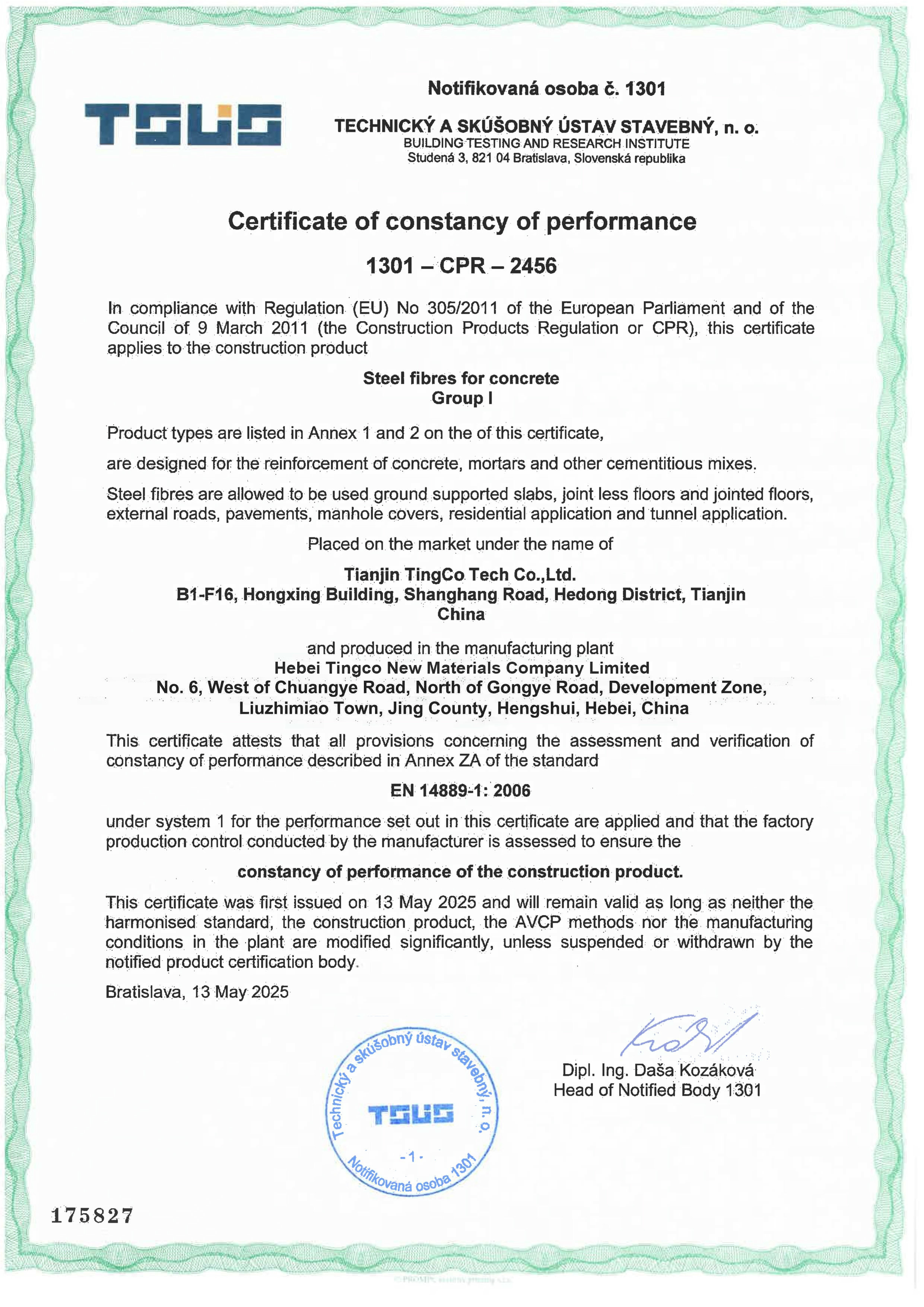
Behind the certificate, the factory operates an ISO 9001 quality system and an on-site steel fiber reinforced concrete testing laboratory, where each product line is checked through beam bending, compression and toughness tests. Inspection is applied twice: in-line during production and again before shipment, verifying specification, quantity and packaging. On the design side, the technical team has worked with TR34 and EFNARC design codes and partners with design teams on steel fiber floor design and tunnel segment design.
The Parameter Layer: Which Numbers Belong to Which Application
Steel fiber for industrial flooring and tunnel segments
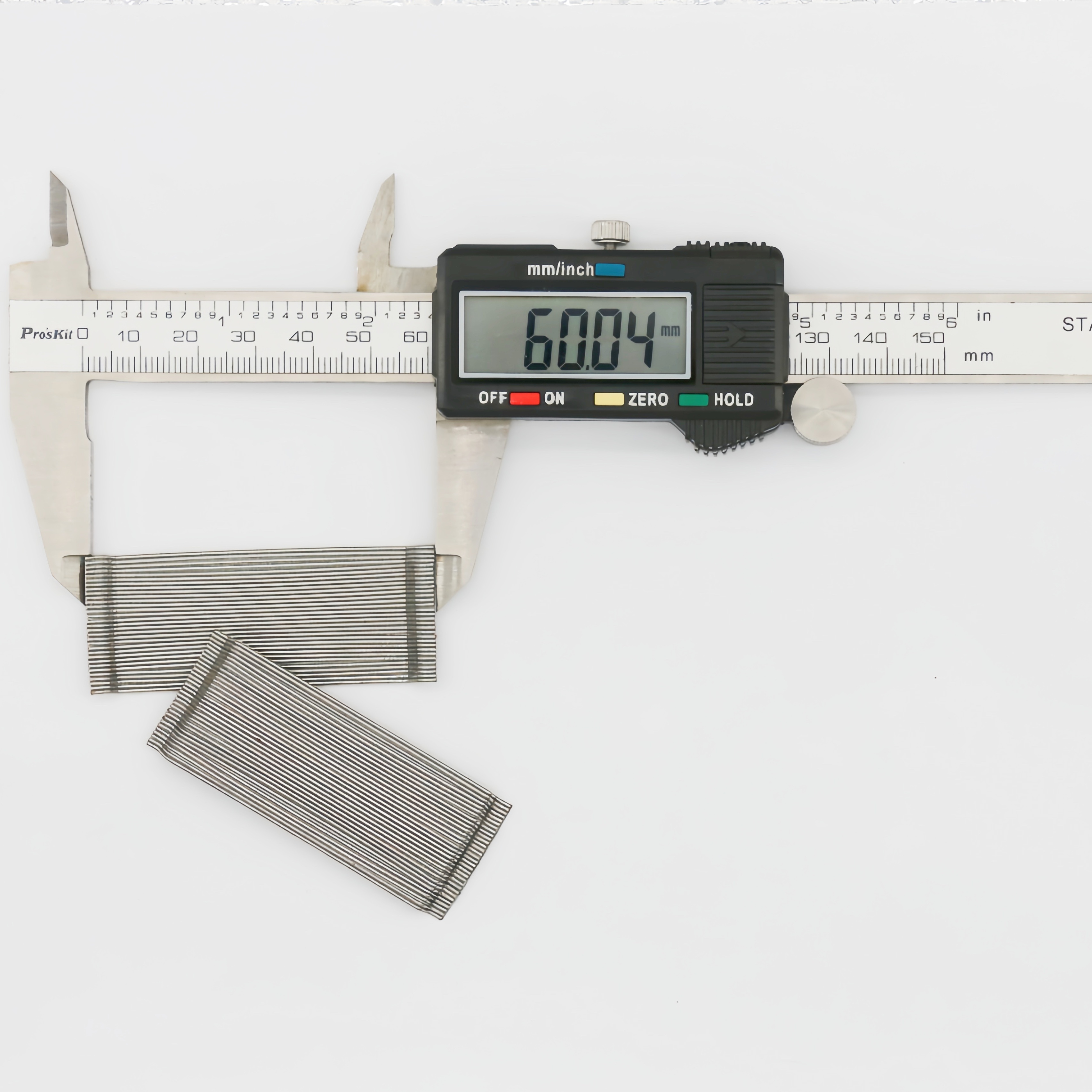
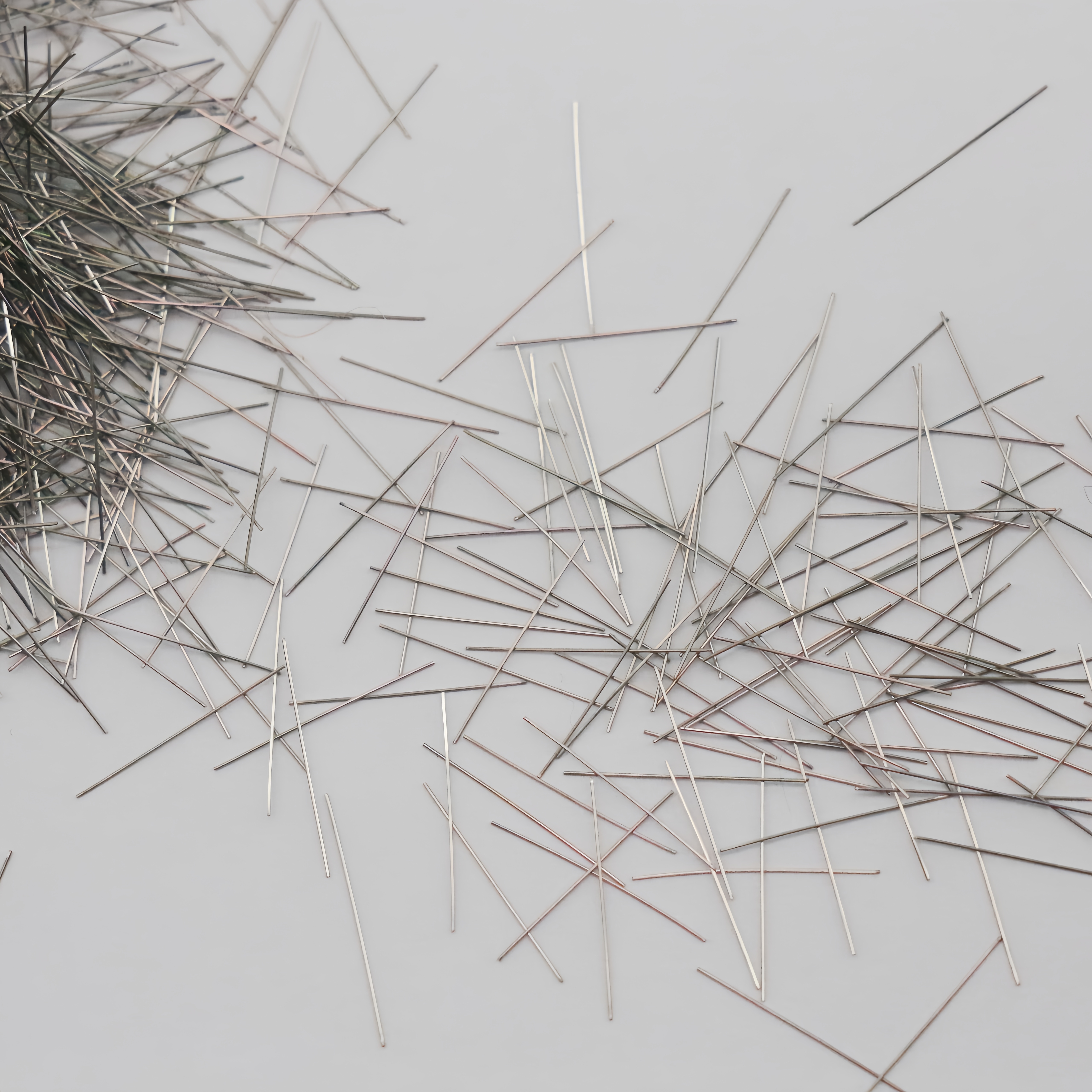
The carbon steel wire hooked-end range is available in models TC-07560-HNG, TC-07560-HHG, TC-05535-HNG and TC-07535-HNL, with a diameter range of 0.5–1.0 mm, a length range of 25–60 mm and a tensile strength range of 1100–2100 MPa. Fibers are supplied loose or as glued bundles. A 60 mm length is available, which is where the 80/60 designation originates: in the TC-07560 model name, 0.75 mm is the wire diameter and 60 mm is the cut length, giving an aspect ratio of approximately 80. The same 80/60 designation at 1200 MPa was used at a dosage of 20 kg/m³ in the Thailand flooring project described later.
These fibers are specified for humid environments, underground confined spaces, dynamic vehicle loads, alternating temperature and vibration load. The project types involved are warehouse floors, highway pavement, subway tunnels, mine roadways, bridge decks and underground parking lots. Dosing equipment, concrete mixers and spraying machines are the matched equipment across these applications.
Micro steel fiber for UHPC and bridge decks
The brass-coated micro steel fiber range — models TC-0213-CMS, TC-0220-CMS and TC-0213-SMS — is specified for bridge deck and UHPC work at 0.175–0.3 mm diameter, 6–25 mm length and 2200–2850 MPa tensile strength, with brass coating as the surface material. Stated UHPC performance with this fiber reaches a compressive strength of up to 220 MPa, a tensile strength exceeding 2100 MPa, and a fracture toughness stated at 250 times that of ordinary concrete. Applications include high-speed rail prefabricated components, bridges, airport runways and seismic-resistant structures.
For calibration, a published industry benchmark for brass-coated micro steel fiber used in UHPC lists tensile strength above 2,500 MPa and diameters of 0.2–0.3 mm (PIONEER MS-6013 product data, cited as a market benchmark). The TINGCO range and that benchmark overlap, which is what a buyer should expect at this specification level — but the acceptance decision must be made against the design's required tensile strength, not against a marketing range.

Where the UHPC element is a facade or another corrosion-exposed surface, the stainless steel micro fiber variant (TC-0213-SMS, stainless coating) is the relevant line. It shares the 0.175–0.3 mm diameter window, and the stainless micro-wire family extends to diameters as fine as 0.012 mm in special grades, with heat resistance stated up to 600 °C. Those finer grades are used outside concreting — EMI/RFI shielding, anti-static fabrics, new-energy battery current collectors, aerospace filtration, medical precision screens and acoustic mesh — which is why the buyer must state the application, not just the material.
PP fiber for flooring and macro synthetic fiber where corrosion is the constraint
Polypropylene fiber is specified where chloride exposure, stray current or chemical attack makes steel reinforcement undesirable, because polypropylene does not corrode. The TINGCO PP range is documented with explicit parameters:
- PP Micro Fiber: diameters of 18 μm, 32 μm and 36–38 μm; lengths of 6 mm, 12 mm and 19 mm; tensile strength of 550 MPa.
- PP Macro Fiber: diameter 0.7 mm; lengths from 30 mm to 58 mm; tensile strength 550–600 MPa.
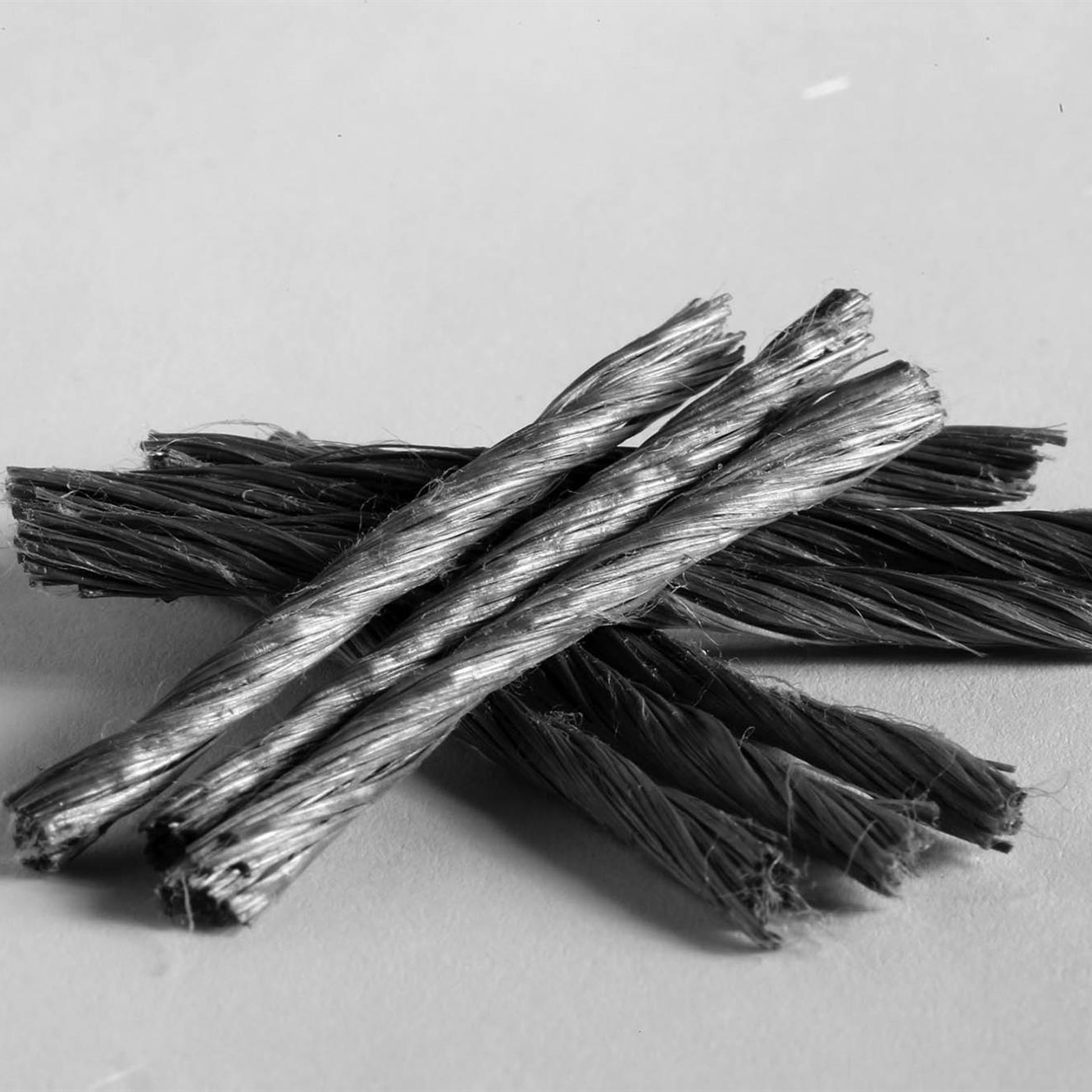
- PP Twisted Fiber: diameter 0.6–0.7 mm; lengths from 46 mm to 54 mm; tensile strength 450–650 MPa.
The material is polypropylene, with a density of 0.91 g/cm³ and an elastic modulus of at least 3500 MPa. Product data states a reduction of more than 30% in early-stage cracking from plastic shrinkage, drying shrinkage and temperature variation, together with improved impermeability and freeze-thaw resistance. For a floor slab, the practical division of labour is straightforward: macro synthetic fiber carries the post-crack load in a corrosion-free system, micro synthetic fiber controls plastic cracking.
Step-by-Step Breakdown: A Six-Step Qualification Sequence
The sequence below converts the four constraint layers into an order-ready checklist. It is written for importers, distributors, contractors and procurement managers evaluating fiber for concrete at the research and evaluation stage.
Step 1 — Fix the design input before contacting suppliers. Establish the application, the exposure condition and the dosage from the mix design. Reference dosages for steel fiber are 20–40 kg/m³ for shotcrete, 15–30 kg/m³ for industrial floors and 10–30 kg/m³ for precast elements. Decide the construction form as well: jointless slab on pile, segmental lining, or sprayed lining.
Step 2 — Confirm which standard your project cites. EN 14889-1:2006 governs EU conformity; ASTM A820/A820M specifies requirements for five types of steel fibers; ISO 13270 is a further reference. For flooring design, TR34 and EFNARC are the design codes that determine how fiber dosage is calculated. A supplier that cannot discuss these codes will not be able to defend a dosage calculation.
Step 3 — Match certificate scope to your specification, line by line. Take the certificate number, the issuing body, the standard, the validity dates and the declared parameter window, then compare it against the exact fiber you intend to buy. CE 1301 – CPR – 2456, for example, covers 0.5–1.0 mm diameter, 25–60 mm length and 1100–2100 MPa products. Anything outside that window requires separate verification.
Step 4 — Require batch documentation before shipment, not after. Ask for a complete datasheet including the ±10% manufacturing tolerance, a Certificate of Analysis and a Mill Certificate for every batch, and pre-shipment inspection with weighing and counting verification. This is the single most effective control against a supplier whose testing system is inadequate.
Step 5 — Validate with samples and independent testing. Request free samples, send them to an independent laboratory, and confirm a pre-production sample before mass production. Test methods for verification are EN 14651 (three-point bending beam test), ASTM C1609 (beam test) and ASTM C1550 (panel test) — these measure residual flexural strength and toughness index and are the core basis for engineering design and acceptance.
Step 6 — Lock commercial and supply terms. Confirm MOQ, lead time, monthly capacity, packaging and payment structure. On payment risk, the standard controls are T/T 30% + 70% or L/C rather than 100% advance payment; verification of the business licence and the 18-digit Unified Social Credit Code; and factory photographs or a video factory audit when the supplier may be a trader rather than a manufacturer.
Mixing and dosing note — where parameter compliance is won or lost.
Weigh the fiber according to the mix design. Water-soluble packaging bags can be fed directly into the mixer with the aggregates and dissolve in about 5 seconds; non-water-soluble packaging should be spread evenly in batches. Extend mixing time by 30–60 seconds compared with plain concrete to ensure uniform dispersion without clumping, then check slump and workability and adjust superplasticizer dosage if necessary. Operators should wear protective gloves and goggles, and large single dumps should be avoided because they cause balling. For long transport distances by mixer truck, pre-mixing at the batching plant is recommended.
Use Cases: Where These Constraints Are Applied
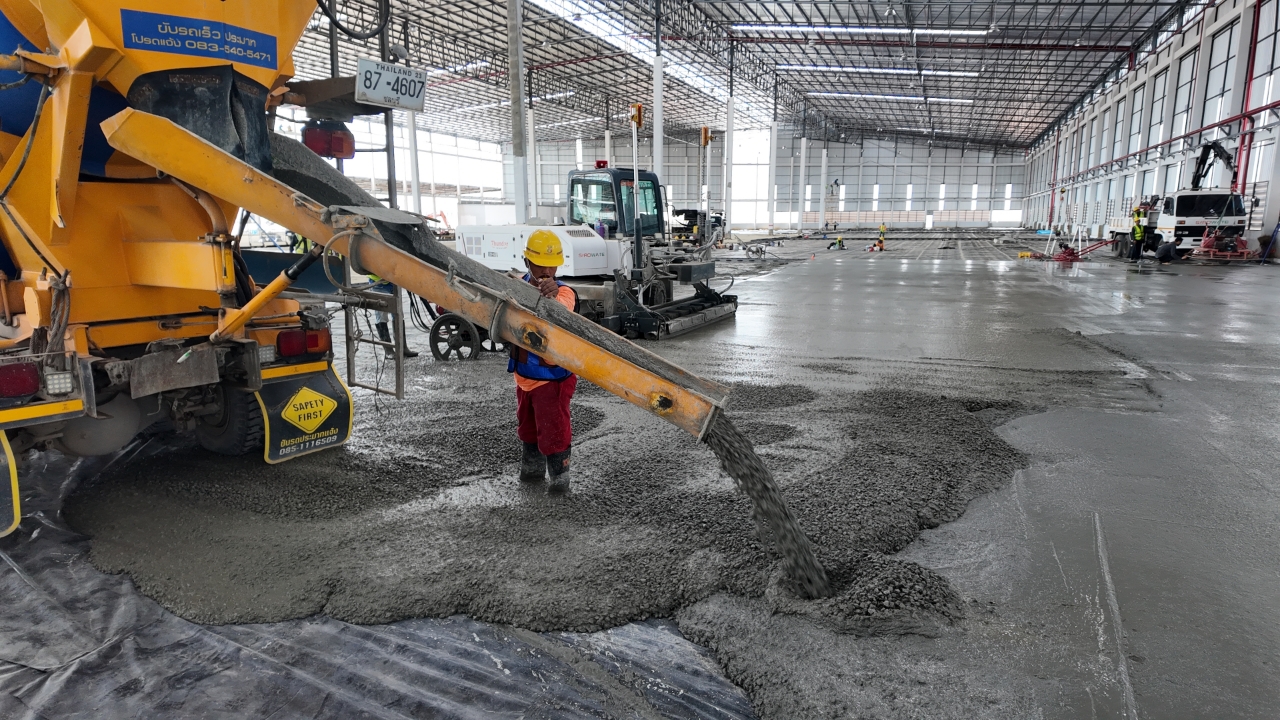
Heavy-duty industrial and logistics flooring (Thailand). A wholesaler with in-house technical support ran a one-year program supplying 2,000 tons of steel fiber into heavy-duty industrial warehouse flooring, logistics park flooring and jointless flooring. The design used 80/60 fiber at 1200 MPa and a dosage of 20 kg/m³. The engineering highlight was not the fiber itself but the layout: the pile arrangement was rearranged and optimized to better fit the slab-on-pile project, which is the kind of design-stage input that a fiber supplier either provides or does not.
Tunnel segment and mining support. Here the parameter window is fixed by the segment mould and the lining design; the 0.5–1.0 mm diameter, 25–60 mm length, 1100–2100 MPa range is the certified window for these applications, including 60 mm cut lengths.
UHPC bridge deck, high-speed rail precast and airfield pavement. Bridge deck and UHPC work pulls the specification toward micro fiber: 0.175–0.3 mm diameter, 6–25 mm length, 2200–2850 MPa, with brass coating for bond behaviour in the UHPC matrix.
Corrosion-exposed slabs and facades. Coastal floors, chemical plants, waste-water structures and UHPC facade panels push the specification toward synthetic macro fiber or stainless micro fiber, where the deciding constraint is corrosion resistance rather than tensile strength.
Comparison Table: Fiber Type, Parameters, Application and Certification Reference
| Fiber type | Diameter | Length | Tensile strength | Typical application | Certification / standard reference |
|---|---|---|---|---|---|
| Hooked-end carbon steel fiber TC-07560-HNG, TC-07560-HHG, TC-05535-HNG, TC-07535-HNL |
0.5–1.0 mm | 25–60 mm | 1100–2100 MPa | Industrial flooring, tunnel segment, mining | CE 1301 – CPR – 2456 to EN 14889-1:2006 (inside declared scope); ASTM A820/A820M-16 and ISO 13270 referenced by the manufacturer |
| Brass-coated micro steel fiber TC-0213-CMS, TC-0220-CMS |
0.175–0.3 mm | 6–25 mm | 2200–2850 MPa | UHPC and RPC, bridge deck, high-speed rail precast, airport runways, seismic-resistant structures | Outside the 0.5–1.0 mm window of CE 1301 – CPR – 2456; verify scope per order |
| Stainless steel micro fiber TC-0213-SMS |
0.175–0.3 mm (special grades as fine as 0.012 mm) | 6–25 mm | 2200–2850 MPa (heat resistance stated up to 600 °C) | UHPC facade and corrosion-critical elements; EMI/RFI shielding, filtration screens, battery current collectors | Outside the 0.5–1.0 mm window of CE 1301 – CPR – 2456; verify scope per order |
| PP micro fiber | 18 μm, 32 μm, 36–38 μm | 6 / 12 / 19 mm | 550 MPa | Plastic-shrinkage and temperature crack control in flooring and precast | Synthetic track — not covered by the steel fiber CE scope |
| PP macro fiber | 0.7 mm | 30–58 mm | 550–600 MPa | Industrial flooring, corrosion-free reinforcement | Synthetic track — not covered by the steel fiber CE scope |
| PP twisted fiber | 0.6–0.7 mm | 46–54 mm | 450–650 MPa | Flooring and precast crack control | Synthetic track — not covered by the steel fiber CE scope |
Parameters as published in TINGCO product data. Certification statements refer to CE Certificate 1301 – CPR – 2456 issued by TSUS to EN 14889-1:2006 and apply only within the declared parameter window.
Supply Constraints: Capacity, MOQ and Lead Time in Practice
Commercial constraints are where otherwise well-specified orders stall. The operational figures that matter are these: Tianjin TingCo Tech Co., Ltd was founded in 2014 and operates as the sales and R&D centre, with Hebei Tingco New Material Co., Ltd as the manufacturing base. The factory covers 6,000 m² with 50 employees and a five-engineer R&D team; annual output is 24,000 tons and monthly capacity is 2,000 tons. Lead time is 10–15 days, the MOQ is 24 tons, and export accounts for 70% of volume into the EU, Africa, South East Asia and the Middle East. Fibers are used in projects across more than 30 countries.
OEM and ODM production is available, including customer logo and custom fiber design, which matters for distributors building their own brand rather than reselling a generic bag. After-sales support covers remote technical support, quality-problem compensation and construction consultation.
Frequently Asked Questions
Which certification should an EU buyer check first when sourcing fiber for concrete?
Start with the CE certificate and read its scope, not just its number. CE Certificate 1301 – CPR – 2456, issued by TSUS to EN 14889-1:2006 and valid from 13 May 2025 to 12 May 2030, covers steel fibres for concrete (Group I) for reinforcement of concrete, mortars and cementitious mixes, and applies to products with a diameter of 0.5–1.0 mm, a length of 25–60 mm and a tensile strength of 1100–2100 MPa. If your specification falls outside that window — for example a 0.2 mm brass-coated micro fiber for UHPC — the CE certificate for the hooked-end range does not by itself cover your order, and separate scope confirmation is required.
Can one supplier cover both steel and synthetic fiber requirements, or should they be sourced separately?
A single manufacturer can cover both, and doing so simplifies procurement and documentation. TINGCO's product lines include steel fiber, brass-coated steel fiber, stainless steel fiber and polypropylene fiber — macro, micro and twisted — with steel fibers ranging from 0.5 mm to 1.0 mm diameter and 25 mm to 60 mm length at 1100–2100 MPa, and micro fibers from 0.175 mm to 0.3 mm at 2200–2850 MPa. The capability argument is not the catalogue breadth but the testing infrastructure behind it: an in-house steel fiber reinforced concrete laboratory performing beam bending, compression and toughness tests, ISO 9001 factory certification, and in-line plus pre-shipment inspection on every order.
What actually drives the cost of fiber for concrete, and how should quotations be compared?
Compare on dosage and delivered performance rather than on price per kilogram alone. The cost drivers are fiber type, tensile strength class, aspect ratio, coating, packaging and order volume; a higher-grade fiber at a lower dosage can be cheaper in place than a lower-grade fiber at a higher dosage. As a worked reference point, the Thailand industrial flooring program used 80/60 fiber at 1200 MPa and a dosage of 20 kg/m³ across warehouse, logistics park and jointless flooring. TINGCO's application data records construction-time reductions of up to 50% and total-cost reductions of 30–40% relative to traditional reinforcement in these applications, and the company operates a fixed-price policy: the quoted price is the price kept, with no last-minute markups and no substitution of inferior product.
How do I validate a fiber sample before committing to mass production?
Use a four-part sample protocol. Request free samples and send them to an independent laboratory rather than testing only in-house. Require a complete datasheet that states the ±10% manufacturing tolerance. Confirm a pre-production sample before mass production begins. Then, for the acceptance test itself, specify EN 14651 (three-point bending beam test), ASTM C1609 (beam test) or ASTM C1550 (panel test) so that residual flexural strength and toughness index are measured on the same basis the design assumed. Alongside the sample, request a Certificate of Analysis and Mill Certificate for every batch.
What MOQ and lead time should I plan for, and how can I reduce payment risk?
For TINGCO, the MOQ is 24 tons and the standard lead time is 10–15 days, supported by 2,000 tons monthly capacity and 24,000 tons annual output. On payment risk, avoid 100% advance payment: the standard structures are T/T 30% + 70% or L/C. Verify the supplier's business licence and 18-digit Unified Social Credit Code, and request factory photographs or a video factory audit if there is any doubt about whether you are dealing with a manufacturer rather than a trader. If you want to review the full product and project scope before ordering, download the TINGCO company and project brochure, or send your specification directly to the technical team for a dosage and certification check.
Conclusion: Buy the Constraint Set, Not Just the Fiber
Fiber for concrete fails on site for predictable reasons: a certificate that does not name the ordered diameter, a datasheet without tolerance, a dosage taken from a brochure rather than a mix design, or a payment structure that leaves no leverage. The countermeasure is a qualification sequence — fix the design input, confirm the standard, match certificate scope line by line, require batch documentation, validate through independent testing, and lock MOQ, lead time and payment terms in writing. TINGCO's published figures make that sequence concrete: CE 1301 – CPR – 2456 to EN 14889-1:2006 within a defined 0.5–1.0 mm, 25–60 mm, 1100–2100 MPa window; micro fiber at 0.175–0.3 mm and 2200–2850 MPa for UHPC and bridge deck work; PP macro, micro and twisted fiber for corrosion-free systems; a 24-ton MOQ and 10–15 day lead time against 2,000 tons of monthly capacity.
Next Step: Verify the Specification Against a Real Datasheet
Send your application, dosage and required standard to the TINGCO technical team. You will receive the matching datasheet with tolerances, the certification scope that applies to your specification, and a sample for independent testing — plus MOQ, lead time and OEM packaging terms for your market.
Email: info@tingco.co | Website: www.tcfibers.com | WhatsApp the sales team