Loose vs Glued Steel Fiber for Concrete: Head-to-Head Decision Guide
Short answer: loose and glued steel fiber can both sit inside the same verified specification — 0.5–1.0 mm diameter, 25–60 mm length, 1100–2100 MPa tensile strength — so the choice is not settled on the datasheet. It is settled at the batching plant. Loose fiber asks you to control how individual fibers are charged and dispersed. Glued fiber asks you to verify how a bundle releases during mixing. The guide below puts both forms against the same constraints, the same certification scope and the same acceptance tests, then ends with an either/or checklist that procurement and the sample approval team can use directly.
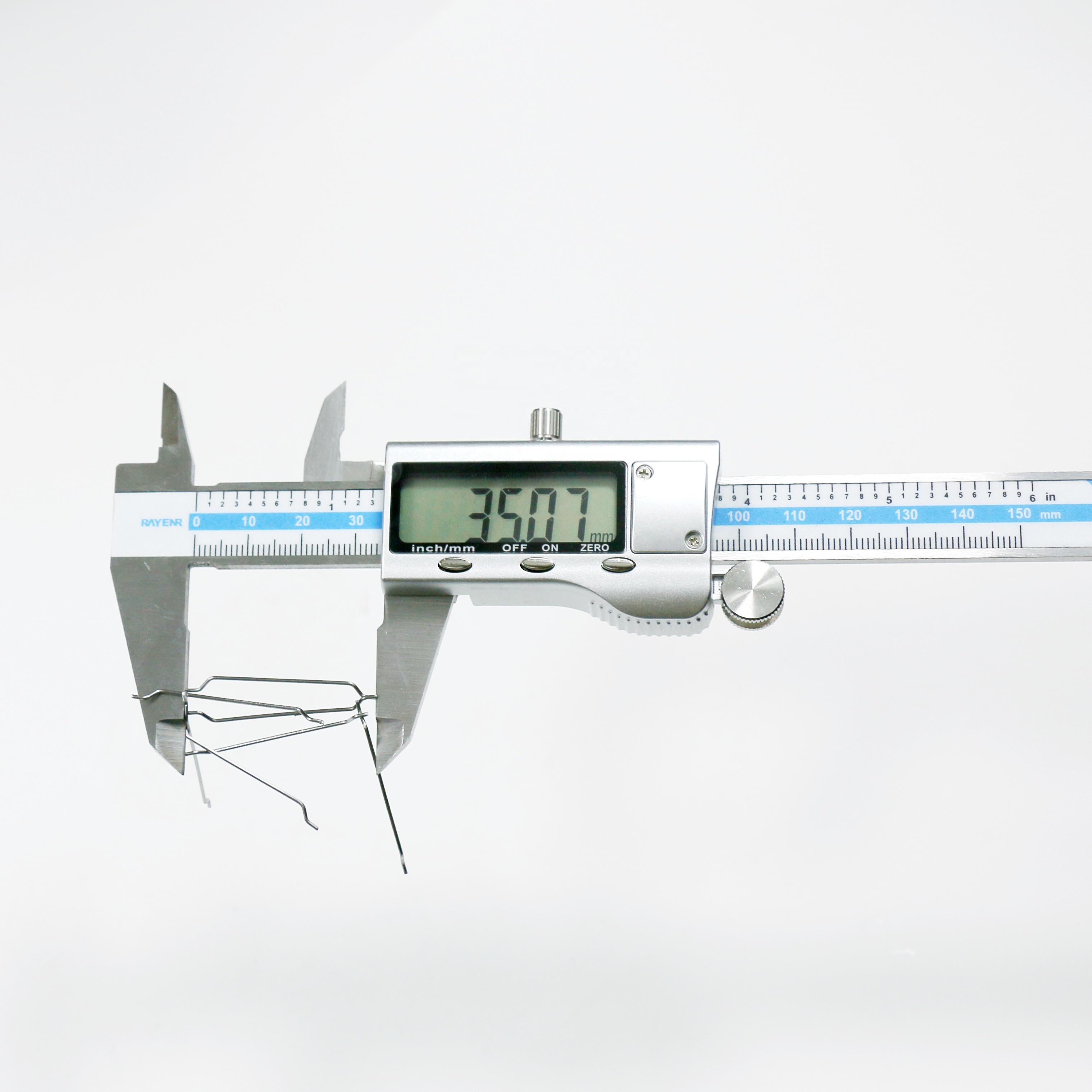
Most fiber comparison content compares materials: steel versus polypropylene, macro versus micro. This article stays deliberately narrower. It compares two delivery forms inside one product family, because that is where buyers get stuck after the structural specification is already written and the model number is already approved.
Problem Definition: Where the Loose vs Glued Decision Actually Sits
A steel fiber specification is normally fixed before anyone discusses form. Diameter, length, tensile strength and dosage come out of the structural design. The delivery form does not appear in that design at all — and that is precisely why it causes friction later. The same approved model can arrive as individual fibers or as glued bundles, and the two behave differently between the weighing scale and the discharge end of the mixer.
Loose steel fiber
Loose steel fiber is supplied as individual, unbundled fibers. Nothing holds the fibers together when the bag is opened, so the batch is built from elements the operator controls: the weighed quantity, the way it is spread into the mixer, and the mixing energy it receives. Dispersion quality therefore depends on the feeding method and the mixing equipment as much as on the fiber itself.
Glued bundled steel fiber
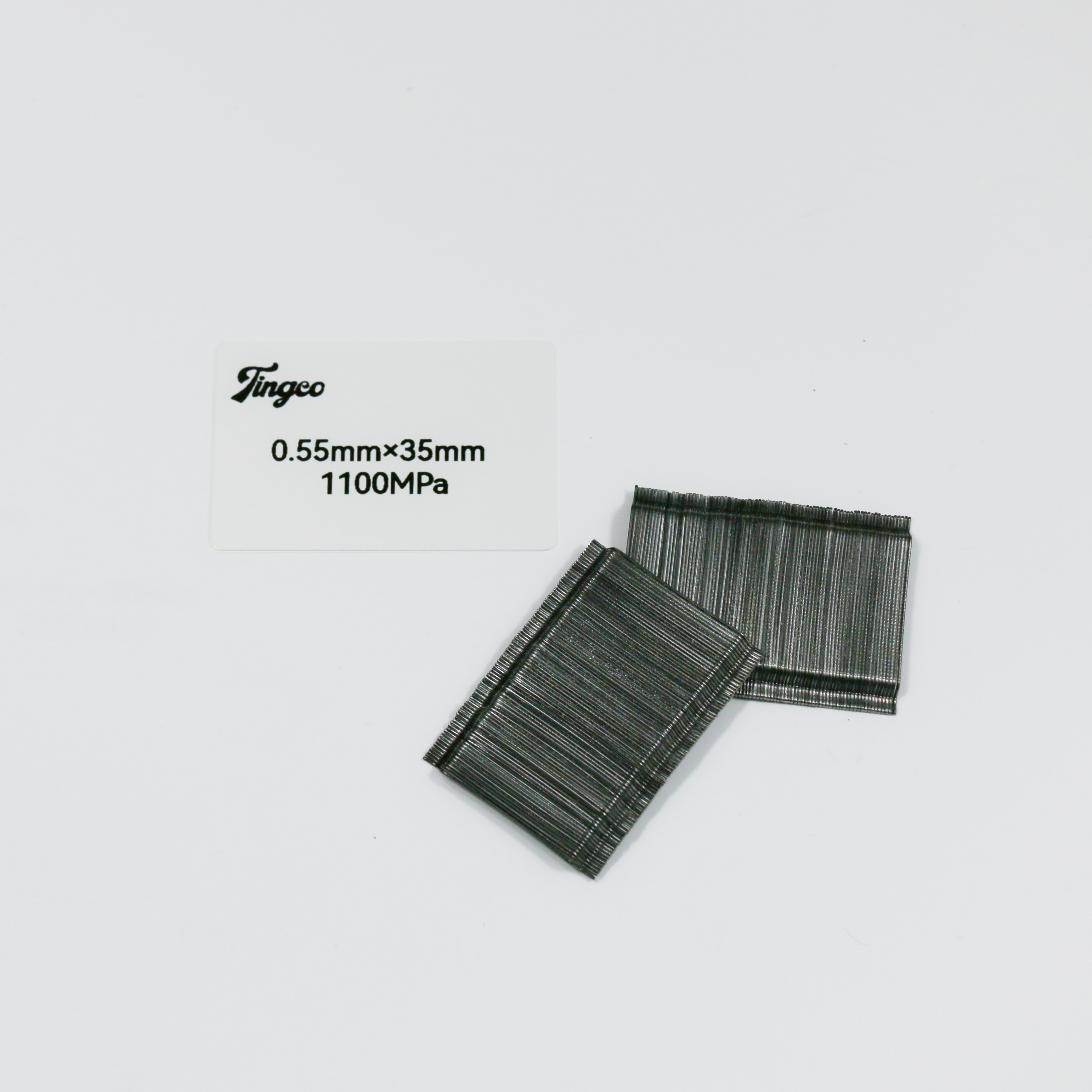
Glued steel fiber is supplied as a bundle. The individual fibers are held together with a water-soluble adhesive so the bundle can be charged into the mixer as one unit instead of fiber by fiber. The adhesive is intended to release during mixing so the fibers separate and disperse into the concrete. How quickly and how completely that release happens depends on the adhesive formulation and on the mix design — it is a supplier- and batch-specific behaviour that should be confirmed with a trial batch, not inferred from the word glued on the bag.
The plant-side constraints that decide the form
Three constraints, all of them plant-specific, decide whether a form survives the journey from goods-in to finished slab:
- Charging equipment. Fibers are introduced through a dosing machine or by controlled manual charging into a concrete mixer; shotcrete work adds a spraying machine downstream.
- Dispersion requirement. The mix has to deliver high dispersion uniformity, good compatibility with cement and no agglomeration during mixing — the requirement is identical whether the fiber arrives loose or glued.
- Time and transport. Fiber batches typically need 30–60 seconds of additional mixing compared with plain concrete, and where mixer trucks travel long distances, pre-mixing at the batching plant is recommended. A form that releases slowly consumes that added time window.
Industry Background: Why the Delivery Form Became a Buying Question
Steel fiber is a mature category that is still expanding. Fortune Business Insights projects the global steel fiber market to reach approximately USD 2.87 billion by 2026, with the industrial floors application segment accounting for a 37.28% share in 2026 and hooked-end fibers holding a 58.89% share of the type segment. Two consequences follow for anyone comparing delivery forms.
First, most steel fiber volume is consumed by floor construction, where pour cycles, pump lines and finishing windows are tight. Second, the dominant fiber geometry — hooked-end — is the geometry most likely to interlock and tangle if it is charged badly. A form decision made in an office and never tested in a floor pour is therefore a decision made in the least representative environment possible.
The standards layer adds a second constraint. ASTM A820/A820M-16 is the core global standard specifying requirements for five types of steel fibers used in fiber-reinforced concrete. EN 14889-1:2006 defines the definitions, specifications and conformity rules for steel fibers used in concrete within the European Union. Both make fibers comparable across suppliers. Neither replaces a trial batch in your own plant — and the trial batch is where loose and glued actually separate.
The Verified Envelope Both Forms Must Sit Inside
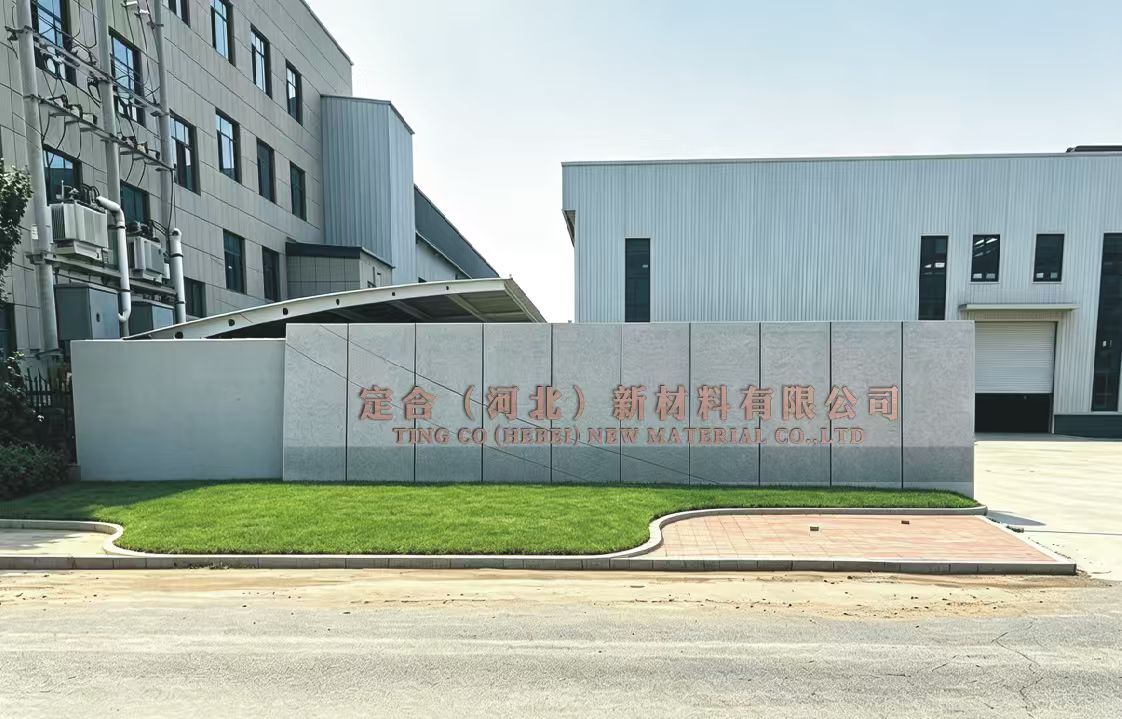
Before the two forms are compared, fix the box they both have to fit into. The figures below come from the product specification for the TINGCO Fiber Reinforced Concrete steel fiber series and from its associated CE certificate. Tianjin TingCo Tech Co., Ltd. (TINGCO) is a Tianjin, China-based manufacturer and technical partner for steel fibers, synthetic fibers and concrete reinforcement solutions, founded in 2014, operating a sales and R&D center in Tianjin and manufacturing through Hebei Tingco New Material Co., Ltd.
- Diameter: 0.5–1.0 mm
- Length: 25–60 mm, with a 60 mm option available
- Tensile strength: 1100–2100 MPa
- Base material: carbon steel wire
- Models in the series: TC-07560-HNG, TC-07560-HHG, TC-05535-HNG, TC-07535-HNL
- Intended industries: industrial flooring, tunnel segment, mining
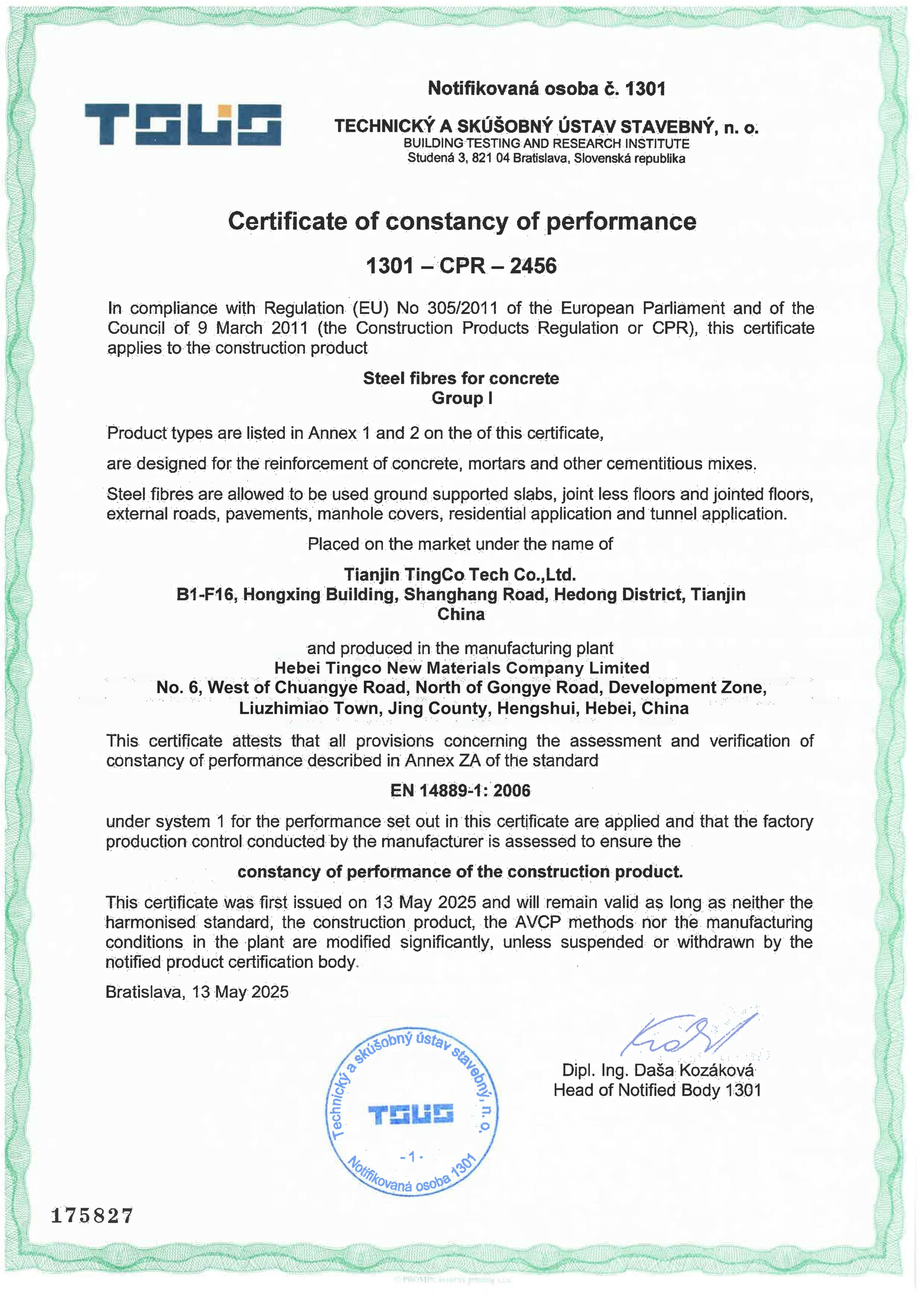
The series is covered by CE Certificate 1301 – CPR – 2456, issued by TSUS to EN14889-1:2006 for the EU market. The certified scope covers steel fibres for concrete (Group I) for reinforcement of concrete, mortars and cementitious mixes, and the certificate applies to steel fiber products with diameter 0.5–1.0 mm, length 25–60 mm and tensile strength 1100–2100 MPa — including products supplied for industrial flooring, tunnel segment and mining. The certificate was issued on 2025-05-13 and remains valid to 2030-05-12.
Head-to-Head Comparison: Loose vs Glued Steel Fiber
The table compares the two forms on the factors that actually change a purchasing file. Where the corpus of verified facts does not support a performance claim, the cell says what has to be verified rather than inventing an advantage.
| Decision factor | Loose steel fiber | Glued bundled steel fiber |
|---|---|---|
| Delivery state | Individual, unbundled fibers | Bundles held together by a water-soluble adhesive |
| Specification range (TINGCO series) | 0.5–1.0 mm diameter, 25–60 mm length, 1100–2100 MPa | Same range, including models TC-07560-HNG, TC-07560-HHG, TC-05535-HNG, TC-07535-HNL and the 60 mm option |
| Charging into the mix | Weighed and spread in controlled batches; dispersion depends on operator discipline and mixer energy | Charged as a bundle unit; release into the mix depends on the adhesive and must be verified in a trial batch |
| Mixing window | Add 30–60 seconds versus plain concrete, then check slump and workability | Same added mixing time; confirm the bundle has fully released inside that window |
| Documented application fit | Industrial flooring, tunnel segment, mining | Industrial flooring, tunnel segment, mining |
| Certification coverage | CE 1301 – CPR – 2456 to EN14889-1:2006, EU market | CE 1301 – CPR – 2456, same certified scope |
| Acceptance testing | EN 14651, ASTM C1609 or ASTM C1550 flexural toughness testing | Same test methods |
| Commercial terms | MOQ 24 tons, lead time 10–15 days, monthly capacity 2,000 tons | Same terms |
| Strongest reason to choose | You want batch-level control of the charge and your crew can spread fiber evenly | You want bundle-level charging and can verify release by trial and incoming inspection |
| Main risk to manage | Uneven manual charging and local agglomeration | Incomplete release of the bundle if the mixing window is too short |
The rows that say verify are deliberately left open. No supplier document, including a certificate, converts an untested bundle into a proven one in your mixer. The trial batch in step 6 is what closes those rows.
Step-by-Step Breakdown: From Specification to Approved Sample
Step 1 — Fix the application and the design dosage
Dosage is set by the mix design and the application, and it constrains how much fiber has to be handled per batch:
| Application | Typical steel fiber dosage |
|---|---|
| Shotcrete | 20–40 kg/m³ |
| Industrial floors | 15–30 kg/m³ |
| Precast elements | 10–30 kg/m³ |
These are dosing ranges for the mix design, not a form recommendation. They tell you how much material the charging point has to handle per cubic metre, which is the number that makes one form easier or harder in your plant.
Step 2 — Map the charging route before choosing the form
Charging is where the two forms diverge in practice. Water-soluble packaging bags can be fed directly into the mixer together with the aggregates and dissolve in about five seconds. Non-water-soluble packaging has to be opened, and the fiber spread evenly in batches rather than dumped in one go. If your line is built around bag-in-mixer charging, the packaging and the delivery form have to be compatible, and that compatibility has to be confirmed on your own equipment — not on a general datasheet.
Step 3 — Choose the form against that route
If your operator can weigh and spread fiber evenly and the mixer has time to disperse it, loose fiber keeps batch-level flexibility and avoids adding an adhesive-release variable. If manual spreading is the bottleneck at the charging point and you are prepared to verify bundle release in a trial, glued bundles reduce the number of handling steps at that point. Neither statement is a performance guarantee; both are operating preferences that must survive the trial in step 6.
Step 4 — Lock the model inside the verified envelope
Whatever form is chosen, the model has to sit inside 0.5–1.0 mm diameter, 25–60 mm length and 1100–2100 MPa tensile strength, from models TC-07560-HNG, TC-07560-HHG, TC-05535-HNG and TC-07535-HNL, with a 60 mm length option available. A form change is not a licence to move the model outside the range the certificate covers.
Step 5 — Verify the paper trail
Ask for three documents and read them together: the specification sheet, the CE certificate scope (1301 – CPR – 2456, EN14889-1:2006, issued by TSUS, valid 2025-05-13 to 2030-05-12), and the batch inspection record. TINGCO's quality control combines in-line inspection with pre-shipment inspection, and the factory runs its own steel fiber reinforced concrete testing laboratory where product lines undergo beam bending, compression and toughness tests. The certificate covers dimensions and tensile strength; the inspection record is what shows what will actually ship, including the delivery form.
Step 6 — Run the trial batch and the acceptance test
Prepare the trial with the same mixer, the same dosage and the same admixture regime as the production pour. Extend the mixing time by 30–60 seconds compared with plain concrete, then check slump and workability and adjust the superplasticizer dosage if necessary. At discharge, verify dispersion visually — and for glued bundles, confirm that the bundle has released completely rather than arriving at the mould as a clump.
For acceptance, use the flexural toughness method named in the project specification: the EN 14651 three-point bending beam test, the ASTM C1609 beam test, or the ASTM C1550 panel test. These methods verify residual flexural strength and toughness index and are the core basis for engineering design and acceptance.
Step 7 — Approve the sample and freeze the checklist
Write the approved form, model, dosage, mixing time and test method into the purchase order and the incoming inspection plan. From that point on, treat any change of form as a change of product, not as a logistics detail. Operators handling either form should wear protective gloves and goggles, and large single dumps should be avoided because they cause clumping regardless of the form supplied.
Use Cases: Industrial Flooring, Tunnel Segment and Mining
Industrial flooring
Industrial floors were the largest steel fiber application segment in 2026 at a 37.28% share, and the working conditions explain why: warehouse floors, logistics park floors, jointless floors and underground parking slabs carry dynamic vehicle loads, alternating temperature and vibration. Dosages typically sit at 15–30 kg/m³, fed through a dosing machine into a concrete mixer.
A Thailand-based wholesaler with technical support used the 80/60 geometry at 1200 MPa at a design dosage of 20 kg/m³ for heavy-duty industrial warehouse flooring, logistics park flooring and jointless flooring — 2,000 tons over one year. During design, the pile layout was rearranged to better fit the slab-on-pile project. For the form decision, the relevant lesson is the pour cycle: repetitive large-area pours reward a charging method the crew can repeat without variation, and punish a method that depends on improvisation.
Tunnel segment and precast
Precast elements are dosed at 10–30 kg/m³ and produced in a fixed factory process with a fixed mix. Steel fiber supplied for tunnel segment work is inside the CE certificate scope, which matters because segment production is inspected batch by batch. Because the mix repeats, the form has to repeat with it — and the trial should be run on the segment mix rather than on a generic floor mix, since release behaviour and dispersion depend on the mix the fiber lands in.
Mining and shotcrete
Mining support and shotcrete combine 20–40 kg/m³ dosages with confined underground space, humidity and vibration load, and the fiber passes through a spraying machine as well as a mixer. Any dispersion problem is amplified by the spraying process, which is why complete release before spraying is the checkpoint that matters most in this application.
| Application | Dosage range | What to verify about the form |
|---|---|---|
| Industrial flooring | 15–30 kg/m³ | Repeatable charging across large pours; slump and workability stability after the added 30–60 seconds of mixing |
| Tunnel segment / precast | 10–30 kg/m³ | Batch-to-batch consistency of the form; trial run on the actual segment mix |
| Mining / shotcrete | 20–40 kg/m³ | Complete bundle release before spraying; no agglomeration at the spraying machine |
Frequently Asked Questions
1. Does the CE certificate cover glued fiber as well as loose fiber?
CE Certificate 1301 – CPR – 2456, issued by TSUS to EN14889-1:2006 for the EU market, covers steel fibres for concrete (Group I) for reinforcement of concrete, mortars and cementitious mixes. Its stated scope applies to steel fiber products with diameter 0.5–1.0 mm, length 25–60 mm and tensile strength 1100–2100 MPa, and it covers fiber supplied for industrial flooring, tunnel segment and mining. Because the scope is defined by fiber type and by dimensional and mechanical range, the delivery form still has to be recorded separately on the purchase order and in the inspection plan. The certificate is valid from 2025-05-13 to 2030-05-12.
2. Can one supplier deliver loose and glued forms within the same model and specification?
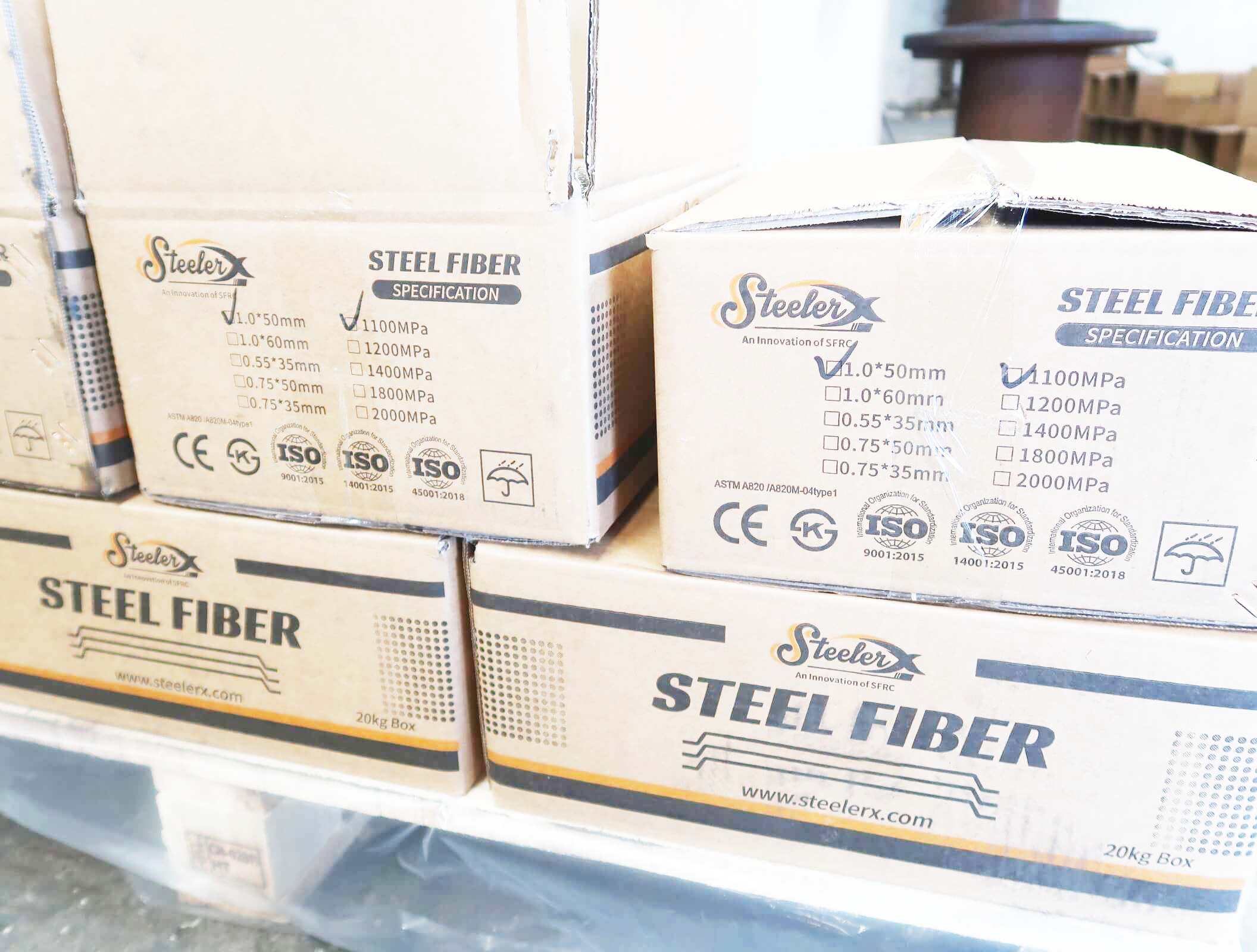
The TINGCO Fiber Reinforced Concrete series lists models TC-07560-HNG, TC-07560-HHG, TC-05535-HNG and TC-07535-HNL at 0.5–1.0 mm diameter, 25–60 mm length and 1100–2100 MPa tensile strength, and the series is documented in both loose and glued bundled form. Capability goes beyond the form: production runs on OEM/ODM terms with logo and different steel fiber design, monthly capacity is 2,000 tons, and quality control combines in-line inspection with pre-shipment inspection. The factory also operates its own steel fiber reinforced concrete testing laboratory, where product lines undergo beam bending, compression and toughness tests. A supplier that offers both forms is useful only if it can also document which form is in which box.
3. What drives cost when switching between loose and glued fiber?
Cost differences come from the process rather than from a published list price. Four items dominate: the charging method and the labour it requires; the 30–60 seconds of extra mixing time per batch; the risk of agglomeration and rejected batches if dispersion fails; and the order size, since MOQ is 24 tons with a 10–15 day lead time against a monthly capacity of 2,000 tons. TINGCO's application data for fiber reinforced concrete states a 50% reduction in construction time and a 30–40% reduction in total cost; those are application-level figures, not a loose-versus-glued price comparison. When comparing quotes, ask for cost per cubic metre of finished concrete with the charging method stated, not a price per ton alone.
4. How should a sample be approved for either form?
Approve the form, not only the fiber. Run a trial with the production mixer and the design dosage; water-soluble packaging bags can be fed directly into the mixer with the aggregates and dissolve in about five seconds, while non-water-soluble packaging must be opened and the fiber spread evenly in batches. Extend mixing by 30–60 seconds, check slump and workability and adjust superplasticizer if needed, confirm at discharge that glued bundles have fully released, then test by EN 14651, ASTM C1609 or ASTM C1550 and keep the pre-shipment inspection record with the approved sample. Operators should wear protective gloves and goggles throughout.
5. What lead time applies to a 24-ton order, and what is the next step?
MOQ is 24 tons and standard lead time is 10–15 days, against a monthly capacity of 2,000 tons; around 70% of output is exported to the EU, Africa, South East Asia and the Middle East. After-sales support covers remote technical support, quality problem compensation and construction consulting. For a buyer comparing forms, the practical next step is to request a sample in the intended delivery form together with the trial checklist, so the form is tested in your mixer before the order is signed.
Conclusion: The Either/Or Checklist
The loose versus glued decision does not change the specification. It changes the route the fiber takes through your plant, and therefore which risks you carry: uneven manual charging with loose fiber, or incomplete bundle release with glued fiber. Decide on the route, then prove it in a trial.
Choose loose steel fiber if:
- Your line can weigh and spread fiber evenly in controlled batches.
- Your mixer can absorb the extra 30–60 seconds of mixing without breaking the pour cycle.
- You want batch-by-batch control of the charge and prefer not to add an adhesive-release variable.
- Your incoming inspection plan records the form as loose and your crew is trained on batch spreading.
Choose glued bundled steel fiber if:
- You want bundles charged as a unit to reduce handling steps at the mixer.
- Your supplier can document the adhesive and you will verify release in your own mixer, on your own mix.
- Your pours are repetitive and you need the same charging action every cycle.
- Your inspection plan records the form as glued and includes a release check at discharge.
Either way, before the purchase order is issued:
- Confirm the model sits inside 0.5–1.0 mm diameter, 25–60 mm length and 1100–2100 MPa tensile strength.
- Check that CE Certificate 1301 – CPR – 2456 to EN14889-1:2006 covers the product and market you are buying for.
- Name the acceptance test: EN 14651, ASTM C1609 or ASTM C1550.
- Approve the sample in the shipping form, not in a substitute form.
- Plan the order against a 24-ton MOQ and a 10–15 day lead time.
Next Step: Sample, Trial Checklist and Quotation
Tianjin TingCo Tech Co., Ltd. (TINGCO) supplies steel fiber, brass coated steel fiber, stainless steel fiber and PP fiber from a 6,000 m² manufacturing base with 24,000 tons annual output, CE certification to EN14889-1:2006 under certificate 1301 – CPR – 2456, ISO 9001 factory certification, and stated conformity with ASTM A820 and ISO 13270. Products are used in projects across more than 30 countries.
Ask for a sample in the form you intend to buy, together with the dosing and trial checklist, and we will quote against your mixer, dosage and delivery schedule. Contact: info@tingco.co · Tel +86-22-59785568 · WhatsApp +86 189-2017-0726 · www.tcfibers.com
Download the company and project brochure: TINGCO Company Profile and Project Introduction (PDF)
Have Questions or Need More Details?
Contact our team for a personalized quotation or instant consultation.
Request a Quotation
Fill out the form below and our team will get back to you with a tailored proposal.
WhatsApp Direct Chat
Prefer to chat in real-time? Message us on WhatsApp for instant assistance & quick answers.
- Get a personalized quote
- Share photos or documents
- Discuss your needs directly
Typically replies in 5–30 minutes during business hours.