Ranking Fiber for Concrete: Best Product Families for UHPC, Industrial Flooring, and Tunnels
Fiber for concrete is an application decision before it is a purchasing decision. A fiber that performs inside a 60 mm tunnel segment is not automatically the right reinforcement for a thin UHPC bridge deck layer, because what a fiber does in concrete depends on diameter, length, tensile strength, coating and bonding mechanism, and dispersion behaviour — not on price per bag or brand familiarity.
This article ranks the fiber families Tianjin TingCo Tech Co., Ltd. manufactures and supplies for concrete reinforcement by application fit: UHPC and bridge deck reinforcement first, then industrial flooring, tunnel segments and mining support, then polypropylene (PP) fiber for crack control, impermeability and service life. Each entry states the documented specification band, the reason it is included in the ranking, and the limits a buyer should verify before ordering. All figures come from TingCo product data, TingCo's own reinforced-concrete testing laboratory, or published standards and market research. No claim of superiority over any named manufacturer is made.

Brass-coated micro steel fiber — rank 1 for UHPC and bridge deck reinforcement (models TC-0213-CMS, TC-0220-CMS).
How this ranking was built. Five criteria were applied in order: (1) specification band versus the demand of the project class; (2) documented performance or project data rather than catalogue claims; (3) dosing and dispersion control in real batching; (4) verification path against recognised test standards; (5) commercial availability — capacity, minimum order quantity and lead time. Application fit is weighted first, because a technically strong fiber used in the wrong application is a cost, not a benefit.
Problem Definition: Why ‘Fiber for Concrete’ Is Not One Specification
Steel fiber and PP fiber are both sold as fiber for concrete, yet they solve different problems. Steel fiber works mainly in the hardened state, adding flexural toughness and post-cracking load capacity. Synthetic polypropylene fiber works early, forming a three-dimensional random network inside the matrix that inhibits micro-cracks caused by plastic shrinkage, drying shrinkage and temperature variation.
Project conditions decide which mechanism matters. TingCo's documented application data covers humid environments, underground confined spaces, dynamic vehicle loads, alternating temperature and vibration loads, with floors operating continuously, 24/7. Those conditions impose four technical requirements on any fiber: alkali resistance, high dispersion uniformity, good compatibility with cement, and no agglomeration during mixing. A fiber that clumps during batching creates weak zones instead of reinforcement, and an alkali-sensitive fiber loses performance in a cementitious environment.
The failure modes are predictable. Plastic shrinkage cracking appears in the first hours on slabs and overlays. Insufficient flexural toughness shows up as wide crack openings under vehicle or seismic loading. A reinforcement that corrodes at an exposed surface becomes a durability problem. Over-specified fiber adds dosage cost without adding performance. Selecting by application first prevents all four.
Industry Background: What the Market and the Standards Say
Published market research places the global steel fiber market at approximately USD 2.87 billion by 2026 (Fortune Business Insights). Within that market, the industrial floors application segment holds a 37.28 percent share in 2026, and hooked-end steel fibers hold a 58.89 percent share of the type segment — which is why this ranking places flooring and hooked-end geometry so high. Construction-grade polypropylene fiber is a growing adjacent category, with a projected CAGR of 6.4 percent from 2026 to 2034 (Fortune Business Insights). On the supply side, a customs-based trade dataset identifies China as the largest exporter of steel fiber under HS 7326, accounting for 51.85 percent of identified imports; that figure comes from a commercial data aggregator and should be treated as directional rather than official.
Market sizing in this category varies between publishers, partly because some reports group synthetic fibers under broader ‘concrete fiber’ headings. When comparing forecasts, check whether the definition includes synthetic fiber and rebar-replacement value, not only the headline number.
Two standards define the technical baseline. ASTM A820/A820M-16 specifies requirements for five types of steel fibers used in fiber-reinforced concrete. EN 14889-1:2006 defines the definitions, specifications and conformity rules for steel fibers used in concrete within the European Union. TingCo's fibers are CE certified in accordance with EN 14889-1, comply with ASTM A820 and ISO 13270, and are produced in a factory holding ISO 9001 quality certification.
Ranked Product Families by Application
Brass-Coated Micro Steel Fiber (TC-0213-CMS, TC-0220-CMS) — UHPC and Bridge Deck Reinforcement
Documented specification: diameter 0.175–0.3 mm, length 6–25 mm, tensile strength 2200–2850 MPa, with a brass coating. In ultra-high-performance concrete (UHPC/RPC) systems this family is associated with compressive strength up to 220 MPa, fracture toughness 250 times that of ordinary concrete, and tensile strength exceeding 2100 MPa, and is applied in high-speed rail prefabricated components, bridges, airport runways and seismic-resistant structures.
Inclusion reason: UHPC matrices are dense and reinforced at small scale, so performance comes from a very high number of short, thin fibers distributed uniformly through the matrix. A 0.175–0.3 mm diameter with a 6–25 mm length is the geometry that fits that requirement, and the brass coating is a bonding and drawing-related surface finish rather than a decorative one.
Market reference point: published product literature for brass-coated micro steel fiber for UHPC — for example the PIONEER MS-6013 benchmark — cites tensile strengths above 2,500 MPa and diameters of 0.2–0.3 mm. TingCo's documented 0.175–0.3 mm and 2200–2850 MPa band sits in the same working range; buyers should compare the certificate and the tested value for the model they receive, not the catalogue headline.
Boundary: the 220 MPa compressive figure is a result of the UHPC system — binder, aggregate, curing and fiber together — not a property of the fiber alone. Micro fiber also demands controlled dosing; hand-feeding at the mixer is the fastest way to create fiber balls.
Stainless Steel Micro Fiber (TC-0213-SMS) — UHPC and Precast Elements Where Reinforcement Corrosion Matters
Documented specification: a stainless coating option within the same micro fiber group used for bridge deck applications, listed in the 0.175–0.3 mm diameter and 6–25 mm length range with a 2200–2850 MPa tensile band. TingCo also produces stainless steel micro wire in diameters as fine as 0.012 mm, combining metallic strength, conductivity and heat resistance up to 600°C.
Inclusion reason: stainless steel is selected when the corrosion behaviour of the reinforcement itself is a design consideration, typically in exposed or durability-critical concrete elements.
Boundary: the very fine 0.012 mm stainless micro wire is documented for non-structural applications such as EMI/RFI shielding, anti-static fabrics, new energy battery current collectors, aerospace filtration, medical precision screens and premium acoustic mesh. Those uses should not be confused with concrete reinforcement. For concrete, the relevant stainless option is the micro fiber in the UHPC size band.
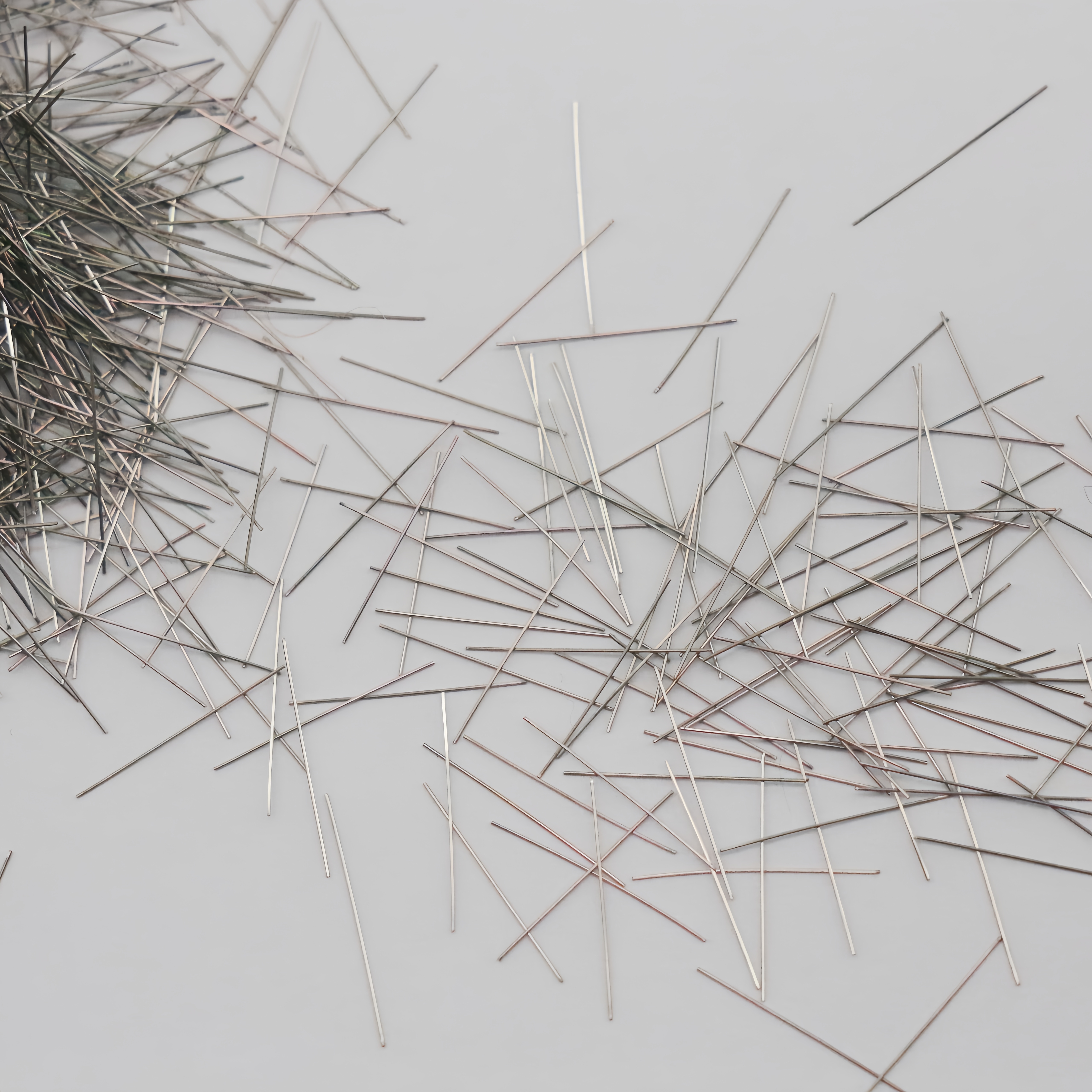
Stainless steel micro fiber — the corrosion-conscious option in the same micro fiber size band.
Hooked-End and Glued-Bundled Steel Fiber (TC-07560-HNG, TC-07560-HHG, TC-05535-HNG, TC-07535-HNL) — Industrial Flooring
Documented specification: diameter 0.5–1.0 mm, length 25–60 mm, tensile strength 1100–2100 MPa, carbon steel wire, with documented application in industrial flooring, tunnel segments and mining. TingCo's steel fiber range includes hooked-end loose steel fibers and glued bundled steel fibers.
Inclusion reason: in the documented industrial flooring application the fiber functions to control cracks while reducing construction time by 50 percent and lowering total cost by 30–40 percent for that project type. Hooked ends provide mechanical anchorage in the hardened matrix, and glued bundles keep the dosing line consistent while reducing the risk of fiber balling in automated batching. The 25–60 mm length band matches the slab thicknesses used in warehouse floors, highway pavement, logistics parks and jointless floors.
Requirements for this family in service: alkali resistance, high dispersion uniformity, cement compatibility, and no agglomeration during mixing. The supporting equipment matters as much as the fiber — dosing machines, concrete mixers and spraying machines are all part of the documented setup.
Boundary: a hooked-end fiber at the bottom of the tensile band (1,100 MPa) and one at the top (2,100 MPa) are different products for different load cases. Both the model number and the tested tensile value should appear on the inspection record.
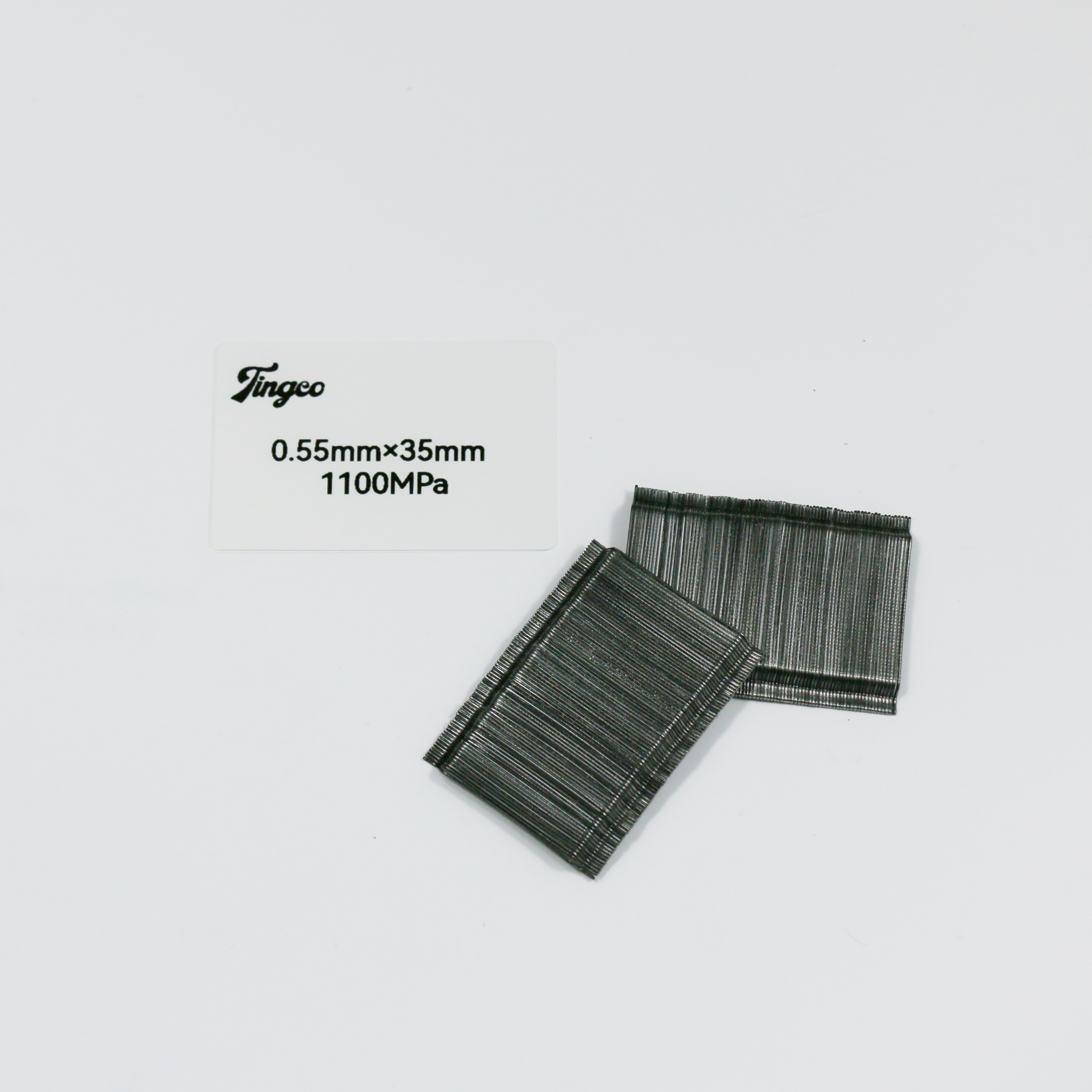
Glued bundled steel fiber — consistent dosing for industrial flooring and jointless slabs.
80/60 Steel Fiber at 1,200 MPa — Tunnel Segments, Mining Support and Heavy-Duty Pavement
Documented project configuration: heavy-duty industrial warehouse flooring, logistics park flooring and jointless flooring reinforcement, with a design dosage of 20 kg/m³ using 80/60 steel fiber at 1,200 MPa tensile strength. The reference project — a wholesaler with technical support in Thailand — covered 2,000 tons of fiber over one year.
Inclusion reason: this is the configuration with a documented dosage-and-design outcome rather than a catalogue specification, which makes it a useful starting point for tunnel segments, mine roadways and heavy-duty pavements exposed to dynamic vehicle loads and vibration. The same project also shows how much design work sits behind fiber selection: the pile layout was rearranged and optimized to fit the slab-on-pile structure.
TingCo supports this stage directly. The team has studied the TR34 and EFNARC design codes and works with professional design teams to provide steel fiber floor design and tunnel segment design services, covering mix design advice through construction guidance.
Boundary: 20 kg/m³ with 80/60 fiber at 1,200 MPa is a project-specific design result, not a default dosage. Dosage must be recalculated against the slab thickness, load class and mix design of each new project.
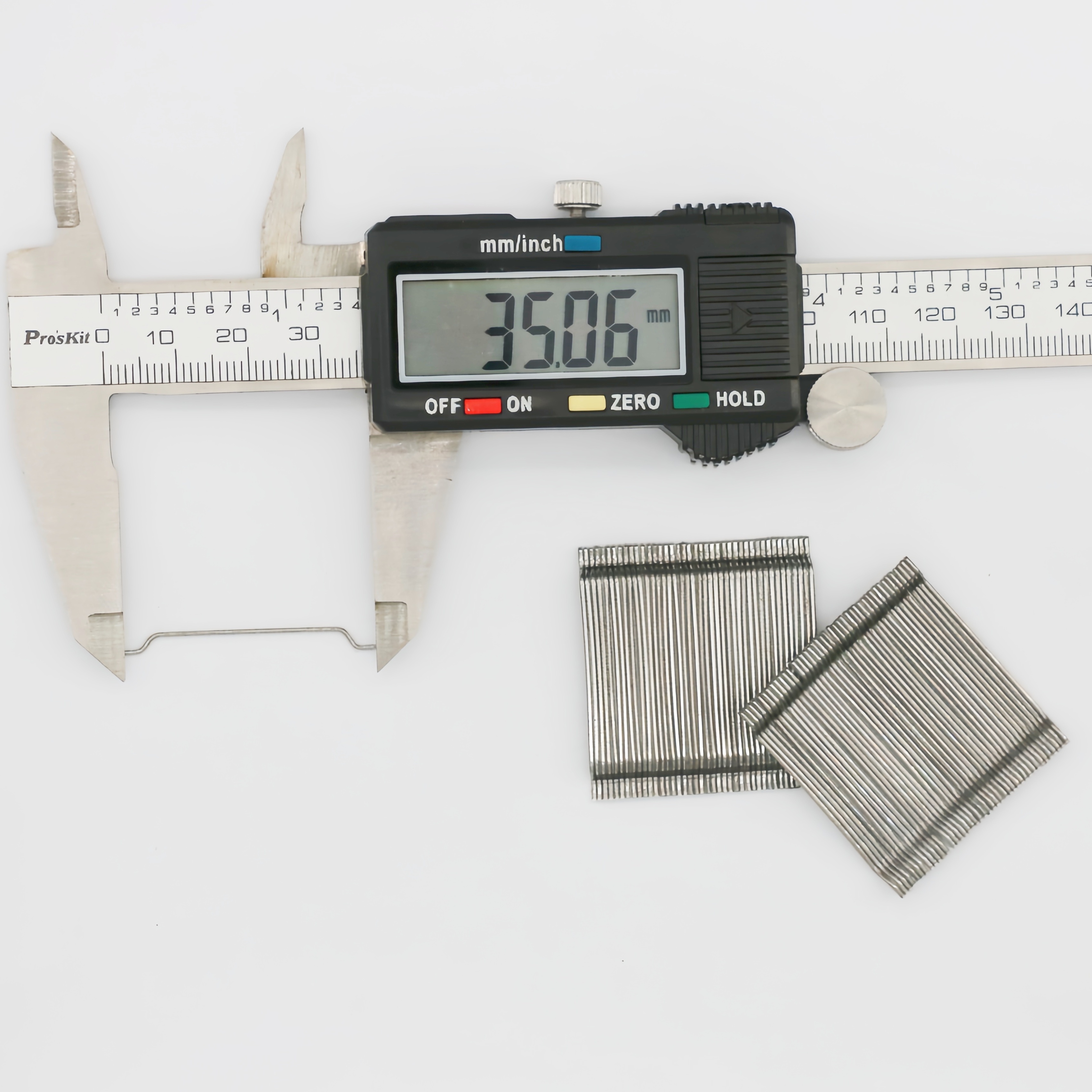
Steel fiber for tunnel segments, mining support and heavy-duty pavement concrete.
Macro PP Fiber — Crack Control, Impermeability and Service Life
Documented specification: macro PP fiber with 0.7 mm diameter, 30–58 mm length and 550–600 MPa tensile strength, in polypropylene. The fiber forms a three-dimensional random network inside the concrete matrix, targeting long-standing weaknesses of concrete: low tensile strength, cracking and durability loss.
Documented performance: early-stage cracking reduced by more than 30 percent, covering micro-cracks from plastic shrinkage, drying shrinkage and temperature variation; impermeability improved by approximately 37 percent, with additional gains in freeze-thaw and impact resistance; structural service life extended by more than 15 percent. Density is 0.91 g/cm³ with an elastic modulus of at least 3,500 MPa, so the fiber adds reinforcement without meaningful added weight. Chemical resistance is the defining advantage: PP withstands strong acids and alkalis and does not absorb water, so it introduces no corrosion path inside the concrete.
Inclusion reason: PP macro fiber is the ranked choice when the application calls for crack control and durability in aggressive environments, and specifically when a non-corroding reinforcement is preferred. It is not a substitute for steel fiber where flexural toughness under heavy load is required.
Market context: construction-grade polypropylene fiber is projected to grow at a 6.4 percent CAGR from 2026 to 2034 (Fortune Business Insights). Documented application fields include high-speed rail, bridges, nuclear power plants, tunnels and hydraulic engineering.
PP Micro and PP Twisted Fiber — Plastic Shrinkage Control and Surface-Critical Concrete
Documented specification: PP micro fiber with diameters of 18 μm, 32 μm and 36–38 μm and lengths of 6 mm, 12 mm and 19 mm at 550 MPa tensile strength; PP twisted fiber with 0.6–0.7 mm diameter, 46–54 mm length and 450–650 MPa tensile strength.
Inclusion reason: micro fiber acts at the earliest age, when plastic shrinkage cracking forms, and hydrophilic surface modification is what keeps the fiber dispersing uniformly and bonding inside the mix instead of floating or clumping. Twisted geometry adds mechanical grip at comparatively low dosage, which suits surfaces where finish and crack-free appearance matter — industrial floors, tunnel linings and overlays.
Boundary: micro and twisted PP fibers control shrinkage cracking; they do not replace structural steel reinforcement for load-bearing design.
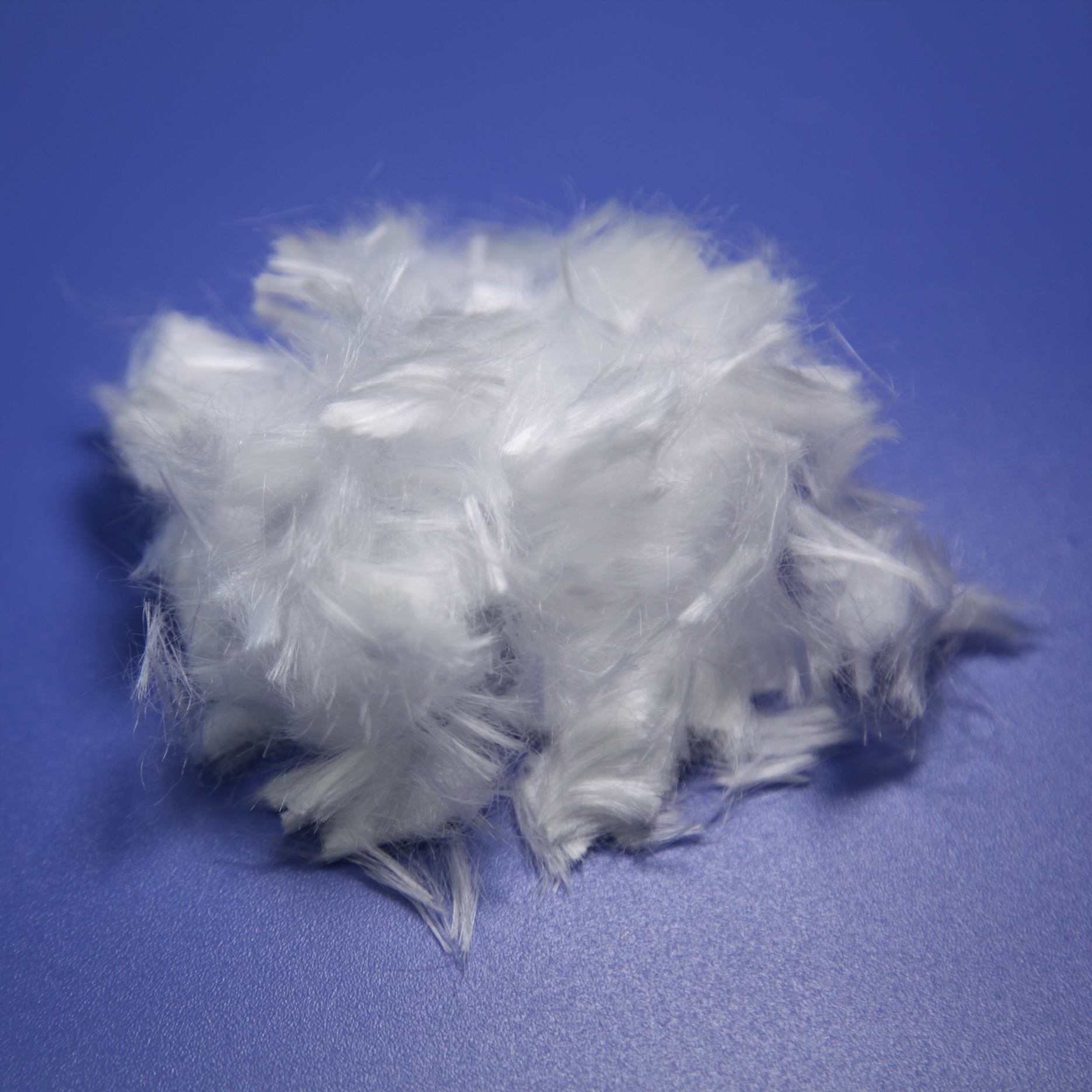
PP micro fiber — early-age crack control in slabs, linings and overlays.
Step-by-Step: From Project Class to Fiber Specification
Step 1 — Define the project class and the working condition. Warehouse floor, highway pavement, subway tunnel, mine roadway, bridge deck or underground parking lot. Then record the environment: humid or underground confined space, dynamic vehicle loads, alternating temperature, vibration, and whether the surface operates 24/7. These conditions eliminate unsuitable families immediately.
Step 2 — Match the fiber mechanism to the failure mode. Plastic shrinkage cracking → micro synthetic fiber. Hardened-state flexural toughness → steel fiber in the 0.5–1.0 mm diameter and 25–60 mm length band. UHPC performance → brass-coated micro steel fiber at 0.175–0.3 mm. Aggressive chemical exposure or a no-corrosion requirement → PP fiber.
Step 3 — Set the dosage from the mix design. Documented dosage bands: shotcrete 20–40 kg/m³; industrial floors 15–30 kg/m³; precast elements 10–30 kg/m³. For reference, the documented heavy-duty flooring project used 20 kg/m³ with 80/60 steel fiber at 1,200 MPa.
Step 4 — Confirm equipment, feeding and mixing time. Dosing machine, concrete mixer and spraying machine are the supporting equipment documented for these applications. Uniform feeding is essential: water-soluble packaging bags can be fed directly into the mixer together with the aggregates and dissolve in about five seconds, while non-water-soluble packaging should be spread evenly in batches. Mixing time extends by 30–60 seconds compared with normal concrete. Then check slump and workability and adjust the superplasticizer dose if needed. Operators should wear protective gloves and goggles, and large single dumps should be avoided because they cause clumping.
Step 5 — Verify with recognised test methods. EN 14651 three-point bending beam tests, ASTM C1609 beam tests or ASTM C1550 panel tests establish residual flexural strength and toughness index — the core basis for design and acceptance of steel fiber concrete. TingCo runs beam bending, compression and toughness tests in its own steel fiber reinforced concrete laboratory, and every shipment is inspected before dispatch for specifications, quantity and packaging, using in-line inspection plus pre-shipment inspection.
Step 6 — Lock commercial and supply terms. TingCo's documented terms: MOQ 24 tons, lead time 10–15 days, monthly capacity 2,000 tons, OEM/ODM with LOGO and design customisation, private-label packaging available on request, and main export markets in the EU, Africa, South East Asia and the Middle East.
Use Cases: Where Each Ranked Family Is Applied
- Heavy-duty warehouse and logistics park flooring (Thailand reference). 2,000 tons supplied over one year to a wholesaler with technical support; used for heavy-duty industrial warehouse flooring, logistics park flooring and jointless flooring; design dosage 20 kg/m³ of 80/60 steel fiber at 1,200 MPa; pile layout rearranged to fit the slab-on-pile structure.
- Tunnel segments and mine roadway support. Underground confined space, humid conditions, dynamic and vibration loading, 24/7 operation — served by the steel fiber family at 0.5–1.0 mm diameter, 25–60 mm length and 1,100–2,100 MPa tensile strength, with segment design support based on TR34 and EFNARC references.
- UHPC bridge decks and high-speed rail precast. Brass-coated micro steel fiber TC-0213-CMS and TC-0220-CMS at 0.175–0.3 mm diameter, 6–25 mm length and 2,200–2,850 MPa tensile strength.
- Shotcrete and underground parking or highway pavement. Dosage 20–40 kg/m³, applied with spraying machines.
- Chemically aggressive concrete — tunnels and hydraulic engineering. Macro PP fiber for acid and alkali resistance, approximately 37 percent impermeability improvement and more than 15 percent service life extension.
Comparison Table: Ranked Fiber Families at a Glance
| Rank | Fiber family & models | Diameter | Length | Tensile strength | Best-fit application | Inclusion reason |
|---|---|---|---|---|---|---|
| 1 | Brass-coated micro steel fiber — TC-0213-CMS, TC-0220-CMS | 0.175–0.3 mm | 6–25 mm | 2200–2850 MPa | UHPC, bridge deck, high-speed rail precast, airport runways, seismic-resistant structures | Highest fiber count per unit volume in a dense UHPC matrix; documented UHPC performance up to 220 MPa compressive strength |
| 2 | Stainless steel micro fiber — TC-0213-SMS | 0.175–0.3 mm | 6–25 mm | 2200–2850 MPa band | UHPC and precast elements where reinforcement corrosion is a design consideration | Stainless coating option inside the micro fiber family; separate fine stainless micro wire down to 0.012 mm for non-structural uses |
| 3 | Hooked-end and glued-bundled steel fiber — TC-07560-HNG, TC-07560-HHG, TC-05535-HNG, TC-07535-HNL | 0.5–1.0 mm | 25–60 mm | 1100–2100 MPa | Industrial flooring, warehouse floors, highway pavement, jointless slabs | Mechanical anchorage plus stable dosing; documented crack control with 50% construction-time reduction and 30–40% total cost reduction |
| 4 | 80/60 steel fiber at 1,200 MPa (reference configuration) | Within the 0.5–1.0 mm steel fiber range | Within the 25–60 mm steel fiber range | 1200 MPa (project configuration) | Tunnel segments, mining support, heavy-duty pavement, logistics park flooring | Documented dosage outcome of 20 kg/m³ in a 2,000-ton, one-year heavy-duty flooring project with pile layout optimisation |
| 5 | Macro PP fiber | 0.7 mm | 30–58 mm | 550–600 MPa | Flooring, tunnels, hydraulic engineering, chemically aggressive exposure | Over 30% early-stage cracking reduction, ~37% impermeability improvement, over 15% service life extension, acid and alkali resistance, no corrosion path |
| 6 | PP micro fiber | 18 μm, 32 μm, 36–38 μm | 6, 12, 19 mm | 550 MPa | Plastic shrinkage control in slabs and overlays | Acts at the earliest age; hydrophilic modification for uniform dispersion |
| 6 | PP twisted fiber | 0.6–0.7 mm | 46–54 mm | 450–650 MPa | Surface-critical floors, linings, overlays | Twisted geometry adds mechanical grip at low dosage |
FAQ: Fiber for Concrete, Ranked by Application
Which standards apply to fiber for concrete, and what should a buyer verify?
ASTM A820/A820M-16 specifies requirements for five types of steel fibers used in fiber-reinforced concrete, and EN 14889-1:2006 defines the definitions, specifications and conformity rules for steel fibers used in concrete in the European Union. TingCo fibers are CE certified in accordance with EN 14889-1, comply with ASTM A820 and ISO 13270, and are produced in a factory with ISO 9001 quality certification. Performance verification uses EN 14651, ASTM C1609 or ASTM C1550. Buyers should tie the certificate to the exact model shipped, not to the product family in general.
Which fiber family fits UHPC, industrial flooring and tunnels?
UHPC and bridge deck reinforcement: brass-coated micro steel fiber at 0.175–0.3 mm diameter, 6–25 mm length and 2200–2850 MPa, models TC-0213-CMS and TC-0220-CMS. Industrial flooring: hooked-end and glued-bundled steel fiber at 0.5–1.0 mm diameter, 25–60 mm length and 1100–2100 MPa, models TC-07560-HNG, TC-07560-HHG, TC-05535-HNG and TC-07535-HNL. Tunnel segments and mining: the same steel fiber range, with a documented heavy-duty reference configuration of 80/60 fiber at 1,200 MPa and 20 kg/m³. Crack control and impermeability in chemically aggressive conditions: PP fiber in macro, micro or twisted form.
How should a buyer evaluate the cost of fiber for concrete?
The cost driver is dosage per cubic metre multiplied by volume, plus placement and finishing time — not the bag price alone. In the documented TingCo flooring application, fiber reinforcement functioned to reduce construction time by 50 percent and lower total cost by 30–40 percent while controlling cracks. The relevant dosage bands are industrial floors 15–30 kg/m³, shotcrete 20–40 kg/m³ and precast elements 10–30 kg/m³. For market context, the global steel fiber market is projected at approximately USD 2.87 billion by 2026 with industrial floors at a 37.28 percent application share, and construction PP fiber is projected to grow at a 6.4 percent CAGR from 2026 to 2034 (Fortune Business Insights).
How can a buyer validate a fiber before committing to a full order?
Validation has three parts: a dosage trial against the project mix design, performance verification with EN 14651, ASTM C1609 or ASTM C1550, and a document check covering CE/EN 14889-1, ASTM A820, ISO 13270 and ISO 9001. TingCo operates its own steel fiber reinforced concrete testing laboratory, where product lines undergo beam bending, compression and toughness tests, and provides technical support from mix design advice through construction guidance, with OEM and private-label packaging available on request. To open a technical or sample-validation conversation, contact info@tingco.co or WhatsApp +86 189-2017-0726.
What are the MOQ and lead time for ordering fiber for concrete?
The documented terms are a minimum order quantity of 24 tons and a lead time of 10–15 days, supported by a monthly capacity of 2,000 tons. OEM/ODM production covers LOGO and design customisation of steel fiber, and main export markets are the EU, Africa, South East Asia and the Middle East.
Conclusion: Choose by Application, Then by Dosage, Then by Terms
The ranking above follows one order of decision-making. First, match the fiber family to the project class: brass-coated micro steel fiber for UHPC and bridge decks, the 0.5–1.0 mm steel fiber range for industrial flooring, tunnel segments and mining, and PP fiber where crack control, impermeability and a corrosion-free reinforcement matter. Second, set the dosage against a real mix design and verify it with EN 14651, ASTM C1609 or ASTM C1550 testing. Third, confirm the commercial and supply terms that keep a project on schedule.
Tianjin TingCo Tech Co., Ltd. is a manufacturer and technical partner for steel fibers, synthetic fibers and concrete reinforcement solutions, founded in 2014 and headquartered in Tianjin, China. The company operates through Tianjin TingCo Tech Co., Ltd. (sales and R&D centre) and Hebei Tingco New Material Co., Ltd. (manufacturing base), with a 6,000 m² factory, 50 employees, 24,000 tons of annual output, 5 R&D engineers, and around 70 percent of output exported to the EU, Africa, South East Asia and the Middle East. TingCo fibers are used in industrial floors, tunnel segments and linings, shotcrete, mining support, precast elements and UHPC projects, with customers served across more than 30 countries.
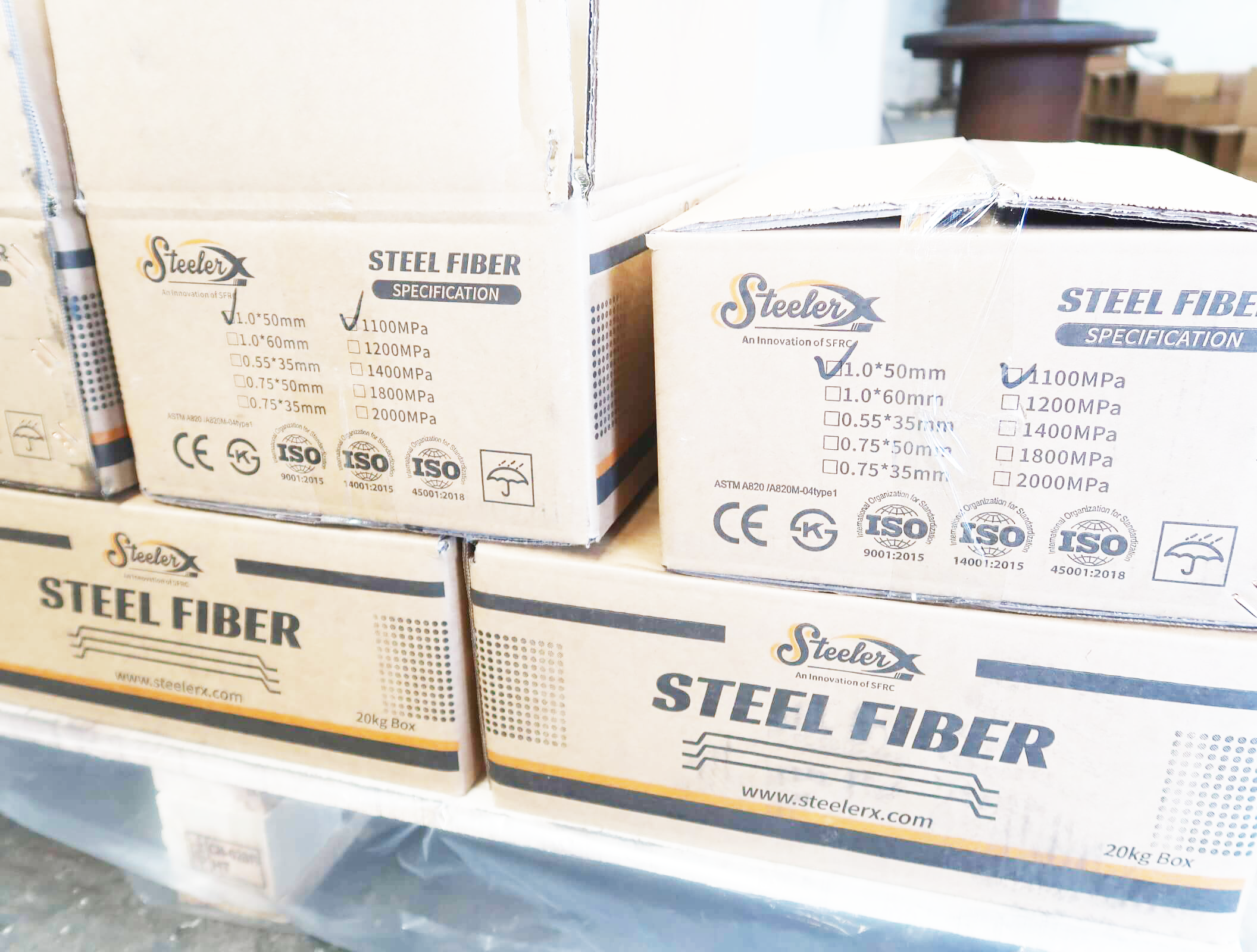
OEM packaging and private-label options support 24-ton minimum orders and 10–15 day lead times.
Next step for your project: send the project class, slab or segment thickness, load condition and target dosage, and the TingCo team will match a fiber family to it and confirm specification, packaging and lead time.
Download the full product and project introduction: TINGCO company and project brochure (PDF).
Website: www.tcfibers.com | Email: info@tingco.co | Tel: +86-22-59785568 | WhatsApp: +86 189-2017-0726
Tianjin TingCo Tech Co., Ltd. | Hebei Tingco New Material Co., Ltd. | Built on Trust. Proven in Concrete.