Tianjin TingCo Tech Co., Ltd.: Company Profile, Capability, and Buyer Value in Fiber for Concrete
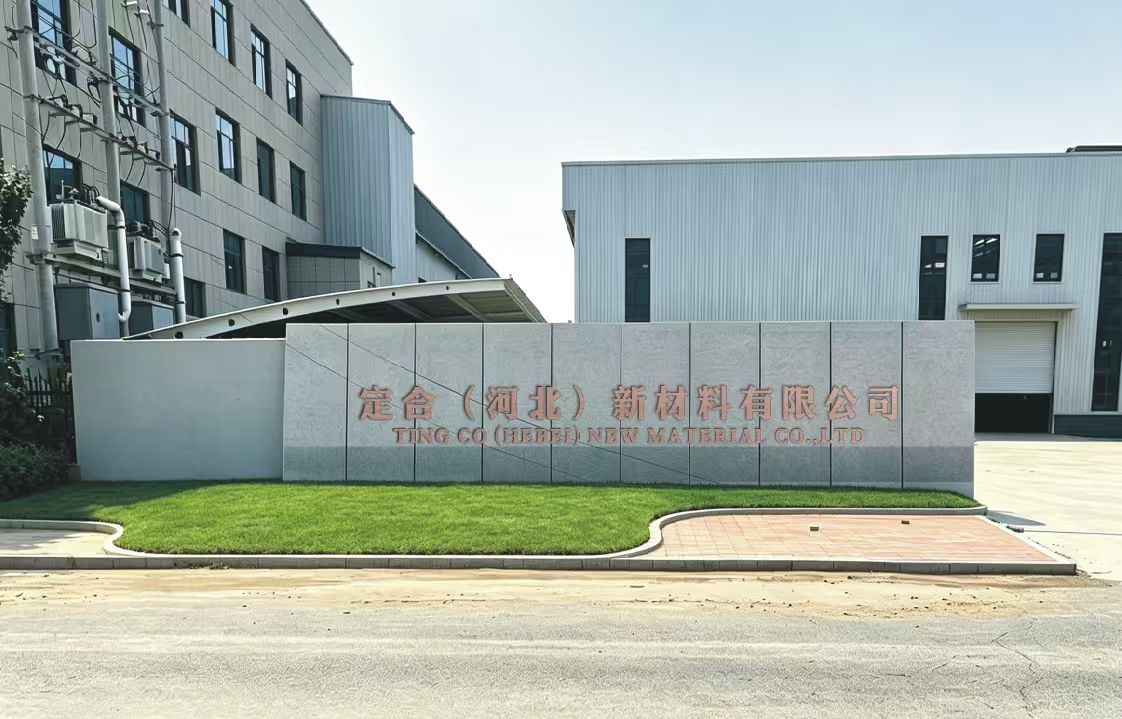
Tianjin TingCo Tech Co., Ltd. is a China-based manufacturer and technical partner specializing in steel fibers, synthetic fibers, and concrete reinforcement solutions. Founded in 2014 and headquartered in Tianjin, the company operates through two entities: Tianjin TingCo Tech Co., Ltd., its sales and R&D center, and Hebei Tingco New Material Co., Ltd., its manufacturing base in Hebei. This integrated structure covers research, production, quality control, technical support, and export service under one roof. Annual fiber output is approximately 24,000 tons, and roughly 70% of total sales are exported to the EU, Africa, South East Asia, and the Middle East.
This profile is written for importers, distributors, contractors, and engineers in the awareness and research stage of sourcing fiber for concrete — the point at which a buyer needs to understand who a supplier is, what it actually manufactures, how it is certified, and how its commercial model works before requesting samples or quotes.
The sections below follow the sequence a technical buyer normally works through: the purchasing problem, the 2026 market context, the company and its product families, manufacturing and quality capability, a step-by-step specification and validation workflow, application use cases, side-by-side comparison tables, market recognition and buyer value, and a short FAQ.
Why Evaluating a Fiber for Concrete Supplier Is a Trust Problem, Not Just a Price Problem
Fiber reinforcement is a low-volume, high-consequence purchase. Dosage in the documented reference ranges typically falls between 10 and 40 kg/m³ depending on the application, which means fiber is a small share of concrete cost — but it controls plastic and drying shrinkage cracking, residual flexural strength, and the outcome of acceptance testing on the finished slab, segment, or sprayed lining.
That imbalance creates a specific evaluation problem: two fiber bags can look identical while behaving differently in concrete. The variables that decide performance — wire diameter tolerance, tensile strength, coating, bundle integrity, surface treatment, and dispersion behaviour — are not visible to the eye.
Buyers researching this category typically run into the same five risks:
- Trader-versus-manufacturer ambiguity. Companies that present as factories may be intermediaries with no production line and no testing system of their own.
- Datasheets without tolerances. A stated diameter is not actionable unless the tolerance (commonly ±10%) and the test method are given.
- No batch-level documentation. Without a Certificate of Analysis (COA) or mill certificate per shipment, performance cannot be traced back to a production lot.
- Unvalidated performance in real concrete. Fiber properties measured on the wire do not automatically translate into residual flexural strength in a given mix design.
- Payment exposure. Structured payment terms and entity verification are the practical defences against non-shipment or delayed shipment.
A supplier profile is useful only if it answers these five risks directly. The rest of this article evaluates Tianjin TingCo Tech Co., Ltd. against each of them, using the company’s disclosed operational data and certification records.
Industry Background: The Fiber for Concrete Market in 2026
The global steel fiber market is placed at approximately USD 2.87 billion for 2026 by Fortune Business Insights. That figure should be treated as directional rather than definitive: research houses publish materially different numbers for this category — from roughly USD 1.96 billion to USD 4.67 billion — largely because some include synthetic fibers under steel fiber headings and because rebar-replacement value is modeled differently. Buyers comparing market reports should check what each report counts before using the number in a business case.
Two segmentation figures are more stable and more directly actionable for procurement:
- Industrial floors accounted for 37.28% of the steel fiber market in 2026, making flooring the single largest application segment (Fortune Business Insights).
- Hooked-end steel fibers held 58.89% of the market by type in 2026 — the dominant fiber geometry in commercial supply.
On the synthetic side, the global polypropylene fiber market for construction is projected to grow at a CAGR of 6.4% from 2026 to 2034 (Fortune Business Insights), a faster growth rate than the steel fiber category — consistent with wider use of non-corrosive synthetic fibers for shrinkage crack control.
Supply remains heavily concentrated. Customs datasets aggregating trade flows under HS 7326 identify China as the largest exporter of steel fiber, at 51.85% of identified imports (Zauba customs data). That concentration is the practical reason many buyers outside China end up evaluating Chinese manufacturers — and the reason entity verification matters as much as product specification.
The governing standards are well defined. EN 14889-1:2006 sets definitions, specifications, and conformity requirements for steel fibers used in concrete in the European Union. ASTM A820/A820M is the US-origin standard specifying requirements for five types of steel fiber in fiber-reinforced concrete. For design verification, EN 14651 (three-point bending beam test), ASTM C1609 (beam test), and ASTM C1550 (panel test) are the core methods used to establish residual flexural strength and toughness index.
What this means for buyers: in a market where hooked-end fiber is close to a commodity, differentiation shifts away from geometry and toward testing data, coating and bundle consistency, tolerance control, and documentation. Those are the criteria used in the evaluation below.
Company Overview: Tianjin TingCo Tech Co., Ltd.
Structure, Locations, and History
Tianjin TingCo Tech Co., Ltd. was established in 2014 and has more than ten years of experience in concrete reinforcement fiber manufacturing. The company operates as two cooperating entities:
- Tianjin TingCo Tech Co., Ltd. — the sales and R&D center, based in Tianjin, China (B1F16, Hongxing Building, Linke West Road, Hedong, Tianjin 300161, China). This is where the five-engineer R&D team and customer-facing technical support sit.
- Hebei Tingco New Material Co., Ltd. — the manufacturing base in Hebei, covering a 6,000 m² factory area.
Grouping sales, R&D, production, quality control, technical support, and export service under one structure means a buyer deals with one responsible party from enquiry through shipment, rather than a factory on one side and an export agent on the other.
Company Snapshot
| Attribute | Disclosed data |
|---|---|
| Company name | Tianjin TingCo Tech Co., Ltd. (manufacturing entity: Hebei Tingco New Material Co., Ltd.) |
| Established | 2014 — more than 10 years in concrete reinforcement fiber manufacturing |
| Headquarters | Tianjin, China |
| Manufacturing base | Hebei, 6,000 m² factory area |
| Workforce | Approximately 50 employees across sales, R&D and production |
| R&D team | 5 engineers at the Tianjin sales and R&D center |
| Annual output | Approximately 24,000 tons of concrete reinforcement fibers |
| Main products | Steel fiber, brass-coated steel fiber, stainless steel fiber, PP fiber |
| Export ratio | Approximately 70% of total sales |
| Main markets | EU, Africa, South East Asia, Middle East |
| Certification | ISO 9001 factory certification; CE in accordance with EN 14889-1; compliance with ASTM A820 and ISO 13270 |
| Typical applications | Industrial floors, tunnel segments and linings, shotcrete, mining support, precast elements, UHPC |
| Contact | Jackie Zhu — info@tingco.co, +86-22-59785568, WhatsApp +86 189-2017-0726 |
| Web | www.tcfibers.com | blog.tcfibers.com |
Core Products and Reinforcement Solutions
TINGCO manufactures both steel and synthetic fibers under one brand, which is less common in this category and matters commercially: a single purchase order can cover a floor slab program (steel fiber), a shrinkage-control layer (PP fiber), and a UHPC element (micro steel fiber), simplifying procurement and consolidating logistics.
Steel Fiber for Industrial Flooring, Tunnels, and Mining
The steel fiber range is built on carbon steel wire and includes hooked-end loose fibers and glued bundled fibers. At company level, TINGCO steel fibers are supplied in diameters from 0.55 mm to 0.90 mm and lengths from 35 mm to 60 mm, with tensile strengths from 1,200 MPa to 2,500 MPa.
The Fiber Reinforced Concrete product line — intended for industrial flooring, tunnel segments, and mining — is documented at 0.5–1.0 mm diameter, 25–60 mm length and 1,100–2,100 MPa tensile strength, and includes the model designations TC-07560-HNG, TC-07560-HHG, TC-05535-HNG and TC-07535-HNL. The two ranges reflect different document scope (company-wide supply range versus this specific product line), and buyers should always confirm the tolerance on the exact model quoted.
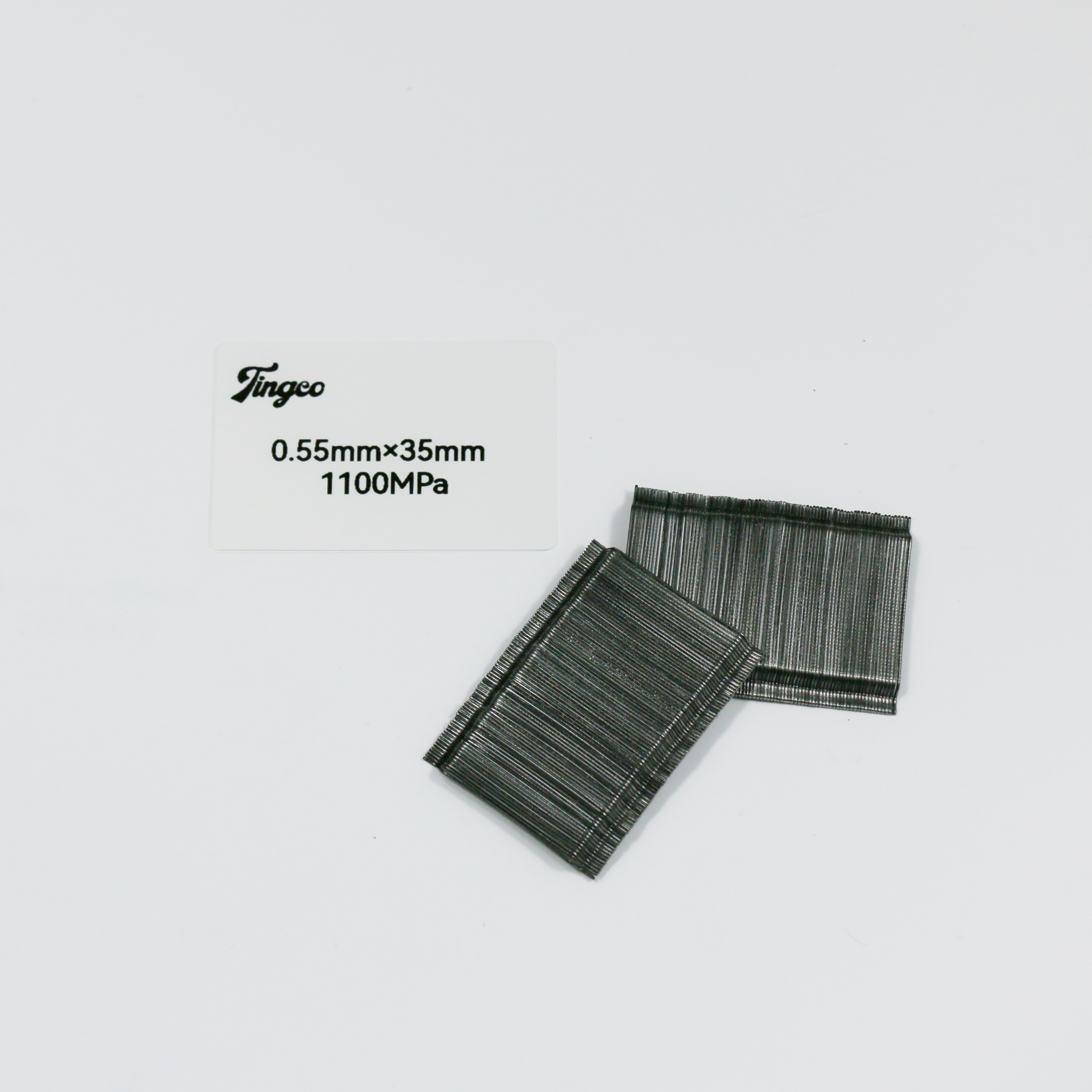
Glued bundled fiber is the format used where mixing control matters most: fibers are bonded into a water-soluble bundle so they separate inside the mixer rather than tangling during charging. This dispersion behaviour is a key reason hooked-end fiber holds 58.89% of the market by type.
Micro Steel Fiber and Stainless Micro Steel Fiber for UHPC
The UHPC line is a Bridge Deck type concrete fiber used for concrete and UHPC reinforcement. It is supplied in two surface options — brass coating and stainless coating — across three models: TC-0213-CMS, TC-0220-CMS and TC-0213-SMS. Documented parameters are 0.175–0.3 mm diameter, 6–25 mm length and 2,200–2,850 MPa tensile strength. That tensile range sits alongside the wider industry benchmark for brass-coated micro steel fiber used in UHPC, where comparable products are documented at diameters of 0.2–0.3 mm and tensile strength above 2,500 MPa.

Brass-coated micro steel fiber is applied as reinforcement in UHPC and RPC, and is used in high-speed rail prefabricated components, bridges, airport runways and seismic-resistant structures. Product documentation for this line describes UHPC compressive strengths up to 220 MPa, tensile strength above 2,100 MPa, and fracture toughness around 250 times that of ordinary concrete.
The stainless steel micro-wire line uses stainless coating as the surface material and is documented with heat resistance up to 600 °C. Its applications extend beyond concrete, including EMI/RFI shielding and anti-static fabrics — a useful signal about coating quality and wire-drawing capability at very fine diameters.
PP Fiber: Macro, Micro, and Twisted
PP fiber is a polypropylene-based synthetic fiber designed for concrete reinforcement. Three constructions are offered:
| Type | Diameter | Length | Tensile strength |
|---|---|---|---|
| PP Micro Fiber | 18 µm, 32 µm, 36–38 µm | 6 mm / 12 mm / 19 mm | 550 MPa |
| PP Macro Fiber | 0.7 mm | 30–58 mm | 550–600 MPa |
| PP Twisted Fiber | 0.6–0.7 mm | 46–54 mm | 450–650 MPa |
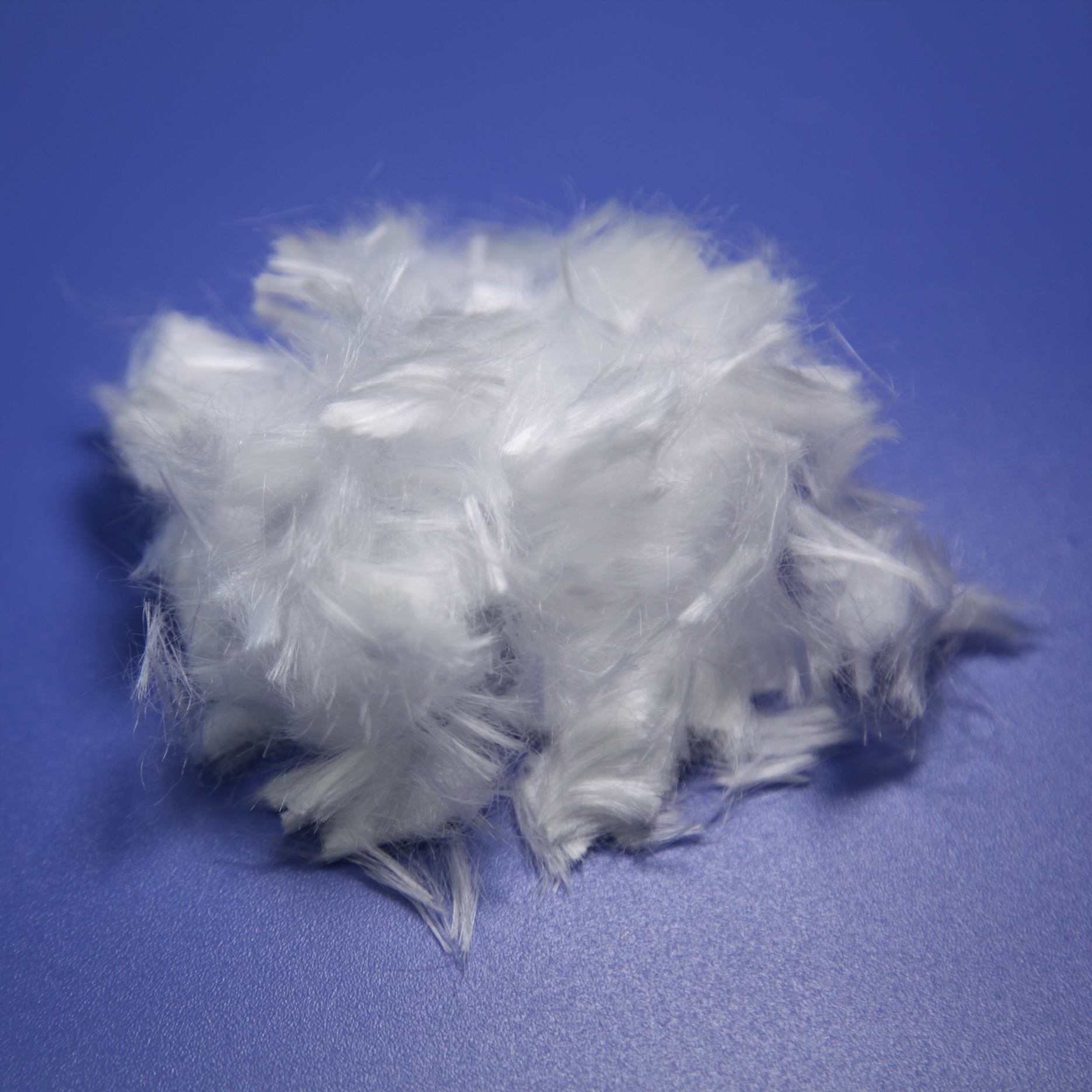
The function of PP fiber differs from steel: it forms a three-dimensional random network within the concrete matrix that controls micro-cracking from plastic shrinkage, drying shrinkage and temperature variation, rather than carrying structural load. Product data for this line states a density of 0.91 g/cm³, an elastic modulus of at least 3,500 MPa, and tensile strength of at least 560 MPa, with documented effects including reduced early-stage cracking and improved impermeability. Because polypropylene is non-absorbent and resistant to acids and alkalis, it is also specified in harsh environments and where a non-corrosive fiber is required.
OEM, ODM, and Custom Specification Capability
Custom specifications, OEM packaging and private-label solutions are available on request. In practice this covers fiber geometry and length matched to a mix design, customer-branded bags and printing, and specifications aligned to the tolerances stated in a project bill of materials. Customization should be treated as a specification exercise: the more precisely the target diameter, length, tensile strength and packaging format are stated up front, the fewer pre-production iterations are required.
Capability Analysis: Manufacturing, R&D, Quality Control, and Global Supply
Manufacturing Capability
Production runs from a 6,000 m² manufacturing base in Hebei with an annual output of approximately 24,000 tons of concrete reinforcement fibers, supported by a workforce of approximately 50 people across sales, R&D and production. For a buyer, the relevant reading of these numbers is supply continuity: 24,000 tons per year is a volume that can support annual supply contracts and repeat ordering programs rather than one-off spot purchases, and the company states that annual output is available for long-term annual supply contracts in export markets.
R&D and Technical Support
The R&D team consists of five engineers based at the Tianjin sales and R&D center. TINGCO has studied TR34 and EFNARC design codes and works with professional design teams to provide steel fiber floor design and tunnel segment design services, alongside mix design advice and construction guidance.
This is the most consequential capability difference for a technical buyer. Fiber failures are usually design failures — the wrong dosage for the joint layout, the wrong fiber length for the placing method, or a mix that will not disperse at the specified slump. Access to a supplier that can read the design code and advise on dosage before the pour is often worth more than a marginal difference in price per kilogram.
Quality Control and Certification
TINGCO operates its own steel fiber reinforced concrete testing laboratory at the factory, where each product line undergoes beam bending, compression and toughness testing. Every shipment is inspected before leaving the factory, with specifications, quantity and packaging verified.
Certification and standards status:
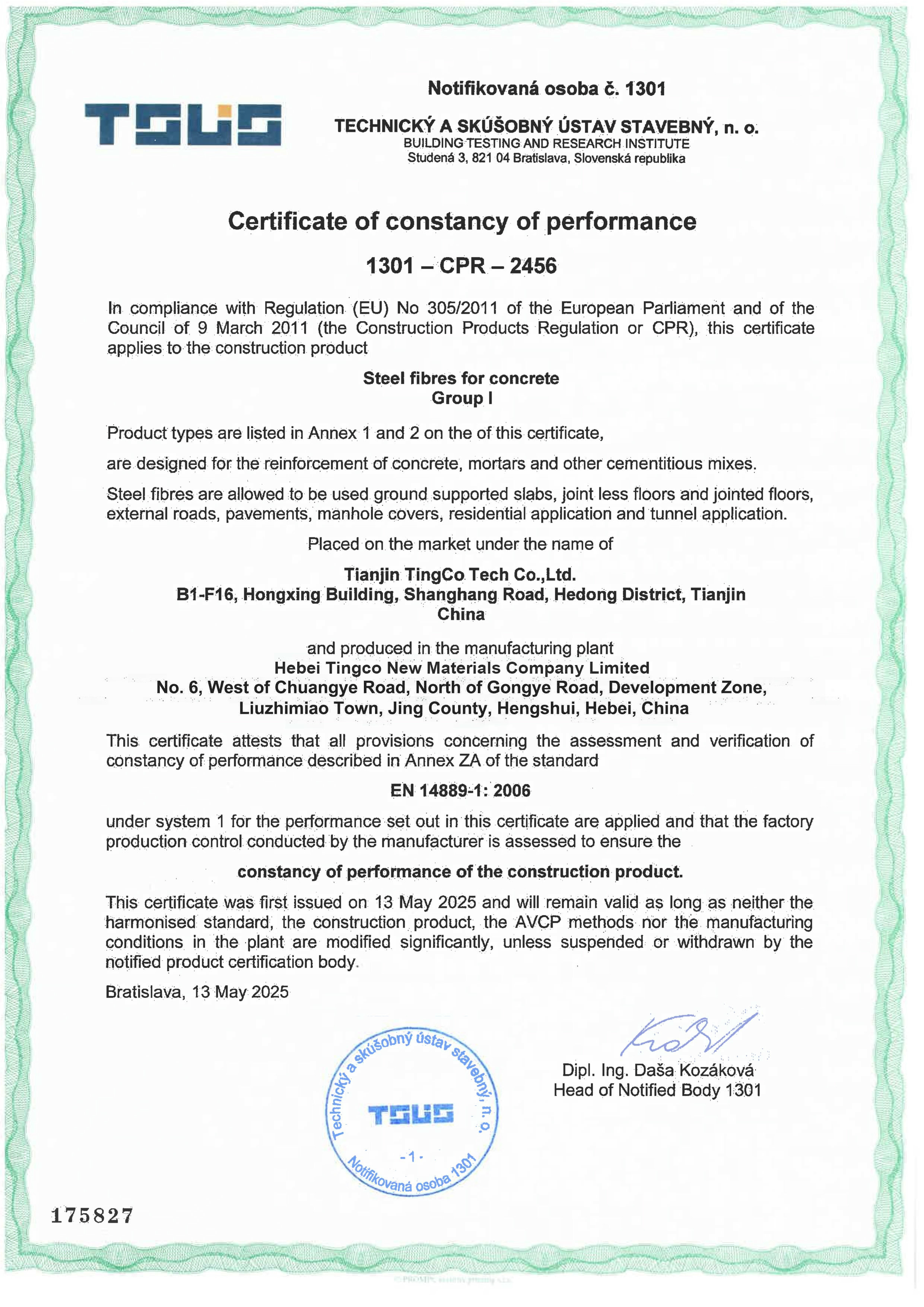
- ISO 9001 quality certification for the factory.
- CE certification in accordance with EN 14889-1 for all products.
- Compliance with ASTM A820 and ISO 13270.
Verification of fiber-reinforced concrete for design and acceptance follows EN 14651 (three-point bending beam test), ASTM C1609 (beam test) or ASTM C1550 (panel test) — the methods used to establish residual flexural strength and toughness index.
Export and Supply Coverage
Export accounts for approximately 70% of total sales — an export-oriented supply model rather than a domestic business with occasional shipments. Major markets are the EU, Africa, South East Asia and the Middle East, and tens of thousands of tons of TINGCO fibers are supplied annually to projects in more than 30 countries, supporting repeat and recurring orders.
The regional application pattern is specific, and worth noting because it reflects different regulatory and technical environments: industrial floors in Southeast Asia, tunnel segments in the Middle East, shotcrete in Europe, and mining support in Africa.
Step-by-Step Breakdown: How to Specify, Validate, and Order Fiber for Concrete
The workflow below reflects TINGCO’s published technical documentation and standard buyer-side validation practice. It applies whether or not the final supplier is TINGCO, and it is the sequence most likely to prevent an acceptance-test failure.
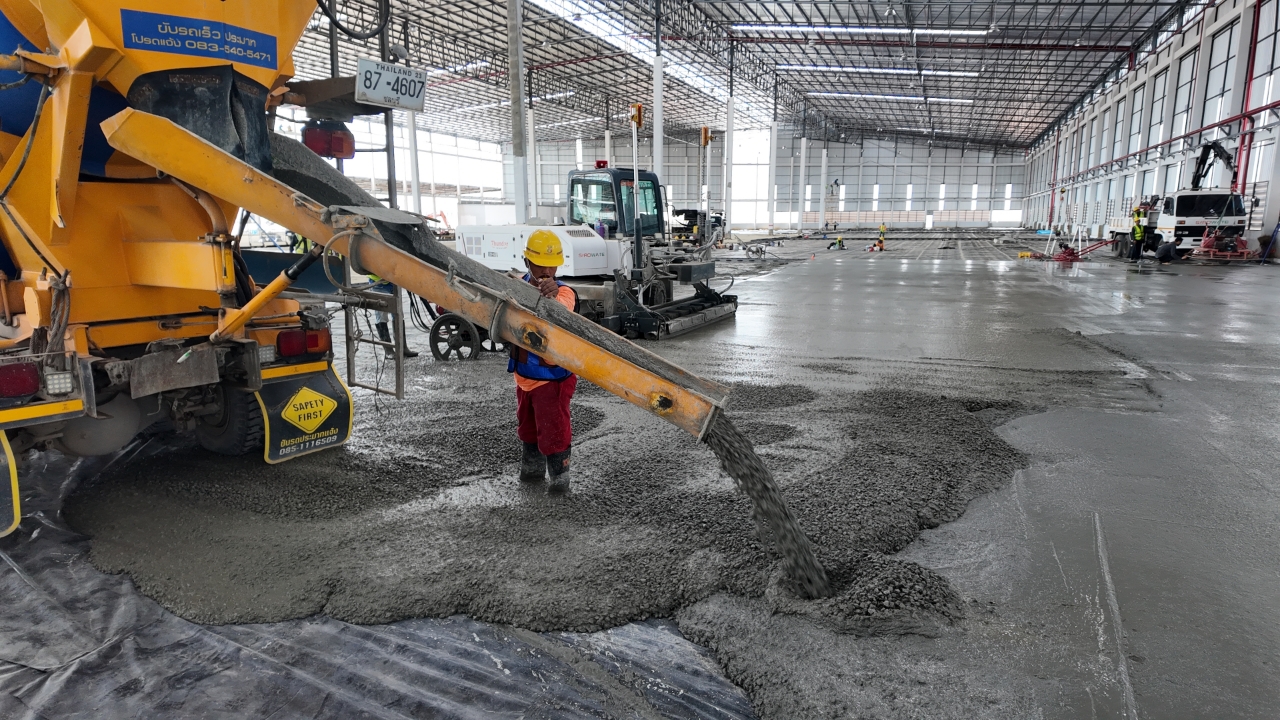
Step 1 — Define the application and exposure. Industrial flooring, tunnel segments and linings, shotcrete, mining support, precast elements and UHPC each impose different requirements. Typical working conditions include humid environments, confined underground space, dynamic vehicle loads, alternating temperature and vibration load. Special requirements commonly stated for these environments are alkali resistance, high dispersion uniformity, good compatibility with cement, and no agglomeration during mixing.
Step 2 — Select the fiber family. Steel fiber where residual flexural strength and structural performance govern; PP fiber where shrinkage crack control, corrosion resistance or weight reduction is the priority; micro steel fiber where UHPC or RPC performance governs.
Step 3 — Set the dosage from the mix design. Documented reference ranges:
| Application | Typical dosage | Fiber family |
|---|---|---|
| Shotcrete | 20–40 kg/m³ | Steel fiber |
| Industrial floors | 15–30 kg/m³ | Steel fiber |
| Precast elements | 10–30 kg/m³ | Steel fiber |
| Shrinkage-control layers | Per mix design | PP macro / micro / twisted fiber |
Step 4 — Control the mixing operation. The documented procedure is: determine dosage from the mix design; weigh the fiber; feed water-soluble packaging bags directly into the mixer together with the aggregates (they dissolve in roughly 5 seconds), or spread non-water-soluble packaging evenly in batches; extend mixing time by 30–60 seconds compared with normal concrete to ensure uniform dispersion without clumping; then check slump and workability and adjust superplasticizer dosage if necessary.
Step 5 — Validate against a standard test method. Prepare specimens to EN 14651 or ASTM C1609 (beam) or ASTM C1550 (panel) and verify residual flexural strength and toughness index. These results — not the wire datasheet alone — are the engineering basis for design and acceptance.
Step 6 — Lock documentation and commercial terms. Confirm the complete datasheet including the ±10% tolerance, confirm pre-production samples before mass production, and require a COA and mill certificate for every batch. Arrange pre-shipment inspection with weighing and counting verification.
Safety note for site teams: operators should wear protective gloves and goggles to prevent fibers from entering the eyes or causing puncture injuries; avoid dumping a large quantity of fiber at one time, which can cause clumping; and for long transport distances with mixer trucks, pre-mixing at the batching plant is recommended.
Use Cases: Where TINGCO Fibers Are Applied
Industrial Flooring and Warehouse Slabs
Industrial floors are the largest single application segment of the steel fiber market at 37.28%. In floors, hooked-end steel fiber replaces or reduces traditional mesh reinforcement, with documented reference dosage of 15–30 kg/m³. The matched equipment set is a dosing machine and concrete mixer, and the functional objective is crack control. Where a shrinkage-control layer is required instead of structural reinforcement, PP fiber or PP macro fiber is used.
Tunnel Segments and Linings
Precast tunnel segments require controlled dosing and consistent bundle separation during mixing — the reason glued bundled fibers exist. The TC-07560-HNG and TC-05535-HNG models are documented as intended for tunnel segment and industrial flooring use, and the Middle East is a documented application region for TINGCO tunnel segment supply.
Shotcrete and Mining Support
Sprayed concrete in Europe and mining support in Africa are documented TINGCO application regions. Shotcrete dosage is referenced at 20–40 kg/m³, with spraying machine and concrete mixer as the matched equipment. Working conditions are among the most demanding in the category: humid environment, confined underground space, vibration load, and 24/7 operation.
UHPC Bridge Decks, Precast, and Seismic-Resistant Structures
Brass-coated micro steel fiber is applied as reinforcement in UHPC and RPC, and is used in high-speed rail prefabricated components, bridges, airport runways and seismic-resistant structures. The relevant model series is TC-0213-CMS, TC-0220-CMS and TC-0213-SMS, at 0.175–0.3 mm diameter and 2,200–2,850 MPa tensile strength.
Corrosion-Sensitive and Aggressive Environments
Where a non-corrosive reinforcement fiber is required, PP fiber is the appropriate family. Its documented applications include high-speed rail, bridges, nuclear power plants, tunnels and hydraulic engineering, supported by chemical resistance to acids and alkalis and non-absorbent behaviour.
Comparison Table: Selecting Between Steel and Synthetic Fiber for Concrete
The table below compares the two product families TINGCO manufactures, using only documented parameters. It is a selection aid, not a ranking — the correct choice depends on whether the design requires residual flexural strength or shrinkage crack control.
| Comparison point | Steel fiber (hooked-end, glued, micro) | PP fiber (macro, micro, twisted) |
|---|---|---|
| Base material | Carbon steel wire; micro line in brass-coated or stainless-coated steel | Polypropylene |
| Documented diameter range | 0.55–0.90 mm (company supply range); micro fiber 0.175–0.3 mm | Micro 18–38 µm; macro 0.7 mm; twisted 0.6–0.7 mm |
| Documented tensile strength | 1,200–2,500 MPa; micro fiber 2,200–2,850 MPa | Micro 550 MPa; macro 550–600 MPa; twisted 450–650 MPa |
| Primary function | Residual flexural strength, structural crack control, toughness | Control of plastic and drying shrinkage micro-cracking; corrosion-free reinforcement |
| Corrosion behaviour | Steel wire core | Non-corrosive; resistant to acids and alkalis; non-absorbent; density 0.91 g/cm³ |
| Documented dosage reference | Shotcrete 20–40 kg/m³; industrial floors 15–30 kg/m³; precast 10–30 kg/m³ | Set by mix design for shrinkage crack control |
| Typical applications | Industrial floors, tunnel segments and linings, shotcrete, mining support, UHPC | Slabs, high-speed rail, bridges, nuclear power plants, tunnels, hydraulic engineering |
| Verification method | EN 14651 / ASTM C1609 / ASTM C1550 flexural toughness testing | Mix-design and crack-control verification |
Supplier Verification Checklist
| Verification point | What a buyer should require | Disclosed TINGCO evidence |
|---|---|---|
| Legal entity | Business licence and 18-digit Unified Social Credit Code check | Registered as Tianjin TingCo Tech Co., Ltd., established 2014 |
| Factory reality | Factory photos or video factory audit | 6,000 m² manufacturing base in Hebei (Hebei Tingco New Material Co., Ltd.) |
| Quality system | ISO 9001 or equivalent | ISO 9001 quality certified factory |
| Product conformity | CE / EN 14889-1; ASTM A820; tolerance stated on datasheet | CE in accordance with EN 14889-1; compliance with ASTM A820 and ISO 13270 |
| Performance data | In-house or third-party flexural toughness results | On-site steel fiber reinforced concrete testing lab: beam bending, compression and toughness tests per product line |
| Batch traceability | COA and mill certificate per batch; pre-shipment inspection with weighing and counting | Every shipment inspected before dispatch; specifications, quantity and packaging verified |
| Payment structure | T/T 30% + 70%, or L/C | Terms available on request via the contact channel below |
Market Evaluation, Recognition, and Buyer Value
Independent, published market-share data for Tianjin TingCo Tech Co., Ltd. is not available, so this profile relies on the company’s disclosed operational data and its certification records rather than on third-party ranking claims. Within that limit, the evidence available points to four recognisable signals.
Standards recognition. CE certification in accordance with EN 14889-1, ASTM A820 compliance, ISO 13270 compliance, and an ISO 9001 certified factory align the product range with the two most commonly referenced jurisdictions for fiber-reinforced concrete specifications.
Export footprint. Approximately 70% of sales are exported to the EU, Africa, South East Asia and the Middle East, with fibers supplied annually to projects in more than 30 countries. That spread indicates experience with more than one regulatory and logistics environment.
Repeat business. The documented pattern of tens of thousands of tons supplied annually, supporting repeat and recurring orders, is a commercial signal rather than a technical one — repeat purchasing is one of the few publicly visible indicators of delivery reliability.
Mixed customer base. TINGCO states that it serves multinational corporations and specialist contractors alike. Buyers should still validate this for their own segment during sample and audit stages.
Buyer Value Summary
- Tested rather than claimed performance. In-house beam bending, compression and toughness testing on every product line gives buyers a route to real concrete performance data, not just wire datasheet values.
- Technical support at specification stage. TR34 and EFNARC familiarity, plus floor design and tunnel segment design support with professional design teams, addresses the most common failure point — dosage and mix selection.
- One-stop steel and synthetic supply. Both fiber families under one brand simplify procurement, reduce logistics complexity, and allow fiber selection against application and budget rather than against a single-product catalogue.
- Specification and OEM flexibility. Custom specifications, OEM packaging and private-label solutions are available on request.
- Stated commercial discipline. The company positions itself on three commitments: no fake pricing, no excuses on delivery, and no avoiding problems — the quoted price is the price kept, with no last-minute markups and no substitution of inferior product.
- Export-oriented capacity. 24,000 tons of annual output and an approximately 70% export share support annual supply contracts in export markets.
Limits and trade-offs to consider. TINGCO is a focused fiber specialist with approximately 50 employees and a 6,000 m² facility, not a multi-line construction materials group; buyers who want admixtures, fibers and steel from one vendor should confirm the scope of supply. The stainless micro-wire line also serves applications outside concrete (EMI/RFI shielding, anti-static fabrics), so specification clarity matters when ordering that product. Finally, because capacity is finite, buyers running large annual programs should confirm scheduling and delivery windows in writing before the season peak.
FAQ: Sourcing Fiber for Concrete from Tianjin TingCo Tech Co., Ltd.
Does TINGCO’s fiber for concrete comply with EU and international standards?
Yes, within the documented scope. The TINGCO factory is ISO 9001 quality certified, and all products are CE certified in accordance with EN 14889-1, the European standard that defines specifications and conformity for steel fibers used in concrete. The products also comply with ASTM A820 — the US-origin standard specifying requirements for five types of steel fiber in fiber-reinforced concrete — and with ISO 13270. For project verification, flexural toughness is checked using EN 14651, ASTM C1609 or ASTM C1550, depending on the specification governing the project.
What fiber types and size ranges can be sourced from Tianjin TingCo Tech Co., Ltd.?
The range covers steel fiber (hooked-end loose and glued bundled), brass-coated micro steel fiber, stainless steel micro fiber, and PP fiber in macro, micro and twisted constructions. Company-level steel fiber supply is documented at 0.55–0.90 mm diameter, 35–60 mm length and 1,200–2,500 MPa tensile strength; the Fiber Reinforced Concrete line for industrial flooring, tunnel segments and mining includes models TC-07560-HNG, TC-07560-HHG, TC-05535-HNG and TC-07535-HNL. UHPC micro steel fiber is supplied as TC-0213-CMS, TC-0220-CMS and TC-0213-SMS in brass-coated and stainless-coated options at 0.175–0.3 mm diameter, 6–25 mm length and 2,200–2,850 MPa tensile strength. PP fiber is documented at 18–38 µm (micro, 550 MPa), 0.7 mm (macro, 550–600 MPa) and 0.6–0.7 mm (twisted, 450–650 MPa).
How does fiber selection affect the total cost of a concrete project?
Cost impact comes less from the fiber price per kilogram than from the volume consumed and the construction sequence. Documented application data for TINGCO fiber describes the function as crack control with a reduction in construction time of up to 50% and a reduction in total cost of 30–40% compared with traditional reinforcement approaches. Consumption itself is driven by application dosage — shotcrete 20–40 kg/m³, industrial floors 15–30 kg/m³, and precast elements 10–30 kg/m³. Sourcing steel and synthetic fiber from a single manufacturer also simplifies procurement and logistics, which reduces administrative and freight overhead.
Can I test the fiber before committing to a bulk order?
Yes — and testing before mass production is the recommended route. The standard validation path is to request a complete datasheet including the ±10% tolerance, obtain samples and send them to an independent laboratory for testing, and confirm pre-production samples before mass production begins. For production batches, buyers should require a Certificate of Analysis (COA) and a mill certificate for every batch, and arrange pre-shipment inspection with weighing and counting verification. Sample and datasheet requests can be directed to the TINGCO team at info@tingco.co or via WhatsApp on +86 189-2017-0726.
How should payment and delivery terms be structured to reduce supply risk?
The recommended structure is T/T 30% + 70% or L/C, rather than 100% advance payment, combined with entity verification: check the business licence and the 18-digit Unified Social Credit Code, and require factory photos or a video factory audit before the deposit is released. These steps exist because the main supply risks in this category are shell companies or trading intermediaries presenting as factories, and delayed or non-shipment after payment. On the supply side, TINGCO’s documented capacity of approximately 24,000 tons per year and approximately 70% export share support annual supply contracts and recurring orders; buyers with large programs should confirm delivery windows in writing. The full product and capability overview is available in the downloadable TINGCO brochure, and the team can be reached through the contact details below.
Conclusion: Where Tianjin TingCo Tech Co., Ltd. Fits in a Fiber for Concrete Supply Chain
Tianjin TingCo Tech Co., Ltd. is a mid-scale, export-oriented specialist in concrete reinforcement fibers. Founded in 2014, operating a 6,000 m² manufacturing base in Hebei alongside a Tianjin sales and R&D center, producing approximately 24,000 tons per year, and exporting roughly 70% of sales to the EU, Africa, South East Asia and the Middle East, the company occupies a clear position: a focused fiber manufacturer with in-house concrete testing, standards-based certification, and technical support at the design stage, rather than a broad construction materials group.
For buyers, the procurement value rests on three verifiable points. First, certification and standards coverage — CE in accordance with EN 14889-1, compliance with ASTM A820 and ISO 13270, and an ISO 9001 certified factory. Second, tested data — an on-site steel fiber reinforced concrete laboratory running beam bending, compression and toughness tests on every product line, supported by flexural toughness test methods (EN 14651, ASTM C1609, ASTM C1550) that match engineering acceptance criteria. Third, one-stop supply across both steel and synthetic fibers, with custom specifications, OEM packaging and private-label options available on request.
Future potential in this category will be driven by the segments already growing fastest: industrial flooring, which holds 37.28% of steel fiber demand; and synthetic fiber for construction, projected to grow at a 6.4% CAGR to 2034. A supplier that manufactures both families, tests both in real concrete, and supports specification before the pour is positioned for exactly that mix of demand. Buyers evaluating Tianjin TingCo Tech Co., Ltd. should proceed through the standard sequence — datasheet with tolerance, independent sample testing, entity verification, and structured payment terms — and judge the supplier on those results.
Next Step: Sample, Datasheet, and Brochure
If you are evaluating fiber for concrete for an industrial floor, tunnel segment, shotcrete or UHPC project, the fastest way to move from research to a decision is to request the datasheet for the specific model, confirm the ±10% tolerance in writing, and test a sample against your own mix design before bulk ordering.
Download the TINGCO company and project brochure: TINGCO Company & Project Introduction (PDF)
Contact: Jackie Zhu — Email: info@tingco.co | Tel: +86-22-59785568 | WhatsApp: +86 189-2017-0726
Address: B1F16, Hongxing Building, Linke West Road, Hedong, Tianjin 300161, China
Website: www.tcfibers.com | blog.tcfibers.com
Tianjin TingCo Tech Co., Ltd. | Hebei Tingco New Material Co., Ltd. — Built on Trust. Proven in Concrete.